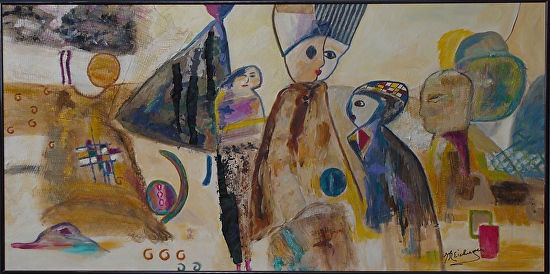
Winter Wonder

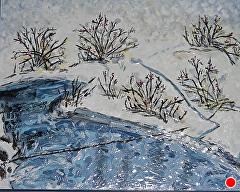
Thunderbird with the World by Ray Losey
14 feet – Available – For information go to raylosey.com

The Thunderbird’s eye cautiously surveys the blanketed landscape outside our home. It has been years since Portland had so much snow in one fall. Ray measured 14 inches in the driveway.  I almost forgot the beauty of seeing white covered branches dipping deeply towards earth. Occasionally a snapped limb peaks up through the snow with its evergreen leaves adding color to the whiteness. During the storm I was conscious of the soft silence that covered the earth and enjoyed looking at the large flakes floating downward that can only be seen swirling under street lights. 

When I went outside the following day, the crisp cold air was refreshing even as I warmed with the effort of shoveling.  By the time I finished my own and my neighbor’s driveway, though my arms stung and back creaked, it felt good seeing what was accomplished in just a few hours.  But best of all was realizing that I recuperated quickly and was ready after lunch to find my sled to go speeding down the hill at the end of my street. Listening to bursts of laughter as adults and children joined in the merriment was fulfilling.  And what a pleasure it was to go cross country skiing from my front door. Who needs a car? We must have enough food stocked in our cupboards to last a month.

As an East Coast transplant, past Portland winters have been too mild for me. I missed bundling up in cold weather and having the opportunity to play in the snow. I do not like the idea of traveling hours to a winter resort. Perhaps Michigan spoiled me for I could ski on the farmer’s fields that surrounded my house.  With children sound asleep it was easy to take off for an hour of contemplation at 10 pm.  When there was a full moon shining on fresh snow it was haunting to silently glide through rows of corn stalks.

Traditionally, the third week of January is when the crocuses start to bloom at the Bishop’s Close in Portland. It is when Ray and I begin our weekly pilgrimage to watch spring unfurl. I wonder what will happen this year? There is no need for deep thoughts when nature makes its presence known.

Winter Wonder by Marilynne Eichinger – Sold

For more artworks by Marilynne go to eichingerfineart.com

Save the date: February 9th at 7 pm.
Book Talk at Annie Bloom’s Books in Multnomah Village, Portland.
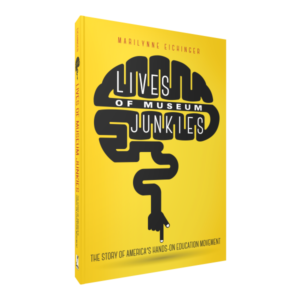
Lives of Museum Junkies:The Story of American’s Hands-On Education Movement.

How Do You Talk to a Bigot

The Next Generation

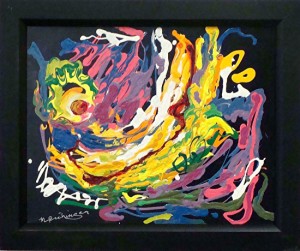
Acrylic painting on canvas / in black frame (not shown) / $ 450 / 25” by 20”

Will this couple raise their child to think and reason independently or will their prejudices get passed?
____________________________________________

How Do You Talk to a Bigot?

A man must be excessively stupid, as well as uncharitable, who believes there is no virtue but on his own side.
Joseph Addison, The Spectator 243, (8 December 1711).

In high school, one of my teachers asked the class, “ How do you talk to a bigot?” The question stayed with me these many years for I found it tremendously difficult to answer. Examining his query scared me because so many family members and friends spoke out against those not made in their own mold.

In the 1950s and 60s, anti-Semitism was rampant as was hatred towards those of color. When Kennedy sought the presidency, wildly disparaging remarks were made against Irish-Catholics and the Pope. In nightclubs and on television, comics made fun of everyone by calling them Dago, White Trash, Paddy, Mik, Hun, Redskin, Honky, and Chink. The audience laughed. These words were part of common parlance and unflatteringly spoken in living rooms nationwide. Movies reinforced cultural differences by mocking minorities by using character actors who supported common prejudices. During my student years, so many people spouted self-aggrandizing beliefs that put others down that I could not imagine a way to turn their minds and hearts around.

In looking back, I realize that we have come a long way towards overcoming prejudice. No longer do we have segregated bathrooms based on racial identity though we still are not comfortable with sexual deviations. There are no black-faced minstrels dancing like children on stages nor are religious slurs tolerated in the media. Recent events, though, have made me realize that bigotry went underground and has not gone away. Many of us are surprised at the rise of the KKK and Arian Brotherhood who never accepted the idea of the United States as a melting pot of people with diverse backgrounds as an advantage to making the country strong.

Family gatherings are a time that brings to the forefront differences. Some friends complain that family members accept them with smiles to their face but then joke and make racial or sexual slurs when they leave the room. A few of my southern acquaintances mention more overt snubs. With self-righteousness and beliefs in their own superiority, they have relatives who liberally sprinkling sentences with words like faggots and Niggers. Families have been known to break up over such differences.

Bigotry, as defined in Webster’s, is “the stubborn and complete intolerance of any creed, belief, or opinion that differs from one’s own.” Ignorance and fear are two powerful allies of bigotry that seem to be on the increase. Bigoted people ignore the reality of diversity and cover themselves with security blankets to suppress their fear. They irrationally discriminate against those who are different and play on emotions rather than logic. Belief is elevated above thought and credence is given to lies before investigation. The possibility of error is beyond their imagination. Yet, their absolute acceptance that they are in the right causes a lot of pain.

So how do you get rid of bigotry? Eliminating bigoted beliefs often means giving up power which makes many people feel uncomfortable. What do you do when family or friends are the ones promoting disparaging statements? How can tolerance be encouraged and ignorance overcome? Is there a possibility for open, honest communication or do you just have to turn away from those who engage in hateful banter?

Doing nothing is not a good enough response for those living in a democratic society. Democracy only thrives when there is open and honest communication, a willingness to compromise, and an agreement to live by consensus or majority agreements.

I have gathered several suggestions on how to respond to a bigot.

1. Speak up to let the person know how you feel about their extremist remarks. Then walk away if racial, ethnic, or religious slurs continue.

2. Find several like-minded people willing meet the offending person at a less emotionally charged time in order to engage in an educational discussion. The meeting can not be confrontational but rather based on shared feelings that speak to fears and prejudices. Facts that counter long-held prejudices will only be heard if the discussion is non-threatening.

3. Decide in advance how important the relationship is to you and if you are willing to leave if the situation can not be resolved? If you come from a household where bigoted behavior was accepted, acknowledge it, but let your family and friends understand that as an adult you have learned to respect others. If your community is not a loving and respectful one, consider moving to one that is.

4. Don’t expect prejudiced people to instantly agree with you, but do expect that in your and your family’s presence offending statements will not continue.

5. Remind yourself that bigotry is not a political issue. It usually is passed on from one uncritical generation to the next. It exists across party, religious and state lines. It is in your backyard and cannot be ignored.

Comments by others to give you pause for thought:

“I ask you to uphold the values of America, and remember why so many have come here. We are in a fight for our principles, and our first responsibility is to live by them. No one should be singled out for unfair treatment or unkind words because of their ethnic background or religious faith.”
George Walker Bush, Freedom and Fear Are at War: Address to a Joint Session of Congress and the American People (20 September 2001).

“Perhaps travel cannot prevent bigotry, but by demonstrating that all peoples cry, laugh, eat, worry, and die, it can introduce the idea that if we try and understand each other, we may even become friends.”
Maya Angelou, Wouldn’t Take Nothing for My Journey Now (1993), p. 12.

“God deliver us all from prejudice and unkindness, and fill us with the love of truth and virtue.”
William Ellery Channing, “Unitarian Christianity”, an address to The First Independent Church of Baltimore (5 May 1819)

“I know a good many people, I think, who are bigots, and who know they are bigots, and are sorry for it, but they dare not be anything else.”
Edwin Hubbell Chapin, Living Words (1869) p. 125

References:

https://en.wikipedia.org/wiki/Sinophobia#Derogatory_terms> – List of derogatory words.
http://www.lifehack.org/articles/lifehack/bigotry-ignorance-and-fear.html _ About Bigotry
http://www.amnottheonlyone.com/how-to-deal-with-bigotry-among-family-and-friends/
– Bigotry among friends and family.
https://www.splcenter.org/20150126/speak-responding-everyday-bigotry– Southern Poverty Law Center- Speak Yup: Responding to Everyday Bigotry

Going Viral

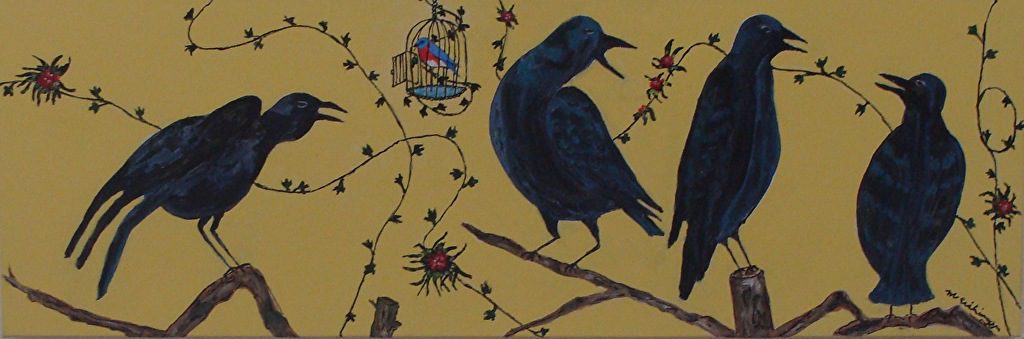
The Gossips
acrylic on wide canvas/ 12” by 36” / $ 325

Going Viral

In 1972 I was developing my first museum, Impression 5 Science Museum in Lansing, Michigan. It was frustrating, in part, because I did not know what I was doing. I certainly was naïve! It was also exciting because my university friends and I would brainstorm ideas for exhibits, go into our work rooms and make devices that explained science. We took the results of our creative endeavors (not always well made) to schools and shopping centers. Our goal was to eventually create a hands-on place for children and adults to play creatively with science and the arts.

This effort was done under the radar of the press until a newspaper reporter wrote a small article about the fledgling museum. Once in print, our project was legitimatized and I became swept into a maelstrom of activity and purpose. A few people did come forth as a result of the article but not much happened because I did not have money and did not know who or how to ask for it. Though determined, was very inexperienced.

My girlfriend and I went around town talking to community leaders about our project and people listened politely. The mayor’s assistant said I had to wait in line for my project to be considered and that might take five years. The man in charge of the YMCA told me that our museum would not get off the ground because “there were only two things that were important, one was sports and the other was sex.” Impression 5 was about neither.

One frustrating day when I was at my desk which a kind school let me occupy when not being used as a lunchroom, I read that Playboy Bunnies would play sporting events with local celebrities to raise money for charity. Wow! Sports and Sex! I had it made. I called up the Detroit club and sure enough, they were willing to play basketball against our community leaders. In those days the leaders were all men. I invited school superintendents, the mayor, the head of Oldsmobile, the university president, real estate moguls, and other community businessmen of note and money to join the game. No one man turned me down. We acquired Jennison Field House at Michigan State to hold the game and plans were under way.

Except. . . a small article appeared in the editorial section of the newspaper saying that a group of women objected to the game. This was a time of awakening at the start of the women’s liberation movement and sensitivities about women’s issues were mounting. An organized group from the high school and university planned to picket the event causing a few of our volunteer players to opt out of the game.

To prove I was not supporting male chauvinism, I called Michigan State’s Women’s Basketball team and asked them to help as a practice team. They agreed. Six women played in the practice game causing our volunteer men had to be rotated every few minutes to avoid having a heart attack. The difference in skill level was incredible.

The more tried to soften the women’s issue the more newspaper articles fanned the controversy. We didn’t know what to do. Should we cancel the game or proceed surrounded by pickets? Ticket sales were dismal.

Mother nature helped us make the decision. The night before the game it started to rain, and rain, and rain. Rivers flooded their banks and the field house court was drenched in two feet of water. The entire town was needed to sandbag riverbanks.

We never did have the charity event but the museum got under way. It was this event that taught me that that bad publicity is more likely to get people’s attention. The museum concept had gone viral. People loved the idea of the museum but they enjoyed the controversy over women’s rights more and followed arguments in detail. By the time the flood ended, Lansing residents knew about the fledgling science and art museum. Many were ready to join our effort. Impression 5 Science Museum now thrives in its forty-fourth year.

Today, when I think about the false information that is widely being circulated through the media, I remember the lessons I learned so many years ago. The difference is that when information goes viral through the net, it travels faster and is convoluted much like the childhood game, “whispering down the line.” The story changes slightly each time it is repeated until the listener turns it into what he or she wants to hear. A lesson to us all. Beware and check facts so misinformation is never passed on.

Stories about the start of the nation’s hands-on museum movement can be found in Lives of Museum Junkies. Any new venture takes perseverance, dedication and a willingness to learn from your mistakes. I would love to hear  your experiences in embracing a new enterprise, whether it is a club, hobby or business. Did you succeed? Fail? Learn? How did you spread the word?

Please share your comments below.

Artwork is always for sale: Contact me at marilynne@eichingerfineart.com.
________________

Lives of Museum Junkies: The Story of America’s Hands-On Education Movement
Available at Powells Books, Annie Blooms Books, MAC Emporium, Broadway Books, and on line at Amazon and Barnes and Noble.

SAVE THE DATE: February 9th – Annie Blooms Books, Multnomah Village, Portland, OR – Book talk and signing for Lives of Museum Junkies. The event starts at 7 PM.

A Whirlwind Descends

Heaven-and-Beyond

Heaven and Beyond
The spinning universe brings a mixture of emotions to earth.
/ Acrylic on Canvas / 20” by 24 “/ $399

A Whirlwind Descends

Each December a whirlwind descends, causing most everyone to join in a helter-skelter flurry of activity. Love it? or hate it? Holidays bring out many emotions. I happen to thrive during the holidays, looking forward to large family gatherings of children and grandchildren. Chaos, noise, and mounds of dishes never bother me though my back often creaks by the end of the holiday visit. I spend weeks looking for the perfect gift for each person, happily wrapping them in my basement surrounded by ribbons and bows while listening to jazz.

My husband, on the other hand, dreads the holidays. The confusion and noise of my large family makes him want to retreat to a man cave. He prefers visits from one family at a time and cringes when all 22 people descend on our home. The cat also hides. Thank goodness he is tolerant. Part of my job at holiday time is to arrange quite places and times for one-on-one conversations so he feels comfortable.

A common emotion at holiday time is sadness. Thank goodness, there is no time for that with our large family, but I do know of many people who can not go home for the holiday to reconnect with friends and family. Holiday decorations and carols may remind them of a happier moment from their past, bringing back nostalgic memories that can never be duplicated.

As the winter solstice approaches and the nights become long, people throughout the ages have found reasons to celebrate. Religious as well as secular practices, remind people that life has cycles, the seasons change, the sun will return, there is hope for mankind and there are many fine reasons to celebrate. Festivities have always drawn people together, reinforcing a sense of community and shared values. It is also a time for remembrance of those who are sick, poor and lonely, those who need special attention. Giving swells hearts and people feel good thinking of others. It is why we see an increase in charitable donations, gift buying for the needy and invitations given to guests who are alone.

There isn’t really one way of approaching the holidays, but to embrace the season’s spirit it helps to take the feelings and needs of others into account. When purchasing a gift I ask myself if it really contributes to the growth and well-being of the recipient. Is it educational? Can it be shared? Is it green?

There are lots of opportunities to show love and affection so I enjoy activities that get everyone involved. The goal, of course, is to leave that warm feeling in the belly of everyone. One year each person in my extended family pulled a name out of a hat and was assigned the task of creating something special to honor that individual. One parent assembled photographs and published a book about her son, another wrote a short story. Several children contributed handcrafted items. One painted pottery and another made a potholder. My granddaughter wrote and sang a song while her younger sister played the harp. The youngest child made a picture for his Dad that looked something like a two-legged dinosaur. Our family sat around oohing and ahhing as the gifts were unveiled.

Play reading was another activity we got involved in during several gatherings. Parts were distributed and everyone joined in with their best acting voices. Imagine reading a Shakespeare comedy in plainspoken English that even young children can understand.Try it, it really is a good read!

Putting a 3-D puzzle together was an annual ritual in our household. As soon as the first person arrived at our home, the card table got cleared, a white board set up and a complex puzzle that takes days to assemble gets put together with everyone’s help. It has was quite challenge working on the New York 3 D puzzle.

With a bit of planning, it is easy to get the entire family to feel a welcomed part of the festivities. These moments become the new memories built on a holiday spirit that everyone can embrace.

Lives of Museum Junkies Book

Lives of Museum Junkies: The Story of America’s Hands-On Education Movement
Available on Amazon, Powells and Borders Books

SAVE THE DATE: Annie Blooms Books, Multnomah Village, Portland, OR – Talk and signing for Lives of Museum Junkies. The event starts at 7 PM.

Workaholic or hard worker?

coos-bay-oregon

Coos Bay – Oregon acrylic on canvas/ 30“ by 40” / $499
Standing in the midst of this gentleness landscape set against moving water was refreshing and invigorating. Nature has a way of saying that there is more to life than work.

Are you a workaholic? What about a playaholic?

When my son was about 15 years old he turned to me and said, you and Dad work too hard. I’m not going to be like you. Life is for having fun. At the time he was just recovering from a life threatening illness, so I didn’t answer him with, “My work is fun!,” though that is what I felt like saying. It was not until years later that he began to realize that he might live to be an old man. Then he had a real conundrum? He had to make something of himself and apply himself. And, he did—but he never forgot how to have fun.

He now has a challenging business, yet finds the time to meet with his large circle of friends on a weekly basis. He works very hard and plays hard. I would never say his is a workaholic, though, I could see it happening. Work, especially for those who own a business, has a way of creeping up on you. There are times when my son is with me when I see that his mind does wander to the multitude of responsibilities he has instead of settling into “be hear now time.”

What is the difference between working hard and being a workaholic? There are clues to look for starting with cell phone use. Addicted people are constantly checking their phones and responding to messages on the spot even when in the company of others. Their work (or play) tasks interrupt social activities. They are the people who would go through withdrawal if their computer was not close-by or the WiFi went down.

We have to be careful, though, not all cell phone responders are workaholics. Edmund Neuhaus, Ph.D., director of the Behavioral Health Partial Hospital Program at McLean Hospital in Belmont, Massachusetts advises that it is important to consider the context of each situation and cautions that there is a big difference between being a workaholic and a person who works hard.

When business or play occupies all your mental and physical time at the exclusion of marriage, family and other relationships you may be verging on addiction. If sitting quietly makes you feel guilty for not being productively engaged, then you could have a problem. If, when no one is paying attention, you try to sneak in a little work, then you may be similar to an alcoholic who hides the bottle from his family. Many have trouble delegating work to others. They are perfectionists who believe they have to do everything themselves or it will not be done right.

Addicted people are often seen turning their hobby into a business. They forget that the hobby was originally selected as a way of relaxing. Play addicts are similar to workaholics in that their every waking moment is consumed in thought or action by the activity. Somewhere along the way, ‘fun-time” stopped being a refreshing break from work. When play adds tension and causes stress to your life, it is important to reevaluate what you are doing and why you are doing it.

Everyone needs some downtime, yet many workaholics resent vacations, even when their work will not be affected. Once that happens, they have likely become full fledged addicts.

“Not good,” says Dr. Neuhaus. Your health can be affected by high-stress activities at work or at play. Burnout, depression, anxiety, psychosomatic symptoms such as headaches and stomachaches and excessive alcohol consumption are frequently the consequences.

Interestingly enough, most workaholics deny their symptoms and do not acknowledge that they have a problem. Unfortunately, in many cases, their denial leads to a heart attack. It is usually family and friends who bring the problem to the workaholic’s attention. It may be done dramatically, such as when a spouse is fed-up with their mate’s long work hours and decides to sever the relationship.

Our culture doesn’t help. The United States is not like Europe where five-week vacations are the norm. Instead, it prizes the work-ethic and overachievement. Bosses reinforce hard work through praise, promotions, bonuses and raises rather than saying, “Good job, why not take time off?”

Play, care of self, exercise and a spiritual life contribute to longevity and a sense of well-being. So—work hard, yes, but be careful and lose the guilt when you are home relaxing with your loved ones. Work has a way of creeping up on you and giving a false sense of what is important to your well-being. Life is rich, varied, and beautiful if you let its many dimensions touch you. This holiday is a time to have fun. Take the stress out of your life. Play to relax and enjoy each moment with family and friends.

References:
http://www.webmd.com/balance/features/are-you-a-workaholic?page=2 – Can workaholism hurt you?

https://www.psychologytoday.com/blog/dont-delay/201003/the-personality-the-workaholic-and-the-issue-self – Psychology Today article about the personality of the workaholic.

SAVE THE DATE: Annie Blooms Books, Multnomah Village, Portland, OR – Talk and signing for Lives of Museum Junkies. The event starts at 7 PM.

Craftiness

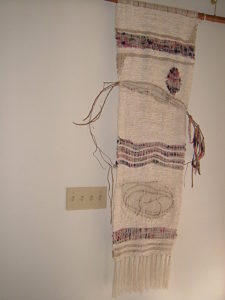
Pulling Ivy – A weaving to commemorate the ivy pullers of the area.
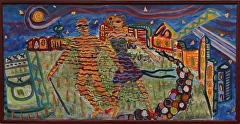
A crafty way to stay out of trouble

By Marilynne Eichinger , Nov. 2016, NFS

CraftinessContinue reading

Still STEAMing!

1353607x240

Walking on Air, by Marilynne Eichinger
Painting made after visiting Bath, England.

The following article was written by my son, Ryan Rosenberg for the Los Gatos Education Foundation. It is an appropriate follow-up to my blog about STEAM education. Thank you for the many comments and suggestions you made to that particular article. The only parts I changed were the pictures.

Study finds arts, music can be the “secret” to a successful tech career 9/26/2016

Successful tech entrepreneurs seem to have a surprising “secret” to their accomplishments – studying art, music, and hands-on creative activities (such as wood or metal working).

A study published in the journal Economic Development Quarterly (1) found that participation in artistic activities boosts the chance of entrepreneurial success in technical fields.

Researchers followed a group of Michigan State University honors college graduates from 1990 to 1994 who majored in science, technology, engineering or mathematics (STEM).

Graduates who were successful entrepreneurs — those who went on to found companies or produce patents — were significantly more likely to have had participation in art, music and hands-on creative activities than those who did not.

And it’s not just entrepreneurs who benefit from the arts; a strong link was found with STEM graduates overall. In fact, the STEM practitioners in this study were 62% more likely to have had classes in visual arts than the general population, 59% more likely to have been taught music, 39% more likely to have had dance instruction, and 38% more likely to have taken acting lessons.

So how does their music, arts, and hands-on creative experience help these engineers and scientists in the real world? It seems artistic thinking is crucial to their work.

The study asked participants to identify the types of tools they used for problem-solving and found, “as one would expect of science and engineering professionals, the vast majority reported using logic while doing their work…[but] an overwhelming majority also reported using ‘artistic’ styles of thinking: 95.3% reported using exploratory play as a method of problem solving; 80% reported using either intuition, imagination, or both; and about 80% reported using analogies. In other words, these successful STEM professionals use ‘artistic’ types of thinking at work just as often as they use stereotypical ‘scientific’ modes of thinking.”

In summary, researchers determined that “participation in various arts and crafts positively correlates with the production of patentable inventions and the founding of new companies, and can differentiate the entrepreneurs from less innovative individuals, even among a group of highly successful individuals such as Honors College STEM professionals.”

Reference:
Arts and Crafts: Critical to Economic Innovation
LaMore et al., Economic Development Quarterly, August 2013, 27 (3), p. 221

Guest Author – Ryan Rosenberg for the Los Gatos Education Foundation

artwork is always for sale. Contact me at marilynne@eihingerfineart.com.
Walking on Air -Acrylic on Canvas / 25.5” by 49.5” / $ 650

Did you find your passion?

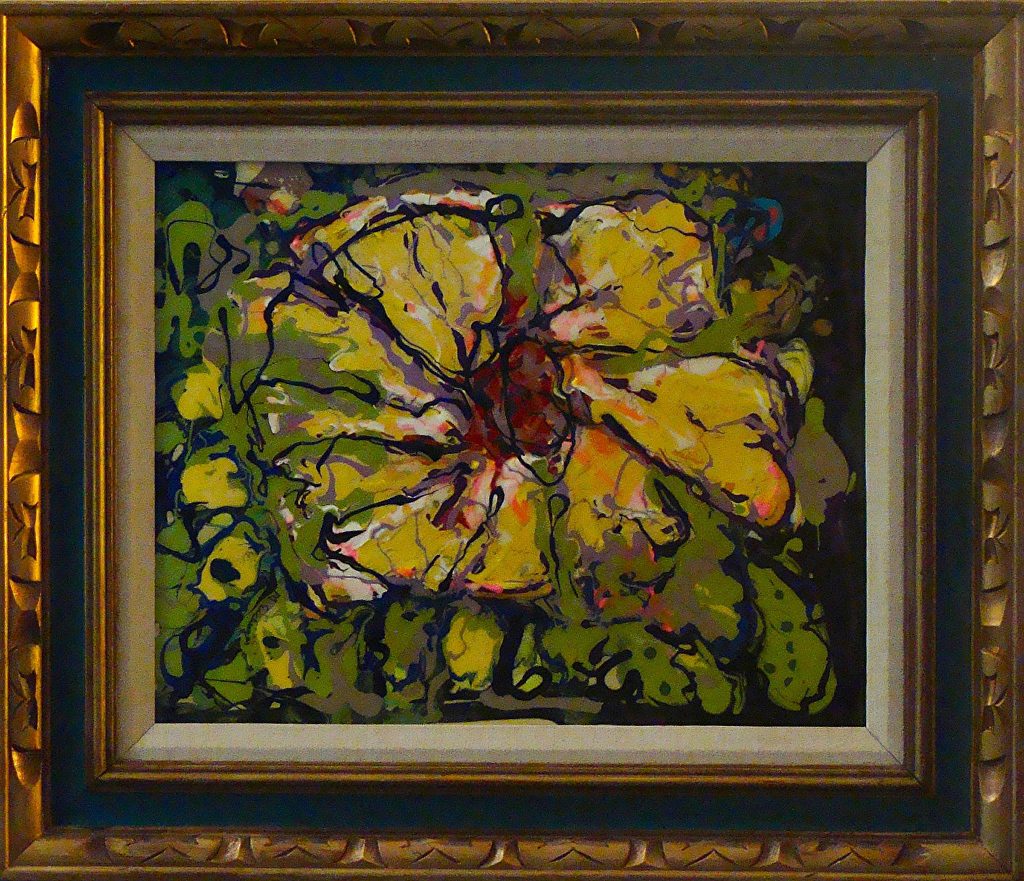
Grand Prize – Passion Flower

How did you find your passion?

This morning my NIA (non-impact Aerobics) teacher mentioned that 30 years ago at the height of the high impact aerobics craze she went to a conference where she participated in an exercise class with approximately 500 participants.  It wasn’t long before half the class left because, rather than stressing boom-boom, jump and twist movements, it stressed grace and centering practices that come from engaging in modern dance and practicing marshall arts. My teacher was ecstatic since  with a smaller crowd there was more room to stretch and move about. She said that by the end of the class she had tears in her eyes.  The zen-like program spoke to her. She had found her passion, her life’s ambition, and a career that still engages her after 30 years.

Her story made me consider how I discovered the focus that directed my life. It was not long before I realized it was accidental. When I speak of passion, I mean that can’t stop myself from pursuing an interest. I love and embrace activities that keep my mind challenged and engaged in the community. At the core of my being a few dramatic events changed the course of my life.  Eventually, they led to embracing science education wholeheartedly as a career.

The pivotal point, however, started at home. 

I have always been influenced by my children and now grandchildren.  They are the reason I became interested in educational psychology in the first place. They are why I started a museum in my basement and why I became involved in art.  You might ask, “Painting? What does that have to do with education.?” I painted because I believe a well-rounded person is versed in the arts, humanities, and science.  I also needed to relax from busy jobs as museum director and mother. Art provides an avenue to practice creativity but it is also meditative.  Painting slows my mind which struggles with a ‘to do” list that seems to go on and on.  It is impossible to put a dab of paint on a canvas or draw a line and think of something else. Art also set an example for my children by demonstrating that hobbies are as important for developing a sense of who you are as work.  

In retirement I continue to pour an equal about of energy into painting, writing and speaking about how people learn.   I am hopeful that the books I write will touch someone’s soul as much as those I have read have influenced me.  This week I was notified of a review to be published by the San Francisco Book Review.  It is presented here because the reviewer’s insight touched me. He grasped my passion and expressed it well. I especial like the last line and know that a great many of my readers are in similar positions to change the world.

Lives of Museum Junkies: The Story of America’s Hands-On Education Movement
By Marilynne Eichinger
Publisher-Inkwater Press, $19.95, 396 pages,  Available on Amazon, Powells Books, Barnes and Nobel and local bookstores. 
 
Picture a museum in your mind. Did you imagine exhibits, roped-off bits and bobs from history meant to inspire, amaze, and educate, but always out of reach? Even today, this idea of the museum as the look-but-don’t-touch institution persists. But there is another way. For decades, hands-on education has sought to break down the barriers between exhibits and visitors, allowing interested minds of all ages the opportunity to interact with exhibits, to learn firsthand by experiencing scientific principles in action. And Lives of Museum Junkies chronicles the long journey behind bringing science and museums to your fingertips.
 
Marilynne Eichinger uses her story — the story of how the Impression 5 Science Center in Lansing, Michigan, was brought to life — as the framework upon which to mount an encouraging, inspiring tale of dedicated people forging their own path and establishing something new and exciting for their community. This is the story of hard-working, generous, driven people starting from scratch and building something unique, valuable, and hands-on. From marketing and sharing one’s brand to expanding an idea on a national and international scale, the stories of Eichinger’s work at Impression 5 and the Oregon Museum of Science and Industry encompass all aspects of community building, starting a business, and shifting people’s perceptions of just what can be accomplished when creativity meets commitment. Readers also get to meet other key voices and entrepreneurs Eichinger has worked with, people who have inspired her and who have helped blaze new trails for hands-on learning. These profiles bolster Eichinger’s mission to lend credibility to the hands-on museum movement and show the many different paths one can take toward achieving success in ambitious charitable works.
 
Although the many benefits of this truly useful style of education are touted here, Eichinger refuses to paint a rosy picture of the process. The author never shies away from sharing the missteps, obstacles, and hard lessons encountered along the way, including a truly shocking revelation that typifies the gender politics at the time and the long legacy of gender bias in this country that still impacts us today. By pulling science and learning out from behind the glass and velvet ropes of traditional museums, Eichinger helped spark a revolution in understanding how we learn and how to engage (and re-engage) young minds in fundamental concepts of science. Lives of Museum Junkies is part tribute, part handbook, and part inspirational guide, reminding us once again that a small, dedicated group of people can change the world… because they’re the only ones who ever have.  – Reviewed by Glenn Dallas for the San Francisco Book Review

Lives of Museum Junkies Book

Book Launch Party, November 3rd at Marylhurst University, Marylhurst, Oregon – 7 PM, in the Old Library. Come join the fun.

Artwork is always for sale – Contact me at marilynne@eichingerfineart.com

Grand Prize – Passion Flower / acrylic on canvas / 24” by 28” / $ 499

Filled with STEAM

Autumn Breeze
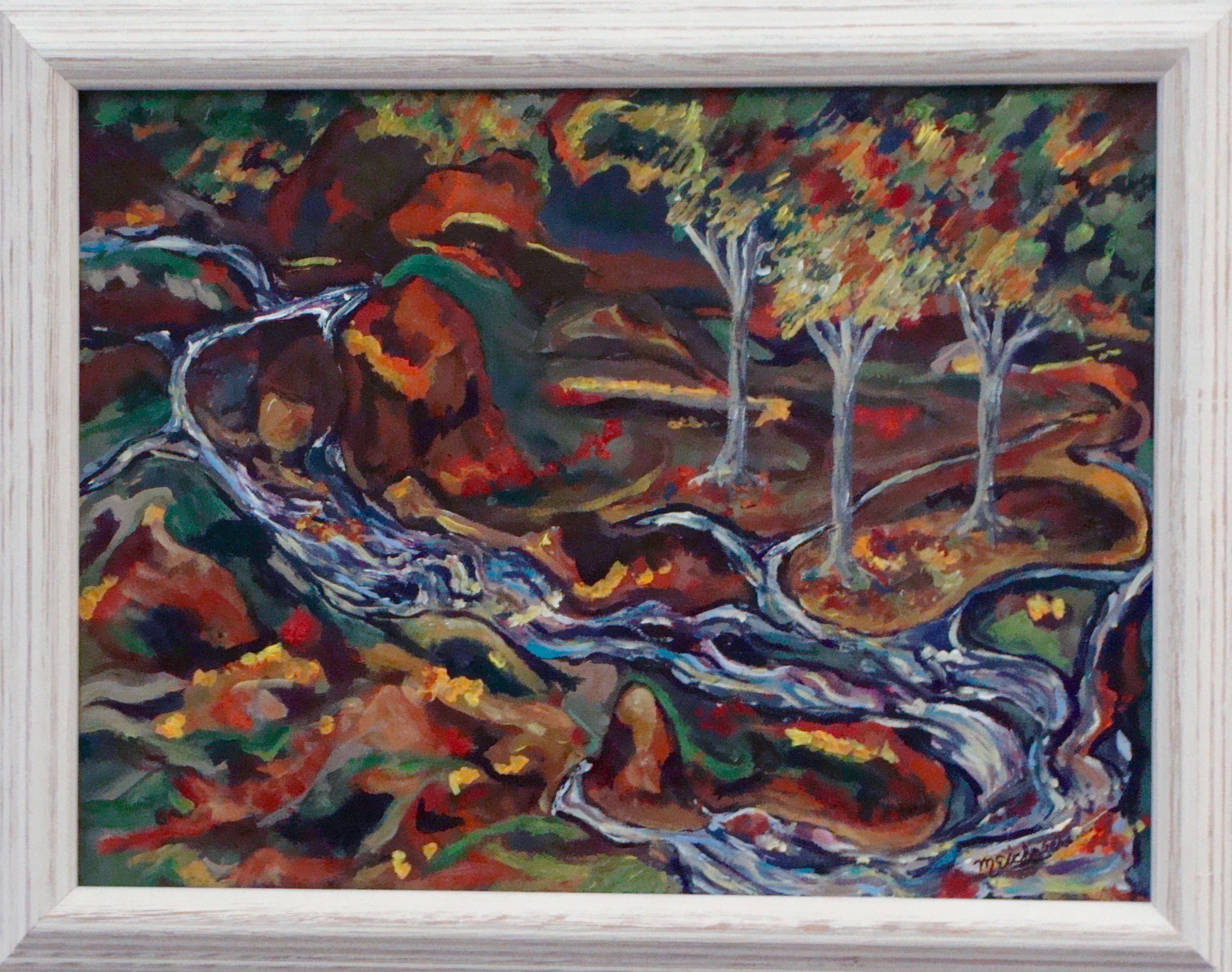
Fall is a time of beauty that makes me consider the changing seasons, vibrant colors, and slow moving rivers in need of replenishing. It is science. It is art. It is comforting and it can be wild when rain and the wind batter the land.

Filled with STEAM

Many parents have heard STEM initiatives bandied about in education circles. Schools are now abuzz with programs that provide science, technology, engineering and math options to meet perceived needs for a technologically able workforce. This expanded curriculum has opened the way for more hands-on teaching. It is a good start.

STEM activities, however, fall short of addressing the needs of all students since they do not always engage those with a more humanitarian or artistic bent. To address this lack the formula is starting to change. By putting art (and design) into the acronym, some educators have given birth to STEAM.

The movement, championed by the Rhode Island School of Design among others, has also been fostered through festivals such as Burning Man where art and technology join in a burst of sensory stimulation. STEAM offers a way to reach those who claim disinterest or fear of science and math. Organizations like the National Science Foundation (NSF) are now collaborating with the arts and humanities by giving grants to multi-disciplinary proposals. NSF recognizes that people are needed to solve problems that deal with pollution, global warming, energy, bio-genetics and advanced technologies. Emotional appeals through the arts can lure those who are hesitant and reach new audiences.

I have many friends who claim they are only interested in the arts and humanities. “I have no head for numbers,” they say. Or, I don’t understand science and never read technical articles.” Yet, these same people may enjoy science fiction and are interested in history. They attend laser light shows, put shoes on their children with heels that flash when they walk and change cell phones regularly to own the latest technology. By tuning into their stated interests and working to entice them with fun approaches to learning, those who are hesitant can be drawn into wanting to understand science and mathematics.

Why bother with all this subterfuge you might ask? Because voters need to grapple with fracking, global warming, and genetically modified food if a democracy is to be maintained. Ignorance will allow technocrats, politicians, and economists to control our lives rather than the other way around. I see confusion regularly in people trying to understand statistics thrown at them from many sources. Numbers can be skewed and misunderstood if you do not have a basic understanding of statistics.

Science and art are intrinsically bound. The scientifically literate see nature through one lens while artists explore it through another. They meet in the middle. Understanding sound waves and how people hear has led to surround sound and improved speakers. Electronics enabled digital production methods to be integrated when producing concerts and films. Studies of gas led to neon sign artistry. Chemistry aides chefs develop seasoning blends and mixtures to tantalize our pallets. Steve Jobs understood that candy-colored sleek casings would shake consumers up and make his computers more popular than others. The interaction of biology and art on the public’s understanding of science is being explored by the Haseltine Foundation for Medical Science and the Arts and the New York Academy of Science.

Sesame Street also has joined the trend to use the arts promote STEM curriculums. “Elmo the Musical” is an interactive, fun-filled adventure created by Elmo and the child at home. With lots of singing and dancing, Elmo uses his imagination and math skills, such as enumeration, relational concepts, addition/subtraction, and geometric shapes to solve problems.” Other segments are being planned to combine the visual and performing arts with STEM.

I read of an anatomy professor who presents her beginning medical students with a CD of songs that help them memorize the various body systems The Nurses Medication song heard on YouTube aids nurses learn the names and uses of various commonly used of medications. For those with kinesthetic intelligence, Living AnatomME, was developed by two medical students in conjunction with the Director of Anatomyat Mt. Sinai School of Medicine in New York to teach musculoskeletal anatomy through yoga and Pilates.

The Cushman school in Florida is one of many embracing STEAM. Following is a sample of the type of curriculum they are offering. It is a good introduction to state of the art thinking.
“The implementation of our STEAM program allows students the opportunity to learn through real-life applications in the critical areas of Science, Technology, Engineering, the Arts and Math. Students become engaged in hands-on projects where problem-solving, collaboration, and the results of their efforts make the lessons more relevant than a textbook alone ever could. By creating real things that “matter,” STEAM, at its essence, is like the apprenticeship of a bygone era.  
 
Our new Innovation Center offers cutting-edge equipment in a free flowing workspace designed to encourage flexibility of thought and creative solutions applicable to today’s competitive marketplace. This active participation in society’s productivity helps students develop an entrepreneurial mindset and effectively prepares them to be leaders in the respective STEAM fields.

Our STEAM programming includes: 
 
• Artists-in-Residence program
• Architectural Design class using Revit
• Video Game Design using Alice software
• Music Composition using Propellerhead Reason (version 4) and Pro Tools 9
• Engineering and Robotics Clubs
• Lego and Vex Robotics
• Music Festival Series that brings professional bands to campus for concerts
• TD Bank – Financial Literacy 
• Common Threads – Teaching children how to cook wholesome, healthy meals through a professional led, curriculum-based program”

I am thrilled to see this type of effort going into education. It is similar to the message Science Centers have embraced for over the past 40 years. And it is a bandwagon worth you and your family joining.
Resources:

http://stemtosteam.org – What is STEAM

http://www.pbs.org/parents/education/music-arts/boost-memory-and-learning-with-music/ – boosting memory through music

http://www.cushmanschool.org/our-program/steam-initiative/ – Sample of a STEAM curriculum within a grade school.

http://www.nyas.org/Publications/Ebriefings/Detail.aspx?cid=1a6933bd-bdd8-422f-b5f8-815972a905aa Biology and Art, Two Worlds or One?

https://www.deepdyve.com/lp/wiley/living-anatome-teaching-and-learning-musculoskeletal-anatomy-through-xdok4g4KYB – Living Anatomy CD

Artwork is always for sale. Contact me at marilynne@eichingerfineart.com
Autumn Breeze – acrylic painting / 28” by 22” / $ 399.

For the Love of Learning

the gossips

Are These Birds Dinosaurs?

dino_path_to_birdsThe Path to Birds
image from westcoastemiko.weebly.com

The Love of Learning

Last week I was in Tampa, Florida reliving my  life  as a museum junkie. Though I was ostensibly there to sell my book, I was  reunited with the passion for educating children I had when first starting a museum in my basement. Meeting past friends and enthusiastic staff at the beginning of their careers was invigorating. Once more I was comforted by the fact that there are good people ready to move our country forward towards better days.  Museum professionals are caring, tolerant and curious, all attributes I admire.

M During his chat, he called today’s birds dinosaurs. Apparently, there is evidence from over twenty dinosaur species that shows they had bird-like skin and feathers. Did you know that the Brontosaurus we studied as children had the skeleton one creature and the head of another that was unearthed in a nearby dig? Paleontologists in the late 18th century decided that the body was that of Apatosaurus and the head belonged to Camarasaurus. For years our favorite gentle vegetarian no longer existed in scientific circles. However, that changed recently. In 2015, just like Arnold Schwarzenegger, he returned. Paleontologists now think that Brontosaurus is different enough from the Apatosaur to be recognized on its own merits. Confused?

Discussions with colleagues ranged from issues around diversity to the latest brain research. We discussed drones, driverless cars and STEAM initiatives.  Practical matters such as fundraising, architecture, outreach programs and exhibitions were also on the agenda. I learned that museums built over 20 years ago like OMSI are facing major facility problems. Just like in a home, wall paint was peeling, roofs leaking, and carpets stained. Exhibitors struggled to keep out of order signs off of displays.

Money, money, money . . . what is to be done in a country that puts its resources into armaments rather than learning. Despite the fact that 92 million people visit science centers every year there is are inadequate resources going to support these institutions.   In second and third would countries the situation differs. China is building 250 well-equipped science museums in order to promote science literacy. Even Saudi Arabia has gotten on the bandwagon by building four, open to men on certain days of the week and women on others.

Most staff agreed that hands-on learning opportunities are not available to children as they were a generation ago. Noticing that kids are not permitted to play and problem-solve without hovering adults nearby was a  theme of many conversations. Moving in the ‘free-school’ atmosphere of a science center provides some relief. Yet  the experience could be improved with a larger variety of informal materials available to encourage more original thinking. Tinkering spaces are springing up to allow for more creative expression.

Tinkering space

It is difficult to serve the variety of learning styles and specialized needs of visitors.  But it is good to know that staff continues to try to understand their differences and understand how they learn.  Perhaps the day will come when as a nation we realize that there is nothing more important than educating children if they are to understand how to live in a technological environment that is also sustainable and inviting.  Maybe we will also realize that adults need to stay abreast of change if they are going to maintain a robust democracy that is fair to all.

references:
http://www.unmuseum.org/dinobront.htm – what happened to the Brontosaurus?

http://www.scientificamerican.com/article/the-brontosaurus-is-back1/ The Brontosaurus returns.

Art is aways for sale. Contact me at marilynne@eichingerfineart.com
The Gossips shown above is an acrylic painting, 12” by 36”, $ 350.

perf6.000x9.000.indd

To learn more about what goes on behind the scenes at museums read the newly released Lives of Museum Junkies available through Amazon, Barnes and Noble, Powells Books, Inkwater Press and many other local bookstores.

Dates to remember : Book reading/signing
October 11 – Broadway Books, NE Broadway, Portland
October 15 – Impression 5 -Lansing, Michigan – all day
November 3 – Marylhurst University, Old Library – 7 pm – Book Launch Party