How Animals Teach

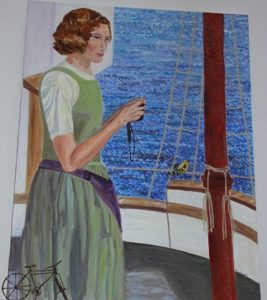
The Gossips
Acrylic on Canvas/ 12” by 36”/ $325

A Birdie Told Me So

A birdie with a yellow bill,
Hopped upon the window sill,
Cocked his shining eye and said:
Ain’t you ‘shamed, you sleepy head!

This poem, by Robert Louis Stevenson, impacted me much as the proverb popularized by Benjamin Franklin that said, “Early to bed and early to rise, makes a man healthy, wealthy and wise.” It reminds me that messages of wisdom are found in the natural world for those who pay close attention. Birds and animals sharing our planet are more intelligent and complex than most people imagine, and they have a lot to teach us.

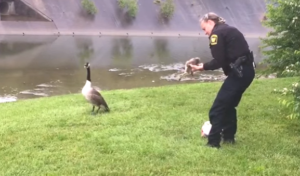
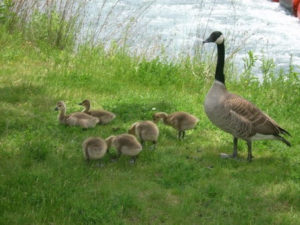
A friend recently shared a story about a goose that sought help from a policeman who was sitting in his car. The officer assumed the goose wanted food when she pecked at his window, quaked and walked away—but that was not the case. When ignored, the goose returned until the man exited his car and followed to see what she wanted. He was led to a grassy spot where a newly hatched chick’s feet were tangled in a cord. Amidst loud but unaggressive quacking, the concerned mother goose stood by while his partner rescued the panicked gosling and set it free near an adjacent creek. The mother then hustled her brood to the water and all was well.

People talk about training their pets but rarely do they mention how their animals train them. We direct cats to litter boxes, teach dogs to fetch balls and even train them to be the eyes of blind people. I proudly taught my black poodle to jump through a hoop, but I too learned from the experience. Patience, caring, fun are a few words that come to mind. Just because we don’t speak their language, doesn’t mean they are not intelligent or that we can’t learn from them.

Our cat, Franny, can tell time. She sits by her food bowl at 7 each morning and promptly at 5:30 in the afternoon. She has trained us to feed her on time—which is fine, because she returns the favor. Somehow, she knows exactly when to wake up our adopted son so that he is never late for work. Much to our surprise, Franny didn’t miss a beat when daylight savings time arrived. How can that be?

A wealthy acquaintance sent his son to a private boarding school during his high school years. On the day he first arrived, he was assigned a horse to care for and exercise during his stay. All students were required to feed, brush and ride their animals rain or shine. Many of the arriving freshmen had been spoiled by generous parents who never required them to do a bit of work. Quite a few suffered from having been emotionally neglected by their parents. Learning to care and be responsible for an animal was a life altering experience for these youth. Though the horses required their attention, they learned that caring for another living organism has rewards. Being trusted by and receiving unconditional love from their horses were life altering experiences for the majority of students.

Animals are often used as an aid for mental or physically ill people. A young woman I know spent much many years suffering from severe depression. Her life went from bad to worse and she was unable to motivate herself to prepare meals or clean her apartment. Obtaining and keeping employment was a distant dream—that is, until she got a care-dog. Her perky pet was not concerned with her depression but trusted her to care for his needs. He required a morning walk and wanted to be fed several times each day. Her dog needed someone to brush his long hairs, bathe him occasionally, and play with him regularly. Though at times the dog was a burden, he gave a lot back in return.

Since dogs live in the moment, he taught her to do so as well. His daily walks improved his owner’s health, with fresh air contributing to her skin glowing. Since he was well cared for, he was happy and flourished, which made her feel good. Though she still suffered from occasional bouts of depression, the woman became more content and less depressed. She and her dog managed to get through bad times knowing that good moments will return. The dog gifted the woman with a nonjudgmental love. A few wet licks, a hug, and a friendly wagging tail is all it took for me to know that the two are a joyful team.

I recently read about how prisoners in many western states are becoming cowboys who train wild horses. As example, in Nevada for the past 17 years, felons have been allowed to leave their minimum-security prison to spend eight hours a day on a ranch where they are addressed as “horse trainer” instead of “inmate.” They represent a tough bunch of men who were incarcerated because their aggressive, impatient behaviors led to conflicts with the law. Some were drug dealers, others burglarized, and many were charged with assault. By the time they learn how to train temperamental mustangs, however, they go through a transformation.

Man and horse bond around a number of issues. Neither are used to being caged. When captured, both react by becoming mean and scary. Yet, in order to be released, they have to exhibit a softer way of acting that embraces respect and trust.

When a trainer is first put in a pen with a mustang, he confronts a wild, angry, snorting animal. It can take weeks before the horse is willing to be touched and many more days before it can be haltered, saddled, and ridden. The trainer works with his animal in a stressful and often dangerous environment. As one man put it, “climbing a 1000 lb. beast that keeps bucking you to the dirt also requires true grit.” When the men return at day’s end, other prisoners and guards do not mess with them. They exude self-confidence as they develop self-worth and respect for all living things.

Though the horses are put up for adoption every four months, the inmates remain supervised until their sentences are complete. During this time they are treated like men, instead of prisoners, and because they love what they are doing, they qucikly discard defensive behaviors and learn patience. Working with horses requires requires emotional control and focus on what they are doing. These skills help them find employment upon their release.

According to veterinarian Vint Virga, animals can teach us a a great deal about being human. Since animals mainly pay attention to the present, they demonstrate how to savor the moment rather than be easily distracted by past and future thoughts. Taking a cue from their behavior, we can learn to appreciate more fully your current activity by focusing on what is most important.

Animals tune into impressions from the world around them, trusting and acting on their instincts. If we too learn to acknowledge our hunches, we will become more open to new choices and opportunities. Rather than taking ourselves too seriously and work all of the time, we will acknowledge that rest and play are also vital to our happiness. Animals vary moments of rest, relaxation and reflection with periods for discovery, invention and joy. They become fully absorbed when playing and do not worry about how good they are at the game. When my dog played catch, she was completely focused and never paid attention to distractions in the environment.

Animals exude unconditional love for those who take the time to know and share their world. A few kind words, a belly rub and neck scratch will produce a friend who is there to greet you when you return from a busy day. By applying what is learn from pets and by taking the time to nurture family and friends, we will expand our circle of warmth and delight.

References:

Virga,Vint, THe Soul of All living Creatures, 10 Things Animals Can Teach Us about Being Human, Psychology Today.https://www.psychologytoday.com/blog/the-soul-all-living-creatures/201501/10-things-animals-can-teach-us-about-being-human

Hernandez,Dan, True grit: how wild horses are turning Nevada Inmates into cowboys. The Guardian, Feb 25, 2015. https://www.theguardian.com/global/2015/feb/25/true-grit-wild-horses-nevada-inmates-cowboys

Oh boy! Stress again!

Peace and contemplation in Eastern Oregon

Acrylic painting on canvas, gold frame, 21″ by 25″ / $ 499. For information contact me at marilynne@eichingerfineart.com

Oh boy! Stress again!

Over the years I’ve written about how children raised in trauma develop fight and flight responses in order to survive. They learn to react quickly when stressed but find it difficult to step back to analyze complex situations. I, and many of my friends, have the opposite problem. We live in our thoughts and are poorly equipped to cope with emergencies that require immediate action. Our minds work overtime, developing worrisome scenarios that may or may not occur in the future. We too are stressed and need to have coping mechanisms, but in a slightly different way.

What makes you calm? Is it a drive in the country? A walk in the woods? Yoga? Meditation? A good book? Do you fall asleep as soon as your head hits the pillow or do you lie awake tossing and turning for hours? When you hear disturbing news can you compartmentalize it so that it does not take over your entire consciousness and ruin your day?

A friend of mine told me that her husband has the ability to put his problems in a box, to take out and explore when the time is right. Whether it is pain or sad news, the input is immediately compartmentalized to be dealt with in a calm manner at the appropriate time. He is “way cool” for I strive for this type of control.

Though stress is destructive when it becomes too much to deal with, it can be good. It keeps life from becoming boring and also helps us perform in dangerous situations. Whether it is good or bad depends on coping mechanisms which dictate a reaction or response. When a situation appears to be overwhelming, we become anxious, which undermines our ability to effectively respond. The pressure also can have a negative effect on our health.

The challenge is to be able to respond quickly and effectively and to leave negative health responses behind. This includes not worrying in advance about something that may never occur, but being prepared in case it does. For instance, a person facing an operation should not worry twice. The operation should be faced with relative equanimity. once the results are known, then it is time to respond. Bad news can then be used as a spur to action. Stress is helpful when it is motivational but not when ‘what if?’ worries continue without end.

Ancient societies used flight or fight training when responding to the many physical dangers they encountered. A wild boar or roaring lion would arouse self-preservation reflexes that were immediately activated since they had been practiced many times in advance. When confronting a dangerous situation, their adrenaline, cortisol levels and heart rate increased to give them enough energy to respond by hiding, running, or attacking. Heightened alertness, muscle preparedness, slowing digestive and immune systems enabled them to move in ways that were essential to their survival. In other words, they were saved by an energized sympathetic nervous system where sensorimotor abilities were integrated with the psychological parts of their brain, allowing them to control emotions and act with speed.

Though the dangers faced today are different, they still exist, and our responses also require training and practice. Our stressors may be triggered by raging road drivers, aggressive skateboarders, or an assault rather than wild animals, but these encounters are no less stressful. Our muscles tense and blood pressure rises just as rapidly as in primordial cultures. These stress signals are a call to action requiring quick reflexes and knowledge in ways to respond.

There can be mental consequences for those who give little thought or practice to emergency situations. The adverse effects of stress may remain for an extended period of time even after the threat is over. Most people I know ignore the fact that our society also has stressors that require attention. We too need to be prepared and gain the skills necessary to survive with a minimum of stress.

One way to discover what is needed is to play a mind game. Begin by sitting quietly in a chair, closing your eyes and imagine dangerous scenarios and how you will respond. Note what when you start to become anxious. The exercise will help you discover what type of training you need in order to lower your stress. Will physical exercise help you improve reflex reaction time? Will classes in personal safety, self-defense or balance lower your stress threshold? One of my teachers suggested I practice shouting with gusto so I will be heard in an emergency. Being prepared for natural and man-made disasters can provide relief from anticipatory worry. Assembling extra water, food, and clothing, and knowing how to turn off gas, water and electricity are basic to handling potential crises.

Meditation was a crutch for me when a tree came smashing down on my roof, shaking the house as though in an earthquake. Glass flew everywhere while rainwater poured through a broken skylight and windows. My immediate reaction was panic, followed by jumping up with confusion about how to respond. My heart beat wildly and I am sure my adrenaline levels peaked. I had to calm myself before I could think and did so by thinking, “Marilynne, you are a meditator—breathe deeply. It took one minute to gain control because of having practiced meditation for many years. Once calm, I assessed the situation was able to respond immediately.

Those who participate in military, fire, or police training are taught how to deal with emergencies. Most ordinary citizens are not. Yet, we need to have these skills for there are bound to be times when we will be vulnerable. Preparation for natural disasters makes sense and should include having a meeting place to go to in case of emergency. Assessing risks and having emergency devices on hand will provide peace of mind.

It is also important to have your body in shape to handle various situations. Exercises that improve balance and reflexes and participating in self-defense, personal safety, and cyber-safety classes can be helpful. Just the process of regular practice can be a stress reducer. And, don’t forget, adequate sleep, a healthy diet and maintaining appropriate weight. The list goes on to include meditation, aroma therapy, warm baths, massage, and herbal teas. Reducing screen time including cell phone, computer, and television use and getting organized are natural stress-reducers. Lastly, in this day of alternative news, I think it is important confront media hype and instead look inward to what you must do to maintain your own sanity.

If we learn to manage the pitfalls of our own environment we are more likely to live with equanimity. We will stop being anxious when our minds play tricks but be ready for action when actually threatened. And, best of all, once the situation is over, we will be able to throw off the extra adrenaline and cortisol circulating throughout our bodies. It is worth the effort to be prepared.

References:

Christian, Nordqvist, December 24, 2015, What is Stress? How to Deal with Stress, Article Medical News Today: http://www.medicalnewstoday.com/articles/145855.php

Stress Symptoms, Signs, and Causes from HELPGUIDE .ORG in collaboration with Harvard Health publications: https://www.helpguide.org/articles/stress/stress-symptoms-causes-and-effects.htm

Uwe Proske, Simon Gandevia, October 2012 Pshysiolgical Reviews, VOl. 92 no. 4, 1651-1597, The Proprioceptive Senses: Their Roles in Signaling Body Shape, Body Position and Movement, and Muscle Force: http://physrev.physiology.org/content/92/4/1651

The Merry-Go-Round

Solar System Planets

The Merry-Go-Round

An old Chinese curse says: “May you live in interesting times.” We certainly do. Each day, events bombard us in the news, and though terrible, they certainly make this era a most interesting one. Twelfth century Chinese believed that the most fascinating periods in history were those filled with upheaval and chaos. I relate to their belief for when I open my eyes in the morning I can’t wait to discover what happened while I slept. Though emotionally, I don’t like living through turmoil, intellectually I do enjoy stepping outside of conflicts to let my mind make sense of the staged events. In order to keep balance, I remind myself that historically peace and war, wealth and poverty, played cyclical games that can last hundreds of years.

Global travel clarifies many of the changes that have taken place during my own short life. Boundaries have moved so often that I keep having to get new maps. Eritrea became independent from Ethiopia in 2002, the Aouzou Strip in Libya was given to Chad, and Somaliland has declared independence, though without UN recognition. Three years ago I went to the Ukraine. Now the borders and access to the land are different. The Crimea was annexed in 2014 after Russia decided that their need for seaports was more important than Ukraine’s sovereignty. By controlling the area they consider historically to be theirs, they gain natural gas rights in the Black Sea and oversight of Sevestapol, the seaport that houses their military fleet. Russia also aquired more wealth by retaining military equipment left behind by the Ukraine people, and they now control access to the remaining Ukrainian seaports. Some power still remains with Ukraine, though, for it owns most electrical plants as well as access to fresh water. The entire region, however, has become a powder keg.

I feel like I am on a merry-go-round and am not sure how to get off. As it cycles I pass an escalating tide of humanity who suffer because of our poorly advised invasion of Iraq. But, what surprises me the most, are the Americans who have become reluctant to help destitute refugees fleeing from harm’s way? I wonder what I would do if bullets rained down on my head? Would anyone be there to help me?

Then I spin past billionaire mansions in gated communities and watch their inhabitants deny workers fair wahes, health care and affordable housing. I pass streets filled with tents and eyeball beggars asking for handouts. I witness illegal farmworkers being emoved by immigration officers while their employers are not fined for hiring them in the first place. Their innocent children live in fear that they will be separated from their parents. If it is so important to remove illegal residents from our country, why aren’t the employers who have become wealthy by their past labor not asked to pay for their resettlement costs? I am curious to discover who will remain working as low pay farm labor and who will make the beds in luxury hotels?

Students of history know that times of peace and prosperity cycle with those of war and chaos. There are eras when demigods, emperors, and kings control the masses and those when the proletariate rise up and rebel. The Magna Carter was the result of one such uprising and our own country rose to expell British rule. China’s dynasties present another example. Each time the wealthy rulers became corrupt the dynasty was threatened, eventually overthrown, and a new government formed. The children of thereformers, would become lazy and spoiled over time and the cycle would start over again. Fascinating? Depressing? Scary? Is this what is happening in our country? Are our leaders corrupt and self-centered? Is this what we are beginning to see throughout the world?

You can’t turn on the news without being blasted with stories of Greece’s fragile economy, removal of the president of South Korea due to corruption, Neo-Nazi’s in the Netherlands, and migrations due to land and resource grabs. We hear that with Brexit, the survival of the European Union is challenged, that pollution in China directly affects our own air quality, that fracking in Oklahoma causes earthquakes, and that overfishing is depleting an important source of the world’s food supply. Interesting times? The merry-go-round continues to cycle with its horses traveling up and down. I ride on it but it is not always fun.

Connected we are, whether we want to be or not. With international banking, mega corporations and trade agreements we left our isolationist past behind a long time ago. Do you know that warming trends have negatively affected coffee growth in Sierra Leone thereby increasing coffee prices in the U.S.? That extreme weather brought on by rising temperatures and changes in precipitation threaten the food we eat, the air we breathe, and the water we drink? Yes, we are a global earth.

Remember the saying “nature abhors a vacuum?” As an anthropology student I was taught that if a poor overpopulated country is located near a wealthier one with a smaller population those living in poverty will soon be pushing boundaries and moving into the country with greater resources. There may be local laws trying to prevent that movement but the laws of nature say that governmental laws will lose in the end because the desire to survive is so great that people will do whatever they can to feed their families.

Countries may try to stop immigrants from coming to their soil but any anthropologist will say that in dire times, need overcomes law. Population movements can’t help but effect the lives of lawful reseidents. Last year 65 million people migrated from war-torn countries and the from those affected by global warming. Severe drought affected livestock and farming and lack of drinking water meant thousands moved or died. Rising sea levels put farmland under water in Bangladesh and the island of Kiribai. What will it be next year? Will we continue to ignore this threat and let people die? What if Manhattan has another severer hurricane that threatens their food supply?

Changing long held thought patterns is difficult. It involves digging for unbiased updated information and a willingness to shift beliefs when presented with new facts. Analysis can be emotional because results often challenge minds that basically want to remain comfortable by clinging to old ways. Still, adapting to change should not be more difficult than learning how to use the latest App. Yet, it is. Strangely, fewer than 50% of American adults believe in evolution. These non-believers view scientists as a threat to their worldview rather than as researches and providers of information from which to reevaluate decisions. Perhaps there is a benefit to clinging on to old ways and thought patterns.

I am an example of a person who resisted using computers when they were first mass marketed. As a museum director, I made sure they were near by but I had other people operate them for I did not want to “waste” my time on the computer. That was a bad decision. Now I realize that staying abreast of social, political, and technological landscapes are requirements for living fully and in the moment. They certainly are a must for any parent educating a child.

Though I often write of how to suvive upheavals, this interesting era is not all terrible. It can be fascinating to put yourself on a merry-go-round when your eyes are open and your heart hopeful for a gold ring to be there to grab. Figuring out underlying causes and developing ways to solve problems can be challenging and rewarding. I am remain ever curious to discover what will happen next. I’d like to return to earth in 200 years and see how this political turmoil will evolve? What is your prediction for the future?

References:

Latest countries formed https://www.washingtonpost.com/news/worldviews/wp/2014/09/16/the-9-newest-countries-in-the-world/?utm_term=.b4297be5a30a

National Center for Science Education –https://ncse.com/node/16774

Effects of Rising Sea Levels –http://www.nationalgeographic.com/environment/global-warming/sea-level-rise/

Global Climate Change, Vital Signs of the Planet: https://climate.nasa.gov/e

NASAffects/ EPA- Effects of global warming: https://www.epa.gov/climate-impacts/climate-impacts-human-health

Please comment below.

Art is always for sale: contact me at marilynne@eichingerfineart.com.

Seeing with Clarity: Recognizing Hope

Seeing with Clarity: Recognizing Hope

Last week I finished reading the Lost Symbol by Dan Brown. His writing style keeps me on edge as he has one mysterious occurrence blending into the next, one clue opening a door leading to a twist in the road that ends with a wall to be scaled. In The Lost Symbol, the topic interested me because it deals with metaphysical questions involving wisdom. Injected into a labyrinth of secrets, codes and hidden truths was a villain who wanted power that he believed came from a single word—one that would give life meaning. At the risk of spoiling the ending, I was surprised that the final revelation was simply the word “hope.”

Words are symbols that can carry deep meaning. And though it has been weeks since completing the book, I have been unable to get this symbol out of my mind. Composed of four ordinary letters, hope elicits more power than I had originally thought possible.

Hope. President Obama wrote a book called, The Audacity of Hope, which contributed to his election. President Trump’s campaign also gave hope, especially to white middle class men who had been feeling left out. Bernie Sander’s did the same for young adults by energizing them to believe that a world based on equality and fairness is possible.

All people want to believe that their lives matter and that their concerns will be taken seriously. Everyone wants to trust that there is a purpose to their existence and that dreams hold promise. But hope only flourishes when we finally accept ourselves and acknowledge that we are enough as we are, even without having billions of dollars. Each is a soul in transition, capable of growth and change so that we can reinvent ourselves over and over again. Just as hope embraces acceptance, it also envelops forgiveness and offers love, for these elements allow for a new start.

During tough times it is difficult to embrace adversity and engage in fighting it. But it is your choice. It is your struggle and your decision to move forward. Believing in yourself as a survivor can help surmount terrible obstacles just as the embracing hope of thousands of people who are willing to fight for democratic values will help our country survive with dignity.

But, there are times when people need our assistance so that they can see a ray of sunshine. Their stumbling blocks may be so severe that hope does not enter their consciousness. For instance, a single mother, living in poverty, raising her children in a drug inflicted neighborhood faces barriers that seemingly have no end. A mentally ill man, experiencing difficulty in getting and keeping a job, may wonder how he will ever house and feed himself. A prisoner sentenced in his youth for years without parole, faces slowly moving minutes without hope for better way forward. An honor role student who watches her mother deported because she immigrated illegally so her children could have a better life may lose hope for her own future. And, it is easy to understand why the 32 million illiterates living within our borders who have little chance for full time employment at a livable wage may despair of hope.

But these people do not have to stay among the hopeless. They too can join the march towards economic security and fulfillment though we may have to give them a boost and help them dig their way out of quicksand that has trapped their feet. If we let them stand on our shoulders they will be able to look over the fence of poverty and entrapment. But, to maintain their hope, what they see must be a land devoid of unbridled capitalism that ignores the welfare of many for the benefit of a few. The sun must shine through air that is healthy to breathe and it must sparkle on streams and green pastures that are maintained for future generations. The fields must be leveled so men and women of all races and religions are treated equitably and without fear of being bullied. The school bell must ring out messages that call all to understand the history of our past and the science and technology of our future so that citizens will want to participate in bettering society.

Once the multitude can see a light shining on tidings that sparkle with promise, then their dreams will compound to add strength to the nation. Hope for a better future is what always brought people to our shores and it is by restoring hope that we will make America great again.

Please comment below on my blogsite.

Artwork is always for sale: Contact me at marilynne@eihingerfineart.com. Seeing with Clarity is acrylic on canvas/ 48″ by 36″/ $ $699.

Best Friends

Best Friends

In elementary school we sang a round with lyrics that told us to,

Make new friends but don’t forget the old,
One is silver and the other is gold.

Those words still lurk in the back of my mind and I think about them often. Who are my friends ? Am I as close to my new friends as I was to to the old?

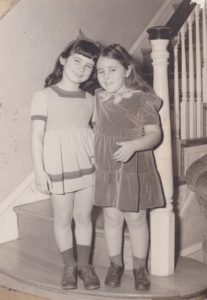
Elaine was my best childhood friend. We were raised together. We were only two weeks apart in age, I being the older. Our mothers were sisters and we lived four streets apart, went to the same schools, and visited Grandma every weekend. I used to taunt her by saying, “You have to listen to me. I’m older than you.” Her quick response was, “ Yea, but you’re going to die first!” That usually put an end to the argument. Now Elaine lives on the opposite coast and it is an effort to stay connected. Occasional phone calls and vacations are not quite the same as being neighbors.

In sixth grade, a cute boy stood attentively by my side when I was on duty as a school crossing guard. I was flattered as we chatted nonstop. Eventually I agreed to participate in a mock wedding and invited our friends to celebrate with us. Once the ceremony was over, we sat on the floor and played spin the bottle though he was more interested in having the bottle point to another girl than me. A crushing moment! Fifty years later the boy, turned professor, got in touch with me. We resumed our communication through email. He had had an interesting academic career and also became an accomplished photographer. We easily shared secrets. But, life moves on, and eventually we lost touch once more. I think of him fondly as a intellectual friend, though not one I would call in an emergency.

When dating, I lived during the era when those of the opposite sex were met through mutual friends. We went to parties, attended school events, and participated in dances put on by religious organizations. In sixth and seventh grade we donned white gloves and attended Saturday dance classes where we were groomed for participation in adult social activities.

Eventually, I met my husband and he soon became my very best friend. But after 25 years we divorced and I lost him as a friend. The shared memories and friendships we had developed as a couple were never spoken of again. I began a new chapter, moved away and developed new friendships.

My first husband and I have since reestablished communication and I find it a pleasure to be in contact with someone who knew my family when I was fourteen. Remembrances pepper life with richness and provide dimensionality. As long as we do not get stuck in the past, there is much to be learned from remembering it.

When my children were young, we partied with couples who had children the same age as ours. I attended a women’s group each month where we sat in a circle sharing inner most thoughts about the month’s topic. There were weekend dinners at each other’s homes and our children visited on playdates. We worked side by side on school committees, baked cookies, participated in auctions, and drove our cars on school outings. It was lots of fun, but today, I am not in touch with even one of these women. What happened to my old friends? Did their lives turn out as they had hoped?
Then Internet came along, and with it Facebook, Instagram, Snapchat, and Twitter. Cell phones arrived along with the ability to text. Instead of attending parties when I wanted to meet a new man I went to match.com and eHarmony. Boy did I have fun for a year meeting fascinating people! I even met a man who asked me to help him license an arithmetic toy he developed. We became business friends and I made it happen. The two of us have not communicated since.

Have these technologies really changed the nature of friendships? I have hundreds of so called friends following my blogs on various sites. Do social media sites develop and keep friendships ? Perhaps the younger generation is more in tuned with this type of friend making.

According to a 2015 Pew Research report, 76% of all teens use social media.They claim it connects them to their friends’ feelings and lives, though they think that they often over do it too and share too much information. 68% report that they have received support from friends during tough times. That sounds wonderful to me though I also understand that there is a class bias. The statistic is more aligned with those living in families earning less than $50,000 than those from more affluent households.

On the flip side, social media can hurt, especially when a girl (boys are more thick skinned) discovers that they had not been invited to an event or activity that had occurred. They are devastated when reading a derogatory remark that has been written about them. Half of those surveyed have had someone post a comment about them that they cannot change or control. Again, this is more prevalent in educated, higher income households which also carries with it a higher amount of what they call drama (conflict, bullying). Unfortunately, the carry over to school can be devastating where fights may occur because of something written online. When friendships end, teens unfriend, block or delete the person. In general, they think that people online are less authentic, less real. The more educated ones spend a lot of time making sure they look good and that they take the time to post only positive content. Teens want to be judged as smart, thoughtful, fun loving hipsters.

Are teen friends true friends? One of my old acquaintances used to say, “it takes 20 years to make a friend.” Aristotle said, “ a friend is a single soul dwelling in two bodies.” A researcher in Birkbeck College in London claims that most of us lose friends as our lives become more technologically connected. The joys of human contact are replaced by electronic stimuli and shallow friendships. Social connections rather than true Aristotelian friendships are the new norm. ‘

According to the American Sociological Review, most people only have two close friends and 25% of Americans have none. Facebook is not usually a place to develop close friendships. Internet contact does not compare with the quality of relationships that are built are face-to face.’
Friendships take time and effort. Relationships deepen when you are willing to be authentic, share intimate feelings, and sensitive vulnerabilities.

Over the course of my career, managing science museums and a catalog company, I met staff, board members and community activists I considered to be my friends. It was a shock to discover that each time I stepped away from my position I was asked to not communicate with those who remained working for the organization. CEOs of businesses are expected to sever ties when they leave, allowing the new president to develop his or her own loyalties. I know of a minister who left her church and had to sign a document saying that she would not attend services or have contact with congregants for two years.

The experience was isolating when that happened to me in Portland. While running OMSI, I was surrounded by people who befriended me because they wanted to be part of an inner elite circle. The day after resigning from the museum, their attention rightly turned to the new director and I was forgotten. That did not bother me too much at first because I had a new business to attend to that took all my time. However, when my catalog company sold after eighteen years of operation, I was confronted by the fact that I had lost so many friends. Surprisingly it was a for-profit business and still the new owner did not want me to have contact with staff for fear they would want to keep old ways of doing things.

Since leaving, I have developed new, wonderful relationships and plan to keep them close to me. And, though I happily have new friendships, I will never forget the old.

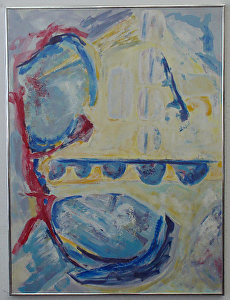
Artwork is always for sale. Picture of Elaine is acrylic on canvas, 48″ by 36″ $699.

Contact Marilynne@eichingerfineart.com

The Patriot

Feeding Crow
Acrylic on Canvas/ gold frame/ 40” by 30” / $ 599
Each of us is called on to defend our country, whether at war or at peace. The rights granted us under the Constitution and the Bill of Rights are worth defending. It is not something for others to do. We will never agree with our neighbors about every issue but our homeland asks us to accept the tenants of democracy.

Call Me Patriot!

Call me Patriot. No one can take that name away from me, neither the right nor the left. In today’s political climate, the word has become loaded with meaning. I love our country and the people I come in contact with daily, even when I do not agree with their political views. Most are good and generous individuals who are ready to help their neighbors in time of need. And, though I am very upset by many things that our politicians do, I see it as my duty to be involved to make things better for the next generation. It upsets me to hear of acquaintances who want to give up their citizenship and go elsewhere. If we want to live on a kinder more compassionate canvas, then it is ours to paint.

A patriot is defined by Webster as a person attached to his or her homeland. Sadly, at times it is difficult to feel connected to ours, especially when congressional delegates act as children and make it hard to believe they have the best interest of the electorate at heart. Wrapped in their own desire to get reelected, they forget they are part of a family unit that gains strength by working together.

Growing up, each of my children had opinions of their own which did not always correspond with mine. Yet I loved them, tried to consider their point of view, and embraced their goodness despite our differences. We always came to some accommodation that permitted us to live in harmony. I would lay down my life for my children no matter how much we disagree.

When it comes to politics, however, I notice that some, who call themselves patriots, take self-centered positions based on identity with such things as social class, race, religion or gender. They may decide that only those who share their culture, ethnic background, language, nationality of origin, profession or sexual orientation are patriots. The dictionary labels them chauvinist patriots for they carry an excess of patriotism. Laying claim to their political position as the valid one, they speak as if only they have the right to the word. Not so!

I fear they do not understand the intent of the Constitution, Bill of Rights and laws that underpin our national identity. Their love of homeland is based on their own mythology. For instance, section 8 in the Constitution says that Congress shall have power, “To regulate Commerce with foreign Nations, and among the several States, and with the Indian Tribes.” This was written, in part, to insure that treaties with Native Americans are respected. Instead, over the years, when money is involved, self-interest has ignored the clause. It seems to me, that since Native-Americans are identified as nations, our government does not have the right to invade tribal lands. If you were an Native-American, wouldn’t you consider a forced pipeline being put through your territory as an act of war? Wouldn’t a Patriot expect the government to honor our agreements?

The Bill of Rights protects free speech, religious freedom, and the freedom of assembly. It does not give permission to isolate those of any one faith, to make inflammatory remarks, or treat them differently. Internet, though, has ushered in shady behavior, for it allows individuals to overstep the bounds of free speech by inciting malicious behavior. A true patriot would not make disparaging comments because of differences in race, gender, or religion.

And, what about voting? All citizens over 18 have the right to vote. A patriot, in my opinion, would not be gerrymandering electoral districts for their own benefit. They would not put obstacles in the way of minority voters, or treat a corporation as an individual. They certainly would not hack emails or spread false information. Unfortunately, that is not how it is, for power brokers who consider themselves patriots, have found ways to go around the laws of our land. Greed controls actions that are difficult to combat.

Many interpretations of the Constitution and its amendments are based on what we imagine the framers meant. It is impossible to get into their heads but common sense says that their intent was always for the good of the people, most people, we the people. The overall goal has always been fairness.

There never will be complete agreement, which is fine. It makes life interesting. We just need to hear each other and respect minority views as having value. Since we are neighbors and often need each other, why not listen compassionately and act with kindness? All human beings are faced with personal difficulties. Why add hate and anger as burdens? Both minority and majority views can be patriotic if the intent is to improve the homeland and actions are done in accordance with the nation’s laws.

That is not what is happening, however. Even those on dating sites such as Match or Zoosk are adding comments to their profiles like, “not interested in a Trump supporter” or “will only date a Republican.” I never would have been born under those circumstances since my parents supported different political parties. They loved each other and their views never seemed to be a burden as they shared their values with their children. I think I was fortunate to be able to evaluate two opposing points of view and take the best ideas from each side of the isle.

Recently, I have been looking at the faces of some of my friends and they are frozen with fear. Since the cold war days, I have not been privy to such raw emotion. They thought that this was their country and now they feel like they are being marginalized. Being fearful is no way to live in America. My America is the land of the free, and it is my patriotic duty to keep it so.

Young Scholar’s Tale

Over the Fence: From Rags to Riches
It is not easy to climb over a fence built of barriers to security and wealth.
Acrylic on Canvas/ 21” x 25” / gold frame / $499.

The following story is about a young man who was helped by a compassionate couple during his senior year in high school. I believe it is import to acknowledge how one individual is all it takes to impact the life of a child raised in traumatic circumstances. As I complete Over the Sticker Bush Fence, a book about homeless and runaway youth, I plan to share certain sections with you. Please give me your honest feedback as I proceed. I hope to inspire others to volunteer to support a child in need.

The Tale of Young Scholar

Jeff Gottfried, a former director of education at the Oregon Museum of Science and Industry (OMSI), initiated and received National Science Foundation (NSF) funding to conduct an innovative Young Scholars program. High school students were selected from a national applicant pool of those interested in working alongside research scientists during their summer vacation. There was no difficulty in finding applicants with a 4.0-grade average who wanted to take advantage of this opportunity. Most of the teens came from caring middle and upper-class families who encourage their children to exceed. But Jeff was interested in looking beyond the obvious to discover children with talent but who, for reasons of poverty or family dysfunction, were not high achievers. He asked teachers to make suggestions of students who might fit into this category of unrecognized youth.

Sure enough, one of the local high school teachers mentioned a boy whose family had moved each of the past five years because of poverty. The young man’s father was a Vietnam vet who, if entering treatment today, would have been diagnosed with post-traumatic stress disorder-PTSD. His mother suffered a variety of mental and physical illnesses and was also incapacitated. He was a neglected child, and if the police had not picked him up while roaming on the beach he never would have started school. The family moved from house to house as they faced consecutive evictions. There were numerous instances when the boy spent his nights sleeping in the family’s car.

Teachers, recognizing the boy’s intelligence, encouraged him to apply for the summer research position at OMSI despite having poor grades. Though his appearance and manner of speaking appeared to be mismatched to his knowledge, they were able to see through the superficial to a spark of genius. His grades were low Bs, and his command of English was marginal. The youth’s dress was shabby, like that of a street kid, yet his application essay was compelling as he spoke of his life and challenges, so the OMSI program decided to take a risk on this young man. Jeff’s intuition was good. I named him “Young Scholar” and throughout the summer he became more energized and hopeful.

The research he participated in was an environmental study of water quality of rivers in eastern Oregon. On one of Jeff’s visits to the site, he noticed that Young Scholar was not there during the dinner hour. In inquiring about his whereabouts, he was told that the boy was so wrapped up in the research that he did not want to stop what he was doing until it became darker. Later that evening, Jeff overheard Young Scholar asking another youth if there was a possibility of living with the boy’s family the following school year since his parents were planning to move once again. Jeff immediately discussed the Young Scholar’s situation with his wife and decided to take the boy into their own home during the following academic year.

Jeff accompanied Young Scholar to his apartment, loaded his few belongings into his car, and brought him into an atmosphere with caring creative people who applauded learning. The following school year, Young Scholar never missed a day, receiving a 4.0-grade point average by year-end and winning a Bausch and Lomb Science Award upon graduation. This prestigious award was accompanied by a four-year full scholarship to Rochester University. It was quite an accomplishment and shows what can happen when a caring adult recognizes potential.

Young Scholar accepted the scholarship and went off to study science , working all the while cleaning dorms to augment his stipend. Young Scholar continued to return to Jeff’s house for vacations, and the family grew to accept and love him as a son. Upon graduation, he accepted a job as a teacher in private school in New Orleans and eventually returned to Oregon to obtain a master’s degree in environmental science, in sedimentology. With diploma in hand, he returned to New Orleans to enter a doctorate program at Tulane University.

Young Scholar lived through Katrina, almost losing his entire Ph.D. dissertation in the disaster. This man, who understood the difficulty of overcoming adversity, managed to rescue his thesis from floodwater when the campus was closed. Presenting and defending his thesis was extremely difficult because his thesis committee had scattered to various locations throughout the United States. Young Scholar had to undertake the arduous task of reassembling his dissertation committee before he could graduate.

Today he is a married man with two children and supports himself as a college professor. Because of astute teachers who recognized his brilliance, the inspiration gained by participating in museum sponsored research, and a dedicated museum professional willing to go the extra mile, this Young Scholar has become a contributing member of society.

Public Service for All

Engaged in Adventure
Acrylic on Canvas/ 42” by 54”/ $ 790 or best offer
It is time for adventure. Test the water, see the world, try new things, develop new friendships.

Public Service for All
Over the past two years, I have been engaged in research about homeless and runaway youth. I studied the causes and interventions used to help these children who come from traumatic backgrounds. I am nearing completion, writing a summary and conclusion section that includes suggestions. One idea is to establish a government-sponsored public service program that all youth participate in one year after graduation. Please read the following section and share your thoughts. Do you think this is a good and doable idea?

Public Service for All

Is it time to consider a public service option for al graduates? We appear not to have enough jobs to gainfully employ graduating high school (even college) youth, so rather than doing menial activities or nothing at all, why not engage them in useful pursuits that develop job skills? What might a one-year obligation be like if all high school graduates were required to enter a civil defense, military or Vista Corps-type program?

Putting teens from diverse backgrounds together could stem political divisions that plague our country and serve as a way to integrate the population. Race and gender concerns fall away when people grow to depend on each other. Wealth and poverty issues are aided by understanding. Public service could give youth an opportunity to interact across class lines and be an aid in overcoming bigotry.

Service jobs offer on-the-job training that teaches recruits to engage in teamwork. This style of learning is especially useful for those who have a difficult time sitting in classrooms engaged in academic studies. Youth, in service positions, learn to follow directions and, as they progress, are awarded leadership opportunities. Service expands a participant’s worldview and is exciting when new challenges are presented and met. Activities could include disaster relief, fighting forest fires, agriculture, working with distressed children, assisting national park rangers, building habitat for humanity houses, and cooking in food shelters. In each case, youth will gain skills that are transferable to future jobs.

For those planning to continue studying for an advanced degree, a year of service could help solidify what direction to pursue. Knowing that you are contributing to a better society is empowering, with life-long benefits that make for a more compassionate society.

Art is always for sale. Contact me at marilynne@eichingerfineart.com.

Violent Storms a’ Comin’

Surf’s Up
Acrylic on Canvas, gold frame, 48” by 36” / $ 699

Violent Storms a’ Comin’

A few days ago a friend of mine went to a Buddhist induction ceremony where Initiates were given a bowl and robe and told that from then on these objects would be their only possessions. Letting go of attachment, being mindful and focused, having kindness and compassion, reducing suffering and increasing happiness they are all that matter. Property ownership is meaningless.

His story made me wonder what it would be like to give up everything I own? I realize that you can’t take objects with you when you die but to possess and create beautify art has always made me feel good. As a visual person, the natural and human-made environments are important to me. Just as I appreciate observing birds in the wild I enjoy putting my hands around a lovely piece of pottery I own to feel ripples in the clay that the potter made when crafting a bowl.

While acknowledging that I was attached to my possessions, I switched the television on to the weather channel where they were reshowing images of the aftermath of Hurricane Sandy. I had never paid a great deal of attention to the trauma that beset the New Jersey Coast but when I heard the newscaster say Barnegat Bay, he grabbed my attention. My family had once owned a summer home on Long Beach Island. Located between the Bay and Ocean, the narrow strip of land bore the brunt of the hurricane’s force. It struck me that no longer can I bury my head and say that losing everything is not a possibility.

During the past two years, several trees landed on my property due to erratic weather conditions and rain saturated land. One smashed through the roof of my house and the second demolished a car in the driveway. In both cases, members of our family were inches away from being killed. Are these violent storms going the be the norm in the future? I decided to explore more deeply why a warming climate produces violent storms that include icy cold winters.

As early as 2007, NASA predicted that increased levels of carbon dioxide would make continents warm more quickly than oceans, resulting in storms becoming more vigorous. On the west coast, an increased amount of rain and snow may solve problems of summer drought as long as there are ways to capture water from saturated grounds that are prone to flooding. Overall, though, the west coast will increase lightning strikes which are prone to start wildfires. Central and eastern states will have their own set of problems. They will be especially vulnerable to more numerous severe storms and thunderstorms like Sandy, Katrina, Andrew and Ike. Social, economic, physical and psychological scars will be left behind.

Doyle Rice, writing for USA Today, reported on proceedings of the National Academy of Sciences. They also say that thunderstorms and violent tornadoes will have “ a robust increase across parts of the U.S in upcoming decades because of climate change.” They predict that between the Rockies and the Atlantic severe storms could increase as much as 40 percent.

“Two primary ingredients are needed to produce severe thunderstorms: The first is the fuel needed for these monster storms to develop — what scientists call “convective available potential energy” (CAPE). CAPE is created as the air in the lower atmosphere warms. The warm air rises, carrying with it moisture to higher altitudes. The second is vertical wind shear, a strong current of wind that helps spin up energy and moisture in the atmosphere.”

The Union of Concerned Scientists continues, “ As ocean temperatures rise, there is also less cold, subsurface ocean water to serve as a braking mechanism for hurricanes. When strong storm winds churn up cold subsurface water, the cooler waters can serve to weaken the storm. But if deeper waters become too warm, this natural braking mechanism weakens. Hurricane Katrina, for example, intensified significantly when it hit deep pools of warm water in the Gulf of Mexico.”

The Nature Conservatory predicts that rising temperatures will cause one-quarter of earth’s species to become extinct by 2050. Ocean acidification, heat waves, droughts, and floods are already endangering species. Poverty, hunger, and disease are among the reasons so many people migrate from their homes in Africa and the middle-east. Warlords in the area fight fiercely to control both oil and water. Without water for crops and animals and when homes are bombed, survival is at stake. What can a family do but seek shelter elsewhere? Though there have always been disasters, an increasing number of people worldwide are a displaced due to war and global warming.

Friends, climate change is not a theory. 97 percent of scientists agree that it is happening and that it is human-induced. Why would anyone but greedy people ignore this information? How come scientists are being forbidden to share the results of Surf’s Up

References:

Global displacement statistics from 1989 to Present from the Internal Displacement Monitoring Center: http://internal-displacement.org/global-figures

NASA predicts severe storms, 2007, https://www.nasa.gov/centers/goddard/news/topstory/2007/moist_convection.html
Rice, D, 2013, USA Today, Study: Climate change pumps up the risk of Severe Storms.

Nature Conservancy on Climate change: http://www.nature.org/ourinitiatives/urgentissues/global-warming-climate-change/threats-solutions/index.htm

Union of Concerned Scientists: Hurricanes and Climate Change: http://www.ucsusa.org/global_warming/science_and_impacts/impacts/hurricanes-and-climate-change.html#references

Works of art are always for sale. Surf’s Up / Acrylic on Canvas, gold frame, 48” by 36” / $ 699Contact me at marilynne@eichingerfineart.com

I look forward to hearing your comments. Please respond below.

Why Trust Science?

Nurturing

Though the environment is being destroyed by those who are insensitive to their surroundings there is still hope if each of us will take the time to plan and nurture one little seed.

Who Trusts Science Anyway?

It concerns me that the gap between the attitudes of scientists and those of the general public is widening. So many people do not realize that science is simply a way of thinking used by scientists. It is not an absolute but is similar to methods employed by mental health counselors engaged in helping clients overcome personal problems. In both instances, the scientific method begins with collecting background information, forming a hypothesis (a guess) about what is happening, testing the guess, and coming to a conclusion only to start the process over again. It is a never ending cycle of refining results based on tested facts. It requires the researcher, the public (or client) to be willing to be wrong about original assumptions and open to changing their opinion.

Social scientist, Gordon Gauchat was most surprised when he analyzed survey data pertinent to the public’s trust of the scientific community today as compared with forty years ago. He was particularly taken aback with information about conservatives. In 1974, Republicans with college degrees had the highest level of trust in science but as of 2010, they had the lowest. They are not alone in changing their attitude about science. There are many factions in our society that value their own beliefs more than those of the scientific community. Religious groups challenge evolution, industry groups are skeptical of climate change, and wary parents mistrust medical recommendations to vaccinate their children.

What has happened? Why are people so willing to accept pseudoscience and fake reports rather than information that has been tested? I find it even more strange to know that 8 out of 10 Americans believe that scientific advances have improved the lives of most people and 7 out of 10 have a high regard for scientists, yet they distrust the findings of these same investigators.

A 2015 study by the Pew Research Center shows that younger adults are less inclined than older generations to believe vaccines should be required for all children. There is a 37 point gap between scientists’ views about climate change being caused by human activity and those of the general public who believe it is mostly due to natural patterns. 3% are even holdouts who adamantly say that there is no solid evidence the earth is getting warmer. In matters of evolution, 65% of the public do say that humans and other living things have evolved over time while 31% believe humans and other living things have existed in their present forms since the beginning of time.

Scientists who want to understand how to make people more comfortable with scientific information do what good researchers always do, they test their hypotheses. One test demonstrated that when the people were presented census-messages that were the combined results of many scientists, they were more likely to change their opinion than if given arguments based on scientific reasoning. This means that if you think global warming is a hoax, you will most likely not accept a scientific presentation that explains otherwise even if it is filled with accurate data. Instead, if you are told that a censuses of scientists agree to thus and so, then you will be more willing to consider the possibility of the earth’s warming being man-made. (According to NASA’s review of multiple studies on climate change, 97 percent claim that climate-warming is likely due to human activities.)

Consensus-information is powerful because it shows the norm within a community. Though it presents information with a social-science approach rather than a scientific one, it is more comfortable to most people since it is similar to consensus decision-making that is part of the basis for cooperation. Consensus-information gives authority to a contention rather than requiring the individual to become an expert evaluator.

The media has been complicit in making the public more skeptical of scientific studies by promoting false news that emanates from political or business greed. Industries often pay scientists and marketers to spread disinformation. Big business has known for a long time that people make decisions on consensus-information rather than facts and have figured out how to spread doubt in order to build their own consensus-group based on false information. In Merchants of Doubt by Naomi Orestes and Erik Conway, the authors provide story after story about how scientists and advisers with deep connections to politics and industry run effective campaigns to mislead the public.

Let’s ask those who work for the media to increase their investigative reporting and challenge where information is coming from. My suspicion though, is that it will only happen if the public is willing to pay for investigations. there was a time when news departments were independent of advertisers. Edward R Murrow, Barbara Walters, Harry Reasoner, Dan Rather, Bob Woodruff, and Peter Jennings were trusted welcome figures in homes across America. Do you think the public could demand in-depth reporting once again? Are you willing to pay?

Please share your thoughts on my blog site, eichingerfineart.com/blog.

Artwork above: Acrylic Painting / 43” by 84” /$ 1,100.