Morality and Happiness

APPLAUDING THE BLUES

APPLAUDING THE BLUES

Morality and Happiness

As I drove past the corner of Broadway and Vista, I was given the finger by a driver plowing out of turn through a four-way stop sign. A few days later in broad daylight, my partner passed a doubled parked car on a busy road while a man was stealing a catalytic converter. There was no place to pull over to stop the thief, and he would be long gone before police could arrive. Both incidents made us angry and unhappy.

As crimes like these increase, I question the moral framework that guided those men when they were young. I think back to my childhood when families, whether religious or not, spoke of the ten commandments and golden rule and felt guilty when they were broken. Parents and teachers indoctrinated children with ethical behaviors that set the stage for their future. 

Today, I doubt that children know the golden rule and wonder how often moral dilemmas are discussed at the dinner table. Children observe their parents tucking elders away in assisted living facilities, purchasing guns, engaging in self-defense cases, and observing neighborhood killings by inebriated, angry adults. Adultery is commonplace, as is stealing and lying. My guess is half the country is unhappy because they don’t follow the tenth commandment that says not to covet (desire)your neighbor’s possessions. 

I believe there are more good people in the world than bad, but also realize that virtuous people aren’t admired as well as those who are bad. Caring, honest individuals are seen as open books that are boring. With evil-doers, you are called to figure them out, a more interesting process. As I write Rightfully Mine, my latest novel, my editor keeps telling me to add chilling events if I want it to be a page-turner. People are drawn to things that put fear in their guts like on a rollercoaster ride.

By surrounding themselves with like-minded friends, evil individuals and nations commonly justify their actions by blaming the other party as deserving of their wrath. The only interest some people have is to acquire power, money, and status. Without concern with harm being inflicted on humanity, they surround themselves with enablers to achieve their agenda. Their happiness, fleeting at best, makes them grab for more. Living on the edge of the law with adrenaline pouring through your limbs can be exciting. And for those who are risk-averse, there is a pleasure to be had by living vicariously through them.

It is difficult to be positive all the time and try to live in harmony. There’s no monetary reward to engaging in good deeds. Goody-goodies often become targets because they make evil-doers own up to things they’re ashamed of. So instead of altering their behavior, bad people are rude, become bullies, and label do-gooders as weak. Their pleasure results from making people more unhappy than they are.

According to Dan Ariel in The Honest Truth about Dishonesty, the world isn’t made up of a few really bad apples but rather a lot of slightly bad ones that include you and me. Most people cheat a little. If a cashier makes a mistake by not charging you for an item at the grocer’s are you likely to bring it to the person’s attention? Ariel says that telling people of the negative consequences of unethical behavior isn’t helpful because most people rationalize and don’t consider themselves to blame. 

His advice is to remind people of moral principles before important decisions, like filling out tax returns or taking an exam, are made. An experiment at MIT demonstrated that students who signed an honor code before taking a test, didn’t cheat, while a high percentage of those who didn’t sign, did. 

Global warming is a human-made situation resulting from the poor decisions of many. To combat unethical societal behavior, however, the rules we live by will have to change. Consider what would happen if people were judged on happy they were instead of how much money, power, and fame they possessed.

An enjoyment model would likely make us more empathetic and interested in how others are enjoying their lives. Days acquire meaning when you follow your interests rather than dig for gold. Creative activities can’t be stolen and doing them rids the psyche of anger and frustration, leaving time to love and have compassion.

I’ve been watching our country becoming more fractured, descending into chaos as groupthink and greed become its moral compass. It doesn’t have to be this way. There are plenty of countries that have happy citizens. An annual U.N. study of happiness looks at life expectancy, social support, trust, corruption, perceived freedom, and generosity as guidelines. 

Finland, ranks first among the happiest countries in the world, followed by Denmark, Iceland, Switzerland, and the Netherland. Those five are also among the top ten morally ranked countries, after Germany and Austria. You might want to visit them the next time you travel abroad.

Resources:

Ragjimatjam.Rak. (2012) The Difficulty of Doing Good. Psychology Today. retrieved from https://www.psychologytoday.com/us/blog/sapient-nature/201209/the-difficulty-doing-good

Website, reviewed by staff (2022) Ethics and Morality. Resources Psychology today. retrieved from https://www.psychologytoday.com/us/basics/ethics-and-morality

Lee, L. (2019) Edutopia,. George Lucas Educational Foundation.retrieved from https://www.edutopia.org/article/benefits-teaching-ethical-dilemmas#:~:text=Teaching%20ethics%20can%20not%20only,and%20social%20and%20emotional%20competencies.

Morton,C. (2022) These are the Happiest Countries in the World. Conde NesteT. retrieve from https://www.cntraveler.com/gallery/the-10-happiest-countries-in-the-world

website, Travel Morality Index: The Top Countries for Theical Travel. Latin America Travel Country. retrieved from https://www.thelatinamericatravelcompany.com/travel-morality-index-the-top-countries-for-ethical-travellers/

____________

Please comment on my blog site BELOW.

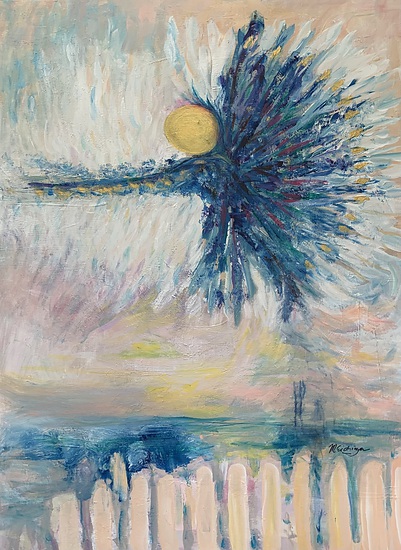
Painting makes me happy and sharing it with you is fun.  It is always for sale. 

19/25” x 23/5” Acrylic on canvas painting in a gold frame. Available for $485. contact me a marilynne@eichingerfineart.com.

A Young Spirit

ALIVE
“Nothing is inherently and Invincibly young except spirit.”  George Santayana

A friend recently mentioned that getting old is inevitable, but growing up is optional. He and I share the desire to keep our minds as young and as flexible as possible to belie our aging bodies. We are not alone among those with this wish, but we do work at it.

London researchers studied the responses of 6,500 men and women to the question “How old do you feel you are?” The respondents were over 52 with an average age of 65.  

  • 70 percent felt three or more years younger than their age, 
  • 25 percent felt close to their actual age 
  • and 5 percent felt more than a year older.

Eight years later, when examining the same group to determine how many were still living.

  • 75 percent of those who felt older than their age were among the living.
  • 82 percent of those who felt their actual age were alive.
  • and 96 percent of those feeling younger than their actual age were still walking about. 

After getting these results, they wanted to know why feeling youthful kept people alive longer and found a relationship between self-perceived age and cardiovascular strength. Feeling younger tends to lead to maintaining better health habits and a sense of resiliency. The advice of many physicians to use it or lose it holds true.  

To maintain a youthful spirit you have to challenge yourself with new activities, continue to learn, and develop new skills. That is how you behaved in your youth, and there’s no reason not to continue the practice through old age.

For those who have fallen off the path, a way to catch up is through mindfulness meditation to help focus you on the here and now. Then, throw away regrets about the past and delete thoughts of future deterioration. Instead, find meaning in what you have, for as long as you are breathing you are alive with possibilities

Focusing on something larger than yourself, connecting with friends and family, and helping to improve the lives of others will give meaning to your days. Participating in pleasurable activities, whether it be gardening, bike riding, or designing birdhouses are energizing pursuits. Exercising, caring for your skin, getting a new haircut, and preparing to dance at ninety will give you something to look forward to and make you happy.

I like Julie Anderson singing in the Sound of Music;

Raindrops on roses and whiskers on kittens

Bright copper kettles and warm woolen mittens

Brown paper packages tied up with strings

These are a few of my favorite things

Cream colored ponies and crisp apple strudels

Door bells and sleigh bells and schnitzel with noodles

Wild geese that fly with the moon on their wings

These are a few of my favorite things…

You are never too old to ingrain positive thinking in your psyche. It was Albert Einstein who advised, “Do not grow old, no matter how long you live.” Though we can’t be against aging, it will happen to us all, we can keep our minds quick and energetic. It’s an attitude that will let you engage in philosophical conversations that rekindle your idealism so you feel excited and make you realize it’s never too late to try, try again.

And for those of you who are under fifty, be careful not to let your spirit age. When you start setting a rigid time to be home so you can see your favorite TV series and have a good night’s sleep, watch out. If you save weekends for errands and chores instead of visiting friends and partying, take care. When you speak to people slightly younger than you and start with, “Back in my day,” warning bells should ring in your ears. If you feel entitled to a seat on the subway because you deserve it, or if everyone and I mean everyone, including babies annoys you-beware of becoming a fuddy-duddy, old grouch! If the thought of traveling or shopping is exhausting, or if you find collecting coupons intriguing and delightful, be cautious. And, if you decide discussing dinner options with your pet is normal-think twice, your youthful spirit is fading away. 

Lastly, if you’re thinking of retiring early, consider your options carefully. Many long-lived professionals work (at least part-time) well after retirement. Work gives a sense of purpose and provides movement to your day that helps keep you healthy. So when you do retire, plan to engage in meaningful volunteer work. 

Many of my friends talk of travel as a way to fill a vacuum, and that may be fun for a while. But travel is increasingly expensive and not as easy as it used to be. And though travel without purpose may occupy your time, it doesn’t necessarily lead to feeling fulfilled.

As Socrates said, “An unexamined life is not worth living.” With that in mind, examine yours and make it count. 

Do share your thoughts about maintaining spirit below.

References:

Lam, D. (2020) How to Stay Young When You Feel Old AF. WOOK:PLAY. retrieved from https://www.wonderwall.sg/workplay/how-to-stay-young-at-heart-when-you-feel-old-af-/

Godman, H. (2014)Feeling young at heart may help you live longer. Havard Health Letter. retrieved from https://www.health.harvard.edu/blog/feeling-young-heart-may-help-live-longer-201412177598

Main,Sami.(2013) 22 Signs You’re an Old Person Trapped in a Young Person’s Body. BuzzFeed. retrieved from https://www.buzzfeed.com/samimain/signs-youre-an-old-person-trapped-in-a-young-persons-body

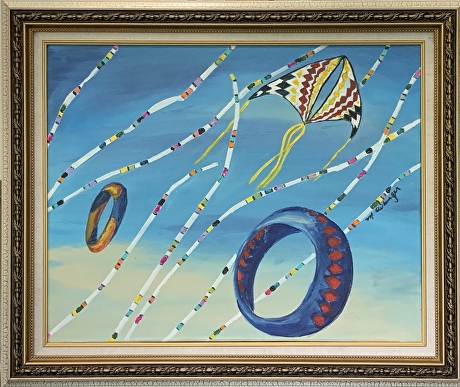
Art is always for sale. ALIVE is a 24” by 20” acrylic painting on canvas/ available for $339. For information call marilynne@eichingerfineart.com.

Out of Chaos

“Ancient Egyptians believed that chaos is the first and most necessary ingredient in the universe. It could sweep you away, but it was also the place from which all things start anew.”  (Jodi Picoult, The Book of Two Ways).

Chaos theory is a mathematical field of study teaching that unpredictability will always remain a constant. In nature and in social behavior the systems that tie elements together are so complex that the only prediction that can reasonably be made is that life is unpredictable. Researchers who are interested in chaos study the unpredictability of behavior or nature with the aim of making it understandable.

Perhaps because it’s spring, I’ve been thinking a lot about our chaotic world. I don’t understand how conditions throughout the globe have become so dire. I yearn for a way to give it order. Like the Egyptians, I am searching for ways out and new beginnings.

From early on, chaos theorists postulated that complex systems go through changes that are rarely repeated. Scientists search for the factors that break up states of equilibrium and study what it takes to return the system to balance. Though chaos theory grew out of mathematics and applied to science, its influence is broad and includes the social sciences. I can easily apply it to my life. 

For example: After giving birth to three children my family settled into a somewhat predictable routine. When an unexpected fourth child came along she interrupted the order in our daily lives. Late-night feedings and other infant cares diminished the amount of time I could spend with my older children.  There were shifts in the relationships between my husband and me, the two of us and our children, and among the three older siblings. Our days became more chaotic. As time went on, we adapted and modified our schedules. After a year, equilibrium returned to our household until it was broken again by moving out of state. And so it goes.  Like many people in similar situations, we never took the time to analyze in advance the potential ramifications of a change in condition.

Three features define a chaotic system.

  • They are not random but are deterministic with equations ruling their behavior.
  • They are sensitive to initial conditions. Slight changes in the starting point can lead to different outcomes. Small changes can lead to large ones later. 
  • They are not disorderly, for there is an order and pattern to chaos.

Since chaos theory emerged in the 1970s it helped answer problems in quantum mechanics and cosmology in the physical sciences. Health scientists gained a better understanding of heart arrhythmia and brain functions. It influenced toy developers who devised games like SimCity, and SimAnt.

What does this me to me, to our community, and to the nation?

It is important to realize that change does not occur in a vacuum but rather within a system. If you want the system to return quickly to a state of equilibrium after the change is made, a variety of factors must be considered and controlled.

To understand what happens when ramifications aren’t thoroughly evaluated we can look at how various governments dealt with COVID-19. The virus was unexpected worldwide, disrupting the way societies operated.  New Zealand responded quickly with sequestering and mask mandates just three days after the World Health Organization raised the alarm in January 2020. By June of that year, New Zealand declared itself free of the virus. As new strains spread the country continued to respond swiftly, and though cases did escalate, they were kept under control. Auckland was recently rated as the most livable city in the world because of its response. Auckland was recently rated as the most livable city in the world because of its response. 

Those with the highest death rate per 100,000 are Bulgaria, Bolivia, Lithuania, Eswatini, and Peru, countries that ignored the virus. The percentage of people wearing masks and the percent of people vaccinated are extremely low.

Scientists suggest that the COVID pandemic may be the first of many. Hopefully, countries will be better prepared for the next disruption, and citizens will be more willing to deal with it rationally.

Native Americans are taught to consider the effect of a decision on the seventh generation. To do this requires patience and a willingness to delve broadly into the potential consequences of suggestions on everything affected before making a change. I wonder how we would have handled the Iraq and Afghanistan wars if we had thought through the ramifications to their people, their environment, their art, our soldiers, informants, and our finances. The wars are vivid examples of what happens when a country reacts emotionally rather than taking the time to understand the ramifications for all involved.

Chaos brings with it fear, trauma, and uncertainty, but it also brings change, hopes, and renewal. Like springtime, plants reemerge seemingly the same, yet always different. This year, as we celebrate Easter, Passover, and Ramadan, let’s make our actions count so that the changes we initiate during the year will bring us out of darkness to a better equilibrium.

References:

Biswas,H. & Hasan, M. & Bala, S. Chaos Theory and its Applications in our Real Life. University of Barishal, Department of Mathematics. retrieved from https://bu.ac.bd/uploads/BUJ1V5I12/6.%20Hena%20Rani%20Biswas.pdf

Crossman, A. (2019) Overview to Chaos Theory in Sociology. Thought Co. retrieved from https://www.thoughtco.com/chaos-theory-3026621

Partridge-Hicks, S. (2020) 5 Countries That Are Getting Covid-19 Responses Right. Global Citizen, retrieved from https://www.globalcitizen.org/en/content/countries-with-best-covid-responses/

Howell, B. (2022) The countries who’ve Handled coronavirus the Best – and Worst. MoveHub. retrieved from https://www.movehub.com/blog/best-and-worst-covid-responses/

Do comment on my blog site below. t is always wonderful to hear from you. 

Art is always for sale. For information contact me at marilynne@eichingerfineart.com.
Unhoused Dilemna

I’m Upset 

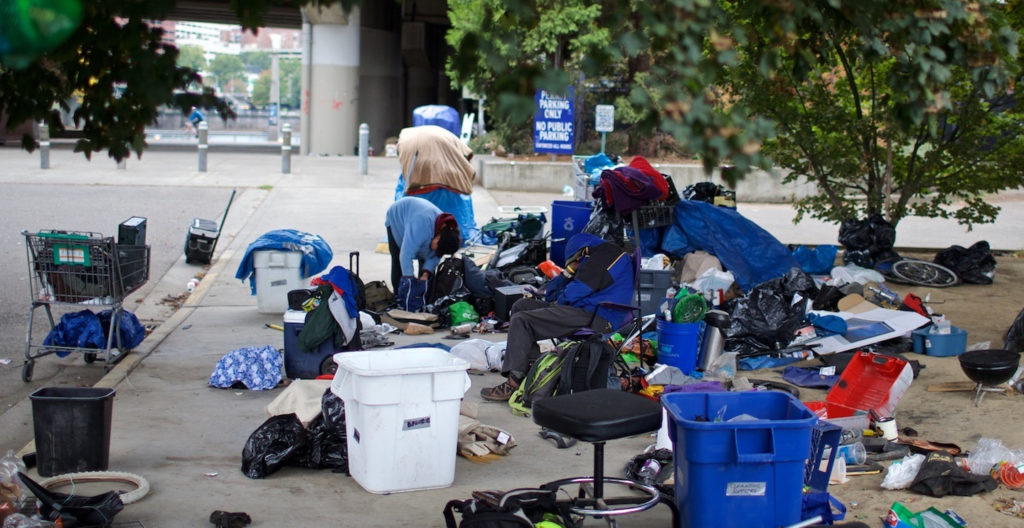
Homelessness, a national crisis, is even more of a problem in Oregon. It is number four in the per capita number of people unhoused. The city reminds me more and more of a giant refugee camp similar those to ones across the border from Ukraine, only our camp is worse because there are no regulations,  few facilities, and limited services. Environmental, sick, and poverty- driven local refugees are creating a pandemic to rival Covid.

The problems are complex, and government leaders are baffled as to how to proceed. Some people feel bad for the homeless, and blame the government while others fault the homeless for having made bad decisions. No matter your feelings, it is a difficult problem needing multiple solutions. We shouldn’t be forming factions that fight as we find our way forward. 

Portland’s Safe Street Policy that legalizes homeless camping was just extended for three years, a decision many find intolerable. Taking a different approach, People for Portland (PfP), a community-based non-profit organization, is collecting signatures for a ballot measure to ban homelessness on city streets. When a city councilman recently suggested opening five, mega-shelters with services, homeless advocates were up in arms. They want funds directed to building low-income housing, not spent on shelters. Unfortunately, constructing apartments for the 16,000 people living in vehicles and tents will take years. With the number of unhoused people escalating at 14 percent annually, how can the city keep up? Scattering homes and safe villages around town that hold 60 residents is a band-aide for a bleeding wound that is spreading.

The city became unsightly almost overnight. Crime, graffiti, and drug use are at a record high. The mentally ill roam neighborhoods unmedicated. Instead of downtown a cultural center that lifts one’s spirit, it was filled with people no one wants to be around. Businesses and tourists are abandoning it in record numbers. I think of our downtown as a donut hole filled by well-meaning people who didn’t understand the consequences of letting street people take over the city.

Finding a solution involves compromise and a willingness to test a multitude of ideas including shelters in facilities like our expo center. When the idea was put forth, I was alarmed by how fast it was dismissed by homeless advocates. The proposal was to erect 1000 refugee-style tents inside a building that is heated and air-conditioned, containing bathrooms and food vendor areas. There’s plenty of outdoor space for RVs and for service organizations to set up clinics, classes, movies, and daycare. Located near light rail, access to the rest of the city is easy. One complaint was that a 1000 person center is too large. I wonder if these same people think 1,500 person high schools, senior centers, and community colleges are also too large.

Criticism was also directed against having the national guard provide security. But, why not? Wealthy people live in gated communities and pay for private security guards. Why shouldn’t our refugees sleep soundly at night and leave their tents without worrying they’ll be robbed? 

Vibrant cities elevate citizens so they want to reach for the stars. They are inspirational cultural centers that attract tourists and tax money that supports the arts as well as those needing special assistance.

Unfortunately, well-meaning volunteers and social justice organizations, not just the government, let our city evolve to the point where ordinary citizens are afraid to walk on sidewalks and in the parks they support. Permitting vagrants to trash the environment is turning several Oregon cities into third-world communities.

A common first instinct is to say no rather than yes, let’s test the premise. People, in general, don’t like change. Yet, to solve the multitude of problems caused by a large unhoused population, we have to stop negating suggestions before they are tested. We are on the same path of seeking a compassionate solution that is acceptable to everyone in the city. We face a very big problem that calls on courage and thinking outside the box to bring our city back to life

States With The Largest Homeless Population Per Capita In The US

  1. New York
  2. California
  3. Oregon
  4. Washington
  5. Massachusetts
  6. Alaska
  7. Nevada
  8. Vermont
  9. Colorado

Please comment below.

My interest in homelessness goes back over forty years. 

I attended many A Home for Everyone meetings, interviewed agencies serving the homeless, wrote numerous articles, gave talks, and authored a book about homeless youth. Before directing science centers, I trained as mental health therapist, counseling alcoholics, and drug addicts.  My husband and I took in a boy who was unhoused for four years, learning a great deal by doing so.  As president of OMSI and The Museum Tour Catalog, I made sure we reached people from every socio-economic sphere.  I can be reached at marilynne@eichingerfineart.com

Groupthink vs Freethink

The VIllage
Responding to an emergency while in a group takes the presence of mind to overcome groupthink.

Groupthink vs. Freethink

Conformity, obedience, diffused responsibility, and  groupthink control behavior,  challenging an  individual’s reactions to an emergency. The power of the crowd compels conformity. We all have a desire to fit in, be liked, and not be considered a fool.  People often seek company from those worse off than themselves to maintain a sense of self-worth. When subjects in a research project were asked if they got an 85% on a test whether they’d prefer to associate with someone who received a 95% or a person with 78%, more chose those with the lower than higher score.

Though groups have a positive influence on human behavior by adding harmony, security, and social support, they can also lead to faulty decision-making. In 1963, Stanley Milgram, a social psychology professor at Yale, designed an experiment that recruited volunteers to participate in a study they were told was to improve learning and memory. 

The participants were instructed to teach students (learners) correct answers to a series of test items by using a device that supposedly delivered electric shocks of varying intensities up to 450 volts. They were instructed to shock the learners when they gave a wrong answer to a test item, assuring them that the shock would improve the learner’s memory.

When responding to incorrect answers from the learners, the volunteer participants obediently and repeatedly shocked them, raising the voltage when instructed to do so. The learners acted out by crying for help and begging the participants to stop. Some even complained of heart trouble.  Yet, when told  to continue, 65% of the participant volunteers did so, raising the maximum voltage to the point that learners became unresponsive. 

Milgram wondered why someone would throw away reason and values to the point of potentially causing serious harm to another individual. He found that the setting seemed to make a difference. When the experiment was conducted in an office rather than a school, the highest shock rate dropped to 40 percent. If the orders were given by phone, the rate dropped to 20 percent.

Groups often manipulate members to act against their own values. Political parties develop platforms that many members don’t support. Groups stop people from hearing opposing information as happened under George Bush in 2003 when the U.S. government convinced a coalition to invade Iraq based on faulty information saying that Iraq had weapons of mass destruction. The war resulted in 6,000 American soldiers killed and thousands of civilians dead or maimed.

Groupthink occurs when perceiving the group as invincible and morally right, believing that it can do no harm. The thought that others  know more than you, makes people willing to give up their responsibility to search out the truth and com to their own conclusions. Some groups censor members by withholding information, quashing dissenting opinions, and shielding the leader from dissenting views. Leaders fan an illusion of unanimity among the members and promotes negative stereotypes of  those who aren’t. It makes members  making less likely to help humanity outside their circle.

The media is filled with examples of people standing by while someone is raped or assaulted without  anyone intervening or calling the police. Though the crime may occur  in front of their eyes, they don’t act. People have been caught taking photos and even laughing as they observe the outrage. Social Psychologists label their behavior as the bystander effect—not offering help when in a group. 

Reasons to act this way start with not recognizing someone is actually in need of help.  When those around us are calm and don’t react to what is happening, then we may fail to acknowledge the need for emergency action. I witnessed this when a man I was talking to at a trade show suddenly stopped breathing and collapsed. Turning to the crowd that was forming, I shouted for CPR assistance, certain someone in the group of educated people could assist. When no one stepped forth, I used my rusty skills, updated by watching television med-series and thankfully brought him back to life well before the paramedics arrived. 

People are afraid to get involved when no one rushes to assist. They won’t take personal responsibility, in part, for fear of appearing foolish. The more bystanders there are, the less responsible an individual feels. They imagine as I did at the trade show, that someone in the crowd was more qualified to help. Since I stood apart from the group, I acted.  I feel certain that among those watching my then-dead colleague, there was a more qualified person.  Alone, I acted immediately.

If you ever find yourself among bystanders watching an emergency, recognize that most people’s first instinct is to deny responsibility for the victim. This awareness can help you snap out of a bubble and realize everyone in the crowd is responsible. If assistance is called for, don’t shout as I did to a wall of bystanders, but look one person in the eye and ask for help, either by calling 911 or assisting with CPR if trained.  Even if that person is unable to assist, it may stimulate someone else to come forward. Trust yourself, not the group, to do the right thing.

As crime increases throughout the country, we need to be vigilant. Thefts of catalytic converters are commonplace, and since the Ukraine fiasco, gas is being siphoned off or taken by drilling a hole in gas tanks under the car. We have to stay diligent and do our part to stop such behavior.

If someone looks suspicious, don’t be subject to groupthink. If the crowd appears unconcerned, yet stays to watch, there’s a problem. Don’t fall into the trap of waiting for someone else to act. We are all on neighborhood watch and must speak up. Talk to the person in question and find out what he or she is doing? Get a nearby person to approach the suspect with you, so you are not alone. Act fast. You may be the next victim needing someone’s assistance.

References:

Forcyth, D. (2022) The Psychology of Groups. NOBA project. University of Richmond. retrieved from https://nobaproject.com/modules/the-psychology-of-groups

Website. (2022) Group Behavior. Lumen Introduction to Psychology. retrieved from https://courses.lumenlearning.com/wmopen-psychology/chapter/conformity-compliance-and-obedience/

Burkley, M. (2009) Why do we Help Less When there is a Crowd. Psychology Today. retrieved from

https://www.psychologytoday.com/us/blog/the-social-thinker/200911/why-do-we-help-less-when-there-is-crow

____________________

Art is always for sale. Contact me at marilynne@eichingerfineart.com.

The Village is a 6′ by 2′ acrylic painting. available for $ 699.

Have you ever seen the negative effects of groupthink?

I look forward to hearing from you and invite you to share your experiences below.

Pulled from Fear

You Decide
Will you pass life in fear or will you live it to the fullest with a serene mind?

Pulled from Fear

People overcome by fear receive lots of advice. If you belong in this category, I’m sure you heard it all.

  1. Take time out. It’s impossible to think clearly when you’re flooded with fear or anxiety. …
  2. Breathe through panic
  3. Face your fears
  4. Imagine the worst
  5. Look at the evidence
  6. Don’t try to be perfect
  7. Visualize a happy place
  8. Talk about it.

What isn’t addressed, is what makes people fearful in the first place. Though fear is in the mind, it triggers strong physical reactions.  Adrenaline is released and blood pressure and heart rate increase. Breathing quickens and blood flows from the heart to your limbs making you ready to run and fight back. 

When hearing a bear growl in the wild or gunshots go off, fear is a good emotion to have. It protects you by initiating your fight or flight response. It isn’t hard to imagine how people feel in Ukraine knowing they could be bombarded at any moment. Fear makes most people run to underground shelters of flee the country while others take up weapons to fight back. 

But, there are those who become so overwhelmed with fear they are unable to react rationally. They may hyperventilate, freeze in place, or scream to no avail needing to be led to safety by someone else. There are also those who worry so much about bad things that might occur in the future that they experience continuous anxiety. Feelings of pending doom prevent them from enjoying life. Most often, their worst fears are never realized. Yet, there are times when fear spurs action that prevents the bad outcome. 

For those who live in continuous angst, there is a separate list of suggestions to build mental muscle. The more you have of it, the easier it is to face your anxieties and get the best out of life. 

  1. Don’t figure things out by yourself
  2. Be real with how you feel
  3. Be OK with some things being out of your control
  4. Practice self-care
  5. Be conscious of your intentions
  6. Focus on positive thoughts
  7. Practice mindfulness.

According to Psychology Today, the top three fears that hold people back are change, loneliness, and failure. Resisting change can cause you to miss out on many opportunities. Fear of loneliness keeps people in bad relationships and can cause them to obsessively use social media. Fear of failure brings with it the fear of embarrassment. Believing that you don’t measure up can make you avoid doing things where success isn’t guaranteed.

People who enjoy my paintings often ask where I studied or how I got started. My art career began forty years ago when needing relief from anxiety at work and the stress of raising five young children. My husband made me an easel for my birthday and suggested I paint for my own pleasure. He advised me not to take lessons and not set  a goal of selling my work. I didn’t have to get good. All I was to do is have fun messing around with paint. His instruction was a gift that let me proceed without judgment, self-inflicted or external. 

Painting relieved my mind from daily problems. It is impossible to draw a line on a canvas without concentrating on where it is going. I started paying attention to colors and shapes in the environment and noticed how objects were shaded under different types of light.  For forty years I painted and to my surprise improved. These days, I sell my pictures, donate some to charity, and others in my house for my own enjoyment. I still have my first painting and look at it occasionally to see how I’ve improved. Most of all, I continue to paint for pleasure and for the freedom it gives my mind. 

I write this blog because we live in fearful times. We are surrounded by horror stories of wars, killings, disease, rising temperatures, and the unhoused. On top of these nightmares are the personal difficulties each of us faces. This is why it is important to find a calm way to navigate through it all. My way of building mental muscle may not be yours. And, what worked in the past may not be the same as you age. Whatever it is, reassess, seek it out and develop a path that works for you.

References:

Schwantes, M. (2022) 8 Successful Mental Habits to Defeat Fear, Worry, and Anxiety. INC. retrieved from https://www.inc.com/marcel-schwantes/8-mental-hacks-that-will-keep-you-strong-under-control-during-tough-times.html

(2020) 5 Things You Never Knew About Fear. Northwest Medicine. retrieved from

https://www.nm.org/healthbeat/healthy-tips/emotional-health/5-things-you-never-knew-about fear#

Fagan, (2020) Top 10 Fears that Hold People Back in Life. Psychology Today. retrieved from about fear#:~:text=As%20soon%20as%20you%20recognize,pressure%20and%20heart%20rate%20increase.

Art is always for sale. For information, contact me at marilynne@eichingerfineart.com.

Please comment below. It is always wonderful to hear from you.

Mystère

Mystère

With much of life shrouded in mystery people, choose different ways to embrace the unknown. Living with uncertainty is difficult, and knowing how to adapt to new information, even more so. The pandemic unveiled a prime example of the confusion uncertainty causes.

The public wanted absolute answers and consistent directions in how to respond to covid. But the virus and our scientists playing an outsmarting each other game of chess left us not knowing who would win.

Science is based on educated guesses and testing based on suppositions. As scientists learned more about the human body and genome sequencing, as in the case of covid and other deadly diseases, they became more adept at halting its progress. As I mentioned before, the covid vaccine was developed in a year because of new gene-editing technology, but the virus kept throwing curveballs calling  for adaptations. What did many people do when faced with uncertainty? They got angry at the men like Dr. Anthony Fouci and research scientists, calling them liars. 

There were those who turned to God in search of absolute authority. Rather than using their brains to unpack the unknown and adjust as new information was revealed, they preferred security, and so died in record numbers. According to CDC, between October and November of last year, when Delta was prominent, unvaccinated people had 13.9 times the risk for infection and 53.2 times the risk for death compared to fully vaccinated persons with booster doses. Then again the virus changed with the Omicron variant and vaccinated people got covid.

Does this mean we shouldn’t accept science? The vaccine still reduced the chance of a serious infection leading to death due to Omicron.

Should we stop looking for cures for devastating diseases and put our trust in existential beings? And if not, how do we change our behavior so we can live with what scientists say about the environment. What will it mean if the new James Webb Space Telescope is able to see back to the big bang and the origin of the universe? Will it change people’s beliefs and behaviors? Some people still cling to the notion that humans have only been on earth for 6,000 years concurrent with the dinosaurs when carbon dating shows us that we’ve been here for millions after the dinosaurs died off.

It saddens me to see people on religious and political bandwagons leaning right or left as the wind blows rather than question and explore on their own. If we don’t accept the notion that we can be logical and rational beings as well as spiritual ones, then there is little chance we can solve the difficult problems facing us today.

Human beings let the earth’s population expand to a point of being out of control. We poisoned our air and streams for the sake of trade. We built cities with high-rise condos for the rich, allowed drugs and alcohol to mess with people’s brains, let the poor live in tents on the street, and permitted lawlessness under the guise of individuality–something that may have worked when few people populated the earth. It certainly, doesn’t work with 7.9 billion people.

There are rational ways to deals with the issues we face and ways to help us adapt to change. Religion gives us moral values and lessons in how to be compassionate so we live with one another peacefully. Injunctions, like in the Ten Commandments in Judaism and Christianity and collective morality expressed in the Qur’an, call on people to be just, fair, and responsible for their actions. Meditation focuses us inward on emotions and on thoughts outside of possessions.

Science also has a place in connecting us to the natural world, letting us live in harmony with the universe rather than fight it. Social, biological, and physical scientists along with spiritual and existential thinkers are needed to explain and find ways to change. The one thing most people agree on is that change is a constant and has to be dealt with. 

Art is always for sale. For information contact me at marilynne@eichingerfineart.com

Mystère is a 36″ x 48″ acrylic painting with a silver metal frame. available for$895.00

I enjoy hearing from you. Please comment below.

A Ninth Intelligence?

Elaine Most Pensive
What does she think? Questions around the meaning of life or about a math problem she has yet to solve?  Does she crave time at the gym or does she wish she was home reading a book?  Is she wondering what to plant in her garden or is she trying to figure out why her friend is so depressed? 

A Ninth Intelligence?

Is there such a thing as existential, spiritual, moral Intelligence? Harvard Professor of Cognition and Education, Howard Gardner, says it is worth considering. He defines it as “the ability to be sensitive to, or have the capacity for conceptualizing or tackling deeper or larger questions about human existence, such as the meaning of life, why are we born, why do we die, what is consciousness, or how did we get here.”

It was in 1983 that Gardner coined the concept of Multiple Intelligence in his book Frames of Mind. He wrote of intelligence as “biopsychological potential to process information that can be activated in a cultural setting to solve problems or create products that are of value in a culture,” —a mouthful, for sure. 

Gardener identified eight intelligences: logical-mathematical, linguistic, musical, visual-spatial, bodily-kinesthetic, interpersonal, intrapersonal, and naturalist. For example, logical-mathematical intelligence is applied to individuals who are sensitive to logical or numerical patterns and can handle long chains of reasoning. Their ideal career is as scientist, mathematician, computer analyst, or accountant. Linguistic intelligence may lead to being a lawyer, author, speaker, curator, or journalist. Gardener suggests human beings possess all eight of these intelligences to varying degrees of proficiency, and that they are capable of being observed and measured.

His theory had a profound impact on education. It inspired teachers to explore new ways of teaching aimed at the different intelligences, though linguistic and logical-mathematical remained the most valued in school and society. But, it’s wise to consider a variety of mental strengths individuals possess for everyone doesn’t  fit into those two categories. 

Cognitive psychologists who criticize his theory say the idea  of a single general intelligence is supported by years of giving intelligence tests. Gardner doesn’t dispute their claims but insists overall intelligence is but one measurement equal in weight to the other intelligences. n other words, some people are generalists while others are not, but a multiple intelligence framework is a fairer test of ability than IQ tests measuring one aptitude.

In 2011, Gardner wrote of other possible categories, among them, spirituality, existential, and moral intelligence. Typically the purview of religious leaders like the Dali Lama, these intelligences ponder questions of human existence. They are wondering, cosmic, and metaphysical smart people who question who we are and what our purpose is. 

Though Gardner didn’t add these intelligences to his original eight, he made an interesting observation recently. There was a sudden uptick in the number of inquiries he received about existential intelligence and he wondered why? He writes that the trend started in 2016 when Donald Trump raised worries about the threats to democracy, decency, and other values people hold dear and that spiritual concerns escalated in a world unprepared for the COVID-19 pandemic.

When long-term plans had to be scuttled and daily routines altered with no end in sight, it sent people into crisis mode. They began asking the big questions, the kind they pondered as children, confronting issues around life and death. Some wondered if contracting COVID was a message sent from heaven.

I too ask questions about the meaning of life but conclude there is no hidden message or reward from having COVID. Like in Camus’ book The Plague, pandemics come and go without reason. The only choice we have is to make meaning out of the time we spend on earth. What type of person do you want to be? How do you want to act towards living things that inhabit the earth with you? With compassion and decency or hatred, destruction, and rudeness? 

These are questions that matter a great deal to me. They guide how I use various intelligence strengths to mold me into the person I want to be.

I look forward to reading your comments below.

______________________________________________________________________________

Would you like to take a Multiple intelligence test? go to https://www.idrlabs.com/multiple-intelligences/test.php. IDRlams.com conducts individual differences research around the world. The test is in the middle of the page. It asks you to rate 45 preferences and scores where you stand with each intelligence.

_____________________________________________________________________________

Art is always for sale.. Contact me at mariynne@eichingerfineart.com.

Elaine Most Pensive— 32” x 32” acrylic painting/ $799.

References:

Cherry, K. (2020) Howard Gardner Biography and Theories. Verywell Mind. retrieved https://www.verywellmind.com/howard-gardner-biography-2795511

Marenus,M. (2020) Gardner’s theory of Mutiplue Intelligences. SimplyPsychology. retrieved from A Ninth Intelligence?https://www.simplypsychology.org/multiple-intelligences.html

Clarken. R. (2012) Howard Gardener on Spiritual, Existential, and Moral Intelligence. the Clarken Chronicles.retrieved from https://rodclarken.wordpress.com/2012/04/21/gardener-on-spiritual-existential-and-moral-intelligence/ 

Gardner, H. (2020) A Resurgence of Interest in Existential Intelligence: Why Now?

Howard Gardner. https://www.howardgardner.com/howards-blog/a-resurgence-of-interest-in-existential-intelligence-why-now

Out of the Doldrums

Hanan and Mirna

For the past three years, I’ve been grandma to two African-American children whose parents immigrated from Ethiopia and Somalia. We meet weekly to do art and science projects,  read, and take excursions in area parks. The escalation of Omicron brought a halt to my visits. Until we can meet again outside, I have to be wary because they attend school unvaccinated. But, I do miss them. They are a large part of my life.

As I often do when bothered, I escape to my studio. In this instance, I made a painting of the girls showing them wearing masks made at Halloween. I find figurative paintings difficult, but in this case, I persevered. Looking back, I realized that painting them was cathartic. It provided a way to give vent to emotions without languishing and becoming depressed. 

Out of the Doldrums

Languishing: a) To be or become feeble, weak, or enervated b) to be or Iive in a state of depression or decreasing vitality  c)  to become dispirited or suffer neglect

Catharsis :a) the process of releasing, and thereby providing relief from, strong or repressed emotions 

While having my hair cut this week, I asked the stylist how many of her customers she would label as languishing. After thinking for a while, she answered, “about a third.” That’s a lot, I thought, wondering why so many. We both agreed that the Omicron variant was making a large number of people feel dispirited, bored, and without hope. Those who put dreams, activities, and family visitations on hold, were finding it most difficult to deal with repeating waves of viral infections.

“But, what about the two-thirds who don’t feel that way?” I asked. “What’s different about them?” The question led to a lively discussion of emotions and the tools people have to heal and keep themselves sane. This led to the importance of ingrained curiosity, and the role music, dance, and the visual arts play in people’s lives..

My hairdresser, an accomplished dancer, and choreographer said that she releases her emotions daily through movement dance. Unlike repetitive exercises, the way she moves varies with her mood. Feeling the music helps her express happy, sad, and angry emotions that send messages outwards so audiences will feel them too. She stays motivated by having an outlet for her creativity that at the same time is cathartic. It gives her purpose and passion. 

It is those two tools, purpose and passion, that help people avoid languishing. “How do I get there, you may ask?” My answer is basic. It starts with a hungry mind. Curious people are not prone to languishing—they’re too busy asking questions and tracking down answers. 

Curiosity is a state of arousal. It is energizing when stimulated, and it tends to snowball as one thing leads to another. As Annie Paul says, it “is the engine of intellectual achievement—it’s what drives us to keep learning, keep trying keep pushing forward.”  When you find a gap in your knowledge, curious people feel deprived and are motivated to obtain the missing information to eliminate the feeling of deprivation. 

Curiosity doesn’t happen in a vacuum. It starts with something about which you have some knowledge but want to know more. It primes the pump as George Lowenstein wrote in “The Psychology of Curiosity,” and sets in motion ways to fill the gap. Researching a topic online or in-person isn’t enough. Communicating findings is equally as important, for it adds different perspectives from friends and coworkers and leaves the participant curious to know more.

So what can you do if you are languishing? Look at the houses you pass by as you take your daily walk and imagine what type of people live inside. What personality does it take to purchase a contemporary as opposed to a classical home? If you see them outside, get into a conversation to see if the house matches their personality.  

Keep the phrase “I wonder if…” at the top of your mind. Look for novelty, something new to keep you stimulated—a game, a class, a book club, a lecture, listening to a new piece of music. Make predictions and then follow up to see if they come true. Get your hands dirty. Try doing instead of observing. Make art, woodwork, play an instrument, experiment with vegan recipes.  A man I know retired and took voice lessons. He now composes and writes music for his own pleasure and that of his friends. Another person I met was interested in geodes. For his own amusement, he set up a saw in his backyard to cut them in half. Now he has dozens of saws working day in night and his lawn is filled with fossilized wood and rocks waiting to be cut for people wanting slabs. 

Most of all—whether you have one year left to live or sixty, ask yourself who you are, who you want to be, and how to get there. Life is before you, not in the past. It is up to you to make every minute count. 

References:

Stulberg,B. (2021)Languishing and the Art of Showing up. the Growth Equation. retrieved from https://thegrowtheq.com/languishing-and-the-art-of-showing-up/

Paul, Annie, (2013) How to Stimulate Curiosity. Psychology, Time Magazine. retrieved from https://ideas.time.com/2013/04/15/how-to-stimulate-curiosity/

Straker,D. (website) Creating Curiosity. Changing Minds. retrieved from http://changingminds.org/explanations/motivation/creating_curiosity.htm

Please comment below. Are you languishing or are your energized? What factors in your life keep you on the go?

I Thought I Knew You

I THOUGHT I KNEW YOU

Most of us don’t know what is going on in our family’s or neighbor’s heads, let alone the country. You might be pleasantly surprised they’re engaged in many activities aimed at improving lives.

How can you be happy if you perceive your country’s falling apart? After talking to people on the left and right sides of the political spectrum, I realized their main area of agreement is that the United States is on a downward spiral. An immigrant from Ukraine told me that she came here to live in a democracy that followed the rule of law. Increased lawlessness, homelessness, and poverty make her feel like she moved to a third-world country. With the media dwelling on tragedy, promoting falsehoods, and taking pleasure in reporting about backbiting politicians, the woman no longer knows what to believe. An uncomfortable rumble resides in her chest that doesn’t subside.

I agree that our political system has lost its way, but also believe many individuals haven’t. Though congress and oil magnates may not be combating global warming, private citizens are. Behind closed doors, in homes, and office buildings a great many innovations are being worked on to right society’s wrongs.

For example, Hydrogen Fuel Cell technology is on a fast track to revolutionizing transportation. Hydrogen, the simplest and most abundant element in the universe and a major component of water, oil, natural gas, and living matter, is in great abundance. For years, engineers and scientists have been searching for a way to release the energy in hydrogen to power machines. 

Hydrogen is a fuel that when consumed in a fuel cell produces only water. Turned into electricity it is clean, highly efficient, and has low power loss. Honda began selling Clarity, its fuel cell car, in 2021. Toyota put the Mirai Fuel Cell vehicle on the road this year. General Motors is expanding the market for hydrogen fuel cells beyond vehicles. They are designing emissions-free generators to power large commercial buildings. Manufacturers of autos, busses, trucks, trains, ships and planes have fuel cell designs in the planning.

How wonderful it will be when we can breathe again without ingesting carbon fuels. I’m excited by this technology and what it will do for the planet.

But, fuel cells are only one of many innovations. Biotechnology has spurred a revolution that will impact our lives the most. Watson’s discovery of the Double helix, mapping the human genome, and now CRISPR, a tool to edit genes adapted from a naturally occurring genome editing system in bacteria gave scientists tools for a better understanding of biology. Their labs are opening possibilities in health care and agriculture never before imagined.

Because of CRISPR, scientists developed a vaccine against COVID-19 in one year rather than the twenty years it took for a polio vaccine or 200 years for the one to irradiate smallpox. It won’t be long before we see a vaccine targeted against the Omicron variant.

CRISPER is being tested as a means of curing cancer, sickle cell anemia, and other chronic diseases. It might even be possible to resurrect extinct species. CRISPER benefits the agriculture community by improving crops to be more tolerant to drought, heat, cold, and pests. It is being used to develop crops with a longer shelf life and greater nutritional value.

Excited? There’s more. Agroecology, the science of managing farms as ecosystems, is a burgeoning field. Scientists study ways to build and maintain healthy soil, manage water wisely, minimize air, water, and climate pollution, and promote biodiversity. The emphasis is away from large ag to locally grown produce eliminating long supply chains.

Regenerative farming is the common term used for implementing sustainable methods to grow and harvest produce. Farms are redesigned to enhance biodiversity and eliminate pesticides and herbicides with plants that protect and nourish soils. Regenerative farming is climate-specific agriculture in that it varies depending on threats like droughts, flooding, or rising temperatures. Soil, weed, and pest management are integrated. 

An example of how symbiotic relationships enhance agriculture is in three sisters planting, a practice used by indigenous communities for generations. Corn, beans, and squash seeds planted together help one another thrive. Corn provides tall stalks for beans to climb, wrap around, and stabilize the stalk during heavy winds. The beans have rhizobia that take nitrogen from the air and convert it into forms absorbed by plant roots. Squash plants spread along the ground large leaves that provide shade, retain soil moisture and prevent weeds. A diet of corn, beans, and the squash provides a complete and balanced nutritional meal.

There is so much I could write about–artificial intelligence, robotics, 3D printing, virtual reality, and brain implants that will enable paralytics to operate a smartphone with their mind rather than thumbs. Individual technologies are combined in transformative ways to affect healthcare, supply chains, utilities, and consumer trust. Quantum computing and nanotechnology are leading to small, light, self-contained devices using little energy. We’ll have to save this for another day. 


Suffice it to say, change is occurring at great speed despite so many people languishing hopelessly in their homes. It is worth getting out of armchairs to look past politicians and media pundits and learn what’s going on in the garages, gardens, and labs of innovators. Perhaps you thought you knew your neighbors–check it out. You will find that creativity abounds where you least expect it.

_______________________________________________

Do comment on my blog site at www.eichingerfineart.com/blog. What exciting things do you see happening that people aren’t aware of but might enjoy taking time to explore. 


REFERENCES:

CRISPER EXPLAINED

CRISPER stands for Clustered Regularly Interspaced Short Palindromic Repeats.

Palindromes are words that can be read the same way backwards and forwards. They are common in DNA, serving as backups for damage to our genetic code. Some are common in cancer mutations. Crisper allows the information to be inserted in the middle of a DNA sequence. In the case of COVID, The insertion, or spacer, as its called, contains the genetic code of viruses that have invaded in the past and developed immunization

Website: Fuel Cells. Hydrogen and Fuel Cell Technologies Office. Energy.gov. retrieved from FUEL

Tabb, M.& Gawrylewski, A. & DelVIscio,J. (2021) What is CRISPR, and Why is it so Important. Scientific American, retrieved from CRISPER

Colarossi, N. (2020) How long it took to develop 12 other vaccines in history. Insider. retrieved from VACCINES

Website (2021) What is Sustainable Agriculture? Union of Concerned scientists. retrieved from AGRICULTURE

Eight emerging technologies and six convergence themes you need to know about. EmergingTechnology . retrieved from TECHNOLOGIES

Art is always for sale: Contact me at Marilynne@eichingerfienart.com.

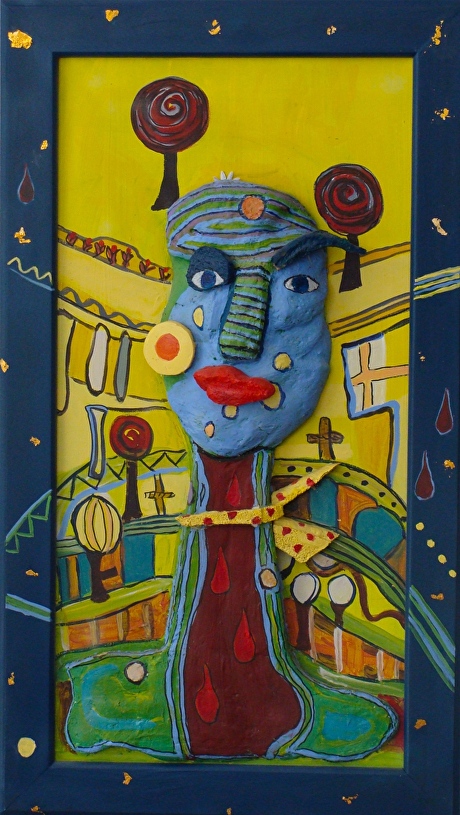
I THOUGHT I KNEW YOU is a 3D painting / 36″ by 18″/ mixed media / framed/ $ 399.

_____________________________________________________________________________________