Best Friends

Best Friends

In elementary school we sang a round with lyrics that told us to,

Make new friends but don’t forget the old,
One is silver and the other is gold.

Those words still lurk in the back of my mind and I think about them often. Who are my friends ? Am I as close to my new friends as I was to to the old?

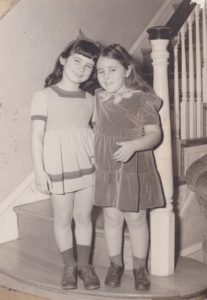
Elaine was my best childhood friend. We were raised together. We were only two weeks apart in age, I being the older. Our mothers were sisters and we lived four streets apart, went to the same schools, and visited Grandma every weekend. I used to taunt her by saying, “You have to listen to me. I’m older than you.” Her quick response was, “ Yea, but you’re going to die first!” That usually put an end to the argument. Now Elaine lives on the opposite coast and it is an effort to stay connected. Occasional phone calls and vacations are not quite the same as being neighbors.

In sixth grade, a cute boy stood attentively by my side when I was on duty as a school crossing guard. I was flattered as we chatted nonstop. Eventually I agreed to participate in a mock wedding and invited our friends to celebrate with us. Once the ceremony was over, we sat on the floor and played spin the bottle though he was more interested in having the bottle point to another girl than me. A crushing moment! Fifty years later the boy, turned professor, got in touch with me. We resumed our communication through email. He had had an interesting academic career and also became an accomplished photographer. We easily shared secrets. But, life moves on, and eventually we lost touch once more. I think of him fondly as a intellectual friend, though not one I would call in an emergency.

When dating, I lived during the era when those of the opposite sex were met through mutual friends. We went to parties, attended school events, and participated in dances put on by religious organizations. In sixth and seventh grade we donned white gloves and attended Saturday dance classes where we were groomed for participation in adult social activities.

Eventually, I met my husband and he soon became my very best friend. But after 25 years we divorced and I lost him as a friend. The shared memories and friendships we had developed as a couple were never spoken of again. I began a new chapter, moved away and developed new friendships.

My first husband and I have since reestablished communication and I find it a pleasure to be in contact with someone who knew my family when I was fourteen. Remembrances pepper life with richness and provide dimensionality. As long as we do not get stuck in the past, there is much to be learned from remembering it.

When my children were young, we partied with couples who had children the same age as ours. I attended a women’s group each month where we sat in a circle sharing inner most thoughts about the month’s topic. There were weekend dinners at each other’s homes and our children visited on playdates. We worked side by side on school committees, baked cookies, participated in auctions, and drove our cars on school outings. It was lots of fun, but today, I am not in touch with even one of these women. What happened to my old friends? Did their lives turn out as they had hoped?
Then Internet came along, and with it Facebook, Instagram, Snapchat, and Twitter. Cell phones arrived along with the ability to text. Instead of attending parties when I wanted to meet a new man I went to match.com and eHarmony. Boy did I have fun for a year meeting fascinating people! I even met a man who asked me to help him license an arithmetic toy he developed. We became business friends and I made it happen. The two of us have not communicated since.

Have these technologies really changed the nature of friendships? I have hundreds of so called friends following my blogs on various sites. Do social media sites develop and keep friendships ? Perhaps the younger generation is more in tuned with this type of friend making.

According to a 2015 Pew Research report, 76% of all teens use social media.They claim it connects them to their friends’ feelings and lives, though they think that they often over do it too and share too much information. 68% report that they have received support from friends during tough times. That sounds wonderful to me though I also understand that there is a class bias. The statistic is more aligned with those living in families earning less than $50,000 than those from more affluent households.

On the flip side, social media can hurt, especially when a girl (boys are more thick skinned) discovers that they had not been invited to an event or activity that had occurred. They are devastated when reading a derogatory remark that has been written about them. Half of those surveyed have had someone post a comment about them that they cannot change or control. Again, this is more prevalent in educated, higher income households which also carries with it a higher amount of what they call drama (conflict, bullying). Unfortunately, the carry over to school can be devastating where fights may occur because of something written online. When friendships end, teens unfriend, block or delete the person. In general, they think that people online are less authentic, less real. The more educated ones spend a lot of time making sure they look good and that they take the time to post only positive content. Teens want to be judged as smart, thoughtful, fun loving hipsters.

Are teen friends true friends? One of my old acquaintances used to say, “it takes 20 years to make a friend.” Aristotle said, “ a friend is a single soul dwelling in two bodies.” A researcher in Birkbeck College in London claims that most of us lose friends as our lives become more technologically connected. The joys of human contact are replaced by electronic stimuli and shallow friendships. Social connections rather than true Aristotelian friendships are the new norm. ‘

According to the American Sociological Review, most people only have two close friends and 25% of Americans have none. Facebook is not usually a place to develop close friendships. Internet contact does not compare with the quality of relationships that are built are face-to face.’
Friendships take time and effort. Relationships deepen when you are willing to be authentic, share intimate feelings, and sensitive vulnerabilities.

Over the course of my career, managing science museums and a catalog company, I met staff, board members and community activists I considered to be my friends. It was a shock to discover that each time I stepped away from my position I was asked to not communicate with those who remained working for the organization. CEOs of businesses are expected to sever ties when they leave, allowing the new president to develop his or her own loyalties. I know of a minister who left her church and had to sign a document saying that she would not attend services or have contact with congregants for two years.

The experience was isolating when that happened to me in Portland. While running OMSI, I was surrounded by people who befriended me because they wanted to be part of an inner elite circle. The day after resigning from the museum, their attention rightly turned to the new director and I was forgotten. That did not bother me too much at first because I had a new business to attend to that took all my time. However, when my catalog company sold after eighteen years of operation, I was confronted by the fact that I had lost so many friends. Surprisingly it was a for-profit business and still the new owner did not want me to have contact with staff for fear they would want to keep old ways of doing things.

Since leaving, I have developed new, wonderful relationships and plan to keep them close to me. And, though I happily have new friendships, I will never forget the old.

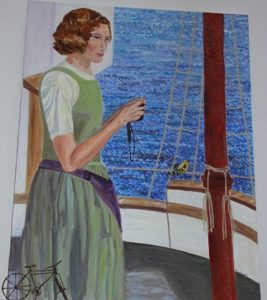
Artwork is always for sale. Picture of Elaine is acrylic on canvas, 48″ by 36″ $699.

Contact Marilynne@eichingerfineart.com

Young Scholar’s Tale

Over the Fence: From Rags to Riches
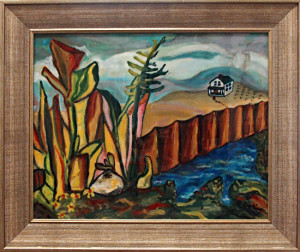
It is not easy to climb over a fence built of barriers to security and wealth.
Acrylic on Canvas/ 21” x 25” / gold frame / $499.

The following story is about a young man who was helped by a compassionate couple during his senior year in high school. I believe it is import to acknowledge how one individual is all it takes to impact the life of a child raised in traumatic circumstances. As I complete Over the Sticker Bush Fence, a book about homeless and runaway youth, I plan to share certain sections with you. Please give me your honest feedback as I proceed. I hope to inspire others to volunteer to support a child in need.

The Tale of Young Scholar

Jeff Gottfried, a former director of education at the Oregon Museum of Science and Industry (OMSI), initiated and received National Science Foundation (NSF) funding to conduct an innovative Young Scholars program. High school students were selected from a national applicant pool of those interested in working alongside research scientists during their summer vacation. There was no difficulty in finding applicants with a 4.0-grade average who wanted to take advantage of this opportunity. Most of the teens came from caring middle and upper-class families who encourage their children to exceed. But Jeff was interested in looking beyond the obvious to discover children with talent but who, for reasons of poverty or family dysfunction, were not high achievers. He asked teachers to make suggestions of students who might fit into this category of unrecognized youth.

Sure enough, one of the local high school teachers mentioned a boy whose family had moved each of the past five years because of poverty. The young man’s father was a Vietnam vet who, if entering treatment today, would have been diagnosed with post-traumatic stress disorder-PTSD. His mother suffered a variety of mental and physical illnesses and was also incapacitated. He was a neglected child, and if the police had not picked him up while roaming on the beach he never would have started school. The family moved from house to house as they faced consecutive evictions. There were numerous instances when the boy spent his nights sleeping in the family’s car.

Teachers, recognizing the boy’s intelligence, encouraged him to apply for the summer research position at OMSI despite having poor grades. Though his appearance and manner of speaking appeared to be mismatched to his knowledge, they were able to see through the superficial to a spark of genius. His grades were low Bs, and his command of English was marginal. The youth’s dress was shabby, like that of a street kid, yet his application essay was compelling as he spoke of his life and challenges, so the OMSI program decided to take a risk on this young man. Jeff’s intuition was good. I named him “Young Scholar” and throughout the summer he became more energized and hopeful.

The research he participated in was an environmental study of water quality of rivers in eastern Oregon. On one of Jeff’s visits to the site, he noticed that Young Scholar was not there during the dinner hour. In inquiring about his whereabouts, he was told that the boy was so wrapped up in the research that he did not want to stop what he was doing until it became darker. Later that evening, Jeff overheard Young Scholar asking another youth if there was a possibility of living with the boy’s family the following school year since his parents were planning to move once again. Jeff immediately discussed the Young Scholar’s situation with his wife and decided to take the boy into their own home during the following academic year.

Jeff accompanied Young Scholar to his apartment, loaded his few belongings into his car, and brought him into an atmosphere with caring creative people who applauded learning. The following school year, Young Scholar never missed a day, receiving a 4.0-grade point average by year-end and winning a Bausch and Lomb Science Award upon graduation. This prestigious award was accompanied by a four-year full scholarship to Rochester University. It was quite an accomplishment and shows what can happen when a caring adult recognizes potential.

Young Scholar accepted the scholarship and went off to study science , working all the while cleaning dorms to augment his stipend. Young Scholar continued to return to Jeff’s house for vacations, and the family grew to accept and love him as a son. Upon graduation, he accepted a job as a teacher in private school in New Orleans and eventually returned to Oregon to obtain a master’s degree in environmental science, in sedimentology. With diploma in hand, he returned to New Orleans to enter a doctorate program at Tulane University.

Young Scholar lived through Katrina, almost losing his entire Ph.D. dissertation in the disaster. This man, who understood the difficulty of overcoming adversity, managed to rescue his thesis from floodwater when the campus was closed. Presenting and defending his thesis was extremely difficult because his thesis committee had scattered to various locations throughout the United States. Young Scholar had to undertake the arduous task of reassembling his dissertation committee before he could graduate.

Today he is a married man with two children and supports himself as a college professor. Because of astute teachers who recognized his brilliance, the inspiration gained by participating in museum sponsored research, and a dedicated museum professional willing to go the extra mile, this Young Scholar has become a contributing member of society.

Public Service for All

Engaged in Adventure
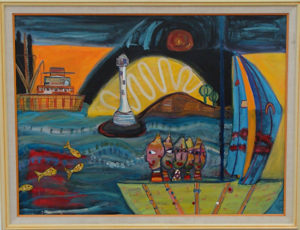
Acrylic on Canvas/ 42” by 54”/ $ 790 or best offer
It is time for adventure. Test the water, see the world, try new things, develop new friendships.

Public Service for All
Over the past two years, I have been engaged in research about homeless and runaway youth. I studied the causes and interventions used to help these children who come from traumatic backgrounds. I am nearing completion, writing a summary and conclusion section that includes suggestions. One idea is to establish a government-sponsored public service program that all youth participate in one year after graduation. Please read the following section and share your thoughts. Do you think this is a good and doable idea?

Public Service for All

Is it time to consider a public service option for al graduates? We appear not to have enough jobs to gainfully employ graduating high school (even college) youth, so rather than doing menial activities or nothing at all, why not engage them in useful pursuits that develop job skills? What might a one-year obligation be like if all high school graduates were required to enter a civil defense, military or Vista Corps-type program?

Putting teens from diverse backgrounds together could stem political divisions that plague our country and serve as a way to integrate the population. Race and gender concerns fall away when people grow to depend on each other. Wealth and poverty issues are aided by understanding. Public service could give youth an opportunity to interact across class lines and be an aid in overcoming bigotry.

Service jobs offer on-the-job training that teaches recruits to engage in teamwork. This style of learning is especially useful for those who have a difficult time sitting in classrooms engaged in academic studies. Youth, in service positions, learn to follow directions and, as they progress, are awarded leadership opportunities. Service expands a participant’s worldview and is exciting when new challenges are presented and met. Activities could include disaster relief, fighting forest fires, agriculture, working with distressed children, assisting national park rangers, building habitat for humanity houses, and cooking in food shelters. In each case, youth will gain skills that are transferable to future jobs.

For those planning to continue studying for an advanced degree, a year of service could help solidify what direction to pursue. Knowing that you are contributing to a better society is empowering, with life-long benefits that make for a more compassionate society.

Art is always for sale. Contact me at marilynne@eichingerfineart.com.

Why Trust Science?

Nurturing

Though the environment is being destroyed by those who are insensitive to their surroundings there is still hope if each of us will take the time to plan and nurture one little seed.

Who Trusts Science Anyway?

It concerns me that the gap between the attitudes of scientists and those of the general public is widening. So many people do not realize that science is simply a way of thinking used by scientists. It is not an absolute but is similar to methods employed by mental health counselors engaged in helping clients overcome personal problems. In both instances, the scientific method begins with collecting background information, forming a hypothesis (a guess) about what is happening, testing the guess, and coming to a conclusion only to start the process over again. It is a never ending cycle of refining results based on tested facts. It requires the researcher, the public (or client) to be willing to be wrong about original assumptions and open to changing their opinion.

Social scientist, Gordon Gauchat was most surprised when he analyzed survey data pertinent to the public’s trust of the scientific community today as compared with forty years ago. He was particularly taken aback with information about conservatives. In 1974, Republicans with college degrees had the highest level of trust in science but as of 2010, they had the lowest. They are not alone in changing their attitude about science. There are many factions in our society that value their own beliefs more than those of the scientific community. Religious groups challenge evolution, industry groups are skeptical of climate change, and wary parents mistrust medical recommendations to vaccinate their children.

What has happened? Why are people so willing to accept pseudoscience and fake reports rather than information that has been tested? I find it even more strange to know that 8 out of 10 Americans believe that scientific advances have improved the lives of most people and 7 out of 10 have a high regard for scientists, yet they distrust the findings of these same investigators.

A 2015 study by the Pew Research Center shows that younger adults are less inclined than older generations to believe vaccines should be required for all children. There is a 37 point gap between scientists’ views about climate change being caused by human activity and those of the general public who believe it is mostly due to natural patterns. 3% are even holdouts who adamantly say that there is no solid evidence the earth is getting warmer. In matters of evolution, 65% of the public do say that humans and other living things have evolved over time while 31% believe humans and other living things have existed in their present forms since the beginning of time.

Scientists who want to understand how to make people more comfortable with scientific information do what good researchers always do, they test their hypotheses. One test demonstrated that when the people were presented census-messages that were the combined results of many scientists, they were more likely to change their opinion than if given arguments based on scientific reasoning. This means that if you think global warming is a hoax, you will most likely not accept a scientific presentation that explains otherwise even if it is filled with accurate data. Instead, if you are told that a censuses of scientists agree to thus and so, then you will be more willing to consider the possibility of the earth’s warming being man-made. (According to NASA’s review of multiple studies on climate change, 97 percent claim that climate-warming is likely due to human activities.)

Consensus-information is powerful because it shows the norm within a community. Though it presents information with a social-science approach rather than a scientific one, it is more comfortable to most people since it is similar to consensus decision-making that is part of the basis for cooperation. Consensus-information gives authority to a contention rather than requiring the individual to become an expert evaluator.

The media has been complicit in making the public more skeptical of scientific studies by promoting false news that emanates from political or business greed. Industries often pay scientists and marketers to spread disinformation. Big business has known for a long time that people make decisions on consensus-information rather than facts and have figured out how to spread doubt in order to build their own consensus-group based on false information. In Merchants of Doubt by Naomi Orestes and Erik Conway, the authors provide story after story about how scientists and advisers with deep connections to politics and industry run effective campaigns to mislead the public.

Let’s ask those who work for the media to increase their investigative reporting and challenge where information is coming from. My suspicion though, is that it will only happen if the public is willing to pay for investigations. there was a time when news departments were independent of advertisers. Edward R Murrow, Barbara Walters, Harry Reasoner, Dan Rather, Bob Woodruff, and Peter Jennings were trusted welcome figures in homes across America. Do you think the public could demand in-depth reporting once again? Are you willing to pay?

Please share your thoughts on my blog site, eichingerfineart.com/blog.

Artwork above: Acrylic Painting / 43” by 84” /$ 1,100.

Winter Wonder

Thunderbird with the World by Ray Losey
14 feet – Available – For information go to raylosey.com

The Thunderbird’s eye cautiously surveys the blanketed landscape outside our home. It has been years since Portland had so much snow in one fall. Ray measured 14 inches in the driveway.  I almost forgot the beauty of seeing white covered branches dipping deeply towards earth. Occasionally a snapped limb peaks up through the snow with its evergreen leaves adding color to the whiteness. During the storm I was conscious of the soft silence that covered the earth and enjoyed looking at the large flakes floating downward that can only be seen swirling under street lights. 

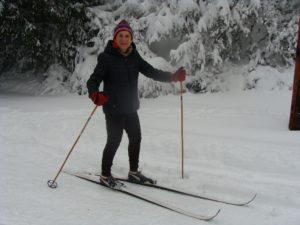
When I went outside the following day, the crisp cold air was refreshing even as I warmed with the effort of shoveling.  By the time I finished my own and my neighbor’s driveway, though my arms stung and back creaked, it felt good seeing what was accomplished in just a few hours.  But best of all was realizing that I recuperated quickly and was ready after lunch to find my sled to go speeding down the hill at the end of my street. Listening to bursts of laughter as adults and children joined in the merriment was fulfilling.  And what a pleasure it was to go cross country skiing from my front door. Who needs a car? We must have enough food stocked in our cupboards to last a month.

As an East Coast transplant, past Portland winters have been too mild for me. I missed bundling up in cold weather and having the opportunity to play in the snow. I do not like the idea of traveling hours to a winter resort. Perhaps Michigan spoiled me for I could ski on the farmer’s fields that surrounded my house.  With children sound asleep it was easy to take off for an hour of contemplation at 10 pm.  When there was a full moon shining on fresh snow it was haunting to silently glide through rows of corn stalks.

Traditionally, the third week of January is when the crocuses start to bloom at the Bishop’s Close in Portland. It is when Ray and I begin our weekly pilgrimage to watch spring unfurl. I wonder what will happen this year? There is no need for deep thoughts when nature makes its presence known.

Winter Wonder by Marilynne Eichinger – Sold

For more artworks by Marilynne go to eichingerfineart.com

Save the date: February 9th at 7 pm.
Book Talk at Annie Bloom’s Books in Multnomah Village, Portland.
Lives of Museum Junkies:The Story of American’s Hands-On Education Movement.

Workaholic or hard worker?

coos-bay-oregon

Coos Bay – Oregon acrylic on canvas/ 30“ by 40” / $499
Standing in the midst of this gentleness landscape set against moving water was refreshing and invigorating. Nature has a way of saying that there is more to life than work.

Are you a workaholic? What about a playaholic?

When my son was about 15 years old he turned to me and said, you and Dad work too hard. I’m not going to be like you. Life is for having fun. At the time he was just recovering from a life threatening illness, so I didn’t answer him with, “My work is fun!,” though that is what I felt like saying. It was not until years later that he began to realize that he might live to be an old man. Then he had a real conundrum? He had to make something of himself and apply himself. And, he did—but he never forgot how to have fun.

He now has a challenging business, yet finds the time to meet with his large circle of friends on a weekly basis. He works very hard and plays hard. I would never say his is a workaholic, though, I could see it happening. Work, especially for those who own a business, has a way of creeping up on you. There are times when my son is with me when I see that his mind does wander to the multitude of responsibilities he has instead of settling into “be hear now time.”

What is the difference between working hard and being a workaholic? There are clues to look for starting with cell phone use. Addicted people are constantly checking their phones and responding to messages on the spot even when in the company of others. Their work (or play) tasks interrupt social activities. They are the people who would go through withdrawal if their computer was not close-by or the WiFi went down.

We have to be careful, though, not all cell phone responders are workaholics. Edmund Neuhaus, Ph.D., director of the Behavioral Health Partial Hospital Program at McLean Hospital in Belmont, Massachusetts advises that it is important to consider the context of each situation and cautions that there is a big difference between being a workaholic and a person who works hard.

When business or play occupies all your mental and physical time at the exclusion of marriage, family and other relationships you may be verging on addiction. If sitting quietly makes you feel guilty for not being productively engaged, then you could have a problem. If, when no one is paying attention, you try to sneak in a little work, then you may be similar to an alcoholic who hides the bottle from his family. Many have trouble delegating work to others. They are perfectionists who believe they have to do everything themselves or it will not be done right.

Addicted people are often seen turning their hobby into a business. They forget that the hobby was originally selected as a way of relaxing. Play addicts are similar to workaholics in that their every waking moment is consumed in thought or action by the activity. Somewhere along the way, ‘fun-time” stopped being a refreshing break from work. When play adds tension and causes stress to your life, it is important to reevaluate what you are doing and why you are doing it.

Everyone needs some downtime, yet many workaholics resent vacations, even when their work will not be affected. Once that happens, they have likely become full fledged addicts.

“Not good,” says Dr. Neuhaus. Your health can be affected by high-stress activities at work or at play. Burnout, depression, anxiety, psychosomatic symptoms such as headaches and stomachaches and excessive alcohol consumption are frequently the consequences.

Interestingly enough, most workaholics deny their symptoms and do not acknowledge that they have a problem. Unfortunately, in many cases, their denial leads to a heart attack. It is usually family and friends who bring the problem to the workaholic’s attention. It may be done dramatically, such as when a spouse is fed-up with their mate’s long work hours and decides to sever the relationship.

Our culture doesn’t help. The United States is not like Europe where five-week vacations are the norm. Instead, it prizes the work-ethic and overachievement. Bosses reinforce hard work through praise, promotions, bonuses and raises rather than saying, “Good job, why not take time off?”

Play, care of self, exercise and a spiritual life contribute to longevity and a sense of well-being. So—work hard, yes, but be careful and lose the guilt when you are home relaxing with your loved ones. Work has a way of creeping up on you and giving a false sense of what is important to your well-being. Life is rich, varied, and beautiful if you let its many dimensions touch you. This holiday is a time to have fun. Take the stress out of your life. Play to relax and enjoy each moment with family and friends.

References:
http://www.webmd.com/balance/features/are-you-a-workaholic?page=2 – Can workaholism hurt you?

https://www.psychologytoday.com/blog/dont-delay/201003/the-personality-the-workaholic-and-the-issue-self – Psychology Today article about the personality of the workaholic.

SAVE THE DATE: Annie Blooms Books, Multnomah Village, Portland, OR – Talk and signing for Lives of Museum Junkies. The event starts at 7 PM.

Craftiness

Pulling Ivy – A weaving to commemorate the ivy pullers of the area.
A crafty way to stay out of trouble

By Marilynne Eichinger , Nov. 2016, NFS

CraftinessContinue reading

Community

The Gossips

The Gossips
12” by 36” / Acrylic Painting / $ 325
Getting community buy-in is often like whispering down the lane. It is a person to person conversation that eventually reaches a tipping point that pushes an idea over the precipice for implementation.

The following excerpt is from Lives of Museum Junkies that is due out at the end of August. Look for information in upcoming blogs. I will be holding several book signings beginning in Tampa, Florida in September; Lansing, Michigan in October; and Portland, Oregon in November. The book is presently at the printers and will be available in a few weeks. I look forward to seeing you at one of these events.

Community
“World events can never be ignored. A milestone that occurred when I was young turned the entire country looking skyward. Sputnik was launched. This was the first time a spaceship was successfully placed in orbit. I remember my mother saying to me that she always prided herself in keeping up with change, but somehow she could not understand what it meant to be putting objects in space. She felt lost and confused about the future.

Many adults today feel like my mother did in the Sputnik era. Technology continuously introduces changes at such a rapid rate that it is not surprising that coping is difficult. We watch many former jobs disappear, and at the same time sophisticated technological positions stay unfilled because of a lack of technical education. Streetwise once told me that he wished he were born one-hundred years ago. He did not like the competition and fast pace of city life, rebelled against using computers, and was fearful of driving on freeways. Thankfully, over the past years he has learned to cope with all of these realities.

This young man’s reaction was similar to that of many of his peers who lacked an understanding of basic subjects, current events, and scientific advancements. Yet these are the men and women who will be voting and making decisions that affect society in the future. The high school dropout rate in the United States is 25 percent, which is a concern since democracy depends on an educated populace.

As a museum director, I remained cognizant of our continually changing society with ever-evolving community issues, and soon realized that the job was filled with push-pull opportunities. I had ideas of what I thought the community needed, but it was not until citizens pushed me to accomplish what I preached that I could succeed. If I had not spearheaded the museum’s growth, it would not have happened, but it was the community that did not let me fail. People grabbed on to ideas and would not let them die. In some respects, I was set up to succeed as long as I was just willing to put in the hours, accept the pain and pitfalls, and not think about anything but the end result. Absolutely no one wanted me to fail. . . .

Lives of Museum Junkies offers insight into how this is done.
__________________________________
You may have a private business with family, investors and bankers committed to your success or you may be involved in a nonprofit organization that depends on community contributions. Perhaps you are working for one or another politician and walking door to door with his or her message. Whatever your passion, it is imperative that you not only communicate but get community buy-in if you want to succeed. This is not always easy. There is an art to organizing people and enabling them to feel a part of your cause.
__________________________________

Do share your experience in how you went about getting community involvement in your project. Respond at eichingerfineart.com/blog.
Artwork is always for sale. Contact me at marilynne@eichingerfineart.com.
________________
For sale on Amazon by Marilynne Eichinger: The True Story of Streetwise, overcoming homelessness and beating the odds. Go to AMAZON .

Fear

1372915lSquiggle –  Acrylic on canvas/ $ 25” by 37” / gold frame/ $ 490
Fear often results from confusion. Being unclear of the path forward can produce unsettled, anxious feelings that do not let you take risks.

FEAR

Throughout my working career I noticed that many workers were reluctant to take risks because they either feared failing or getting fired. Instead they remained docile and stayed in the shadows as they went about their tasks. I wonder if their brains were clamoring, “ you won’t succeed if you try a new concept or you can’t possible do that because it’s too difficult.”

Perhaps as children these yes sayers were ridiculed for spending time on “crazy or unproductive,” ideas. Maybe they had parents who told them, “you don’t do anything right! You always mess up. That’s just the way you are. ” Those deflating words can create insecure, timid adults afraid of tackling new ventures. Or perhaps they were risk takers but lost money trying to get their venture off the ground. Their self-image might have been destroyed and they became afraid of trying an unproven concept again.

Public pressure is another reason people refrain from testing new ideas. Savvy politicians are quick to say an idea won’t if it doesn’t come from their political party. Opponents are always on the look out for power plays and the media has great fun elevating potential failures to lofty heights making it politically dangerous to try. Once an idea fails, even though a great deal was learned that could lead to a more productive outcome, negative press can be devastating.

The difficulties generated from not taking risks can be great because failure is often a precursor to success.The scientific community know this is the only way to make progress. Scientists experiment with ideas, continuously making adjustments because of failures. Years are often spent pursuing an idea even though disappointing results face the investigator.

In 1937 a Bell Labs scientist named George Stibitz used relays in a demonstration adding machine. The same year a German engineer built his Z2 computer using telephone company relays. Building on these trials David Packard and Bill Hewlett played around in their garage, overcoming one failure after another before inventing the 200A Audio Oscillator, a piece of test equipment for engineers. In 1940 Walt Disney Pictures took a risk by ordering their 200B model to test recording equipment and speaker systems for newly equipped theaters in order to show “Fantasia.” Each of these entrepreneurs spent hours taking risks, often failing before developing societally useful applications.
I wonder what their families thought of their early frustrations. Did they say, “Honey, what you are doing is well and good but you need to spend your time making money to support our family.” Did they turn to their friends and say, “ She’s such a nurd, never doing anything practical!”

Penicillin was accidentally discovered by Alexander Flemming, Professor of Bacteriology at St. Mary’s Hospital in London. In the 1940’s he had just returned from a holiday in 1928 when he went to his lab. Sorting through petri dishes of Staphylococcus bacteria (the one that causes boils and sore throats), he noticed something strange in one dish. In a spot where a bit of mold was growing the Staph colony had disappeared. He had an idea. Yet It took ten years of further study, failures and research at Oxford University to turn what Flemming discovered into a life saving drug. Researchers focused on their goal even though they did not achieve immediate results. The risks they took cost money but their curiosity and hope led them to pursue their dream of curing many diseases. As they looked for answers I wonder if they were stymied by insecurities.

My life has been filled with many failures but each one gave me an idea to treasure. And though I want to help my children avoid my mistakes I have come to realize that they need to reach out, take risks and learn on their own. The best I can do is support them in their endeavors, overlook their failures and encourage them to use boldness in following their ambitions.

http://www.computerhistory.org/timeline/computers/ – history of the computer

http://www.acs.org/content/acs/en/education/whatischemistry/landmarks/flemingpenicillin.html#alexander-fleming-penicillin– discovery of penicillin

Art work is always for sale. Contact me at marilynne@eichingerfineart.com

Do respond below with your thoughts.

_______________________
For sale on Amazon by Marilynne Eichinger: The True Story of Streetwise, overcoming homelessness and beating the odds. Go to AMAZON .

Streetwise

Seeking Passion

DSC06759 (1)Bold Beauty by Marilynne eichinger

Acrylic Painting/ 30″ by 24 ” / $ 350.

Seeking Passion
A preview: The following excerpt is from my book, “Lives of Museum Junkies.”

Publication will be complete by August of this year. I’ll keep you posted.                         copyright © 2016 by Marilynne Eichinger.

“Passion has many definitions. It can include love and rage, sometimes at once. It can mean fear and hate as found in the writings of Mao Tse-Tung or joy, a feeling that is natural to all people. When I watched the movie Gandhi, I observed a man feeling a rage so intense that it moved him to action. Gandhi was willing to die for his cause. His love for his homeland and his compatriots was so powerful, so overwhelming that he was able to justify sacrificing himself. In the process of freeing India, he provided an important model of peaceful resistance. Martin Luther King based his civil rights marches on Gandhi’s lead, as did Nelson Mandela. The passion of these men helped win their fights for freedom.

I spent many evenings with my children discussing the pros and cons of passion. My most fervent hope was that they would be willing to take the risk to live honestly and with commitment. I did not want them to be afraid to experience the rewards and the pain that comes from following opportunity. When they were young, I tried to help them discover things to do that they would find absorbing. It did not make any difference what their interest was as long as it was legal. I wanted them to experience what it felt like to be totally invested in an activity and to be consumed so that it occupied their minds for hours each day. My hope was that when they became adults they would crave the feelings experienced as a child, and transfer their desire for passion to selected careers.

My views were influenced to an extent by my parents. Mother was a Republican and staunch capitalist. She believed nothing was beyond my grasp if I became focused and passionate about my undertaking. Mom convinced me that at the very least it was my responsibility to try wholeheartedly to reach my goals. As a side value I learned how important it was to have family support for my activities. My mother believed it was part of a family’s responsibility to their children to provide a consistent and positive foundation. She encouraged me to participate in various ventures and, if I failed, to view it as a learning experience—no problem. I am sure that is why I see failure as a precursor to success. It is also why I am not afraid to try.

Dad was a Social-Democrat who dedicated his life as a physician to serving the poor. He believed it was his responsibility to care for others less fortunate than he. His actions led him to seen as a saint to his patients and an eccentric to his family. We all paid a price for his passion as he worked around the clock to take care of those in need. I remember him getting up at two or three o’clock in the morning, rushing to see a patient in hospital or home. Observing Dad’s total dedication to his profession was inspiring to a young mind.

Martin Luther King Jr., the Kennedys, and Nelson Mandela knew the risks of advocating social and economic changes. As the nation honored these men of conviction, surely their families anguished over whether the risks taken were worthwhile. Janis Joplin, Judy Garland, and Jimmy Hendrix were passionate about their music and yet were never satisfied with their accomplishments. With every performance they were compelled to do better, to be more perfect. They were afraid of slipping, of being ordinary. They had passion for their art, but they lived without compassion for themselves. All three committed suicide. There is a delicate balance between dedicating yourself to a cause and maintaining a sense of identity. This is a great challenge in a meaningful life. . . . .”

More recently I am moved by stories of Mohamed Ali and by the actions of Bernie Sanders. Both men lived passionately and stood by their beliefs. Ali in particular exhibited tolerance for those who thought differently but was effective in finding ways of getting his views heard. From the distance of my living room I believe Ali and Sanders have lived happy, fulfilling lives. They have done their best and were not afraid to try.

Art work is always for sale. Contact me at marilynne@eichingerfineart.com
Do respond below with your thoughts .
___________________________
For sale on Amazon by Marilynne Eichinger: The True Story of Streetwise, overcoming homelessness and beating the odds. Go to AMAZON .

Streetwise