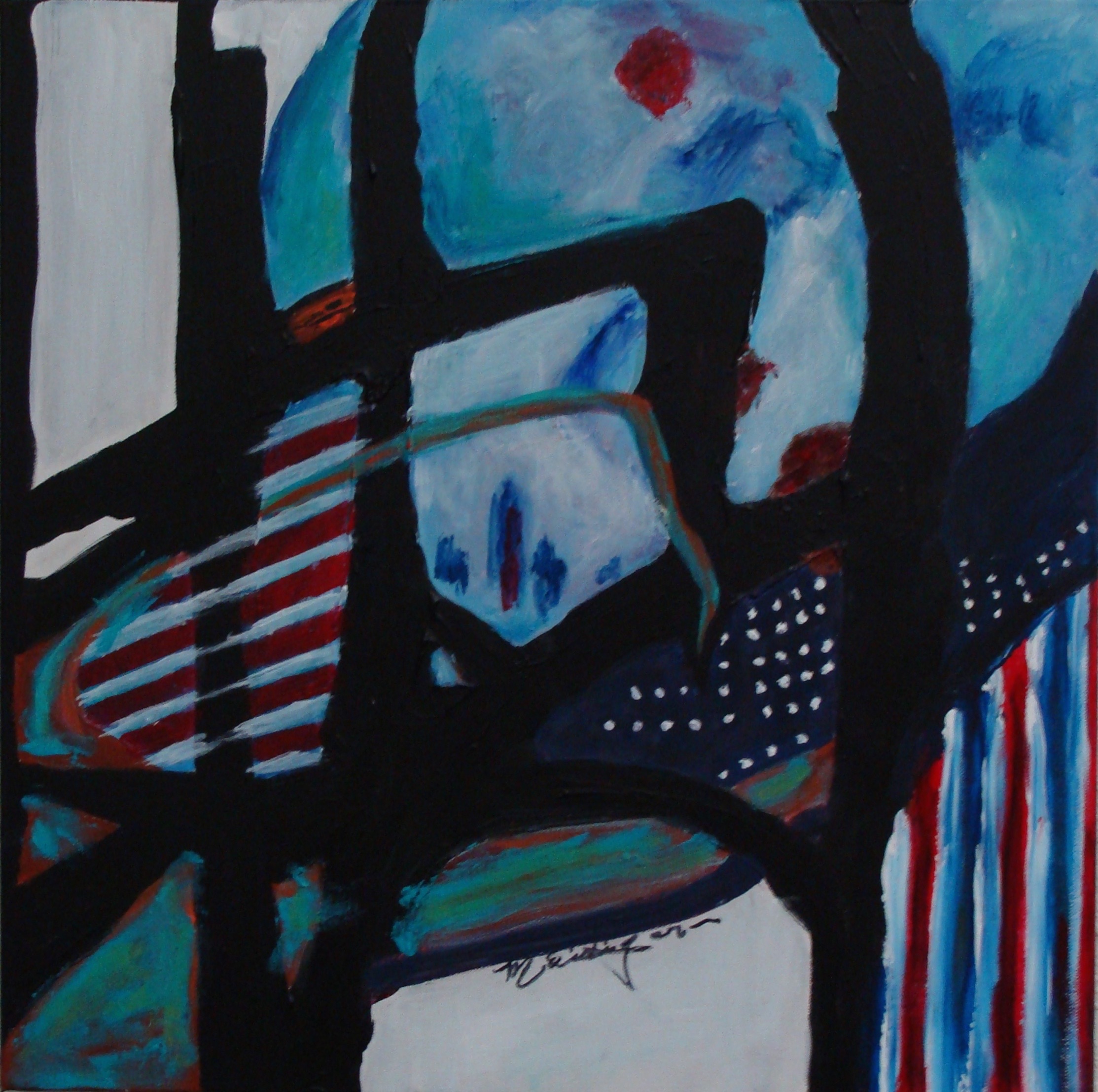
Fractured America


Fractured America  – painting by Marilynne Eichinger

acrylic on canvas/ 24”by 24”/ $ 450

Those supporting either right or left wing agendas agree on one thing—that America’s political system is fractured. Partisan discussions can easily destroy once solid relationships that were built over many years. The other day I overheard two childhood friends embroiled in a shouting match about illegal immigrants that was so hateful that I doubt they will ever speak to each other again. They inspired me to search for a way to overcome the fractional divisions that plague our country.

The values I was taught as a child that made America unique and great are now in question. Due process of law, the presumption of innocence, and freedom of speech are suspect. The right to privacy has been eliminated. There is no control over the way our taxes are spent, so we drive on streets and highways dangerously flawed by pot holes, bearing signs covered with untrimmed shrubbery. The homeless (25% are mentally ill, 40% are under 18) are permitted to sleep on sidewalks, intimidate bystanders, and urinate on street corners because no one wants to pay for their care.

There are those of us who would get rid of the first Amendment which protects political speech and others who want it suppressed when words are unsettling to sensitive persons or groups. Hypocrites speak of virtue yet vote for known bullies, harassers, and sex offenders. Anti-abortionists cling to family values yet are unwilling to provide health care for children born into poverty. Hunters believe they are better at preserving the environment and endangered species than a bureaucracy. When the wind blows towards one party controlling the three branches of government, the party in power is fast to forget beliefs held by half of the country’s citizens. Compromise and consensus are two important words that have been eliminated from our vocabulary.

The Statue of Liberty has little meaning for we are not willing to do as it says:

“Give me your tired, your poor,                                                                                                                                      
Your huddled masses yearning to breathe free,
                                                                                                              The wretched refuse of your teeming shore.
                                                                                               Send these, the homeless, tempest-tossed to me,                                                                                         
I lift my lamp beside the golden door!”

Have we lost the way? It seems to me that both Republicans and Demarcates have gone haywire, holding extremist ideals that make compromise untenable. Yet it is bargaining in good faith that brings about a balanced society.

According to the Haidt and Abrams of the Washington Post, between 1930 and 1980, voters in both parties were centrists. It was later that Americans became purists, changing the way they dress, take vacations, drink, and read. It intensified the divide that separated urban and rural dwellers since before the Civil War. The Democratic Party, located historically in the agrarian South, became an urban party focused on the concerns of city dwellers. Rural areas shifted towards the GOP which became more religious, patriotic, and family-oriented.

Newt Gingrich escalated the political breakdown in 1995 when he changed the congressional calendar to mid-week meetings and encouraged new delegates to go home for the weekend rather than reside in Washington and befriend members on the opposite side of the isle. Without socializing to build cross-party relationships a bitter culture developed. Simultaneously, the seniority system for selecting committee chairs was eliminated. Leadership was free to assign positions based on party loyalty, making it difficult for independent thinkers who were not willing to tow the party line.

As immigration grew in the 1970s and 80s, the parties became heavily divided by race, with the Republican party becoming more white. The introduction of cable TV and internet enabled viewers to seek out hundreds of partisan stations rather than put their trust into commonly watched commentators like Walter Cronkite. Today it is rare for someone to take the time to seek evidence that confirms or denies the truth of the information they receive. Most people do not look beyond articles that confirm their own biased theories. Adding to our confusion is a polarized media which makes it difficult for politicians to work across the isle without setting themselves up to be backstabbed by one newscaster or another.

The high cost of campaigning also contributes to our country’s political fractures. Because it is so expensive to run for office, politicians are afraid to offend party donors. They are compelled to spend two to three hours on the phone each day fundraising instead of governing.

When the two world wars and cold war dominated America, national interests were put above partisan politics. People were more or less afraid but they perceived common enemies and were united in supporting their politicians. The following generation, shaped by Vietnam, participated in a culture war that was divisive. Baby boomers marched and fought against the establishment, and as lies about the war escalated, distrust in government grew.

So, what are we left with? Hatred, class war, manipulation by power elites? It makes us wonder if it is possible to revamp the way Washington works. Haidt and Abrams suggest improving the social and political functioning of congress by encouraging after hour get togethers and by bringing congressional families back to Washington. We citizens could demand that politicians stop the blame game and labeling the other party as evil. We are in this together and thankfully most lawmakers have good intentions.

Excellent suggestions were made in 2014 by the Commission on Political Reform. Members like Tom Daschle and Trent Lott, were challenged to find ways to improve congressional working relationships. Starting with having policy makers focus on solving problems rather than getting elected they offer 60 ideas ranging from improving the electoral system, increasing voter turnout and addressing gerrymandering to congressional reform that is less hyper-polarizing. They suggest engaging young adults in service, reinstating a five day congressional work week, and limiting time for debate.

Their findings, referenced below, are interesting to read and make me believe that a more civilized way of ruling is possible. Lets begin by not dissolving long term friendships over political differences but use our heads and hearts for the benefit of all who reside in this wonderful land.

__________________

Don’t forget to share your thoughts below.. Many readers are interested in what you have to say.

Art is always for sale. Contact me at marilynne@eichingerfineart.com.

References:

HUD. 2016. Annual Homeless Assessment Report to Congress. The U.S. Department of Housing and Urban Development . retrieved from https://www.hudexchange.info/resources/documents/2016-AHAR-Part-1.pdf

Demote Sr.,C. 2018, Repairing our Fractured Politics, National Review. retrieved fromhttp://www.nationalreview.com/article/455330/fix-americas-broken-politics-balanced-budget-amendment-filibuster-abolition

Haidt, J and Abrams, S.2015. The top 10 reasons American politics are so broken. The Washington Post. retrieved from https://www.washingtonpost.com/news/wonk/wp/2015/01/07/the-top-10-reasons-american-politics-are-worse-than-ever/?utm_term=.ac85eec6918a

Commission on Political Reform 2014. Governing in a Polarized America: A Bipartisan Blueprint to Strengthen our Democracy.Bipartisan Policy Center retrieved from https://bipartisanpolicy.org/library/governing-polarized-america-bipartisan-blueprint-strengthen-our-democracy/
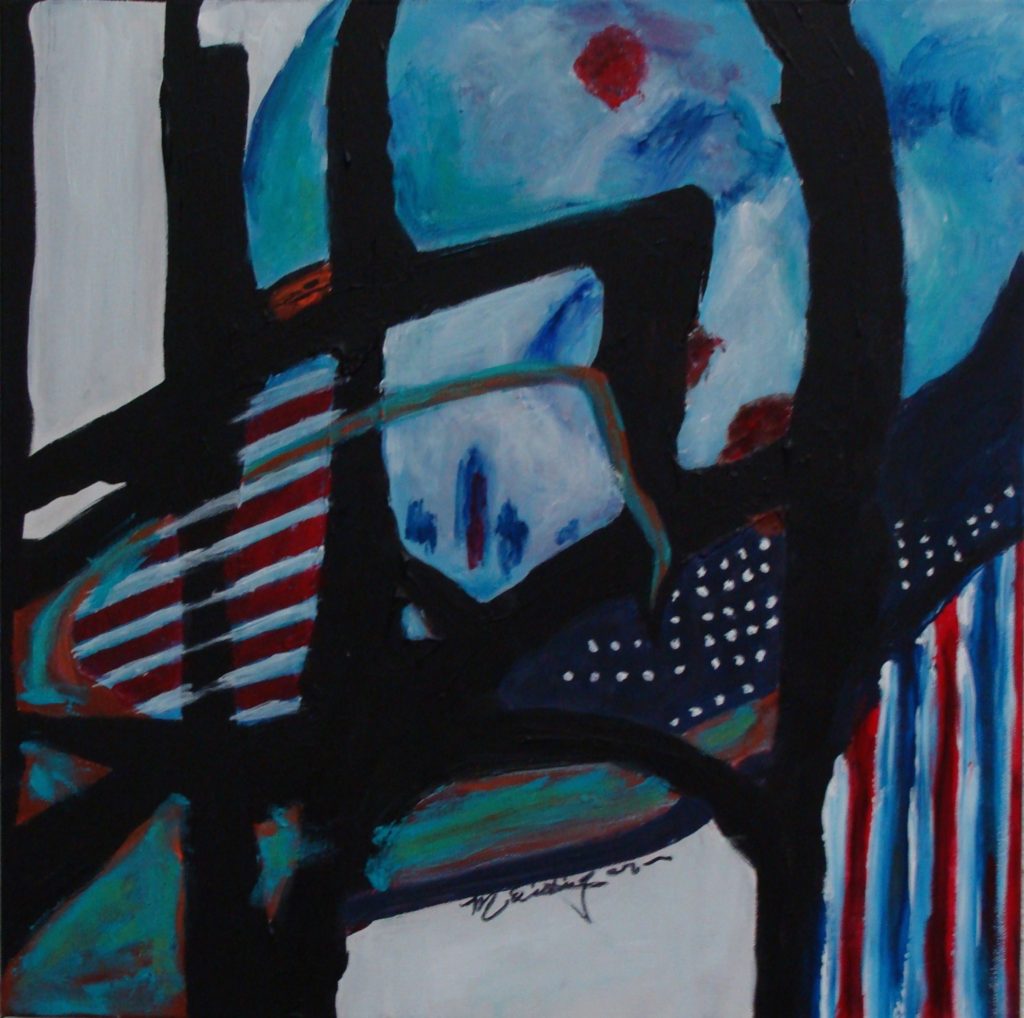

The Best of Times, The Worst of Times

Best of Times, Worst of Times

Summer Night’s Dream
Acrylic on Canvas/ 26” by 32”/ $ 498
Is it the best or worst of times? Surely we are living through confusing times.

On December 27th, President Obama was interviewed by Prince Henry and asked what he sees for the future. He responded by saying, ” If you had to choose a moment in history in which you’d choose to be born, you’d choose today because the fact is that the world is healthier, wealthier, better educated and more tolerant, more sophisticated and less violent.” His comment made me wonder if his words rang true and thought that a bit of fact checking was appropriate at the start of a New Year.   After hours of research, a have come to realize that fact checking  gives complex results.  I will share what I discovered in the next two newsletters.  Part I follows.

Part I

Last on Obama’s list is violence which I thought was a good starting place given the events of 2017.  Articles about gangs, drug cartels, Middle Eastern wars, and gun violence led me to believe that we live in more, not less violent times. However, some studies say otherwise. According to evolutionary psychologist Nigel Barber, the world is a lot less violent than at any other time in history. It is the constant diet of media reporting that turns killers into instant celebrities, and readers into empathetic dispensers of sympathy for victims, stirring a sense of danger that is out of proportion to threat. This is one man’s view based on an evolutionary time line. However, when I explored a shorter period of time, I came across a Forbes magazine article report of the latest Global Peace index published by the Institute of Economics and Peace in June, 2017. As well as full-blooded conflicts, the index takes into account everything from the level of government weapons purchases to homicide rates, incarceration rates, perceptions of criminality, political repression and suppression of free speech.

Over the past year, 93 countries were identified as being more peaceful, while 68 were considered to be less so. Improvements occurred in countries where state sponsored terrorism declined or because of a reduction of US forces, such as in Afghanistan. A disproportionate amount violence exists in Syria, Afghanistan, Iraq, South Sudan and Yemen. Fractionalized politics over the past four years is a major reason peacefulness declined in certain countries. Internal divisiveness leading to the election of Donald Trump, the Brexit vote, terrorist atrocities in France and Belgium, increasing inequality, rising perceptions of corruption and a decline in freedom of the press are contributing factors. The Unites States fell to the 114th spot, below Rhonda, Algeria and Belarus. Yet, despite these declines, internationally, there has been improvement. The most peaceful country is Iceland with New Zealand, Portugal, Austria and Denmark not far behind. Europe is still the most peaceful part of the world claiming 8 of the top ten countries.

What about health? The World Health Organization (WHO) collects statistics for 194 countries. In 2017 it compiled information around 100 indicators such as child care, sanitation, traffic injuries, infant mortality, communicable diseases and life expectancy. Overall, adult mortality rates declined in most wealthy parts of the world. Life expectancy at age 15 increased 2 to 3 years over the last 20 years with the exception of Africa where it decreased by nearly 7 years and the United states which is down 2 years due to opioids. The major causes of deaths among adults is due to noncommunicable diseases, injuries among males, and violence due to war. Causes vary significantly by region. About half the world lacks access to health services and over 100 million people are put into extreme poverty due to health expenses. WHO President Dr. Jim Yong Kim advises that that if we are serious about improving health we must end poverty and urgently provide universal health coverage.

Obama believes that people are more tolerant. In the past year hate crimes rose significantly in the United States according to a 2016 report by the FBI. Rising Islamophobia and anti- Semitism are on the rise, not only in the U.S., but in many European countries. A Huffpost article concurs that “there are strong signs that the modern West is, indeed, becoming less tolerant.” In analyzing tolerance we have to ask, compared to what? Do we look at Spain during the Inquisition, ISIS and their many beheadings or do we compare ourselves to 50 years ago. If we consider more recent society at home, since the Civil Rights movement Americans have become more racially tolerant. People are careful about what they say publicly about Black and Asian Americans and no longer poke fun at Pollocks or the Irish. A 2015 study published in the journal of Social Forces confirms increasing tolerance towards those with differing lifestyles and views. Americans bare more willing to accept of those who divorce, unwed mothers, and the LGBTQ community. Youth continue an upward trend of accepting opinions and lifestyles that differ from their own.

A recent Pew Research study reports that Americans are also more tolerant of religious groups than just a few years ago. Even with negativity around the election, people report greater acceptance of all religious groups with Jews and Catholics receiving the warmest reactions with Muslims and atheists receiving the coolest, though neutral ratings. The concept of “other” focuses on Latino immigrants and Muslims. Hopefully that designation will not last forever for intolerance is not an option for a democratic society.

Max Fisher, professor of ethnicity, compiled a map of world tolerance that shows Anglo and Latin countries to be the most tolerant while India and Jordan are the least. Wide variations exist across Europe where immigration and national identity are major challenges. The large numbers of economic migrants that go for work to countries like Egypt and Saudi Arabia are at risk, though a slight a improvement was registered. Racial tolerance is low in many Asian Countries and especially so in South Korea. Pakistan is surprisingly tolerant despite areas of sectarian violence. The United Nation reports discrimination, marginalization, injustice and violence to be the most common indicators of intolerance. Better education is needed to fight against intolerances which are recipes for conflict disaster and war. Tolerance is a “treasure that enriches us all.”
Do join me next week for Part II, a look at wealth and education.

References:

1. Wintour, P. 2017. Obama tells Prince Harry: Leaders Must Stop Corroding Civil Discourse. The Guardian. retrieved from https://www.theguardian.com/us-news/2017/dec/27/barack-obama-tells-prince-harry-leaders-must-stop-corroding-civil-discourse

2.Barber, N. 2016. Is the Modern World More Violent. Psychology Today. retrieved from https://www.psychologytoday.com/blog/the-human-beast/201506/is-the-modern-world-more-violent

3. Dudley.D/ 2017. Most of the World is Becoming More Peaceful but the US and the Middle
East are Bucking that Trend. retrieved from https://www.forbes.com/sites/dominicdudley/2017/06/01/most-of-the-world-is-becoming-more-peaceful-but-the-u-s-and-the-middle-east-are-bucking-that-trend/#3d8c3fda22e1

4. World Health Organization Web Site. 2017. retrieved from http://www.who.int/gho/en/

5. Marglin,J.2016. Are we Getting More or Less Tolerant, And Does it Matter? Huffpost. retrieved from https://www.huffingtonpost.com/jessica-marglin/are-we-getting-more-or-le_b_8833514.html

6. Perry, S. 2015. Americans have become more tolerant with each generation, Study finds. MINNPOST. retrieved from https://www.minnpost.com/second-opinion/2015/03/americans-have-become-more-tolerant-each-generation-study-finds

7. Williams, W. 2017. Americans are becoming more tolerant of many religious groups, survey finds. The Christian Science Monitor. retrieved from
https://www.csmonitor.com/USA/Society/2017/0215/Americans-are-becoming-more-tolerant-of-many-religious-groups-survey-finds

8. Fisher, M. 2013. 5 insights on the racial tolerance and ethnicity maps, from an ethnic conflict professor. The Washington Post. retrieved from https://www.washingtonpost.com/news/worldviews/wp/2013/05/17/5-insights-on-the-racial-tolerance-and-ethnicity-maps-from-an-ethnic-conflict-professor/?utm_term=.8a7df968ab1c

9 United Nations Educational, Scientific, and Cultural Organization, 2017. Learning to Live Together. UNESCO . http://www.unesco.org/new/en/social-and-human-sciences/themes/fight-against-discrimination/promoting-tolerance/

______________________________________________________________________
Please comment on my blog site below.

Art is always for sale. Contact me at marilynne@eichingerfineart.com for costs and shipping information.

Changing Sexual Mores

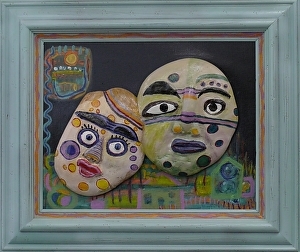
FACES
mixed media on canvas / 24 x 29” x 2” / $ 450
Good relationships are trick and must be nurtured. They survive because of respect and caring. Violence and rape have no place.

Changing Mores Sexual

The outcry over sexual abuse and harassment has finally been heard throughout the country. “Let it not let it happen again,” is the mantra. And, so old wounds of the past are now willingly being dragged through the media to be relived in the hope of putting this ugliness to bed. Hopefully the actions of brave speaking victims will have a lasting effect, though I must admit to having doubts around power politics. Some predators manage to hold on to their positions despite their despicable behaviors while others, who acknowledge wrong doings with humility and have changed have had to step down.

Are we doing democracy a service by holding so many men accountable in the court of public approval rather than the judicial system? I realize that none of the claims can not be ignored, and that most may be justified . . . but not all. Should those acting in accord with the mores of their adolescent years and have since mended their ways receive equal punishment with rapists, pedophiles, and those using power positions to seduce the young?

Do we treat men who patted a fanny, groped a breast, or kissed an unwilling face as we do one who drugged, molested children, or raped? Not long ago our men lived in a society that ignored these types of behaviors. Old men like George Bush Sr. were seen as harmless when they pinched their nurse. As children they had been taught that chauvinism was simply a manly way to tease those they desired. Sexual harassment and the way men and women acted towards Black Americans was on an equal par.

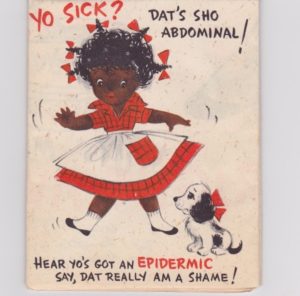
Last week, I found a get well card buried in a box of letters that were mailed to me in the late 1950s. The card had an image of a young black girl speaking in a way that would horrify anyone today. However, during that pre-civil rights era, such pictures were socially acceptable. Should the person who sent this card be judged by today’s standards? Should he lose his job? face consequences because of the way white society thought in the past? Should I, as receiver, have been insulted? Are either of us bad today for having seen the message sent in ’58 as cute? I do not believe we are terrible people, for once the damage caused by such images was explained, we became sensitized. No longer would such a card be an acceptable. This new awakening was then carried forward to the next generation. Culturally acceptable norms were changed.

So too, in matters of sexual harassment. In 1953 Playboy Magazine featured Marilyn Monroe in its first issue. Hugh Hefner and his clubs were popular places for both men and women to go for a drink and entertainment. Hefner was considered a visionary editor accepted by much of society. The 1960’s was a period of profound societal changes in a growing sexual revolution. With the spread of birth control pills and penicillin to fight diseases like syphilis, attitudes towards sex became increasingly permissive, even weakening marriage boundaries.

Though the era also heralded in the women’s movement, men and as well as women were confused about their roles. The revolution had negative as well as positive features for though promised sexual freedom and liberation, women increasingly found themselves victims of rape and oppression. Some men, feeling emasculated, tried to assert their claim to being the strong, superior bread winner to whom the weaker sex owed allegiance. Having lived through these times, I can attest to the fact that it was exciting yet confusing, flirtatious yet risky. It is not surprising that many women became victims for we did not know how to act.

As we consider important steps taken on behalf of traumatized victims, let us proceed wisely. Rape, drugs, violence, pedophilia can never be tolerated. But there are gray areas that impel us to move cautiously to not wreck a good person’s career. Once the individual has acknowledged past mistakes and demonstrated change there can be room for forgiveness. It behooves us to teach young women and boys about predatory ways, so they are not naive and can firmly, politely and swiftly put an end unwanted approaches. Though difficult, we need to have conversations with our children to help them better evaluate flirtations and to know behavioral boundaries so that one person’s will will not be forced on another.

Consequences from abuse make victims feel vulnerable and insecure, two emotions that can last a lifetime. I know this well, for I too was raped by a powerful man. Fortunately, the current turmoil is a chance to grow and learn better ways for men and women to communicate. Let’s not turn the past into a political travesty that backfires but move forward by changing minds.

Power Play

The Three Sirens

Which one will become prey in a game of one-upmanship?

Acrylic on canvas/ 36” by 12’ / $ 350

Power Play

Women have finally found the courage to share their stories of the powerful men who made unwanted sexual advances towards them.Their predators were masterful players of the one-upmanship game. They knew how to induce fear in their victims by feeding ego that supported their privileged status as employer and reenforced the belief that they were the superior player.

Before the civil war, plantation owners believed in their right to physically and sexually abuse slaves. As property, their prey had little recourse against rape or beatings by cruel masters. Society supported the rights of property owners over the enslaved. Though much has improved since those days, a great deal has stayed the same with ugliness pushed underground. Out of site and out of sound, sexual assaults until recently have been hushed up, though perhaps times are finally changing. Politicians, Hollywood moguls, and industry bosses have always been abel to engage in hurtful acts through bribery, trickery and outright force.

I too was victimized. My first encounter was mild, but demonstrates how unfeeling some young men can be when showing off to their friends. At the age of 19, while walking through Harvard Yard, an approaching student stuck out his arm to brush my breasts. I was shocked as he and his friends had a good laugh at my expense. Fifty years later the memory of that small incident remains burned in my brain. What kind of upbringing did the young man have to believe he had the right to abuse me?

In my thirties, I was subjected to unwanted advances by the chairman of the board under which I served. His power moves were scary for I was naive, neither knowing how to handle his unwanted advances nor willing to confide in someone in since he occupied the organization’s top position. I reasoned that if I went to the police the incident would be exploited in the media. Since the man was a well respected community leader, I wondered if I would be believed over his denials? Would my reputation be tarnished? Would I lose my job? In the early 1970’s women rarely won such cases by suing in court.

Fearing that my young children and spouse would be pulled into my nightmare, I elected to remain silent. By not sharing, my silence created a wedge between me and my husband.

However, once aware of sexual power games, I became determined never to be victimized again. When invited to install an OMSI exhibit in the senate office building in D.C. I was asked to give a private tour to a senator who had a predatory reputation. Forewarned, I was on guard. Sure enough, the man made overtures, but I was able to gracefully and competently end the encounter without making an enemy.

News about the predatory actions of Hollywood directors, politicians and corporate leaders is not surprising. For years their have been tales of exploits shared through backroom gossip networks. I applaud the willingness of the nearly fifty actresses who came forward to expose Harvey Weinstein. However, there is safety in numbers and most are aging ladies with little to lose. What would have happened if they stood alone and confronted him in their younger years? Talented women who work their way up the corporate ladder are at particular risk.

What will insure that job advancement stays in the boardroom rather than involve an unwilling visit to a bedroom. According to Angela Skirtu, “one part of our sex life is power roles.” Most people assume a dominant or submissive role, though some are comfortable back and forth. In a consensual relationship, power dynamics are discussed and agreed upon with the result of deepening the relationship. Without a willingness to communicate, relationships can quickly become power plays that end poorly.

Unfortunately, there are those who disregard consensual practices when outside their homes. They believe they have a license to proceed aggressively with unwilling participants. Powerless to flee, resentment, anger and depression take set in. An abused woman (or gay youth) may fear going to work.

Most employee manuals have a no-tolerance clause for sexual harassment. These rules are difficult to enforce for those at the top of the organization for there is no place further up the ladder to go to seek justice. The consequences of complaint can ruin hard built careers and undermine families. We have only to look at Anita Hill’s exposure of Clarence Thomas to understand how difficult stepping forward can be. Aggressors often have many powerful friends to form a protective ring around them.

In my case, if the situation happened today, I might still remain quiet and not report the event to authorities. However, I like to think it would never be an issue, for I am better armed with an arsenal for nipping unwanted advances in the bud. It behoves everyone to understand their own sexuality and how it affects those they associate with. There are times when flirtation is harmless and can be encouraged. But there are also situations when that is not the case and clear expectations have to be communicated.

How often have your heard, ”women don’t really mean it when they say no?” It is a stereotype about them that reinforces the idea that women are not straightforward. The phrase becomes a convenient excuse to ignore what is being said. Women, as are men, are complicated. There are times when body language is as important as words. Though we want our children to be social and caring, it becomes a problem if they are so sensitive that they fear hurting a predator’s feelings.

A young woman asked me for advice when an older, competitive colleague threatened her career by demanding sex. As a happily married mother, her family meant more to her than advancement through appeasing this individual. The process of vocalizing her concern gave her courage that enabled her to handle he situation in a safe, public arena. She told the man how flattered she was by his interest but that she was happily married and that an affair was not possible. By being open and direct, she was able to set limits. It may not seem fair to some that flattery was her way out, but it was a prudent solution for it enabled her to maintain a useful working relationship.

Moms and Dads, please don’t avoid discussing this difficult subject with your daughters and sons. At the start of their careers they need to know how to respond to unwanted advances without becoming paranoid. Discussions might focus on appropriate work attire and how to deal with inebriated co-workers. It is important let them know that most men and women are considerate and reasonable, so they will not go overboard in fear. Still, it is good to be realistic as well as cautious for there will always be power hungry predators. Women need to be trained at an early age that it is OK to say no. And men need to learn early that a lack of no does not mean yes. Consent needs to be verbalized and valued.

And men, don’t be fooled. The situation can be reversed, for there are women at the top ready to play the same type of one-upmanship game.

References:

Skurtu, Angela (2016) Power Dynamics in Sexual Relationships. Huffpost. retrieved from https://www.huffingtonpost.com/angela-skurtu/power-dynamics-in-sexual-_b_9843280.html

Mitra, M. (2017) what Women Don’t Mean When They Say “No”. retrieved from http://www.filtercopy.com/what-women-don-t-mean-when-they-say-no-2473499543.html

Aaron, M.( 2017) The Role of Power in Relationships, Dr. Michael Aaron – licensed Psychotherapist, Sexologist and Sex therapist. retrieved from Web http://www.drmichaelaaronnyc.com/the-role-of-power-in-relationships/

Art work is always for sale. Contact me at marilynne@eichingerfineart.com

Terrorized at Home

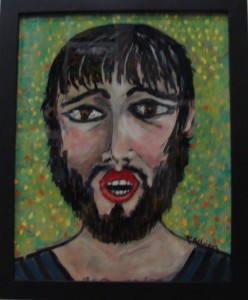
The Orator
In Hyde Park, England, the Orator stands on a soap box speaking his mind. Sharing views with curious onlookers he occasional appears deranged and at other times brilliant, but his right to express himself is never questioned.

Acrylic on Canvas, 22” x 18” , black frame, $ 325

Terrorized At Home

You may or may not share my political views but I imagine you agree that our citizens do deserve the truth and do not deserved to be terrorized.

A friend recently said that she lived in a bubble surrounded by a state of terror. Her daily life was going well, she enjoyed her family and loved spending time with grandchildren. However, as soon as she slowed down to think or take a walk in the woods, fear washed over her. She was gripped with terror. This kind, compassionate woman was born in Germany and remembered how Hitler came to power by stirring discontent and hate. With deja vu she sees the same rhetoric providing ammunition to a Neo-Nazi movement in our country that is filled with ugliness. Terror affects her life as it is does many of her friends.

Under the guise of freedom, U.S.citizens are watching their right to free expression erode and replaced by confusion over values. Women, once again viewed as sex objects are reengaged in battles they thought had been won. They are subject to increased domestic violence, experience greater inequality in the workplace, and are fearful of losing the right to choose. They worry that their daughters will join the rising tide of raped, assaulted, and prostituted women and that their grandchildren will live in a polluted, overpopulated world. Gays are increasingly bullied and once more relegated to second class citizens while low income families continuously have to fight to keep health care insurance, a right given to citizens in all first world nations. And people of color? . . . those poor misaligned men and women are constantly targeted for the shade of their skin. Hard working Hispanic parents are separated from their families and deported to countries where they can not find work. Black men are shot in shameful numbers by racist and fill the jails due to ignorant police and an antiquated judicial system. No wonder so many people walk the streets feeling terrorized.

Fake news? Anyone watching the recent Ken Burns series on Vietnam learned how presidents in both parties distribute fake or misleading news. Kennedy, Johnson, and Nixon were not above manipulating the press to bend a naive, patriotic chanting crowd to their end. It wasn’t until honest newscasters shed light through investigation and printing on-the-site photos that the public realized the truth about Vietnam. The same thing happened when President Bush deceived the country by claiming Iraq had weapons of mass destruction when it was clear that they did not. He too looked for an excuse for war.

A free press is imperative to support a democratic nation and citizens are needed who care enough to check facts. Having a major news network owned by a foreign capitalist with an extreme political agenda that favors the wealthy is scary enough. But being told by our current president that the media distributes fake news, and to only trust his Tweets, is unconscionable and quite frankly bizarre., stirs divisiveness, and adds discord and tension to the country’s unease. Divide and conquer seems to be his motto, for I see no policy designed to bring citizens together. Instead, we face the potential for civil war.

In 1858, Abraham Lincoln said, “a house divided against itself cannot stand. I do not expect the Union to be dissolved—I do not expect the house to fall—but I do expect it will cease to be divided. It will become all one thing or another.” Lincoln was talking about slave or free states. This may be another defining moment in history when we have to decide which way will we go? Will we be subjected to dictators who espouse Facist ideology favoring the wealthy or do we remain democratic and accept regulated capitalism to benefit the majority. Are we too set in our ways to listen to differing opinions or do we censor those who do not share our beliefs? Do we engage in ethnic cleansing in order to have a white Christian country, or do we enjoy a diversity of races and religions in a tolerant society that the world recognizes as compassionate? And lastly, are we wedded to the idea that we will be at war for the rest of our lives? If we do not choose wisely we run the risk of creating one for generations that follow.

In his farewell address President Eisenhower warned us to beware of the military-industrial complex. As a retired five-start Army general, he recognized it as a threat to our democratic way of life.

“In the councils of government, we must guard against the acquisition of unwarranted influence, whether sought or unsought, by the military-industrial complex. The potential for the disastrous rise of misplaced power exists and will persist.”

War makes money for munitions dealers. Defense contractors send thigh paid lobbyists to congress to lock-in political support for their businesses. Why should they care where the war is, as long as there is one? When warplanes fly near the DMZ and threats are made towards North Korea, they see dollar signs light up the sky.

I find the exchange of words by two mad men who call themselves leaders to be quite frightening. People who play chicken are asking for trouble, yet Citizens Joe and Jane are the ones who will suffer. But, the public’s lack of concern about whether to engage in numerous wars on eastern and western fronts is also unnerving. Since drones we started using instead of foot soldiers, killing innocent people miles away from our homes, we don’t worry about ruined cities and displaced people in distant lands. Instead our citizens are sadly apathetic, easily closing doors to fleeing refugees who have no where to run. Where would you go if bombs reigned down on your head or if severe drought brought famine to your land?

Is living in a state of constant terror to become the mood of the country as it was during the cold war? Will we, as did Germany, bring chaos down on our heads by insisting on a “me first” attitude rather than work with other countries for the common good?

Who is in charge here? The American public? No way. I say, we certainly better get ourselves together, take to back our humanity or learn to live with terror as an expected emotion.

References

Sandum,J. & Johnson,D. (2017) Violent Crime is on the Rise in U.S.Cities. Time. retrieved from http://time.com/4651122/homicides-increase-cities-2016/

Bloom,N (2017) Corporations in the Age of Inequality. Harvard Business Review. retrieved from https://hbr.org/cover-story/2017/03/corporations-in-the-age-of-inequality

(2016) Murders, rapes and assaults rise in US, says FBI report. BBC News. retrieved from http://www.bbc.com/news/world-us-canada-37479529

Duffey, C (2017) LGBt Youth Bullying is on the Rise.https://thepridela.com/2017/07/lgbt-youth-bullying-rise/

Lincoln Home (1958) House Divided Speech. National Park Service. retrieved 2017 from https://www.nps.gov/liho/learn/historyculture/housedivided.htm

NPR Staff (2011 Eisenhour’s Warning Still Challenges A Nation, Oregon Public Broadcasting. retrieved from http://www.npr.org/2011/01/16/132935716/eisenhowers-warning-still-challenges-the-nation

Love Has It All

Floating Free in a Bed of Roses

Roses, a symbol of love float freely trusting that they will remain
committed to their beatiful community.

29” by 23”, Acrylic on Canvas, $425.

Love Has It All

I recently heard an enlightening, though cerebral talk about love. The speaker was passionate in his belief that if we all practice love and kindness, it can lead to peace and harmony. Though the content of the speech was hopeful and intellectually powerful, his words left me emotionless. I found it difficult to move from my brain to my gut to absorb what he was saying, and did not leave the talk with the warm fuzzy feeling you get from love. I also wondered, how it would be possible to get everyone in a community ( or a relationship) to practice love?

I became acutely aware of how easy it is to disconnect mind and emotions when trying to communicate an important message. I empathized because I am often criticized for doing the same in my writings. The newsletters I send out weekly are vetted in a writers group I belong to and an oft heard complaint is that I am too academic. The more I thought about this problem the more challenged I became. Can I turn thoughts and words into something that tugs at the “heart?”

Years ago I had a friend from Ghana who asked me, “What is this thing called love?” In his culture, marriage was arranged by adults who knew the two young people well. He believed that his parents were much more likely to find a good spouse from him than he would for himself. Companionship, compatibility, and commitment were the basic ingredients for a love that would come after years of living together. He was a doctoral student at MIT and his parents sent him a woman to wed in his final year. They were married in the Washington Cathedral with a lively celebration afterwards in the Ghanian Embassy.

Arranged marriages were the norm for generations.

In the movie, Fiddler on the Roof, Tevye sings to his wife after giving permission to his daughter to marry the man she loves.

“Do you love me?” he asks Golde?

His wife answers,
“ Do I love you?
For twenty-five years I’ve washed your clothes
Cooked your meals, cleaned your house
Given you children, milked your cow
After twenty-five years, why talk about love right now?
Raising his children, how can he ask such a question?”

She then turns to the audience,

“For twenty-five years I’ve lived with him
Fought with him, starved with him
Twenty-five years my bed is his
If that’s not love, what is?”

“ I suppose I do,” says Goldie.
and Tevye replies, “ And I suppose I love you too.”

The last verse they sing together is most telling,

“ It doesn’t change a thing
But even so
After twenty-five years
It’s nice to know.”

Who do you love and how do you know you love? When did you first feel loved? When did you first give your love without condition? And lastly, how often do (or did) you tell the person of your love?

OK. . . a bit of an aside because I can’t help myself. Psychology Today gives a few answers to the first question (DiDonato, 2014). They mention seven research-based signs of love and attachment.

You’re addicted to this person.
You really want your friends or family to like this person.
You celebrate this person’s triumphs ( even when you yourself fail).
You definitely like this person, and this person likes you.
You really miss this person when you’re apart.
Your sense of self has grown through knowing this person.
You get jealous-but not suspicious.

The article goes on to say that falling in love is a basis for a healthy relationship but keeping it going is based primarily on satisfactions and feeling good in the presence of the other person. Love needs to be buttressed by commitment.

I know that I love my partner, children, grandchildren and siblings and a great many friends. I feel stirrings in my core when I think of them. When we are together I feel warm, happy and content. The little annoying things they do are also what makes make them special and unique. As I age, I even started appreciating their mistakes . . . they seem funny, youthful, and naive. Their mishaps are what makes them human and able to grow and learn.

When family or close friends are ill, I grieve and will do anything in my power to help them over their hurdle. They are first in my mind and time, and always have been . . . before job, hobbies, and my to-do list. When it comes to those I love, I am a tigress protecting her lair.

My difficulty comes when I am told to love everyone else . . . community, country, and by extension, the world. Religious leaders ask us to love beggars, thieves, prostitutes, murderers and malicious gossips. Perhaps the Dalai Llama can do this but I fail in this regard. Should I try to get over this hurdle? I am not sure.

The several times I came close to loving a large group of acquaintances is when I was responsible for their well being. When president of OMSI and Impression 5 I wanted to create organizations that were not only efficient but places where people enjoyed coming to work. The best way to do that, I thought, was to insure that staff were committed to a cause greater than themselves and also cared for each other. In general we became such an organization by reaching out to staff experiencing unexpected trauma, by providing shoulders to cry on, and by sharing camaraderie in good times.

I did not realize how successful we were until I did a terrible thing and lost the trust of those I had ostensibly embraced. After OMSI opened its new riverfront facility many young educators, ticket takers, and guides were hired to meet increased demand. Several of these employees roomed together and shared rides to and from work. Over the inauguratory year I gave many speeches about how we were a loving, caring family working for the betterment of the community. Staff were energized and worked exceedingly hard as they took my words to heart.

Unfortunately, most new museums see declining visitor attendance after the public’s initial curiosity subsides. Ours was no exception, so, in order to balance the budget we had to lay people off. When were forced to downsize, the decision played havoc to the lives and dreams of these trusting, innocent young adults. Their co-housing arrangements were disrupted and belief in our loving community came to an abrupt end as was demonstrated with tears turned to anger which was expressed by turning over furniture and a bowl containing 1000 computer chips the lobby near my office. 

I felt miserable, knowing there was not much I could do. But it made me understand that love involves responsibility, commitment, and telling the truth. In this case, I knew that we most likely would need to downsize, but since I did not know when that would happen, I neglected to tell new employees that it was a possibility.

The experience made me realize the power of honesty, being committed, giving of yourself, and being open to receive from others. It is overwhelmingly disruptive to the well-being of the person you profess to love, when these sentiments are suddenly withdrawn, for whatever the reason. In many ways it is cruel. If there has been honestly all along, when change is necessary it should not be a surprise.

Loving communities flourish by trusting that help will be there when needed and that are joyful moments will be shared and celebrated together.  The love offered to one another is not conditional, not based on everything going right, nor is it withdrawn willy-nilly. It is a gift that when given and received freely, fosters a deep sense of well-being.  

I can love, I do love, I send you my love.

Reference:

DiDonato,T. (2014) How Do You Know If You’re in Love? Psychology Today. retrieved from https://www.psychologytoday.com/blog/meet-catch-and-keep/201406/how-do-you-know-if-youre-in-love.

Art is always for sale. Contact me at marilynne@eichingerfineart.com.

Death Wish


Feeding-Crow
Acrylic on Canvas/ 40” by 30”/ gold frame/ $ 599

Death Wish

For a short time I worked as a community mental health worker and encountered people from all socio-economic strata. As a protected girI had not been exposed to the trauma experienced by so many children during their formative years. Their scars were brutal and healing required insight, self-acceptance, and a willingness to enter a portal to new ways of thinking.

Unfortunately, though exposed to other options, not everyone was capable of traveling through the tunnel to reach them. I witnessed cases where the tension created during the transformation process was so great that it manifested itself as a death wish.

For example, one 21 year old football athlete came to me during his senior college year after he injured his knee. He had expected to become professional upon graduation but his injury forced him to change course. His presenting clinical symptoms were dramatic for not only was he depressed, but he thought his body was eating away at itself. I hospitalized and medicated him for a while, which enabled his symptoms to subside and allowed him to become open to counseling. Over the course of many months he improved, seemingly accepting his fate, and ready to complete his final college year. His parents and I were very pleased with the willingness he showed to reform his career options. Two days after his return to school I received a call saying that he had taken a gun to a distant park and killed himself. He had become strong enough to end his life.

At the time, I was a young counselor and was devastated by my patient’s death. I brutally had learned how vulnerable people are during the process of healing and that caution must be taken before claiming that someone is “out of the woods.” This is especially true of youth who survive trauma for to do so, their flight and fight responses become so well developed that it is difficult to slow down for rational analysis to take place.

When terror strikes, whether due to natural conditions conditions producing floods, fires, or drought, human induced circumstances around war or gangs, or abuse within the family, the body responds with increased adrenaline in preparation for immediate response. If the situation continues for an extended period of time, some people begin to crave the feeling of being on the edge and so add even more risk to their days. The movie, American Sniper, is an example of how a trained soldier can develop a craving for adventure (war) which he eventually could not manage. These risk cravers (adrenaline junkies) are labeled as having PTSD and disproportionally land in hospitals or jail. They crave adventures that put them on the edge where they dare fate over and over again. When they survive, they consider themselves to be skilled and intrinsically lucky, and do not believe they could ever fail. “After all,” they rationalize, “I overcame trauma, therefore I am invincible and know I can survive future tests of fire. And so, their risky behaviors become a way of life which continues, while parents and loved ones worry and eventually suffer the consequences of their behavior.

I recently read a book written by an Afghan refugee whose mother sent him out of a Taliban war zone. At the age of twelve he embarked on a hazardous journey to safety that was almost as bad as living with constant shelling. Gulwali Passerlay’s story is brilliantly told in his book “The Lightless Sky.” A great deal of money was paid to ruthless smugglers traveling a dangerous route to Europe. During the way he was tortured, put in jail, starved, frozen, and nearly drowned. Occasionally he was shown courageous acts of kindness by good people who went out of their way to help him. Each time Gunwale overcame a difficult condition he was forced to rise to the occasion or perish. When finally given a secure place to stay, adequate food and tender care his mind collapsed inward and entered a severe depression, trying suicide on several occasions. Though he had become physically healthy and was not running on pumped up adrenaline, when his brain had a chance to focus, he thought only of the losses and trauma to his young life. In other words, while living with risk, he did not have time to think, but when settled his fears and trials had time to surface giving rise to a wish to end his life.

Today I am sitting in a rehabilitation center in Omaha, Nebraska meeting patients and parents who are encouraging their children to reinvent themselves. Forty percent of the young men in the facility are here because of motor cycle, car, and sporting accidents. Another third have accidents related to working in dangerous situations. “A tree fell on my son while climbing as an arborist,” said one mother. “A crane landed on my husband while moving paper in a factory,” said another woman. “The last 20 percent had mishaps of fate well behind their control. Some of the risk taking youth come from disturbed backgrounds, but not all. Others simply craved the excitement promoted in action movies and on internet.

Though seriously maimed, many patients remain attuned to their high risk demons rather than listening to more cautious advisors. One problem is that if they slow down and take time to consider what happened and how their lives have changed, they run the risk of depression. Though in most cases, sadness is reasonable and can be a motivating factor for change, in some instances a death wish is not far behind. Without maintaining an adrenaline rush that comes from risk taking they perceive the game as over, and have no desire to live.

It is important to acknowledge that after a dreadful accident, once strength is regained, the person may still crave the same dangerous behavior that caused the incident. As care givers and friends must remember that change is a struggle that does not happen over night. Highs and lows are part of the mending process. We expect those who suffer to struggle on until past demons are overcome and a more mature outlook is achieved, yet as onlookers, we too are called upon for patience and adaptability to changes in your loved one as he or she heals.

Risky Business


MidSummer Night’s Dream
Pursuing dreams often involve taking risks. What is thought of by night may turn into a jumble of emotions that focus on fears and demand courage by day.

Risky Business

Stacy Allison, the first American woman to reach the summit of Mt. Everest, relates stories of overcoming obstacles and the courage it took to pursue her dream through overwhelming negative odds. After years of work to get her body in shape and to find funding for the excursion, she was forced to abandon a her first half completed climb due to brutal weather. Stacy watched friends become seriously maimed and observed the ruthlessness of climbing a mountain that kills. Her experience at the higher reaches of Nepal was cold and miserable. Rather than give up, however, she grabbed at an opportunity a year later and this time was successful at reaching the pinnacle. Stacy’s experiences are well documented in her book, Many Mountains to Climb: Reflections on Competence, Courage, and Commitment. The motivational talks she gives are designed to inspire people to pursue their dreams, take risks, and not give up under challenging circumstances.

The amount of risk taking a individual should assume is difficult to assess. It is a personal decision that greatly affects how broadly one embraces their slice of life. Some people think that driving a car or walking across a busy street is enough of a risk in today’s crowded cities teaming with road rage. Parents, fearful of potential consequences, increasingly hover over their children to protect them from tumbles. Their anxiety, unfortunately, can affect the way their offspring navigate the world by making them cautious and restrained.

There are those, myself included, who have a need for adventure and are likely to reach out to embrace higher levels of unpredictability. At times it means that I put myself in harm’s way.

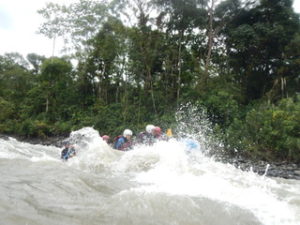
For the last two weeks I’ve been traveling through Ecuador, living with host families in the Amazon jungle and in highlands of the Andes Mountains. We river-rafted in the Amazon, horseback rode in areas adjacent to active volcanoes, zip-lined over high cliffs and climbed slippery waterfalls on narrow jungle trails while avoiding snakes, scorpions. and thorn bushes.

While rafting, our cocky guide toppled five out of six participants (including himself) into churning waters when showing off by standing on the raft’s rim. Our lives were put at risk in a second of his madness as I was thrown into a whirlpool under the water’s surface. Wondering if I would rise to the top and be rescued before my breathe gave out, I could have drowned. . . but I didn’t. The experience was exhilarating and I can’t wait to go again. I was trained in survival techniques before the trip so was able to remain calm rather than panic as did several fellow rafters.

But looking back, I realize that despite my daily fitness schedule, the strength I had as a youth is not there. I n acknowledge that risk-taking is relative to skill level, strength, and the ability to remain calm when stressed. A seventy-eight year old woman is not as agile or strong as the twenty year olds who filled the adjacent raft.

The young man my partner and I mentor is also a risk taker. He was fit with a good sense of balance and fearless. He worked hard by not always cautiously. Because he believed his life to be charmed and that he was above the possibility of a serious injury, instead of wearing his heavy safety-harness on lower-level scaffolding, he went without protection. His desire to move quickly, to be efficient, and to outshine other workers made him take risks. An accidental hit to his leg by a fellow painter sent him flying into permanent quadriplegic exile that now affects the entire family.

How much risk taking is a good thing? Sitting in a chair and never leaving home would be quite limiting. Physical inactivity caries its share of risks including the possibility of high blood pressure, coronary heart disease, anxiety and depression. Idleness and lethargy have instigated major health problems worldwide.

How can the need for physical challenges be balanced with our desire for safety? Do we protect our children from climbing trees or walking ta mile to and from school rather than sitting on a bus? In many nations, children travel two to five miles by foot to get to school each day. Walking or bicycle riding were the norm when I was a child but at time traffic was not as congested and we never heard of kidnapping or sex abusers.

An article in the BC Medical Journal talks of the risk-benefit paradox of exercise. It says that a certain amount is good and life giving while prolonged strenuous exercise training is associated with the risk of sudden cardiac death, atrial and ventricular arrhythmias and damage to muscles and bones.

How safe is safe enough in industrial settings, on children’s playgrounds, or in emerging technologies? The public ’s desire for a zero-risk society is threatening to political, economic, and personal expression. Our liturgical society has shifted risk away from individual responsibility. How do we set a balance for culpability? Some people crave more risky experiences than others. Is it in their DNA or part of their childhood exposures? If a person with Attention Deficit Disorder craves risk and acts without forethought who bears responsibility for the consequences of his or her action?

These questions are explored by many researchers and are difficult to assess. I can only speak for myself as a middle-of-the-road risk taker who tries to be prepared for an adventure that moves me a bit beyond my comfort zone. As a result, I have a rich variety of memories and experiences from having personal contacts with those living in other cultures. I’ve danced with tribal members in the streets of Kenya and in homes high in the Andes and learned about there views of family, politics, and religion. These excursions reinforce my belief that each person views the world in a unique way, yet are similar in their love of family, homeland, and a desire for peace and security.  
 

References:
Risk of Physical Inactivity: http://www.hopkinsmedicine.org/healthlibrary/conditions/cardiovascular_diseasesrisks_of_physical_inactivity_85,P00218/

Warburton, Taunton, Bredin, Isserow, The BC Medical Journal, The risk-benefit paradox of exercise, Issue: BCMJ, Vol. 58, No. 4, May 2016, page(s) 210-218 Articles: http://www.bcmj.org/articles/risk-benefit-paradox-exercise.

Pierced Through

These beautiful birds are protected at the Malheur Wildlife Refuge, yet they risk their lives when traveling to Mexico for the winter. I painted them last spring after taking our annual excursion to view Oregon’s migratory birds. Sorry, but the painting sold.

Ray took this picture of the Band-Tailed Pigeon perched on our back porch feeder. Notice the dart (or broken arrow) sticking out of it’s shoulder. This was a courageous bird that managed to make the trip from Mexico north, carrying the projectile the entire distance. It made me wonder why this poor pigeon was treated so poorly so I did a bit of research about killing birds.

The Guardian reported that conservationists are appalled at the illegal killing of 25 million birds a year in the Mediterranean alone. Egyptians line beaches with high nets across miles of the Nile Delta . Cypriots stop songbirds by smearing branches with glue, while the Italians kill anything that flies and the French set metal traps for small birds. Though these countries do have strong laws, they are not working. The Guardian mentioned that Italy and Egypt are the most dangerous countries for migratory birds followed by Syria, Lebanon and Cyprus where songbirds are a culinary delicacy.

Advertisers on Google promote dove hunting adventures to countries like Argentina, Uruguay, and Columbia. Hunters are supplied with 1000 free shells, and go on 8 shoots over four days for a cost of $2,600 plus tips. High volume dove shooting is also advertised by South America Adventure Safaris where the most experienced shooters stay in luxurious lodges. These mighty hunters face-off with ducks, pigeons, and doves. Most of the meat goes uneaten by the hunters though the organizers claim the birds supply food to the local community. Since most of birds are shot with lead pellets that become imbedded in their flesh, they are not safe to eat. The pellets also are a hazard to birds, such as hawks, that pick up lead shot from the ground and get poisoned.

I read a blog by a horrified writer who echoes my sentiments. “ I understand the idea of hunting for food or pest control, and I get the idea of hunting for sport but what I don’t get is why someone would go and kill a thousand birds, or a couple dozen. Is it the challenge? Doesn’t seem like a big challenge if some kid can take down a thousand on a weekend? What is the appeal?”

There were many answers.

One person mentioned that Doves eat grain and are considered a plague by farmers for they destroy entire crops in a night. Another boasted that their meat is delicious and hunting is fun, for it occurs when the weather is good as opposed to hunting ducks or geese.

Another answered, “There are a great many things I shoot and kill, yet have zero desire to eat. Moles, feral cats, nutria, rats, field mice, the neighbor’s dogs, voles, starlings … of course possum, raccoon and coyote as well. Crows just aren’t worth the trouble to clean (much like dove), but I hunt them anyway.”
However, one response that did make some sense to me was, “Number 1 rule of hunting . . . you eat what you kill! If you were hungry enough, you’d not only eat dog, you’d fight for the scraps.”

Now I am stymied. My bird feeder attracts lovely feathered creatures that I have come to treasure. The thought of them being killed for sport is demoralizing. The fact that we are wiping out populations of birds and animals on a mass scale I believe is unconscionable. On the other hand, the idea of people going hungry is also unethical. In poor countries, entire populations of wildlife are eliminated because of food insecurity.

What do we as a society do to address hunger as well as the needs of sportsmen? There are very real nutritional as well as recreational needs. Questions of population control, agricultural practices that encourage small farmers, and sharing of resources must be considered. Why can’t hunters have fun shooting drones or skeets instead of living creatures? Surely there must be a way to enjoy life without destroying nature.

The Anthropologist’s Way

Summer Night’s Dream
Acrylic on Canvas, 26” ato 32”, Gold Frame, $498

We are afloat in a world that has changed. The systems we grew up with in comfort are no longer applicable for a blended society that spans the globe.

The Anthroplogist’s Way

In college I majored in cultural anthropology, a pursuit my parents thought was one step up from useless. Since they assumed I would get married rather than travel the world to live among exotic tribes, they were not worried and never complained. They were right since I did get married at 18 and was a mother at 21. I never did go to the outreaches of Nigeria where I hoped find an unstudied people who would carry me to fame and fortune.

Looking back, I realize that I could not have made a better choice of major. Anthropology taught me a great deal and continues to guide my thoughts. It helped me understand how each person is culturally tied to the world from a unique vantage. And, though we reside within communities, our individual struggles make each of us the center of our own universe. We peer through tinted glasses shaded by family, community, economic conditions, and our own experiences.

Yet, with all of our differences, societies are similar in that they are organized around common systems. To understand the interrelationships between individuals, groups and institutions we studied beliefs and ways of organizing. The systems are identified as:

-religious
-political
-family
-economic
-social classes
-racial diversity
-gender roles
-ethical values
-distribution of wealth

These categories create an exchange of energy that defines the whole. Every society has them yet in each they differ.

Once I realized that societies have similar organizational needs, I reasoned that ego-centricity is the main cause of tension between cultures. The more I learned, the more difficult it became to define a particular system as good, better or best for it was created relative to the totality of everything in the environment.

I thought of how clothing can define a culture, yet they most likely were designed to accomadate a particular climate and habitat. For instance, those living in a Middle-Eastern desert would need to cover head, face, and body for protection from sandstorms and the burning sun. After realizing that these garments work well in harsh conditions, it is probable that the fashion was spread by nomads to nearby towns and cities. Since men and women’s bodies in Middle-Eastern countries are fully covered, their garments may also have contributed to ideas about morality and modesty. Of course, this is speculation on my part, but it makes some sense.

My high school history books talked about how ancient societies of hunters and gatherers slowly evolved to live a more agrarian existence. Further readings explained how pregnancies were welcome, for multiple births insured the group’s survival. Childhood diseases and accidents were rampant before antibiotics and deaths frequent. Hunting was dangerous and farming families needed many hands to till the land.

Today’s world has different challenges. Augmented farming methods give us the ability to feed more mouths with less need for labor. And though the birth rate has slowed in industrialized nations, population still increases in poor countries lacking resources. When a warming climate and war impacts those living in poor countries, families suddenly find that there is not enough safe, fertile land and drinkable water to survive. They are forced to migrate and come in conflict with strange organizational systems and beliefs.

Migrants as well as those in communities that accept them as immigrants become confused, don’t understand cultural differences, and have conflicting feelings about the ways “the others” view the world. The centers of their universes are now overlapped, causing tensions that can even lead to war. It happens quickly, with little time to accommodate.

Systems that previously worked well become suspect as migrants try to provide input even though most of their ideas are frowned upon by the dominant society. Few of us want to change. We hold on to our beliefs as though they are etched in stone forever more. We scream, fight, belittle, and say that we will not move away from what we have always known. We prefer to remain in a childhood comfort zone.

Time does not stand still and migrants do influence change. Societies constantly and painfully reorganize systems that mix cultural norms. The pushing and shoving, giving and taking that goes on around us is exacerbated by war, climate warming, population growth. Eventually a synergy results from this blending of cultures and people slowly adapt.

There are no absolutes. As mentioned earlier, we each see things from the center of our own universe. Einstein spent his waning years looking for a unified theory of the universe. His search for one unqualified, universal truth remains an unsolved challenge. We may never know absolute truth and for now, at least, have to deal with uncertainty and chaos.

What this means for most is that we must constantly question and realign systems as new input is received. It involves investigating beliefs and allowing that there are conflicting views that may be valid but we may never know for sure.

My parents would be surprised to discover that an anthropologist’s way of looking at systems might help different cultures coexist ccompassionately. By exploring common needs around food, water, land use and population perhaps rational decisions can be made to reorganize systems to benefit the majority.

Let’s also agree that it is OK to disagree when it comes to items of religious faith and embedded customs that do no harm to others. To live on this earth together, we have to bend a bit.
bend a bit.References:
1. Definition of Socio Cultural Anthropology, http://www.cod.edu/dept/anthro/cultural%20anthropology%20definition.htm
2. Noakes, Zoe, Why do the Poor Have Large Families? Compassion, January 2011, https://www.compassion.com.au/blog/why-do-the-poor-have-large-families
_______________________________

I look forward to your comments below.

Art is always for sale. Contact me at marilynne@eichingerfineart.com