Why Trust Science?

Nurturing

Though the environment is being destroyed by those who are insensitive to their surroundings there is still hope if each of us will take the time to plan and nurture one little seed.

Who Trusts Science Anyway?

It concerns me that the gap between the attitudes of scientists and those of the general public is widening. So many people do not realize that science is simply a way of thinking used by scientists. It is not an absolute but is similar to methods employed by mental health counselors engaged in helping clients overcome personal problems. In both instances, the scientific method begins with collecting background information, forming a hypothesis (a guess) about what is happening, testing the guess, and coming to a conclusion only to start the process over again. It is a never ending cycle of refining results based on tested facts. It requires the researcher, the public (or client) to be willing to be wrong about original assumptions and open to changing their opinion.

Social scientist, Gordon Gauchat was most surprised when he analyzed survey data pertinent to the public’s trust of the scientific community today as compared with forty years ago. He was particularly taken aback with information about conservatives. In 1974, Republicans with college degrees had the highest level of trust in science but as of 2010, they had the lowest. They are not alone in changing their attitude about science. There are many factions in our society that value their own beliefs more than those of the scientific community. Religious groups challenge evolution, industry groups are skeptical of climate change, and wary parents mistrust medical recommendations to vaccinate their children.

What has happened? Why are people so willing to accept pseudoscience and fake reports rather than information that has been tested? I find it even more strange to know that 8 out of 10 Americans believe that scientific advances have improved the lives of most people and 7 out of 10 have a high regard for scientists, yet they distrust the findings of these same investigators.

A 2015 study by the Pew Research Center shows that younger adults are less inclined than older generations to believe vaccines should be required for all children. There is a 37 point gap between scientists’ views about climate change being caused by human activity and those of the general public who believe it is mostly due to natural patterns. 3% are even holdouts who adamantly say that there is no solid evidence the earth is getting warmer. In matters of evolution, 65% of the public do say that humans and other living things have evolved over time while 31% believe humans and other living things have existed in their present forms since the beginning of time.

Scientists who want to understand how to make people more comfortable with scientific information do what good researchers always do, they test their hypotheses. One test demonstrated that when the people were presented census-messages that were the combined results of many scientists, they were more likely to change their opinion than if given arguments based on scientific reasoning. This means that if you think global warming is a hoax, you will most likely not accept a scientific presentation that explains otherwise even if it is filled with accurate data. Instead, if you are told that a censuses of scientists agree to thus and so, then you will be more willing to consider the possibility of the earth’s warming being man-made. (According to NASA’s review of multiple studies on climate change, 97 percent claim that climate-warming is likely due to human activities.)

Consensus-information is powerful because it shows the norm within a community. Though it presents information with a social-science approach rather than a scientific one, it is more comfortable to most people since it is similar to consensus decision-making that is part of the basis for cooperation. Consensus-information gives authority to a contention rather than requiring the individual to become an expert evaluator.

The media has been complicit in making the public more skeptical of scientific studies by promoting false news that emanates from political or business greed. Industries often pay scientists and marketers to spread disinformation. Big business has known for a long time that people make decisions on consensus-information rather than facts and have figured out how to spread doubt in order to build their own consensus-group based on false information. In Merchants of Doubt by Naomi Orestes and Erik Conway, the authors provide story after story about how scientists and advisers with deep connections to politics and industry run effective campaigns to mislead the public.

Let’s ask those who work for the media to increase their investigative reporting and challenge where information is coming from. My suspicion though, is that it will only happen if the public is willing to pay for investigations. there was a time when news departments were independent of advertisers. Edward R Murrow, Barbara Walters, Harry Reasoner, Dan Rather, Bob Woodruff, and Peter Jennings were trusted welcome figures in homes across America. Do you think the public could demand in-depth reporting once again? Are you willing to pay?

Please share your thoughts on my blog site, eichingerfineart.com/blog.

Artwork above: Acrylic Painting / 43” by 84” /$ 1,100.

Winter Wonder

Thunderbird with the World by Ray Losey
14 feet – Available – For information go to raylosey.com

The Thunderbird’s eye cautiously surveys the blanketed landscape outside our home. It has been years since Portland had so much snow in one fall. Ray measured 14 inches in the driveway.  I almost forgot the beauty of seeing white covered branches dipping deeply towards earth. Occasionally a snapped limb peaks up through the snow with its evergreen leaves adding color to the whiteness. During the storm I was conscious of the soft silence that covered the earth and enjoyed looking at the large flakes floating downward that can only be seen swirling under street lights. 

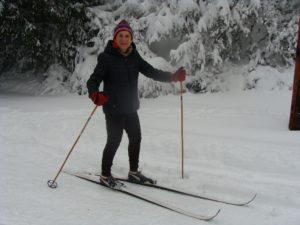
When I went outside the following day, the crisp cold air was refreshing even as I warmed with the effort of shoveling.  By the time I finished my own and my neighbor’s driveway, though my arms stung and back creaked, it felt good seeing what was accomplished in just a few hours.  But best of all was realizing that I recuperated quickly and was ready after lunch to find my sled to go speeding down the hill at the end of my street. Listening to bursts of laughter as adults and children joined in the merriment was fulfilling.  And what a pleasure it was to go cross country skiing from my front door. Who needs a car? We must have enough food stocked in our cupboards to last a month.

As an East Coast transplant, past Portland winters have been too mild for me. I missed bundling up in cold weather and having the opportunity to play in the snow. I do not like the idea of traveling hours to a winter resort. Perhaps Michigan spoiled me for I could ski on the farmer’s fields that surrounded my house.  With children sound asleep it was easy to take off for an hour of contemplation at 10 pm.  When there was a full moon shining on fresh snow it was haunting to silently glide through rows of corn stalks.

Traditionally, the third week of January is when the crocuses start to bloom at the Bishop’s Close in Portland. It is when Ray and I begin our weekly pilgrimage to watch spring unfurl. I wonder what will happen this year? There is no need for deep thoughts when nature makes its presence known.

Winter Wonder by Marilynne Eichinger – Sold

For more artworks by Marilynne go to eichingerfineart.com

Save the date: February 9th at 7 pm.
Book Talk at Annie Bloom’s Books in Multnomah Village, Portland.
Lives of Museum Junkies:The Story of American’s Hands-On Education Movement.

Workaholic or hard worker?

coos-bay-oregon

Coos Bay – Oregon acrylic on canvas/ 30“ by 40” / $499
Standing in the midst of this gentleness landscape set against moving water was refreshing and invigorating. Nature has a way of saying that there is more to life than work.

Are you a workaholic? What about a playaholic?

When my son was about 15 years old he turned to me and said, you and Dad work too hard. I’m not going to be like you. Life is for having fun. At the time he was just recovering from a life threatening illness, so I didn’t answer him with, “My work is fun!,” though that is what I felt like saying. It was not until years later that he began to realize that he might live to be an old man. Then he had a real conundrum? He had to make something of himself and apply himself. And, he did—but he never forgot how to have fun.

He now has a challenging business, yet finds the time to meet with his large circle of friends on a weekly basis. He works very hard and plays hard. I would never say his is a workaholic, though, I could see it happening. Work, especially for those who own a business, has a way of creeping up on you. There are times when my son is with me when I see that his mind does wander to the multitude of responsibilities he has instead of settling into “be hear now time.”

What is the difference between working hard and being a workaholic? There are clues to look for starting with cell phone use. Addicted people are constantly checking their phones and responding to messages on the spot even when in the company of others. Their work (or play) tasks interrupt social activities. They are the people who would go through withdrawal if their computer was not close-by or the WiFi went down.

We have to be careful, though, not all cell phone responders are workaholics. Edmund Neuhaus, Ph.D., director of the Behavioral Health Partial Hospital Program at McLean Hospital in Belmont, Massachusetts advises that it is important to consider the context of each situation and cautions that there is a big difference between being a workaholic and a person who works hard.

When business or play occupies all your mental and physical time at the exclusion of marriage, family and other relationships you may be verging on addiction. If sitting quietly makes you feel guilty for not being productively engaged, then you could have a problem. If, when no one is paying attention, you try to sneak in a little work, then you may be similar to an alcoholic who hides the bottle from his family. Many have trouble delegating work to others. They are perfectionists who believe they have to do everything themselves or it will not be done right.

Addicted people are often seen turning their hobby into a business. They forget that the hobby was originally selected as a way of relaxing. Play addicts are similar to workaholics in that their every waking moment is consumed in thought or action by the activity. Somewhere along the way, ‘fun-time” stopped being a refreshing break from work. When play adds tension and causes stress to your life, it is important to reevaluate what you are doing and why you are doing it.

Everyone needs some downtime, yet many workaholics resent vacations, even when their work will not be affected. Once that happens, they have likely become full fledged addicts.

“Not good,” says Dr. Neuhaus. Your health can be affected by high-stress activities at work or at play. Burnout, depression, anxiety, psychosomatic symptoms such as headaches and stomachaches and excessive alcohol consumption are frequently the consequences.

Interestingly enough, most workaholics deny their symptoms and do not acknowledge that they have a problem. Unfortunately, in many cases, their denial leads to a heart attack. It is usually family and friends who bring the problem to the workaholic’s attention. It may be done dramatically, such as when a spouse is fed-up with their mate’s long work hours and decides to sever the relationship.

Our culture doesn’t help. The United States is not like Europe where five-week vacations are the norm. Instead, it prizes the work-ethic and overachievement. Bosses reinforce hard work through praise, promotions, bonuses and raises rather than saying, “Good job, why not take time off?”

Play, care of self, exercise and a spiritual life contribute to longevity and a sense of well-being. So—work hard, yes, but be careful and lose the guilt when you are home relaxing with your loved ones. Work has a way of creeping up on you and giving a false sense of what is important to your well-being. Life is rich, varied, and beautiful if you let its many dimensions touch you. This holiday is a time to have fun. Take the stress out of your life. Play to relax and enjoy each moment with family and friends.

References:
http://www.webmd.com/balance/features/are-you-a-workaholic?page=2 – Can workaholism hurt you?

https://www.psychologytoday.com/blog/dont-delay/201003/the-personality-the-workaholic-and-the-issue-self – Psychology Today article about the personality of the workaholic.

SAVE THE DATE: Annie Blooms Books, Multnomah Village, Portland, OR – Talk and signing for Lives of Museum Junkies. The event starts at 7 PM.

Craftiness

Pulling Ivy – A weaving to commemorate the ivy pullers of the area.


A crafty way to stay out of trouble

By Marilynne Eichinger , Nov. 2016, NFS

CraftinessContinue reading

Community

The Gossips

The Gossips
12” by 36” / Acrylic Painting / $ 325
Getting community buy-in is often like whispering down the lane. It is a person to person conversation that eventually reaches a tipping point that pushes an idea over the precipice for implementation.

The following excerpt is from Lives of Museum Junkies that is due out at the end of August. Look for information in upcoming blogs. I will be holding several book signings beginning in Tampa, Florida in September; Lansing, Michigan in October; and Portland, Oregon in November. The book is presently at the printers and will be available in a few weeks. I look forward to seeing you at one of these events.

Community
“World events can never be ignored. A milestone that occurred when I was young turned the entire country looking skyward. Sputnik was launched. This was the first time a spaceship was successfully placed in orbit. I remember my mother saying to me that she always prided herself in keeping up with change, but somehow she could not understand what it meant to be putting objects in space. She felt lost and confused about the future.

Many adults today feel like my mother did in the Sputnik era. Technology continuously introduces changes at such a rapid rate that it is not surprising that coping is difficult. We watch many former jobs disappear, and at the same time sophisticated technological positions stay unfilled because of a lack of technical education. Streetwise once told me that he wished he were born one-hundred years ago. He did not like the competition and fast pace of city life, rebelled against using computers, and was fearful of driving on freeways. Thankfully, over the past years he has learned to cope with all of these realities.

This young man’s reaction was similar to that of many of his peers who lacked an understanding of basic subjects, current events, and scientific advancements. Yet these are the men and women who will be voting and making decisions that affect society in the future. The high school dropout rate in the United States is 25 percent, which is a concern since democracy depends on an educated populace.

As a museum director, I remained cognizant of our continually changing society with ever-evolving community issues, and soon realized that the job was filled with push-pull opportunities. I had ideas of what I thought the community needed, but it was not until citizens pushed me to accomplish what I preached that I could succeed. If I had not spearheaded the museum’s growth, it would not have happened, but it was the community that did not let me fail. People grabbed on to ideas and would not let them die. In some respects, I was set up to succeed as long as I was just willing to put in the hours, accept the pain and pitfalls, and not think about anything but the end result. Absolutely no one wanted me to fail. . . .

Lives of Museum Junkies offers insight into how this is done.
__________________________________
You may have a private business with family, investors and bankers committed to your success or you may be involved in a nonprofit organization that depends on community contributions. Perhaps you are working for one or another politician and walking door to door with his or her message. Whatever your passion, it is imperative that you not only communicate but get community buy-in if you want to succeed. This is not always easy. There is an art to organizing people and enabling them to feel a part of your cause.
__________________________________

Do share your experience in how you went about getting community involvement in your project. Respond at eichingerfineart.com/blog.
Artwork is always for sale. Contact me at marilynne@eichingerfineart.com.
________________
For sale on Amazon by Marilynne Eichinger: The True Story of Streetwise, overcoming homelessness and beating the odds. Go to AMAZON .

Fear

1372915lSquiggle –  Acrylic on canvas/ $ 25” by 37” / gold frame/ $ 490


Fear often results from confusion. Being unclear of the path forward can produce unsettled, anxious feelings that do not let you take risks.

FEAR

Throughout my working career I noticed that many workers were reluctant to take risks because they either feared failing or getting fired. Instead they remained docile and stayed in the shadows as they went about their tasks. I wonder if their brains were clamoring, “ you won’t succeed if you try a new concept or you can’t possible do that because it’s too difficult.”

Perhaps as children these yes sayers were ridiculed for spending time on “crazy or unproductive,” ideas. Maybe they had parents who told them, “you don’t do anything right! You always mess up. That’s just the way you are. ” Those deflating words can create insecure, timid adults afraid of tackling new ventures. Or perhaps they were risk takers but lost money trying to get their venture off the ground. Their self-image might have been destroyed and they became afraid of trying an unproven concept again.

Public pressure is another reason people refrain from testing new ideas. Savvy politicians are quick to say an idea won’t if it doesn’t come from their political party. Opponents are always on the look out for power plays and the media has great fun elevating potential failures to lofty heights making it politically dangerous to try. Once an idea fails, even though a great deal was learned that could lead to a more productive outcome, negative press can be devastating.

The difficulties generated from not taking risks can be great because failure is often a precursor to success.The scientific community know this is the only way to make progress. Scientists experiment with ideas, continuously making adjustments because of failures. Years are often spent pursuing an idea even though disappointing results face the investigator.

In 1937 a Bell Labs scientist named George Stibitz used relays in a demonstration adding machine. The same year a German engineer built his Z2 computer using telephone company relays. Building on these trials David Packard and Bill Hewlett played around in their garage, overcoming one failure after another before inventing the 200A Audio Oscillator, a piece of test equipment for engineers. In 1940 Walt Disney Pictures took a risk by ordering their 200B model to test recording equipment and speaker systems for newly equipped theaters in order to show “Fantasia.” Each of these entrepreneurs spent hours taking risks, often failing before developing societally useful applications.
I wonder what their families thought of their early frustrations. Did they say, “Honey, what you are doing is well and good but you need to spend your time making money to support our family.” Did they turn to their friends and say, “ She’s such a nurd, never doing anything practical!”

Penicillin was accidentally discovered by Alexander Flemming, Professor of Bacteriology at St. Mary’s Hospital in London. In the 1940’s he had just returned from a holiday in 1928 when he went to his lab. Sorting through petri dishes of Staphylococcus bacteria (the one that causes boils and sore throats), he noticed something strange in one dish. In a spot where a bit of mold was growing the Staph colony had disappeared. He had an idea. Yet It took ten years of further study, failures and research at Oxford University to turn what Flemming discovered into a life saving drug. Researchers focused on their goal even though they did not achieve immediate results. The risks they took cost money but their curiosity and hope led them to pursue their dream of curing many diseases. As they looked for answers I wonder if they were stymied by insecurities.

My life has been filled with many failures but each one gave me an idea to treasure. And though I want to help my children avoid my mistakes I have come to realize that they need to reach out, take risks and learn on their own. The best I can do is support them in their endeavors, overlook their failures and encourage them to use boldness in following their ambitions.

http://www.computerhistory.org/timeline/computers/ – history of the computer

http://www.acs.org/content/acs/en/education/whatischemistry/landmarks/flemingpenicillin.html#alexander-fleming-penicillin– discovery of penicillin

Art work is always for sale. Contact me at marilynne@eichingerfineart.com

Do respond below with your thoughts.

_______________________
For sale on Amazon by Marilynne Eichinger: The True Story of Streetwise, overcoming homelessness and beating the odds. Go to AMAZON .

Streetwise

Seeking Passion

DSC06759 (1)Bold Beauty by Marilynne eichinger

Acrylic Painting/ 30″ by 24 ” / $ 350.

Seeking Passion
A preview: The following excerpt is from my book, “Lives of Museum Junkies.”

Publication will be complete by August of this year. I’ll keep you posted.                         copyright © 2016 by Marilynne Eichinger.

“Passion has many definitions. It can include love and rage, sometimes at once. It can mean fear and hate as found in the writings of Mao Tse-Tung or joy, a feeling that is natural to all people. When I watched the movie Gandhi, I observed a man feeling a rage so intense that it moved him to action. Gandhi was willing to die for his cause. His love for his homeland and his compatriots was so powerful, so overwhelming that he was able to justify sacrificing himself. In the process of freeing India, he provided an important model of peaceful resistance. Martin Luther King based his civil rights marches on Gandhi’s lead, as did Nelson Mandela. The passion of these men helped win their fights for freedom.

I spent many evenings with my children discussing the pros and cons of passion. My most fervent hope was that they would be willing to take the risk to live honestly and with commitment. I did not want them to be afraid to experience the rewards and the pain that comes from following opportunity. When they were young, I tried to help them discover things to do that they would find absorbing. It did not make any difference what their interest was as long as it was legal. I wanted them to experience what it felt like to be totally invested in an activity and to be consumed so that it occupied their minds for hours each day. My hope was that when they became adults they would crave the feelings experienced as a child, and transfer their desire for passion to selected careers.

My views were influenced to an extent by my parents. Mother was a Republican and staunch capitalist. She believed nothing was beyond my grasp if I became focused and passionate about my undertaking. Mom convinced me that at the very least it was my responsibility to try wholeheartedly to reach my goals. As a side value I learned how important it was to have family support for my activities. My mother believed it was part of a family’s responsibility to their children to provide a consistent and positive foundation. She encouraged me to participate in various ventures and, if I failed, to view it as a learning experience—no problem. I am sure that is why I see failure as a precursor to success. It is also why I am not afraid to try.

Dad was a Social-Democrat who dedicated his life as a physician to serving the poor. He believed it was his responsibility to care for others less fortunate than he. His actions led him to seen as a saint to his patients and an eccentric to his family. We all paid a price for his passion as he worked around the clock to take care of those in need. I remember him getting up at two or three o’clock in the morning, rushing to see a patient in hospital or home. Observing Dad’s total dedication to his profession was inspiring to a young mind.

Martin Luther King Jr., the Kennedys, and Nelson Mandela knew the risks of advocating social and economic changes. As the nation honored these men of conviction, surely their families anguished over whether the risks taken were worthwhile. Janis Joplin, Judy Garland, and Jimmy Hendrix were passionate about their music and yet were never satisfied with their accomplishments. With every performance they were compelled to do better, to be more perfect. They were afraid of slipping, of being ordinary. They had passion for their art, but they lived without compassion for themselves. All three committed suicide. There is a delicate balance between dedicating yourself to a cause and maintaining a sense of identity. This is a great challenge in a meaningful life. . . . .”

More recently I am moved by stories of Mohamed Ali and by the actions of Bernie Sanders. Both men lived passionately and stood by their beliefs. Ali in particular exhibited tolerance for those who thought differently but was effective in finding ways of getting his views heard. From the distance of my living room I believe Ali and Sanders have lived happy, fulfilling lives. They have done their best and were not afraid to try.

Art work is always for sale. Contact me at marilynne@eichingerfineart.com

Do respond below with your thoughts .
___________________________
For sale on Amazon by Marilynne Eichinger: The True Story of Streetwise, overcoming homelessness and beating the odds. Go to AMAZON .

Streetwise

Seeking Perfection

Seeking Perfection

Seeking Perfection
acrylic painting on canvas/ 20” by 24”/ $ 399.

I have decided that perfectionism can be a curse. (Please don’t let my doctor hear that.) I imagine Olympians are not interested in this line of reasoning either. But as a parent and business woman I find that perfectionists create problems.

When I first started my museum in Michigan I hired an exceptionally talented woman to direct our education programs. She worked hard developing class curriculum and demonstrations that she gave to spellbound visitors. Her difficulty was in working with a team of people, many of whom were not as quick to grasp issues or creative solutions. She paid attention to what other staff was engaged in and was certain that she could do their jobs better. As a result of her disappointment in those she worked with she tackled evermore projects. Eventually she burnt out and quit.

This woman taught me an important lesson. It is important to maintain perspective by assessing progress periodically rather than daily when evaluating overall performance. I realized that people make mistakes and getting angry or being unforgiving is not a way to improve achievement or moral. She made me realize that my job as administrator was to teach, prod and inspire others to improve.

I noticed many workers arrive on the job reluctant to try new approaches because they feared failing or getting fired. They were docile and in the shadows as they went about their work. Their perfectionist brains clamored loudly saying, “ you won’t succeed if you try a new concept . . . you are a loser.” Perhaps these individuals were ridiculed at one time or another for spending time on “crazy or unproductive,” ideas. Maybe they had parents who told them, “you don’t do anything right! You will always mess up. That’s just the way you are. ” Those words are likely to produce insecure and timid adults afraid of tackling new ventures.

Or, they may have been more of a risk taker but lost money trying to get a new venture off the ground. Perhaps their self-image was destroyed and they became fearful of trying once more. At times public pressure keeps people from testing solutions to problems. Politicians are of good example of those who fear that “the other side” will be quick to say an idea won’t work. Opponents look for power plays and the media has great fun elevating potential failures to lofty heights even before they are tried.

The difficulty with the above scenarios is that failure is often a precursor to success. Scientists experiment with ideas over and over again, making adjustments because of failures. Years can be spent pursuing an idea even though disappointment results often face the investigator.

In 1937 a Bell Labs scientist named George Stibitz used relays in a demonstration adding machine. The same year a German engineer built his Z2 computer using telephone company relays. Building on these trials David Packard and Bill Hewlett played around in their garage, overcoming one failure after another before inventing the 200A Audio Oscillator, a piece of test equipment for engineers. In 1940 Walt Disney Pictures took a risk by ordering their 200B model to test recording equipment and speaker systems for newly equipped theaters in order to show “Fantasia.” Each of these entrepreneurs spent hours taking risks, often failing before developing societally useful applications.

I wonder what their families thought of their early frustrations. Did they say, “Honey, what you are doing is well and good but you need to spend your time making money to support our family.” Did they turn to their friends and say, “ She’s such a nurd, never doing anything practical!”

Penicillin was accidentally discovered by Alexander Flemming, Professor of Bacteriology at St. Mary’s Hospital in London. In the 1940’s he had just returned from a holiday in 1928 when he went to his lab. Sorting through petri dishes of Staphylococcus bacteria (the one that causes boils and sore throats), he noticed something strange in one dish. In a spot where a bit of mold was growing the Staph colony had disappeared. It took ten years of further study and research at Oxford University to turn what Flemming discovered into a life saving drug.

These men focused on their goal even though they did not achieve immediate perfection. They were curious and pursed a dream. They didn’t worry about what everyone else was doing or saying, but concentrated on their own work. As they looked for answers they weren’t stymied by perfectionist insecurities.

My life too has been filled with failure but each one taught me something to treasure. Though I keep wanting to help my children avoid my mistakes I have come to realize that they need to reach out and learn on their own. The best I can do now is support them in their endeavors, overlook their failures and encourage them to use boldness in following their ambitions.

http://www.computerhistory.org/timeline/computers/ – history of the computer


Art work is always for sale. Contact me at marilynne@eichingerfineart.com

Do respond below with your thoughts.
__________________________

Streetwise

For sale on Amazon by Marilynne Eichinger: The True Story of Streetwise, overcoming homelessness and beating the odds. Go to AMAZON .

Gossip and the Media

The ChairmanThe Chairman
mixed media on canvas/ 20” by 16”/ $399
Ever wonder how Mao Tse Tung got into into power? He was not loved by the establishment and once in office was feared by the very people who originally supported him.

Gossip and the Media
How many times have you heard people say, “I don’t want to fail.” When you hear those words it is often from a person who is trying hard to succeed. Their efforts may be pushy and the individual willing to ignore the social implications of what they are doing. There are also larger number of people who give up their dreams without striving because they are so afraid of the fallout from failure. They do not try and therefore never learn from their mistakes. They are afraid of gossip fallout and and a media that loves to expound on failures. Strangely publicizing controversy can turn vinegar into honey for a dedicated entrepreneur.

I certainly failed many times over. It would take more fingers and toes than I presently have to count the many instances of trial and error that ended poorly. Luckily, I had enough presence in mind to say, “well that didn’t work, what should I do next.” I try to learn from my mistakes especially when alternative viewpoints make sense. I’ll share a story from my book, Lives of Museum Junkies, that will be published this August.

My adventure began when I visited executive offices in Lansing, Michigan to meet with corporate and education leaders to discuss the idea of starting a new science museum. I wanted to raise funds for a hands-on education center and was not having much luck. One of the men I spoke to was the director of the YMCA. He emphatically told me I would fail because, “in Lansing there are only two things that matter. One is sports and the other is sex and you are not involved in either.” His comment was incredulous to me but I tucked it away to be recalled later.

“One day, with not much to do, I relaxed in my chair reading a magazine article about how the Playboy Bunnies visited communities to engage in sporting events against local celebrities in order to raise money for charity. My brain started churning and I remembered what the director of the YMCA said: “Sports and sex would be the secret of success.”
The Detroit Playboy Club was close enough to Lansing that I immediately called their manager. Much to my amazement, without hesitation or questions the Bunnies agreed to visit and play basketball against our community businessmen.

Days became exciting once more. I began to telephone every well-known chief executive I could think of and asked for his involvement. In the 70s they were all men and no-one declined. The game was on with a who’s who of local participants that included the mayor, president of MSU, superintendent of schools, CEOs of various manufacturing companies, real estate developers, the head of Oldsmobile, and state politicians. When the local newspaper learned of the event the game to became a feature.

One problem — a big one — reared its ugly head and I was reminded of lesson #1, “Nothing ever occurs as you might imagine.” The early 70s heralded in the start of the women’s lib movement with books by Gloria Steinem and Betty Friedan circulating and being read by a wide audience. The equal rights amendment was headed to the states for ratification and organizations like Planned Parenthood and NOW were growing in prominence. In East Lansing a group of high school students and university women threatened to picket the Bunny Game. What had started out as a fun crazy event was turning into a political nightmare and we didn’t know what to do. Now we had the makings not of a feature but of a gossip column. In fact, the gossip columnist did pick up the controversy with gusto and had a great time splashing the story daily. A number of the men who held public office called to inform me that they were reluctantly compelled to back out of their commitment.

My stomach churned with worry and I started looking for ways to work with the women libbers, finally coming up with the idea of asking Michigan State University’s woman’s basketball team if they would be willing to hold a practice game against our local celebrities. I hoped that by involving the female team the newspaper would soften the Playboy image and make the game acceptable. Their coach agreed to the practice, and the celebrity men arrived for a grueling session. The women on the basketball team were of course fantastic athletes in perfect condition. Our men, many of whom were potbellied, had to be replaced every three minutes to ensure there were no injuries.

Our celebrity team enjoyed their practice game, but it was not enough to silence the critics. Ticket sales were sparse and we were prepared to fail when a miracle occurred. Thankfully for us (though tragically for a great many) we were rescued by Mother Nature. The night before the game the clouds exploded and it started to rain and rain and rain. The greater Lansing area was deluged with a fifty-year flood and all citizens not concerned with their own water-filled basements were called on to bag the river banks. Jenison Field House at Michigan State, where we were to have played, was swimming in two and a half feet of water, flooding the basketball court.

The Playboy Bunny Game had to be canceled. My sigh of relief is still being carried on the winds today. But the upside to the controversy is that the science museum became a known entity and on its way to becoming more than just an office in a public school. By now the entire Lansing community knew what was being planned and though many did not like the Bunny Game they certainly did support our idea for Impression 5.”

The museum got off to a start with the basketball game that was never played. I learned very directly that bad publicity as well as good can get you towards your goal. This experience is why I understand the phenomenon we call Donald Trump. It is why every time he says something horrible, his publicity increases and more people flock to his side. It is also how social beliefs get changed and evaluated. In my case, the women’s movement entered my consciousness for the first time. As the only female president of a science center I never thought about other women as I pursued my dream. Suddenly I became aware that I as well as others were fighting an uphill battle and we had to join together for a common cause.

Trump has brought to the forefront previously unspoken issues that need to be addressed. He appeals to an underclass of people who have been neglected and are angry. Whether Trump is the one to solve inequality problems I will not comment on in this article. But because of Sanders and Trump there is a good chance that the issues around trade and Wall Street will not go away.

A recurring problem is that when a politician is not ethical or has hidden agendas, once in power the outcome may not be what the voting public desired. A pattern of corruption can be found throughout the world in local as well as national political elections. Unfortunately, once in power the oligarch often controls the very media that helped him or her get elected.

I am not saying that people should barrel ahead and make news worthy waves whenever they want to accomplish something new. I am suggesting that an entrepreneur or politician has to persevere at times and look outside of the box by taking risks. Hopefully the cause is just and the promoter has intentions that will benefit society. A wise viewer listens skeptically to TV news gossip and digs to find the true intentions of the speaker.

References:  Quote from Lives of Museum Junkies, by Marilynne Eichinger, presently being published by Inkwood Press. Look for an announcement August 2016.

Art is always for sale. Contact me at marilynne@eichingerfineart.com.


Spring Has Sprung

Spring has SprungSpring Has Sprung

When I was a kid I remember reading a poem that went like this:

Spring has spring
the grass is riz
I wonder where
my jacket is.

Every spring those words pop into my mind when with the first flower that peeks through the ground. I tried to discover who wrote the verse and came up with a big zero. Though often attributed to Ogden Nash or ee cummings, the poem has roots that go back further in time to an anonymous author.

Spring is sprung, the grass is riz,
I wonders where the birdies is.
They say the birds is on the wing.
Ain’t that absurd?
I always thought the wing was on the bird.

There is my favorite adaptation in Arnold Silcock’s Verse and Worse.

The Budding Bronx

Der spring is sprung
Der grass is riz
I wonder where dem boidies is?

Der little boids is on der wing,
Ain’t dat absoid?
Der little wings is on de boid!

And then – attributed to Ogden Nash though I can’t find proof.

Spring has newly sprung
the hills are full of grass
and along comes a billy-goat
sliding on his overcoat down the summer pass.

Whatever the words, they carry the joy, laughter and beauty of springtime and with it a reminder of the earth’s rebirth and the possibility of starting anew and having a second chance.

So often I dwell on problems confronting society that I forget that the universe is in a constant state of transition. I have to remind myself that political movements are cyclical, that family crises peak and somehow get resolved, and that those who help others are honored in return. Since time does not stand still and the earth will be here long after I am gone, I can only hope there care wise land stewards enabling my great, great grandchildren to enjoy the boidies and see that the grass is riz. Or perhaps we all must look inward and ask ourselves if we are doing our part to care for the environment.

http://www.answers.com/Q/Who_wrote_’Spring_has_sprung_grass_has_ris_I_wonder_where_the_birdies_is’ – sources for spring has sprung.

Your thoughts? please respond below.

Art is always for sale. Contact me at marilynne@eichingerfineart.com

____________________

Streetwise

For sale on Amazon by Marilynne Eichinger: The True Story of Streetwise, overcoming homelessness and beating the odds. Go to AMAZON. What is it like to live on the streets? How do we help so many young people escape a life of hopelessness?