#FutureOfWork

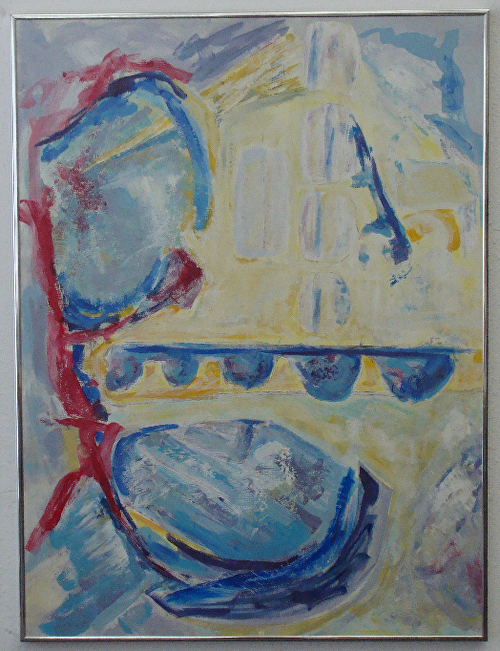
Oregon City Falls
Oregon City, located at the end of the Oregon Trail, was the first city west of the Rocky Mountains to be incorporated. It also boasts being the site where the first long distance electricity was sent over wires, traveling 14 miles to Portland. It takes a boat ride to fully see how the area has changed. Mills that used to line the river are abandoned and buildings look dilapidated. Change is a constant in everyone’s life. Are you ready for it?

Preparing for Work-Part 1

Following is the first of a series of newsletters discussing education and employment opportunities for working age people. This blog provides background information that will feed into stories about how to adapt in an era where rapid changes in the economy, political climate, technology, and environment are the norm.

Parents often direct their high school graduates to enter fields that pay well in today’s marketplace. As a result, students register for college classes that are narrowly targeted towards careers they may or may not be interested in. Though current research shows that attaining a higher education leads to a better job, only 58% of those starting college graduate according to the National Student Learning House Research Center. This means that only 6 out of 10 enrolled students will receive a degree by the end of six years. Those leaving early can be so weighted down with debt that they will never have the earning potential to pay it off. 

In 2019, postsecondary enrollments decreased by 1.3 percent, though the completion rate did rise a piddling amount. Business, marketing, health related professions, and general studies are among the most popular majors for entering freshmen.

Colleges increasingly find it difficult to make ends meet, causing them to  become more inventive.  They lure students in with degree or certificate granting programs in such fields as casino management, cybersecurity, sports communication and business, eSports, competitive video gaming, food studies, hip-hop studies, social entrepreneurship and aging, beer fermentation, wine and viticulture technology, and manufacturing. There are masters degree offerings in peace education, political campaign management, and embodiment studies (Goddard College describes this as “honoring the intelligence of the body and its capacity for insight and liberation with respect to lived bodies, social bodies, and the living earth.” Some, but not all of these programs are good bets.

Technology has had a major influence on the way classes are taught. The number of students enrolled fully online increased dramatically during the last few years. In the past, work and family obligations were typical reasons given for distance learning, but today a growing number of students (34 percent) say they prefer to learn this way. Those under 45 years are likely to use mobile devices to complete course related activities.

Most college students work, but the type of work they do and the hours employed differs for low and high income students. Low-income students are more likely to have full-time jobs than those with financial resources. Unfortunately, students working 15 or more hours per week have C grade point averages or lower. Those employed less than 15 hours a week attain B average and higher grades. In general, lower income students enroll in associate degree and certificate programs while those with higher incomes aim for bachelors degrees. 

The greatest difference between the poor and the wealthy is that low-income students work to feed and house themselves while their more privileged colleagues work in order to make connections for long-term professional and academic reasons. This disparity tends to “compound social inequity” according to Lindsay Ahlman at the Institute for College Access and Success. In other words, all too many students, have to choose between studying or working for their food and shelter. 

Student homelessness has been on a steady rise. Approximately 1.5 million public school students experienced homelessness during the 2017-18 school year. Among college students the situation is reaching crisis proportions. The Hope Center for College, Community and Justice found that 18% of two-year college enrollees and 14% of those in four year institutions are essentially homeless. They live in cars, couch surf occasionally with friends and stay in overnight shelters. Insecurity affects their emotional stability, creating doubts about their future. 

Not everyone is college bound, but a stigma still exists in choosing a trade school over college. This is especially true for youth living in households where their parents consider college to be the only true path to success. 

Despite this disdain, trade-school enrollment is up from 9.6 million students in 1999 to 16 million in 2014. This follows a decline in the 80’s and 90’s that left the country with a shortage of skilled workers and trades people. Many vocational jobs, though, requires four or more years training that includes attaining computer skills. Businesses like general motors and Intel work have joined forces with colleges and unions to offer a mix of on-the-job-training with academics. Half of the secondary school students in Europe are enrolled in vocational programs. It ’s time to get rid of the college-for-all narrative in the U.S.. 

The next fifty years are going to be quite different than those of the boom years following the second world war. Computers and robots have already assumed jobs previously held by people. Drones and driverless trucks will deliver packages. Legal research, accounting, computer programming, web design, and call center systems are being managed by people in distant countries like India. 

Youth are going to have to develop the mental aptitude and flexibility to thrive in a chaotic altered landscape. What a person studies in college may not be related to their employment twenty years later. Being curious, having a broad perspective, and the ability to problem solve is apt to prove more valuable than a narrowly defined expertise.  

Since this is likely the situation students will face, what do they need to know to be able to move-within-the-flow of uncertainty?  Let’s think about this question and consider it more fully over the next few weeks.

Next week – Preparing for the Future: Part II – The Path Least Taken

References: 

Nadworny,E. (2019) College Completion Rates are Up, but the numbers will Still Surprise You. NPR. retrieved from https://www.npr.org/2019/03/13/681621047/college-completion-rates-are-up-but-the-numbers-will-still-surprise-you

Marcus,J ( 2018)Panicked universities search of students are adding thousands of new majors. The Hechinger Report. retrieved from https://hechingerreport.org/panicked-universities-in-search-of-students-are-adding-thousands-of-new-majors/

current statistics  (2019)  Term of Enrollment Estimates, National Student Clearinghouse Research Center. retrieved from  https://nscresearchcenter.org/report-search/

Lederman,D. (2019) Online College Studenets.  Inside Higher Ed. retrieved from   https://www.insidehighered.com/digital-learning/article/2019/06/05/annual-survey-shows-online-college-students-increasingly

St.Amour,M. (2019). Working College Students. Inside Higher Ed.  https://www.insidehighered.com/news/2019/11/18/most-college-students-work-and-thats-both-good-and-bad

Zaveri,M. (2020) Number of Homeless Students Rises to New High, Report Says. New York Times. retrieved from https://www.nytimes.com/2020/02/03/us/Homeless-students-public-schools.html

Jones,C (2019) Homeless in College: Students sleep in cars, on couches when they have nowhere else to go. USA Today. retrieved from https://www.usatoday.com/story/money/2019/06/10/homelessness-among-college-students-growing-crisis/3747117002/

St-Esprit,M (2019) The Stigma of Choosing Trade School Over College. The Atlantic. retrieved from https://www.theatlantic.com/education/archive/2019/03/choosing-trade-school-over-college/584275/

_________________

Art is always for sale. Contact me at marilynne@eichingerfineart.com

Oregon City Falls– Acrylic on canvas – 36” x 48” – $ 1,100

#transformations

You Decide

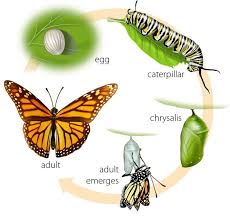
“We delight in the beauty of the butterfly, but rarely admit the changes it has gone through to achieve that beauty.”  Maya Angelo 

Maya Angelo made me think about how I’ve changed over the past one hundred and ten active years (I wish).

Metamorphosis of a Butterfly

The Beauty of a Butterfly

Developmental psychologists have differing ideas about of the number and kind of transformations human beings experience in a life time.  In the mid-1900s, German-American Psychoanalyst, Erik Erikson, coined the word identity crisis which brought about changes that occurred in childhood, adolescence, and emerging adulthood. And, he spoke of eight stages of virtues people acquire throughout their lives.

Dr. Thomas Armstrong, Executive Director of the American Institute for Learning and Human Development, says their are twelve developmental stages.  Developmental psychologist, Piaget, noted four childhood stages.  Rudolf Steiner extended Piaget’s thinking into adulthood and added three more. My head whirls with competing ideas of how often transformation takes place, but in, general they, they all focus on cycles of learning, changing, and transforming to attain beauty. 

A question raised by psychologists is whether human development is a continuous or discontinuous process.  Most agree that failure to successfully complete a stage can result in an unhealthy personality and unrealistic sense of self, but they disagree about the stages need to be completed in an age order progression. I happen to believe that there is no set age for a transformation to be complete. 

Dr. Armstrong writes, “Since each stage of life has its own unique gift to give, humanity needs to do whatever we can to support each stage and to protect each stage from attempts to suppress its individual contribution to the human life cycle.” What does this mean? It means we need to be careful not to apply undo pressure to preschoolers to achieve academic success, that parents need to be taught to support and recognize their child’s developmental stages, and that the wisdom of seniors needs to be acknowledged and protected from elder abuse. It also means giving everyone the care and assistance needed to blossom to the fullest degree possible.. 

I like the way Armstrong discusses the stages and why completing each one successfully is important in later life. A synopsis follows.

  1. Prebirth:  Potential – Parents dream. The child who has not yet been born could become anything – a Michelangelo, a Shakespeare, a Martin Luther King.
  2. Birth:  Hope – A newborn instills a sense of optimism that this new life may bring something new and special into the world.  
  3. Infancy (Ages 0-3):   Vitality – The infant is a vibrant and seemingly unlimited source of energy.  
  4. Early Childhood (Ages 3-6):  Playfulness, innovation, transformation – Young children at play recreate the world anew to combine what is possible with what has never been seen before. 
  5. Middle Childhood (Ages 6-8): Imagination – The sense of an inner subjective self developing for the first time serves as a source of creative inspiration in later years.
  6. Late Childhood (Ages 9-11): Ingenuity – Acquiring social and technical skills enables children to develop strategies and inventive solutions for dealing with the pressures society places on them. Ingenuity lives on, helping adults seek ways to solve practical problems and cope with responsibilities.
  7. Adolescence (Ages 12-20):  Passion –  Puberty unleashes powerful changes reflecting sexual, emotional, cultural, and/or spiritual passion. It remains a touchstone for adults seeking to reconnect with their inner zeal for life.
  8. Early Adulthood (Ages 20-35):  Enterprise – Young adults become entrepreneurial in order to find a home and mate, establish a family and/or circle of friends, and get a good job.  Enterprise helps young adults go out into the world to make their mark.
  9. Midlife (Ages 35-50):  Contemplation – People in midlife commonly take a break from worldly responsibilities to reflect upon the deeper meaning of their lives. Contemplation is a resource to draw upon for enrichment at any age.
  10. Mature Adulthood (Ages 50-80): Benevolence – Mature adults contribute to the betterment of society through volunteerism, mentorships, and philanthropy.  Humanity benefits from their benevolence. 
  11. Late Adulthood (Age 80+): Wisdom – Elders can help younger people avoid the mistakes of the past while reaping the benefits of lessons learned throughout life.
  12. Death & Dying:  Life – Those who are dying, or who have died, teach us about the value of living and remind us not to take our lives for granted.

Where I am? Did I complete each stage successfully or do I still have some work to do to transform fully. I do wonder if the wisdom I believe I acquired is relevant. The world is not the same as it was when I was a child. Technology, population increases, methods of communication, and environmental degradation add dimensions to my childhood experiences.  

Young adults aren’t interested in listening to dinosaurs who live in the past. They want to explore life on their own. The enjoyable challenge of being alive is partaking in the process of discovery. They willingly risk making mistakes in order to learn on their own. This is why historians find missteps in governance, war and social order are repeated many times over. 

China’s dynastic tradition presents a good, though oversimplified, example. Enlightened rulers were followed by generations who inherited positions of power. Successive rulers became lazy and greedy, causing ordinary citizens to suffer until the leadership was overthrown, bringing about dynastic change which started the process again. Through the past 5000 years, China watched numerous dynasties collapse and new ones gain in strength. Yet, societal transformation was slow, falling into five major stages— Primitive, Slave, Feudal, Semi-feudal and semi-colonial, and Socialist. 

The wisest thing this butterfly can do before flying away, is to hold her tongue and not tell people how to live their lives, but help them learn to think so that they will grasp nuances and changes in the social and physical environment. Youth needs to know how to gather a range of information, to consider it honestly and critically before making decisions. They need to listen to the news and dig for the truth on their own rather than rely on others to tell them what to believe. Instead of answers, elders should spread their wings over the next generation while they question preconceived values and ideas and integrate their findings with the world as it is today and the way they want it to be tomorrow.  

References:

Armstrong, T. ( 20201 )The Human Odyssey: Navigating the Twelve Stages of Life. American Institute for Learning and Human Development. retrieved from website at https://www.institute4learning.com/resources/articles/the-12-stages-of-life/

McLeod,S. (2018)Erik Erikson’s Stages of Psychosocial Development. Simply Psychology. retrieved from https://www.simplypsychology.org/Erik-Erikson.html

History of China, Travel China Guide. retrieved from their web site at https://www.travelchinaguide.com/intro/history/

————————-

Art is always for sale. Contact me at marilynne@eichingerfineart.com

You Decide – Acrylic on deep canvas – 16” x 40” – $ 385

I look forward to your comments on my blog site.

#activeshooter

Eastern Oregon Contemplative 

Remaining calm, aware and ready to act in the face of adversity is a practice that can be learned. 

Active Shooter Preparedness

I don’t think of myself as an alarmist, but do believe active shooter preparedness is necessary for people living in a politically divided, trigger happy country that provides inadequately for those suffering from mental illness, permits extremists to threaten church goers, is unwilling to tackle gun control legislation, and has replaced “pardon me” and “I’m sorry” with “fuck you” and “shit.” 

How people acted in the wild west in the seventeen and eighteen hundreds was more restrictive than now. Tombstone, Dodge City and many other towns required visitors to disarm when they entered, either at a hotel or a lawman’s office. Saloons had the right to bar guns from their establishments and criminals were run out of town. Today, we live next to people who take the right to bear arms as a right to invoke fear and act independent of the law. 

As a member of a center city church that emphasizes the commandment to “love thy neighbor as thyself,” I don’t like to think badly of others. But we were tested when extremists blocked the entrance, shouting obscenities and bible passages condemning us to hell. Choir and congregants handled it well by surrounding the agitators and serenading them with songs of love and peace. The UU church in Washington, DC had a similar experience just two weeks ago. They found the experience frightening. 

Over the years, a great many intimidating situations threatened my equanimity. 

  • My physician father, his office nurse, and a patient were made to lie on the floor at gunpoint by a patient looking for drugs. After the incident was over, he installed dozens of security buzzers throughout. 
  • A close friend was held hostage by men hoping to receive a disgracefully large amount of ransom money. The woman had composure enough to push an alarm alerting the police. 
  • 3) My sleep was shaken by men shouldering our door in an effort to break into our home at 2 am. While I cowered, my partner became instantly alert and was able to frighten them away. 
  • 4) On the East Coast, my cousin’s son, a psychiatrist, was shot by a mentally ill patient he was counseling. Thankfully he lived by knowing how to protect himself.
  • 5) While still a business owner, my facility was burglarized several times. Fortunately, guns were not used. One year, several men broke into my warehouse the day after Christmas and stole hundreds of toys.
  • 6) On another occasion, after being alerted by my security system, I drove in the middle of the night to find a semi truck without plates parked by the facility’s overhead doors. Fortunately, the incident was resolved without violence, but it was a close call.
  • A more violent incident occurred while president of OMSI. A manager fired an employee who instantly turned against the manager, punched him and continued beating him up. We were concerned about the disgruntled employee returning armed.
  • 8) My granddaughter traumatically surviving the horrible 2017 shooting at a music concert in Las Vegas took away the last remnants of my naivety. Thankfully, someone in the audience knew to shout commands of when to duck and later run. Without that person’s awareness, she and others might have remained frozen in place.

I am an ordinary woman who always lived and worked in “safe” neighborhoods without drugs or drive by shootings. Yet, my family and I were victims of the ugly side of human nature. I imagine many of you have similar stories you could share. 

People do not always abide by the laws of love, kindness and fair play that were instilled in me as a child. Recognizing this, I asked myself what I needed to know to respond appropriately to threatening situations, without becoming fearful or paranoid. What would help me think clearly if I found myself in such a setting? The federal government provides advice; “Remember during an active shooting to RUN. HIDE. FIGHT.”

Be Informed

Sign up for an active shooter training. If you see something, say something to an authority right away. Sign up to receive local emergency alerts and register your work and personal contact information with any work sponsored alert system. Be aware of your environment and any possible dangers.

Make a Plan

Make a plan with your family, and ensure everyone knows what they would do, if confronted with an active shooter. Look for the two nearest exits anywhere you go, and have an escape path in mind & identify places you could hide. Understand the plans for individuals with disabilities or other access and functional needs.

DURING, run and escape, if possible.

Getting away from the shooter or shooters is the top priority. Leave your belongings behind and get away. Help others escape, if possible, but evacuate regardless of whether others agree to follow. Warn and prevent individuals from entering an area where the active shooter may be. Call 911 when you are safe, and describe shooter, location, and weapons.

HIDE, if escape is not possible.

Get out of the shooter’s view and stay very quiet. Silence all electronic devices and make sure they won’t vibrate. Lock and block doors, close blinds, and turn off lights. Don’t hide in groups- spread out along walls or hide separately to make it more difficult for the shooter. Try to communicate with police silently. Use text message or social media to tag your location, or put a sign in a window. Stay in place until law enforcement gives you the all clear. Your hiding place should be out of the shooter’s view and provide protection if shots are fired in your direction.

FIGHT as an absolute last resort.

Commit to your actions and act as aggressively as possible against the shooter. Recruit others to ambush the shooter with makeshift weapons like chairs, fire extinguishers, scissors, books, etc. Be prepared to cause severe or lethal injury to the shooter. Throw items and improvise weapons to distract and disarm the shooter.

After

Keep hands visible and empty. Know that law enforcement’s first task is to end the incident, and they may have to pass injured along the way. Officers may be armed with rifles, shotguns, and/or handguns and may use pepper spray or tear gas to control the situation. Officers will shout commands and may push individuals to the ground for their safety. Follow law enforcement instructions and evacuate in the direction they come from, unless otherwise instructed.

Take care of yourself first, and then you may be able to help the wounded before first responders arrive. If the injured are in immediate danger, help get them to safety. While you wait for first responders to arrive, provide first aid. Apply direct pressure to wounded areas and use tourniquets if you have been trained to do so. Turn wounded people onto their sides if they are unconscious and keep them warm.

Consider seeking professional help for you and your family to cope with the long-term effects of the trauma

To these lists I add;

Run over scenarios in your mind, imagining the best way to respond. Envision yourself remaining calm, alert, and looking for an opportunity to escape and call for help. This exercise will help you react rather than remain frozen in passivity if you find yourself in a real situation. 

Make sure doors and windows at home have locks and each night check that they are in place. 

When walking alone be aware of your surroundings. Keep your distance from people who might threaten your safety. Look in the back of your car before entering, ensuring that it’s empty.

Thinking of possibilities in advance and deciding how to react strangely enough is a calming activity. Worry stops and muscle memory steps in if you are prepared. No one wants to live in constant fear. If you do, you would never step into a car or plane again.

To deny that we live in unstable times, is foolish . . . to be prepared as best one can, is wise. My assumption is that most people are kind, helpful, and well meaning. My hope is that with tenderness even the most difficult hearts can be reached. I send these thoughts with love and caring for your safety this Valentine season. 

Resources:

Jancer,M. (2018) Gun Control is as Old as the Old West. Smithsonian Magazine. retrieved from https://www.smithsonianmag.com/history/gun-control-old-west-180968013/

Disasters and Emergencies, Ready. retrieved from the web site at  https://www.ready.gov/active-shooter

RUN. HIDE. FIGHT.® Surviving an Active Shooter Event – English (video)

Please share your thoughts on my blog site. 

______

Art is always for sale. Contact me at marilynne@eichingerfineart.com.

Eastern Oregon Contemplative Acrylic on Canvas/ 21’ by 25/ gold frame – $ 389

#Envisioning

Clarity
acrylic on canvas / 45” x 36” / silver frame / $699

To Look, To See, to Envision.

What does it mean to see well, to see the world clearly, as it is, and to envision the future? A newborn discovers her hands and spends hours fascinated by their shape and movement. A mother turns a switch on a mobile above her sons crib so it will rotate to the sound of a lullaby that helps him fall asleep. As the days go by, a fog lifts slowly from the children’s eyes. The mother’s features sharpen as the infants study her closely while held against the warmth of her body. 

Several years later, those same infants are thrust into the reality of every day life in a poor household. They move through their small home, admonished not to wake their father who is sleeping, exhausted from a demanding night job. The mother, absent by day, returns late afternoon after spending eight hours on her feet cleaning houses. She too would like to rest and be left alone.

These parents love their children and work diligently to provide for their offspring. They cope by lowering the shades, turning off lights and allowing the glow of children’s programs to permeate their living area. Television is the third parent in the room. It raises their children by keeping them safe at home though mindlessly occupied and physically inert. Cartoon images flash and high voices babble twenty-four-seven, maintaining a continuous backdrop of sound that put them sleep and greets them awake. 

I’ve been observing the household for several yeas and can understand how tight finances can create a visual handicap.  The children look but don’t really see. They are not asked to do anything no presented with opportunities to try, fail,  persevere, and succeed. They are learning to give up easily. 

Interacting with them mades me think about the difference between looking, seeing, testing, and envisioning.  Given this background, I wonder how to inspire them to be curious and to search for details in the objects of their curiosity.

My childhood mentors helped me stretch my vision. One demonstrated the scientific method and demonstrated how to bring what observations into the microcosm of my soul. Another coached me to recognize edges. I studied a drop of dew on a leaf,  learned to visualize rainbow colors in flash of sunlight, and to smell the perfumes of everyday objects. A third, showed me subtleties of nature, to notice the movements of animals and birds against a background in camouflage. I became aware that wisdom of evolves with stops, starts, twists and turns, influencing how I envision the future. He helped me notice that the rocks we stand on, the homes we build, the air we breathe, and the people we love are an interconnected part of nature.

I’ve been wondering what presents I can bestow on the youth who cross my path. I decided it is not money or material things they need most but rather twin gifts of vision and curiosity. If I can influence them to look beyond the surface, to search for truth, to see details and nuances, they will never be bored. If they can gain courage to try, to fail, and to try again, they will be content. And, as they assimilate what they see and learn, they will envision a future filled with opportunity. 

#theeducatedperson

ON TOP OF IT ALL- but, does he know it all?

What is an Educated Person?

Schools teach, and students presumably learn. When I interact with recent graduates,  however, I wonder how well educated they are. I realize that notions of what makes an educated person have changed through the ages and that I have to “get with the new,”  but it is not easy to do. 

The Sparatican Greeks considered the gymnasium as essential to Greek culture. They saw the purpose of education to develop well rounded warriors.  They made education available to males and non-slaves through public schools and private tutors who included music and dance as ways of enhancing maneuverability as soldiers. Youth learned poetry and musical lyrics to focus attention on beauty, nobility, harmony and rhythm. Children were taught to read and write with a stylus on wax-covered boards and made to memorize and recite legends of old. By the time a boy reached adolescence formal education ended and human experience took over. 

It was not until about 420 BC that higher education emerged in Athens where philosophers and teachers like Socrates holding forth. Intellectual attainment began to be held in higher regard than physical capacity. It was a democratic city subject to the votes of adult male citizens. The Athenians believed that education should develop the whole man. To that end, studies included mathematics, astronomy, harmonics and dialectic. They thought it important to learn rhetoric and techniques of persuasion to get the assembly to act as they desired.  Skill training and academic subjects came later.  The goal of learning was to develop philosophical insight, a necessary tool for using knowledge within a framework of logic and reason.  Does that makes sense to you?  It does to me.

Society’s needs have changed, and notions of what makes an educated person is fraught with factionalism. Eleanor Dickey Professor of classics at the University of Reading, “Spartan king Agesilaus once said that what matters in education is that children must learn the skills they will use when they grow up.” Though still quoted, public schools don’t design curricula with that purpose in mind.

Several years ago students at Harvard were warned that professional credentials will count for less when measured against real world training. They compiled a list of the skills they thought were needed.

  1. The ability to define problems without a guide.
  2. The ability to ask hard questions which challenge prevailing assumptions.
  3. The ability to quickly assimilate needed data from masses of irrelevant information.
  4. The ability to work in teams without guidance.
  5. The ability to work absolutely alone.
  6. The ability to persuade others that your course is the right one.
  7. The ability to conceptualize and reorganize information into new patterns.
  8. The ability to discuss ideas with an eye toward application.
  9. The ability to think inductively, deductively and dialectically.
  10. The ability to attack problems heuristically (learn something for yourself).

Josh Kaufman, noted author of the Personal MBA, added to this compilation a list of what he calls “Core Human Skills.”

  1. Information-Assimilation – how to find, consume, and comprehend information and identify what’s most important in the face of a problem or challenge.
  2. Writing – how to communicate thoughts and ideas in written form clearly and concisely.
  3. Speaking – how to communicate thoughts and ideas to others clearly, concisely, and with confidence.
  4. Mathematics – how to accurately use concepts from arithmetic, algebra, geometry, calculus, and statistics to analyze and solve common problems.
  5. Decision-Making – how to identify critical issues, prioritize, focus energy/effort, recognize fallacies, avoid common errors, and handle ambiguity.
  6. Rapport – how to interact with other people in a way that encourages them to like, trust, and respect you.
  7. Conflict-Resolution – how to anticipate potential sources of conflict and resolve disagreements when they occur.
  8. Scenario-Generation – how to create, clarify, evaluate, and communicate a possible future scenario that assists in decision-making, either for yourself or another person.
  9. Planning – how to identify the necessary next steps to achieve an objective, account for dependencies, and prepare for the unknown and inevitable change via the use of contingencies.
  10. Self-Awareness – how to accurately perceive and influence your own internal states and emotions, including effective management of limited energy, willpower, and focus.
  11. Interrelation – how to recognize, understand, and make use of key features of systems and relationships, including cause-and-effect, second and third-order effects, constraints, and feedback loops.
  12. Skill Acquisition – how to go about learning a desired skill in a way that results in competence by finding and utilizing available resources, deconstructing complex processes, and actively experimenting with potential approaches.

Not to be outdone, Princeton University also made  list. Though it incorporates much of the above, it is more philosophically nuanced.

  1. The ability to think, speak, and write clearly.
  2. The ability to reason critically and systematically.
  3. The ability to conceptualize and solve problems.
  4. The ability to think independently.
  5. The ability to take initiative and work independently.
  6. The ability to work in cooperation with others and learn collaboratively.
  7. The ability to judge what it means to understand something thoroughly.
  8. The ability to distinguish the important from the trivial, the enduring from the ephemeral.
  9. Familiarity with the different modes of thought (including quantitative, historical, scientific, and aesthetic.)
  10. Depth of knowledge in a particular field.
  11. The ability to see connections among disciplines, ideas and cultures.

I especially like Princeton’s #8, “the ability to distinguish the important from the trivial, the enduring from the ephemeral.”

Do you agree with the above lists and if so, do you think our classrooms are designed to produce educated children? Do we train them in ways to impact positively to the world positively or is their education aimed at boosting the economy. Do they graduate knowing how to participate in a democracy, to be inventive, to think independently and to evaluate the overwhelming onslaught of information they are subject to.

I talk to students studying for higher degrees who think of themselves, but give little thought to how their studies will benefit the broader society. I observe many youth living hermitic lives, spending untold hours playing computer games, communicating trivia to friends, and forwarding unanalyzed tweets as fact. They do the world little good. 

My notion of an educated person includes the expectation that knowledge should be applied to improve civilization.  I envision youth learning to recognize right from wrong, truth from lies, and be able to evaluate shades in-between. I would hope they  treat their peers well and competently handle personal finances, their job, and relationships. 

As the Spartans believed, educated people need to be physically fit, mentally alert and able to recognize beauty. But to society demands much more. It needs emotionally stable people to step forward assuming inspirational roles that use what they learned to impact others positively. Being grounded in the arts and history will help students climb on the shoulders of previous giants, understand their successes and failures, enabling them to see the way forward. 

References:

Marelisa,F *(201920) 50 Characteristics of an Educated Person. Daring to live Fully, retrieved from https://daringtolivefully.com/educated-person

kaufman,J. (2020) What Must and Educated Person Know? Harvard University and Prinscton’s  list. retrieved from https://joshkaufman.net/what-must-an-educated-person-know/

Fineman, J. (2016) What really Makes Someone an ‘Educated’ Person? Odyssey, University of California Santa Cruz, retrieved from https://www.theodysseyonline.com/what-makes-someone-an-educated-person

Education in ancient Greece. Wikipedia. retrieved from their web site at https://en.wikipedia.org/wiki/Education_in_ancient_Greece

Dickey,E (2014)The ancient Greeks and the importance of education. Being Human. Retrieved from https://beinghumanfestival.org/ancient-greeks-importance-education/

#Celebrate

The Cave
40″ x 30″ / deep canvas/ acrylic painting

We exist in outer and inner worlds, enjoying the beauty and intrigue of everyday life while experiencing a see-saw of buried emotions.  Bringing to light hidden feelings from within and integrating them into your daily routine creates the person known as YOU, a cause for celebration.

I am so glad you are part of my tableau and wish you joy, adventure, and good health during the holidays and coming year.

#Happiness

Applauding the Blues
“The secret of contentment is knowing how to enjoy what you have, and to be able to lose all desire for things beyond your reach.” ~ Lin Yutang

What exactly is Happiness?

It’s the holidays. We smile, say Merry Christmas, and are expected to emote joy and contentment even if you don’t really feel that way. Scientists call this awareness “the subjective well-being.”  It’s your response to how you feel and how satisfied you are with life? It’s a recognition that you have more positive emotions than negative ones. And, it’s realizing that your existence is worthwhile and has meaning.

According to researcher Sonja Lyubomirsky, happiness is a fleeting emotion consisting of two components, positive emotions ( love, joy, contentment, excitement ) and having a sense of satisfaction with your life. Yet, these two sentiments don’t always coincide. For instance, there were long periods of time when I was totally content with my job and family. I could not imagine having more meaningful and rewarding ways to fill the days. Unfortunately, I wasn’t always happy. The stress of moving between two very different orbits put me on edge. I rarely had time for myself. 

Perceptions of happiness are also affected by culture. When analyzing perceptual differences between Americans and Russians , Lybomirsky noticed that Americans equated happiness with concrete obtainable things such as a job, success, money, fun, and family, while Russians mentioned more spiritual ideals like beauty, mutual understanding among people, spiritual salvation, and world of peace.

“Joy has nothing to do with material things, or with man’s outward circumstance…A man living in the lap of luxury can be wretched, and a man in the depths of poverty can overflow with joy.” ~ William Barclay

Numerous magazines provide guidelines on how to have a blissful, contended life. They print articles telling readers the best way to raise happy children. They present the latest research showing that happy people pursue goals and overcome obstacles, keep connections with friends, and stave off physical and mental ailments. These articles make us feel guilty if we don’t stay in a perpetual state of cheerful bliss.   

After reading many euphoric write-ups, I started wondering if being happy is always good and found that many social scientists have explored this very question.  Following are four ways in which being happy may not be appropriate.

1. Too much happiness may be a bad thing. It is related to your creativity quotient and may actually have adverse effects on inventiveness. I know many artists who say they do their best work when struggling. Those with intense and overwhelming amounts of happiness (or too little) often become less flexible and lose their creative edge when facing new challenges. People in happiness overdrive, take risks they wouldn’t ordinarily engage in. For instance, there are gamblers who visit casinos when they are happy and stay away when sad. Believing that luck is finally with them, they gamble away savings they worked years to accumulate.

2. Happiness tends to be situational. A psychologist once asked me why I smiled when I told him of unhappy childhood experiences. I wasn’t able to feel loss by letting my sadness come out.  An emotion such as anger is useful when you have to overcome obstacles. Fear mobilizes fight and flight actions that help with survival. Though working towards a goal can add to your happiness, it is not an appropriate emotion in every situation. Finding enjoyment from watching another person suffer is far from normal. It a signal of having a major emotional disorder.

3. Some forms of happiness are good for you while others are not. Feeling happy can make us more energetic, feel closer to other people, and more generous. Having success after working hard leaves us feeling proud.  However, according to researcher                                                                                                                                                                    June Gruber, feelings of pride without merit can lead towards aggressiveness and antisocial behavior. Excessive pride can hinder a person’s ability to empathize with others.

4. The pursuit of happiness as its own goal, makes most people unhappy.  Those focused on happiness as an end in itself, according to a study conducted by Iris Maus,  are likely to set such high standards that they can’t be met. The more a person tries to be happy, the more difficult it is to achieve. This, in turn ,can lead to severe depression. It is not the search for happiness that makes people happy but rather the process of working for and attaining self-set goals. When goals are realized, they create moments of pure happiness and joy.  But, over time, the high and intense feelings subside and new new challenges have to be set. 

“Happiness is a journey, not a destination; happiness is to be found along the way not at the end of the road, for then the journey is over and it’s too late. The time for happiness is today not tomorrow.” ~ by Paul H Dunn

Happiness is a matter of emotional balance that occurs at a specific time and place. Context and situation matter, and being grounded in reality is critical. Unfortunately, the process that brings about a happy state of mind often involves times of discomfort. It is by pushing through real or perceived barriers that an environment is created to let joy flow.

Happy people find satisfaction in small pleasures. They get absorbed in challenging activities, set and work to meet goals, maintain close social ties, and find purpose beyond themselves. They engage in physical challenges that promote good health. And they learn to understand and accept their emotions, strengths and weaknesses. This makes them strong and able to reach out to others with compassion and kindness.

“Life is made up of small pleasures. Happiness is made up of those tiny successes. The big ones come too infrequently. And if you don’t collect all these tiny successes, the big ones don’t really mean anything.” ~ Norman Lear

References:

Lyubomirsky, S. (2019) What is Happiness? Greater Good Magazine, U.C.Berkely. retrieved from  https://greatergood.berkeley.edu/topic/happiness/definition

Davis, Tchiki. (2019)Happiness. Psychology Today. retrieved from https://www.psychologytoday.com/us/basics/happiness

Gruber, J. (2012 Four Ways Happiness can Hurt Your. Greater Good Magazine, U.C.Berkely. retrieved from  https://greatergood.berkeley.edu/article/item/four_ways_happiness_can_hurt_you

Art work is always for Sale. Applauding the Blues is Acrylic on canvas/ 19.25” by 23.50 “ / $ 495.00 contact me at marilynne@eichingerfineart.com

#Dreams

Five Men in a Tub: On a quest for meaning

Impossible Dreams

Do you remember the lyrics from The Impossible Dream? The first two verses of Mitch Leigh’s song from Man of La Mancha go like this—

“To right the unrightable wrong
To love pure and chaste from afar
To try when your arms are too weary
To reach the unreachable star

This is my quest to follow that star
No matter how hopeless, no matter how far
To fight for the right without question or pause
To be willing to march into Hell for a heavenly cause”

I’ve often asked myself how far I would be willing to go for a cause. Leigh’s song reminds me of how powerful dreams can be for those willing to act on the insights they provide. During the Vietnam and civil rights movements, thousands of 18 to 24 year olds marched, rode on freedom busses, and burned draft cards. They fought for a cause that affected them personally. Many faced jail or left the country because they believed the war unjust.

The next two lines of the song are-

“This is my quest to follow that star
No matter how hopeless, no matter how far
To fight for the right without question or pause
To be willing to march into Hell for a heavenly cause”

Making dreams come true takes courage and perseverance. To be the-best-you-can-be at what you choose to do, to find a mate, to embrace a healthy lifestyle, and to stay informed takes time and determination. It requires staying physically active and mentally calm.

I’m reminded of the story of Siddhartha by Hermann Hesse. It’s a tale of self-discovery and explains life’s passages well. Siddhartha travels on a path rich with experiences that eventually lead him to understand the meaning of human existence. He moves from practical goal oriented activities to a more enlightened state as he starts grasps the fullness of life. He comes to realize that every truth has its opposite, and urges his readers to love the world in its entirety. His directive is to reach out to those most unlike us and learn from them. This is a message our politicians need to take to heart.

Young adults face a serious dilemma. Their survival requires them to be self-centered and focused on basic needs, and yet, to do so, they have to take into account what is happening to the environment. The economic and political situation they find themselves in today, is brutal. Many youth work two jobs and carry the burden of student debt into their fifties. With the rising cost of housing, food, and transportation, and the scarcity of family wage jobs, all too many live in survival mode.

They won’t go through life as easily as our generation did for they face an overwhelming crisis—that of a warming planet. It is a cause that will influence them more than the draft that led so many to die in Vietnam. Rising temperatures will affect their health, access to food, water, and housing due to pressure from mass migrations. It will require massive expenditures to fight fires, floods and infestations of insects. It will cause wars due to desertification of vast tracks of land.

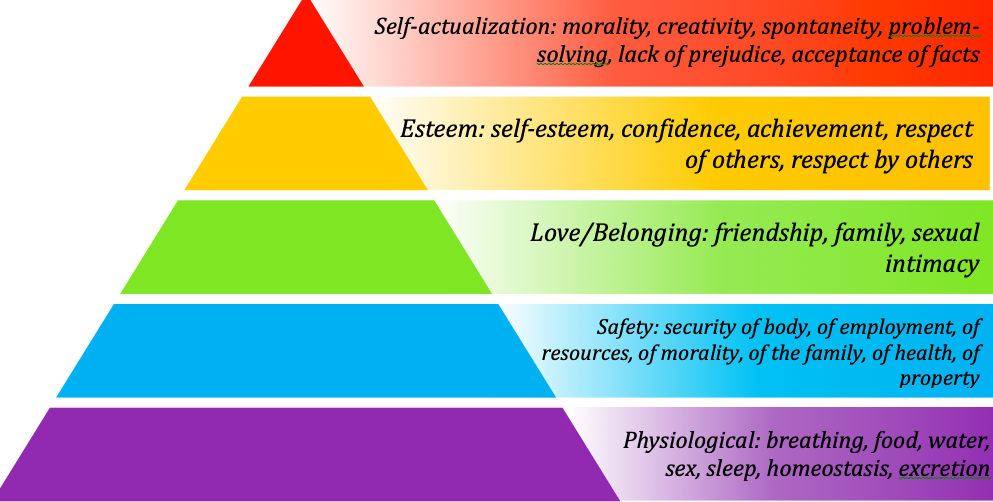
Psychologist, Abraham Maslow construed another way to depict human development. His pyramid shaped ladder shown below, explains why young adults are self-centered. They have to be. Most twenty-year-olds are on the bottom rung of the pyramid, trying to satisfying physiological needs. Maslow reserves the apex for self-actualized people who are spontaneous, creative, moral, lack prejudice, accept facts and engaged in problem solving.

People have to have to feel that their need has been satisfied before moving to the next higher rung. It tales courage to climb, for it requires a new dream and resetting goals. But most try, for we are driven by an innate curiosity that makes us want more and thus follow the path we call life. It is a self-absorbing journey, risky and at times scary, yet somehow satisfying. Striving to reach one’s full potential, to-be-everything-one-can-be, is reward in itself. 

Maslow’s Hierarchy of Needs

Those at the bottom of the pyramid will be highly affected by climate crisis. They will have to take rising temperatures into account as they struggle to meet their most basic needs. And, to get by, they’ll have to think more broadly than did past generations. Their ability to flourish individually is connected to how people throughout the world grapple with the crisis. It will require coming together to solve problems affect all of humanity. It is a worthwhile quest for everyone to undertake. 

 Imagine what would happen if each of us pushed to reach a higher rung on the ladder. Our communities would be filled with compassion, creativity, and beauty. Artificially set boundaries and self-serving biases would be left behind. Diversity and innovation would be welcome.

 It is not a quest to be undertaken by sissies, but rather it is one for the strong—an adventure worth embracing with passion. 

“And I know if I’ll only be true to this glorious quest
That my heart will lie peaceful and calm when I’m laid to my rest

And the world will be better for this
That one man(woman) scorned and covered with scars
Still strove with his last ounce of courages
To reach the unreachable star.”