Invisible Injustice

Eastern Oregon Contemplative 
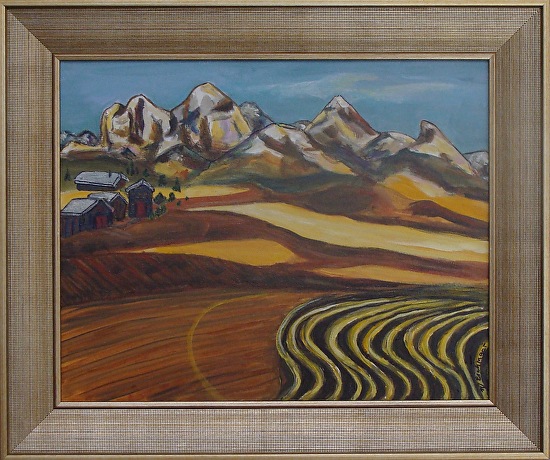
Expansive, settling, calm, beautiful, meditative—walking in nature helps maintain perspective and mental health.

Invisible Injustice

“Be prepared. The worst is yet to come,” is the message released by scientists getting ready for the UN’s Global Conference on Health and Climate Change in November. It will be a summit like no other, for it will ask us to get ready for unprecedented changes of a magnitude that are hard to fathom. There will be suggestions for containing COVID-19, for sure. But, most of us can imagine the pandemic eventually coming to an end. It’s the climate part, asking for global collaboration that will cause most of the nervousness. It is an invisible injustice with mental health consequences.

All nations agree that everyone has the right to live in a healthy environment free of pollution, yet plans to make that happen lack agreement and human activities continue to destabilize the earth’s air, water, and climate to the point where there may be no return——certainly not in our lifetime.

Human beings have dealt with nature’s tragedies before. Pandemics, earthquakes, tidal waves have occurred throughout history, but nothing we know of has ever been on the scale that is evolving. Never have we had a crisis with such misunderstood consequences. What is  acknowledge, is that it is worse than scientists originally thought and that there is no end in sight. We are being told to prepare for the long haul——one lasting 300 or 500 years or longer. How do we do that?

The visible consequences of rising temperatures——fires, floods, hurricanes, and tornadoes are easy to see. Poor air quality, degraded food, inadequate water systems, and physical illnesses plaguing our lives are recognized problems we are trying to address. Fear of mass eco-migrants fleeing homelands due to global warming is more difficult to discuss. Instead of compassion, people respond with aggression when they feel community cohesion being threatened. 

Where can people go who lose homes to rising waters? Who will support them when a fire burns down their house? Where will funds come from when they are ill and lack nourishment? From you? From me? These questions plague the mental health of Americans. Dealing with an invisible injustice requires resilience that is difficult to come by. It depends on overcoming the guilt and despair that comes from feeling helpless. 

Eco-anxiety, characterized by severe and debilitating worry about climate and environmental risks, has become a reason for seeking professional help. Loss of appetite, difficulty sleeping, and panic attacks are on the increase. Some psychiatrists consider anxiety an adaptive mechanism, a call to action that is an advantage for survival. They say if we don’t worry enough, we won’t take action. 

The difficulty with climate change, however, is that there is no end in sight. We are on a steamroller gaining speed as the years go by. Children and marginalized communities will suffer the most, as they always do. But, all are affected, whether by conflict avoidance or by feeling powerlessness, by sensing loss and helplessness, or by feeling frustrated.  The health consequences of these concerns are seen in increased injuries, asthma and cardiovascular disease, malaria, forced migration, malnutrition, drug and alcohol use, stress, mental illness, dengue fever, and other illnesses related to ecological change.

Given such dire consequences, it is important to learn how to maintain a sense of well-being. Suggestions from psychiatrists include walking and or biking rather than driving. Not only does it reduce fossil fuel consumption, but physical commuting reduces depression, anxiety, and stress. A second proposal is to spend more time in green spaces. Interacting with nature can significantly lower stress-related illnesses. 

Using wind, solar, hydro, and other climate-friendly sources of energy can reduce particles and pollution in the air and make you feel good for doing your part. Practicing meditation, yoga, or mindfulness twenty to thirty minutes a day is all that is needed to lower blood pressure and help you function with a clearer head. 

Another tip is to become part of a  community. As you adjust to the realities of climate change, it is important to know you are not alone and that others are struggling beside you. If your economic livelihood is threatened, don’t wait until you are penniless. Change your circumstances——relocate, go back to school, try a different line of work even if it means losing money in the short run. Think of change as an adventure rather than a loss.

If forced to move, keep old cultural connections and find ways to celebrate new ones that are comforting. The internet can keep you in touch with distant friends, but it doesn’t replace having people around you with compatible interests. As human beings, we need flesh and blood companionship. 

Family, friends, and networks are critical to supporting resilience. It helps to have people in our circle of acquaintances to whom we can let off steam. Children, especially, need support. They are growing up with the knowledge that the world is not as it should be—safe and secure. Many are afraid for their future. Adults can help them build confidence in their own resilience by fostering optimism and cultivating active participation and self-regulating behavior.

Lastly, it’s a good idea to boost personal preparedness by assembling short-term emergency kits. They add comfort when contemplating natural disasters. Knowing you have done your best by preparing your mind and body to accept change will help keep you calm and when facing unforeseen hurdles. 

References:

Ingle, H & Mikulewicz, M Mental (2020) health and climate change: tackling invisible injustice. The Lancet Planetary Health. retrieved from https://www.thelancet.com/journals/lanplh/article/PIIS2542-5196(20)30081-4/fulltext

(2017) Mental Health and Our Changing Climate: impacts, Implications,, and Guidance.American Psychological Association. retrieved from https://www.apa.org/news/press/releases/2017/03/mental-health-climate.pdf

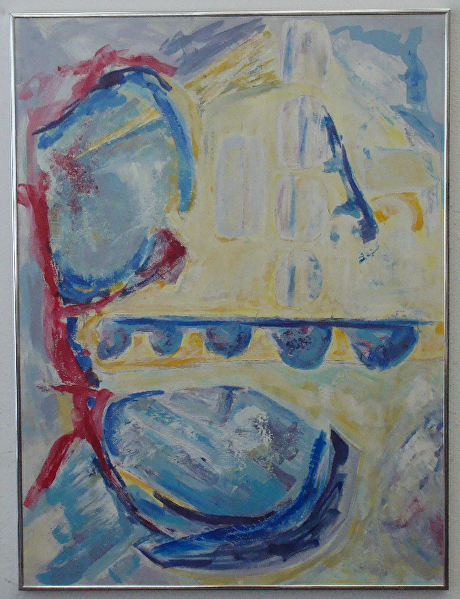
Art is always for sale. contact meat marilynne@eichingerfineart.com Eastern Oregon Contemplative / 21” x 25” gold frame/ acrylic on canvas/ $425. 
Freedom by Mastery

Soaring

Freedom by Mastery

Discussions about individual rights and political freedom plaster the news, while other types of freedom are rarely discussed. Infants standing upright to take their first steps,  gain freedom by moving beyond their crib or parent’s arms to explore on their own— freedom gained. An elder who falls and can’t get up without help will lose the confidence to move without fear of freedom lost.

I remember my 11-month-old-son learning to crawl backward in order to go down the eight stairs to our living room. For a half-hour, he went up and down while my husband and I watched to make sure he was safe. At the bottom of each trip, he would look up at us and grin. He cried when we got bored and picked him up to go somewhere else.  Building muscles and the ability to master steps gave him great joy. The increased freedom he gained results from practice that strengthened his muscles and brain.

  Dancers practice for years before they can leap and twirl with abandonment across a stage. They spend grueling hours focused on stretching,  building muscles and training their brains to tell their limbs what to do. With each advance comes a greater ability to execute moves they imagine in their minds. They work hard and concentric to eliminate outside static and center on the moment. A dancer who gets in “the flow” or “the zone”experiences true freedom. 

Musicians, artists, cooks, athletes, gardeners, and computer programmers speak about the transformation that occurs when the body they inhabit performs as they desire.  They crave moments when they are so completely focused on the task at hand that they are unaware of what’s going on around them. When in the zone, you can float above the cares of everyday life until an insight frees you to create something unique. This is a freedom I enjoy when painting and writing. 

Freedom can also be obtained from synergy.  The effect of that comes from working together can be greater than the sum of the individuals in the group. Yet, as the group grows in stature and abilities, the individuals amazingly do too.

A teacher described to me what it was like to lead a jazz band of talented high school students. The youth were exceptional musicians who had been enrolled in private lessons since childhood. That they had mastered their instruments, led him to believe that if his students were free to express themselves, his band would create exceptional music. The result of everyone doing his or her own thing was chaos. It wasn’t until he took control and added structure, that their individual talents were able to shine through. With skills that perfectly matched the performance requirements set forth, the musicians entered a state of flow felt by their audience. They played so well the students didn’t need to think about how to execute notes but could give themselves over to feeling the music and to expressing their emotions. Within the constraints of the piece they were playing, the youths were free.

We cannot all be masterful artists, musicians, or athletes, but most of us are capable of nurturing body and mind and developing skills that match the performance requirements we set for ourselves. Establishing challenges, learning skills, practicing, and mastering tasks is a recipe for joy. Dopamine levels in the brain increase to make you feel good even when small tasks are accomplished. It is like a drug that makes you crave more. So, you set new goals initiating a cycle that increases freedom with every success. 

The infant learning to crawl backward downstairs will later find joy in balancing a bicycle. The elder who practices how to spin slowly while going down and getting up will gain the confidence to move more freely. A quadriplegic with a functioning brain can find ways to transpose himself from the world he inhabits to the one he wants. 

As the country struggles with issues around political freedom, remember there are other ways to judge how free you are. It is up to you to open your mind and soar.

Share your thoughts about individual freedom on my blog site.

Art is always for sale. Soaring is a 38” x 49” framed acrylic painting on canvas with feathers. Available for $765. For information, contact me at marilynne@eichingerfineart.com.

Do Protests Work?


Gold Static

When you care, your care circulates to make us all better. But what is the best way to show compassion that initiates change? Millions take to the streets to protest social injustice and societal wrongs, but does it do any good?

Do Protests Work?

In the midst of the pandemic and economic crisis, the United States witnessed the broadest, sustained wave of protests experienced in decades. Starting with the presidential election, there were demonstrations against George Floyd, police brutality, ICE, systemic racism, gun violence, mask-wearing, elected officials, eviction notices, voting rights, removal of monuments, and name changes. The Capitol itself was under siege.

But, do protests work? Zeynep Tufekci, writing for The Atlantic, says it takes decades to find out. In the short term, they let authorities know that people are unhappy and want change, but changes to the political system don’t happen overnight. It took over ten years for the 1963 civil rights March on Washington to go from idea, to organization, to dedication, to overcoming obstacles, to change.

The Capitol protesters with their goal of taking over the government were not well organized, and thankfully didn’t succeed, though they scared me and others wishing to preserve a country based on law. But, laws are not always fair, and when people don’t like them, they take their frustrations out with marches and riots.

Some protests in our country’s history have made a difference.

  • The Boston Tea Party on Dec. 16, 1773, sparked the First Continental Congress the following year, leading to the American revolution in 1775.
  • After 60 years of fighting, the Women’s Suffrage Parade, held in 1913 on the eve of President Woodrow Wilson’s inauguration, revived attention for the movement. It took seven more years before the 19th amendment granted women the right to vote.
  • The March on Washington for Jobs and Freedom of 1963, where Martin Luther King gave his “I Have a Dream” Speech, led to the Civil rights Act of 1964 and the Voting Rights Act of 1965.
  • The Stonewall riots in 1969, where Gay and Lesbian communities resisted and protested harassment, led to decades of activism within the LGBTQ+ community. Starting in the ’90s, the Supreme Court established several landmark rulings, including one on June 15th of this year, legalizing gay marriage and making it illegal to fire employees for sexual orientation.
  • The 1969 Native American occupation of Alcatraz led President Nixon to abolish the Indian Termination Policy of the 1040s to forcibly assimilate Native people into American society.
  • The March for Our Lives in 2018 starting at Marjory Stoneman Douglas High School in Parkland, Florida after seventeen people were killed, was a turning point for calls for gun-control legislation. Florida, along with sixteen states and Washington, D.C. raised the minimum age for gun purchases from 18 to 21, enacted red-flag laws, and banned bump stocks to increase the firing power of semiautomatic weapons.

Whether more recent protests will lead to change has yet to be determined.

  • The People’s Climate March in New York City in 2014 that drew nearly 400,000 participants protesting along with 2700 climate-related demonstrations in more than 150 countries brought attention to global warming. It wasn’t long after that President Trump pulled us out of the Paris Accord and cut the EPA’s budget. Though the Biden administration and various individual companies are trying to address global warming, success continues to elude our country and the world as we suffer more climate related crises.
  • The Women’s March on Washington in 2017 drew between 3.2 and 5.2 million people and inspired marches in 400 U.S. cities and 600 worldwide including one in Antarctica. Those advocating for reproductive rights and women’s rights remain concerned about future Supreme Court and state rulings.
  • Protests against police killings of George Floyd, Ahmaud Arbery, Breonna Taylor, and others people of color were among the most intense in U.S. history. Starting peacefully, they quickly moved to violence, setting fires, breaking windows, spraying graffiti, and looting. As I mentioned last week, the Black Lives Matter movement has already created a generational shift, with 65 percent of those under thirty-five supporting the movement but what policies and laws will change remain uncertain.
  • Most protests occur when government supports those at the top and disadvantages those at the bottom. They often start with a single event, igniting long-held grievances. However, if they are not well-organized, they are doomed to die.

What makes protests successful? According to Dr. Catherine Fiechie in a speech given at the Common Futures Conversations Community, dialogue has to be the protest’s priority. Citizens’ assemblies, referendums, and participation in policy-making opens channels for institutionalizing grievances. She also advises that,

  • Protests have to be well-planned, focused, and clear. They must state the problem and what changes are desired. The George Floyd protests were unclear and demands varied from city to city. Cries to charge the officers who killed George Floyd turned into shouts to defund the police, train officers better, administer anti-social personality tests, rid cities of specific elected officials, ban behaviors such as chokeholds, end for-profit policing, end the War on Drugs, make reparations to the Black community, change hiring practices, override police unions, wear body cameras, and remove the Confederate flag.
  • Successful protests employ both digital means of communicating and professional media outreach. Social media plays a major role in facilitating participation. Flash mobs emerge as a result of Twitter, email, blogs, Facebook, and text messages. The #BlackLivesMatter movement gained worldwide visibility on Twitter and through traditional news sources, creating a sense of global unity. Onlookers provided videos of violence taking place that magnified their voices, but when messages put online were not honest and unbiased, they died. Human rights organizations have good techniques for maintaining the public’s attention.
  • All concerns need to be heard and everyone has to work together to find solutions. Protests work well when there is a broad coalition of support that amplifies the voices of the marginalized. The Occupy Wall Street protests against economic inequity, for example, failed because demands were unclear and protesters offered no solutions.
  • Networking with activists across the country and the world adds support to a movement, expands leadership skills, and puts protesters in a position where authorities are forced to engage in talks with them and hopefully answer their demands. Organizers of the Women’s March in 2017, received help from Planned Parenthood and over 100 other organizations to ensure its success.
  • Learning how to take political action should begin in school civic classes. Youth should be brought into discussions and educated in the process. Participation is integral to democracy and essential for creating critical thinkers. I was surprised when my fourteen-year-old grandson asked for Presidential Elections: Strategies and Structures of American Politics, for his birthday. At his age, I wasn’t interested in politics, but he and youth like Greta Thunberg, give hope for the future.
  • Non-violent protests are effective for they convey that they do matter. Movements do well that incorporate methods that have worked in the past and are strategic in their tactics.

Many of us are interested in what we can do to bring about change. Some people feel insignificant and powerless. Waving placards in a mob definitely makes a statement, but it is not for all. Protests fizzle without behind-the-scenes commitment. I, for example, feel like I can be more effective in other ways. There are many opportunities to get involved and lend your voice without having to march. The important thing is to get out of your comfort zone and take a step forward. 

References

Dudenhoefer, N (2020) 7 Influential Protests in American History. University of Central Florida. retrieved from https://www.ucf.edu/news/7-influential-protests-in-american-history/

Garfield,L. & Ettinger,Z. (2020) 14 of the biggest marches and protests in American history. Business Insider. retrieved from https://www.businessinsider.com/largest-marches-us-history-2017-1

Blodget, H & Plotz, D. (2020) Wahl are the protests so much more intense. Business Insider. retrieved from https://www.businessinsider.com/why-are-the-george-floyd-protests-so-much-more-intense-2020-6.

Staff (2021) U.S. Civil Unrest. Center for Disaster Philanthropy. retrieved from https://disasterphilanthropy.org/disaster/u-s-civil-unrest/

Staff (2020) Protests. GlobalSecurity.org. retrieved from https://www.globalsecurity.org/military/world/usa/protests-2020.htm

Haan, L., Barrail, H.,Burdette, e.,Ciasnocha.M. and more. (2020) What Makes a Successful Protest. Chatham House. retrieved from https://www.chathamhouse.org/2020/12/what-makes-successful-protest

2017 Women’s  March. Wikipedia. retrieved from https://en.wikipedia.org/wiki/2017_Women%27s_March#:~:text=The%20Women’s%20March%20was%20a,day%20protest%20in%20U.S.%20history.

Knowing Where to Look

Blue Ladders
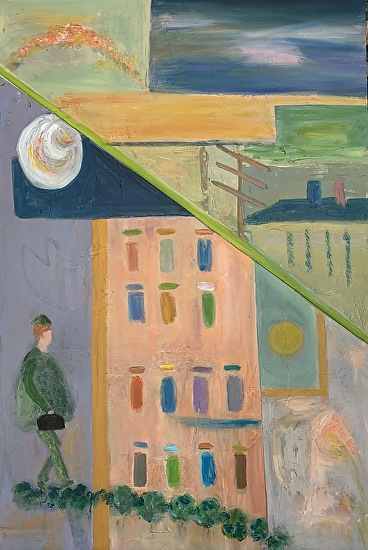
There are many ladders to climb and many problems to tackle

Knowing Where To Look

Proof that people are good is all around if you know where to look. With so many troubles facing society, it is easy to forget there is much to celebrate. 

Though trained in psychology, I didn’t pursue a career in mental health. Counselors spend days with people who are sad, lonely, and confused. I empathized with them feeling their pain and wasn’t able to divorce myself from their problems. Carrying their misery I forgot there was a happy side to life.

I left the profession to be surrounded by positive thinkers. I sought out those who had dreams and passions. They were doers who overcame hurdles with hard work and open-minded thinking. Many had gone to counselors, but they fought to overcome their difficulties. I became associated with compassionate people who lived productive, engaged lives. When I looked behind my own interests to find what inspired them, my world expanded tenfold, and I shared in their excitement.

At my catalog company, we gave PRIDE awards to employees who contributed above and beyond their job descriptions. Focusing attention on small acts of kindness and collaboration rather than on mistakes made the organization flourish. 

Individual Deeds: 

Look around and you will find an abundance of people engage in doing good.  Recognizing their decency is a way to keep from being drawn into a quagmire of despair and hopelessness. Their actions are uplifting and an inspiration to others.  Following are examples from my life and from those I read about recently on MSN, FOX NEWS, HuffPost, USA Today, Good News Network, and Sunny Skyz.

Last week a busy physician came cross-country to visit a friend recently diagnosed with Leukemia. Their weekend was spent in laughter and answering his medical questions. The man left his friend better able to face an uncertain future.

On August 3rd an Israeli woman donated her kidney to a 3-year-old Palestinian boy.

Instead of issuing tickets for broken headlights, the Denver police are handing out gift cards to get them fixed.

A man set up a camera inside a bird box and attracted 41 million fans worldwide. He was overwhelmed to discover how many bird enthusiasts there are in the world.

Two Boy Scouts rescued a drowning woman from Missouri Floodwaters, and in British Columbia, a woman trained as a lifeguard 20 years ago, kept a family of three from drowning by jumping in the lake to tow them closer to shore. Onlookers made a human chain and reached out by grabbing her arm and pulling her and the family close enough to get a foothold.

A woman with special needs wanted to be a cook, so Jordyn’s Deli in Falling Waters West Virginia made it happen. “When life gives you lemons, you make lemonade,” the owner said. “ And when one of your best employees comes to you and says that in spite of all obstacles, they want to be a cook. . . you find a way to make it happen.”

My granddaughter had the wedding of her dreams a year after it was postponed because of the pandemic. It was held outside for vaccinated guests and those testing negative for covid. Afterward, her mother looked like she could sleep for a week and hopefully did, but the pleasure she and her husband gave our family after being separated for 18 months was a gift we will always treasure.  

Sam Schmidt, a race car driver paralyzed in 2000, stood and took his first steps due to new technology from Arrow Electronics. As a positive thinker, he discovered a high-tech vehicle that enabled him to compete in races again.

Group Deeds: 

There are times when it takes a group to bring about a change that benefits society. Because of efforts by international governments, scientists, and health organizations, as of August 7th, at least 4.4 billion shots of the Covid vaccine have been administered worldwide (15.3% fully vaccinated) In the U.S.166 Million are fully vaccinated (50.5% of the population). We have more to go, but look how far we have come.

People put their lives at risk to do what they believe is right for society. The Black Lives Matter movement has already created a generational shift, with 65 percent of those under thirty-five supporting the movement. Protests in the United States are escalating to overturn state laws that limit voting rights laws and threaten the foundation of our democracy. Greenpeace organizes ongoing boat interventions in the Antarctic to protect the whales.

Over the past year, COVID-19 itself played a role in protecting ocean wildlife.  Humpback whales became happy when tourism came to a near-halt and 13 million people visiting Alaska on cruise ships stayed away. Researchers at Glacier Bay National Park hear gurgling and bubbling water sounds that haven’t been heard for years. The happy whales spread out across larger swathes of the bay, mothers leave their calves to play while they swim out to feed, and the songs they sing are more varied. 

A group calling themselves the Cruise Control got organized in 2020 to gather signatures for a ballot measure to limit the times and sizes of visiting cruise ships when the pandemic subsides. The drive failed because the business community fought it, but it is not over. “Though tourism is good for the economy, it’s not good if the whales feel too much pressure and leave,” Cruise Control says.

The power of group action was evident when the Supreme Court, with its conservative majority, voted in June to expand employment protections to gender identity and sexual orientation. Old ways of thinking had dissolved and the culture shifted to embrace the LBGTQ community.

Most people want to be fair and try to do what is right. Some innovations, like dams, seemed good at the time it electrified the country. Now we know they kill the fish, destroy cities and farmland, and divert water needed for crops and other living organisms. Dams are being taken down as we find other ways to electrify our towns. 

With population increasing, it is time to reimagine the way energy, agriculture, trade, property, communication, and water are managed. Privacy laws, individual rights, and the limits of capitalism, socialism, and democracy ave to be reimagined. The troubles we have will only be solved by banding together and lobbying for solutions that benefit all.

Younger generations will have a great many problems to solve. There are interesting challenges that will be exciting for citizens with a good heart to tackle. Knowing where to look and taking action is the antidote to despair, making life worthwhile. And, for those of us who are elders, we are also being challenged to help youth find their way.

References:

Tufekci,Z ( 2020) Do Protests Work? The Atlantic. retrieved from https://www.theatlantic.com/technology/archive/2020/06/why-protests-work/613420/

Zurcher,A. (2021) Why whales in Alaska have been so happy, BBC News. retrieved from 

https://www.bbc.com/news/world-us-canada-58032702.

Soar like an eagle

  Silence
From the silence within comes great thoughts and attainable dreams for the future. 

In 1964 Billy Mills, an Oglata Lakota (Sioux) from South Dakota, won the Gold Medal in the 10,000-meter run. It is considered one of the Olympic’s greatest upsets because the victory came from an unknown Native American athlete. Though Mills grew up in poverty on a reservation, he didn’t know it because there were gardens for food and there was a lot to keep him busy. Without a car, he ran, rode bikes, and swam in ponds, developing cardiovascular conditioning without realizing it. At the age of eight when his mother died, he became despondent, yet managed to become the only American to ever win a gold medal in the 10K event.

Mills’ father’s advice helped him overcome his depression and focus on the future. “Your wings have been clipped,” he said to the young boy. They are broken and the only way to grow them back is by following your passion. Chasing dreams will make you whole again and let you soar like an eagle.” The youth started running and found he excelled at it. Over the years he learned how to manage bouts of low blood sugar and severe depression. He dealt with bullying and racism dished out in high school and at the University of Kansas. A low point during his last year at the University was when a photographer pulled him from a group shot after qualifying for a prestigious race in Brazil. He returned to his dorm room afterward prepared to jump to his death.

As a commissioned officer in the US Marine Corps, he trained at Camp Pendleton for the Olympic Games. During his epic run at the Tokyo games, Mills thought he saw an image of an eagle on a fellow contestant’s shirt. Remembering his father’s words, his feet began to speed. He had the wings of an eagle and realized he had a chance at winning. After the race, he looked for the runner and discovered there was no eagle, only the perception.

“Tokyo was about healing a broken soul,” Mills said. “It was finding peace, making friends.” Mills was finally accepted. “When they played the United States National Anthem, it was powerful. It was beautiful,” though he whispered to himself that he didn’t belong, and cried.

When his track career was over, the Olympian decided to give back to the community and share his legacy. He hoped “to empower the visions of the elders and inspire the dreams of the youth.” In 1912 President Obama awarded Mills the Presidential Citizens Medal for his efforts in Native American causes. Mills at 83 worries that our country is losing its democracy. His days are spent as a philanthropist building hope for the future by teaching his twelve grandchildren and community youth to reach for their dreams.”We need everyone to come together so collectively we can choreograph the horizon of the future.”

I tell this tale because so many people have been sharing stories of their broken souls. I too, find it hard to find good when there is so much of the world appears broken. The pandemic, hot erratic weather, families in disarray, cities of trash, and the unhoused invade our senses. Hatred, fear, and confusion about the future have clipped all too many wings. Instead of looking forward to better times, many people appear to be stuck in a cycle of hopelessness. Rather than searching for their passion and following it to make life better, they wallow in self-pity and look for someone to blame. They lash out at politicians and strangers and make things worse for themselves and society at large. You have only to look at the news and read about escalating domestic and gun violence, road rage, homelessness, and alcoholism to know what I say is true. 

Too many eaglets fallen from their nests lay broken and silent on the ground, unwilling or unable to move. Yet they breathe–and if given a little bit of hope, they could heal. Though their wings were clipped they can grow strong and stretch wide to carry them to their dreams. A person, no matter age or circumstance, who believes in him or herself and has a passion for making something happen that will improve their life has the ingredients needed to pull forward. It can be done. 

No one ever said that a transition was easy. Turning a dream into reality take perseverance, and it may require putting a hard shell around you that keeps adversity at bay–but it can be done. As our country moves through an unprecedented era of transformation we must never give up hope. It is the dreams of young and old that carry light into the world. Imagine what it would be like if everyone dreamt of achieving success in a just and fair society. We’d look up in amazement at seeing thousands of powerful fliers–eagles soaring, gliding, and flapping their spectacular wings over great distances, guiding themselves and loved ones to the places they were meant to be.

Do share your dreams and the energy you put forth to make a better future for yourself and others. Add them to my blog site below.

Art is always for sale. Silence is a mixed media, three-dimensional acrylic painting backed by canvas. 28″ by 40″. Framed. Available for $650. Contact me at marilynne@eichingerfineart.com.

The Whys of Healthcare Frustration

Clarity
Understanding the healthcare system is not easy. Seeing it with clarity is almost impossible.

The Whys of Healthcare Frustration

Last week I wrote of my frustration with a health care system that no longer focuses on patient satisfaction. A reader suggested I explain why costs are so high and what led to the degradation of services. Though healthcare is more expensive in the U.S. than in any other industrialized country, it is not best for all, according to a 2019 Johns Hopkins report. Of the $ 3.5 trillion spent by Americans per year, one-third is wasted according to Harvard Professor of Global Health, David Cutler.  NBC News reported that a man hospitalized with COVID-10 for 62 days received a $1.1 million medical bill. Receiving that large a bill would give me gray hair if I didn’t already have it.

There are several reasons doctors don’t provide patients with the compassionate care that was once considered standard. David Cutler, professor in the Department of Global Health and Population at Harvard puts it down to three factors; corporate greed, price gouging, and higher utilization of costly medical technology. Not having universal health care with guaranteed access for everyone is a contributing factor. 

The most notable problem is that U.S health care operates within a “for-profit insurance system.”  Private individuals and companies pay for their care and for that of their employees in contrast to who pays in most developed countries that consider health care to be a right, not a privilege. The motive to make money ripples through our medical economy. Insurance companies, for example, pay a great deal to review claims with the aim of not paying consumers for the care they believe themselves to be entitled to.

Other issues revolve around structure. From billing to service delivery, the system is fragmented and complex. Administrative processes and overhead make up 34.2 percent of costs, twice that of Canada with its decentralized, publicly funded program. The only exception is in the U.S. with Medicare for older Americans.  Operating with less bureaucracy than private healthcare systems, administrative costs are much lower. Little time is given to denying people care.

In a privatized system, patients are charged based on the services they receive. It’s in the economic interest of hospitals and physicians to call for extra tests or scans—the more the better. In my previous article, I complained about the service primary care physicians provide. Hospitals and clinics are buying up private physicians and pushing their profit motive down to the primary-care doctors. Internists are pressured to see a certain number of patients every day. Those who meet their quotas, often find them increased the following year. During visits to the doctor’s office, rather than handling minor problems with a physical exam or collecting history that might provide answers, patients are routinely referred to specialists who cost more. This is why over several years, my one-hour annual check-up was reduced to a half-hour and finally a fifteen- minute visit. I was asked to make a separate appointment for every issue I wanted to raise, no matter how insignificant. 

Perhaps the most difficult part to understand is what results from a lack of government regulation. Hospitals systems and pharmaceutical companies have an easier time keeping costs high when negotiating with private insurance companies. With a single- payer system run by  the federal government, they would be pressured to meet demand at a lower cost. Private insurance companies often pay as much as two and a half times more for services at the same facility as does Medicare. 

The federal government doesn’t regulate how much companies charge for services, whether insurance, drugs or care. And, as more and more hospital systems and insurance companies merge, costs have risen significantly. There is little incentive to keep fees low since patients don’t have much of a choice.

If you are sick and wealthy, the U.S. is still a good place to be. You can get the care you need though you may have to dig for it yourself.  But, our country does not have a system that caters to all. It leaves thousands of vulnerable people to fend for themselves when ill. That is not compassion. It is not ethically nor morally the right way for a society to behave. No wonder so many people walk around angry much of the time. 

References:

Hohman, M. (200\20)Why is health care so expensive in the United States? Today. retrieved from https://www.today.com/tmrw/why-healthcare-so-expensive-united-states-t192119

Himmelstein, D .,Woolhandler,S. & Campbell, T. ( 2018) Health Care Administrative Costs in the United States and Canada, 2017. Annals of Internal Medicine. retrieved from  https://www.acpjournals.org/doi/10.7326/M19-2818

Cutler, D. (2020) the world’s Costliest Heath Care Harvard Magazine. retrieved from https://www.harvardmagazine.com/2020/05/feature-forum-costliest-health-care

I enjoy hearing from you. Do comment on my blog site below.

Art is always for sale. Clarity is a 48″ by 36″ acrylic painting in silver metal frame. contact me at marilynne@eichingerfineart.com.

Medicine—What Happened?

House Call 

Medicine – What happened?

Medical care today is beyond my comprehension. As technology, sophisticated treatments, and pharmaceuticals improve, the quality of interactions between physician and patient appears to decline. Instead of getting to know patients and their families, doctors don’t take the time. Sick people marching through their primary care offices or visited online are treated as though they are robotic machines needing oiling. I don’t like it. 

The last time I went for an annual check-up, the doctor sat in front of her computer, typing without looking up. She drilled me with questions, tested my memory, and wouldn’t discuss the list of issues that were on my mind. Believe me, when I say, my memory is good. I remember that visit in detail. 

“You’ll have to come back for another appointment to talk about specialists,” she said at the end of the 15 minutes allotted to our session. I was shocked. Come back? Specialists? What happened to the general practitioner who listened to my heart, thumped my chest, and tried to answer the questions I brought with me to her office? I was told later that it was because of the way insurance companies were billed. Doctors make more money if they set up separate visits for each concern. I naively thought that primary care physicians were there to manage my health care, but learned quickly that if you are ill and need hospitalization, he or she won’t stop by the room to say hello or ask how I am getting along. There is no money in it. 

My dismay came to a head recently when, after two nights in the hospital recovering from hip surgery, Ray, my partner, was discharged to recuperate from a  hip operation at home. Two years earlier patients were typically kept under observation for five days or more after such a procedure. Watch out for blood clots, soreness around the wound, bathroom functions, don’t fall, and don’t get addicted to opioids were on the written instructions handed to him as we went out the door.

What bothered me most, however, was that no one called the next day to ask how he was doing or if I, untrained as a nurse, had a question. Neither a visiting nurse nor a physical therapist was sent to check on him. The first time we heard from the doctor’s office was two weeks later on a video conference call with an assistant. Ray was asked to remove his dressing under the very distant eye of a professional who had difficulty seeing the wound. A man we know who was similarly discharged after an operation died from a massive blood clot his first night at home. He might be alive today if he had remained under professional observation for a few days.

I realize circumstances are different today, and the medical profession has drastically changed the way it manages patient services since I was a child. I suppose I should not fret for fear of being labeled old-fashioned. However, as the daughter of a general practitioner watching her father called from bed three to four nights a week to see patients, I know the meaning of compassionate family care. Dad paid house visits and could assess what type of care they were receiving from their relatives. It wasn’t unusual for him to deliver a baby, remove a cyst, set bones, or stitch wounds since he managed all routine procedures.

His type of ministration was still practiced when my children were young. I never took a child with a high fever to a waiting room where other children might catch my child’s disease. And, I didn’t have to worry about who would care for my toddlers while seeking help for the one who was ill. Seeing a patient in a safe and timely manner was my doctor’s central concern and arrangements were made through the receptionist that worked for all. 

As recently as ten years ago, my primary care doctor removed a non-malignant tumor from my neck. I was taken care of in his office and not sent off to a stranger to do something he was capable of doing himself. I trusted him, felt listened to, and well cared for. He participated in a group practice, so when he retired, I was given another physician to call my own. The service I now receive is not as thorough and the quality of interaction not as compassionate. If I mention a concern, though minor, without further inquiry I will be sent off to a specialist and get stuck with a consultancy co-pay four times higher than with my primary care physician. Answering 5-minute questions by phone can elicit a $100 to $200 charge to the insurance company.

Come on friends, neighbors! When you hear the health care system is broken, what you hear is correct. It is, and like a broken bone, needs fixing.

Please your thoughts below.

Art is always for sale. For information contact me at marilynne@eichingerfineart.com

Take the Hard Road

 Larch Tree
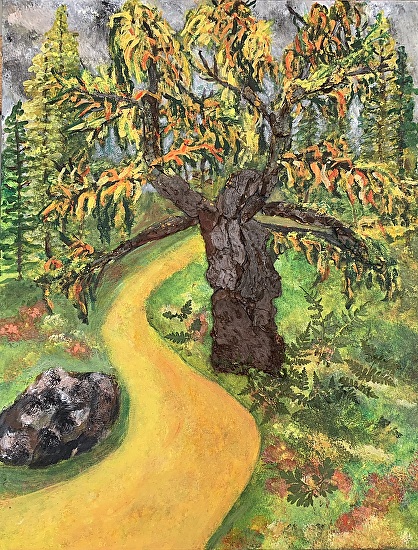
It is easy to be fooled when passing a Larch tree during the summer. They grow cones and have soft two-inch needles bundled like a pine. Each fall, the needles turn a golden yellow before dropping their leaves. They are among the first deciduous tres to grow new needles (leaves) each spring. 

Take the Hard Road

A few days ago I watched a TV show where a high school athlete was given a scholarship opportunity on the track team at UCLA. Acceptance rested on her willingness to move far away from home, leave friends behind, and forgo the usual social activities of an incoming freshman. To succeed, along with academics, she would have to devote herself to her sport. The twelfth grader wasn’t sure she wanted to make such a sacrifice, thinking of how difficult it would be to travel along such a singularly focused path.

Feeling conflicted, she spoke to her boyfriend, asking him what to do. And, though he didn’t want her to leave, without hesitation, he told her she had to go for it. “I used to wait tables and do odd jobs,” he said. “I had no direction and never thought about my future. Now I’m that I’m in an EMT course in training to be a first responder, I find it hard—but, it feels so right. I’m not sure why, but the work  is fun. It feels great to have a purpose. Take the hard road to fulfill your dreams.”

It was sound advice from a young man and it holds for people no matter what their age. Walking on a purposeful path, sacrificing playtime to do something meaningful, though not easy, is likely to be interesting. The boy’s comment made me remember my childhood passion to be a world-famous prima ballerina and my college desire to travel to exotic places as an anthropologist.  It was easy to spend hours practicing dance and studying primitive peoples. Absorbed in what I was doing, I was happy and never thought of it as hard work. As a child, I spent hours in my basement practicing pliés and pirouettes. When older, my time was spent in the library reading about social, political, religious, economic, and childrearing customs in tribal societies. Though I never achieved either career intention, having goals to pursue enriched my student days. 

I still enjoy dancing and continue to do so. Exercise became embedded in my daily routine and it helps me stay healthy and flexible. Anthropology taught me how to think and analyze different cultures. I learned that every society has customs and beliefs to answer questions about human existence and they all have ways of organizing their communities. Anthropology turned me into a more tolerant person by realizing that human beings see the world through different lenses. It made me forever curious. 

That I eventually pursued a career with museums was not a far reach from  having been wrapped up in Indian and African cultures. But the road to success as a science museum director was unexpectedly hard. I had a lot to learn with bumps in the road that, at times, caused me to trip and fall.  Thankfully, my earlier studies and training  remained with me and served as a buffer going forward. The sum of my effort and failures were a help every time I took a fork in the road. 

Those who walk the hard road feel alive. Today’s political situation, confused ethical considerations, pandemics, and global warming make the path forward appear dangerous. Yet, now more than ever, it is important to ask what issues are important and what you are going to do about taking them. No one can afford to sit back and wait for “others” to come up with miracle cures. It won’t happen. But have heart. Taking on a cause adds purpose to each day. Setting goals and following them through with passion will grow your inventory of wisdom and keep you feeling energized and complete.

Bird Talk

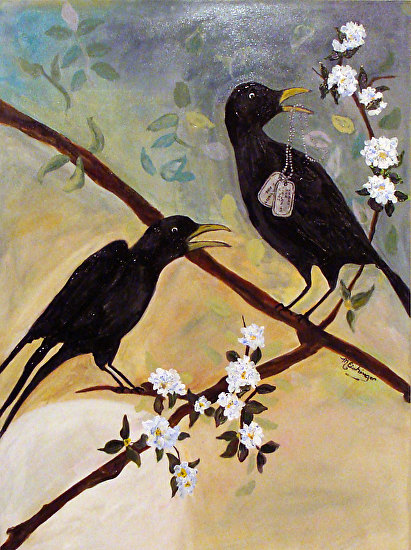
Feeding Crow–Acrylic painting by Marilynne

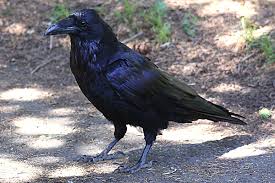
They’re big, black, smart, and noisy. Most of us recognize the short and long caw sounds of crows invading our neighborhoods. I’ve been on the park blocks in Portland when it was difficult to talk to the person standing next to me. Trying to understand what birds are saying is like trying to understand an alien language. But, with study, determination, and patience it can be done. And, doing so might keep them from going extinct.

Bird Talk 

While hiking on Fairmont Boulevard last week I met a fellow traveler. A large raven landed seven feet ahead and to the right of where I walked. As I continued, the bird hopped ahead always keeping the same distance away from me. After ten minutes the bird changed tactics and flew onto a nearby branch. Flying from tree to tree slightly ahead, he waited patiently until I arrived. We continued to travel together for at least an eighth of a mile until another raven, perhaps his mate, lured him away.

Fellow Traveler

I’m certain the raven was trying to communicate. His antics made me wonder if I had passed too close to his nest and he was luring me away. My partner thinks he wanted food, but I don’t agree. He never called, nor did he seem impatient. I’ll never know.

This was not the first time I watched a wild bird reach out. One time, when the bird feeder on our back deck was empty a Towee approached the sliding glass doors on our deck. Cocking his head he stared through the window with a pleading look that asked why the feeder was empty. We responded to his demand immediately and filled it with seeds he devoured.

The twittering sounds and body language of birds say a lot. Chirps, Cheeps, and melodies send messages that can be understood by humans. Some sing love poems designed to woo a mate while others use sound to show strength and warn unwanted birds to back off. Critters in the wild pay attention to their messages. Squirrels, for instance, respond to the short low-and high-pitched shrieks of robins indicating a predator like a coyote is in the area.

The Yao people in Mozambique team up with wild birds to find beehives. Scientists documenting the hunt for honey say it is a two-way relationship. The birds, wanting the combs inside the hives, can’t crack them open and risk being stung. So when they spot a hive they seek out human partners who will smoke out the bees and crack open the nests. The natives leave the combs for the birds to eat. And, when the people have a yen for honey, they make a “brr-hm” sound that calls out for bird assistance.

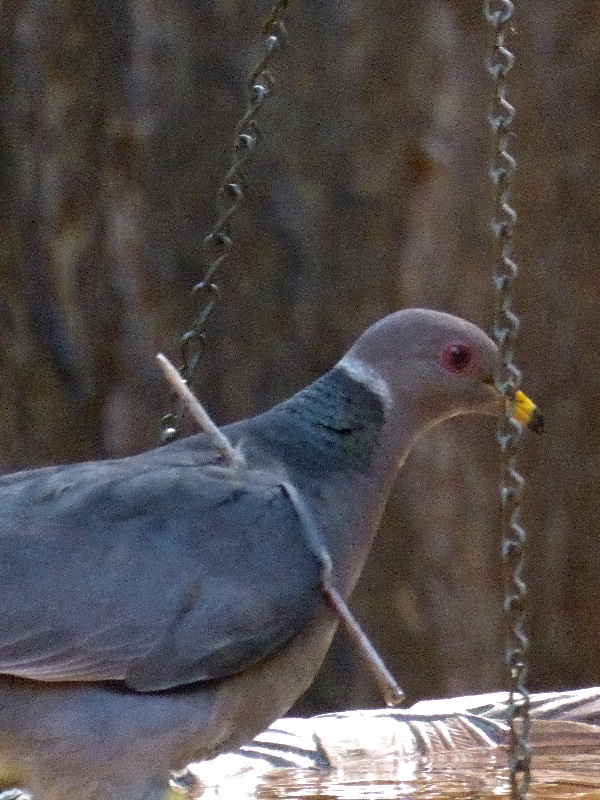
For the past twenty-five years, I’ve been entertained by watching birds at my feeder, though recently I’m seeing things that make me sad. I always looked forward to the return of the ring-necked pigeon from central America. A few years ago one arrived with a dart in his shoulder. How he managed to fly, eat and drink with a stick in his wing is hard to imagine. Birds hit by darts are in pain,  subject to infection, and to becoming entangled or stuck in something. Unfortunately, blowgun injuries are being reported more often in the United States. 

Pigeon with Dart in Wing

I consider shooting birds for pleasure to be  malicious, yet expensive pigeon and dove hunting trips to Central and South America are increasingly popular. Though prices vary, a hunter will pay $1,725 for a two-day trip for a high volume (1000 birds) shooting in Montaraz, Argentina this fall. The cost excludes airfare, hotel room, hunting license, permits, and insurance). Pleasure hunters leave pieces of shot embedded in the birds, making the meat impossible to eat. They destroy an important source of food for native people living in the area.

It is not surprising that with activities like this there are fewer species at our feeder each year. Birds have rapidly been losing the habitat they need to live, find food, rest, and raise their young in safety. According to an article in USA Today, there are three billion fewer birds in North America than there were in 1970. They are being threatened by pesticides, free-roaming cats, wind turbines, insect decline, and disease. While the nation was concerned with COVID-19, Pine Siskins were also falling ill and passing their infection on to other birds. Early spring the Audubon Society asked people to stop filling their bird feeders. I found two dead Pin Siskins on my deck. Since then we have been careful to regularly clean our water tray and feeder.

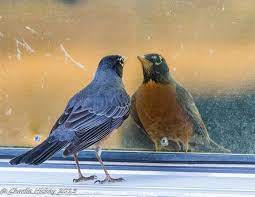
Birds are also killed by moving vehicles that hit them when they are seeking food from road kills. It is a common end for Condors newly introduced into the wild. They land on large animals like deer and are not fast enough to escape a vehicle being driven seventy miles an hour. Birds are struck by planes more than 40 times a day and they fly into windows on houses and high-rise buildings. This was a problem at our house until we put an image of a hawk on our large picture window to stop birds from hitting it.

All of the problems mentioned are accelerated by climate change. Two-thirds of the continent’s bird species are at risk of extinction.  In 2015, nearly 1 million common murres died at sea and drifted ashore, blighting beaches between California and Alaska. It was the largest mass die-off of seabirds in recorded history. When I was vacationing on the Oregon coast, my dog licked over a half-dozen murres scattered on the beach before I could pull him away. The next day my beautiful poodle was dead and I was in tears.

A warmer planet and expanding population are causing more wilderness land to be converted into farmable pastures. Breeding and nesting grounds are becoming agricultural fields and housing developments. “It’s a bird emergency,” says David Yarnold, CEO and president of Audubon. Yes, it is, I agree. And it’s like the canary brought into a coal mine to warn of what will happen to those who don’t pay attention.

While out walking, the raven I saw did nut vocalize but used  body language to communicate with me. Rather than through words, he had a more concrete, sensory way to reach me. By doing so, he captured my attention and invited me to take him seriously. If I want to continue hearing birds sing, I will have to do more than I currently do to see that they survive. 

A birdie with a yellow bill           

Hopped upon my window sill,

Cocked his shining eye and said:

“Ain’t you ‘shamed, you sleepy-head!”

  by  Robert Louis Stevenson 

                  from A Child’s Garden of Verses.

References:

Hammeri, tl (2017) More Pigeons With Blow Gun Dart Injuries Appear In The Castro, Mission. Hoodline. retrieved from https://hoodline.com/2017/05/more-pigeons-with-blow-gun-dart-injuries-appear-in-the-castro-mission/

Rice,D.(2019) There are 3 billion fewer birds in North America than there were in 1970. USA Today. retrieved from https://www.usatoday.com/story/news/nation/2019/09/19/3-billion-fewer-birds-north-america-now-than-1970/2365747001/

Woodward, A. (2020) An avian apocalypse has arrived in North America. Birdsong could become a rare sound. Business Insider. retrieved from https://www.businessinsider.com/birds-disappearing-in-north-america-2020-1

Jones, B. (2018) How to decode the secret language of birds. Popular Science. retrieved from https://www.popsci.com/learn-bird-language

MacDonald, F. (2016) Scientists Document Wild Birds ‘Talking’ With Humans for the First Time. Science Alert.  retrieved from https://www.sciencealert.com/scientists-document-wild-birds-communicating-with-african-tribespeople-to-help-them-find-honey

Mertins,B. (2021) Do BIrds Have Language? Yes! AndIt’s Amazing What they Say . . .Nature Mentoring. retrieved from https://nature-mentor.com/birds-language/

(2011) Language and Culture of Crows. Crows.net. Retrieved from http://www.crows.net/crows.html

Pepperberg, I (2008) Alex & Me: How a Scientist and a Parrot Discovered a Hidden World of Animal Intelligence—and Formed Deep Bond in the Process. ISBN 978-8-06-167398-6. HARPER.

What is In a Name?

Floating Free

What is a Name?

Memorial Day is a time of remembrance. Many people honor family and friends who are no longer alive while others look back further to uncover their family’s lineage. I became interested in the history of my parent’s surname and was surprised at what I found.

What is in a name? “That which we call a rose by any other name would smell as sweet,” wrote William Shakespeare in the 1600s. What he said is not necessarily so. For commercial reasons, roses have been given specific names that denote color as well as odor. There was a time when human brains may have been geared more towards detecting smells for survival. It helped primitive man avoid certain poisonous plants and caves inhabited by dangerous predators. Today, smell connections are primarily a matter of nostalgic memory. People reach for scents with names that bring a sense of well-being-lavender, lemon, forest/pine, and sea breeze. In our litigious world, we can even trademark names used to remember objects and attributes. In earlier eras, names were used to recognize what was important to the society of the time.

The sources from which names are derived include an endless number of physical attributes, places of origin, trades, heraldic symbols, trees, and almost any object one can think of. In hunter-gather societies, people were commonly distinguished by an event, a characteristic, or religious connotation. Before the Norman conquest, Britains were known only by singular personal names or nicknames. Communities were small, and there was no need for hereditary surnames. As the population grew and people were more difficult to identify, second names such as William the Short, John the Tailor, Roger son of Peter ‘the Bald’, and Mary of Wales were added. The Norman barons introduced Smith, Green, and Johnson, names that began to stick. Between the 11th and 16th centuries in England, they began to be passed on from one generation to the next. Surnames became necessary when governments introduced personal taxation. In England, it was known as a Poll Tax. 

Countries added to the stockpile with names like French, Fleming, Beamish (Bohemian), Lubbock (from Lubeck a port in NW Germany), and Moore (Morocco). Wang, a common Chinese surname meaning ‘King’ was royal. Other names were derived from landscapes of hills, woodlands, and trees. As in the game whispering down the lane, adaptations of the original name were added to the litany of available surnames. Moore became Morris and  Maurice.Hill became Hull, Holt, and Knoll. Wood turned into Greenwood, Woodman, and Attwood. Trees offered names such as Leaf, Bark, Root, Maples, and Oakley. Yang, a type of tree, was the royal surname during the Zhou Dynasty in China.

Names ending in —man or —er usually imply they were influenced by trade. Chapman was a shopkeeper, Leech a physician), Goldsmith a jeweler), and Baker—well, you can guess. By the 14th century, building skills were represented by Wright, Leadbeater, Carpenter, Plummer, and Smith, the most common name in English-speaking countries. From the military came Knight, Squire, Archer, Bowman, and Fletcher (arrow maker). Zhang, the Chinese word for archer came after the invention of the bow and arrow. The arts led to Painter, Fiddler, Piper, Harper, and the church added Pope, Bishop, Monk, and Abbott.

Spanish surnames originated as a way to distinguish between two men with the first name by using the name of their father or mother as the second. Examples include, Leon Alvarez (Leon, son of Alvaro) and Pedro Velazquez (Pedro, son of Velasco). Some names derived from geographic areas like Rcardo de Lugo (Ricardo from the town of Lugo) and others derived from occupations like Lucas Vicario (Lucas, the vicar). Hispanic people occasionally use two last names, one from each parent, though the practice is dying out.

Social class and culture had a strong influence on what people were called. Those of lower social status with less control often had their names handed to them by aldermen, lords, and other authorities. They weren’t always kind and included names like Dullard, meaning a hard conceited man, and Shakespeare (masturbator), though there were others emphasized good qualities like Kind, and Triggs (trustworthy). A Schiller was cross-eyed, Armann, a poor man, and Bechard a gossip. Those of higher status bore less common names like Baskerville, Darcy, Montgomery, Byron, and Percy. They indicate you come from a wealthy family, perhaps of royal blood.

My married name, Eichinger, is German in origin. It was first recorded in Austria’s medieval, feudal society. The name later emerged as a noble family with great influence, noted especially for its involvement in social, economic, and political affairs. Variations of Eichinger include Aiching and Aychinger.

I was previously married to a Rosenberg. He too bore a German name, one of the very first names on record to \be recorded. The name refers to one who resides by a place or area of roses. In medieval times, names were often based upon good feeling, mythical situations, or, as in Romeo and Juliet, a pleasing scent. An adaptation of Rose is found in every European country and varies from Roze in France, Rosette in Italy, to Ruzek in Czechoslovakia. 

My partner for the last thirty years is a Losey whose family name can be traced back to Lueneburg in the province of Utrecht in the Netherlands as early as 1277. Losey’s migrated throughout Europe adding variations like Loseke and Loosman. Early American Losey’s worked on the Erie canal.

My mother’s father, a Friedman, was also Austrian-Germanic in origin. He was born in East Prussia before immigrating to America. My maiden name, Katzen, is one of the many forms of Katz. It derives from the Jewish words, ’kohen tsedek” meaning a priest of righteousness. Its earliest known use was in Germany in 1252. Since I cannot escape a Germanic heritage, I must remain a righteous person. 

Over the weekend, why not look into the origin of your family’s name? The ten most common in the United States may surprise you. They are Smith (English), Johnson (English, Scottish), Williams (English, Welsh), Brown (English, Scottish, Irish), Jones (English, Welsh), Garcia (Spanish), Miller (English, Scottish), Davis (English, Welsh), Rodriguez (Spanish), and Martinez (Spanish). Those of European descent can search a free internet surname database site: https://www.surnamedb.com/Surname/. Sites for those of African, Hispanic, or Chinese are listed in the reference section below. Have fun and a relaxing Memorial Day discovering your past.

References:

Ericsson, Lena (2015) What’s in a Name? Valea Technology and Law. retrieved from https://www.valea.eu/en/news/2015/whats-name-which-we-call-rose-any-other-name-would-smell-sweet-quote-romeo-and-juliet

Blake, P. (2011) What’s In a Name” Your link to the Past. BBC. retrieved from http://www.bbc.co.uk/history/familyhistory/get_started/surnames_01.shtml

Hall of Names. retrieved from the website at https://www.hallofnames.org.uk/surname-meaning/?v=79cba1185463

Common US Surnames and Their Meanings ( ranks from the 2000 and 2010 U.S. Census. retrieved from https://www.thoughtco.com/common-us-surnames-and-their-meanings-1422658

Powell, K. (2019) The Meanings and Origins of Spanish Surnames. thoughtCo. retrieved from https://www.thoughtco.com/spanish-surnames-meanings-and-origins-1420795.

Koon, W. (2016) The Complex origins of Chinese names demystified. Post Magazine. retrieved from https://www.scmp.com/magazines/post-magazine/long-reads/article/2046955/complex-origins-chinese-names-demystified

Website, (2020) 120 Most Popular African Last Names or Surnames. MomJunction. retrieved from https://www.momjunction.com/articles/most-common-african-last-names-surnames_00457713/

Art is always for sale. Floating Free is 29” by 23”, framed / acrylic on canvas/ flowers appear to be floating on ice. $425. For information, contact me at marilynne@eichingerfineart.com

If you discover something interesting about your family’s name, do share it on my blog site.