Escape from Market-Speak

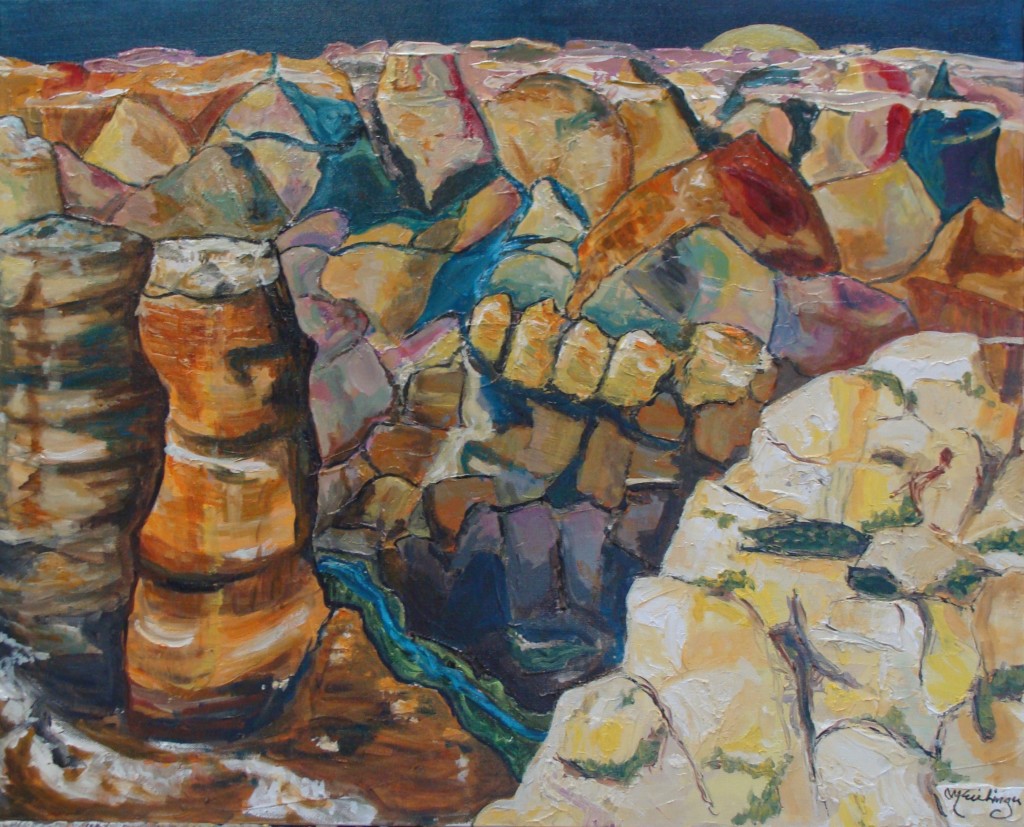
Grand CanyonThe Grand Canyon

29” by 35” / Acrylic, Gold Frame/ $ 799

The beauty of the Grand Canyon is overwhelming. I was there recently on a snowy day which added to the contrasting shadows and colors.

Escape from Market-Speak

The political wrangling for president has just begun and already I am tired of market- speak. One candidate wants revolution while another prefers walled-in isolation. One plans to bring jobs back, in part by lowering the minimum wage. Another says pay must be raised. And then . . . Get rid of Obamacare . . . transform it . . . replace it with a single payer system. Free community college for all . . . improve education . . . eliminate the Department of Education. “I love the uneducated,” says one. Wall Street is bad, billionaires are bad, businessmen are good, billionaires deserve it all, politicians are weasels (but,mine is OK). Why do the poor feel angry and neglected? She’s a bitch, he has a big penis, he can’t be trusted, she’s a liar, he waffles. He’s a religious fanatic, he’s an atheist, and look at the bigot. Bring on the guns, build defense, reduce the military, negotiate, make deals. We’re Americans and live in the greatest country on earth, but need to be great again. Respect us, fear us, personal freedoms are passé, waterboarding is in. . . bomb the hell out of them. Go to rallies. Yippee!!! a fight! just like Germany when Hitler first came to power! What fun!

 What fun? You’ve got to be kidding.  This year’s scary rhetoric makes me want to escape from news broadcasts and television debates. Where to go?

Last January I revisited the Grand Canyon and was reminded that nature provides the best escape route. The view was beautiful, breathtaking, and expansive. Daily concerns disappeared as I meditated on the millions of years it took to carve such a natural sculpture. The air was still pure and the view unobstructed. Its silence enabled me to hear my own heartbeat underneath the rustling of wind on nearby trees.

We the People deserve to have the Grand Canyon be a National Park as much as we do Oregon’s Malheur National Wildlife Refuge, Yellowstone, and the Everglades. What right do ranchers and militia groups have to take away what is ours for the private ownership of a few. Americans need places to go that remind us that we are of nature and have a relationship to all that live in the natural world. As we destroy much of our planet, those few areas that are set aside for contemplation are increasingly more valuable for they bring us back to reality. It is not the words of politicians that matter most, but the actions of our citizens as good stuarts of the land. In nature we are no longer self-center but reminded of our connection to every tree, particle of air and movement of water.

This year, as much as I can, I plan to breathe the stillness and soak in the beauty of the woods, lakes and oceans. And so I will find my peace.

Art is always for sale. Contact me at marilynne@eichingerfineart.com.

______________________

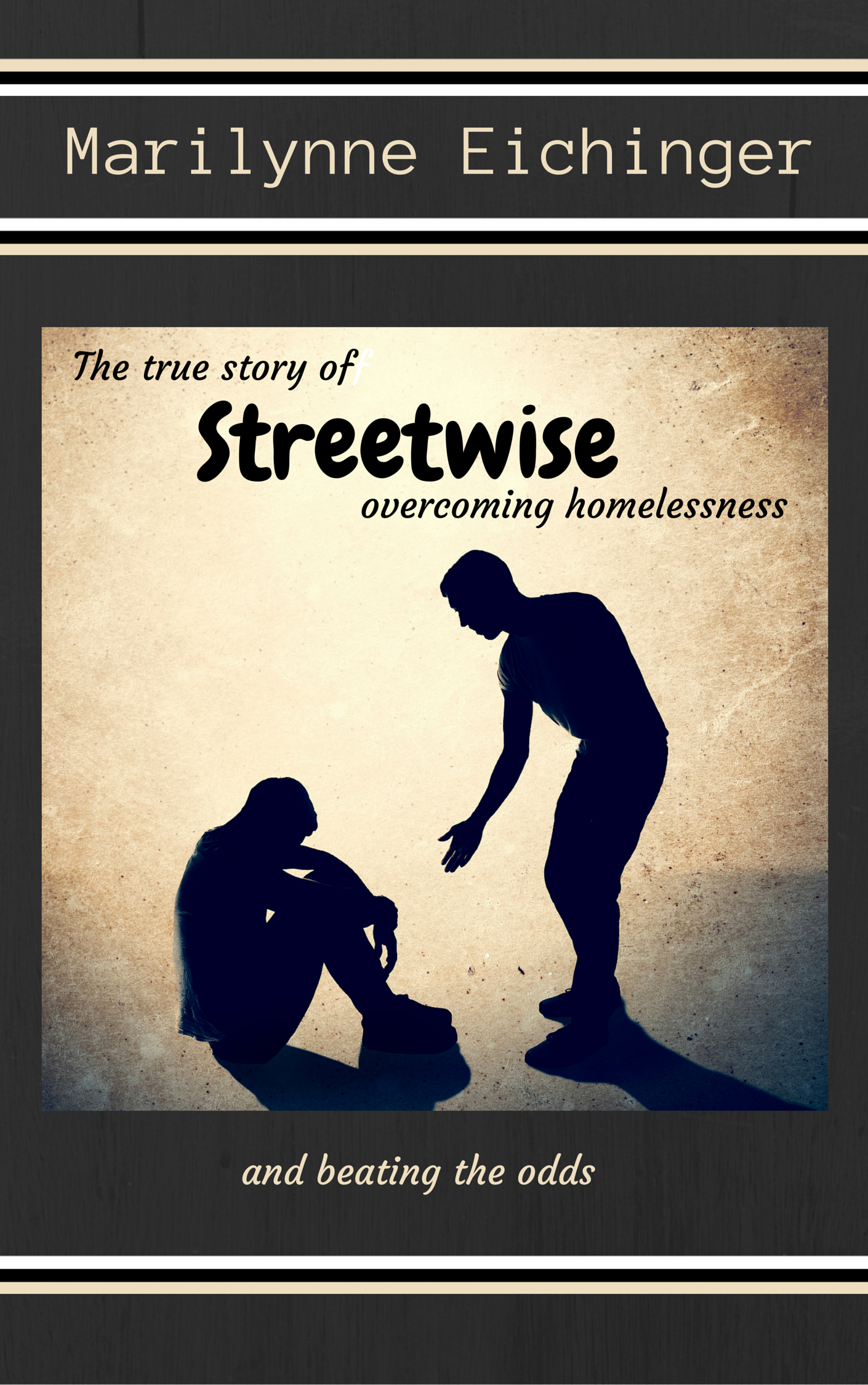
Streetwise    For sale on Amazon by Marilynne Eichinger: The True Story of Streetwise, overcoming homelessness and beating the odds. Go to http://www.amazon.com/dp/B01AAXMJOG

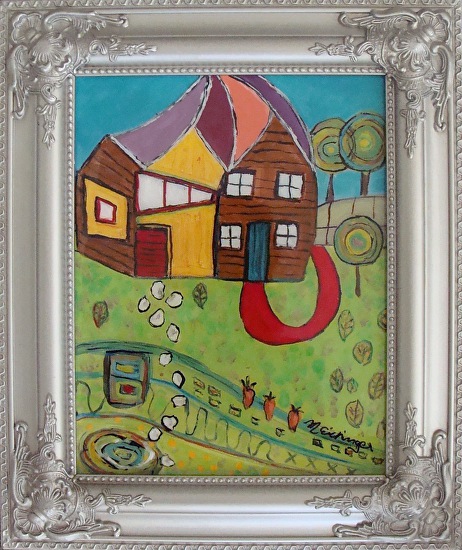
Over the Peanut FenceOver the Peanut Fence
Acrylic/ Gold Frame/ 21” by 25’’ / $299

Look closely at the isolated house and small struggling garden trying to survive on barren land. It is set apart by an almost insurmountable fence. On the other side you see water, growth, lush green plants and colorful flowers. Imagine yourself in the house but wanting to move. How will you get over or around the fence? Are you frighted of what you might find? There may be insects or snakes that you did not know were there. What will you bring with you? How will your present strengths become your platform for a better future?

A Sense of Purpose
We all need a sense of purpose, an overarching mission that unites the different journeys we take throughout our lives. Mine has always been centered on education. Though my career started with raising five kids and evolved to include mental health counseling, running museums, owning a catalog company and authoring books, my underling purpose has always been to inspire a love of learning. Promoting problem solving skills (the job of parent, counselor and teacher ) and independence has always been my quest. Tools I use involve a plethora of sensory-intelligence teaching approaches to fit each individual’s learning style. I implemented this education mission by developing hands-on exhibits and classroom programs, educational toys. I promote philosophical underpinnings through my writing and thought provoking paintings. Reading voraciously and traveling broadly are journeys I take for inspiration.

Having a mission that held steady for most of my life has made transition periods easier. As I moved from childhood, to adulthood, from parenting to empty nesting, and from job to retirement there were many rocky roads to be carefully navigated. I experienced physical energy increase during my 30s, 40s and 50s only to be cut down by illness in my 60s. But then, happily my strength reemerged and I was tasked with continuing my mission.

I also experienced loving relationships that had been carefully nurtured over years become lost because of moves or employment changes. These transition times initiated a period of confusion and impetus to build new friendships. Comfortingly, as my path changed, my goal to improve education remained singular. This consistency provided a smooth passage to my next challenge.

Each of life’s plateaus required rethinking before evolving in a such a way as to take advantage of the knowledge and wisdom I had acquired to date. In retirement I became interested in understanding the crisis facing homeless youth, and you might wonder what it has to do with hands-on education? The more I study the causes, life styles, brain development, and interventions used with this population, the more I realize that individualized education within a loving context is the the way to heal hearts and minds.

What is your sense of purpose? Most people do have one but they may not have stopped to identify it. It is an interesting exercise to look at all of the phases of your life in search for the common denominator or life thread that guides your actions.

Art work is always for sale. Contact me at marilynne@eichingerfineart.com

Please respond on my blog site at eichingerfineart.com/blog.

For sale as an ebook on Amazon: The True Story of Streetwise, overcoming homelessness and beating the odds. $2.99 Go to  AMAZON.

Mean Aunt Martha’s Brain

1356531mMean Aunt Martha                                                                                                                                      Acrylic/ 30” by 30” / gold frame/ $ 399

She was a beautiful, talented alcoholic who was mean to her children.
What type of brain did she have?

Over and Under-stimulated Brains

Sean Suib director of New Avenues for Youth recently told me that there are two types of brains. The thought intrigued me so I did a little research. What I discovered is that one brain type is over-stimulated while at rest. I have one of those. My brain does not like going on roller coaster rides or being exposed to extreme circumstances. We who are over-stimulated are hypersensitive since our brains are continuously at an “all systems go” level. Our brains often cause us to have social anxiety and exhibit fear based responses.

When it comes to taking physical risks I am cautious even though I like to get up on the roof and sweep off the leaves. Heights don’t seem to bother me as much as my neighbors who worry about me falling. I am smart enough to attach a rope if I have to go to a particularly dangerous spot where the ground is 40 feet below.

It takes courage to grow up and strike out on your own. Those of us with over-stimulated brains have a difficult time becoming independent unless we learn to calm our minds. In my twenties my career suffered because of anxiety and fear. I turned down a wonderful position offered by the Boston Children’s Museum when I first graduated from college. I had to learn how to overcome my disability and eventually did so through the practice of Transcendental Meditation. When I first started Impression 5, a science museum in Lansing Michigan, I sat in my car meditating for 20 minutes before going to appointments. Over time, I learned to relax and eventually to enjoy the chaos of a stimulating work environment. I started to thrive under the pressure of daily decision making that was required in my challenging job a president of OMSI. Though I now consider myself a risk-taker when it comes to my personal and business life, I am rarely impulsive. My moves are well analyzed and calculated.

The second brain type is under-stimulated. Those with this type of brain have constant feelings of boredom. They become the thrill seekers who love roller coaster rides and high speed car chases. These individuals are in danger of depression and acquiring compulsive behaviors like drinking and gambling. They seek extreme activities to overcome boredom and have a propensity for poor impulse control. Under-stimulated brains tend to feel and move through life without thinking of the future. Under-stimulation is often paired with a psychological condition known as motivational syndrome, defined as a low desire to participate in social situations. They are often apathetic to what goes on in the world outside of themselves.

Streetwise, as do many homeless teens, has an under-stimulated brain. When we first met him he constantly complained of boredom. With a lack of motivation nothing interested him saying nothing interested him. He could sit staring into space for hours, not responding to our suggestions to go out and enjoy the world. . “Go visit a friend.” I would say or “ If you are bored, why not join a bowling team or get involved with a hobby.” The answer was always, “I’m not interested.” However, when it came to physical risks his response was different. Streetwise was ready to jump into a risk taking position as long as someone else initiated the interaction. I would hear of his dreams of bungee jumping, skydiving, speed racing, and skateboarding as they swirled around his head while he lay on the sofa.

One day Ray and I noticed how much Streetwise enjoyed getting up on the roof to look over the edge without being tied on by a rope. One section of our roof is over 50 feet off the ground but its height did not phase him. The higher the roofline he could stand on the happier he was. His attraction to danger is what led us to suggest that he become an industrial painter. This career puts him on 75 foot water towers where he can hang over the side to sand blast and paint. At times he has to walk along narrow platforms and climb cables on bridges that span huge distances over turbulent water. Streetwise embraced his training and apprenticeship program with gusto. He has excellent job possibilities ahead of him as long as he stays safe. We have observed a big change in the way he problem solves so I am optimistic. His brain has adapted making him a more outgoing personality who is comfortable in social situations once he has been pushed into attending.

I do believe that Aunt Martha was in many ways similar to Streetwise.  Her under stimulated brain, however, took her towards self medication through alcohol.  She reacted instinctually when she did not like something and slashed out at her children with biting verbal remarks.  Her anger was a way of stimulating adrenaline, making her feel alive.

Which of the two categories do you fall into? Is your brain over or under-stimulated? Have you ever had to overcome adversity due to the way your mind works? Have you tried to repattern the way you think?

Do share your thoughts below.
Art is always for sale. Contact me at marilynne@eichingerfineart.com

For sale on Amazon: The True Story of Streetwise, overcoming homelessness and beating the odds. Go to AMAZON.

 
References:

http://hubpages.com/health/processing-disorders-under-stimulated-brain – About the overstimulated brain.

http://www.ehow.com/way_5418991_mean-feel-understimulated.html – Understimulated brain.

The Importance of Love

1357239l

The Lovers                                                                                                                                                                                                      three dimensional multi-media picture/  24″ by 28″ /$ 450

The Importance of Love

Most of us are fortunate for we have experienced love.   As children we had family members who held and cherished us. As adults we found partners and formed bonds based on love. Have you ever stopped to think about what happens to those children who are never held or told that they are special.

In my search to understand the root cause of youth homelessness I wondered about the long term effects of never being touched or cuddled? or being neglected or abandoned?

A cornerstone study about infant neglect began in the 1980s when Dr. Nathan Fox from Harvard Medical School along with colleagues walked into an orphanage in Romania. Due to the country’s ban on abortion the number of orphan babies had soared. 170,000 children were in 700 overcrowded and impoverished facilities across the country without sufficient caretakers. Though the facilities were clean the infants were emotionally neglected. Left all day in their cribs the babies were changed periodically and fed without being held. The nurseries were eerily quiet places. Crying babies were ignored and so they stopped making sounds since crying didn’t produce attention.

Dr. Fox and colleagues have been following these children for over fourteen years. In the beginning they saw autistic-like behaviors such as head-banging and rocking. As the children grew their head circumferences remained unusually small. They had difficulty paying attention and comprehending what was going on around them. Over time, 50 percent of the children suffered from mental illness. They displayed poor impulse control, were socially withdrawn, had problems coping and regulating their emotions and were shrouded in low self-esteem. Pathological behaviors manifested themselves such as tics, tantrums, stealing and self-punishment. Their intellectual function was poor giving rise to low academic achievement.

Those children who were lucky enough to be put in a loving foster home before the age of two were able to rebound. Their brain’s electrical matter as seen on MRIs looked normal by the time they were eight. However, those who entered foster care later where not so lucky. They were left with permanent damage.

Closer to home is the Perry Preschool Project in conjunction with Nurse Family Practitioners. Children were followed until the age of forty with many successful interventions developed through the the years. Researchers concluded that, “without repeated acts of love, a child’s brain doesn’t make the growth hormone needed for proper mental and physical development.” Without it children are left permanently scarred.

Even small insults of shame and rejection can impact a youngster’s ability to survive. Verbal abuse from parents such as, “I can’t believe you embarrass me like that.” or “You Idiot! Who do you think you are?” hurts and affects a child’s self-esteem. These children are the ones who grow up to be cruel to animals, set fires, take drugs or simply withdraw into themselves.

Is there hope for these youngsters? Psychologist Philip Fisher at the University of Oregon has been studying the corrosive levels of abused children. He claims that their abnormal levels can be impacted by reducing stress, their own as well as that of their are care givers. Educating natural and foster parents so that they understand what happened to the child helps them realize that they are not dealing with a normal brain. Instead the youngster make the same mistakes over and over again, the frustrated adult is taught patience. They are shown how to reduce their own stress levels as well as that of the child. Behavior modification programs, reward systems and support groups provide positive paths that can replace feelings of hopelessness. Targeted interventions such as computer-based brain training games also help some malfunctioning children learn to tune into the cues they are missing. Quite a bit of work is being done in this field with positive results mounting.

For those of us who are fortunate, let’s take nothing for granted. Giving and receiving love is a blessing to be cherished. Happy Walentine’s Day to you with all my love.


For sale on Amazon by Marilynne Eichinger: The True Story of Streetwise, overcoming homelessness and beating the odds. $2.99  Go to Amazon.


References:

http://www.apa.org/monitor/2014/06/neglect.aspx:
Drs. Nathan Fox, Charles Zeanah and Charles Nelson study of Romanian orphans.

http://healthland.time.com/2012/05/24/the-measure-of-a-mothers-love-how-early-deprivation-derails-child-development/ – Lack of Love.

http://www.rand.org/pubs/research_briefs/RB9145.html – Rand published research on education programs that work. – Early interventions for at risk children.

http://evidencebasedprograms.org/1366-2/65-2 -Perry School and Nurse Family Partnership

Why Read?

1353336l (1)TV Diva

acrylic painting, 30” by 40” / $ 499
How do illiterate people get the news? from internet? bloggers, TV personalities,
news channels, friends? church?. . . . or do they just not bother.

Why Read?

A few years ago National Geographic had an article about Australian aborigines. One man was quoted as saying, “Why read books? When you are hungry, can you eat a book?”

To that I say yes. If you can read you have a better chance of getting a job, earning money and putting food on your plate. Many young people, however, do not subscribe to this view. Streetwise, for instance, tells me that there is no need to read for he can get everything he needs to know off of a YouTube Video. He listens to anyone who has a jazzed up message and is not critical about where it comes from.

His attitude disappoints me. I fear being at the mercy of uneducated voters who, without the facts, make decisions that affect my life. If YouTube is their carrier then critical reasoning skills are needed to wade through a lot of misinformation. Though he is literate, reading does not come easy. Getting information from a news article is not part of Streetwise’s repertoire.

Did you know that 1 in 4 children in America grow up without learning how to
read? 44 million adults are unable to read a simple story to their children.

Those who don’t read proficiently by 3rd of 4th grade are 4 times more likely
to drop out of school.

85% of juvenile’s facing court trials are functionally illiterate.

75% of Americans who receive food stamps perform at the lowest 2 literacy
levels. 50% of adults cannot read a book written at the 8th grade level.

50% of unemployed youth between 16 and 21 are functionally illiterate

The US is the only free market company where the current generation is less
educated than the previous one. We rank 12 out of 20 in literacy among high
income countries.

90% of high school drop outs are on welfare.

Literacy is a learned phenomenon while illiteracy is passed along by parents who do not read or write. But what happens when there is a burgeoning illiterate population? Daily living requires adults to read basic texts, understand legal and financial documents and navigate technology. Those who cannot miss out on job opportunities. If employed they earn about $ 230-45 a week and only work 18-19 weeks a year.

Politicians talk of working wage jobs for all but we are not going to get there if we do not solve illiteracy as a fist step. Elections worry me because their are not level playing fields with knowledgeable voters ready to execute their democratic rights. Instead emotional oratory bravado that says little captures the imagination of the public.

Most of the people who pay attention to my blog are readers. They read to their children when young and grandchildren as they come along. Now I implore you to consider going one step further. Mentor a person who needs extra help.

It is not easy to motivate a reluctant reader and involves developing a relationship that is close and trusting. Helping a slow reader requires flexibility and being in tune with psychological blocks that may have impeded learning in the first place. It takes patience, compassion and persistence.

The exciting result, though, is that once a student experiences success, self-motivation often takes over. Eyes light up, understanding occurs and confidence builds. Mentors find that they receive as much as they give.

Consider volunteering today to turn around a life. There are many organizations throughout the country seeking help. Several in my area include The Portland Literacy Council ( http://portlandliteracy.org) , Portland Community College volunteer tutoring ( http://www.pcc.edu/resources/tutoring/volunteer/), the library and the public schools.

Don’t wait. Did you know that in 2015 Portland ranked # 6 out of large cities in volunteering and # 1 for Millennials? We are a caring community.

Art work is always for sale. Contact me at marilynne@eichingerfineart.com

Please respond below. I would love to hear from you..

____________________________________

Streetwise


For sale on Amazon: The True Story of Streetwise, overcoming homelessness and beating the odds. $2.99
Go to http://AMAZON

Repatterning the Brain

Coming Home: 

Children need to grow up in a safe environment
acrylic painting/ 16” by 19” / $ 195

Repatterning the Brain

While reading and interviewing those who work with homeless and runaway youth I kept asking myself if there is hope that we will get ahead of this crisis. The reported number of street kids keeps escalating and I am concerned. Over the past half year, though, I have become more positive in my outlook because I learned of therapies that do work. Some treatments have been developed because of our growing knowledge of how the brain works. I take this opportunity to share what I have learned about repatterining treatments for a better future. Those of you working in the field may want to add to my comments.

As a child we learned to crawl by coordinating our muscles to move – first the right arm, then left leg, left arm followed by right leg. This learned neurological process we developed on the floor was then carried forward to walking. Our practice formed on- off switches that helped co-ordinate the muscles we used in locomotion, posture and balance.

Nerves in our body are alive with energy and every time we do a new exercise or learn a new fact neurological connections are made. The more active we are the stronger the network of nerves develops to keeps us functioning well. Those who do little often lose their ability to move with ease, but those willing to become active soon get it back.

Cross crawl marching, is a therapy employed for people suffering from certain types of traumatic brain injury. The shock to their system that left them confused and uncoordinated caused their muscles to relax with resultant disability. Repatterining exercises are one form of therapy used to fix the problem. Repatterining has been found to be effective in minimizing dyslexia, ADD, handwriting and coordination problems and other learning disabilities.
In addition to the physical realm, trauma can also precipitate emotional disfunction. A newborn child is usually develops trust when surrounded by a nurturing, secure environment. But when trauma is introduced such as child abuse, hunger, loss of home or drugs the child’s brain is shocked. Their newly scrambled neurological connections can lead to a state of confusion.

Researchers can now identify the impact of stress through brain scans that record the result of long-term physical and psychological abuse. The limbic system, often called the ‘emotional brain’ controls emotions that drive survival. It is the center for fight, flight or freeze responses. It communicates with the more rational cortex which is slower to respond.

Most adjusted people rely on the cortex to navigate their way through life. When a child has experienced frequent abusive encounters, however, instead of staying calm to problem solve he or she may misinterpret the threat and respond inappropriately because of an overactive limbic system. Victimized children have nervous systems that are on constant alert because they anticipate further danger.

Just as with physical disabilities repatterning is used as a therapy. It may take many years to repattern a brain and nervous system even after the environment becomes safe. Repatterning is a natural healing remedy used to relieve trauma, abuse, stress, anxiety and fear. It is even used to aide concentration and memory and enhance sports performance. A variety of therapies come under the umbrella of repatterining, including such techniques as Eye Movement Desensitization to targeting stressful thoughts as a way of allowing natural energy to resume and bring relief.

It is good to know that there is hope for turning lives around. Relief is more readily available because of the good work being done by brain researchers.

______________

Art work is always for sale. Contact me at email.

I would love to hear from you. Please respond on my blog site.

Streetwise For sale on Amazon: The True Story of Streetwise, overcoming homelessness and beating the odds. Go to Streetwise.


References:

http://www.headbacktohealth.com/Cross_crawl.html – reference about repatterning.
http://www.cdcrehab.com/brain-integration-therapy – repatterning the brain during therapy
http://www.asca.org.au/WHAT-WE-DO/Resources/General-Information/Impact-on-the-physiology-of-the-brain – From an Adults Surviving Child Abuse article.
http://www.brainbreakthrough.com/modalities.html – Therapies used to repattern.

Create a Museum at Home

totally-modern

Totally Modern : A home museum can be full of adventure
Mixed media / 16” x 20” x 2” /$ 425

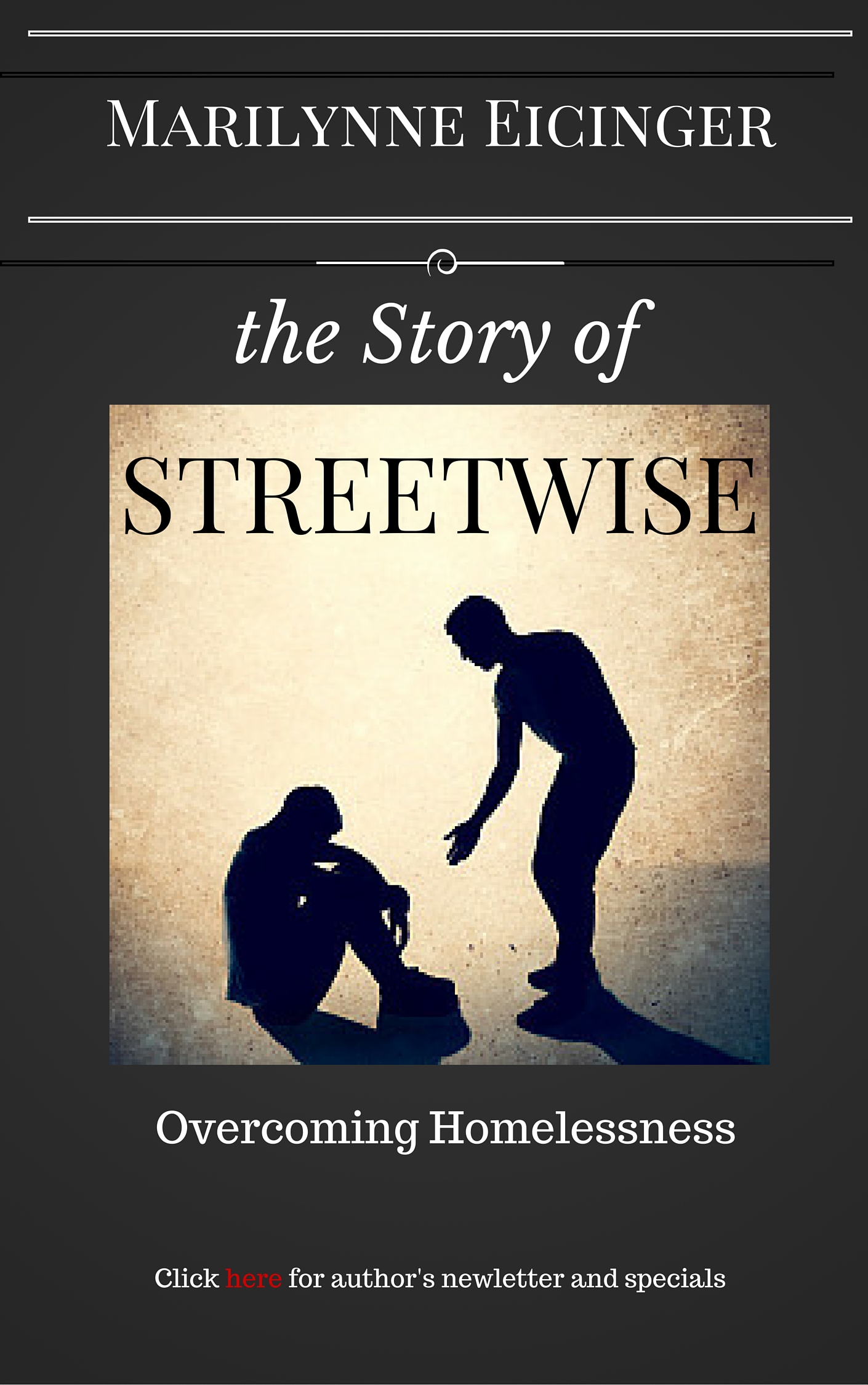
2 copy 3In The True Story of Streetwise; overcoming homelessness and beating the odds, I talk of the education system and how traditional classroom teaching is not right for all children. The addition of tactile experiences makes a difference for a great many learners. Parents and grandparents can take matters into their own hands and make sure it happens. The True Story of Streetwise is available for $ 1.25 as an ebook on Amazon:
Create a Museum at Home

Why are hands-on museums unique? As a previous museum director I visited hundreds of children’s museums and science centers, finding their creativity and ingenuity to be more than just little bit exciting. They are places of engagement where children spend hours doing activities such as water play (learning physics and hydrodynamics without realizing it), dressing up in period costumes (learning history), constructing and plumbing buildings (engineering), watching balls speed down ramps and a host of other activities that involve the whole body as well as mind. Young visitors often cry as their parents pull them away from the exhibits to go home.

When my children were young I often visited the Boston CHildren’s Museum and was influenced by their educational approach. At preschool age, I decided to send them to Montessori schools where classrooms are laid out as mini-museums. Students are permitted to approach materials at their own developmental time frame and are encouraged to master a concept before going on to the next.

According to The American Association of Children’s Museums, a children’s museum is “an institution committed to serving the needs and interests of children by providing exhibits and programs that stimulate curiosity and motivate learning.” That definition fit my philosophy perfectly. When I moved to a community without a hands-on museum I decided to turn my home into one.

Part of the challenge was organizational, so I decided to set up our playroom as a museum with a Montessori approach. I envisioned it as a place filled with meaningful toys that promoted factual learning and creative imagination.

Maria Montessori had a major influence in the education of young children. A 19th century physician turned educator, she became involved in designing Casa dei Bambini, a school for low-income children. As she experimented with curriculum and classroom design, “she began to see independence as the aim of education and the role of the teacher as an observer and director of children’s innate psychological development.”

Montessori believed young children were sensitive to order, enjoyed doing activities repetitively and were happiest doing practical things. She developed an environment that was kid-size so that materials could be easily reached and put away when completed. Over time, very sophisticated materials were developed for for sale with teachers specially trained in her methodology.

I did not have the training or money to set up a true Montessori school but I did have the ability to develop a child-sized, child-centered environment. I started by organizing different locations in our play area for various activities. Shelves were divided into sections for math manipulatives, reading readiness, puppetry, puzzles, costumes, and a crafts. I added a carpentry area with safe tools and a music tree filled with percussion instruments. Once in place I took the tine to demonstrate how to use various toys and learning materials. As my kids succeeded with an activity, they were encouraged to use the objects more imaginatively before returning them to their storage locations.

A big part of training was putting items away after use. The task was easily accomplished by being consistent. Keeping the environment clean for the next project not only makes a parent’s job easier but it provides an uncluttered work space. A secret to a successful home museum is introducing toys (activities) one at a time. I began by demonstrating the item’s use. Then I sat back and observed my child in action, making sure the clean up phase was part of the cycle. Once these steps were mastered, I would note if he or she was ready for a more difficult challenge. My goal was to have my children master the activities independently. With each success they became motivated to continue to learn.

This home-museum environment does take careful planning, but once operational the task becomes easier because children will navigate the space on their own.They choose toys they know how to use. Because they enjoy the challenge they concentrate and move progressively from one skill level to the next.

One last thought — a child of two and a half is ready for a home museum. At first only a few toys should be visible and easily accessible. Once the manipulative is mastered, introduce another toy, the next challenge. If you have several children at home then each child needs to understand which items they have earned the right to use.

Yes, hands-on museums are fun because they are child centered and permit freedom of movement. If you do decide to set up a museum at home, I would love to hear from you and learn of your success or difficulties. What toys did you select? What problems have you encountered?

New Release: Streetwise


Streetwise

The True Story of Streetwise, Overcoming homelessness and beating the odds is the tale of a twenty year old boy who lived on the streets of Washington and Oregon for four years. Though wise to ways of the streets, he was incapable of carrying on a sustainable life style. At one time he considered going to jail in to get roof over his head and three meals a day.

Several years ago my partner and I became involved with his saga as he passed  before our car.  After observing his unsteady walk we determined that he was ill and invited the boy home to nurse back to health.  Once healed, we were unable to turn him out during the cold, rainy month of November. Instead we embarked on a four year difficult adventure. Yet, through determination and perseverance Streetwise eventually evolved. In reading this book you will share our heartaches and excitement as he transformed into a contributing member of society.   We now consider Streetwise our hero, for he gives as much as he ever received.
Author: Marilynne Eichinger

To purchase for $ 1.25 go to :
http://www.amazon.com/dp/B01AAXMJOG

A Crafty Way

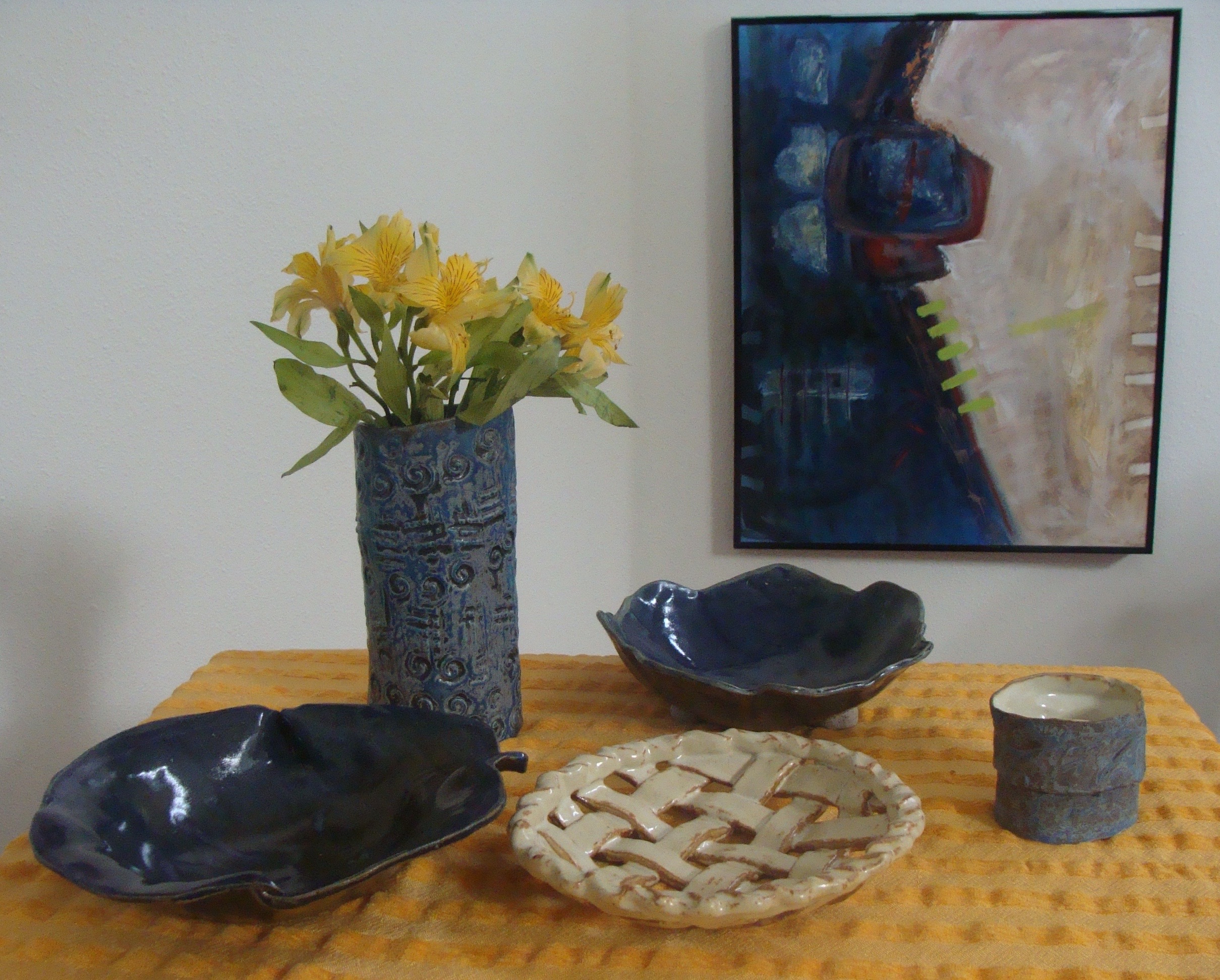
DSC06355Sampling my pottery – a new hobby. Picture in background is one of my acrylic paintings: Seeing Infinity / 30 in. x 24 in. / $ 549.00

Keep those Fingers Busy
A crafty way to stay out of trouble

When I was a child my grandmother and mother used to teach what I considered to be the womanly arts. I was introduced to a sewing machine at the age of eleven and made a white pinafore. I was certainly proud of my creation and wore it everywhere I went. Today I remember everything about the process, from laying out a pattern, to cutting, pinning and sewing. My mother helped me every step of the way.

Grandma was a knitter, with needles that went click, click, click as they speedily moved. She never had to look down at her work to see if she was doing it correctly. Grandma used to take me to the neighborhood yarn shop where a small group of women sat gossiping around a big table while sweaters, scarves and afghans rolled down their laps. I was often asked to spread yarn between outstretched hands while she turned it into a ball. In time, grandma taught me to knit, and I made simple items like mittens, hats and scarves but I could never duplicate her speed or complexity. She died over 40 years ago yet I still use one of her beautiful handmade blankets.

Needlecraft and crocheting were also part of my education. A few days ago, when cleaning a closet, I discovered a towel embellished with flowers that I embroidered as a child. I also found a lacy doily, though to my disappointment it was torn and had to be discarded.

Sewing and knitting were not the only crafts I learned. In sixth grade it was customary for my friends to exchange Christmas gifts. I identified 10 girls and my teacher as needing presents . . . a major expense for me at that age. So, following mother’s suggestion and assistance, I made autograph books with wooden covers. In the process I learned to use a jig saw, to sand until my arm hurt, and to varnish wood to a deep luster. My wood burning set was put to good use to engrave each recipient’s name. A stack of paper was sandwiched between the front and back covers held together by a threaded red ribbon. My gifts were greatly admired by my friends, making me realize that creative entrepreneurship is a valued commodity.

Why am I telling you this? I don’t knit, sew, crochet, do needlepoint or woodworking today. I do paint, tried weaving once, and take pottery classes. I have become appreciative of the time it takes to develop into a master artist and have great admiration for quality craftsmanship. Best of all I cherish the connection between my grandmother, mother and myself. They demonstrated me how to enjoy creative activities so I would never be bored.

In addition to art appreciation, craft projects introduced me to problem solving. I had to decide what to make, it’s design, color and size. Budgeting, selection of materials, arranging a storage area and developing a time line were part of the process. I employed math skills for measuring and estimating, and considered consequences such as, “who pays if I start a project and don’t finish?” Craft activities promoted patience and concentration and they improved my small motor skills.

Children I have recently observed are given limited exposure to arts and crafts in school and home. It is too bad, for developing patience and concentration are skills that carry over to school and work. The thrill of completing a project is a great motivator for future endeavors. The warmth of being mentored by a supportive parent, grandparent or craft instructor develops security and feelings of love.

Is craft time, play time? Not really, yet crafts are a form of entertainment, though, as in the case of pottery, they can have very practical purposes. Some crafts have purely decorative uses that, when done well, can bring beauty into your home.

Getting involved in a craft is certainly worth a try. If you are already hooked why not explore something new. Challenges are good for brain health. Whatever craft you choose it is bound to be captivating. Happy crafting to you and yours.

Do comment below or contact me at marilynne@eichingerfineart.com.

DSC06364

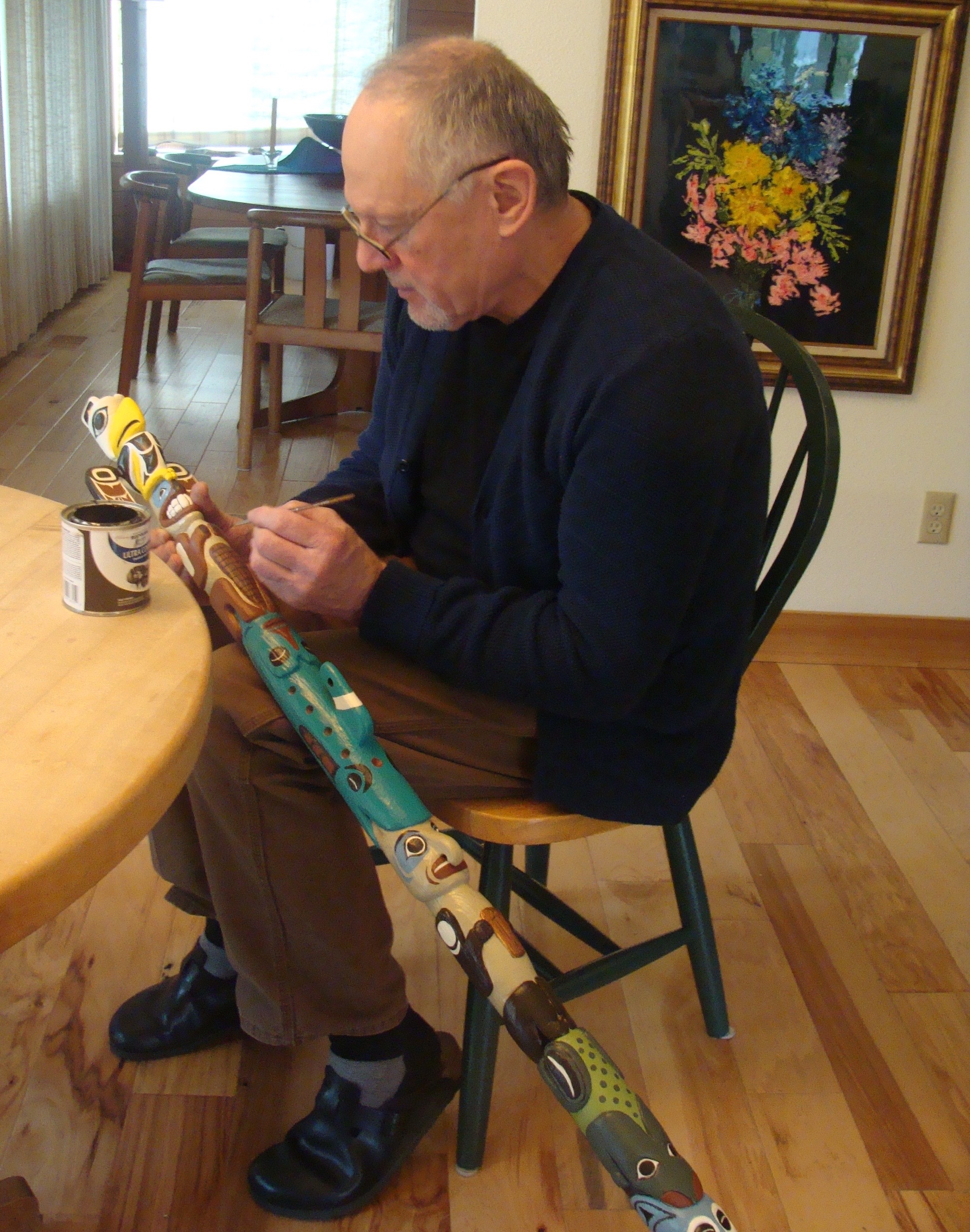
Ray Losey practicing his craft. Totem Pole is
6 feet tall, 6” at wing span / Price $ 1900 / Early bird price before completion – one week only thru January 17th. . . $1650
Animals on totem are eagle, beaver, whale, wolf, frog and owl.

Art work is always for sale. Contact me at marilynne@eichingerfineart.com.

Please share your craft stories on my blog page below.

War of Ideologies

1546585lFamily in a Turkish Village                                                                                                                         acrylic painting / 24” by 48” / $ 690.00

War of Ideologies

Donald Trump shouts about making America strong . I wonder what he really means.  His words imply one direction – increase military might.  Is that where America gets its strength?

Many of the candidates talk of war and fighting ISIS, with no discussion of why so many youth take up the call of Jihad. Their solutions are directed to increasing military spending, decreasing our privacy by freely accessing phone and internet messages, targeting peaceful Muslims, and “bombing the hell out of them” irrespective of whether innocent victims are killed. My head spins and my stomach churns when hearing candidates talk sound bites rather than strategic planning. It reminds me of how Hitler came to power, how he rallied Germans by making the Jews the enemy.

There is no doubt we have a serious threat that has to be handled on many fronts, but an important one is being ignored . . . reinvigorating what made America great in the first place. It was not military might that made immigrants want to come to this country, but the values we professed and the economic possibility for a better life. It was our humanity, the Bill of Rights, the vote, the ability disagree without being put in jail, and the respect given to man, woman and child despite race or religious preference. It was the idea of America as a melting pot and the belief that together we are stronger than any one individual.

ISIS too has a vision of a society, and use their ideology to attract revolutionaries to their cause. It is one in which men make decisions, provide for their families, and live strictly according to Sharia law. Their utopia maintains leadership though control and fear, yet somehow they are able to entice people to make the ultimate sacrifice for rewards after death.

The reality of how a select group of men at the top are getting wealthy and powerful by controlling water and oil is not spelled out in their propaganda. The fact that many revolutionaries are not practicing Muslims is kept quiet. Battle lines they established are philosophical and to fight them we have to answer in-kind. ISIS promotes their version of a good society and we must demonstrate why our way is better. Youth embraces utopian ideals. They want to make a better world. Let’s show them the way.

If the values that established our nation are believable then we must live by them. We should teach children our ideology and speak of it day and night. And we should implore the media to help instead of putting fuel on our advisories’ fire. They have a chance to play an important role by turning a negative, gossipy reporting style upside-down. Rather than feature the worst parts of our nature, I would appreciate equal time given to how neighbor helps neighbor, the richness of our freedoms, and the way so many more people than not do try to live by values imbedded in the constitution. Share with the world a vision of a democratic society that was, and still is, the dream of those who want to be free. We can develop an economy that works for all, so that youth don’t feel that their future is hopeless so they are willing to stay to develop their skills.

If the media— and I include bloggers in this comment — continues to hammer ugliness, if politicians don’t work together for the common good, and if citizens do not take responsibility for making sure that our system of government works, then we are no greater than ISIS. We can and we must do better.

Yes, this is a philosophical war and it is time to remind our citizens how precious and fortunate we are to be Americans. It is also a time to understand why other’s might like to live here so we can make appropriate accommodations to those who do respect our values.

Art work is always for sale. Contact me at marilynne@eichingerfineart.com or to see more, go to  eichingerfineart.com.

I would love to hear your comments below.