
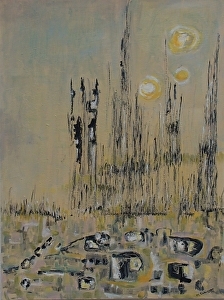
THREE SUNS
40” by 30” / Acrylic on Canvas / $ 499
Scorching Sun allows fires to burn so that Earth appears dry and lifeless. Life hovers underground waiting for Mother Nature to help it reemerge to make Land beautiful once more.
Dynamo for Change
Over the Sticker Bush Fence is a book in progress about homeless and runaway youth. In it I discuss the difficulties caused by childhood neglect and abuse. Over the past three years I interviewed many people who were motivated to work with this population because of experiences they had in childhood. Today I would like to introduce you to Sean Suib, the executive director of New Avenues for Youth. Sean has a special interest in the plight of foster children. Following is an excerpt from the manuscript.
_____________________________________________
Dynamo for Change – Sean Suib – New Avenues for Youth
“Our foster system is broken,” Sean Suib said forcefully. “The only way we are going to fix it is to get it out of the hands of the government. There are smart people in the system but they can’t change anything. The system, like the children they serve, is traumatized. There is not enough money to operate successfully, but that is only part of the problem. Because the system operates out of a place of crisis, it cannot think strategically or even beyond its most basic function, survival. Evidence of this can be seen in the many recent highly publicized examples of the system failing to act to keep children safe, despite clear information about danger. I don’t want you to think the people running the system are bad, to the contrary, there are man caring, hard working, and well-intended people. They just can not get beyond their systemic crisis to prevent its perpetuation. To understand the intersection between foster care and homelessness for youth, it is helpful to think about the Department of Human Services (DHS) as an impoverished single parent responsible for rearing 10 children at the same time. With too little money to meet every child’s specialized needs, DHS can only focus on keeping the most vulnerable children as safe as possible. Older children are less vulnerable when compared to younger, higher needs youngsters. By the time they get to be an adolescent, a system like DHS is not designed for, resourced for, or able to focus on or meet a teen’s needs. As a result, 50% of the kids who leave the foster care system at the age of 18 find themselves homeless within three years. The private sector needs to take over.”
I was sitting across the table speaking to this tall, handsome man whose every pore seemed energized as a change agent. As director of New Avenues for Youth, he moves purposefully among the many challenges he has to confront each day. Though busy overseeing the center’s diverse programs, he had invited me into his small office and graced me with his rapt attention as though I was the only thing in the world that mattered. In my effort to understand the basis of youth homelessness, I had not considered the foster care system and wondered what should be done. Sean shared his thoughts.
“There are critical intervention points that have to be addressed before transitioning a child out of state supervision. Children need social capital, people not paid to be in their lives, who can be called at 2 in the morning if needed. They need to learn life skills, accountability, given leadership opportunities and ways to connect with their community to practice the skills of being an adult. Programs like ours try to sprinkle as many of these proactive experiences into the young person’s life as possible.”
I quickly learned that New Avenues was quite innovative in their approaches and that their work with youth had come a long way from the juvenile detention policies practiced in the past by social service agencies in conjunction with the judicial system.
“We are beginning to understand the unique circumstances that face foster children,” he responded with intensity, making sure that I followed his words. “Many of them have spent years being shuffled from one home to another, often falling through the cracks educationally and emotionally. We already are making a difference with an array of programs and targeted interventions. One of the interventions we are most excited about is a partnership with a non-profit called Bridge Meadows. Bridge Meadows is a multi-generation housing community in which low-income seniors live in community with families that have adopted young foster children. In this model, the entire community works together to help heal and raise these kids.
recently combined resources to build a second housing facility (15 unit apartment complex) dedicated to youth aging out of foster care. Named New Meadows, the facility will sit on land adjacent to the Bridge Meadows campus and leverage relationships and social capital to foster youth as they move into adulthood. New Avenues will wrap a comprehensive program around housing residents by providing mental health counseling, case management, life skills classes, education and college support, and job training.”
As I listened to Sean talk I couldn’t help but imagine that he could have been a successful businessman, spending his working hours amassing a small fortune for his family. He is engaging, has people and organizational skills, and is a strong spokesman for his cause. Sean knows how to work with teams of people in the community from low income to wealthy donors who make up his board. He is also a practiced tradesman with years of construction experience. It would have been logical for him to run his own company, yet he chose to work with the disenfranchised. I wondered why Sean selected a non-profit route. Why was he so ferociously passionate about what he was doing? With little prodding he shared his story.
_____________________________________________________________
Sean’s path to the directorship of New Avenues was inspired by a rocky family life that made him fend for himself at an early age. His journey took him through traumas caused by drugs, divorce and neglect. Sean’s early employment at Janus Youth Services and Outside In provided experience and insight that enabled him to identify holes in the welfare system. Once Over the Sticker Bush Fence is released you will have and opportunity to see how he was influenced as young and why this entrepreneurial dynamo would choose to help those less fortunate.
Do let me know if you think of these last two posts from my new book, Over the Sticker Bush Fence. If you have suggestions, now is the time to make them, since it has not yet been published.
Art work is always for sale. Contact me at marilynne@eichingerfineart.com.

 Surf’s up




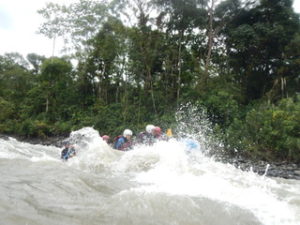 While rafting, our cocky guide toppled five out of six participants (including himself) into churning waters when showing off by standing on the raft’s rim. Our lives were put at risk in a second of his madness as I was thrown into a whirlpool under the water’s surface. Wondering if I would rise to the top and be rescued before my breathe gave out, I could have drowned. . . but I didn’t. The experience was exhilarating and I can’t wait to go again. I was trained in survival techniques before the trip so was able to remain calm rather than panic as did several fellow rafters.
 These beautiful birds are protected at the Malheur Wildlife Refuge, yet they risk their lives when traveling to Mexico for the winter. I painted them last spring after taking our annual excursion to view Oregon’s migratory birds. Sorry, but the painting sold.
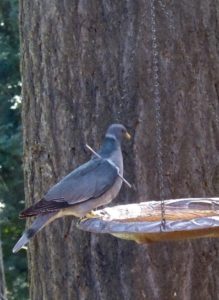 Ray took this picture of the Band-Tailed Pigeon perched on our back porch feeder. Notice the dart (or broken arrow) sticking out of it’s shoulder. This was a courageous bird that managed to make the trip from Mexico north, carrying the projectile the entire distance. It made me wonder why this poor pigeon was treated so poorly so I did a bit of research about killing birds.