Past and Present

Georgetown Row Houses

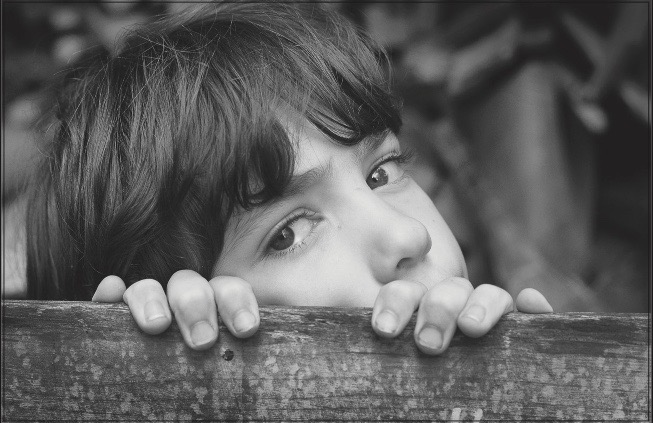
Until the age of eleven, I lived in a row house close to neighbors, where friends were easily made and it was safe to roam the streets.

Then and Now

Last Saturday was my birthday. I was born on Rosh Hashanah, the Jewish New Year, which ushers in the Days of Awe that last through Yom Kippur. According to the Jewish calendar, fall rituals have been happening for 5779 years.  These high holy days are a time for remembrance, contemplation and forgiveness. It is a solemn occasion, yet joyous, for with forgiveness comes healing and joy. Children are blessed, extra charity is dispersed and honey cakes eaten to usher in a sweet year.

While celebrating my birthday and the holiday, I reminisced about my childhood and dead relatives. My first recollection as an infant was of my father waking me in my crib and while half asleep, carrying me downstairs to a house full of friends partying in our living room. I was bewildered by the noise, but the faces that peered in my direction were friendly.  Dad held me securely, as he and my mother did throughout the years I lived at home.

This memory brings to mind images of less fortunate families, those fleeing homes because of war or famine. I remember seeing a pictures of a child who drowned at sea while his parents watched helplessly from an overcrowded boat. Courageous men and women live through unimaginable adversity in order to escape the tragic realities of their homeland.  At the same time, the images make me grateful, for I was held securely, never dropped or neglected, but always loved, cradled and protected.

Grandpa protected us by roaming the neighborhood during WWII to make sure blackout shades were lowered. Mother watched out for us by carefully clipping rations to insure that we ate balanced meals that included vegetables from my grandparent’s victory garden. When the men left for the front and an aunt and cousins came to live with us, the adults shielded us from the brutality the war, made sure our early years were happy ones.

Later, when the U.S. was embroiled in the Cold War, there were no adults to protect me from fear.  Air-raid drills and bomb shelter talk put me in a state of continuous worry. I felt stressed and wanted to move far away from the coast, believing that Boston would be a prime target.  Propaganda said we’d be safe ducking under school desks to avoid harm from a blast. We were told to make preparations in case the had to stay in a basement shelter for several days. I became cynical after realizing we were lied to and being fed propaganda. It reinforced a belief that my future was tied to education. I wanted to be able to dig for the truth and make decisions based on fact.  But I digress. . .

Until my eleventh birthday I lived in a lower middle-class area of Philadelphia during a time peddlers hawked wares on the streets. I used to run outside the moment the organ grinder stopped to play in front of our house. His music attracted neighborhood kids with nickels to place in the monkey’s cup. Dressed in colorful shorts and red jacket, we were mesmerized as the animal ran back and forth from music box to the organ grinder’s shoulders.

Some families still used ice boxes instead of electric refrigerators, which brought the ice truck to a nearby corner. The iceman’s arrival always attracted a crowd of kids to his tailgate on hot summer days. When finished with deliveries, he took out his long icepick and chipped slivers of ice to put in outstretched hands. Licking icicles was a cooling way to enjoy the heat—and it cost nothing. However, the Howdy Doody truck which jingled later in the day, was also popular. I always tried to be first in line to get a popsicle.

Summer was for leisure and play. Hours were not heavily booked with classes and camps. We had plenty of time to splash in the water gushing from a hydrant that was opened by a friendly fireman and to play Hide and Seek, Jacks or Red Light, Green Light. Stay-at-home-moms watched out for our safety. I could get a band aid or drink of water at anyone’s house.

Today, I rarely see children gathering in the neighborhood for a pick-up game of ball or hopscotch. During vacations, most are away at camps or classes. When home, their parents hover over with worry, fearing that they’ll be hit by a car driving fast down our windy street or even kidnapped. Instead of letting them explore a nearby trail on their own, they accompany them on prescribed walks. No one would be permitted to play Red Rover, Red Rover across the road.

My biggest fear is fire. Last summer, my partner Ray, organized a fire watch for we were afraid of someone accidentally setting off a blaze in the dry canyon edging our property. Fortunately there were no incidents nor was water consumption limited but I fear a warming planet may make it happen one day. I empathize with residents of California who lost everything to fires that whipped through their neighborhoods. I”m grateful to live in the northwest where it is not as hot, and hope  we will have enough water and resources in the future to care for thousands of people flowing to Portland to escape unlivable heat.

In my twenties, I lived near Harvard University in Cambridge, MA. In many ways, shopping was easier then than it is now, for vendors still hawked wares up and down our street.  The milkman delivered dairy goods, baby diapers arrived and were taken away twice weekly. The Salvation Army’s band entertained us as it marched by our front steps. Trucks piled high with fresh fruits would be followed by one peddling pots and pans. And of course, everywhere we went the ice-cream truck jingled its tune. My favorite vendor, however, was the knife sharpener.  For a few coins, scissors and knives were kept dangerously sharp. Now, I depend on Ray to do the job when he has time. I’m too lazy to take them to a hardware store for sharpening. I used to walk to the grocery, meat market, hardware store, and I took sheets and shirts to the laundry where they were washed and ironed for such a reasonable sum that everyone, even college students, could afford to do so.

Today, most of us drive to mega stores, park a block away from the front door.  But, I noticed that there is a revival of inbound services. Not only can you get pizza delivered, but groceries and entire cooked or uncooked oven-ready meals can be delivered to your front door. Working adults are happily pampered by tip seeking deliverymen who make their lives easier. They certainly have benefited my wheelchair bound son.

I am, however, still a holdout waiting for the knife sharpener to come around.  My scissors are dull.

Art is always for sale. Contact me at marilynne@eichingerfineart.com.

Do share some of your fond memories from childhood and contrast them with how you live today.

Love: The Romantic Kind

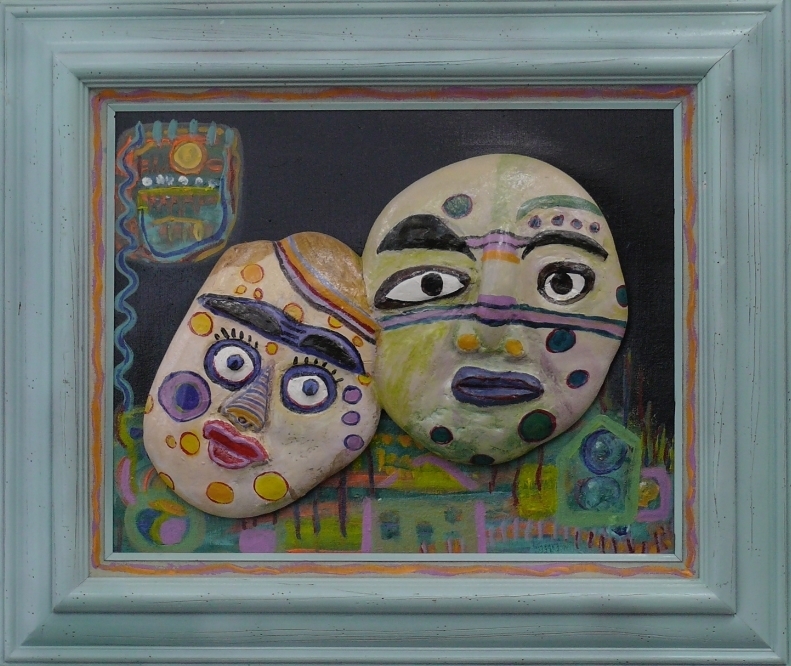
Richard and Marilyn

Mixed media on canvas/ framed/ 24”x 28” x 2” /  $ 450

Love: The Romantic Kind

My first romantic encounter happened when I was in sixth grade. While\a safety crossing guard at a slow intersection, a good looking classmate named Ralph stopped every morning to keep me company. I don’t remember what we talked about, but I do know that we had a lot to say to each other. The attraction blossomed to the point of organizing a mock wedding complete with bridesmaids and rabbi. During my basement rec. room reception, we ate cookies and played spin the bottle. The bottle never stoped  my way to give us a chance to kiss, but it was soon obvious that one of the bridesmaids was more attractive to Ralph than me. That was the end of our romance, love affair and marriage.

Years later, when my future husband first kissed me goodnight on the lips, it was only a peck, but electricity soared through my body. Though the moment lasted a second, the memory of that kiss lasted a lifetime. I wondered what was happening to my body and why I felt weak all over. We hardly knew each other, so I didn’t pretend to be in love, but he certainly captured my attention and I wanted to get to know him better. We spent the next many months romancing each other.

An explanation of the difference between love and romance that I read on-line says, “Romance is the expressive and pleasurable feeling from an emotional attraction towards another person often associated with sexual attraction. And love in best defined as a variety of different feelings, states, and attitudes that ranges from interpersonal affection to pleasure.”

Romance is at its peak in the preliminary stage of a relationship, when people go out of the way to make gestures of fondness. It is not until they understand each other and learn to compromise that love can deepen and take over.  Romance is important for it brings the couple closer to explore boundaries. Though a time of wishful thinking, flirtation, and lust, it can also produce fake and unrealistic yearnings. It’s only when small daily acts of consideration and kindness occur that the carpet unfurls a path t\ leading to love.

I have loved. More than once I’ve been romanced and then loved. And, though there were several liaisons that ended with us going separate ways, feelings of love for the person have endured to this day.  I acknowledge how each relationship provided me with strength to tackle the challenges I faced at the time.

This summer, when I ran my  “Do You Need a Mother” booth at Shift Festival, many young visitors asked for advice of the heart. What I noticed is that they are impatient. They long for a love partner without wanting to go through the romance and relationship building phase. Unfortunately it doesn’t work that way. It takes a long time to build enough trust to communicate honestly. Romantic wooing is part of the deal and it stays as part of the formula of those in long term relationships. For love needs to be nurtured as much as a plant requires fertilizer.

I look back fondly to memories of romance—the time I was a newlywed in Europe, sharing a delicious meal accompanied by enough wine to let my husband and I dance, hug and kiss our way back to our hotel though deserted Parisian streets. —or when I was in Monte Carlo, hoping to cheer my injured husband by dancing before him to an orchestra that was playing in an empty restaurant. —or when the clock struck 12 on New Year’s Eve,  2000, and dressed in finery, my fiancé and I were at the top of the Seattle’s Space Needle watching fireworks exploding below.

Romances are pleasures and shared moments that propel us into deeper love. It is a tool that prolongs and reinforces the bond between two people. Taking time to reaffirm your appreciation and acknowledge how special your partner is, will only strengthen your relationship. Though love may deepen over time, it can also be lost if taken for granted. It is important to periodically renew your commitment, to  play, to laugh and to share special experiences that remind you why you fell in love in the first place.

Do share some of your most romantic remembrances on my blog site below.

Art is always for sale at marilynne@eichingerfineart.com.

Reference

Difference Between Love and Romance. retrieved from https://www.quora.com/What-is-the-difference-between-love-and-romance

Mentally iIl Homeless Youth


Change

Mental Illness is a changing tableau with twists, swoops and buds that blossom over time

Acrylic on Canvas/ black frame/ $ 299

The following section is an excerpt from the section on Mental Illness in Over the Peanut Fence, scheduled for release in late September.  A book signing event is planned for a Sunday in October. I’ll keep you posted on the date.


Mental Illness

“My early training in mental heath was during the time large state hospitals were emptied of their patients. Simultaneously, government subsidies were cut. Community health centers, were inadequate to care for the needs of so many seriously ill people, ushered in an era of in- creased homelessness.

The Canadian Journal of Adolescent Psychiatry conducted a random study of 60 youth in homeless shelters and found 50 percent of them to be clinically symptomatic or with a drug ad- diction problem.116 The study, one among many, provides evidence that mental illness undermines problem-solving abilities needed for survival. Only recently have social agencies for the homeless started addressing psychiatric diseases, but it is becoming a growing area of concern. The Canadian teen population mirrors that of the United States, so I include the following information as an approach to combat hopelessness.

There is conflicting evidence about whether lack of shelter undermines hope. Therapists believe that without optimism, there is suffering, which in severe cases can lead to suicide. Youths with stable housing are more likely to feel hopeful and able to perceive themselves as resilient, are less lonely, and engage in fewer life-threatening behaviors. Those in unstable living situations are more likely to have bleak, hopeless attitudes, becoming easily depressed and in need of psychiatric intervention. Counselors face a conundrum, for unless a mentally ill youth walks into their clinic seeking help, there is not much that can be done for a disturbed adolescent wandering the streets.

Homeless adolescents never use fee-based services and only rarely use those that are free. Hospital emergency rooms are the path of least resistance when health concerns are serious. Since most teens consider themselves to be more mentally stable than they actually are, the bur- den falls on emergency room and clinic practitioners to identify those who are unstable and offer services beyond the presenting illness.

U. S. statistics report that 20 to 25 percent of people who live on the streets suffer from severe mental illness as compared to 6 percent of the general population. Psychological problems contribute to an inability to develop stable relationships, and the youths often push away care- givers, family members and friends willing to assist.

Emotional problems often lead to physical disease because of neglectful health practices and inadequate hygiene. Skin diseases, exposure to tuberculosis or HIV, and respiratory diseases are among those commonly seen in emergency room settings. Minorities are especially vulnerable. Those who are mentally ill are prone to self-medicate by using readily available street drugs.

Contrary to popular belief, once identified and contacted by a health provider, mentally ill adolescents tend to accept treatment willingly. Housing, though a first concern of runaways and caseworkers, does not give adequate care for emotionally challenged teens in need of a trusting counselor. Those from impoverished backgrounds also may need lessons in personal hygiene, finances and how to navigate the health care system. Emotional problems are not easily mended and require treatment and supportive services over many years. Education, employment, money management and peer support need to be integrated into medical and psychological treatment plans.

Mental problems tend to accelerate in the late teens and early 20s, causing impulsive acts and irrationality. But oftentimes, symptoms are visible earlier, well before the youth gets into serious trouble and leaves home. Family physicians and parents need to intervene when distress is first suspected, for once the teen has left home it’s harder to get help. Homeless youth are wary and tend to distrust the medical system because they don’t think they will be taken seriously. They believe adult solutions are likely to involve pills being thrown at them rather than helping them understand the root cause of their problems. When sent to mental wards that serve a mixed- age group, they don’t feel free to discuss their problems. Adolescents need to be in environments among their peers, and not with mature adults.

It is important to remember that treatment only works if the person is ready and not compelled. Culturally specific counseling of a nontraditional nature that prepares them to go through the stages of change has a better chance of succeeding. For instance, a depressed LGBTQ youth might need peer mentors who are encouraging, while an anorexic teen might be aided by someone who overcame an eating disorder. A learning disabled child might benefit from tutoring. In each case, the counseling goal is to motivate the youth to want to overcome their dysfunction and develop a personalized action plan.”

Do comment on bellow. It is always good to hear from you.

For art  please contact me at marilynne@eichingerfineart.com

Lovelessness

The following excerpt from Over the Peanut Fence discusses one of  the causes of youth homelessness. Lack of love is devastating to a child’s physical and mental growth. Over the Peanut Fence is in its final pre-production stage and will be for sale  late September.  An signing party is being organized for October. I’ll keep you posted.

Lovelessness

As I wander around Portland, observing dozens of teens hanging out, I wonder who will have a productive, happy life and which ones will fail. If you’re like me, you do not enjoy having homeless youths take over neighborhood parks or sit on public sidewalks begging for a handout as you pass. If you’re like me, you don’t enjoy descending the stairwell of city-center parking garages that smell like urine. And, if you are like me, you feel intimidated when a gang of youths walks down the street making lewd remarks.

Helping these adolescents is important, not only for their sake, but selfishly for mine. This is why I questioned whether street youth were permanently damaged. I wanted to know if they lost all sense of morality. What I discovered was that antisocial behavior is aimed at society at large and not their own peer group. Most follow a strict set of rules that define street-life values. They care for friends by sharing food, cigarettes, information and a code against “ratting”.

These are hopeful behaviors because they can be exploited and transferred to society at large. My questioning continued. When did they acquire a willingness to help others? Did lack of parental love affect their behavior? I had always assumed love is instinctual and that every newborn is a recipient of warm parental care. Without it, I reasoned, a helpless infant could never survive. I now realize feelings of love and responsibility are not a given.

The majority of us are fortunate in that we are surrounded by affectionate parents and relatives. As infants, we were held and cherished. And as adults, we find partners and form bonds based on fondness and mutual respect. But what happens to children who are never caressed or told they are special? What are the long-term effects of never having been touched or cuddled? What befalls those who are abandoned, left on doorsteps or placed in cribs and not attended to when they cry or their diapers need to be changed?         . . . . . . . . 

“Between 1962 and 1967, the HighScope Perry Preschool Project, in conjunction with nurse-family practitioners ran another insightful study conducted with three and four year old African- American children.28 The school had an average child-teacher ratio of 6:1 and their curriculum included decision-making and problem-solving activities as well as physical movement. Program directors asked parents to participate in weekly visits designed to bring them into the education process.

The project is important because it followed the children until the age of forty, proving the effectiveness of early intervention. In-depth analysis enabled educators to design successful curriculums. The study concluded that “without repeated acts of love, a child’s brain doesn’t make the growth hormone needed for proper mental and physical development.” The child is left scarred and permanently affected. Their stress levels are high, setting the stage for elevated cholesterol levels, cardiovascular disease, metabolic syndromes and other conditions that pose serious health risks.

Even small insults of shame and rejection can impact a youngster’s health. Adults who say “I can’t believe you would embarrass me like that,” or “You Idiot! Who do you think you are?” hurt the child and affect the child’s self-esteem. Many children act out by being cruel to animals, setting fires, taking drugs or simply withdrawing into themselves. Warmth and love are crucial for a child’s well-being.

Zach’s story is a good example of the importance of attachment. Though often neglected and occasionally abused, he was loved by his parents. When they were high on drugs or alcohol he was occasionally smacked and at times not fed, yet those instances were not as important in the long-run as knowing he was wanted. Since he belonged to an extended family that lived nearby, when the situation became intolerable he found shelter with relatives. This minimal amount of support during difficult times helped him grow into a caring person. Those who have never been the recipient of affection are not so fortunate.

Search for Community

Search for Community

Between 1870 and 1920, eleven million people migrated from rural to urban America. Today, only two percent live on farms or ranches. Due to industrialization, homogeneous towns disbanded and city dwellers had to find ways to connect. They joined churches and animal clubs like the Lions, Elks and Moose, and participated in business/charity associations like Rotary. The upper classes became members of exclusive clubs and joined Masons, Shriners and Junior Leagues.

My immigrant grandmother met women in a corner knit shop where needles clicked in time with their mouths as they shared local gossip. Krewes sponsored balls and floats in New Orleans and New Years Associations contributed to the Mummers Day Parade in Philadelphia. Youth organized themselves in social club or gangs which offered protection as well as a sense of belonging. Sports and Gentlemen’s clubs, those organized around nationality of origin, and unions made it tolerable to live next to strangers who traveled silently on subways and trolleys.

As years passed, many of the clubs lost their luster, finding it difficult to recruit young members. But though membership declined, the need for community hasn’t changed. Living in cities distant from relatives and childhood friends, electing not to be married, it is easy to feel lonely and isolated. 

Most of us are aware of some of the ways internet brings people together. Sites like match.com promise love connections. LinkedIn allows participants to scan profiles and send “Connect with Me” notices. Tweets, Instagram feeds and Facebook are avenues for friends and acquaintances to stay in touch, share interests and seek advice.  But, though friends spend hours communicating on-line, it cannot allow them to touch or look into eyes while sharing a meal. You cannot notice a person’s flush when they say something awkward or sexy. And a friend recuperating in a hospital can not be helped or comforted from a computer as they can from a warm bodied friend.

Face-to-face relationships are as important as they ever were. The way people form friendships and develop community  today is a reflection of changes brought about by the economy and population growth interacting with the internet.

Snowbirds and Nomads: A growing number of retired people travel south for the winter and north in the summer. Wealthier snowbirds have condos in gated golf communities or travel in forty-foot RVs, camping seasonally at resorts or state parks. They party and join fellow campers who own dune buggies, horses and kayaks. Over several years deep friendships develop, forming community based on shared interests.

A burgeoning subset of seasonal travelers, are less affluent nomads living in second hand RVs, school busses, pickup trucks and sedans. They drive the highways to reach mega-lots outside of warehouses run by Amazon, Walgreens and Walmart, where they are employed seasonally. They may harvest sugar beets or sell Christmas trees and pumpkins at roadside stands.

These wanderers are middle class Americans who do not have enough money to retire. The Great Recession of 2007 wiped out their savings. Though many are educated, they can only find employment in low paying jobs that demand long hours of physical labor that is not enough to sustain them. Eventually they sell their possessions and take to the roads. They sleep in parking lots, truck stops and public camping areas in warm weather and reach out to family and friends when it turns cold.

Their way of life is more freeing than expected when they first embark on it. Fellow nomads are friendly and helpful. They use the internet to stay in contact off-season, sharing advice about jobs and places to camp. They pass the hat when someone’s vehicle needs repair, help them if they are ill, share meals, play cards and socialize. They enjoy their freedom, stay off the grid, use solar power and participate in community.  Like gypsies, these wanderers develop an appreciation for adventure and escape from social norms. The lifestyle becomes more difficult when they can no longer lift a 50 pound bags or stand on their feet 10 hours a day.

Makers – A diverse group of inventors are drawn into affinity groups around art, electronic music, science, and technology. Maker fairs, held in most states, feature inventions and activities that take place in garages, museums and homes. Open to the public, they are attended by NASA, MakerBot Industries, Shop Bot, 3D systems, Kickstarter, Autodesk, Instructables, universities, etc. 3 D printing is the latest explosion along with robotics, electronics, metal fabrication and computer controlled technology, though woodworking and aboriginal skills remain in the mix.  Makezine.com is a good place to go to find out what’s happening.

Intel, General Electric, science centers and education institutions sponsor maker spaces. But a great many more are organized by individuals with a desire for community. Makers are more than hobbyists. They are multi-age inventors who enjoy the diversity of talents and skills gathered together to execute someone’s project. Maker spaces encourage grown-ups to play with leading edge technology. They construct everything from terrariums, music venues, computer designed knitted ski masks and t-shirts with electronic messages to mechanical-art sculptures. They allow those with unfulfilled potential (often college drop-outs) to show off and have a chance of attracting investors.

Habitat for Humanity is an organization that is built around community. Volunteers along with the future homeowner, lend expertise and muscles to construct affordable housing. Those who stay involved for years, going from project to project, form tight friendship groups. Building a habitat house reminds me of they way the Amish gather to raise a barn. It is a a joyful event with a tangible outcome that puts smiles on the new owner’s face.

Meetup.com—More than a web site, “meetup” it is a movement that connects like-minded people to small affinity communities. I belong to Nine Bridges, a writers group promoted on meetup.com. My group is one of hundreds over a five state region that meet weekly, giving twelve people the opportunity to read from their work and receive criticism.

Meetup categories range from outdoors & adventure, sports & fitness, photography, food & drink, music, film, LGBQ, Language & culture, Beliefs to  Movements, Pets, Hobbies and Crafts, Fashion & Beauty. There are social and career & and business sites listed as well. Connecting is easy for those willing to leave their homes, computers and TVs to venture forth into the unknown.

Street Life – Homeless youth are also a communal lot, sharing much more than the sidewalk. They understand each other, for most left abusive home situations to  seek safety and shelter on the streets. The young adults they meet are their friends, even if they only interact for only one day.  Friends hang out, play games in parks and share survival skills. They couch surf at the homes of more those who have an apartment. They are loyal to a street code that prohibits tattling and promotes sharing. They lend money, food and drugs when they have them.

Older homeless denizens also share community, though members may be less healthy because of mental and physical illnesses developed from imbibing alcohol and drugs and living in inclement weather. They socialize on sidewalks, in parking lots and under freeways, sharing their stories and information about services and shelter.  When given permanent lodging, they often miss their street buddies. I was on the board of a group called The Giving Tree that helped homeless people adapt to housing and saw first hand how depressed some become. While holding a weekly tea in a unit for elderly people, a woman jumped from a 6th story window. Suicide is not uncommon among the newly housed and insect infestations are rampant. To combat isolation we provided cooking, cleaning and art classes.

Social Clubs – Clubs pull young adults together for music, film, food and drinks. An example is the White Owl Social Club which features everything form live bands and comedy skits to movies shown with old fashioned projectors. Prices are moderate and stereo volume kept low to allow for conversation. Social clubs are more than a restaurant or bar. They are gathering sites for friends who share apartments and homes that are not large enough to accommodate a group. Pool and ping pong tables, bowling alleys and foosball provide a Chucky Cheese type experience for grown ups. Comfortable sofas, a fire pit, and laid back gathering areas make it easy to relax and deepen friendships. 

Burners and Festivals- Many young adults spend summer months traveling from festival to festival engaged in a culture around music, art and community. Small Burning Man style festivals that operate throughout the world (China included) preach compassion and sharing over commercialism. Corporate logos are never displayed and money doesn’t change hands. People assist with the work of setting up, cleaning up and feeding attendees. Resources are willingly shared. One camp (a friendship group) might operate a misting tent, while others dispense food, provide entertainment, psychological advice, showers and off-beat clothing. Technology, art, bright lights and colors flash from bicycles, floats and sculptures. Dancers twirl fire while techno-music plays until dawn. What makes Burning Man unique is that the camps are composed of people who value creativity and the arts. Friends meet year round to work on festival projects.

My son occupies a transmission shop that he converted into living, office and shop spaces. Friends gather weekly to implement techno-art projects for festivals like Burning Man. They have fun while maintaining community. Festivals provide them with deadlines, goals and purpose. They think of themselves as family and support each other throughout the year.

Senior Centers – Day centers operating throughout America bring the elderly. into community. They provide information and connection to local health, housing and legal services, yet most are a great deal more than counseling centers. They offer recreational activities, classes, lectures and discussion groups and a place to lounge. Some operate in conjunction with service organizations like Meal on Wheels. The YMCA, Urban League, Native American Family Centers, Latino Networks and private non-profits are actively involved. Their goal is to kindle joy and make retirement purposeful. I’ve given talks at senior centers in wealthy suburbs and in poor neighborhoods. What I’ve witnessed in general, is that those who participate are active, age well and enjoy being with a community of peers.

There are a great many ways people participate in community.  Gangs, political organizations, veterans associations, food and craft groups, church committees, professional and exercise clubs, and shared office workspaces unite people by common activity, affinity and proximity.  Co-housing is one I hope to explore another time

References:

Kahn Academy website  (2018)America moves to the cityKahn Academy. References: retrieved from website. https://www.khanacademy.org/humanities/us-history/the-gilded-age/gilded-age/a/america-moves-to-the-city

Merchant,N. (2017) Feel like you don’t fit in?  Here’s how to find where you truly belong.  ideas.Ted.Com. retrieved from.  https://ideas.ted.com/feel-like-you-dont-fit-in-heres-how-to-find-where-you-truly-belong/

Agrawal. M. (2018) Community is Everything: How to Build Your Tribe. Inc. retrieved from https://www.inc.com/miki-agrawal/community-is-everything.html

Bruder,J. Nomadland   Surviving America in the Twenty-First Century (2017) W.W. Norton & Company, New York

Complainers


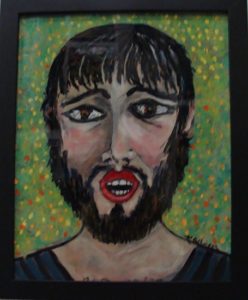
The Orator

Acrylic on Canvas/ $325/ 18” x 22”

He stands on his box and complains to an audience of onlookers who egg him on. They applaud and laugh at the crazy way he rails against government, politicians, and certain religions.  It’s entertaining to watch him shout and rave about injustice. He isn’t take seriously, though, for he has few solutions to unite people for change.


Complainers

Complainers.  You know them well, for they pop in from every direction. Some whine, others murmur, grumble or growl. They find fault easily and are dissatisfied with most things they come in contact with, commenting frequently on how much worse the world is today than it was when they were young.

In the company of a complainer, I often tune out. After hearing an injustice repeated multiple times, it is difficult to pay attention. Complaints about traffic jams, bicyclists, potholes and homeless people urinating on the street may need to be addressed, but complaining about them to me serves no purpose. I can’t do much more about the situation than you can. Complainers rarely view their observations as calls to action, but instead, wallow in misery, affecting the mood of those around them

Complainers come in a variety of packages.  Some are jumpers. These people react quickly letting everyone know immediately how upset they are. Some jumpers become whiners who continue repeating their complaints.  Once they start, they never let up. Comments such as, “he’ll never stop drinking. I don’t know why I stay married,“ or “all politicians are corrupt. You can’t trust any of them,” may echo for years.

Then there are the venters, the angry frustrated people who complain to solicit attention and sympathy. They speak in loud demanding voices, repeat themselves endlessly and consider their views to be so important that insist everyone stop what they are doing to hear them. Venters seek validation and want to be surrounded by yes sayers. They lack interest in problem solving discussions. When asked to share their views and contribute to finding a solution, they turn away, complaining that the situation is hopeless.

Venters can easily wear a listener down. “The bus is late. The doctors don’t know what they are doing. My neighbor is a jerk. The coffee XXX makes is crummy.” After putting so much attention on all that is bad, venters occasionally get fed up and decide to move to greener pastures only to find new reasons to complain. It is in their nature, until they willingly alter their outlook.

Perfectionists can also be complainers. When I ran Impression 5 Science Museum in Lansing, Michigan, I hired a woman to direct our education department. She focused so heavily on problems that she was unable to see the good she did. Her reaction to positive happenings was, “That’s nice, but look at this? It’s not up to par.”  She was miserable much of the time, for she believed that her colleagues and the teachers  she hired would never be able to live up to her expectations. She also made it clear to all on staff that she was better able to do their jobs. Perhaps she was, but she could not be everywhere at once. She had to delegate and was unhappy doing so. Education programs blossomed under her leadership, yet she was so dispirited that she resigned.

Let’s not forget the jokers who make light of their complaints. They use humor as a way of venting frustrations. They don’t want to appear selfish for not putting out effort to solve a problem, so they hide their displeasure by smothering it with jokes, especially with  strangers. They pretend to be happy when they are not.  Though they think they are communicating clearly, the person they are speaking to is often confused by the joking manner.

More cautious are the hesitaters. They wait until a mysterious threshold is reached before they begin to complain. Hesitaters tend to be more introverted than jumpers, whiners and venters. How much control they have over a situation determines how and when they will react. They wait to hear a variety of opinions, preferring to stay positive if at all possible.  Hesitaters are good at listening to complaints before deciding if there is a legitimate point that requires further investigation. They realize the importance of not passing on unsubstantiated facts and gossip.

I’m an occasional hesitater.  When my suitcase was misplaced on a flight to Morocco, I was upset but took my complaint to the airline counter.  Hearing that my bag wouldn’t  arrive until the next day, I bought a clean shirt, undies and toothbrush. My complaint worked to take care of the problem. Much of the time, complaints are ignored because the solution is not readily available. Focusing on such things as homeless people loitering the streets is fruitless. Instead of complaining  that the city is going to pieces, homelessness is a call for attention—at least for me it is.

Complainers tend to be unhappy. They see problems wherever they go, and are convinced that they will never be solved. They spout their displeasure and let bad situations continue as a way of proving their point. They don’t believe it is their responsibility to do more. They’re convinced they deserve better, that the problem is not their fault and that they have the right to get more from life. They believe that if they were in charge, the world would be better, and they are determined that if they can’t be happy, then no one else should be.

Thankfully, there are also the good complainers—the doers. Their complaints identify problems which motivate them to action. In general, they are a happier bunch than the jumpers, winers, jokers and venters, because they have goals and strategically plan ways to meet them. Though their complaint may not get completely solved, they feel rewarded by taking baby steps in the right direction.

A way to be happier, is to limit making complaints as well as your exposure to complainers. Why dampen your mood and that of others with negativity? It is important not personalize the thoughts of chronic complainers, but to have empathy for their misery. They see the world through a reality that can affect their health, for there are physical side affects to complaining. Neck and shoulder muscles tighten, migraines occur and the heart can be affected.

Being around people who complain is exhausting, frustrating and unproductive. Unfortunately, there are times when you can not just ignore them, but have to decide to move on or your own health will suffer.

I agree with Anais Non who wrote,

“You are in charge of how you react to the people and events in your life. You can either give negativity power over your life or you can choose happiness instead. Take control and choose to focus on what is important in your life.”

My suggestions?  Assess complaints for their opportunity. Identify problems that need attention and  commitment and only complain when you think it will effect real, positive change. Choose one problem to work on and try to make a difference.

References:

Moodie, K .(2017)  Here’s How Much Each Personality Type Complains.Personality Growth.   retrieved from https://personalitygrowth.com/heres-how-much-each-personality-type-complains/

Biswas-Diener,r. (2017) The Three Types of Complaining.  Psychology Today. retrieved from https://www.psychologytoday.com/us/blog/significant-results/201706/the-three-types-complaining

Herald, M. (2015) How to protect Yourself from Chronic Complainers. Emotionally Resilient Living. retrieved from https://www.emotionallyresilientliving.com/how-to-protect-yourself-from-chronic-complainers

Davis, A. (2017) 6 Reasons Why Complainers Are the Most Miserable People. HuffPost. retrieved from   https://www.huffingtonpost.com/adam-davis/6-reasons-why-complainers_b_9818706.html

Nin, A .(author) Herron, P. (Editor) (2015) The Quotable Anais Nin: 365 Quotations with Citations. Sky Blue Press


Art is always for sale. Contact me at marilynne@eichingerfineart.com.
Education in a divided America

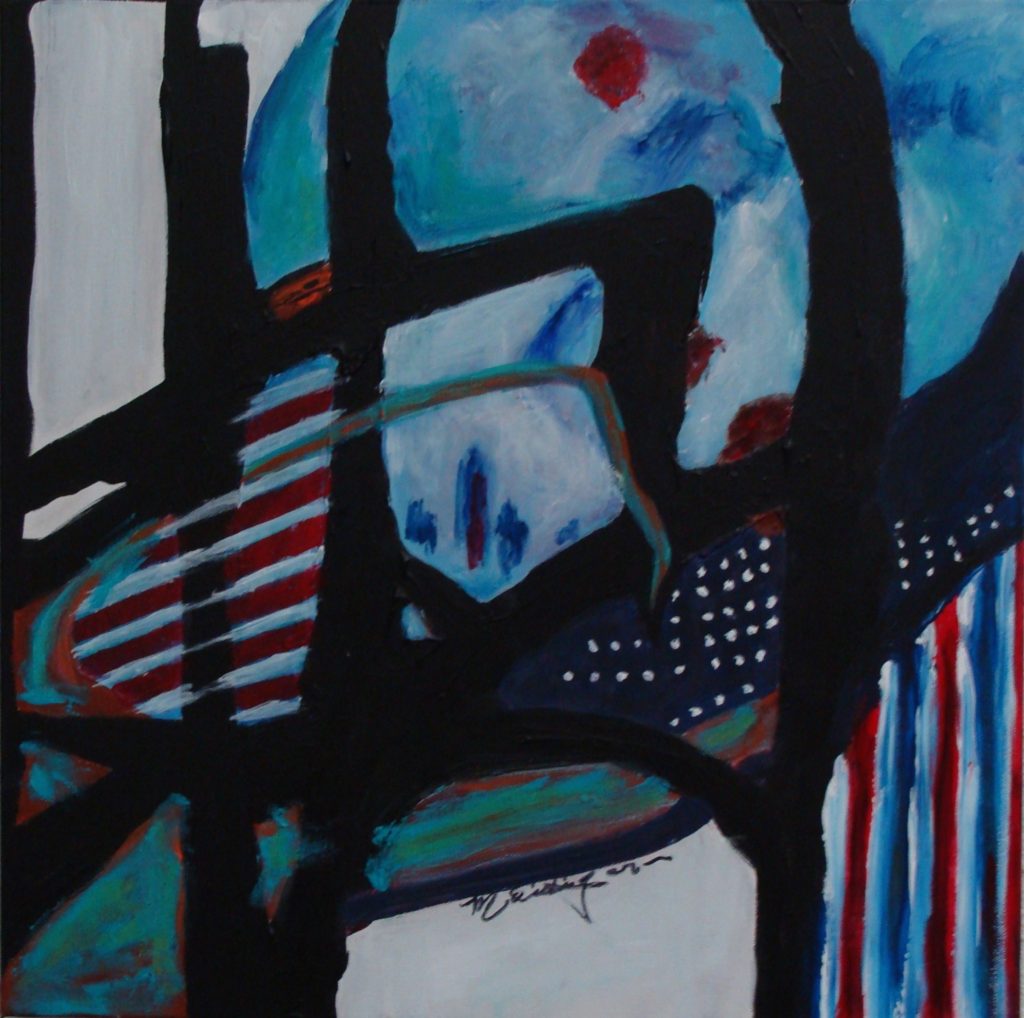
Fractured America

This picture is shared again because it depicts our fractured country. There are many ways we are divided, but the one at the

top of my list is education.

Acrylic on wide canvas/ 24″ by 24″/$ 450

Education in a Divided America

Last week, I had a conversation with an African-American man about problems facing the nation. As is commonly done, he stratified the population by economic divisions (lower, middle and upper class) and made suggestions accordingly.

There are many ways to look at our citizenry. I explored one method when writing about generational differences brought about by technological and economic change. Generational stratifications include 1901-1926), Mature/Silents; (1926-1945) Baby Boomers, Flower Children ; (1946-64) Generation X, Lost Generation; ( 1965-80); Xennials, Sandwich Generation; ( 1977- 1983) Millennials, Narcissistic Tech Gurus; (1984-2000) Generation Z, The Boomlets (2001 +) .This method does  partial insight.

Divisions by race, religion, residence and culture also help us understand society. Each system presents a microcosm of the whole. Yet, all factors (which is difficult to do) must be taken into account when analyzing an individual. It is why I like Anatole Frances’ saying, ”Even a little dog is the center of his own universe.”

However, it is not possible to rule a country that appeals to each person’s unique vision, so societies adopt systems for governing by way of democratic, autocratic, theocratic and consensus models. Economies are primarily traditional (close ties to farming), command  (centralized power), market ( firms and households act in self-interest) and mixed systems (cross between command and market economy. The United States governs in a pluralist country with democratic intentions and a mixed economic system that leans toward a market economy.

But to rule well , another stratification has to be taken into account – that of education. An enlightened populace is imperative when governing a democratic country with a mixed economic system.

Unfortunately, most people are not well enough educated to understand the the ramifications of learning which is making a mockery of our country among other civilized nations. Academic achievement divides the United States in unsettling ways. People with stratified educational backgrounds are targeted through information delivery systems (CNN vs Fox), ways of communicating (authoritarian vs consensus) and methods of settling differences (arms vs. non-violence).

The Brooking Institute says that the United States is ruled by a power elite composed of approximately 250 people with military, business and congressional backgrounds. For the past forty years, they have followed directives of Think Tanks, which have become To Do tanks with political agendas. Though independent research organizations continue to operate, the new breed of Advocacy Think Yanks puts a spin on pure research. They are policy, partisan and ideological organizations that couple themselves with salesmanship. Their influence is massive, yet they remain hidden behind the doors of most minds.

A quote from a Brookings publication,The Fifth Estate ,“According to some scholars, right- wing think tanks have benefited strongly from a proactive approach to collectivizing and organizing their search for funding. Conversely, left – wing think tanks have suffered because, historically, progressive individuals and foundations have been more reluctant to provide financial support for policy research. Further, conservative donations have been more integrated than progressive donations, simultaneously supporting conservative think tanks, academic programs that sponsor conservative thinkers, conservative-friendly media, powerful lobbies, and a strong Republican Party. These various elements work together successfully to implement conservative policy.”

People are commonly divided by academic achievement. We speak of the uneducated, poorly educated, well educated, and those with advanced learning. In addition the being able to read and write, a schooled individual hopefully gains a grasp of social, spiritual, sanitary and behavioral customs. In addition, he or she will acquire workplace skills. Think tanks are staffed by those with advanced degrees. Partisan organizations influence their research in order to target and manipulate people by how well educated they are.

In the United States, 32 million illiterate people (over 720 million worldwide) remain at the bottom of the economic and social ladder with limited employment opportunity. Illiteracy costs the global economy about $ 1.19 trillion a year and plays havoc in democratic societies. The poorly educated are easily controlled by dictators and fear mongers.

In 2016, Donald Trump told supporters in Nevada that he credited his poorly educated supporters as part of the reason he won. Spoken by a man with a college degree and a 158 IQ (according to Reuters), he said, ”I love the poorly educated.”

Why would that be? The President describes the highly educated as the smartest people and the poorly schooled as the most loyal. According to Trumpism, the poorly educated are willing followers and not snooty.  By telling less informed people that they are valued, he let them know that their votes count. All they had to do is believe in his wisdom. What Trump did so brilliantly, was develop a way to reach less informed people through plainspoken, short Twitter feeds. He calls on their trust rather than their understanding. Those who follow his dictates have no need to fact-check, analyze data or delve into complex issues. His is a faith based rule.

In the last election, education, not income was the best predictor of who would win. Of the 981 U.S. counties with 50,000 or more people, Hillary Clinton ’s margin surged over Obama’s wins in the 50 most-educated counties. These counties were otherwise economically and socially diverse. Trump won in the 50 least-educated counties. Though there was a small correlation between income and education, in general, the amount of money a person has was not the determining factor.  Education was. To check these statistics go to Silver’s article mentioned in the reference section.

In 2015, 88 percent of the U.S. population had attained a high school diploma or GED.  33 percent held a bachelor’s degree, and 12 percent an advanced degree. Within these categories are variations by race, age, sex, disability and country of origin. But overall, what does it mean?

The political cleavage caused by education is so significant that unless concerned politicians find ways to speak to less informed voters and bring more of them into the educated category, they will not win in large swarths of the country. Without realizing that they have been taken advantage of, under-educated people will continue to lose their rights to the power elite. They blindly vote against their best interests by remaining ignorant of the interplay of economic and environmental factors in global affairs.

No longer is the United States a lone player separated by oceans. We are tied to the rest of the world by high speed internet and the ease of travel. Decisions depend on a deep understanding of issues. Democracy and a mixed economic economy depend on enlightened, informed voters.

There have always been greedy people with personal agendas. This is why we have to pay attention to knowledge brokers. Politicians need  non-biased information to rule. Concerns of social and physical scientists with advanced learning should be intelligently examined and questioned. Motivation must be taken into consideration. We can not trust the media or politicians to do our job for us. I am uncomfortable with ignorant people going to to poles to decide my fate. Aren’t you?

References:

Novak,J. (2018) The Six Living Generations in America. University of Phoenix, Texas A & M University. retrieved from http://www.marketingteacher.com/the-six-living-generations-in-america/

Reynolds,H.(2097)The Power Elite. University of Delaware. American Political Systems.https://www1.udel.edu/htr/Psc105/Texts/power.html

Ranney, M. (2015) 8 startling facts about illiteracy you might not know. Mashable.retrieved information from World Literacy foundation, 2015 at https://mashable.com/2015/09/08/project-literacy-makeathon/#CkPTiAfEcaqA

Hafner,J. (2016) Donald Trump loves the ‘poorly educated’ — and they love him.  USA Today. retrieved from https://www.usatoday.com/story/news/politics/onpolitics/2016/02/24/donald-trump-nevada-poorly-educated/80860078/

Silver,N. (2016) Education, Not Income, Predicted Who Would Vote For Trump. FiveThirtyEight.retrieved from https://fivethirtyeight.com/features/education-not-income-predicted-who-would-vote-for-trump/

Galston,W & Hendrickson,C. (2016)The Educational rift in the 2016 election. Brookings institute. retrieved from https://www.brookings.edu/blog/fixgov/2016/11/18/educational-rift-in-2016-election/

Wiarada,H. Think Tanks and Governance in the United States. Brookings Institute. retrieved by https://www.brookings.edu/wp-content/uploads/2016/06/chapter-one_-the-fifth-estate.pdf

Agarwal,P, (2017) The Four Types of Economics. Intelligent Economics, retrieve from https://www.intelligenteconomist.com/types-of-economies/

Art works are always for sale. Contact me at marilynne@eichingerfineart.com.

Xennials: Finding Community

Walking on Air

Above they city they pass in search of life’s meaning and a way to cope in a rapidly changing technological stratified society.

Acrylic on canvas/ 26.5″ x 49.5”/ wood frame/  $650.00


Xennials: Finding Community

The parenting focus in my last two newsletters discussed why couples with children born in the the United States score at the bottom of an international scale for happiness. Last week I shared these findings with young adults who visited my “Do You Need A Mother?” booth which my son set up for me at Shift-Festival, an Oregon techno-art-music extravaganza (similar to Burning Man). A great many attendees appeared relieved to have a chance to talk about problems they were facing. I learned of a myriad of concerns Xennials have when coping with social and economic issues.

Who are these Xennials?  They previously were under the “Millennia” umbrella, but found that it covered such a broad spectrum of ages they did not fit in.  So, Mellenial was subdivided into two groups—Xennials (born between 1977 and 1983) and Millennials (born 1984 to 2,000). Millennials are often labeled as narcissistic and spoiled by helicopter parents. They are blamed for much of what is wrong in society today. Baby Boomers say they are lazy and entitled. Xennials didn’t want to be associated with such negativity which is why they christened a new category. Now, in their 30s and 40s, they are able to affect the dynamics of our country.

Though not digital natives, Xennials are comfortable with technological advances. They still remember dial-up internet and heavy mobile phones. In their teens, they mixed music on cassette tapes, owned a walkman and remember when they first heard about Google and Facebook. Xennials were the first group to embrace social media but squeezed through high school and college before it overtook their lives. They are cynical, though not as pessimistic as early Gen Xers and remain somewhat optimistic, though not as much as Gen Yers.

Xennials got rid of paper bank statements, brought down bar soap, nixed nine-to five works days and ended the time when interactions started off-computer. They are the sandwich generation, caught between analog and digital computers, and were hit hardest by a recession that caused job loss and created excessive student debt. Highly influenced by the tragedy of 9/11, they lost much of their optimism. As Monica Hunter-Heart says, “they were first given a sweet taste of the good life, and then kicked in the face.”

Most of the people I met attending Shift-Festival belong to the Xennial generation. They embrace health and wellness trends and have slightly more disposable income than the Millennials who follow.  Many have chosen not to have children, but if they do, they  likely waited until in their thirties and have only one. Xennial’s believe in relaxation and science based solutions, spending time and income on taking several vacations per year. They want to “do good,” support feminist ideals and accept those of LGBTQ persuasion.

Since they are not in the top economic echelon, the middle class world they inhabit is more brutal than the one I experienced at the same age. Their coping mechanisms do not depend on family or small town community fabric. Rather than go it alone, however, they band together sharing residences and forming friendship groups based on common interests. Meetup and Maker events lead the way. Festivals like Burning Man and Shift have camps composed of friends who design art and science projects that are worked on throughout the year. Sculptures, circus acts and musical entertainment are then brought to summer events. These social groups are reminiscent of the krewes that sponsor floats and balls for Mardi Gras in New Orleans.

The people I met at Shift are middle income Americans. For the most part, they are college educated computer scientists, engineers, teachers  and psychologists or they received advanced training at a technical school. Though they applied themselves to their studies, upon graduation, they had a difficult time getting a meaningful job. Those who did, discovered that their salary was barely enough to cover living expenses and repay college debt.

Most began their careers enthusiastically and worked hard in hope of improving society, but when the market crashed, they became discouraged. Though previously earning a decent wage, a great many were suddenly deprived of employment and security.  If married, the added stress contributed to depression and relationships that ended in divorce. They settled into a state of  stress and worry and became hesitant to make long term commitments. Instead they started seeking gratification through rotating connections and continuous partying.

Many times over I heard people say they were engaged in a search for meaning. They were looking for something, but knew not what it was, and hoped to regain the passion they had felt when younger. They want a job that will help build community, provide a meaningful focus and contribute to their financial stability. Unfortunately, there are few job opening for those with a social conscience. They lucky few who don’t find what they are looking for at work are able to discover a purpose through Maker friendship groups.

So— instead, they attend festivals and dance in night long marathons, often escaping in a haze of alcohol and drugs. Underneath their cheerful exterior and wishful words, I heard fear and uncertainty. They expressed concerned about what will happen  without having children to care for them as they age.

Yet, despite their confusion, I am cautiously optimistic that they will find a path. It will be different than mine, but their search for meaning and community is already taking expression in numerous communal forms. Living in over populated cities, affected by crime and climate change, they experiment with new friendship forms that meet their desire for family. I can’t help but admire the compassion and creativity they bring to their work and play.  I hope that they will be better able to create a just society than the hippies of the 60’s espousing peace and love.

As Sharon Jackson wrote in the Star Tribune, “Baby boomers are stereotyped as hippies and tree-hugging idealists. Gen Xers are considered jaded slackers. Millennials are disparaged as coddled narcissists. But for the newly coined Xennials, there’s no bad rap: Their story hasn’t been written.”

Addendum:

Marriage status for each generation at age 25-30

Boomers -1980 = 60%

Gen X – 1990-54%

Gen X -2000 -50%

Xennials 2010- 38%

Millenials-2015 33%

References:

Lord, E. (2017) 11 Sisgns  That You’re a Xennial Not a Millennial. Notable Live. retrieved from  https://notablelife.com/xennial-millennial-definition/

Haunter-Hart.M. (2017) What is an Xennial? What People Born Between ’77-’83 Need to Know. The Bleeding Edge (A Netflix Documentary) retrieved from https://www.inverse.com

Wertz, Jia. (2018) Analog and Digital: Xennials present a Unique Opportunity for Marketers, Forbes, retrieved from https://www.forbes.com/sites/jiawertz/2018/04/19/analog-digital-xennials-present-unique-opportunity-for-marketers/#35da894266ba

Jackson, S. (2017) ‘Sandwiched’ between Gen X and Millennials, Xennials seek own identity.  Star Tribune. retrieved from http://www.startribune.com/sandwiched-between-gen-x-and-millennials-xennials-seek-own-identity/461129323/

Are Children a matter of White Privilege?

The Next Generation
Acrylic on Canvas/26″ by 20″/ $

Are Children a Matter of White Privilege?

Last week I wrote that 15 percent of American women do not have children and that 1.8 was the average birthrate for those who did. In 2016, that number represented an all time low, and if not for immigrants, the country’s population would be in decline. I also discussed reasons couples chose not to have a family and shared the pleasure I had from raising my brood of 5 and later, an adopted street youth.

Though most people said they liked the article (it was upbeat) and found the statistics interesting, one person surprised me. A woman I greatly respect said she didn’t enjoy the blog at all and that it sounded like white privilege. What? Her comment startled me and  filled my thoughts the following week.  So… I investigated further.

I started lookin at racial differences. In 2016, White and Asian women birthed fifty-one infants for every thousand women. Native Hawaiian, American Indian and Alaska Natives bore sixty per thousand, Hispanic women, fifty-eight  and African-American fifty-four per thousand. During the past couple years birth rates fell among certain ethnic groups. Non-Hispanic white women gave birth to three percent fewer children. A two percent decline was seen among Hispanic and Asian women while the birthrate among Black, Native American and Hawaiian women didn’t change.

White, Hispanic and Asian women chose to have fewer children which made me wonder why. Do they view children as a burden or is something else going on? If the choice of whether to have children or not is influenced by wealth, age and education, why do those who can least afford children have larger families?

A majority of 20 year-olds working towards advanced degrees say they desire children but plan to wait until they are economically secure. They hope to finish school, establish a career, acquire a modicum of financial security, including access to good healthcare, and be able to live in a safe neighborhood before beginning a family. They’d like to travel and afford to pay for babysitters and preschool care.

Yet, by the time they’re in their thirties they’ve changed their minds. They like their independence, are immersed in their jobs and social activities, and are more reluctant to undertake the responsibility of parenthood. They mention childcare as being a major concern if both parents work. Those deciding to raise children are likely to be older and have fewer children than in past generations.

Surprisingly, minority, low-income and less educated twenty-year-olds are less likely to wait for financial security.  Young adults living in low income neighborhoods have poor health care and limited income potential.  Since they are in a continuous state of economic insecurity, they experience a high degree of stress due and a weak support network. It is not uncommon for young women to find themselves pregnant out of wedlock and wind up abandoned.

Their needs are great, yet they lack political representation in congress to help them out of poverty.  Most couples can’t afford $10-$15 an hour for babysitting services, though all parents need relief to maintain sanity. I began to wonder if couples are happier with or without children and was pleased to find that researchers have looked at this very question.

According the the Washington Post, eight first world countries report couples with children as being happier than those without. They include Portugal, Hungary, Spain, Norway, Sweden, Finland, France and Russia (just barely). Eleven countries find childless couples happier. They are Ireland, Greece, Britain, New Zealand, Switzerland, Poland, Israel and four more, with the United States being last. On average, American parents are 12 percent less happy than childless couples. The reasons are obvious. Unlike European countries, we provide little assistance to families with young children. Raising children through high school is outrageously expensive ($284,570 on average). Wealthy couples paying for summer camps, college tuitions, and family vacations spend a great deal more.

  In general, what I discovered is that though parenthood does not bring happiness, it does provide a sense of purpose, gives meaning to life, and stimulates social connections. The amount of pleasure a parent gets from their children is directly influenced by privilege.  Countries that report couples as happier with children have paid parental leave, mandatory paid sick and vacation days, subsidized childcare, work-schedule flexibility. They provide an environment conducive to childrearing.

I now understand why touting the pleasures of parenthood might seem like I was promoting white privilege. Being a happy parent is not a matter of race, but it is a matter of education and economic stability which favor those who are white.

  I was privileged to have adequate resources with which to raise my brood of kids. They continue to provide me with pleasure and comfort as I age. I would like this gift to be available to all who wish to bring a child into the world. To do so will take voters who value children and are willing to insure that every child has a good life.

Research:

Swanson, A. (2016) Many parent will say kids made them happier. They’re probably lying. Washington Post. retrieved from  https://www.washingtonpost.com/news/wonk/wp/2016/07/06/many-americans-will-tell-you-having-kids-made-them-happier-theyre-probably-lying/?utm_term=.1c878a9c565d

For the Love of Kids

  Julia                                                                          25” by 36”/ Acrylic on Canvas / $ 425                                                                                 Resting from a day job, housework and chauffeuring children, she considers the pile of requests and applications to teachers, healthcare providers, camps and colleges that remain piled on her desk.

 For the Love of Kids

Eight senior managers were employed to help me run OMSI. Though all were married, only one beside me had children. Four interacted with kids on a regular basis while the remaining mangers handled the business of running a large institution. All were committed and worked tirelessly to ensure the museum’s success.

It surprised me that adults interested in educating children did not want to become parents. Several mentioned concern about overpopulation, but most wanted freedom to immerse themselves in work, travel and other interests.

I realized they were happily engaged in what they were doing, but privately thought they were missing out on the most important part of life. As they near retirement, I wonder if they still believe they made the right choice. I worry about their a safety net for end of life needs.

Though they have adequate resources to enter comfortable retirement facilities, who will visit?  Who will take the time time to hear their stories, shower them with love and mourn when they are no longer alive. 

Before the nineteenth century, children were important to their parent’s welfare. They worked on the family’s farm, were sent into mines at the age of thirteen or took after-school jobs carrying groceries. In old age, their children took care of them.

The economic value of children decreased with transformation from an agrarian to urban society. Medical advances led to a decline in childhood mortality rates. Since fewer children were needed for economic reasons, birth rates declined.

At the same time, cost of raising their offspring increased. Schooling added to the family’s expenses for children have to be fed, clothed, enrolled in after-school activities and provided with an indoor place to study. Children, once treated as property, were given entitlements. Parents became more egalitarian, friendlier and less strict. Motherhood began to lose its value. 

The government demanded an ever-larger share of earnings in the form of taxes. As usable income declined, both parents had to work to make ends meet. Children were a hardship to exhausted couples embroiled in debt. Divorce rates escalated, adding to the burden of single parents.  According to 2017 consumer expenditure statistics, the average cost to raise a child through age 17 is $284,570.

Approximately 67 percent of women decide as teenagers to have two children and, by and large, do so, even though they view motherhood as an overwhelming commitment. 15 percent of American women never experience motherhood. Free from child-care responsibility, they peruse careers, travel and socialize. Women were given  freedom to work while men benefited by having freedom from work.

Judged negatively, those who do not choose parenthood are pressured by family and friends. Over time, many become concerned about their lack of forming a love-bond with a child. They may be successful in their jobs, have financial security, but become bored by chasing happiness. This is seen in a 6 percent upswing of people over 40 becoming parents. Children start to be viewed as the legacy they hope to leave behind, the minds they hope to mold to their way of thinking.

Childless couples also consider their legacy, but rather than through parenthood, they pursue it through art, science, religion or career. Friendship and professional networks are developed as a substitute to having a young family. And, childless couples claim to be just as satisfied with their lives as parenting women (except for teen moms).

Yet, I still maintain that childless couples miss out on life’s greatest pleasure. Following are thoughts about what children mean to me. 

1. Children keep alive my thirst for knowledge. I relearned math, history and literature as my children went through school. By the time they were adults, their opinions often challenged my beliefs and helped me adapt to change.

2. They make me happy. When they give me a kiss, tell me they love me or say positive things, everything seems right in the world.

3. When young, they kept me involved in healthy activities. Taking them to museums, zoos, water parks and on hikes took me far away from stress.

4. They kept me alert, for they acted in surprising ways that often involved problem solving. If they needed a science fair project their father or I became involved. I was both a booster and cheerleader enabling them to take risks, overcome difficulties  and act creatively.

5. They keep me laughing. Starting in infancy, their big smiles, giggles and oft-times crazy antics made me smile and laugh. Jumping on a trampoline, trying to free a frisbee caught in a tree and winning at scrabble were happy times. They continue sending emails that make me laugh.

6.  My children taught me to see more clearly. I will never forget when my 9 month old son saw snow for the first time. The expression on his face wrapped me in the beauty and mystery of the moment as though I too was seeing it for the first time. 

7. The occasionally provided me with an alibi for getting out of something I didn’t want to do. I shamelessly used their slightest sniffle as a reason for staying home. 

9. Children gave our family tax savings which was important, for their costs were great.

10. Lastly, my children kept me sane, contrary to the belief that most will drive you crazy. The crazy part was momentarily while the sanity was long lasting.  I had to rise to the occasion of being a dependable presence who loved them unconditionally and appreciated their accomplishments.

As a mother, I never asked about the purpose of life or whether what I was doing was worthwhile. I knew in my heart and soul that it was. Inspiring thoughtful, happy, creative children who contribute to bettering society, was the most important thing I could do. 

References

Perry, S. (2014) Children aren’t worth very much —that’s why we no longer make many. Family Values. retrieved from https://qz.com/231313/children-arent-worth-very-much-thats-why-we-no-longer-make-many/

Khazan, O. (2017) How People Decide Whether to Have Children. The Atlantic. retrieved from https://www.theatlantic.com/health/archive/2017/05/how-people-decide-whether-to-have-children/527520/

 Lino, M. (2017) The Cost of Raising a Child. Center for Nutrition Policy and Promotion report in Food and Nutrition. retrieved from https://www.usda.gov/media/blog/2017/01/13/cost-raising-child

  (2012) Common myths about having a child later in life. CBS News. retrieved from https://www.cbsnews.com/media/common-myths-about-having-a-child-later-in-life/