As an early promoter of Santa Claus, I admit to having been part of a worldwide conspiracy. My husband and I went so far as to take photos of Santa’s boot coming down our chimney and showing our seven-year-old son a dish of half-eaten cookies that he supposedly snacked on while depositing gifts. I did have a twinge of guilt when the pictures we took were taken to school to share as proof of Santa’s existence.
However, it was easy to rationalize that fairies, goblins and a toy manufacturing center at the North Pole run by elves are good things for children to believe in. Fantasies help spur their imagination, I thought. It makes them happy to know there is a place where sugar plum fairies exist. On the negative side, I risked losing his trust. Why should he believe what I tell him in the future?
Fantasies are ways of seeing a world composed of hopes, dreams, fears and plans for the future. At times they go so far that people project onto others what they imagine they are thinking and feeling. Tensions within marriages are often colored by such unconscious fantasies.
Ethel Person, Professor of clinical Psychiatry says, “You need fantasy, but there has to be a way to put the brakes on. Killing your boss may be a pleasurable fantasy and can reduce tension, but murder is a terrible thing.” Being overtaken by fantasy can be detrimental to your mental health. Porn addition, for example, can grow to take precedence over real-life interactions. Fantasizing about a stranger may lead to stalking.
But, for healthy, well balanced individuals, there are many benefits of fantasy. Reading travel magazines and imagining a vacation sailing down the Rhine River can be a mood booster that lets you escape from mundane routines or being sequestered at home during a pandemic. Those caught in adverse family situations or in jobs they can’t walk away from can insert themselves in happier environments through imaginative stories.
Allowing your mind to go to a place without rules or parameters opens up creative possibilities that are useful to solving problems. Fantasy feeds artists, writers, and readers as well as those involved in scientific pursuits. Playing with ideas is can motivate us to try something new. Psychoanalyst, Lisa Schlesinger writes that fantasy is a mental holding space that is safe, a place where the mind is able to play with the idea of change before doing it.
Difficulty arises when the mind turns fantasy into reality and barriers between thought and action disappear. Over the past year, the public has been inundated with misinformation from the alt right. Fake news, a type of fantasy, was presented in such a way as to be believable and accepted as truth. Commentators on Fox News, QAnon and other conspiracy promotors spread lies, some of which were homegrown while others emanated from foreign entities. They created mistrust and chaos around institutions Americans always held sacred. Testing the accuracy of false statements required hours of research that most people are not willing to engage in. It was easier to accept illusions presented by charlatans they hope will better their lives.
I find disproven and discredited far-right conspiracy theories so unbelievable, it is a wonder anyone takes them seriously. QAnon conspiracies center on the idea of a “deep state” in which anti-American elements in the government, industry, media and other institutions are involved in bringing down President Donald Trump. It promotes that Satan-worshiping pedophiles are running a global child sex-trafficking ring that control the world and the media, and that Princess Diana was murdered after trying to stop the September 11th attacks. Conspiracy theorists also subscribe to the belief that COVID-19 was planned. Why accept such outlandish statements?
Unfortunately, like telling a seven-year-old that Santa is real, misinformation not only plays havoc with the lives of gullible people, but with the rest of society as well. Though social media sites attempt to ban such falsehoods, they are still passed on and gossiped about to friends through private accounts on Facebook and Twitter. An increasing number of people are allowing harmful fantasies to creep into U.S. politics.
During the past election, over two-dozen Republican candidates who engaged with QAnon conspiracies, ran for congress, and one, Marjorie Taylor Greene, from Atlanta is headed there. QAnon believers divorced themselves from reality are capable of bringing about real-world violence. The FBI published a report last year calling them a potential source of domestic terrorism.
According to Pew Research Center, the majority of Americans who learn of right wing conspiracy theorists, say they are a bad thing for the country, but they don’t know what to do about it. The fight for the U.S. presidency is being taken to bitter end by nay-sayers who do not believe in democracy.
So, what is the difference between conspiracy theorists and Santa promoters? Santa is a benevolent jolly man who brings presents and fulfills wishes. He’s fair, and only rewards the good children, bringing coal to the bad. In the United States 85% of five-year-old children believe Santa exists, stopping by the age of eight.
Some psychologists say that believing in him is harmful because it asks children to suspend critical thinking and encourages them to consume false ideas. Other experts consider it harmless to let children believe that if they are good they will be rewarded, and is innocent fun for parents who get a kick out of surprising little ones with magic on Christmas morn.
I’ve come to believe the Santa story more harmful than good after realizing so many people don’t know how to separate truth from fiction. Santa doesn’t care if the child believes in him or not. Kids can enjoy fantasizing about him as a storybook character as much as they have fun imagining the Grinch stealing Christmas. They will still wake up with excitement and anticipation on Christmas morning ready to tear wrappings off gifts piled under the tree.
Whatever your beliefs, have a Merry Christmas and enjoy the holiday season. ____________________________________________________________________
HOLIDAY Art SALE 20% off all art until December 20th.
The Gossips – 12” x 36, acrylic on deep canvas/ $ 325, now $260. Contact to arrange for pick up, marilynne@eichingerfineart.com. _____________________________________________________________________
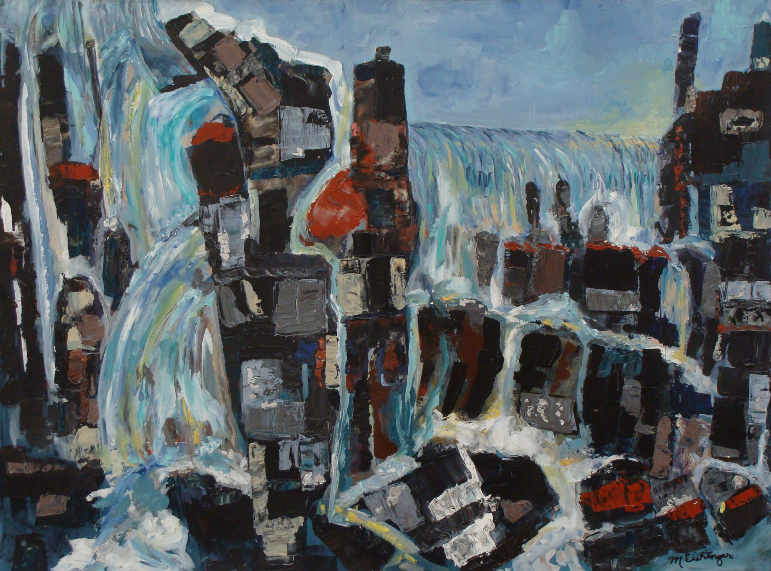
The Oregon Trail ended near falls that became an energy hub for area, transmitting the first electric power to light Portland streets and providing energy to feed industrial mills along its banks. Today the buildings lie vacant in disrepair, with plans for them to be demolished and the falls resorted to its original beauty. The wheel turned. The area has to be cleansed of debris to meet today’s needs.
History- A case for Study
In the New Reformers (1844) Ralph Waldo Emerson wrote, “We are students of words: we are shut up in schools and colleges and recitation rooms for ten or fifteen years and come out at last with a bag of wind, a memory of words and we do not know a thing.”
His complaint is valid today, and that history is poorly taught, affects the nation. Lectures and memorization are history killers for most students. The relevancy of what happened hundreds of years ago is difficult for most children to comprehend but unfortunately, most adults find it mystifying as well. A survey by the Woodrow Willson Institute found that only one in three Americans would pass the U.S. citizenship test, that 2 percent of those surveyed identified climate change as the cause of the Cold War and that many confuse the civil rights movement with the Civil War.
Americans are prone to consider history is boring and lacks practical purpose. Yet, the subject doesn’t have to be presented in dry, pedantic ways. It can be told through stories that bring the past to life. It is through them that we learn how to manage the future. Knowing who we are, where we come from, and how the world operates is essential to deciding where we are going. History provides us with data that we use to make laws and develop theories about how society operates.
Our ancestors exert both positive and negative influences on how we live today. Ignoring historical events thrust into a purgatory where human induced tragedies repeat themselves causing unnecessary for misery. Our handling of the pandemic is a case in point. The plan put together by the Obama administration, based on years of information about past pandemics only to be ignored by the present administration to the detriment of thousands of people. The past is a map that delineates cause and effect and can help us understand human frailties and point out moral issues and evolving values that keep up with changes in society.
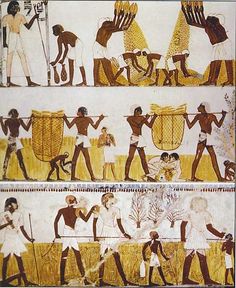
Before the birth of Christ, around 5114 years ago, Egypt’s Old Kingdom dynasties cycled through 30 dynastic periods assigned by scholars to seven kingdoms. Major shifts occurred during times of greed, political strife, invasions, and civil war. During peaceful times the country prospered, producing architectural masterpieces that displayed the kingdom’s wealth. With few threats, there was time to cultivate art in its highest forms.
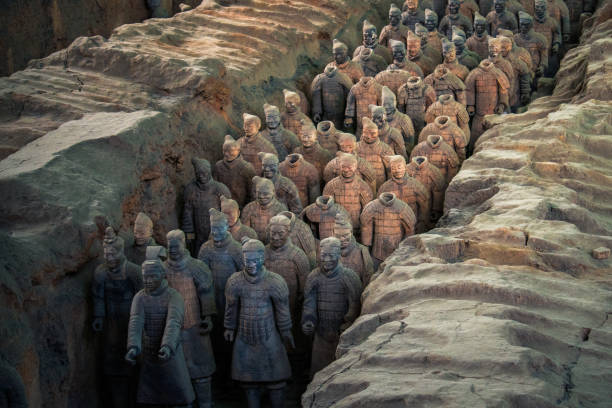
The terracotta warriors at the Mausoleum of the First Qin Emperor in Xi’an, Shaanxi Province, China
China also went through dynastic cycles. Many scholars today consider the communist rule but another repetition. According to theory, the various dynasties reach a political, cultural and economic peak when, because of moral corruption, they lose the “Mandate of Heaven, and fall, to be replaced by a new dynasty. The Mandate of Heaven says that there can be only one legitimate ruler at a time and that the power bestowed on the emperor is blessed by the gods as long as he uses it for good. Dynasties fall when children of wealthy rulers receive privileges that make them lazy and less inclined to work for the betterment of the state. They become focused on building personal wealth and power and willingly do so on the backs of peasants and the working poor. Dynasties were overthrown through rebellion and bloodshed, peasant revolts and external invasions.
Books have been written about the rise and fall of The Roman Empire, The Third Reich, The West, and Texas Oil Tycoons. History tells of powerful leaders who rule bloated empires that fall under their own weight. It tells how discord and corruption run rampant brings about uprisings that usher in periodic stretches of order and prosperity such as the great Pax Romana—two centuries of peace under Augustus in 27 BC.
At this moment, I feel like I am living in the horror loop of a great historical cycle. Around me I see greed and desire for personal wealth above all supersede fairness and justice. It is a period where contemporary Machiavellis rule nations with dictatorial authority. In 1530s when Machiavelli wrote “The Prince” in a letter to Lorenzo de Medici ruler of Florence, he meant it to be a guide on how to lead. His basic premise was that staying power justifies any means used to do so-no matter how horrific. That is certainly occurring in the United States and many other nations around the globe today.
Though I will never concede that the end justifies the means, Machiavelli goes on to argue that once leadership is obtained, reason and understanding should be used to better politics so that it will work for the common good. He gives warnings of what will happen when power is misused. His cautions can be applied to ideas of the alt right and the way the media and politicians promote “fake news.” Contemporary Machiavellian leaders use evil methods to gain and maintain a power that they do not use for the common good. Instead, they line their own treasure chests and set up legal precedents that undermine democracy. They spread falsehoods and rumors that make people fearful. By doing so, they divide citizens, incite civil unrest and arm neighbors who take law in their own hands.
There is no doubt in my mind that the cycle we are in will eventually play out, and the strife will end. Unfortunately, you and I may not live long enough to enjoy the fruits of the next “Pax America.” But, for the sake of our children’s grandchildren, let’s study history and look back in time to discover ways to break through dysfunctional cycles that allow self-serving magnates to flourish at the expense of humanity.
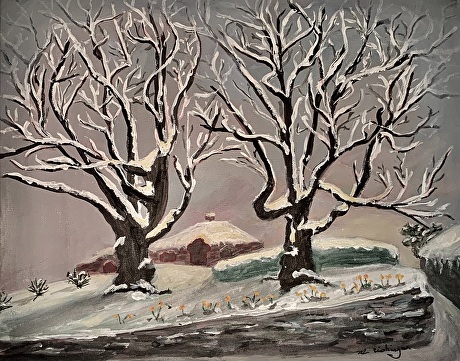
In Portland, Snow arrived late in 2019 and didn’t last long. During the first week we were sequestered I painted Spring Snow after noticing daffodils breaking though the snow at a neighbor’s house, imagining the pandemic would soon be over. Now, nine months later, I realize we have a long way to go. Yet, the pandemic will end and our world will continue turning in never ending cycles.
Snowflakes, like people, are unique.
The other day, I spied our snow shovel buried in the basement closet indicating it was time to move to the garage where it will be more accessible. The white caps of the Cascade Mountains expanded over the past month. It won’t be long before snow will creep from its high perches and descend on rooftops and sidewalks in the lower Willamette Valley.
I love the snow and wish Portland had more of it. Thirty-five years ago, I could cross country skiing through Washington Park during lunch breaks from work. That pleasure is long gone. Global warming has effected such escapades close to town.
The street I lived on as a child was entered on a high plain that swooped down to where my house was situated. When it snowed the children in my neighborhood spent the day whizzing down the hill on our sleds to see who could go the furthest. In those days, sleds were made of wood and had metal runners you steered with a cross bar. Plastic disks and molded toboggans didn’t exist.
We dressed in puffy snowsuits and boots that were more clumsy to wear than the cold-weather clothes sold in stores today. My Mom had hot chocolate waiting by the time we came in with frozen fingers and toes.
In addition to making snowmen, building forts and having snowball fights, my cousin Elaine and I would go to Grey Nuns Pond, not far from our house, to see if the ice was fit for skating. One year, against my Elaine’s advice, I took a few steps on the ice to a spot I thought was thick, when it cracked and I fell in. Thankfully, I was near the edge and didn’t drown. Elaine thought what happened hilarious and started laughing as I pulled myself out. I laughed so hard that tears came down my cheeks and I wet my pants, which amused her even more.
When my youngest son was seven months old son, my husband and I took him outside so he could see snowflakes falling from the sky for the first time. The delight and amazement on his little face as he stretched out his hand to capture them is imbedded in my memory forever.
Watching white fluffy precipitation blanket our one-hundred-year-old farmhouse was thrilling. I kept cross country skis on the porch and took off through neighboring farm fields with the moon lighting my way.
Snowflakes have always fascinated me. Though similar to their companions, each one is a unique ice crystal that develop as a result of thousands of distinct water molecules combining in random formations. The flakes are clear, not white, appearing that way because of how light is reflected through them. Like snowflakes, people too share a fleeting moment of individuality before disappearing into the mass of humanity.
Snow is a reminder that cycles control the seasons and all living matter. Water vapor rises to form into clouds before falling as flakes on mountain tops where they will melt and run through rivers into seas before rising again. We are like the flakes, individuals, united in societies that are born, grow and die in continuous cycles of transformation.
You might wonder how one is formed.
–Flakes, or snow crystals develop around a dust particle that grows into a hexagonal prism. It happens when water freezes and molecules join together to form six smooth sides. It takes approximately 100,000 water droplets to make one snowflake.
–The flake grows larger, becoming unstable, which causes the corners to sprout
arms.
–As it falls from the clouds, the crystal moves though different temperatures
and arms starts to grow on the arms.
–It keeps moving through more temperature changes that cause new growth to grow on the arms.
No Two Are Alike
Fun facts your teacher never told you.
The world’s largest snowflake was just under 15 inches wide and 8 inches thick. It fell at Fort Keogh, Montana on January 28, 1887.
Snowflakes fall at 3-4 miles an hour
Each snowflake is made up of about 100,000 water molecules forming 200 ice crystals.
80% of the world’s water comes from snow.
The most snowfall over a year was on Mount Rainier in Washington. It snowed 1, 224 inches between February 1971 and February 1972.
Snow at the North and South Poles reflect heat into space. The snow acts like a mirror from the sun with light bounces off it and traveling into space.
While sequestered it is good to stay busy.
Project 1: Have fun making watching crystals form as you make snowflake ornaments out of pipe cleaners to hang on you Christmas tree.
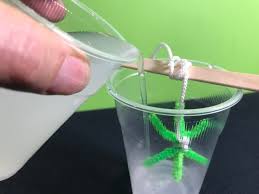
Pour Borax solution into cup with pipe cleaners
Supplies
Box of Borax detergent
Hot water
Wide mouth jars or paper cup
Pipe cleaners
Food dye if you want to color them
Process
Shape various Christmas ornaments using pipe cleaners. For example, shape pipe cleaners into a stocking, star, or cross. Note: The shapes must fit into the jars.
2. Tie a string to the top of the ornament.
3. Fill jars with hot water.
4. Add three tablespoons of Borax to each jar of water with a few drops of food dye if you want to color them.
5. Lower the string so that the ornament is completely covered. And then tie the string around the top of the open jar to keep it in place.
6. Leave the ornaments in the water overnight.
7. Next day the Borax will have crystallized in the water and attached themselves to the pipe cleaner ornaments.
Why does it work?
Because Borax is an example of a crystal. Salt and sugar are other examples. Hot water molecules move away from each other. When you add Borax, the molecules make room for borax crystals to dissolve. But a point of saturation can be reached, meaning there will be some remaining crystals. As this water cools, the water molecules move closer together again. Crystals begin to form and build around another item in the water, such as the pipe cleaner. This is especially true as the water evaporates.
Project #2: Capture your own snowflakes
Supplies
A cold, winter day
black piece of foam board or paper
magnifying glass
Place the black paper or foam board outside, but out of the snow, for 15 – 20 minutes, or until snowflakes can land on it and not melt immediately. When the paper is cold enough place the paper on a level surface or hold it carefully where snowflakes can fall on it. Observe the collected snowflakes with the magnifying glass quickly before they disappear.
Applauding the Blues Beauty surround us, though it is elusive when we forget to open our eyes.
Lean into Love
Platitudes about love and happiness make me shudder. Those uttering such statements imply they are easy to acquire. Love and happiness require thought and determination and, like most things, they take effort to achieve. Positive emotions may come naturally if you were fortunate enough to have parents who modeled them, but for many, they are obtained by setting goals that are reached by trial and error.
Emotions are difficult to understand. Many psychologists consider romantic love not to be an emotion at all. They call it a drive associated with feelings produced by activating neurons in the midbrain that secrete dopamine. Sound romantic? Rage, hate, and revenge fall into that category, though anger is considered an emotion. Whether a drive or emotion, it is buried within, and can be triggered in positive and negative ways that influence the meaning you give to life.
Negative emotions (and drives) are difficult to change. Directives that tell you to “Lean into love and love will lean into you,” or, “Have fun and you’ll be happy,” mean little to a person who is sad and has no idea how to make them happen. And, as most people know, happiness is not the same as contentment. Behind the directive is the implication that success is simply a matter of mind over matter.
During my short career as a mental health counselor, I spoke to a mother unable to control anger. She lashed out by shouting and slapping her young children and was brought to the attention of social services. Warned by a judge to control herself or have the kids taken away, she stared at him fearfully and hopelessly. She didn’t know how to stop the rage that welled up inside. The judge thought his harsh words would inspire the woman to change. She wanted to be kinder and hated being angry all the time, but his advice was difficult to follow as a single mom. She was stretched thin by poverty, exhausted by a manual job, and faced rowdy children the moment she arrived home. She was overwhelmed and her brain had stopped responding to reason.
So, how do you help a stressed woman generate positive emotions? How does she go about turning anger into love? My client’s stress was alleviated with counseling and acquiring time-management skills. She childproofed her apartment and rearranged cabinets to get dangerous products away from little hands. She joined a babysitting co-op that gave her time away from children. Though it meant bringing other children into her apartment, they became playmates for her children, and reduced the burden of being constantly on call. She was advised to hug her children more, which she did, and eventually came to my office with a smile brightening her face.
Platitudes do not help a person who lost a loved one get over the fear of being hurt by loss. It doesn’t help someone find love in a pandemic. And, they can’t help you find happiness, though some may try by resorting to drugs or short term solutions. A vacation or a party might make you happy, but those moments are fleeting and don’t bring about a lasting sense of well being.
What tools do you need in your arsenal to go from apathy to love, from depression to contentment? They are not as easily obtained as watching a blossom open on a magnolia tree. People can’t just turn a switch or wait for the season to change to find love or happiness. Whether by meditation and looking inward or by reaching out, action of some sort is required.
Let’s focus on love. There are rewards to being loved and giving love. Love brings about feelings of well-being and fosters emotions that keeps us in good spirit. There are tangible health benefits such as lower blood pressure, reduced anxiety, improved immunity, less pain and longer life. Love is good medicine, but to have it you need to seek out positive relationships from a spouse, friend or even a pet, and avoid loneliness, a current day health hazard. If you don’t have love and want it in your life, it requires you to change your behavior.
Love is something you have to make yourself capable of giving and receiving. It is influenced by the way you deal with others and often starts by helping friends in need with their problems. Love evolves from appreciating someone else’s successes and being grateful to those who reach out to you. It means thinking good things about a person and acting in a way to make that individual feel comfortable. It can’t be demanded or preserved. It is the opposite of possessiveness.
Reaching out connects you to other people, provides stability and security, and removes fear of being alone. As relationships mature over time they have the chance of turning into loving ones. Doing good deeds tends to generate feelings of love. Doing them often, intensifies them and leads to a higher level of spiritual growth. The opposite is also true. Love won’t flow over a person filled with ego, anger and selfish tendencies, for negative emotions suppress the inner urge to love.
Love is a feeling that fills us with happiness and triggers emotions derived from an inner need to love. Sadly, the object of your love may not love you back. Irrespective of how the other person feels, the feeling of being in love resides in yourself alone. The object of your love can only be a facilitator to bring out the emotion that makes you happy. And, it cannot be taken in or felt unless you are open to it. But when you are, when you open your inner self, you feel light and joyful.
Love and happiness, like life, has ups and downs. They require adjusting to changing situations and taking them in stride. Doing so affects relationships to others and the quality of your life. It is a mistake to think that love is trouble and pain free. It is not. You can love and lose the object of your affection due to circumstances beyond your control, and unrequited love can hurt. Yet, learning to live with its problems, understanding differences that arise as relationships mature, making changes in life style, and becoming tolerant are skills that can be learned. They take us beyond physical attraction to something deeper, and provide a contentment that flows through the days to give life meaning.
The forests were cut to make room for people. Humans inhabited and warmed the planet bringing about natures fury. Now, to have rich and meaningful lives, we must replant, reduce our carbon footprint, and develop new ways to exist in harmony with nature.
Why is it difficult to do what’s right?
We all require access to energy, food and healthcare at reasonable prices. To be happy we need to relax and have places to go where we can join others in community. We encourage our children to have dreams and enjoy helping them get realized. And, as adults, we believe we deserve salaries that will enable us to live without fear of landing on the streets do to a quirk of nature.
Unfortunately, our most ardent desires are easily shaken by natural events that bring disaster to communities and individuals. Floods, earthquakes, hurricanes, tornadoes, fires, droughts, and pandemic, to name a few, are becoming increasingly destructive. And, as in COVID’s case, they can affect a large part of the globe’s population.
If our goal is to live a rich fulfilling life, we need to pay more attention to events of nature that may disrupt dreams. Surprisingly, though we know that natural disasters are bound to occur, it is difficult to get motivated to prepare for emergencies. Most of us are procrastinators.
As chair of an emergency planning committee, I’ve learned that getting people to plan for unexpected events is as difficult as getting people to wear masks at the start of a pandemic. Humanity prefers to wait until tragedy strikes before acting, which may not be catastrophic if you are wealthy. If you are middle income or poor, it could be devastating and require those with money to help assist if they don’t want their streets completely taken over by homelessness and illnesses like typhoid.
Our country was fore warned of the possibility a global pandemic by scientists, yet was of little interest to the general public. And, though the Obama administration did develop a plan for dealing with a pandemic, it was defunded by the Trump administration. What they did is not unusual. Plans made in the heat of the moment are often shoved to the of back file cabinets and never reviewed again.
Few Americans have rainy day funds in anticipation of a disaster. They don’t carry emergency kits in their cars or have a five day supply of water in their homes. Those living in earthquake or flood prone areas may carry extra insurance a year or two after an event, but tend to drop it a few years later.
Scientists repeatedly say that disasters caused by climate change will get only worse. Though it already impact millions of people, those unaffected become angry with eco-migrants waiting at our borders. They ignore projections about future migrations despite the fact that a billion people will be affected. I never hear talk about how to accommodate people fleeing climate tragedies, though there will be ramifications for every town in every country with a habitable climate. Before long, doing nothing will not be an option.
I don’t appreciate how President Trump made people doubt science, yet I do marvel at his ability to attract followers who take his word over that of experts. One thing he does is paint a rosy picture of the future. Imagine what would happen if his marketing skills were used to inspire people think critically and seek truth. Since nature will continue to throw unexpected events our way, what if we changed tactics? Rather than present doom and gloom futures, lets frame arguments that show ways to develop richer, more satisfying lives
For instance, rather than say, “burning gasoline produces carbon that warms the planet, causing rising waters, wild storms and fires,” say, “electric cars will make cities quieter and the air cleaner giving you a better quality of life.”
When discussing energy, point out ways we have cut energy consumption so people think we are headed in the right direction. Cell phones and computers, for example, enable us to communicate world wide instead of having to travel to see family or business partners in gas guzzling cars and airplanes.
Rather than ask people not to drive gasoline guzzling cars, build transportation networks that are safe, clean, comfortable, and less expensive than owning several vehicles. Small electric busses (Jitneys) moving through neighborhoods on frequent schedules are safer to be in, less polluting, and easier to manipulate than large buses.
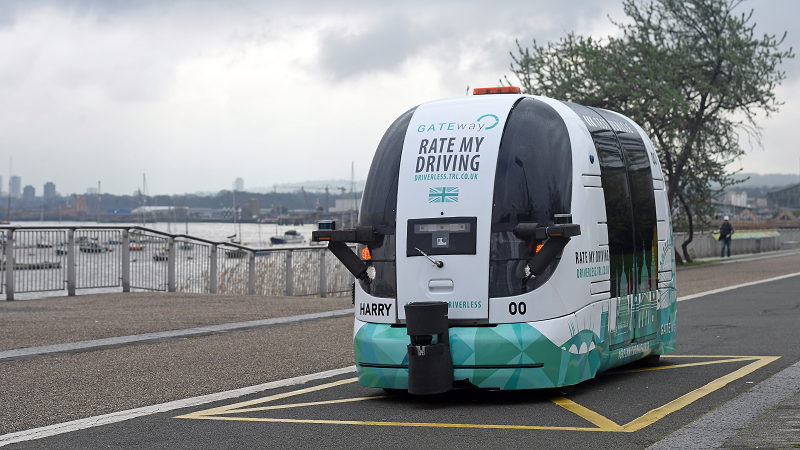
Ask city planners to to redesign streets to accommodate family sized driverless buses like those starting to be used in Taiwan and London. Many of these vehicles will travel on specially designated lanes that make travel safer with fewer accidents.
Let’s get rid of trolley tracks that are the source of many casualties and make bike lanes as safe for children as they are in the Netherlands so they don’t have to be bussed to school. Health benefits from cycling and walking are significant and go far to connect people to their communities.
When the pandemic ends, many business will continue to have their employees work from home. Workers will share desks and computers and mainly come to headquarters for in-person conferences. Companies will save a great deal of money with these hybrid measures. Stress will decrease with fewer cars on the road and health will improve when people don’t have to share crowded elevators with sneezing riders.
Rather than fear messages calling us to lock out eco-migrants, let’s find a way to integrate them into our communities, by teaching them our language and sharing our values rather than pushing them into ghettos. Migrants are not pariahs, but simply people forced to face catastrophic change. And-global warming will force everyone to change with them. Migrants will have to be accommodated, not only by us, but by countries throughout the globe.
Climate change is not a problem we can solve by ourselves. It is an international crisis that requires countries to work together to find solutions. Migrants need to shelter, food, employment and to be educated into the host country’s way of life. Accommodating them will give construction workers jobs, provide income for landlords, outlets for farm produce, and sales for retail stores. If we make our guests are happy, we will be happy too. Nature is not bringing about the end of the world, but the beginning of a entirely new way of being.
Do comment below. I look forward to hearing from you.
Many beautiful trees carry thorns. I study them. Instead of staying glued to television during the election I spent time in my studio painting out frustrations. It is a place I go to remind myself that people are basically good and do what they can to survive.
Understand. Have Hope! Biden won, but many people are angry. This is especially true of gun wielding, flag flying middle age men. The 2020 presidential election pointed out ways our country is divided, but addressing the fury of so many citizens needs to be tackled immediately. I believe that doing so will reduce unrest and bigotry and make it better for everyone. Non-Hispanic white men without a college degree are committing suicide in record numbers and their concerns need to be addressed. There have been many research papers written over the past five years that focus on white working-class Americans in their 40s and 50s who are dying of suicide, alcoholism and drug abuse. Their high death rates contrast sharply from those of college graduates. They are having a particularly difficult time adjusting to changes brought about by the Fourth Industrial Revolution-the one we are in now. Though I’ve mentioned this concern in previous blogs, I feel it is important enough a subject to dig deeper into their plight. Uneducated white men, fearing loss of masculinity, often wind up joining militias and participating in acts of intimidation. Lies told at the expense of minority groups bolster them into believing they are not at the bottom of society’s totem pole. Unable to adapt to the new reality brought on by advanced technology, they are angry, frustrated and follow QAnon conspiracies with the misguided idea that they will hold back change. Though European countries face the same kind of technological change, men are not killing themselves with guns, drugs or alcohol. The United States is unique in the dramatic way inequality has risen while middle-class incomes have stagnated more than in Europe, Japan, or Asia. As large corporations increased their market share worldwide they left workers with little bargaining power. Outsourcing remains the norm as executives seek low-wage workers over developing company loyalty. Days lack structure, status and meaning for many middle- and low-income Americans. Those who are employed, don’t always know what days or hours they will work each week so it is difficult to make leisure time plans. Lack of loyalty to their employer or business frequently translates into lack of pride in the work they do. There was a time when the corporation or institution a person worked for gave meaning to the person’s life. Miners and factory workers identified with the company that employed them, knowing they would work there for life. Today they rarely have the same connection and fear they are expendable to executives looking for ways to reduce costs. Other factors come into play as well. Men without college degrees are less likely to attend church and less likely to get married. They register a high degree of chronic pain and they find it difficult to do basic things like climb a flight of stairs or socialize. Since they are unhappier they drink and use drugs to excess leading to obesity and heart disease. How can these men be helped to transition through the latest technological revolution? We need to start with empathy for their plight. Imagine how difficult it must have been to go from a horse and buggy agrarian society to life in cities with steam engines, automobiles and assembly line factories. The present economic revolution is equally difficult and already alters the way we live, work and relate to one another. Breakthroughs in artificial intelligence and biotechnology are happening at a faster rate than most people can keep up with, making adjustment difficult. Set against a background of warming environment we are called to transform entire systems of production, management, and governance at breakneck speed. One way to help people adjust is to keep big business from maximizing profits at the expense of their workers. Inequality is sited as the greatest societal concern associated with the Fourth Industrial Revolution. Antitrust laws need to be enforced and there needs to be an evolved form of labor unions to deal with management. Added to labor issues is the fact that the United States suffers by far from having the world’s most expensive health-care system. It drains resources that could be more productively spent on schools, daycare, roads and public transit. And, despite high costs, the American medical system fails to keep large segments of society healthy.Last but not least is the need to reform our healthcare system.To do so, politicians will have to do a better job explaining to the public why our current system does not work. The health of our citizens should be a higher priority than the wealth of the those working in the industry. Education, though, is at the core of preparing present and future generations to survive. To insure everyone is educated, government will have step in and subsidize four-year college degrees and meaningful vocational training. People in their thirties and forties need to be drawn into a massive effort to get them retrained. A demand for highly skilled workers will continue to increase while the demand for workers with less education and lower skills will only decrease. But, education is not just a matter of machine learning. Things that set people apart from machines, such as how to work collaboratively to solve real world challenges and gaining an understanding of different cultural needs and perspectives have to be taught. Now that social scientists better understand what is happening to uneducated white men, we can put our heads together and solve this problem. It is time to act aggressively and compassionately as a nation in order to move it forward. I have hope. References:Brown-Martin,G.(2018) Education and the Fourth Industrial Revolution . Learning to thrive in a transforming world. Keynote talk at Regenerative Global. retrieved from GLOBAL. MacGillis, A. and ProPublica.(2020) The Original Underclass.The Atlantic. retrieved from UNDERCLASS. Reed, I. (2018) the Plight of the White American Male. Haaretz. retrieved from MALE. Schwab, K, (2016)The Fourth Industrial Revolution: What it means, How to respond. World Economic Forum. retrieved from FORUM. Leonhardt,D. & Thompson, s. (2020) How Working-Class Life is Killing Americans, in charts. New York Times. retrieved from KILLING.
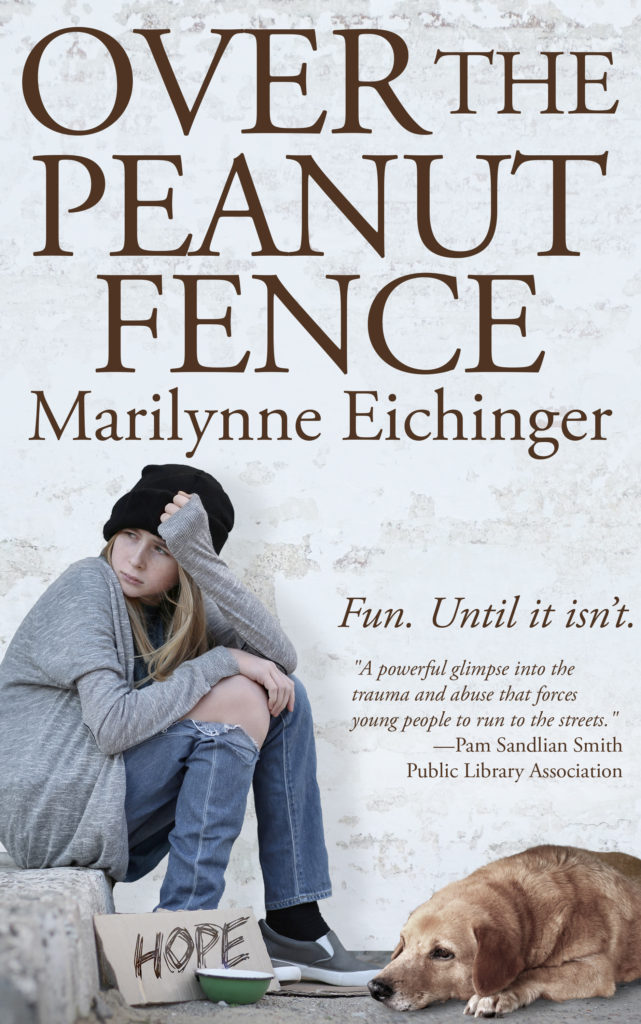
Art is always for sale. Hawthorn Tree is 20″ x16″ x 2 ” / mixed media on canvas/ $325. Contact me at marilynne@eichingerfineart.com to discuss shipping. _________________________________________________________ Join me on November 17th at 7pm (PST) for a book talk sponsored by Lake Oswego Library. To receive information about how to connect on zoom go tohttps://www.ci.oswego.or.us/library/third-tuesday-author-marilynne-eichinger-0?date=0 and register. Over The Peanut Fence, a book about homeless and runaway, focuses on problems of traumatized youth, many of whom experience the effects of PTSD. Over the past twenty years we have learned a lot about developing brains and are learning how to help them overcome barriers to having a successful life.
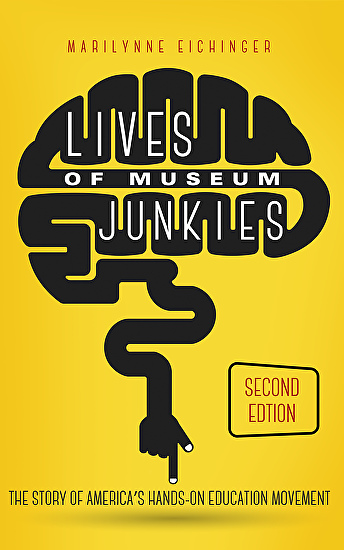
Revised and re-edited, the second edition of Lives of Museum Junkies is now available. It corrects mistakes and brings stories about the development of science centers up to date, covering ongoing events affecting communities nationwide.
* * *
When I was a young wife and mother, I started a science museum in my basement. It was 1972 when Impression 5 Science Museum was incorporated as a non-for-profit organization in Lansing, Michigan. That action heralded the beginning of an adventure that changed a timid, naive woman into one capable of running the Oregon Museum of Science and Industry (OMSI), one of the nation’s foremost science museums.
A wise man advised me, “When the time feels right, go for it! Don’t wait for everyone else to agree with your dreams because that never happens. Grab your own opportunities.” And that is what I did, though not alone. In Lives of Museum Junkies: Second Edition I share the joys and difficulties I experienced, as well as the struggles of eleven men and women who were on the leading edge of an international movement to create experiential museums dedicated to science.
As pioneers, we were change agents influencing the country’s education ethos. And, as visionaries, we broke from tradition by combining art with science, engineering, math, and technology. Years later schools followed our leadership with a curriculums known as STEM, and when the arts got included, STEAM education. We saw ourselves as promoters of lifelong self-improvement, practitioners of creative problem-solving, believers in equal opportunity, disseminators of the latest scientific information, and teachers who made learning so much fun that students were compelled to ask the next question. We wanted visitors to leave the museum yearning to know more.
We were unsophisticated when we started our museums and not skilled at fundraising, board development or staff management. We were artless in the way we constructed interactive displays and did not understand how chauvinism, race, poverty, and social class played a role in what we were doing. Included are sections called “lessons learned” so you will understand how the people I write about were changed by their experiences. Hopefully, the insights shared in the book will be helpful to anyone attempting a new venture.
I built and ran science museums for twenty-five years. In my late fifties, I took a risk by leaving the comfortable cocoon I had spun around me. With the help of twenty-two national museums and several board members, I left OMSI to found the Museum Tour Catalog in order to spread science literacy to homes throughout the country. My goal was to provide parents with information and hands-on manipulative devices in order to help their children become engaged in doing and questioning rather than retreating to mindless television programs.
For eighteen years, The Museum Tour Catalog along with science centers inspired toy companies to develop hands-on science materials for children. Today science and art kits are found everywhere toys are sold. In the pandemic these materials are providing vital props for parents willing to augment virtual classroom learning.
The American Alliance of Museums recently estimated that one-third of the nation’s museums and science centers will close as a result of COVID-19. Thankfully, Impression 5 and OMSI look like they will survive. Their staffs are engaged in educating sequestered children and providing special in-museum offerings for those needing help with homework. They offer a variety of programs for adults craving intellectual stimulation. Special exhibits like the one OMSI opened about Genghis Khan are made available through timed entrance reservations.
What these overworked staff members do is not easy. OMSI, for example, had to reduce its budget by half which meant laying off fifty-three percent of its employees. Though the organization remains viable due to the commitment and inventiveness of its staff and financial support from the community, each day is a struggle.
The revised edition of Lives of Museum Junkies explains how science museums became integrated into their communities, making them valuable assets that help people stay abreast of change. The pandemic focused attention on the importance of heeding scientists and medical professionals with years of training rather than giving credence to wishful thinkers and rumor mongers who extend Covid’s dangerous reaches. Science centers play a critical role in separating truth from fiction in confused minds.
Lives as Museum Junkies’ second edition demonstrates how entrepreneurs who follow their dreams stay motivated and dedicated despite setbacks. Remaining positive and reaching for a better tomorrow is as important today as it was fifty years ago. As Norman Stiles implied in his children’s book Everything in the Whole Wide World Museum, the entire universe is everyone’s museum and we just have to fine tune the way we see things to take advantage of all that is there. I hope my writings will encourage readers to do just that.
Lives of Museum Junkies: Second Edition is available online in ebook and paperback formats. The print version will be in bookstores on Monday, November 2nd.
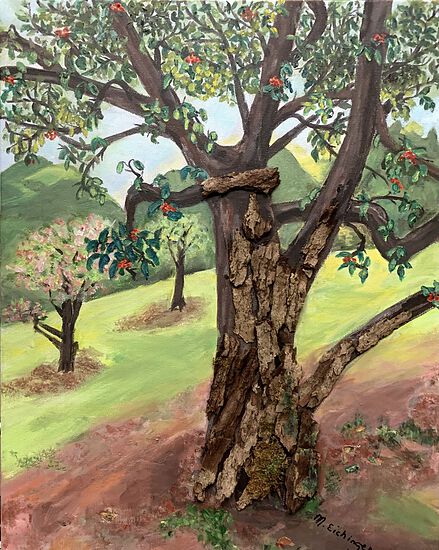
Chestnut trees are known to live 800 years. Imagine the changes that occur while they spread their limbsduring the fourth industrial revolution.
The Fourth Industrial Revolution
COVID-19 is a wake-up call, a shout-out for resilience. The pandemic created a vacuum that opened space for possibility. Though the illness is horrific, it let us see changes that have been occurring over the past several decades. It pointed out problems but also showed us what happens when society is thrust into a new era. We left the industrial and computer ages behind years ago and are moving to a world where advances in artificial intelligence and biotechnology will lead the way. The period we are in is spoken of as the fourth industrial revolution.
Now able to visit distant friends virtually instead of boarding a plane, within ten to twenty years we will be able to communicate with friends who leave earth to reside on the moon. With 3D printers, machines that can show emotions, bionic body parts, and genetically designed health care, the old ways are gone forever. In order to prepare for change, shine light from the past through a prism and watch it emerge as a rainbow of possibilities on other side.
COVID, our prism, illuminated empathy and the importance of science. It focused on dangerous antics of uneducated middle-class men while showing us people suffering in a land of plenty. Sequestering forced us to grapple with loneliness and learn to live in the moment, holding off plans for a future we don’t fully understand.
With pictures of the nation’s economic and political divide brought into living rooms, we saw the plight of the poor and how people of color and native populations are treated. We learned that poverty is interconnected with health care, unemployment and lack of affordable housing. And, in the midst of multiple traumas we realized how important it is to share in community and yet reserve time for ourselves.
The pandemic also demonstrated that good government matters and that leaders who carried the welfare of their countrymen and women in their hearts, mitigated effects of the illness.Their examples taught us that the way we interact with neighbors matters. But for citizens to follow directives by government leaders, they must be transparent, trustworthy, and accountable.
Nations practicing multilateralism experienced synergistic benefits from working together. The European Union, for example, became stronger while facing COVID, migration, and climate change challenges. International participation in youth rallies, the women’s movement, and Black Lives Matter marches demonstrated what is possible when like minded people build platforms for resilience and fight against seemingly impossible odds.
The pandemic is already spurring discussions on how to make systemic improvements to the way business and government operates. I am more hopeful now than I was a year ago. There are times when things have to hit rock bottom before they get better. When that happens, there is a lot to do.
China, the largest emitter of greenhouse gasses, has done an about face by instituting policies that shift their economy toward a low-carbon future. When the United States dropped out of the Paris Accord, they assumed a leadership position in greening the world through carbon neutral investments in foreign infrastructures. Though our federal government is not involved, thankfully, individual states and companies are committed to lowering carbon emissions, with the hope of slowing global warming.
The projected surge in migrations caused by drought, flooding, and unlivable conditions has to be faced head on. Climate displacement has already caused entire communities to leave their ancestor’s bones behind on islands and coastal areas. Western Alaskans are forced to abandon their villages due to melting glaciers and erosion. We need to make plans to accommodate and help migrants resettle rather than treat them as pariahs.
But there are signs of progress as well. During the next fifty years, developments in artificial intelligence and biotechnology will explode. Have you noticed the shift in attention given to mind than rather than body activities? Fantasy sports and gaming, for instance, attract more people than ever attended live sporting events. A man like Steven Hawking could not have survived to contributed so well without advances in healthcare and AI. Symbols rather than the written word are used by youth who communicate with emojis and computer short hand. My son sent “<3” as an expression of love and best wishes. I had no idea what he meant.
Change in energy and materials technology already influence the way buildings are constructed and transportation systems designed. From airplane windows we see solar panels and gardens on rooftops. City planners of costal cities are reimagining how to coexist with rising waters with some suggesting we direct the sea through town in canals like the Dutch do in Amsterdam.
Corporate capitalism is bending to public pressure by incorporating social responsibility into its mode of operating. 200 Chief executive officers, including Amazon’s Jeff Bezos, Apple’s Tim Cook, and General Motors’ Mary Barra, signed an agreement to move away from “shareholder primacy,” to include all stakeholders such as employees, suppliers, and consumers. By doing good, they expect to have a positive impact on global economies which in turn will be good for business.
No one knows for sure how this Fourth Revolution will fully evolve, except that the way our lives are conducted is bound to be different. COBOTS, robots designed to interact physically with humans in collaborative environments and augmented reality and virtual reality are bringing enriched immersive experiences. Big data will allow massive data management and interpretation for business purposes and 3D and 4D printing will give us a way to quickly, accurately, and economically develop prototypes and products for sale.
My advice in how to cope with change is try to understand the past but not overly dwell on it. Rather, look to the future with curiosity and flexibility. Change can be exciting if you are a part of it. To prepare children, immerse them in STEAM education and teach them to be empathetic, creative, and competent problem solvers.
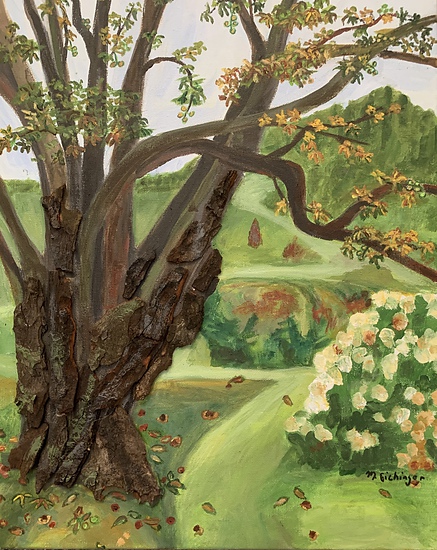
Art is always for sale. Chestnut Trees is an acrylic on canvas with tree bark imbedded in the painting/ 20″ x16″ x2″ / $325. Call for to make arrangements. marilynne@eichingerfineart.com.
___________________________________________
About homeless and runaway youth. Available online and in bookstores in paperback and ebook formats.
Save the date:November 17th at 7pm.
ZOOM book talk sponsored by Lake Oswego Library, Lake Oswego, Oregon.
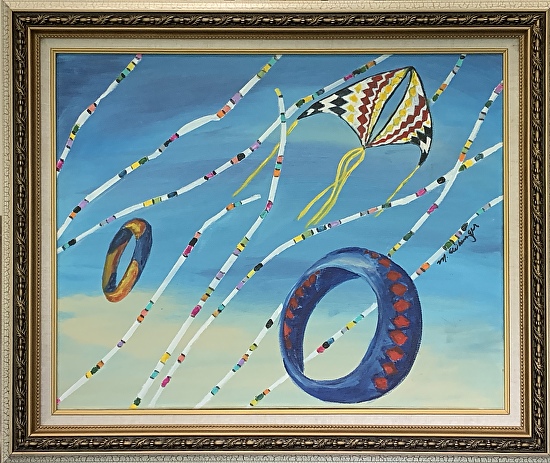
Flying High by Marilynne Eichinger : COVID brings home the fact that we live in community. One person can affect people living on the other side of the globe.
Whose Freedom is it?
The question raised is how far should freedoms go? Does freedom of speech give you the right to lie or incite hatred? Is a free press given the right to spread false rumors? The Declaration of Independence maintained that people have the right to life, liberty and the pursuit of happiness. The Constitution set parameters under which laws of the land are enacted and the Bill of Rights spelled out civil rights and liberties for the individual: freedom of speech, press, and religion.
A war was fought to free the nation from tyranny by a foreign power. Since then, our citizens have been obsessed with the concept of freedom, with many considering it a right to do whatever makes them happy. happiness.
Whining about wearing masks and calling social distancing an infringement of personal freedom seems ludicrous, childish, and even dangerous. Why does anyone think that an individual’s rights are more important than everyone’s safety in a pandemic? Perhaps these “freedom lovers” grew up watching cowboy movies or space odysseys with wide open spaces between homesteads and planets where no one was paid attention to how they acted. Do they remember that even cowboys had to drop their guns off at the sheriff’s office when they came to town?
There have always been constraints on how to behave, but COVID and protests against police brutality made us aware of what happens when an individual’s pursuit of freedom impinges on the rights of others. This occurs often, but not in ways that are flaunted by extremist groups.
The Pilgrims left their homelands to come to the Americas because of religious persecution. This led to the Bill of Rights that prevented government from creating or favoring a religion. Unfortunately, many of the freedoms the founders cherished are being undermined today.
Packing the Supreme Court entirely with men and women of conservative Christian persuasion reminds me of the Inquisition, a time when individuals were denied the right to live according their spiritual conscience. Laws upheld by judges or made by legislators who place personal beliefs about the Almighty more important than the Constitution that separates governance from religion, can easily make criminals out of non-believers. When powerful people are firmly imbedded in dogma, they dismiss individuals and religions that countenance that LGBTQ is a biological condition, that women have the right to manage their own bodies, and that the universe is best understood by the study of science. A small group of nine can impinge on the freedoms of many.
The Declaration of Independence spells out why the colonists wanted to be free from England. Many of the disagreements they wrote about in the seventeen hundreds are similar to concerns expressed by individual States and citizens today. Quotes from the Declaration (about King George):
“He has endeavored to prevent the population of these States: for that purpose obstructing the Laws of Naturalization by foreigners, refusing to pass others to encourage their migrations hither. . .” Today we have our own power elite obstructing naturalization by foreigners and discouraging migrations.
“He has made Judges dependent on his Will alone, for the tenure of their offices. . . “ We again have an oligarch demanding absolute allegiance to his will alone.
“He has erected a multitude of new Offices and sent hither swarms of Officers to harass our people, and eat out their sustenance. . . “ A swarm of Immigration and Customs Enforcement officers (ICE) harass individuals who have lived peacefully in the country for decades, divide their families, and treat them inhumanely.
“He has kept among us in times of peace standing armies without the consent of our legislature.” We send our army to foreign lands and station them in homeland cities without war being declared by the legislature.
“He has affected to render the military independent and superior to the civil Power.” The president uses the military as his private army and sends them into states when not requested to do so and without the backing of congress.
“He has plundered our seas, ravaged our Coasts, burnt our towns, and destroyed the lives of our peoples.” Though this is a stretch, leaders who deny global warming, allow the seas to be polluted, and destroy plant and animal life in record numbers, are the ones causing land and towns to be plundered by fire, floods, and drought. People are suffering in record numbers.
“He has excited insurrection amongst us. . .” When the Declaration was written this article talked of how King George incited native peoples to plunder and divide our colonizers. Today, our president divides our citizens and incites right and left wing reactionary groups that are bent on destruction.
Though we inherited the right to life, liberty and the pursuit of happiness, as well as freedom of speech, press, religion and the right to bear arms, they were not given in a vacuum. We live in a global community of 7.8 billion neighbors, whose welfare affects our freedoms and happiness. In the 1700s there were an estimated 643 million inhabitants on earth.
Do to the way we trade and travel, their diseases reach our shores. A warming climate and wars push millions of families to migrate to foreign lands. They have no choice if they are to survive. There are now so many people on this planet, that we would do well to consider our collective human family when thinking of our own welfare, for they are connected and can never be separated again.
Historian: What would Founding Fathers Think of Trump? CNN, Joseph Ellis, 2016