Peace on Earth

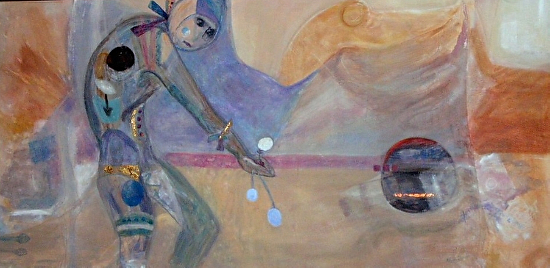
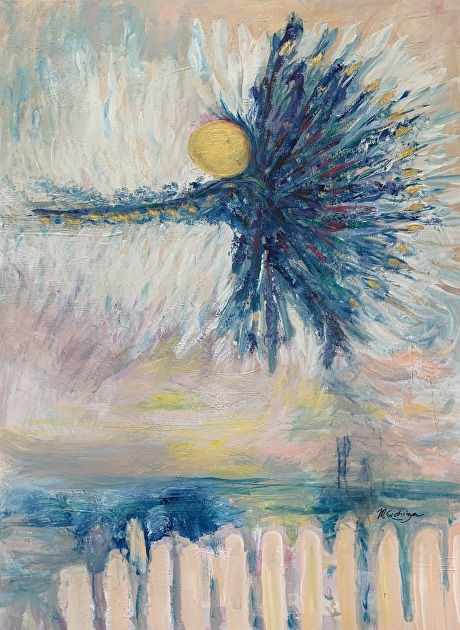
Mystére

  Bringing peace to Earth

 Peace on Earth, Good Will to Men (women and those in between)

It’s the Christmas season when people sing carols like Hark the Herald Angels Sing and The Peace Carol. The lyrics to these songs were inspired by Luke 2:14. The New American Standard Bible reads, “Glory to God in the highest, And on earth peace among men with whom He is pleased.” The MSG version says, “Glory to God in the heavenly heights, Peace to all men and women on earth who please him.”  

Whether you believe there is a supreme being or not, the sentiment for peace is noble.  Peace on Earth, who wouldn’t want that? The question is, how do you get there? I don’t believe the human species can wait for divine intervention. We’ll have to be proactive to bring it about.

At the end of 1922, there were at least 150 armed conflicts worldwide, up from previous decades when the number covered around 100, according to Our World in Data.  Armed conflicts began escalating in 2013 and have been increasing yearly. From 1800 through 2022, more than 37 million people died in wars.

How does a violent world become peaceful? The answer is complex; a miracle won’t make it happen. It requires the collective efforts of individuals, communities, governments, and international organizations and starts with the media’s willingness to combat the spread of misinformation and propaganda. News anchors have to be allowed to report honestly, irrespective of the bias of owners and advertisers. Peace will never flourish without a factual press.

Problem-solving starts with diplomacy and dialogue, not weapons. Conflict resolution tactics employed at local, national, and international levels move warring factions to discuss their differences in a calm atmosphere. Strengthening international organizations like the United Nations and alliances promoting cooperation on climate change, public health, and poverty helps nations compromise.

At the heart of all peace movements is a commitment to protect every inhabitant’s human rights, regardless of background, ethnicity, or beliefs. A Guatemalan woman I heard recently said, “Even terrorists have families who want to live without fear. Don’t give up hope and think that conflicts between Israel and Gaza  and the Ukraine and Russia can’t be solved.” She said that she had almost given up hope for Guatemala but improved drastically after electing an anti-corruption president who had been considered a terrorist by the opposition.

Hope requires nations to advance education for both sexes and adopt a cultural understanding that addresses the inequalities that lead to social unrest and conflict. It means promoting inclusive, environmentally sustainable economic policies and recognizing that the earth has limited resources. Hope empowers women. Multiple studies indicate that societies with greater gender equality tend to be more peaceful.

Strengthening the rule of law, combating corruption, and ensuring fair, transparent legal systems promoting justice are essential for bringing peace. It is also wise to stay alert to potential conflicts and address them before they blossom. 

To achieve peace on earth is a tall order. Our own country is going in the opposite direction. It has become less democratic and more violent. Lies, inequities, greed, unwillingness to compromise, and disregard for the environment have spiraled out of control. An economy based on selling military weapons and ammunition, one that soothes itself with narcotics and allows homelessness to exist, is on the wrong track. A citizenry that worships criminal politicians and allows the media to promote lies destroys its humanity and all hope for peace. There isn’t a God in the cosmos who would be pleased with what is happening.

Next time you sing a song or receive a card wishing peace, consider your role in bringing it about. For sure, light candles,  fill your home with smells from a home-cooked meal and enjoy a Yule-time drink.  But if you wish others a peaceful year, realize that won’t happen unless you and they practice love, not aggression. Join those who crave a peaceful society and engage in activities toward that end. Vote for candidates who will understand compromise and seek out non-violent solutions. Enjoy in spirit as people celebrate Christmas, Hanukkah, Kwanzaa, Diwali, Yule, the Solstice, and the New Year. It is a chance to show you acknowledge diversity. Let’s ignite an era that brings peace on earth and goodwill to the men, women, and those in between in every nation of the world.

References

Herre, B. Rodes, L. Roser, M., Hassell(2023)  War and Peace. Our World in Data.  retrieved from https://ourworldindata.org/war-and-peace#:~:text=Key%20Insights%20on%20War%20and%20Peace&text

Crespo-Sancho.C. (2018) Can Gender equality prevent violent conflict? World Bank Blogs. retrieved from https://blogs.worldbank.org/dev4peace/can-gender-equality-prevent-violent-conflict#:’

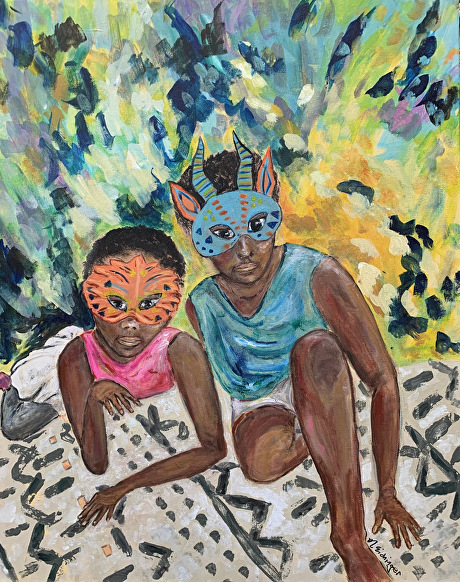
Mystére is a 36” x 48” acrylic canvas painting available for $1,900, shipped free in the continental U.S. For information, contact marilynne@eichingerfineart.com

I enjoy reading your comments. Please do so below.

.
Kepping Up Appearances

Do you get tense around the Christmas holiday? Don’t let it get to you. Take the time to enjoy nature and relax.

Keeping Up Appearances

Though there is much gaiety and joy during December, for some people, the month magnifies their depression. They don’t like the long dark nights and fear being around people where they feel obligated to smile when, on the inside, they are melancholy or upset. They become like walking zombies with smiling depression, a term not found on any psychologist’s list. Their depression may have started with a job loss, illness, or the death of a loved one or simply by being obligated to decorate their house and entertain.

Depressed smilers are highly functioning people who believe it is essential that they keep up appearances. They are good are good at faking it, appearing cheerful and optimistic. They can stay productive at work and even laugh appropriately when hiding an anxiety that gives them headaches. As perfectionists, they don’t want to burden others with their problems and are too embarrassed to share the truth. Though there may be a good reason for their depression, they pull away from friends, some turning to drugs or alcohol.

People with smiles plastered on their faces deny their true feelings, thinking they are all right as long as they smile. They worry about appearing weak, being judged or punished, and fear a backlash by admitting to their depression. They are also more likely to harm themselves than those with classic depression symptoms. To compensate, some people will overeat, while others lose their appetite. Some find it hard to wake up, yet others experience insomnia. Feeling pressured to be happy when you are not is problematic, causing emotions to fluctuate between hopelessness, guilt, and worthlessness.

Smiling depression takes a particular toll during the holidays. The best thing a person can do is try to outsmart it, says psychologist Jessica Schneider. Don’t just grin and bear your melancholy; that will only worsen matters. Develop a plan to overcome it. The problem with acting together on the outside, when you are not on the inside, is that you may not realize you are depressed. A person who thinks they have everything – a lovely house, a wonderful family, and a good job, yet isn’t happy may feel guilty, which can be exhausting. Admitting to being overwhelmed is the first step toward healing.

The good news is that smiling depression is usually a short-term phenomenon and very treatable the moment you take a step toward being your authentic self. If this malady plagues you, make sure you stay connected to your friends. Talking to someone you trust can be a powerful antidote to holiday depression. Stop worrying about living up to expectations. No one expects you to be perfect. If you are angry because your partner won’t help put up the tree or participate in festivities, don’t worry when you become irritable. That’s natural. It is also advisable not to dwell there. Instead, do something that enables you to relax. Exercise, listen to music, make art, meditate, or engage in an enjoyable activity that will change your mood.

During this season of miracles, close your eyes and imagine that your most pressing problems are gone and that you will wake up in the morning relaxed and happy. Allowing yourself needed downtime will brighten your day.

____________________________

How do you feel now that Christmas is upon us? Is it a struggle to get through the days or, do you embrace each one joyfully? Do share your thoughts on my blog site below.

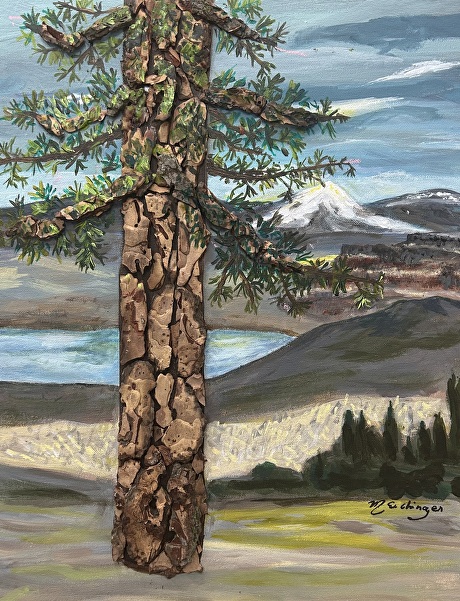
Art is always for sale. A Ponderosa pine canvas print is available for $99, shipped free. Tree selections can be reviewed and purchased online at https://www.eichingerfineart.com/collections/182747

_______________________________

Moroin, A. LCWS.(2023)  Smiling Depression: When Things Aren’t Quite as They Seem. Verywell Mind. retrieved from https://www.verywellmind.com/what-is-smiling-depression-4775918

Casarella, J. MD. (2022) Smiling Depression: What You Need to Know. WebMD. retrieved from https://www.webmd.com/depression/smiling-depression-overview

Mastrocola, K. (2023) Outsmart the ‘Smiling Sadness’ That Can Take Its Toll During the Holidays. First, for women. https://www.firstforwomen.com/posts/health/what-is-smiling-depression

Connections

NURTURING

Though humans destroy the environment, there is still hope for its revival. Nurturing one tiny seed can have immense repercussions.

Connections

Deep down, we know we are connected to one another but don’t act like it. As a five-year-old, my circle of contacts was limited to me at the center. I learned how the bones in my body were connected to help me stand.  I sang “Dem Dry Bones,” an old spiritual often sung at Halloween.

“Dem bones Dem bones Dem dry bones
Dem bones Dem bones Dem dry bones
Dem bones Dem bones Dem dry bones,
Hear the word of the Lord.

The toe bone connected to the foot bone
Foot bone connected to the heel bone
Heel bone connected to the ankle bone
Ankle bone connected to the leg bone
Leg bone connected to the knee bone
Knee bone connected to the thigh bone
Thigh bone connected to the hip bone
Hip bone connected to the back bone
Back bone connected to the shoulder bone
Shoulder bone connected to the neck bone
Neck bone connected to the head bone
Hear the word of the Lord.”

By the time I was in elementary school, I knew I was part of an extended family, lived in a neighborhood, and was somehow connected to the children in my classroom. My parents were not the only ones looking out for me; my teachers were also.  I sang; Hey, hey, hey—

“We are family

I got all my sisters with me

We are family

Get up everybody and sing

Everyone can see we’re together

As we walk on by (and)

And we fly just like birds of a feather

I won’t tell no lie (all)

Living life is fun and we’ve just begun

To gain our share of this world’s delights (high)

Our high hopes we had for the future

And our goal’s in sight”

By high school, I knew I was part of the greater world. Friends had pen pals in the Netherlands and Japan. I studied French and couldn’t wait to go to Paris. The civil rights movement was around the corner, with schools being integrated.  I joined a volunteer group in college that helped international students adjust.  And, I sang—

“We are the world

We are the children

We are the ones who make a brighter day, so let’s start giving

Oh, there’s a choice we’re making

We’re saving our own lives

It’s true we’ll make a better day, just you and me

When you’re down and out, there seems no hope at all

But if you just believe there’s no way we can fall

Well, well, well, well let us realize

Oh, that a change can only come

When we stand together as one, yeah, yeah, yeah.”

My view of the importance of humans diminished as I took science courses in college. Anatole France wrote,” Even a little dog is the center of the universe.” That may be true since I am a collection of all my experiences and learning, and I see the world through my eyes. But, when learning about the cosmos, I realized I am much smaller than a grain of sand. I had been fooled into thinking that I was part of a dominating species that could control my environment when the truth is that I am made up of atoms and electrons that are no more important than the shoes that cover my feet or the tree outside my window. Albert Einstein told us that the universe is nonlocal and that objects are linked even though events cannot communicate through spacetime. When two objects come into contact, they affect each other. If one’s direction is changed, so too will the other.

Dr. Roger Nelson at Princeton University conducted a 14-year-long study involving 60 countries called the Global Consciousness Project to introduce Einstein’s findings at the human level. Using massive computing power, he studied the probability that 426 events would have a 50/50 outcome over time. That wasn’t what happened. He found that quantum mechanics does apply to the human psyche.” Something occurs when you touch someone’s heart emotionally becoming attached to someone. Your atoms, the building blocks of your presence in the universe, become entangled.” 

Quantum mechanics comes into play with the Israeli/Gaza war, where two countries at loggerheads have impacted the direction of each entity. The confrontation had a domino effect, spreading to communities around the globe. Just as waves in the ocean move endlessly, hitting the shore, vibrating, and transforming, so do human beings. Serge Benhayon wrote in Time, Space and All of Us, “There is no them. There is only all of us. We have this perception of the need to unify, to come together; however, in truth, we are already all unified as one, and in this oneness, we cannot help but be connected to everything else – such is the mechanics of vibration in space, our universe.”

Though we may chant, picket, and sing that the world has to come together, we are already connected and unable to separate. Our responsibility is to recognize this truth. When nations collide, they should be given a positive nudge that improves both parties rather than one that destroys lives and economies. We must understand and act, knowing we are not alone but connected.  When one country destroys another or when a company pollutes the environment, the world is affected.  The song in my heart rings out,

“The more we get together

Together, together

The more we get together

The happier we’ll be

‘Cause your friends are my friends

And my friends are your friends

The more we get together

The happier we’ll be

__________________

Art is always for sale. Nurturing is a framed acrylic on-panel painting, 43” x 84”. Available for

 $ 2,900. For information about shipping, contact me at marilynne@eichingerfineart.com

I look forward to reading your comments below.

References:

Borbon, L. (2014) Quantum Mechanics. Learning Mind. https://www.learning-mind.com/quantum-mechanics-reveals-how-we-are-all-truly-connected/

Moses, P & O’Hara P, ( 2023) Quantum Mechanics –  the science of absolute connection. Unimed Living. retrieved from https://www.unimedliving.com/science/everything-is-energy/quantum-mechanics-the-science-of-absolute-connection.html#

Den Bones Lyrics.  retrieved from https://www.google.com/search?q=dem+bones+lyrics&oq

We are Family Lyrics. retrieved from https://www.google.com/search?q=we+are+family+lyrics&sca_esv

We are the World Lyrics. retrieved from https://www.google.com/search?q=we+are+the+world+lyrics&sca_esv

The More We Get Together lyrics. retrieved from https://www.google.com/search?q=dem+bones+lyrics&oq

Think Gratitude

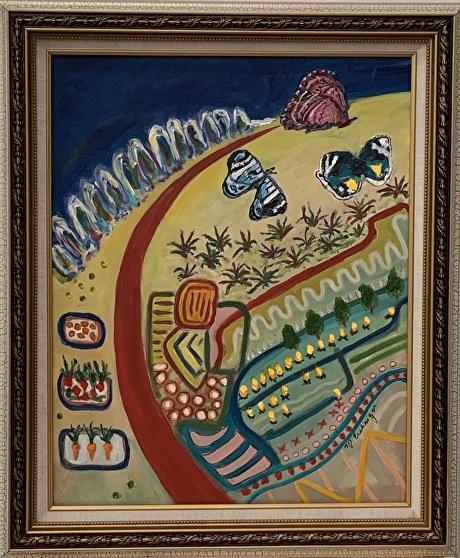
Planting a garden and reaping its harvest are among the many things to feel grateful for.  

Think Gratitude

America: Thanksgiving (the fourth Thursday of November) is a time for gratitude. The holiday has roots back to 1620 and the landing of the Mayflower. As well as being a day to remember contributions from Native Americans that helped the Pilgrims survive, it is a celebration of appreciation for the bounty of the earth. It is a happy occasion to join with family and friends, divorced from the stress of daily life.

Related to our Thanksgiving is a celebration that takes place in Leiden, Netherlands, in remembrance of the Pilgrims who lived there before leaving for the New World. The city in the Dutch Republic had permitted Pilgrims to practice their religion there without being hassled. After trying to adjust to Dutch society, they left for the New World due to a lack of education, harsh working conditions, and a potential war with Inquisitional Spain. Leiden’s annual Thanksgiving celebration takes place at Pieterskerk, a Gothic church that has the grave of one of the Pilgrim leaders.

Listening to the news, it is easy to forget that there is much to be thankful for. I am grateful to have food on my table and cherish the friends and family who fill my life with good cheer. For families yet on pilgrimages undertaken due to poverty, war, or natural disasters, gratitude is more difficult to achieve.  Yet, they, too, are filled with hope for a new beginning. Following are some of the ways countries celebrate the harvest and give thanks for abundance.

Canada: Jour de l’Action de Grace – (second Monday in October) Canada’s first Thanksgiving was celebrated in 1578 when English explorer Martin Frobisher’s crew gave thanks in Newfoundland for a successful journey to North America. Their feast is similar to ours, a three-day weekend with parades, a Canadian Football League doubleheader, and a dinner with turkey, mashed potatoes, corn, and pumpkin pie.

Korea: Chuseok (25th day of August, lunar calendar) is a festival with roots dating back to 2000 years ago when Korea was an agrarian society. Legend relates that the ancient king, Silla, held a month-long weaving competition, treating the winning team with food, drinks, and gifts from the losing team. Today, families gather in a bonding activity a night before the celebration to prepare rice cakes and share presents. Spam is a standard gift popular among Koreans.

UK: London’s Harvest Festival (October–days differ), a relatively new festival that started in 1998, showcases livestock, horticulture, and home products. Competitions are held for the animal most like its handler, the most pleasantest pig, the best goat beard, the best animal portrait, and more. Celebrations are held in churches, schools, pubs, and even barns where participants sing hymns, pray, and decorate event halls with baskets of fruit and food. Lavish meals featuring several types of meats, vegetables, puddings, tarts, and ale are accompanied by songs, drinks, and games. The Royal Horticulture Society organizes the festival.

Germany: Erntedankfest is a rural festival thousands of years old that celebrates the harvest. There is no set date, but festivities are held between mid-September through October in various communities, especially in rural areas. Christian and Protestant churches celebrate with a service, a parade, music, feasting, and the crowning of a Harvest Queen. It is primarily a religious holiday for fun, food, and Thanksgiving.

Ghana: The Homowo Festival commemorates a time when the Ga tribe in Ghana had no food to harvest because of infertile soil. Starving people had no choice but to wait for the rains to come again and the famine to end. In remembrance of the famine, the capital city, Accra, enforces a noise ban and prohibits fishing in lagoons for a month. The silence ends when the rainy season begins. The celebration starts with a church service that lifts the ban. Harvest feasts and gaiety follow.

China: Chung Chi (August Moon Festival–5th day of the eighth lunar cycle of the year). Families enjoy three days of public and private gatherings where they worship the moon, give thanks for the harvest, and encourage life-giving sunlight. People float paper lanterns and share mooncakes that represent unity and peace for the coming year. Mooncakes contain duck egg yolks, lotus seed paste, and sesame seeds. Chung Chi is a favorite time for matchmaking.

Argentina’s month-long celebration starts with the archbishop of Mendoza sprinkling the season’s first grapes with holy water and offering the vintage to God. Crowds line the streets afterward to watch parades with regional floats with competing beauty queens. Musicians, dancers, and others entertain until the Harvest Queen is chosen and fireworks begin.

Israel, a country now in mourning, is going through a horror similar to the ones inflicted on past generations of Jews. This year’s Sukkot celebration ended on October 6th, the day before Hamas invaded. Sukkot is a biblical holiday known as the Feast of Tabernacles. People construct makeshift huts decorated with harvest hangings with roofs open to the sky. Celebrating bountiful harvests, they give thanks and reflect on the 40 years the Israelites spent in the desert after the exodus from slavery in Egypt. Wands of Myrtle, willow, and palms are shaken daily in every direction to honor the earth’s gifts. Families pray, dine, and sometimes sleep in the Sukkah for seven days.

As a citizen of the United States, my blessings are many. I’m not faced with hunger, war, or poverty. My family is loving, and my children and grandchildren help each other when it is necessary. Yet, I feel deeply sorrowed by those struggling in war-torn countries and those at home with unimaginable difficulties. I do what I can to ease some of their burdens, for as a child, I was taught that that is what good neighbors do. From the comments I receive, I believe that people who read my blogs have generous hearts and put themselves out as well.

I’m glad for a day to consider my blessings and am thankful for all that is good in life. Warm wishes to you and your loved ones this Thanksgiving.

References: 

Wolfe, D. (2016) Think About What Family Means Around the World. HuffPost. retrieved from https://www.huffpost.com/archive/ca/entry/think-about-what-family-means-around-the-world_b_9951754

Travel Chanel website. retrieved from https://www.travelchannel.com/interests/holidays/photos/giving-thanks-around-the-world

StarTribune website. retrieved from https://www.startribune.com/how-cultures-around-the-world-show-gratitude-in-their-ceremonies-of-thanksgiving/565530632/

Mellinger, J (2020). Top 10 Ways Different Countries Give Thanks.LISTVERSE. retrieved from https://listverse.com/2020/11/20/top-10-ways-different-countries-give-thanks-2020/

I look forward to hearing about how you celebrate Thanksgiving.  What in life are you most thankful for? Share your thoughts below.

Replanting the Garden: 12” 16” framed acrylic painting / available $ 495 / free shipping in the continental U.S. Explore my website at www.eichingerfineart.com for holiday gift ideas. Contact me at marilynn@eichingerfineart.com

.

Terror Unleashed

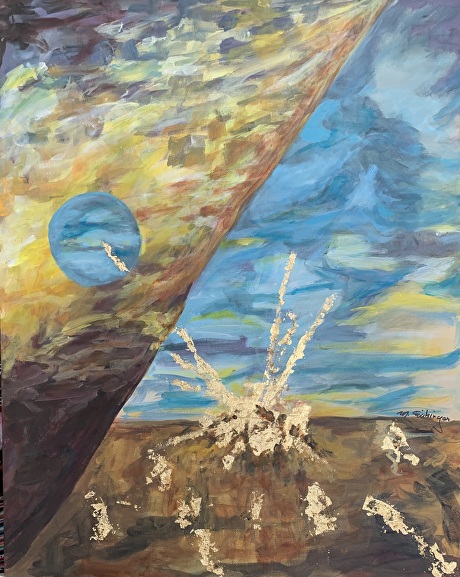
HOPE EXPLODING

Terror Unleashed

Last week, I attended a performance of the rock opera Hair. I was reminded of the social upheaval during the Vietnam War, but also of the hope raised by protesters of the Vietnam War, the Civil Rights Movement, and the Women’s Movement. Despite the carnage abroad, it was an era of inspiration. We sang-=Let the Sunshine In. Open up your heart, let it shine. And, we sang to Aquarius, to a time when humanity would take control of Earth as its rightful heritage–This is the dawning of the Age of Aquarius with Harmony and understanding, Sympathy and trust abounding, No more falsehoods or derisions, and Golden living dreams of visions. Friends and I were horrified by the death and destruction brought about by war and thought we could create a peace-loving, compassionate generation. I’m sad that we failed.

Not only is the U.S. consistently involved in wars abroad, but its citizens have to worry about terrorists creating havoc at home. With so many people armed to the hilt, cities have become battlegrounds for militias, the drug trade, and uneducated masses believing fake news and conspiracy theories put out by politicians craving power. power. Jews, Palestinians, and the LGBTQ community live in fear as antisemitism and hatred are at all-time highs. Fanatics bully migrants seeking shelter from poverty and war and are mean to those with political, cultural, or religious positions that differ from theirs. They want freedom from government intervention as long as it is their brand of freedom and don’t care it their brand of freedom impinges on their neighbors.

I blame myself and my contemporaries who protested for love and peace without finishing the job. We made strides with civil rights and women’s issues, but what happened to peace? Where did we go wrong? Why doesn’t peace reign triumphant? Why can’t I walk city streets at night and feel safe? Why do I worry about an armed shooter attacking my grandchildren at music festivals or while in school? Why do scope scope out places to hide when attending church or synagogue? And why lock doors at night for fear of being robbed and murdered? I never had these concerns when my children were young.

What does it mean to be an American in the land of the free? President Dwight D. Eisenhower warned the nation about the military-industrial complex becoming too powerful, but we let it happen. Industries supplying ammunition and military equipment, including lobbyists like the NRA, spread fear, manipulating us for their financial gain.

The United States has been in continuous wars since the 1960s. The Veteran’s Administration reports there are more than 18 million living veterans, 6 percent of the adult population. Though fewer American lives have been lost since Vietnam, the destruction and deaths on foreign soil from the wars we participate in are beyond my comprehension. Imagine the terror of hearing a stealth bomber overhead.

Wars since 1961

Bay of Pigs -1961

Vietnam War-1964-75

Laotian Civil War -1959-75

Permesta Rebellion in Indonesia -1958-61

Dominican Civil War -1965-66

Korean DMZ conflict -1966-69

Cambodian Civil War -1967-75

Multinational Intervention in Lebanon -1982-84

Grenada -1983

Bombing of Libya -1996

Tanger War in the Persian Gulf -1987-86

Invasion of Panama -1989-90

Gulf War ( Iraq, Kuwait, Saudi Arabia, and Israel ) -1990-91

Iraqi No-Fly Enforcement Operations -1991-2003

First I.S. Intervention in Somali Civil War -1992-95

Bosnian War and Croatian War -1992-95

Intervention in Haiti -2994-1995

Kosovo War – 1998-1999

War in Afghanistan – 2001-2021

American Intervention in Yemen – 2002-present

Iraq War – 2003-2011

American intervention in the War in North-West Pakistan – 2004-2018

Second U.S. Intervention in the Somali Civil War – 2007- present

Operation Open Shield in the Indian Ocean (war on terror) – 2009 – 2016

International intervention in Libya (war on terror ) – 2011

Operation Observant Compas in Uganda – 2011 – 2017

American military intervention in Niger – 2013 – present

American -led intervention in Iraq – 2014-2021

American-led intervention in Syria – 2013 – present

Global Coalition to defeat Isis – 2014 – present

American Intervention in Libya – 2015 – 2019

Israel-Hamas War – 2023 – present

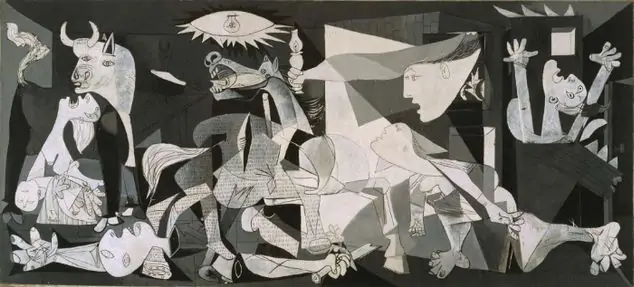
Famous war paintings.

Stealth by Peter Kalhkof Guernica by Pablo Picasso

Reference:

To see a listing of all U.S. wars, go to https://en.wikipedia.org/wiki/List_of_wars_involving_the_United_States

Please share your thoughts below.

HOPE EXPLODING by Marilynne Eichinger is a 30” x 24” x 2” Acrylic on Canvas painting. Available for 4495. Sipped free within the continental U.S.

If you want to purchase a canvas print in time for the holidays from the tree collection, now is the time. Go to  Https://www.eichingerfineart.com/works Click on the canvas print Tree section.

To see a listing of all U.S. wars, go to https://en.wikipedia.org/wiki/List_of_wars_involving_the_United_States

Is Loneliness Trending?

PEACEFUL

Trees have an underground social network to help them survive.

Is there a loneliness epidemic?

Loneliness is trending in America, according to the U.S. Surgeon General’s (Dr. Vivek H. Murthy) advisory board on the Healing Effects of Social Connection and Communication. But is it true? When I examine various studies, I get mixed messages. His shows that social interactions decreased for youth between 15 to 24 over the last two decades and that half of all adults are lonely. Dr. Murthy says he didn’t view loneliness as a public health concern when he took office in 2014 but became concerned when people of all ages and socioeconomic backgrounds told him they felt isolated, invisible, and insignificant. Common comments heard included, “I have to shoulder all of life’s burdens by myself,” or “If I disappear tomorrow, no one will even notice.”

What he says is concerning for a lay minister who interacts with older adults and as a grandmother of children between eight and thirty-two. Yet, among most of the people I work with, I rarely hear talk about them being lonely. The study made me wonder how many people are honest with me. Loneliness is a health risk associated with a greater risk of cardiovascular disease, dementia, stroke, depression, anxiety, and premature death.

The elders I know who are socially active and community-involved as adults tend to stay busy until they become infirm. Since they never imagined ending up alone and isolated, they don’t succumb to the mythology of old age decrepedness. Even those over 75 who have lost a spouse, friend, or relative stay active by volunteering, auditing college courses, traveling, and being engaged in an art or craft. My acquaintances tend to be educated and adequately housed, with enough money to visit distant relatives and friends. 

After reviewing numerous studies, I found discrepancies that made me see the importance of not succumbing to generalizations. One size does not fit all. Older adults with a lower socioeconomic status (low education level, low income, residential dissatisfaction, living in deprived neighborhoods) are the ones most likely to be lonely. A married person with children can also be lonely. As society continues to squeeze out the middle class, more and more people are affected by the lack of funds to pursue social events.

The Committee on Aging writes that we need a movement to mend the nation’s social fabric. They want everyone involved-individuals, families, schools, workplaces, health systems, technology companies, governments, faith organizations, and communities. They challenge us to destigmatize loneliness and change the nation’s cultural policies.

International studies on loneliness aren’t quite as bleak as ours, though they do indicate that as much as 33 percent of the world’s population is lonely, with the highest rate in Brazil. The U.S. registers in the middle of the pack worldwide. Denmark, Switzerland, and Sweden show the lowest rates of loneliness in Europe. 

This information goes against the notion idea that loneliness equates to isolation. Swedes, for instance, stop living with their parents at 18, much earlier than in southern Europe, where young adults remain home until they are 26. The Pew Research Center reports that a similar trend in the U.S. shows that young adults also remain living at home until they are twenty-six, unlike they did in the 1940s when they were on their own after high school. 

Societies labeled as ‘individualistic’ report the lowest amount of loneliness due, in part, to a difference in expectations regarding social relations. For example, the culture in Sweden is to raise independent individuals. The result is that more than half of Swedish households are single-person dwellings. When young adults have difficulty adapting to a singular lifestyle where they have to manage their own finances and develop a social network, they are helped. By the time they retire, they are so used to living alone that they wouldn’t have it any other way. 

In 2011, the Swedish Department of Health built its first co-living apartment complex that included a social area for residents to gather. Within a decade, tens of thousands of co-living units were constructed in Stockholm, with intergenerational options available. Though co-housing units are also expanding in the U.S., they remain limited. Our culture doesn’t focus on creating independent high school graduates.

Sweden also encouraged app development that helps people locate friends with similar interests. “Meetup” sites in the U.S. serve the same purpose. I found my writer’s group through Meetup, and though members come from different backgrounds and experiences, after ten years of interactions, we are a caring support group

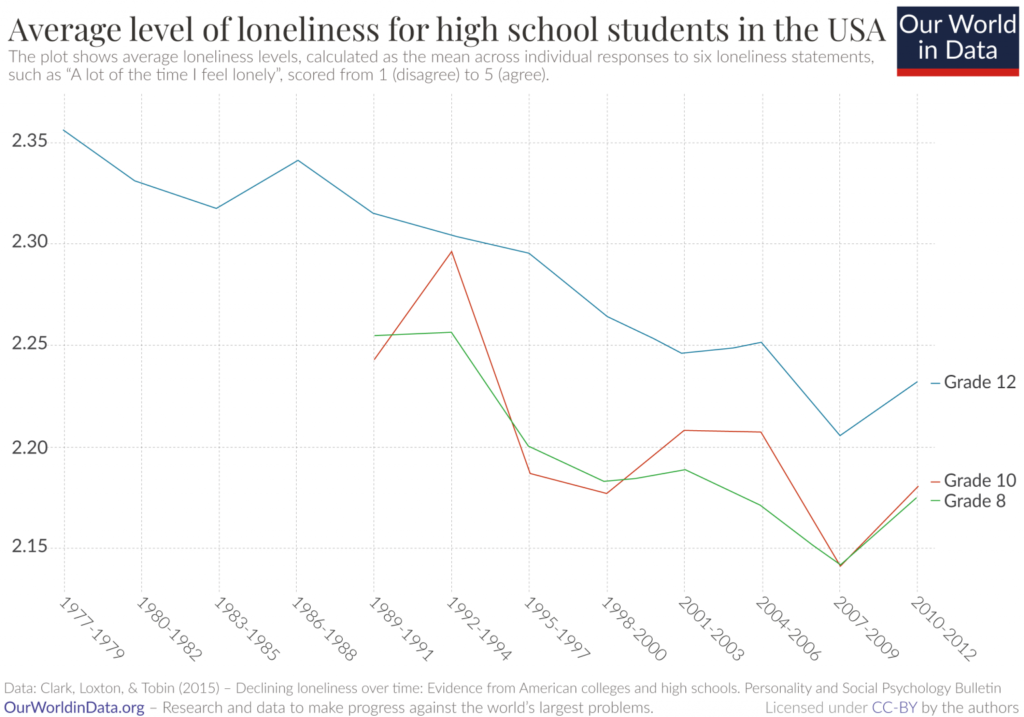
According to World Data, there is little evidence to support the notion of an epidemic of loneliness, though COVID hurt school-aged children.

The Psychology and Aging Journal reports that loneliness decreases after age 50 until about 75. Though developing ways to reduce loneliness deserves consideration, headlines about an epidemic are inaccurate when matched with historical data. Surveys worldwide don’t report higher levels now than in past generations, including surveys taken in the United States.

 This doesn’t mean we shouldn’t support those suffering from loneliness. People become isolated when they can’t drive or lose their social network due to a move, age-related illnesses, or the death of close friends and relatives. It would help if our country followed Sweden’s mindset by learning how to manage independence. Financial management skills and ways to develop a social network can be taught in high school.

Residing in a co-housing unit, joining a like-minded group through a social app, and volunteering are a few ways to build a community outside of work. Aging adults and those with a disability don’t have to be left behind. To learn more about volunteering, visit VolunteerMatch, where you can find listings of virtual and in-person opportunities in every state.

____________________

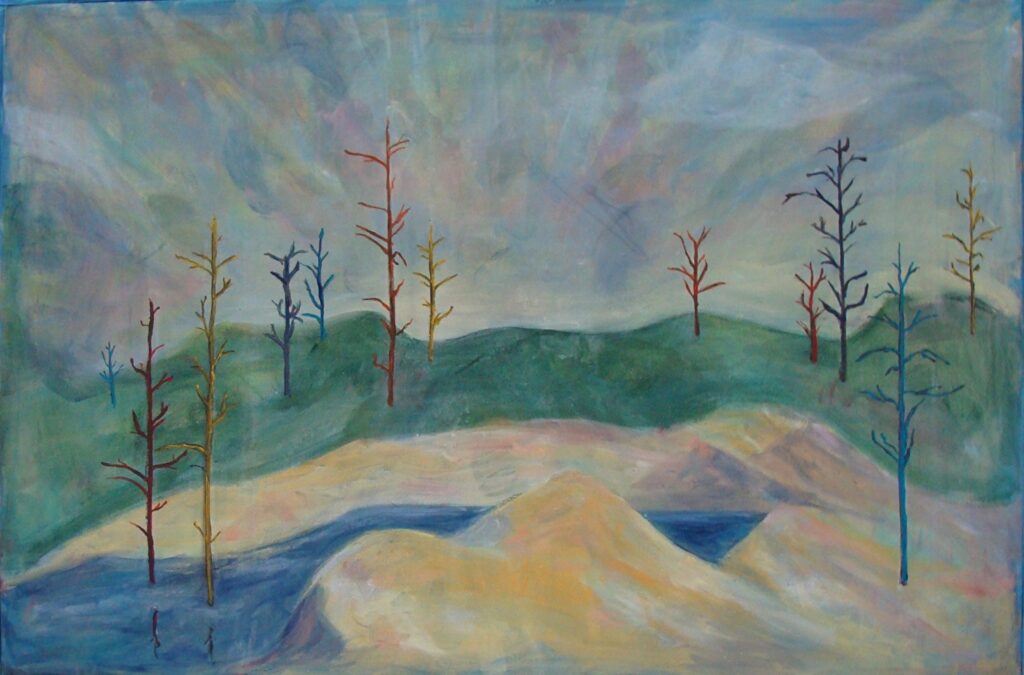
 Art is always for sale. Peaceful is an acrylic on canvas painting/ 25.5″ x 38″/ metal frame/ available for $495/ shipping included in the continental U.S. To learn more, contact me at marilynne@eichingerfineart.com

  I look forward to reading your comments below.

____________________

 References:

U.S. Surgeon General’s Advisory Report 2023. Our Epidemic of Loneliness and Isolation. retrieved from https://www.hhs.gov/sites/default/files/surgeon-general-social-connection-advisory.pdf

  Savage, M. (2019) Why so Many Young Swedes live alone. BBC Worklife. retrieved from htpps://www.bbc.com/worklife/article/20190821-why-so-many-young-swedes-live-alone

  Ortiz-Ospina, E. (2019)  Are people more likely to be lonely in so-called individualistic societies? Our world Data. retrieved from https://ourworldindata.org/lonely-not-alone

  Search for  volunteer opportunities at Volunteer Match at

https://www.volunteermatch.org/search/virtual?gclid=Cj0KCQjwtJKqBhCaARIsAN_yS_lGJQ9f7EElM5Iz-HZszMkvvv4fF83T6T4v01HrO1Fd0aYvZfYOCi4aAvvrEALw_wcB

  Zauderer, S. (2023) 49 Loneliness Statistics: How Many People are Lonely?Cross River Therapy. Retrieved from https://www.crossrivertherapy.com/research/loneliness-statistics#:~:text=

   Frontiers in Public Health website (2022) The micro-macro interplay of economic factors in late-life loneliness: Evidence for Europe and China. retrieved from https://www.frontiersin.org/articles/10.3389/fpubh.2022.968411/full

Trauma No More

SHOCKED!

Trauma No More

Emotional trauma occurs unexpectedly, violating your moral fiber. It is not the same as long-term suffering, which occurs slowly over time. The shock from a traumatic experience affects both body and mind with unexpected consequences. For many people, it has a spiritual overlay since they can’t believe their God would let what they are going through happen. Though people react differently during horrific experiences, freezing in place is common. Soldiers are trained in mock battles in hopes that they will respond automatically when faced with real action.

Post Traumatic Stress Disorder (PTSD) can be triggered immediately or occur years after an event spurred by war, violence, an accident, or a natural or human-made disaster. When traumatized, victims often push the horror to the back of their minds, where it lays dormant for years. A sound, smell, or image may create a flashback that immobilizes them. That happened to an Afghan vet I counseled. He became highly agitated ten years after his discharge after visiting a Middle Eastern-style tea room at a music festival. He was one of the fortunate men who sought help, so he was able to function. Ignoring PTSD causes sleeplessness and stress that affects bodily functions, especially the heart. Other symptoms are uncontrolled anger, lack of energy, apathy, and suicidal thoughts. Though bad for the victim, it also affects friends and relatives. It is hard to live with a person in the throes of PTSD.

When newscasts display bombs exploding on innocent people or shoppers gunned down by a deranged killer, I can’t help but wonder what the event is doing to the psyche of those in the situation, as well as those of us who vicariously watch. Innocent people dying violent deaths that could have been avoided scars us all.

Several immigrant male acquaintances described a childhood filled with violence due to political rivalries. One man remembers how his uncle was shot by a zealot from a rival party while walking home; the other described fleeing his village at thirteen when a rival tribe couldn’t find his father and was coming after him. Thirty years later and a continent away, he still keeps his blinds closed for fear that he’ll be found. While in their twenties and thirties, both men focused on finding a safe place to live and a way to earn a living. The horrors they had experienced as children were pushed from their minds. The United States was living in Nirvana compared to their country, where genocide was common. But now, as are all Americans, they are shocked by what is happening in our backyards. Hate messages, homicides, and burglaries are at an all-time high. Their peace of mind is again shattered as the injustices these men witnessed as children tumble forward.

I shudder at seeing the Middle Eastern war escalate as the Vietnam War did sixty years ago. How many more years will it take to get over the death and destruction it will cause? Will those who were under fire ever feel safe again? This week, I listened while an Israeli woman talked through tears as she described how members of her family fled to Israel after the Holocaust. Though she resides in the United States, she always considered Israel to be a safe haven, a place Jews could escape to if antisemitism got out of hand. Her belief was shattered when Hamas invaded Israel. With threats against Jews at an all-time high, with U.S. synagogues threatened, and Israel out of bounds, she lives in constant fear.

It is not only war in distant lands but what occurs on the homefront that has the country agitated. I get goosebumps thinking about the Maine residents who were sequestered last week after eighteen people in their town were shot. According to Forbes, since January, our country experienced 566 mass shootings. We are flooded with grieving, fearful, and angry people experiencing preventable violence in schools, churches, parks, supermarkets, and entertainment venues. I worry about my granddaughter’s peace of mind after running for cover during a shooting at a Las Vegas concert. Will Fourth of July fireworks be a reminder of that horrific day? Will she feel safe at a show or in a crowd?

Medical advice suggests that trauma victims seek help. That’s not easy to do when millions need assistance. Where will these trained professionals come from, and who will pay for their time? Unfortunately, most people will suffer from PTSD throughout their lives. And for those who receive the help they need, it isn’t as though a magic wand waved over them will make them better. It can take years to forgive and dull the impact of living through a traumatic experience.

Mothers, fathers, grandparents, teachers, uncles, aunts, and religious leaders, speak up! Let’s combat hate and discourage rivalries that create fear, dull the mind, and kill. We don’t need more victims of trauma. Set an example by practicing compassion and love.

Remember Martin Neimoller (1892-1984), a prominent Lutheran pastor in Germany. When young, he sympathized with many Nazi ideas, but after Adolf Hitler came to power, he became an outspoken critic. Starting in 1937, he spent eight years in prisons and concentration camps. Neimoller is known for the following quote taken from the Holocaust Encyclopedia.

“First they came for the socialists, and I did not speak out–because I was not a socialist.

Then they came for the trade unionists, and I did not speak out–because I was not a trade unionist.

Then they came for the Jews, and I did not speak out–because I was not a Jew.

Then they came for me–and there was no one left to speak for me.

___________________________________________________________

A Cause of Trauma Today

ABC News documented 54 court cases where the perpetrators said President Donald Trump inspired their violence. There were no incidences made in the name of President Barack Obama or President George W. Bush. The nation is afraid of the man and his followers who make false claims and bully their opponents into submission. A few weeks ago, Donald Trump suggested that the chairman of the Joint Chiefs of Staff, Mark Milley, deserves to die. That is one of many violent threats against federal law enforcement, judges, poll workers, and past “friends” doing their jobs. He posted on Truth Social, “If you go after me, I’m coming for you.” The mental health impact of the Trump presidency is over, but the trauma lingers on, with the fear that it could happen again.

Reference: Levits, E. (2023) Trump Wants His enemies to fear for their lives. Intelligencer. Retrieved from https://nymag.com/intelligencer/2023/09/trump-milley-death-fbi-threats.html

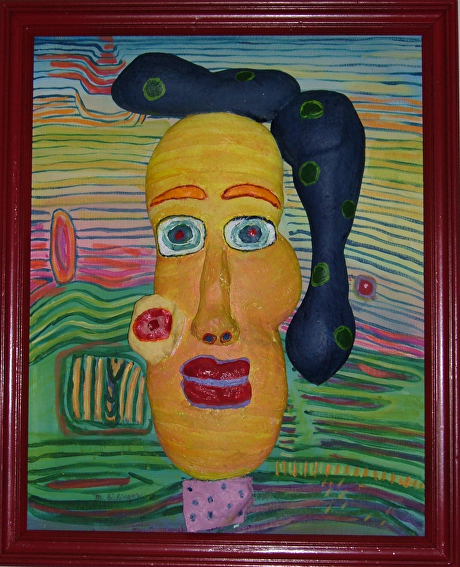
Art is always for Sale. Shocked is a multi-media framed painting available for $650. Includes shipping in the continental U.S. For information, contact me at marilynne@eichiungerfineart.com

I enjoy hearing from you. Please comment below.

Love, Hate, Indifference

MIRNA AND HANAN – My African-American grandchildren are easy to love.

Love, Hate, Indifference

Is finding love tough? Has anyone said that you were difficult to love? What does it mean when a leader says to go in peace and practice love? How is that done in a world where hate groups spout conspiracy theories? These questions are on my mind as I see homeless people struggling to stay alive and watch newscasts of countries bombing their next-door neighbors. If a person can’t love, be loved, or practice love, how can there be peace in the world? Issues around love and hate are complex, and with the war in Israel and Gaza escalating, I have a need to unpack them in my mind.

The definition of love is difficult to pinpoint. According to the Berkeley Well-Being Institute, it is a feeling, an action, a state of being, and a motivation that artists, scientists, and philosophers have tried to define throughout the ages. Despite the confusion about what it is, most people believe that a person in love is invested in the well-being of the object of their affection for that individual’s sake alone. This means that they want the person to be happy and healthy. Practicing love and going in peace is doing everything you can to see it happen. Love between nations is doing everything in a government’s power to help another country thrive. The United States overcame its anger and put Japan on a growth path at the end of WWII. In one sense, we acted as parents with the goal of raising successful, happy children. The occupation was a great success, resulting in economic stability and a close relationship between our two countries.

A parent with a helpless newborn gives of his or herself selflessly, ensuring that the infant survives. Though not a two-way love relationship at first, with nurturing over the years, it can turn into one. It is not easy to sacrifice your freedom to raise a child any more than it is to care for a bedridden relative later in life. Yet, those who make sure the infant or elder is fed, their dog is walked, they go to the doctor, and their prescriptions are picked up are practicing love.

And though the person may complain about the burden of caring for children or a sick parent, they miss having them close by when the child leaves home or the parent dies.

Hate, a powerful emotion as strong as love, is defined as intense hostility, extreme dislike, and loathing. Stemming from fear, insecurity, and mistrust, it makes hateful people turn toward individuals and groups with whom they identify, often to join forces for revenge. Hate, like love, can feed on itself and intensify the emotion. Hatred can be aimed at a person, a group, or a nation. When it leads to violence and suffering, it can last for generations.

Strange as it may be, love and hate have a shared opposite emotion–indifference. People falling out of love lose interest in the well-being of the person they once cared for. Without fear or anger, they become less interested in revenge. Love and hate, like two balloons when popped, will lie deflated, be empty of feeling, lack energy, and die.

The Middle East conflict goes back thousands of years. Since the fires of hate have been continuously stoked, extinguishing them won’t result in a love relationship. Indifference might be the first step to healing. But peace can be possible if people ignore their differences and, as my father always said,” live and let live.” The fighting factions might live peacefully if they become indifferent to each other’s beliefs and way of life. Continuing as they are, the war between Israel and Hamas will escalate, increasing the pain and suffering of thousands of innocent people.

I do not believe in an eye for an eye and a tooth for a tooth, yet I do think nations have the right to defend themselves with the goal of de-escalating emotions, not the annihilation of their adversary. In the Israeli/Gaza war, indifference and tolerance may lower emotions and allow both nations to thrive.

Art is always for Sale. MIRNA AND HANAN is a 30″ by 24″ deep canvas acrylic painting available for $ 885. For information contact me at marilynne@eichingerfineart.com

Do share your thoughts on my blog site at www.eichingerfineart.com/blog

Eichinger books are available in bookstores and online in ebook and paperback formats. Click the link to purchase on AMAZON.

References

Huntington, C. (2023) What is Love? Definition, Signs & Types. Retrieved from https://www.berkeleywellbeing.com/what-is-love.html

Abrams, A. (2017) The Psychology of Hate. Psychology Today. retrieved from https://www.psychologytoday.com/us/blog/nurturing-self-compassion/201703/the-psychology-hate

The News Feels Unreal

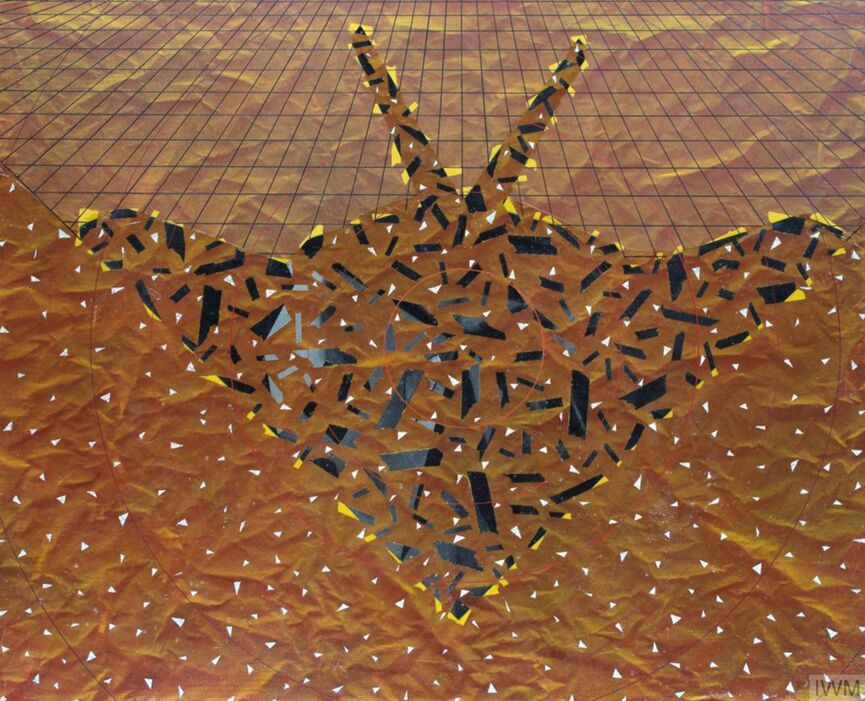
Fractured America by Marilynne Eichinger

The News Feels Unreal

This is one of those weeks when the news feels unreal. Watching Israel, Gaza, Ukraine, and Russia slaughter citizens in a power play over land and politics is despicable, but it is so far away. Unless you have family there, the scenes are like watching the movie All Quiet on the Western Front.  Such films are all too familiar, desensitizing us to brutality.The American Academy of Family Physicians reports that 91 percent of movies on television contain violence, including extreme violence. The public appears to crave seeing them. 

Unfortunately, what we’re witnessing on news channels is occurring in real-time and is not fun or exciting. Despite what is happening abroad to thousands of innocent people, life in the U.S. continues with relative calm. I spoke to an intelligent woman who didn’t know about Israel’s invasion. She doesn’t follow the news, saying it is too depressing. Life continues without too much concern for the suffering of others. I worry about my granddaughter turning in her seventh-grade assignments and a homeless man’s housing situation when he leaves the hospital. I did the laundry and made a savory stew, sending odors through the house that reminded me of my childhood.

In early summer, my sleep was disturbed by Fl6 planes going through maneuvers in preparation for deployment to Ukraine. This week, military helicopters practice overhead in preparation for deployment to Israel. Though not as obnoxious as the jet planes, they disturb the calm I try to maintain at home by the edge of the woods.

Despite the carnage displayed on television, I am Pollyanish enough to hope peace is possible and that the combatants will come to their senses and compromise. Otherwise, I don’t see how the Earth’s eight billion inhabitants will continue to get along. Staking out of a rigid position begets distrust, hate, and violence. Sometimes, I wonder if Mother Nature isn’t getting impatient in her wait for humans to find a way forward. Perhaps war, pandemics, and homelessness are her ways of reducing the population and returning it to the earth’s carrying capacity. Too many people are fighting, polluting, and emitting greenhouse gasses for us to continue without making changes.

The first week of the invasion killed 1,300 Israelis, took 150 plus hostages, and wounded over 3,400 people. Palestinian officials say there are 2,215 dead and 8,714 wounded. The attempt by Israel to rid Gaza of Hamas started by cutting off water, food, power, and medical supplies, creating a humanitarian crisis.  Though we aren’t hearing as much about Ukraine, their casualties continue to mount, with 120,000 dead and 180,0000 injured during the past 20 months. Russia also suffers, with 70,000 dead and another 120,000 wounded.

Towns are being destroyed, and children are terrorized while the world’s nations decide what side to take in a conflict that started in 1948. During WWII, my college history teacher served on a Roosevelt-appointed committee to determine if Israel should be taken from Palestine to establish a Jewish homeland. The committee concluded not to do it—that fighting would plague the region forever. President Roosevelt, an anti-semite, ignored the committee’s recommendation. He didn’t want millions of Jewish refugees from concentration camps settling in the U.S. Does this approach to refugees sound familiar? As a result of that decision, the fight continues, with thousands of people in Gaza becoming homeless.

Social media and news outlets issue false reports and spin the news to get people to take sides. It is the way a gullible nation reacts to misinformation.  The twenty-seven election lies listed in Trump’s Georgia Indictment, though well analyzed many times and disproved, haven’t stopped much of the public from buying into his lies.  We are warned that many false reports have been posted about the Israeli-Hamas fight. We must be careful about what we read and pass on to others if the information hasn’t been fact-checked. I don’t like strong-armed would-be dictators like Netanyahu and Trump, nor do I like Republicans and Democrats pitting people against one another. 

While citizens wait for democracy to work on their behalf, the press gives us distracting information. News articles posted this week include “6Captivating Facts about Jackie Kennedy.” Who cares? The food page has photos of apples dipped in chocolate and nuts that look scrumptious. Taylor Swift donated funds to food banks on her Eras Tour, and fans followed her lead. A 104-year-old Chicago woman skydived from a plane. “Age” is just a number,” Dorothy Hoffner said after landing. The Musical!, a play about the printing press inventor, opened on Broadway. NASA unveiled a collection of asteroid rocks from the Osiris-Rex seven-year journey to the asteroid Bennu. The samples included waterlogged clay materials, indicating that Earth may have become a water planet when similar asteroids crashed into it four billion years ago, filling our oceans. Nasa says the successful mission collected a treasure trove of scientific samples to analyze.

These articles may be comforting, but they take us away from a critical debate that needs to happen if worldwide peace is to prevail.  In theory, sovereignty among minorities should equalize the playing field, but in practice, it never has. Maintaining stability requires relinquishing a degree of autonomy for the betterment of the whole while respecting social customs and religious beliefs. When thirteen colonial states joined to become a sovereign nation, they gave up rights to the federal government. In 1993, European countries handed over powers to a supranational authority in Brussels, charged with balancing national and collective interests. Though there are problems, the experiment is working with EU countries obtaining economic, political, and security benefits.

In 1960, 1,9 million Jews and 239 thousand non-Jews occupied Israel. Gaza had 266 thousand residents. This September’s census shows 7,145 million Jewish citizens and 2.07 million non-Jews in Israel. Gaza’s population is 2.4 million, half under 19 years of age. These numbers translate to 434 people per square kilometer in Israel and 500 people per square kilometer in Gaza. They are among the most densely populated countries on earth. It isn’t surprising that both Israel and Gaza want more land. 

Though just as violent as many of Hollywood’s movies, the fighting in Israel doesn’t have a plot we know will end well. Real problems need to be debated and acted on, perhaps under the auspices of a more powerful United Nations. Once again, I fear that wars, pandemics, and homelessness will be nature’s way of dealing with the earth’s problems if we’re unwilling to compromise and rule with our brains, not emotions.

Now is the time to enter into a debate. Don’t be shy. Please comment below.

Art is always for sale. For information about Fractured America, go to www. eichngerfineart.com

References:

Chang, K. (2023) NASA Unveils First Glimpse of ‘Scientific Treasure’Collected from Asteroid Samples. New York Times. retrieved from https://www.nytimes.com/2023/10/11/science/nasa-asteroid-osiris-rex-bennu.html#:~:text=rex-bennu.html-

Website. Good News. Today. Retrieved from https://www.today.com/news/good-news

Dale, D. (2023) 27 Donald Trump election lies listed in his Georgia indictment. CNN. https://www.cnn.com/2023/08/16/politics/fact-check-trump-georgia-indictment-lies/index.html

Cordesman, A. ( 2023) Latest Analysis: Israel-Hamas War. Center for Strategic and International Studies. Retrieved from website, https://www.csis.org/

Vital Statistics: Latest Population Statistics for Israel: Jewish Virtual Library.. retrieved from https://www.jewishvirtuallibrary.org/latest-population-statistics-for-israel

.

Ten Thousand Years Ago

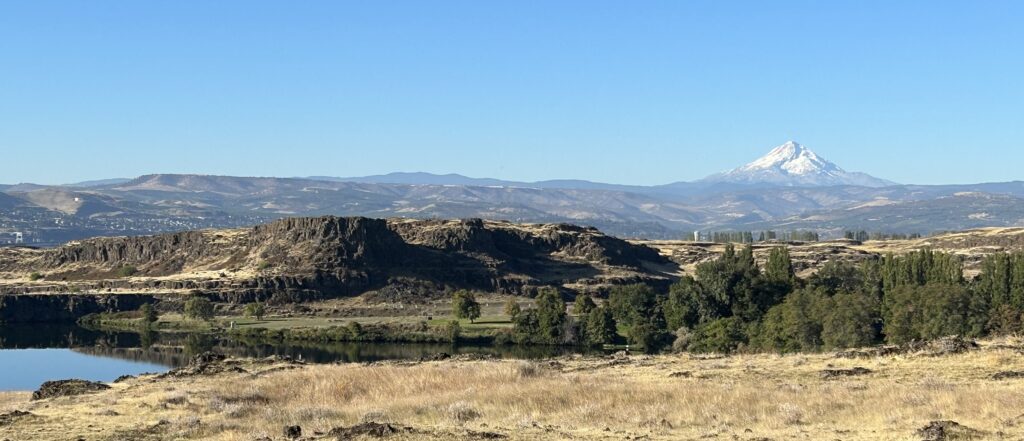
One of the best ways I know to stay sane is to get out of town for an overnight vacation. I’m more relaxed when I return than when I take an extensive trip requiring weeks of preparation and delving into a catch-up list upon returning home. I am always surprised when what I think will be a familiar excursion turns into something extraordinary. Ray and I spent Thursday night hot tubbing at a Spa in the Columbia Gorge. During that day and the next, we visited a pioneer ranch and hiked along the basalt columns lining the river. The views are spectacular.

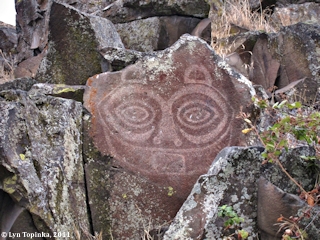
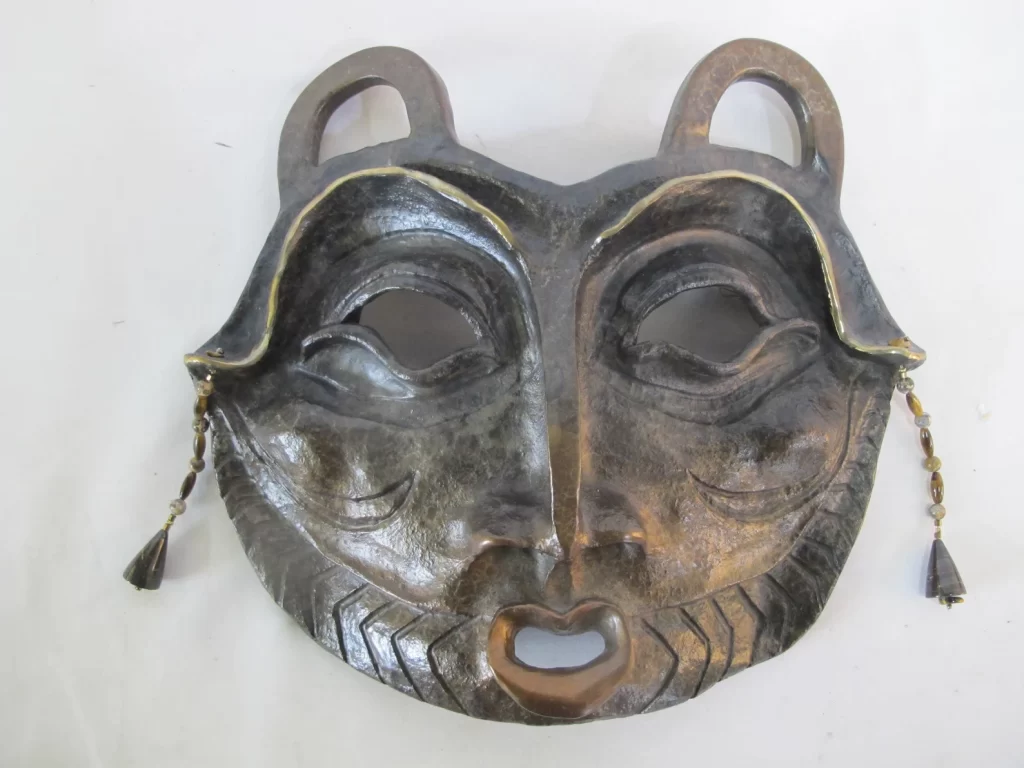
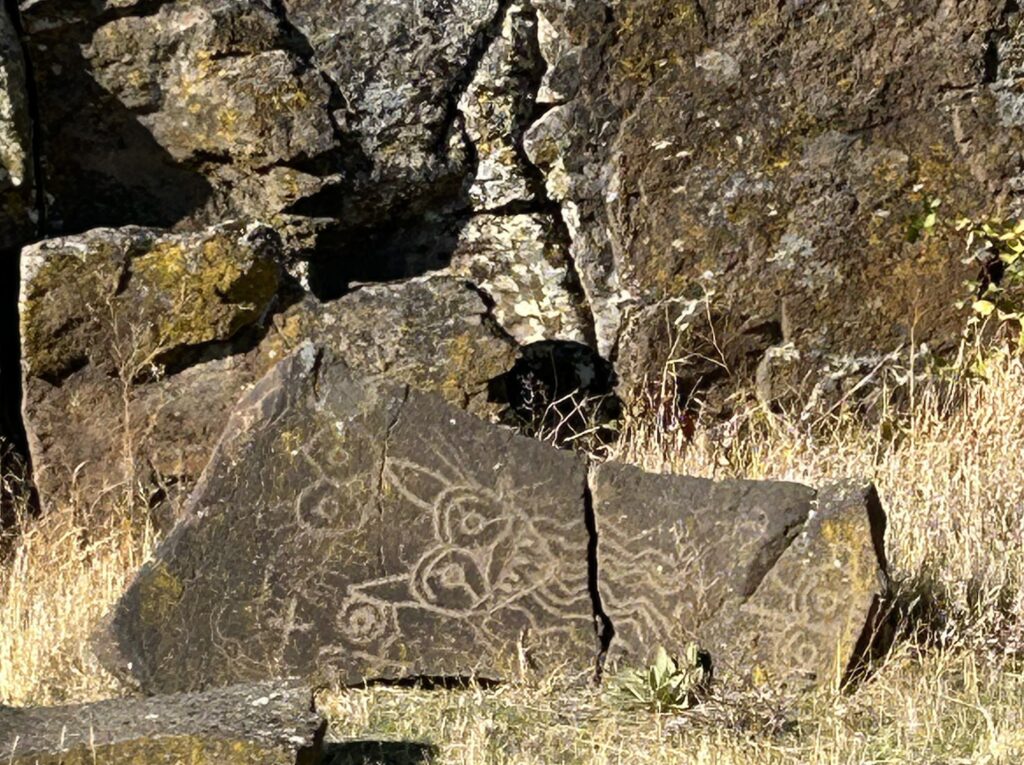
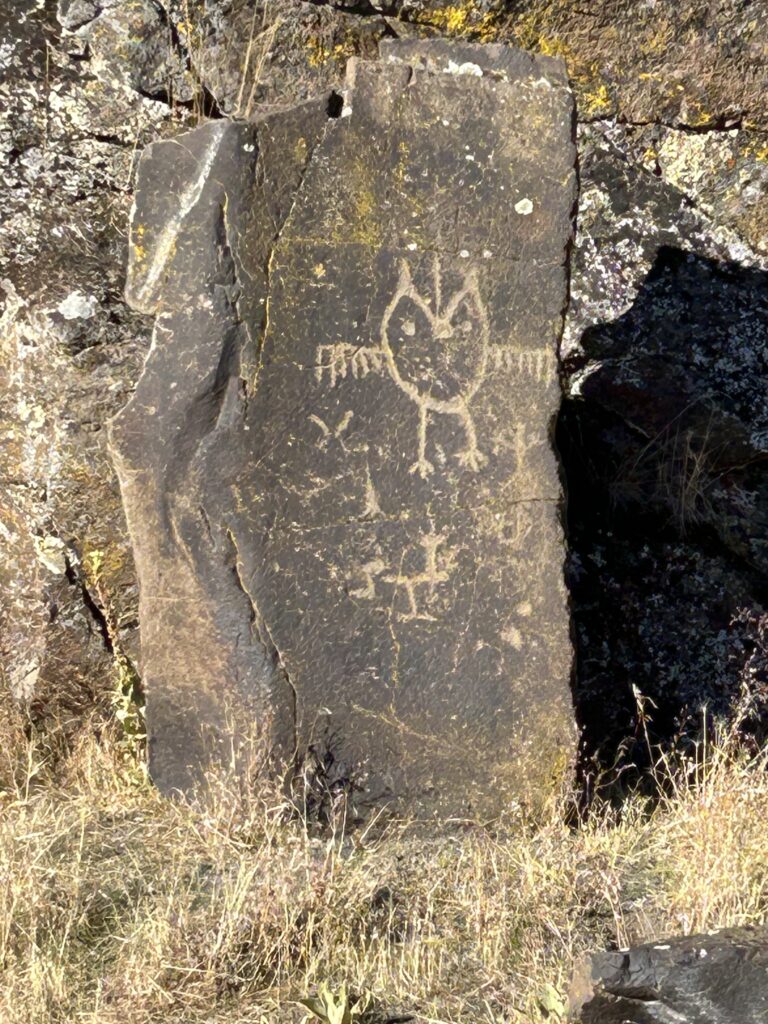
No matter how often we visit the Central Gorge area, we discover something new. We ventured into a place we had passed at least a hundred times over the past twenty years. The Horsethief Lake section of the Columbia Hills Historical State Park is a National Historic Site protecting indigenous petroglyphs thousands of years old. Following is the story of “Tsagaglalal”, She Who Watches, as told to the Park Department by Lillian Pitt, a Pacific Northwest Native American Artist whose work is influenced by ancient cliff art. 

There was this village on the Washington side of the Columbia Gorge. And this was long ago when people were not yet real people, and that is when we could talk to the animals.

And so Coyote—the Trickster— came down the river to the village and asked the people if they were living well. And they said “Yes, we are, but you need to talk to our chief, Tsagaglal. She lives up in the hill.”

So Coyote pranced ups the hill and asked Tsagaglal if she was a good chief or one of those evildoers. She said, “No, my people live well. We have lots of salmon, venison, berries, roots, good houses. Why do you ask?” And Coyote said, “Changes are going to happen. How will you watch over your people?” And so she didn’t know.

And it was at that time that Coyote changed her into a rock to watch her people forever. 

Following are photos I took this week.

Indigenous people lived in and around the Columbia Basin for at least 10,000 years. The earliest inhabitants of the Columbia Basins were primarily nomadic hunters relying on big game. Two thousand years later, salmon became central to their diet, culture, society, and religion.  They hunted and foraged from winter villages and established seasonal camps for fishing and gathering. Anthropologists have identified thirty-two separate groups from the headwaters to the Pacific speaking six major languages. 

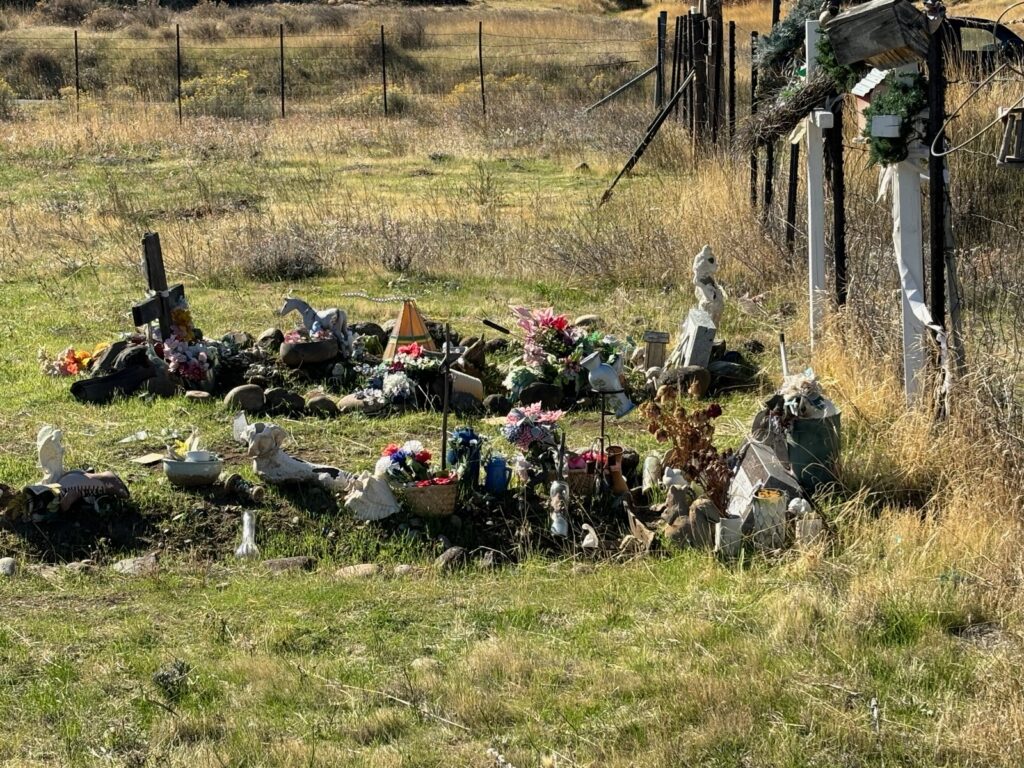
Until recent times, tribes did not bury their dead. Instead, they wrapped them in robes, tule mats, or furs, put them in canoes or burial vaults with prized possessions, and placed them in the woods, on rocky points, or on vacant islands like the Island of the Dead not far from Horsethief Butte.  A cliff near She Who Watches was used as a burial site for infants in papooses.  These ancient sites were looted and destroyed when white people took over the area. Today’s Native Americans, either cremate or bury their dead in shallow graves, mounded and topped with facsimiles of artifacts meaningful to the person’s life.

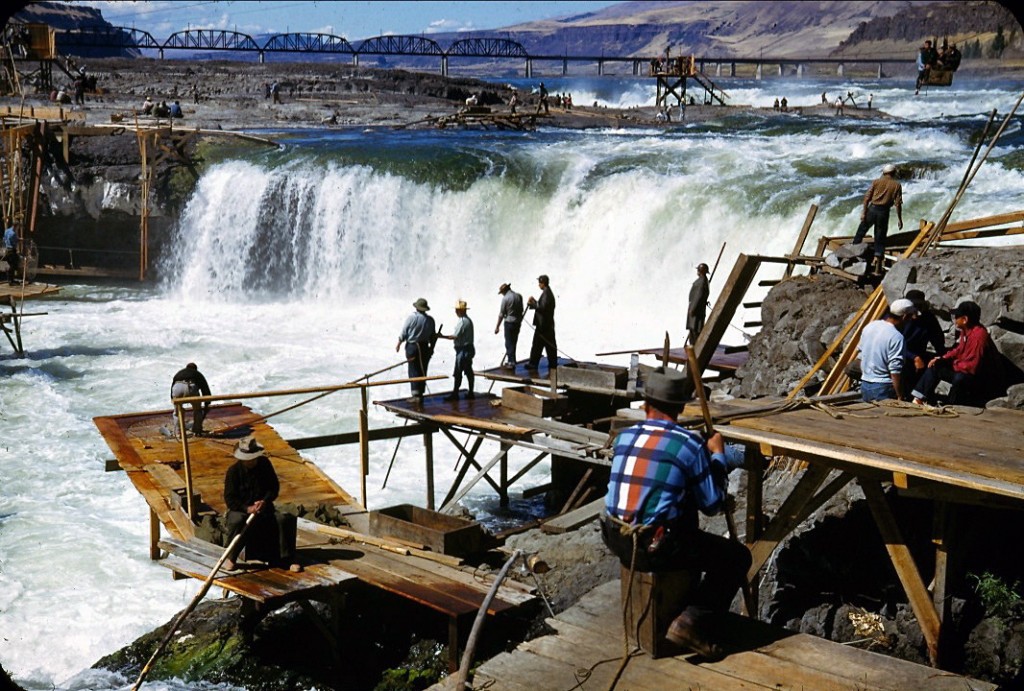
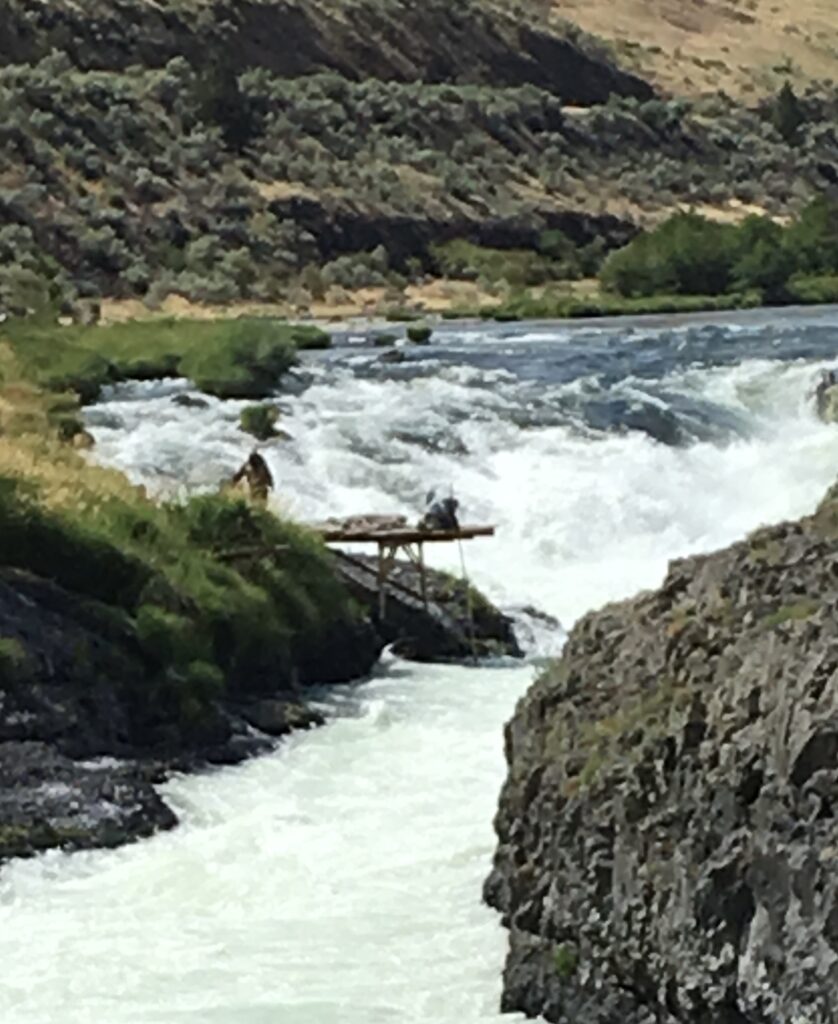
Native peoples believe that souls and spirits are inextricably tied to the natural world and its inhabitants, with salmon among the most important for bringing prosperity and life to the rivers and streams. Below is a picture from the Matheny Collection of the Celilo Falls before it was flooded behind the Dalles Dam. I took the photo to the right along the Deschutes River.

  Estimates vary, with reports that say  9,140 to 14,890 people lived along the banks of Columbia when Lewis and Clark passed the Celilo/ Horsethief Butte area in 1805 on their way to the Pacific. They lived in villages in multi-family houses made of planks and used ones constructed of mats and poles when traveling and hunting. Being surrounded by an abundance of wildlife, fish, roots, and berries and a good trading location on the Columbia made them very wealthy.

We need to respect the rights and beliefs of the people who occupied North America before smallpox decimated their tribes and white settlers looted, killed, and pushed them off rich tribal lands. We can no longer treat them as second-class citizens and ignore their contributions and what Americans did to them in the past.

Resources:

website. Columbia River Inner-Tribal Fish Commission. retrieved from https://critfc.org/member-tribes-overview/#:~:text=Indian

website. Northwest Power and Conservation Council: Indian Tribes. retrieved form. https://nwcouncil.org/reports/columbia-river-history/indiantribes#:~:text=A%20total%20of%2032%20separate,basin%20dating%20back%2010%2C000%20years

Estimate of Western Indians, Lewis and Clark Journals. retrieved from https://www.oregonhistoryproject.org/articles/historical-records/estimate-of-western-indians/

Michael,S. (2019) Island of the Dead .Pacific Northwest Adventures. retrieved from https://pacificnorthwestadventures.weebly.com/blog/island-of-the-dead

Read how Native American Youth and Family Services help troubled youth overcome homelessness, abuse, drugs, and gang affiliation.

Available online and in paperback in bookstores. Click to purchase on AMAZON