Negotiating Volatility

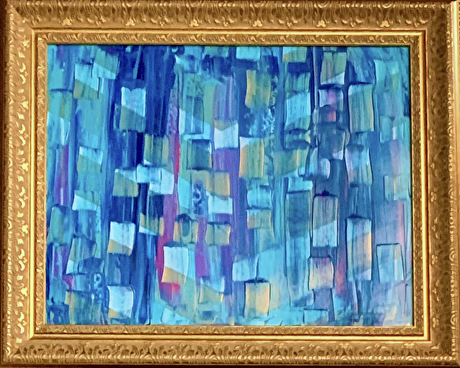
Limitless Possibilities

           Confusing, Volatile, Hateful, Loss, Changing, Compassionate, Loving, Opportunity, Joy

Negotiating Volatility

Though retired, I keep one foot in the museum world. This February’s American Alliance of Museum magazine was about navigating the future during a volatile time. Trendswatch, a center forecasting the future for museums, supplied data for the article. Since insights are as pertinent for ordinary people as they are for museums, I decided to share them.

The magazine begins by summarizing data that affects us all. I was surprised to read that one hundred sixty educators have been fired for political reasons since 2022, and the increase in global carbon emissions since 1970 is 90%.  By 2090, with the adoption of generative AI, they project job loss to be as high as 30%. The number translates into 300 million current jobs being eliminated globally. Last year, 53 % percent of hiring managers reported that their company eliminated the requirement for a bachelor’s degree in some or all roles.

I knew that book banning was a problem but was horrified to learn that over 2,571 book titles have been challenged or banned in U.S. public libraries and school libraries between 2020 and 2022; so much for freedom of expression, with so many people becoming morality censors.  I’m not surprised that the segment of U.S. adults who reported feeling lonely a lot of the time yesterday is 17% of the population (44 million American adults).

The speed of change is increasing exponentially. Google’s director of engineering predicts that a year’s worth of change that occurs today will only take three months to do by 2041. ChatGPT, launched in November 2022, had over a million active users by January 2023. It and other AI platforms are changing the landscape for thousands of writers, illustrators, and journalists. Rapid change is unpredictable and can be terrifying for those unprepared.  AI is a record-breaker. It processes data and completes tasks faster than humans. Plus machines, don’t need bathroom and lunch breaks.

Frey and Osborn, who accurately predicted job loss over the past twenty years, predict that the following jobs are at immediate risk. 

  • Transportation and material moving (nearly 12 million jobs)
  • Sales and sales-related roles (3.8 million jobs)
  • Production (2.8 million jobs)
  • Office and administrative support (14.4 million jobs)
  • Food preparation and service (4.4 million jobs)
  • Business and financial operations (700,000 jobs)
  • Other, which include:
    • Art, design, entertainment, sports, and media (14,000 jobs)
    • Building, grounds cleaning, and maintenance (3.8 million jobs)
    • Legal occupations (414,000 jobs)
    • Personal care and service operations (179,000 jobs)
    • Protective service operations (91,000 jobs)                               These predictions are causing people to rethink career paths.

What does this mean to you and me? The future will be frightening and challenging for anyone set in their ways. There will be exciting possibilities for individuals with a broad outlook who are not afraid of technology and can adapt. Those who survive unscathed will set a course that helps them adapt without becoming overly stressed.

They will–

  • Pay attention to hot-button topics likely to set people off, realizing that verbiage matters. They won’t use words designed to hurt or likely escalate emotions.
  • Find purpose through meaningful social interactions with people who support their beliefs. It will be a mechanism for developing friendships and close family relationships. It can start with discussions around the dinner table, getting children used to analyzing the risks and benefits of their positions. It will mean joining friendship groups to get help with employment opportunities.  
  • Learn to deal with angry, aggressive people and find ways to engage them in a more productive dialogue. They will do this by participating in discussion groups that include people with differing backgrounds and beliefs. They will take into account the perspectives of others, respecting their viewpoints even when they disagree with them.  
  • Participate in neighborhood watch, become friendly with neighbors, and are willing to help and be helped in an emergency. They will discuss ways to deal with extreme weather situations and will stock up on supplies so they are prepared for natural disasters predicted in their area.
  • Monitor local legislative and legal decisions to ensure that water, utilities, and land use aren’t areas for corporate exploitation. They will take a stand on issues that concern them—knowing that everyone loses when cultural and educational institutions are held hostage by partisan politics. These institutions are among the few that can be trusted to deliver non-partisan information.

Navigating the future will be difficult and not for the light-hearted. We are headed for a time of extreme poverty, displaced people due to climate change, and increased mental illness due to stress. Maintaining a democratic society will be difficult, but it can be done. We can’t give up hope.

While working through confusion, we’ll have to roll with the times and find enjoyment where we can. We can love and be loved and expand our love to include those less fortunate than ourselves. Compassion can get us through bad times and stir up peace. Valentine’s Day is an excellent time to start expanding love. 

I look forward to your comments about the volatility of your life. Do you find change stressful? How do you deal with it? Please share at www.eichingerfineart.com/blog

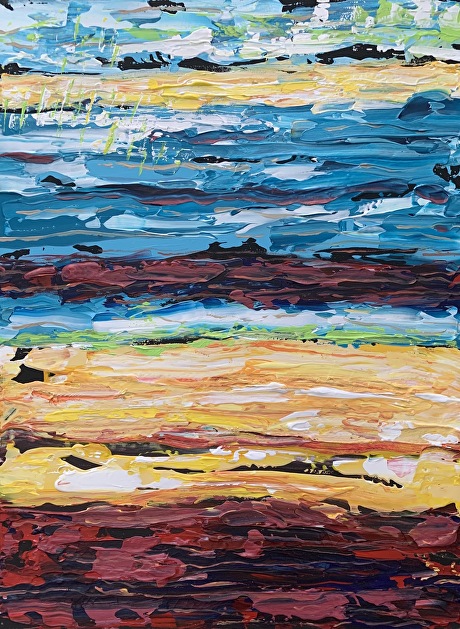
Art is always for sale. Limitless Possibilities is a 24″ x 18 “acrylic painting on canvas. Available for $595. Free shipping within the continental U.S. To purchase, contact me at marilynne@eichingerfineart.com or go to the abstract work category on my website at www.Eichingerfineart.com

and buy online.

Aliens?

Heaven and Beyond. What lies beyond our sight?

Aliens?

Most people are accustomed to alien life forms in their backyards and don’t think twice about them. But perhaps you do, especially when English Ivy, introduced by European colonists in 1727, creeps up your tree to the canopy, killing it. More recently, our neighborhood has been dealing with stink bugs that arrived from the Orient in container ships. According to Washington State University researchers, changing weather patterns have increased the habitat for stink bugs throughout the country.

And though immigrants seeking asylum in the U.S. are called aliens, they aren’t the ones I’m writing about. The papers are full of the pros and cons of integrating people of different skin colors, languages, religions, and cultures into American society. From insects and immigrants, we can see how difficult it is to adapt to things alien to our environment. What if the situation becomes even more extreme and science fiction becomes a reality?

I am curious why the U.S. Congress became so interested in U.F.Os that funding was tucked into a measure in the annual defense policy bill passed last December. It directs the National Archives to collect documents about unidentified anomalous phenomena, technologies of unknown origin, and nonhuman intelligence. Conspiracy theories abound, and suspicions persist that the government has been concealing information about UFOs for decades. I started wondering about the upsides and downsides of finding intelligent life somewhere in space.

Planetary travel and chance intergalactic meetings can excite and scare those who believe it is possible. Whether the thought is exciting or causes fear depends on a combination of psychological, cultural, and societal factors. Meeting an alien will require people on our planet to change beliefs held since childhood. Remember how long it took for the Catholic Chuch to accept that the world is round? Men like Galileo Galilei were tortured in the Inquisition before their calculations were accepted. People in the Flat Earth Society still think the world is flat, not round. Adapting to a multi-inhabited universe would require change at warp speed.

Some with strong religious and cultural beliefs will view extraterrestrial arrivals as a divine or spiritual event. Within the Aztec Empire, many believed that Cortés was Quetzalcoatl, a god who would return to overthrow the god Tezcatlipoca, who demanded human sacrifice. Other people would view arrivals from space as a threat to the religious and cultural indoctrination they grew up with. A perceived threat to their way of life and well-being would most likely trigger a fear response. Extraterrestrials might stir evolutionary instincts geared toward survival that could lead to intergalactic wars.

In 2014, the Center for Theological Inquiry received $1.1 million to study the societal implications of astrobiology. Many taxpayers were enraged, saying it was a waste, but others said the day will come when humanity has to respond to aliens from space. An increasing number of scientists agree that this is not an idle fantasy and that extraterrestrial visits are a question of when, not if. Their reasoning is influenced by the rapid discovery of thousands of planets seen through the Kepler space telescope.

By January 25th, 2024, space telescopes identified and confirmed 5,572 exoplanets and 4,145 planetary systems, with 59 potentially Earth-sized exoplanets occupying a “habitable” zone around their star. Some studies analyzing Kepler data calculate that the Milky Way could have as many as six billion Earth-like planets. The truth is, we really don’t know. We do know that the more scientists peer into space, the more likely they’ll find something.

Fear of the unknown and unpredictable scenarios are the most common reasons for not wanting to find extraterrestrials. Media and popular culture play a role in stirring up fear. Movies, TV shows, and books range from friendly and benevolent to hostile and menacing. It is easy to be influenced by their portrayals, even when you know they are the imagination of some writer’s brain.

Seeing is believing for those who say they’ve encountered UFOS and extraterrestrial beings. Whether real or imagined, if the experience is positive, the person feels excitement and curiosity. Negative sitings produce fear of future encounters. When such reactions and opinions become supported by their social circle or broader society, they shape the perspectives of a wide range of individuals. Scientific study provides a more reasoned way to view extraterrestrial incidents than believing in your senses, which can easily be fooled. Anyone tricked by a Magician understands what I mean.

To study human uniqueness, scientists consider the principles around nature’s uniformity, plentitude, and mediocrity. They surmise that the physical processes seen on Earth are found throughout the universe, that everything is possible as long as there are no impediments to life forming, and that there is nothing special about Earth’s status. In other words, alien life will likely exist and, if encountered, will require humans to adapt to changes beyond our imagination.

In The Cosmic Question, Carl Sagon wrote that space exploration leads directly to religious and philosophical questions. According to the Center for Theological Study, the main problem is the mediocrity principle that says there is nothing special about humans. It challenges Abrahamic teaching that God purposefully created human beings and that they occupy a privileged position in relation to other creatures. Rather than rely on the bible for the creation story, scientists look to space. They study images captured through satellite telescopes, sophisticated instrumentation, and computers that analyze the data. In  Religion and Extraterrestrial Life, David Weintraub notesthat “we live on an insignificant planet of a humdrum star lost in a galaxy tucked away in some forgotten corner of a universe in which there are far more galaxies than people.”

When alien lifeforms are discovered, religions will have to adapt or perish. The Koran says that “All things in the heavens and/or the Earth” are Allah’s, so they have a built-in mechanism for adaptation. BBC investigator Brandon Ambososino quotes the Talmud as saying, “God spends his night flying throughout 18,0000 worlds. It’s another setup for accepting alien life forms. Though the Mormon church denies its members are taught they will get their own planet in the afterlife, the Broadway show The Book of Mormon influenced many people.  I had a Mormon acquaintance who, on her deathbed, shared the planet she was headed for.

The ones who will have the most difficulty adapting to life beyond earth are people who take the Bible literally. Many fundamentalists continue to reject Darwin’s theory of evolution, believing instead that God created the world in seven days. They will have a hard time since salvation is an Earth-only concept. Given the immense timeline of the universe’s existence, there are probably life forms much older than ours. Survival will require giving up Earth-centric religious beliefs for an order that expands into the unknown. More spiritually and socially advanced extraterrestrials may have to teach us how to become children of the universe.

References:

Ambrosino, B. (2016)If we made contact with aliens, how would religions react? BBC. Retrieved from https://www.bbc.com/future/article/20161215-if-we-made-contact-with-aliens-how-would-religions-react

NASA website. Exoplanet Exploration: Planets Beyond our Solar System: Retrieved from https://www.bbc.com/future/article/20161215-if-we-made-contact-with-aliens-how-would-religions-react

Lewis, B. (2023)There may be hundreds of millions of habitable planets in the Mikey way, new study suggests.LiveScience. Retrieved from https://www.livescience.com/space/exoplanets/there-may-be-hundreds-of-millions-of-habitable-planets-in-the-milky-way-new-study-suggests

Alper, B. & Alvarado, J. ( 2021) Religious Americans less likely to believe intelligent life exists on other planets, Pew Research Center. retrieved from https://www.pewresearch.org/short-reads/2021/07/28/religious-americans-less-likely-to-believe-intelligent-life-exists-on-other-planets/

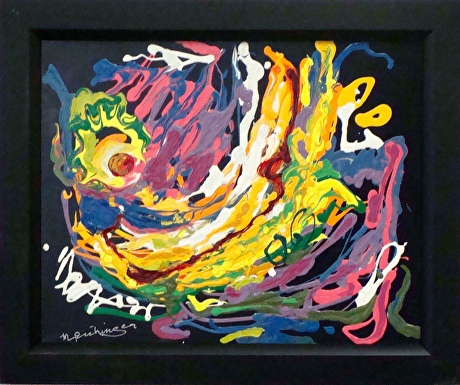
Heaven and Beyond is a 20   x 24, framed acrylic canvas painting. Available for $450, free shipping within the continental U.S. For additional information, contact the artist at marilynne@eichinger.com

I look forward to your comments below.

.

A Writer’s Passion

Flickers Caring for Their Young

Access to food and clean water is necessary for the survival of all living species. We need to be diligent about preserving nature’s gifts to humanity. 

A Writer’s Passion

While president of OMSI, I collaborated with Dr. Marion Diamond, my counterpart at the Lawrence Hall of Science in Berkeley. Before assuming its directorship, she was one of the founders of modern neuroscience and the first to demonstrate that the brain improves with experience and enrichment. Though known for her studies of Einstein’s brain, her rat studies showed that an enriched environment (toys and companions) beneficially changed the brain’s anatomy. In contrast, an impoverished environment lowered the capacity to learn. By showing the plasticity of the brain, she shattered past beliefs of the brain as static and unchangeable, degenerating as we age.

Dr. Diamond advised me to stay active after retirement by changing my daily activities, interests, exercise routine, and readings. Doing so, she said, would develop new synapses to keep me vibrant and engaged throughout my senior years. To grow and continue learning throughout my life would keep me relevant and give life purpose.

So…when I retired at seventy-three, I followed her advice. Instead of remaining a consultant to the corporate world, I divested myself of boards, committees, and fundraising activities, choosing to spend my time with individual endeavors instead. Community activities took on a counseling aspect with singular individuals rather than leading groups. I spent hours engrossed in my art. But of all the undertakings, writing is the one I focused on most. I had always been an idea person, but when I put my thoughts on paper, I relied on others to make my thoughts well composed. My retirement goal was to learn how to write. I joined a writers’ group, so what I put down is critiqued before distribution.  The best way to become a writer is to write every day without fail. Sending out a weekly blog keeps me on course, but most of my effort goes towards my books.

Lives of Museum Junkies and Over The Peanut Fences were non-fiction, partly biographical endeavors. The first explored my early involvement with science museums and hands-on learning, how I learned to manage large institutions, and the people who helped the profession grow. The second accounts for the days spent mothering a previously unsheltered youth and getting to know the staff and volunteers of organizations that help young adults heal.

As I watched the environment suffer due to global warming and pollution, I decided it was time to write a novel, a thriller to capture the public’s imagination and to encourage governments to improve their care of life-affirming resources.”

Capturing attention with the written word requires dedication, a nuanced knowledge of the English language, and an understanding of people’s emotions. My first attempt at an environmental novel was focused on petcoke, a little-known petroleum by-product that resembles coal. When I wrote the last chapter, I realized it could have been better, but I needed to figure out what was wrong. I found a teacher who had me flush out character descriptions in the middle of the night when my mind wasn’t sharp. I was advised not to begin my story before I understood how each looked, walked, talked, was raised, and felt. I had to live in the head of each individual and worry about their families and friends.

After three years of research and writing, I completed The Water Factor, a thriller about the corporate takeover of water. It should be in bookstores and online by late spring. Though set in the future, everything I write about has already occurred.  Access to clean drinking water is in peril and will affect everyone’s life in the future. I was shocked to learn that the World Water Forum of 1998 and 2000 led to water being declared a commodity and not a right. This opened the way for it to be traded on Wall Street and privatized by corporations that charge 2000 times more by bottling it than letting it flow through a tap. Backing from the World Bank and the International Monetary Fund followed, giving a handful of international corporations license to take over the management of public water services aggressively, leading to higher water and sanitation rates.

The United Nations recognizes access to water and sanitation as a human right fundamental to everyone’s health, dignity, and prosperity. Unfortunately, well over billions of people today live without water being safely managed. The plot moves from rural Oregon to Ethiopia to a Native American reservation, showing what can happen when corporate interests take over access to clean water.

My purpose in writing The Water Factor is to bring this issue to the forefront so communities can do something about it. The first of the  Rightfully Mine series, the novel shows the depths of manipulation and deceit people will engage in for money. It’s a page-turner to stimulate your brain, though I hope it will do more. The book is a call to action for citizens to monitor how their water and sewage systems are managed. Northwest Natural, an investor-owned gas company in Oregon, has begun purchasing small water companies in Oregon, Idaho, and Washington. The company is positioning itself to buy municipal water systems as it expands. It is time to ask if we want our water to be privatized.

Communities need to take heed of water issues. Lives depend on it. Who is selling, and who is purchasing local water rights? How will this affect your family in the future? I hope you get actively involved. Your effort is bound to stimulate new brain synapses and be a meaningful endeavor. 

References:

United Nations website. Human Rights to Water and Sanitation. Retrieved from https://www.unwater.org/water-facts/human-rights-water-and-sanitation#:

Burtka, A. & Montgomery, W. (2018) A water right—Is water a human right or a commodity? ERB Institute University of Michigan. Retrieved from https://erb.umich.edu/2018/05/30/a-right-to-water-is-water-a-human-right-or-a-commodity

Green, E. (2018)NW Natural is buying water utilities. Should Oregonians be concerned about privatized water? Street Roots. Retrieved from https://www.streetroots.org/news/2018/08/10/nw-natural-buying-water-utilities.

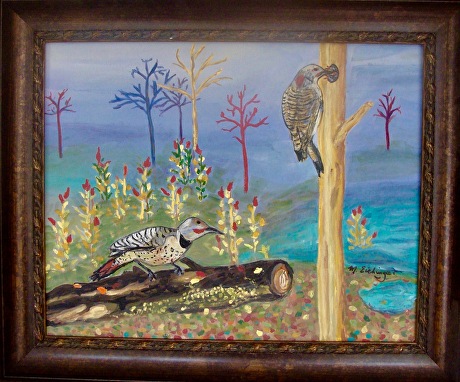
Art is always for sale. Flickers Caring for Young is a 22” x 25” framed acrylic on canvas painting. It is available for $425 and shipped free in the continental U.S.A. For information or to answer questions, contact marilynne@eichingerfineart.com

I look forward to reading your comments below.

Outside the Box

Time Outside the Box

Do you remember the first time you left home? Overnight, you were without parents telling you what to do. The day I was accepted to college, I dreamt about how wonderful it would be on my own and not have to care for a younger sibling. I’d be free to stay up late and party through the night. As a sheltered child, my parents didn’t want me far from home, so my higher education began at Ursinus College, an Evangelical and Reform-sponsored college 100 miles west of Philadelphia. 

The surprise that first week away was to find that instead of freedom, I was trapped on campus with strict oversight rules regulating my whereabouts. Among other things, it was mandatory to attend chapel three days a week, with attendance taken to ensure we were there. The transition from Philadelphia suburbia was difficult for a Jewish eighteen-year-old used to the richness of the city. I loved visiting museums, going to theatrical performances, and attending symphonic and folk events. As a child, I was taken to Saturday morning children’s concerts; as a teen, I graduated to youth concerts and went with my friends to Symphony Hall. I was enrolled in art classes at The Philadelphia Art Museum, where their collection of masterpieces inspired me, and I studied ballet with plans to go professional.

My parents weren’t concerned when I traveled from suburbia to Rittenhouse Square for piano lessons. Though going by bus and subway took an hour, it was considered a safe means of transportation. Philadelphia was my playard, grounding me in American history and providing more freedom than I realized.

Years later, I was asked why I chose to attend a small rural college and if I would do it again. I went to Ursinus because Dad had taken his medical residency nearby. It was known for its strong liberal arts and pre-med programs. I was thrilled to be accepted and couldn’t wait to meet my roommate, a young woman who turned my world upside down. She was an enigma, leading me to question my take on reality. Alice (not her real name) opened my eyes to a slice of society coming from another world. There was one other Jewish woman in my freshman class and both of us were matched with Catholic roommates so we wouldn’t pollute the minds of our evangelical classmates.

Alice roommate lived in a small New Jersey town where she grew up riding horses from an early age. In her teens, she attended demolition derbies , went to wild beach parties, and galloped across the country club’s grounds with friends dressed as Ku Klux Klan members. I was shocked by the cavalier way she described her exploits and disdain for Black Americans. In our dorm, she partied in a friend’s room until the wee hours of the morning, and slept afternoons in ours. I tiptoed around the room during the day, studying with the shade down in the dark .

Undergraduate men were also different than the boys from home. Except for the pre-med students serious about their studies, they were into cars, sex, and physical exploits. Their childhoods didn’t include hours spent in cultural institutions. They liked Elvis, while my friends and I were enthralled with the Beatles and Pete Seeger. Most male undergrads came from families where practical work was valued over academic achievement. During hunting season, male undergrads attended class with hunting licenses pinned to the back of their shirts. They’d head for their rifles and hunting gear, he second the bell rang. I’m not sure where firearms were kept. Hazing rituals at fraternities made my hair stand on end. I still hear the screams of initiates drifting through my open window at night.

 Though Ursinus had a stimulating lecture series, few students attended. I sat among the staff with a handful of co-eds, wondering about the curiosity of my fellow students. School dances and movies were well attended.

Freshman women, subject to a hazing ritual supported by the administration, were compelled to wear one yellow and one red sock for our first six week. We slung name placards over our shoulders, like a sandwich sign, and wore freshman beanies wherever we went. As a newby, I memorized the long, fanciful names sophomore leaders took on, and addressed them like royalty whenever they passed. The consequence of forgetting a name was having to sing the school’s anthem before everyone at pep rallies. First-year students met at noon to be tested on our knowledge of the school’s football chants and songs. We were later told that the goal of hazing was to get the freshman class to bond and rise against the sophomores. Our class overwhelmingly failed, and the following year, hazing was abandoned.

I was shy and fearful and didn’t understand all of the rules in the women’s dorm. We had to sign out when we left after seven p.m. and in before ten p.m. weekdays, midnight on weekends. It wasn’t until the last quarter that I broke through my fear of doing something wrong. As a former ballet student, I secured a lead part in a spring homecoming extravaganza. After performing in the stadium before thousands of students, parents, and alums, I was recognized as someone other than a wallflower and suddenly had friends. College became life bearable.

 The following year, I transferred to Boston University where I loved walking through the halls without being recognized. I think fondly the the times I spent having lunch with classmates who talked about what they were studying. Boston University is in the heart of a city with over sixty universities and colleges, and I thrived in the intellectual atmosphere. But when I reflect on my days at Ursinus, I realize that learning to enjoy and accept people with different customs and values may have been the more valuable experience. After opening myself to the joys and hardships of fellow students, I saw that every family has some level of dysfunction, but most children figure out ways to survive. My classmates were down to earth, grounded in reality, and as concerned about their future as I was\. In 1958, only 7.7 percent of American women attended college. Today, that number is at 60 percent. Back then, there was a strong emphasis on exiting with a husband.

Leaving home, whether to further education, travel, take a job, or join the military, is life expanding. It takes getting out of your comfort zone to discover who you are and to be able to evaluate your strengths, likes, and dislikes. A willingess to accept some level of risk taking is as import for senior citizens as high school graduates. Humans are continuously evolving creatures that metamorphosis as they go through life’s passages. 

Congress would do a better job running the country if legislators opened themselves to the commonalities of the human condition. Unfortunately, too many hide inside boxes and shoot barbs at people they don’t understand or know. Cultures differ as does the food we eat.  But as human beings, we all lose baby teeth, learn to control our bladders, and get grey hair as we age. We care about our children and friends and put ourselves out to see they are happy and well-fed.  We teach children to ride bikes, catch balls, cook, clean, brush their teeth, enjoy sporting and cultural events, and use computers.

Everyone wants to be free from illness, poverty, road rage, potholes, and crime. We enjoy decorating our homes for the holidays and spending time with friends and family. Focusing on  shared interests and traits is the starting place for understanding. I implore politicians to get out of their boxes and embrace humanity instead of trashing those they don’t agree with.

I look forward to your comments on my blog site.

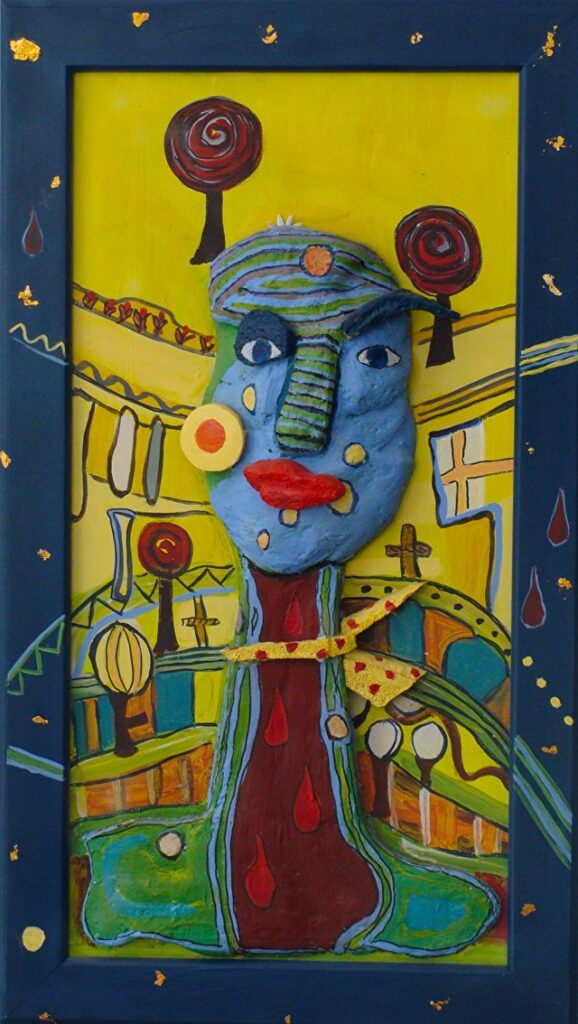
Art is always for sale. I Thought I Knew You is a 36″ by 18″ Mixed Media painting on Canvas/ available for $795 / free shipping in the continental U.S. For Information, go to  www.eichingerfineart.com.

Eichinger books are available in paperback and ebook formats in bookstores and online. To purchase on Amazon go to https://www.amazon.com/s?k=books+by+Marilynne+Eichinger

SPECIAL THIS WEEK/ Free Kindle download of Lives of Museum Junkies second edition.

Spiritual? You Kidding

Blue Ladders (NFS)

There are many pathways to inner peace.

Spiritual? You Kidding?

I never considered myself to be a spiritual person, yet friends say I am. The word itself bothers me. Spiritual brings forth images of ghosts and angels flying in spook shows.  Part of the problem is that I used to live next to Spiritualists whose home was shrouded in mystery. They held weekly seances to call forth the dead behind covered windows. I was also affected by a twenty-year-old client I counseled.  The young man wouldn’t acknowledge he was an alcoholic, though drinking was damaging his life. Though he agreed to go to a detox clinic, he never admitted to the problem.  A year later, I received a call at home saying he didn’t do it. Having no idea what he was referring to,  I asked him to explain. A year earlier, two women died when he crashed into their auto while driving intoxicated. Unable to live with the guilt, he sought out a medium who, after contacting the spirits of the dead women, said it wasn’t his fault. I was stymied about how to respond.

The demand for spiritual guidance soars when people are fearful and when that fear is coupled with uncertainty. A surprising number of people, one in five Americans according to a 2017 Pew research study, have consulted fortune tellers. Consultations with mediums often resemble armchair counseling, with thoughts reflected back to clients through a mystical lens. With more than a quarter of U.S. adults thinking of themselves as spiritual but not religious, more people seek comfort through paranormal sessions.

A boom in psychic readings began with COVID-19 when mediums were forced to conduct their meetings by phone or computer. Ulema Hormaeche, a Los Angeles tarot reader, says that the pandemic and the last election “upended people’s lives and sapped their optimism.” The cost to visit a psychic can be steep, varying between $100-$150 for an hour’s session. I know of a Miami psychic who charges $ 4.49 a minute and another fully booked woman in California who collects $1,000 to read your Akashic Record.

Thomas Rabeyron, a psychology and psychopathology professor at the University of Lorraine in France, labels psychics as barometers of social anxiety. He considers them dangerous fraudsters looking to trick vulnerable clients out of money. There are good reasons to doubt readings based on an endlessly interpretable mystical realm. “Throughout history, whenever there has been some sort of upheaval or some sort of collective anxiety in society, interest in psychics has shot up,” writes York University Professor of Psychology James Alcock. People find it hard to deal with uncertainty. They don’t trust scientists, physicians, and elected officials  hesitant to speak authoritatively. Lacking control over the environment fosters anxiety about the future, so people seek out spurious sources for reassurance.

Spirituality, unlike spiritualism, embraces the deepest values and meanings by which people live. I feel at my best when I am in tune with my inner psyche, my actions, and my perception of the universe. Believing I’m connected to something bigger than myself, I am at one with humanity. To experience this feeling, I have to be in the zone. It is the moment when the world falls away and all that exists in myself and my thoughts.

There are many paths to spirituality, all requiring commitment. Basketball players, musicians, dancers, and fine artists strive through their respective fields to get there. Athletes who are physically and mentally fit get in the zone when they are about to tune out the static that keeps them from acting in the moment. Sufi Dervishes clear their minds with a whirling meditation. When I watched them spin in Turkey, it took about ten minutes to tune out the audience and become immersed in their practice.

The zone is a moment of relaxation and peace. Free from anxiety, it allows you to see the larger picture. It is a religious experience for some, a psychic one for others, and a rational explanation for the scientifically minded. For thousands of years, people of every faith meditated to get relief from the inner turmoil controlling their lives. They do so with the hope of expanding the time they spend worry-free. The moment may start with a flash of realization. With practice, it can spread until calmness takes over both body and mind. A feeling of wholeness and connection with the universe reduces stress, lowers blood pressure, and slows heart rate.

My path includes meditating, painting, writing, and walking solo through the woods. Those are moments when I am entirely focused on the here and now. One of my neighbors gets in the zone when she cooks, another when gardening, and yet another through prayer.  Whatever you choose, your mental and physical health must be attended to first.

Our country is going through a difficult time with no magical cure in sight. People are angry, frustrated, and at wit’s end as to what to do to survive global warming, increasing crime, the influx of millions of migrants, and thousands of homeless vagrants. Working on these problems starts by clearing your mind. If you don’t have a calm center, you can’t help others.

I enjoy reading your comments. Please do so below.

To see my art, go to https://www. eichingerfineart.com

References:

Macdonald, F. (2021) What, if Anything, Can Psychics Tell Us About All of This? New York Times. retrieved from https://www.nytimes.com/2021/01/15/style/did-you-predict-this.html#:~:text

Lipka, M. & Gecewicz C. (2017)More Americans now say they’re spiritual but not religious.Pew Research Center. retrieved from https://www.pewresearch.org/short-reads/2017/09/06/more-americans-now-say-theyre-spiritual-but-not-religious/

Peace on Earth

Mystére

  Bringing peace to Earth

 Peace on Earth, Good Will to Men (women and those in between)

It’s the Christmas season when people sing carols like Hark the Herald Angels Sing and The Peace Carol. The lyrics to these songs were inspired by Luke 2:14. The New American Standard Bible reads, “Glory to God in the highest, And on earth peace among men with whom He is pleased.” The MSG version says, “Glory to God in the heavenly heights, Peace to all men and women on earth who please him.”  

Whether you believe there is a supreme being or not, the sentiment for peace is noble.  Peace on Earth, who wouldn’t want that? The question is, how do you get there? I don’t believe the human species can wait for divine intervention. We’ll have to be proactive to bring it about.

At the end of 1922, there were at least 150 armed conflicts worldwide, up from previous decades when the number covered around 100, according to Our World in Data.  Armed conflicts began escalating in 2013 and have been increasing yearly. From 1800 through 2022, more than 37 million people died in wars.

How does a violent world become peaceful? The answer is complex; a miracle won’t make it happen. It requires the collective efforts of individuals, communities, governments, and international organizations and starts with the media’s willingness to combat the spread of misinformation and propaganda. News anchors have to be allowed to report honestly, irrespective of the bias of owners and advertisers. Peace will never flourish without a factual press.

Problem-solving starts with diplomacy and dialogue, not weapons. Conflict resolution tactics employed at local, national, and international levels move warring factions to discuss their differences in a calm atmosphere. Strengthening international organizations like the United Nations and alliances promoting cooperation on climate change, public health, and poverty helps nations compromise.

At the heart of all peace movements is a commitment to protect every inhabitant’s human rights, regardless of background, ethnicity, or beliefs. A Guatemalan woman I heard recently said, “Even terrorists have families who want to live without fear. Don’t give up hope and think that conflicts between Israel and Gaza  and the Ukraine and Russia can’t be solved.” She said that she had almost given up hope for Guatemala but improved drastically after electing an anti-corruption president who had been considered a terrorist by the opposition.

Hope requires nations to advance education for both sexes and adopt a cultural understanding that addresses the inequalities that lead to social unrest and conflict. It means promoting inclusive, environmentally sustainable economic policies and recognizing that the earth has limited resources. Hope empowers women. Multiple studies indicate that societies with greater gender equality tend to be more peaceful.

Strengthening the rule of law, combating corruption, and ensuring fair, transparent legal systems promoting justice are essential for bringing peace. It is also wise to stay alert to potential conflicts and address them before they blossom. 

To achieve peace on earth is a tall order. Our own country is going in the opposite direction. It has become less democratic and more violent. Lies, inequities, greed, unwillingness to compromise, and disregard for the environment have spiraled out of control. An economy based on selling military weapons and ammunition, one that soothes itself with narcotics and allows homelessness to exist, is on the wrong track. A citizenry that worships criminal politicians and allows the media to promote lies destroys its humanity and all hope for peace. There isn’t a God in the cosmos who would be pleased with what is happening.

Next time you sing a song or receive a card wishing peace, consider your role in bringing it about. For sure, light candles,  fill your home with smells from a home-cooked meal and enjoy a Yule-time drink.  But if you wish others a peaceful year, realize that won’t happen unless you and they practice love, not aggression. Join those who crave a peaceful society and engage in activities toward that end. Vote for candidates who will understand compromise and seek out non-violent solutions. Enjoy in spirit as people celebrate Christmas, Hanukkah, Kwanzaa, Diwali, Yule, the Solstice, and the New Year. It is a chance to show you acknowledge diversity. Let’s ignite an era that brings peace on earth and goodwill to the men, women, and those in between in every nation of the world.

References

Herre, B. Rodes, L. Roser, M., Hassell(2023)  War and Peace. Our World in Data.  retrieved from https://ourworldindata.org/war-and-peace#:~:text=Key%20Insights%20on%20War%20and%20Peace&text

Crespo-Sancho.C. (2018) Can Gender equality prevent violent conflict? World Bank Blogs. retrieved from https://blogs.worldbank.org/dev4peace/can-gender-equality-prevent-violent-conflict#:’

Mystére is a 36” x 48” acrylic canvas painting available for $1,900, shipped free in the continental U.S. For information, contact marilynne@eichingerfineart.com

I enjoy reading your comments. Please do so below.

.

Kepping Up Appearances

Do you get tense around the Christmas holiday? Don’t let it get to you. Take the time to enjoy nature and relax.

Keeping Up Appearances

Though there is much gaiety and joy during December, for some people, the month magnifies their depression. They don’t like the long dark nights and fear being around people where they feel obligated to smile when, on the inside, they are melancholy or upset. They become like walking zombies with smiling depression, a term not found on any psychologist’s list. Their depression may have started with a job loss, illness, or the death of a loved one or simply by being obligated to decorate their house and entertain.

Depressed smilers are highly functioning people who believe it is essential that they keep up appearances. They are good are good at faking it, appearing cheerful and optimistic. They can stay productive at work and even laugh appropriately when hiding an anxiety that gives them headaches. As perfectionists, they don’t want to burden others with their problems and are too embarrassed to share the truth. Though there may be a good reason for their depression, they pull away from friends, some turning to drugs or alcohol.

People with smiles plastered on their faces deny their true feelings, thinking they are all right as long as they smile. They worry about appearing weak, being judged or punished, and fear a backlash by admitting to their depression. They are also more likely to harm themselves than those with classic depression symptoms. To compensate, some people will overeat, while others lose their appetite. Some find it hard to wake up, yet others experience insomnia. Feeling pressured to be happy when you are not is problematic, causing emotions to fluctuate between hopelessness, guilt, and worthlessness.

Smiling depression takes a particular toll during the holidays. The best thing a person can do is try to outsmart it, says psychologist Jessica Schneider. Don’t just grin and bear your melancholy; that will only worsen matters. Develop a plan to overcome it. The problem with acting together on the outside, when you are not on the inside, is that you may not realize you are depressed. A person who thinks they have everything – a lovely house, a wonderful family, and a good job, yet isn’t happy may feel guilty, which can be exhausting. Admitting to being overwhelmed is the first step toward healing.

The good news is that smiling depression is usually a short-term phenomenon and very treatable the moment you take a step toward being your authentic self. If this malady plagues you, make sure you stay connected to your friends. Talking to someone you trust can be a powerful antidote to holiday depression. Stop worrying about living up to expectations. No one expects you to be perfect. If you are angry because your partner won’t help put up the tree or participate in festivities, don’t worry when you become irritable. That’s natural. It is also advisable not to dwell there. Instead, do something that enables you to relax. Exercise, listen to music, make art, meditate, or engage in an enjoyable activity that will change your mood.

During this season of miracles, close your eyes and imagine that your most pressing problems are gone and that you will wake up in the morning relaxed and happy. Allowing yourself needed downtime will brighten your day.

____________________________

How do you feel now that Christmas is upon us? Is it a struggle to get through the days or, do you embrace each one joyfully? Do share your thoughts on my blog site below.

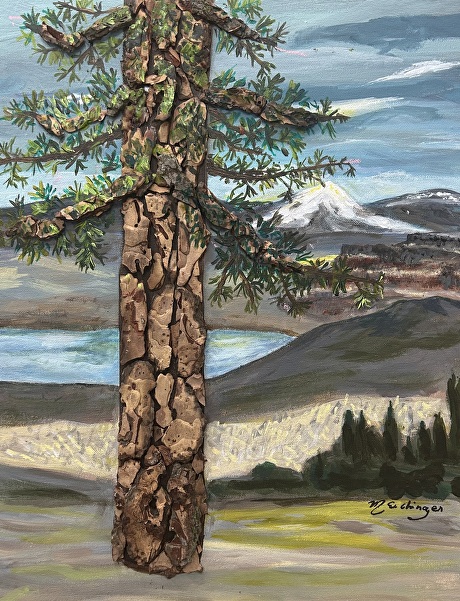
Art is always for sale. A Ponderosa pine canvas print is available for $99, shipped free. Tree selections can be reviewed and purchased online at https://www.eichingerfineart.com/collections/182747

_______________________________

Moroin, A. LCWS.(2023)  Smiling Depression: When Things Aren’t Quite as They Seem. Verywell Mind. retrieved from https://www.verywellmind.com/what-is-smiling-depression-4775918

Casarella, J. MD. (2022) Smiling Depression: What You Need to Know. WebMD. retrieved from https://www.webmd.com/depression/smiling-depression-overview

Mastrocola, K. (2023) Outsmart the ‘Smiling Sadness’ That Can Take Its Toll During the Holidays. First, for women. https://www.firstforwomen.com/posts/health/what-is-smiling-depression

Connections

NURTURING

Though humans destroy the environment, there is still hope for its revival. Nurturing one tiny seed can have immense repercussions.

Connections

Deep down, we know we are connected to one another but don’t act like it. As a five-year-old, my circle of contacts was limited to me at the center. I learned how the bones in my body were connected to help me stand.  I sang “Dem Dry Bones,” an old spiritual often sung at Halloween.

“Dem bones Dem bones Dem dry bones
Dem bones Dem bones Dem dry bones
Dem bones Dem bones Dem dry bones,
Hear the word of the Lord.

The toe bone connected to the foot bone
Foot bone connected to the heel bone
Heel bone connected to the ankle bone
Ankle bone connected to the leg bone
Leg bone connected to the knee bone
Knee bone connected to the thigh bone
Thigh bone connected to the hip bone
Hip bone connected to the back bone
Back bone connected to the shoulder bone
Shoulder bone connected to the neck bone
Neck bone connected to the head bone
Hear the word of the Lord.”

By the time I was in elementary school, I knew I was part of an extended family, lived in a neighborhood, and was somehow connected to the children in my classroom. My parents were not the only ones looking out for me; my teachers were also.  I sang; Hey, hey, hey—

“We are family

I got all my sisters with me

We are family

Get up everybody and sing

Everyone can see we’re together

As we walk on by (and)

And we fly just like birds of a feather

I won’t tell no lie (all)

Living life is fun and we’ve just begun

To gain our share of this world’s delights (high)

Our high hopes we had for the future

And our goal’s in sight”

By high school, I knew I was part of the greater world. Friends had pen pals in the Netherlands and Japan. I studied French and couldn’t wait to go to Paris. The civil rights movement was around the corner, with schools being integrated.  I joined a volunteer group in college that helped international students adjust.  And, I sang—

“We are the world

We are the children

We are the ones who make a brighter day, so let’s start giving

Oh, there’s a choice we’re making

We’re saving our own lives

It’s true we’ll make a better day, just you and me

When you’re down and out, there seems no hope at all

But if you just believe there’s no way we can fall

Well, well, well, well let us realize

Oh, that a change can only come

When we stand together as one, yeah, yeah, yeah.”

My view of the importance of humans diminished as I took science courses in college. Anatole France wrote,” Even a little dog is the center of the universe.” That may be true since I am a collection of all my experiences and learning, and I see the world through my eyes. But, when learning about the cosmos, I realized I am much smaller than a grain of sand. I had been fooled into thinking that I was part of a dominating species that could control my environment when the truth is that I am made up of atoms and electrons that are no more important than the shoes that cover my feet or the tree outside my window. Albert Einstein told us that the universe is nonlocal and that objects are linked even though events cannot communicate through spacetime. When two objects come into contact, they affect each other. If one’s direction is changed, so too will the other.

Dr. Roger Nelson at Princeton University conducted a 14-year-long study involving 60 countries called the Global Consciousness Project to introduce Einstein’s findings at the human level. Using massive computing power, he studied the probability that 426 events would have a 50/50 outcome over time. That wasn’t what happened. He found that quantum mechanics does apply to the human psyche.” Something occurs when you touch someone’s heart emotionally becoming attached to someone. Your atoms, the building blocks of your presence in the universe, become entangled.” 

Quantum mechanics comes into play with the Israeli/Gaza war, where two countries at loggerheads have impacted the direction of each entity. The confrontation had a domino effect, spreading to communities around the globe. Just as waves in the ocean move endlessly, hitting the shore, vibrating, and transforming, so do human beings. Serge Benhayon wrote in Time, Space and All of Us, “There is no them. There is only all of us. We have this perception of the need to unify, to come together; however, in truth, we are already all unified as one, and in this oneness, we cannot help but be connected to everything else – such is the mechanics of vibration in space, our universe.”

Though we may chant, picket, and sing that the world has to come together, we are already connected and unable to separate. Our responsibility is to recognize this truth. When nations collide, they should be given a positive nudge that improves both parties rather than one that destroys lives and economies. We must understand and act, knowing we are not alone but connected.  When one country destroys another or when a company pollutes the environment, the world is affected.  The song in my heart rings out,

“The more we get together

Together, together

The more we get together

The happier we’ll be

‘Cause your friends are my friends

And my friends are your friends

The more we get together

The happier we’ll be

__________________

Art is always for sale. Nurturing is a framed acrylic on-panel painting, 43” x 84”. Available for

 $ 2,900. For information about shipping, contact me at marilynne@eichingerfineart.com

I look forward to reading your comments below.

References:

Borbon, L. (2014) Quantum Mechanics. Learning Mind. https://www.learning-mind.com/quantum-mechanics-reveals-how-we-are-all-truly-connected/

Moses, P & O’Hara P, ( 2023) Quantum Mechanics –  the science of absolute connection. Unimed Living. retrieved from https://www.unimedliving.com/science/everything-is-energy/quantum-mechanics-the-science-of-absolute-connection.html#

Den Bones Lyrics.  retrieved from https://www.google.com/search?q=dem+bones+lyrics&oq

We are Family Lyrics. retrieved from https://www.google.com/search?q=we+are+family+lyrics&sca_esv

We are the World Lyrics. retrieved from https://www.google.com/search?q=we+are+the+world+lyrics&sca_esv

The More We Get Together lyrics. retrieved from https://www.google.com/search?q=dem+bones+lyrics&oq

Think Gratitude

Planting a garden and reaping its harvest are among the many things to feel grateful for.  

Think Gratitude

America: Thanksgiving (the fourth Thursday of November) is a time for gratitude. The holiday has roots back to 1620 and the landing of the Mayflower. As well as being a day to remember contributions from Native Americans that helped the Pilgrims survive, it is a celebration of appreciation for the bounty of the earth. It is a happy occasion to join with family and friends, divorced from the stress of daily life.

Related to our Thanksgiving is a celebration that takes place in Leiden, Netherlands, in remembrance of the Pilgrims who lived there before leaving for the New World. The city in the Dutch Republic had permitted Pilgrims to practice their religion there without being hassled. After trying to adjust to Dutch society, they left for the New World due to a lack of education, harsh working conditions, and a potential war with Inquisitional Spain. Leiden’s annual Thanksgiving celebration takes place at Pieterskerk, a Gothic church that has the grave of one of the Pilgrim leaders.

Listening to the news, it is easy to forget that there is much to be thankful for. I am grateful to have food on my table and cherish the friends and family who fill my life with good cheer. For families yet on pilgrimages undertaken due to poverty, war, or natural disasters, gratitude is more difficult to achieve.  Yet, they, too, are filled with hope for a new beginning. Following are some of the ways countries celebrate the harvest and give thanks for abundance.

Canada: Jour de l’Action de Grace – (second Monday in October) Canada’s first Thanksgiving was celebrated in 1578 when English explorer Martin Frobisher’s crew gave thanks in Newfoundland for a successful journey to North America. Their feast is similar to ours, a three-day weekend with parades, a Canadian Football League doubleheader, and a dinner with turkey, mashed potatoes, corn, and pumpkin pie.

Korea: Chuseok (25th day of August, lunar calendar) is a festival with roots dating back to 2000 years ago when Korea was an agrarian society. Legend relates that the ancient king, Silla, held a month-long weaving competition, treating the winning team with food, drinks, and gifts from the losing team. Today, families gather in a bonding activity a night before the celebration to prepare rice cakes and share presents. Spam is a standard gift popular among Koreans.

UK: London’s Harvest Festival (October–days differ), a relatively new festival that started in 1998, showcases livestock, horticulture, and home products. Competitions are held for the animal most like its handler, the most pleasantest pig, the best goat beard, the best animal portrait, and more. Celebrations are held in churches, schools, pubs, and even barns where participants sing hymns, pray, and decorate event halls with baskets of fruit and food. Lavish meals featuring several types of meats, vegetables, puddings, tarts, and ale are accompanied by songs, drinks, and games. The Royal Horticulture Society organizes the festival.

Germany: Erntedankfest is a rural festival thousands of years old that celebrates the harvest. There is no set date, but festivities are held between mid-September through October in various communities, especially in rural areas. Christian and Protestant churches celebrate with a service, a parade, music, feasting, and the crowning of a Harvest Queen. It is primarily a religious holiday for fun, food, and Thanksgiving.

Ghana: The Homowo Festival commemorates a time when the Ga tribe in Ghana had no food to harvest because of infertile soil. Starving people had no choice but to wait for the rains to come again and the famine to end. In remembrance of the famine, the capital city, Accra, enforces a noise ban and prohibits fishing in lagoons for a month. The silence ends when the rainy season begins. The celebration starts with a church service that lifts the ban. Harvest feasts and gaiety follow.

China: Chung Chi (August Moon Festival–5th day of the eighth lunar cycle of the year). Families enjoy three days of public and private gatherings where they worship the moon, give thanks for the harvest, and encourage life-giving sunlight. People float paper lanterns and share mooncakes that represent unity and peace for the coming year. Mooncakes contain duck egg yolks, lotus seed paste, and sesame seeds. Chung Chi is a favorite time for matchmaking.

Argentina’s month-long celebration starts with the archbishop of Mendoza sprinkling the season’s first grapes with holy water and offering the vintage to God. Crowds line the streets afterward to watch parades with regional floats with competing beauty queens. Musicians, dancers, and others entertain until the Harvest Queen is chosen and fireworks begin.

Israel, a country now in mourning, is going through a horror similar to the ones inflicted on past generations of Jews. This year’s Sukkot celebration ended on October 6th, the day before Hamas invaded. Sukkot is a biblical holiday known as the Feast of Tabernacles. People construct makeshift huts decorated with harvest hangings with roofs open to the sky. Celebrating bountiful harvests, they give thanks and reflect on the 40 years the Israelites spent in the desert after the exodus from slavery in Egypt. Wands of Myrtle, willow, and palms are shaken daily in every direction to honor the earth’s gifts. Families pray, dine, and sometimes sleep in the Sukkah for seven days.

As a citizen of the United States, my blessings are many. I’m not faced with hunger, war, or poverty. My family is loving, and my children and grandchildren help each other when it is necessary. Yet, I feel deeply sorrowed by those struggling in war-torn countries and those at home with unimaginable difficulties. I do what I can to ease some of their burdens, for as a child, I was taught that that is what good neighbors do. From the comments I receive, I believe that people who read my blogs have generous hearts and put themselves out as well.

I’m glad for a day to consider my blessings and am thankful for all that is good in life. Warm wishes to you and your loved ones this Thanksgiving.

References: 

Wolfe, D. (2016) Think About What Family Means Around the World. HuffPost. retrieved from https://www.huffpost.com/archive/ca/entry/think-about-what-family-means-around-the-world_b_9951754

Travel Chanel website. retrieved from https://www.travelchannel.com/interests/holidays/photos/giving-thanks-around-the-world

StarTribune website. retrieved from https://www.startribune.com/how-cultures-around-the-world-show-gratitude-in-their-ceremonies-of-thanksgiving/565530632/

Mellinger, J (2020). Top 10 Ways Different Countries Give Thanks.LISTVERSE. retrieved from https://listverse.com/2020/11/20/top-10-ways-different-countries-give-thanks-2020/

I look forward to hearing about how you celebrate Thanksgiving.  What in life are you most thankful for? Share your thoughts below.

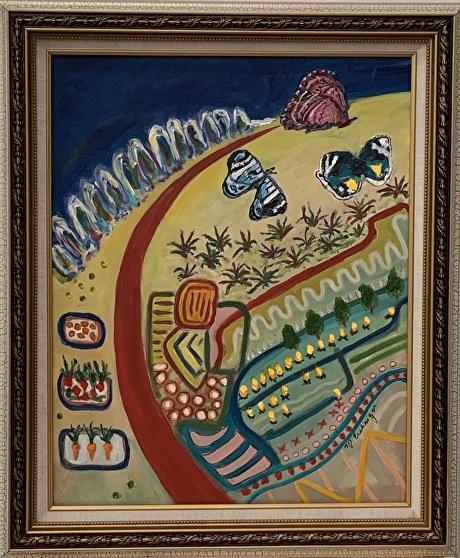
Replanting the Garden: 12” 16” framed acrylic painting / available $ 495 / free shipping in the continental U.S. Explore my website at www.eichingerfineart.com for holiday gift ideas. Contact me at marilynn@eichingerfineart.com

.

Terror Unleashed

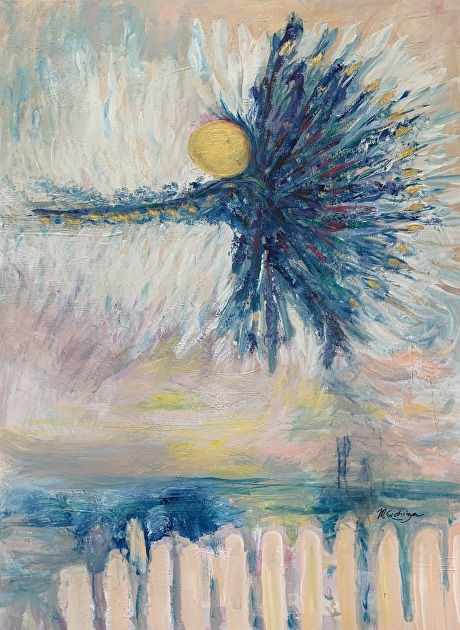
HOPE EXPLODING

Terror Unleashed

Last week, I attended a performance of the rock opera Hair. I was reminded of the social upheaval during the Vietnam War, but also of the hope raised by protesters of the Vietnam War, the Civil Rights Movement, and the Women’s Movement. Despite the carnage abroad, it was an era of inspiration. We sang-=Let the Sunshine In. Open up your heart, let it shine. And, we sang to Aquarius, to a time when humanity would take control of Earth as its rightful heritage–This is the dawning of the Age of Aquarius with Harmony and understanding, Sympathy and trust abounding, No more falsehoods or derisions, and Golden living dreams of visions. Friends and I were horrified by the death and destruction brought about by war and thought we could create a peace-loving, compassionate generation. I’m sad that we failed.

Not only is the U.S. consistently involved in wars abroad, but its citizens have to worry about terrorists creating havoc at home. With so many people armed to the hilt, cities have become battlegrounds for militias, the drug trade, and uneducated masses believing fake news and conspiracy theories put out by politicians craving power. power. Jews, Palestinians, and the LGBTQ community live in fear as antisemitism and hatred are at all-time highs. Fanatics bully migrants seeking shelter from poverty and war and are mean to those with political, cultural, or religious positions that differ from theirs. They want freedom from government intervention as long as it is their brand of freedom and don’t care it their brand of freedom impinges on their neighbors.

I blame myself and my contemporaries who protested for love and peace without finishing the job. We made strides with civil rights and women’s issues, but what happened to peace? Where did we go wrong? Why doesn’t peace reign triumphant? Why can’t I walk city streets at night and feel safe? Why do I worry about an armed shooter attacking my grandchildren at music festivals or while in school? Why do scope scope out places to hide when attending church or synagogue? And why lock doors at night for fear of being robbed and murdered? I never had these concerns when my children were young.

What does it mean to be an American in the land of the free? President Dwight D. Eisenhower warned the nation about the military-industrial complex becoming too powerful, but we let it happen. Industries supplying ammunition and military equipment, including lobbyists like the NRA, spread fear, manipulating us for their financial gain.

The United States has been in continuous wars since the 1960s. The Veteran’s Administration reports there are more than 18 million living veterans, 6 percent of the adult population. Though fewer American lives have been lost since Vietnam, the destruction and deaths on foreign soil from the wars we participate in are beyond my comprehension. Imagine the terror of hearing a stealth bomber overhead.

Wars since 1961

Bay of Pigs -1961

Vietnam War-1964-75

Laotian Civil War -1959-75

Permesta Rebellion in Indonesia -1958-61

Dominican Civil War -1965-66

Korean DMZ conflict -1966-69

Cambodian Civil War -1967-75

Multinational Intervention in Lebanon -1982-84

Grenada -1983

Bombing of Libya -1996

Tanger War in the Persian Gulf -1987-86

Invasion of Panama -1989-90

Gulf War ( Iraq, Kuwait, Saudi Arabia, and Israel ) -1990-91

Iraqi No-Fly Enforcement Operations -1991-2003

First I.S. Intervention in Somali Civil War -1992-95

Bosnian War and Croatian War -1992-95

Intervention in Haiti -2994-1995

Kosovo War – 1998-1999

War in Afghanistan – 2001-2021

American Intervention in Yemen – 2002-present

Iraq War – 2003-2011

American intervention in the War in North-West Pakistan – 2004-2018

Second U.S. Intervention in the Somali Civil War – 2007- present

Operation Open Shield in the Indian Ocean (war on terror) – 2009 – 2016

International intervention in Libya (war on terror ) – 2011

Operation Observant Compas in Uganda – 2011 – 2017

American military intervention in Niger – 2013 – present

American -led intervention in Iraq – 2014-2021

American-led intervention in Syria – 2013 – present

Global Coalition to defeat Isis – 2014 – present

American Intervention in Libya – 2015 – 2019

Israel-Hamas War – 2023 – present

Famous war paintings.

Stealth by Peter Kalhkof Guernica by Pablo Picasso

Reference:

To see a listing of all U.S. wars, go to https://en.wikipedia.org/wiki/List_of_wars_involving_the_United_States

Please share your thoughts below.

HOPE EXPLODING by Marilynne Eichinger is a 30” x 24” x 2” Acrylic on Canvas painting. Available for 4495. Sipped free within the continental U.S.

If you want to purchase a canvas print in time for the holidays from the tree collection, now is the time. Go to  Https://www.eichingerfineart.com/works Click on the canvas print Tree section.

To see a listing of all U.S. wars, go to https://en.wikipedia.org/wiki/List_of_wars_involving_the_United_States