

Truth or Consequences
Several days ago, I received a text meant for someone named Sophie. The sender asked to meet for dinner after work. I replied that she had the wrong number. She apologized, and then, unexpectedly, invited me to coffee.
That wasn’t possible, of course. She lived in New York; I live in Oregon. Still, something about the exchange felt harmless, even charming. A small mistake, a moment of connection. We began to text. I told myself I had stumbled into a modern version of a pen pal—someone to perhaps meet if I ever found myself in Manhattan.
Then I mentioned it to a friend. Her response was immediate: This is a scam. She sent me an article describing a growing scheme, one that begins exactly this way. A wrong number. A polite apology. A slow, friendly conversation. Trust is built over days or weeks. And then, eventually, comes the pivot: an investment opportunity, often involving cryptocurrency or insider access.
I went back to my messages with a different eye. The woman had told me she was a financial advisor at Citibank, working with wealthy clients. Yet when I asked for her last name or a professional email, she deflected. She preferred to keep our conversation on WhatsApp. She was friendly, attentive—and just evasive enough. The relationship suddenly felt less like chance and more like design.
I realized I was standing at a quiet threshold: on one side, curiosity and connection; on the other, the possibility of manipulation. If she was genuine, I risked losing a budding friendship. If she wasn’t, the consequences could be far worse.
It wasn’t a difficult decision, but it was a disappointing one. I ended the exchange. What lingered was not fear, but sadness—that something as simple as a mistaken text can no longer be taken at face value.
Scams like this are not confined to the United States; they are a global phenomenon, increasingly sophisticated and disturbingly effective. While the details vary from country to country, the underlying strategy is strikingly consistent: establish trust, then exploit it.
Older adults are particularly targeted, for reasons that cross cultures:
- The likelihood of savings or home equity
- A tendency to trust authority or extend politeness
- Less familiarity with rapidly evolving technology
- Social isolation, which makes genuine-seeming connection more powerful
The forms these scams take are familiar: impersonations of government officials or banks, frantic calls from a “grandchild in trouble,” romance scams, tech support fraud—and, increasingly, investment schemes like the one I may have narrowly avoided.
In countries like the United States and the United Kingdom, the problem is widely reported, with significant financial losses tied to phone, email, and online fraud. Public awareness campaigns have grown, and banks are becoming more proactive in flagging suspicious transactions. Still, scammers evolve just as quickly, refining their methods to match our habits.
What has changed most is not just the technology, but the emotional terrain. Scams no longer rely solely on urgency or fear—they often begin with something far more disarming: friendliness. A simple text. A small mistake. An opening.
And that may be the hardest consequence of all—not the money lost, but the uneasy realization that trust, once given freely, now comes with hesitation. It is this tension that lies at the heart of my Rightfully Mine novels. These stories explore corporate scams, hidden agendas, and the quiet deceptions carried out in the name of profit. What at first feels like a nice connection becomes “I can’t trust this anymore.” The damage is not always visible, but it is deeply felt by those caught in the fallout, people whose lives are altered not by violence, but by betrayal.
In both life and fiction, the cost of deception is the same: the erosion of trust. And trust, once lost, is not easily restored. I believe individuals, businesses, and nations are strongest when trust is honored—when leadership is grounded in integrity rather than exploitation. It is what allows people to sleep at night and wake with the clarity to face the day ahead. Without it, we are left second-guessing even the simplest human connection.
Have you ever been a victim of a scam? Share your experience on my blog site to make other readers aware.
Art is always for sale. See All is an acrylic painting on a 24” by 48” deep canvas. For information and to purchase go to https://www.eichingerfineart.com/workszoom/5558644/see-all#/
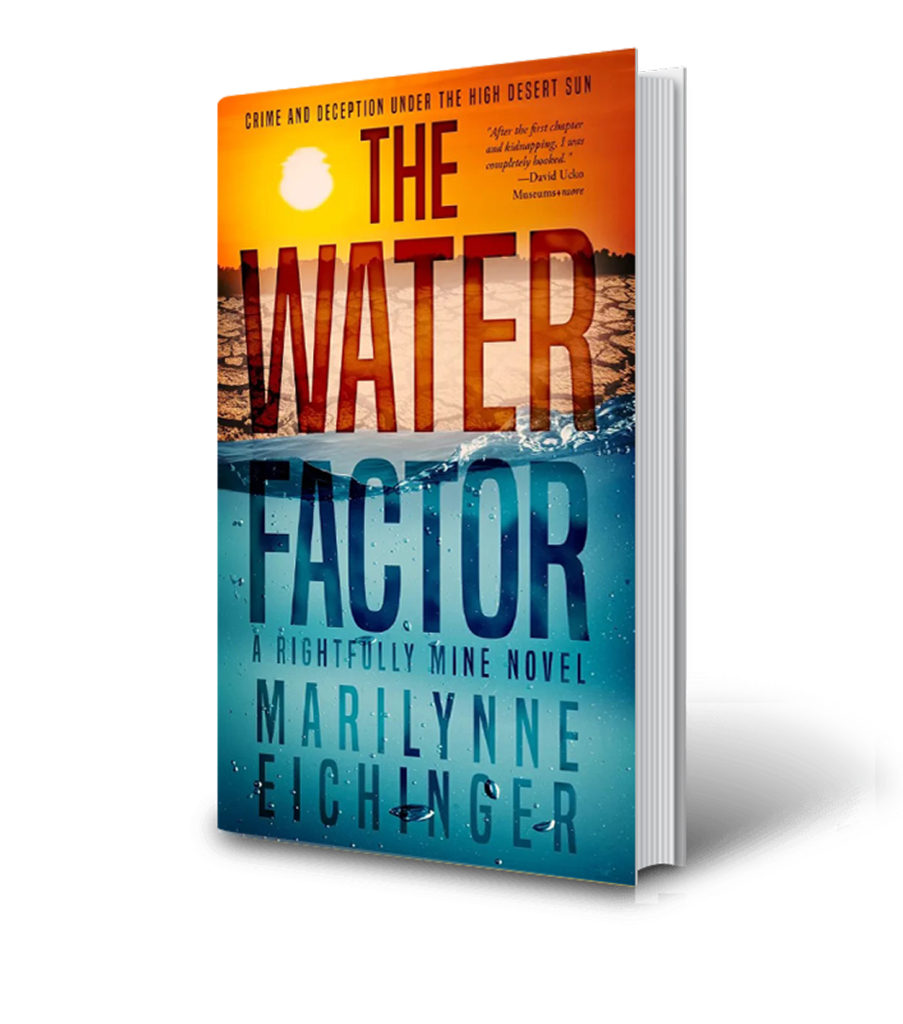
Available on AMAZON