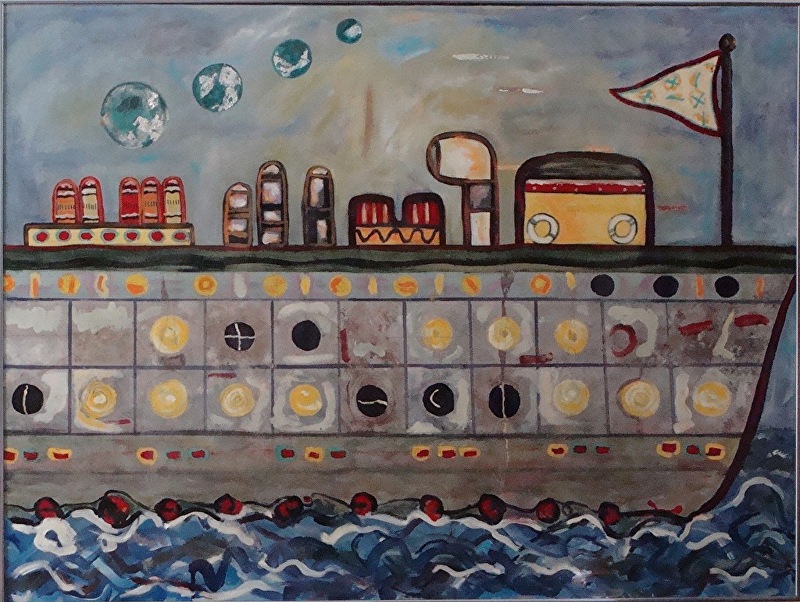
 All Aboard
Acrylic on Canvas framed/ 36” by 48”/ $ 695 /sale price $ 556 – Holiday special through July 10th
Why Travel?
Adventure travel calls out to me, for I enjoy visiting foreign countries and meeting people with unfamiliar customs. I go at it much as an anthropologist does, studying art, exploring political and social systems, seeing how meals are shared and observing celebrations of life’s passages . But recently, I’ve questioned whether globe-trotting is worth the hassle.
When in college, I occasionally traveled from Philadelphia to Boston by plane to visit my fiancé. On one such trip, I was late getting to the airport. By the time I reached the gate the doors were closed and the plane had started taxiing toward the runway. Seeing my distress a smiling the ticket taker contacted the pilot and directed him to stop the plane. He did so, lowered the stairs and waited on the tamarack until I arrived. Now that’s what I call customer service! Hail to the good old days.
When Homeland Security took over, a new era began. It introduced the period of ticket holders only, shoes off, jackets off, electronic devices out, no liquids, no, no, no. I know a man who cracked a joke (another no) to one of the security guards causing him to be escorted to a side room and strip searched. It is not unusual for international travelers to have their belongings scanned two or three times before boarding. The process is particularly terrible for those with an accent or skin color that is not “lily white.”
Travelers are understandably frustrated. In 2012, a Portland man took off all of his cloths in protest of TSA rules. When changed with a misdemeanor he decided to go to trial for being unlawfully hassled. Since public nudity is legal in Portland, he was acquitted by a local Judge. He didn’t get away unscathed, though, for TSA fined him $ 1,000. This man is not the only inconvenienced traveler to respond by stripping. It happened in Russia when a flight to Jamaica was overbooked. Times are improving ,however, for in 2017, a man was permitted to pass through Milwaukee security as though he was the emperor who has no clothes.He was deemed not to be a security threat.
I wonder what would happen if everyone took off their garments while waiting in line? Imagine the press that action would generate and the statement it would make. TSA must be paying some attention to these complaints, for with a five year pass you can now keep all your clothes on. Of course, that costs extra money and the lines are apt to be long.
Once through security most of us breathe deeply with relief, that is, until we sit down and find our knees bumping into the seat in front or are pushed sideways by a fat neighbor. I am relieved that there’s no smoking on planes. Do you think we could petition for people to take showers before traveling? How about insisting they’re healthy and will not a spread cold?
If you don’t like airport security lines or expensive parking lots, perhaps you prefer driving to your destination. Freeways are a good choice for those traveling between 10pm and 5am in the morning. Near some small towns you can also move freely between 10am and 3pm. It is in metropolitan areas and tourist locations that drivers have to contend with speed maniacs weaving in and out of lanes and men who raise their middle fingers as though it was an item of sculptural beauty. To counterbalance road rage, however, you can relax behind those beatific seniors who drive ten miles under the speed limit while gracing you with broad smiles when they signal left and turn right. At least their grandchildren are there to entertain you with waves and funny faces when traffic stops moving.
Is it worth the it? Is travel more cumbersome today than it was in prior years? It took my mother twelve hours to travel from New York to London in 1961 when my first son was born. The average flight today takes seven hours. Even with security issues the trip takes less time. A few years from now a supersonic flight is expected to cross the ocean in three hours.
What about cost? Has anyone noticed that since 1978 the average round trip on domestic flights has dropped 50 percent? Traveling by plane was a big deal when I was in my twenties. It is why I crossed the ocean four times by ship. But what a luxurious fairy tale experience that was. On my first trip with Holland American Lines there were white gloved waiters training apprentices who were proud to be of service. Staff pampered us over a five day period. By the time we arrived in Europe I was thoroughly rested but more importantly I was ready to transition to a different reality. Later crossings took only three days to complete, not nearly enough time to unwind.
In the 1900s, most people vacationed close to home, but change was coming. In 1903, Horatio Nelson (known as “The Mad Doctor”) and his mechanic, responding to a $50 bet were the first to travel from New York to San Francisco in a Winton touring car. It took 63 days and cost them $ 8,000. According to reporter, Peter Fimrite, “they left the trail littered with broken parts, tools, clothes, flat tires and tears.” Today, a cross-country trip can be accomplished in two days if you drive nonstop or go by train. It is much faster than going by covered wagon. In the early 1800s, the trip from the Missouri River to Sacramento, California took four to six months. Even then there were choices. You could go by train and save a great deal of time. In the 1830s, in five weeks you could travel from New York to Minnesota. By 1856, you could reach California in just over a month. Just love that speed, don’t you?
Construction of the interstate system was the gift that made long distance driving possible. It was authorized in 1956 by President Dwight D. Eisenhower when he signed the Federal-Aid Highway Act. Three states, Missouri, Kansas and Pennsylvania claim they were the first to complete their roads.
How exciting it was to speed down empty highways going 80 to 90 miles an hour while avoiding the policemen hiding behind billboards. No need to worry about that today, however, for there are few traffic-free roads. Yet, even with clogged freeways, the wonders of the country are within reach of most people. Just as in yesteryear, those who travel need patience. As you plan your vacation, take time to enjoy the process. Consider how fortunate your are to be able to stay connected to your love ones and to explore beautiful sites worldwide without having to travel by sailing ship or wagon train.
References:
Thompson, D. (2013) How Airline Ticket Prices Fell 50% in 30 Years.THe Atlantic. retrieved from https://www.theatlantic.com/business/archive/2013/02/how-airline-ticket-prices-fell-50-in-30-years-and-why-nobody-noticed/273506/
Fimrite,P. (2003) Long before the interstate . . . SF Gate. retrieved from https://www.sfgate.com/news/article/Long-before-the-interstates-there-was-a-Winton-2608886.php
Richard, M.(2012) How fast could you travel across the U.S. in the 1800s? Mother Nature Network.retrieved from https://www.mnn.com/green-tech/transportation/stories/how-fast-could-you-travel-across-the-us-in-the-1800s
Art is always for sale. Contact me at marilynne@eichingerfineart.com
How do you feel about travel. I would love to hear your experiences both good an bad.