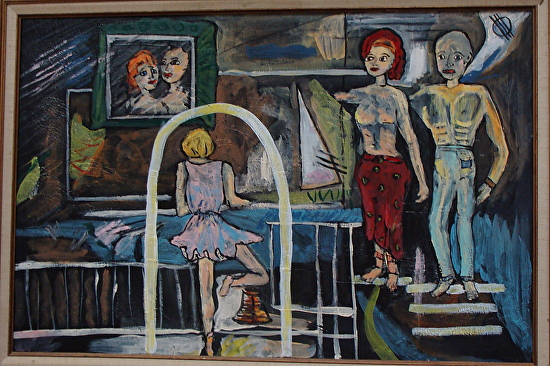
The Studio Acrylic on canvas/ $ 399 / framed “It’s not enough to have lived. We should be determined to live for something.” ―Winston S. Churchill
Dance to Life
When four-years-old, Mother took me to my first dance class. She enrolled me young because I tripped over my feet when walking. She thought my clumsiness would be helped by engaging in an activity that stresses balance. Mom never realized that those classes would teach me a great deal more than dance. Though I still have a difficult time balancing, dance lessons guided me through the years.
As a mother of five with a full time job, I was, as the saying goes, “up to my ears in alligators.” I dealt with one challenge after another at work and at home. My daily diet was responding to situations like, “So-and-so hit me. What’s for dinner?” to “Earnings are down. Should we lay people off?” Following is how dance guided me.
BALANCE: To manage a demanding schedule stress-free, I had to make sure that work and playtime were balanced. This was not always easy to accomplish, for I often wanted to bury myself in what I work or artistic endeavors. Instead, I carved out time to spend with for friends and family, to take flute lessons, and to vacation with and without children. I retreated to a quiet place to meditate daily and get away from noise and chaos. Today, my situation is reversed, for in retirement, I’m able to vacation year-round if I want to. But that is boring so I’ve added a bit of chaos by volunteering, painting and writing.
GRACE: Dancers learn to move with grace, a skill that guides daily interactions. The way I connect with others is important for developing friendships, creating business collaborations and insuring loving relationships. Graceful people understand the struggles between good and evil, yes and no, kindness and hostility and ignorance and knowledge. They use their knowledge to waltz, tango and spin through illnesses, conflicts, anger and loss. Moving gracefully requires a calm, firm center that can glide delicately through the mist.
FLEXIBILITY: Body and mind become expansive when limber and stretchable. Flexibility is required when facing challenges that can’t be overcome by ordinary means. Its opposite, rigidity can turn you into an uncompromising has-been who may as well be dead. Flexibility allows for adaptation to change upon change. One truth I value knowing is that society and individuals are in constant states of transformation.
“The only way to make sense out of change is to plunge into it, move with it, and join the dance.” ― Alan Wilson Watts
PRACTICE: “Try again until you get it right,” was a mantra drilled into me as a child. Without developing the gifts we are born with, our talents may as well not be there. Once you discover what they are, they have the potential of providing great joy. It takes effort to overcome inertia and requires energy to train. Dancers prepare by practicing for hours each day—as do doctors, artists, basketball players, teachers, plumbers and many more. Perfected skills enable them to perform their craft with competency, ease and grace.
CONCENTRATION: Staying focused, being mindful and remaining centered reduces stress. Dancers whose minds wander while executing a leap or turn may get hurt. Those who can’t memorize their routines are unable to perform. When fully engaged in what you are doing, there is little room for worry. When in control of your mind, you are able to turn off unwanted thoughts and fears. Learning to concentrate in the moment, is an acquired skill that enables relaxation when walking through storms.
PERSEVERANCE: Muscles and toes ache from hours of practice. Not giving up and remaining committed are difficult when in pain. When a ballerina falls, she is taught to get up and finish the performance. Similarly, mishaps occur throughout life, yet we must continue on. Failure becomes a teaching moment when it is accepted as a lesson in how to improve and not make the same mistake twice. Perseverance requires overcoming embarrassment, remembering the goal and acknowledging small steps taken in the right direction.
STRENGTH: Moving effortlessly requires strength and stamina. Dancers learn to be aware of the weak parts of their bodies and to work diligently to make them stronger. Strength does not happen overnight. Recognizing faults is the first step towards growth. The second involves hours of hard work to overcome them. With strength comes the ability and courage to make clear headed decisions even in the face of opposition.
RISK: Dancers accept that there is a certain amount of risk in their art. Though not as bad as football, where players are prone to getting concussions, ballerinas get bloody, misshapen toes, and suffer from sprains, broken bones and back injuries that may last a lifetime. But, life is uncertain and, at times, dangerous. Walking across a street, riding a bicycle, putting money in the stock market, purchasing a house, starting a new business, getting married, accepting a challenging job, though risky, are also full of possibility. Risk needs to be analyze, understood, and consciously accepted. Dance thought me not to be foolish and leave life to chance.
When balance, flexibility, concentration, gracefulness and strength come together, dancers say they are “in the flow” or “in the zone.” It’s a moment of full engagement directed towards purpose and provides feelings of unabashed joy and wellbeing. Flow is motivating for it awakens a desire to achieve the next level of excellence. Once a person experiences what it is like to be ”in the zone,” a craving develops to be there again.
Several times during over the course of my life, I was fortunate enough to experience “flow.” In my twenties and thirties, when my body was young and under my control, strength, flexibility, concentration, grace and balance allowed me to dance with rapture. Another time was when I was exiting a supermarket with four children bouncing around my cart. For some reason, when I looked at them that day, an overwhelming feeling of contentment enveloped me. I was a supermom assure of my purpose at the moment. More recently, the feeling of being in the zone occurs when painting or writing. There are times I become so engrossed in what I am doing that the outside world fades away. Being at one with my art is like being struck with lightning. I am lit and alive with aspiration, peacefulness and contentment.
Studying dance has taught me how to live. Yet, there is much more to know and I remain a willing student.
“The heart of human excellence often begins to beat when you discover a pursuit that absorbs you, frees you, challenges you, or gives you a sense of meaning, joy, or passion.” ―Terry Orlick
______________________________________________________________________
““`Annual HOLIDAY ART SALE ““`
30 % off works of art thru December 21st
All paintings – find what you want on eichingerfineart.com
Contact marilynne@eichingerfineart.com to arrange for payment and shipping