Dance to Life


                                                                                 The Studio                                                                                                                                               Acrylic on canvas/ $ 399 / framed                                                               “It’s not enough to have lived. We should be determined to live for something.” ―Winston S. Churchill

Dance to Life

When four-years-old, Mother took me to my first dance class. She enrolled me young because I tripped over my feet when walking. She thought my clumsiness would be helped by engaging in an activity that stresses balance. Mom never realized that those classes would teach me a great deal more than dance.  Though I still have a difficult time balancing, dance lessons guided me through the years.

As a mother of five with a full time job, I was, as the saying goes, “up to my ears in alligators.” I dealt with one challenge after another at work and at home. My daily diet was responding to situations like, “So-and-so hit me. What’s for dinner?” to “Earnings are down. Should we lay people off?”  Following is how dance guided me.

BALANCE: To manage a demanding schedule stress-free, I had to make sure that work and playtime were balanced. This was not always easy to accomplish, for I often wanted to bury myself in what I work or artistic endeavors.  Instead, I carved out time to spend with for friends and family, to take flute lessons, and to vacation with and without children. I retreated to a quiet place to meditate daily and get away from noise and chaos. Today, my situation is reversed, for in retirement, I’m able to vacation year-round if I want to. But that is boring so I’ve added a bit of chaos by volunteering, painting and writing.

GRACE:  Dancers learn to move with grace, a skill that guides daily interactions. The way I connect with others is important for developing friendships, creating business collaborations and insuring loving relationships. Graceful people understand the struggles between good and evil, yes and no, kindness and hostility and ignorance and knowledge.  They use their knowledge to waltz, tango and spin through illnesses, conflicts, anger and loss. Moving gracefully requires a calm, firm center that can glide delicately through the mist.

FLEXIBILITY: Body and mind become expansive when limber and stretchable. Flexibility is required when facing challenges that can’t be overcome by ordinary means. Its opposite, rigidity can turn you into an uncompromising has-been who may as well be dead. Flexibility allows for adaptation to change upon change. One truth I value knowing is that society and individuals are in constant states of transformation.

“The only way to make sense out of change is to plunge into it, move with it, and join the dance.”  ― Alan Wilson Watts

PRACTICE:  “Try again until you get it right,” was a mantra drilled into me as a child. Without developing the gifts we are born with, our talents may as well not be there. Once you discover what they are, they have the potential of providing great joy. It takes effort to overcome inertia and requires energy to train. Dancers prepare by practicing for hours each day—as do doctors, artists, basketball players, teachers, plumbers and many more. Perfected skills enable them to perform their craft with competency, ease and grace.

CONCENTRATION: Staying focused, being mindful and remaining centered reduces stress. Dancers whose minds wander while executing a leap or turn may get hurt. Those who can’t memorize their routines are unable to perform. When fully engaged in what you are doing, there is little room for worry. When in control of your mind, you are able to turn off unwanted thoughts and fears. Learning to concentrate in the moment, is an acquired skill that enables relaxation when walking through storms.

PERSEVERANCE:  Muscles and toes ache from hours of practice. Not giving up and remaining committed are difficult when in pain. When a ballerina falls, she is taught to get up and finish the performance. Similarly, mishaps occur throughout life, yet we must continue on. Failure becomes a teaching moment when it is accepted as a lesson in how to improve and not make the same mistake twice.  Perseverance requires overcoming embarrassment, remembering the goal and acknowledging small steps taken in the right direction.

STRENGTH: Moving effortlessly requires strength and stamina. Dancers learn to be aware of the weak parts of their bodies and to work diligently to make them stronger. Strength does not happen overnight. Recognizing faults is the first step towards growth. The second involves hours of hard work to overcome them. With strength comes the ability and courage to make clear headed decisions even in the face of opposition.

RISK: Dancers accept that there is a certain amount of risk in their art. Though not as bad as football, where players are prone to getting concussions, ballerinas get bloody, misshapen toes, and suffer from sprains, broken bones and back injuries that may last a lifetime. But, life is uncertain and, at times, dangerous. Walking across a street, riding a bicycle, putting money in the stock market, purchasing a house, starting a new business, getting married, accepting a challenging job, though risky, are also full of possibility.  Risk needs to be analyze, understood, and consciously accepted. Dance thought me not to be foolish and leave life to chance.

When balance, flexibility, concentration, gracefulness and strength come together,  dancers say they are “in the flow” or “in the zone.” It’s a moment of full engagement directed towards purpose and provides feelings of unabashed joy and wellbeing. Flow is motivating for it awakens a desire to achieve the next level of excellence. Once a person experiences what it is like to be ”in the zone,” a craving develops to be there again.

Several times during over the course of my life, I was fortunate enough to experience “flow.” In my twenties and thirties, when my body was young and under my control, strength, flexibility, concentration, grace and balance allowed me to dance with rapture. Another time was when I was exiting a supermarket with four children bouncing around my cart. For some reason, when I looked at them that day, an overwhelming feeling of contentment enveloped me. I was a supermom assure of my purpose at the moment. More recently, the feeling of being in the zone occurs when painting or writing.  There are times I become so engrossed in what I am doing that the outside world fades away. Being at one with my art is like being struck with lightning. I am lit and alive with aspiration, peacefulness and contentment.

Studying dance has taught me how to live. Yet, there is much more to know and I remain a willing student.

“The heart of human excellence often begins to beat when you discover a pursuit that absorbs you, frees you, challenges you, or gives you a sense of meaning, joy, or passion.” ―Terry Orlick

______________________________________________________________________

““`Annual  HOLIDAY ART SALE ““`

30 % off works of art thru December 21st     

All paintings – find what you want on  eichingerfineart.com

Contact marilynne@eichingerfineart.com to arrange for payment and shipping

Xennials: Finding Community

Walking on Air

Above they city they pass in search of life’s meaning and a way to cope in a rapidly changing technological stratified society.

Acrylic on canvas/ 26.5″ x 49.5”/ wood frame/  $650.00


Xennials: Finding Community

The parenting focus in my last two newsletters discussed why couples with children born in the the United States score at the bottom of an international scale for happiness. Last week I shared these findings with young adults who visited my “Do You Need A Mother?” booth which my son set up for me at Shift-Festival, an Oregon techno-art-music extravaganza (similar to Burning Man). A great many attendees appeared relieved to have a chance to talk about problems they were facing. I learned of a myriad of concerns Xennials have when coping with social and economic issues.

Who are these Xennials?  They previously were under the “Millennia” umbrella, but found that it covered such a broad spectrum of ages they did not fit in.  So, Mellenial was subdivided into two groups—Xennials (born between 1977 and 1983) and Millennials (born 1984 to 2,000). Millennials are often labeled as narcissistic and spoiled by helicopter parents. They are blamed for much of what is wrong in society today. Baby Boomers say they are lazy and entitled. Xennials didn’t want to be associated with such negativity which is why they christened a new category. Now, in their 30s and 40s, they are able to affect the dynamics of our country.

Though not digital natives, Xennials are comfortable with technological advances. They still remember dial-up internet and heavy mobile phones. In their teens, they mixed music on cassette tapes, owned a walkman and remember when they first heard about Google and Facebook. Xennials were the first group to embrace social media but squeezed through high school and college before it overtook their lives. They are cynical, though not as pessimistic as early Gen Xers and remain somewhat optimistic, though not as much as Gen Yers.

Xennials got rid of paper bank statements, brought down bar soap, nixed nine-to five works days and ended the time when interactions started off-computer. They are the sandwich generation, caught between analog and digital computers, and were hit hardest by a recession that caused job loss and created excessive student debt. Highly influenced by the tragedy of 9/11, they lost much of their optimism. As Monica Hunter-Heart says, “they were first given a sweet taste of the good life, and then kicked in the face.”

Most of the people I met attending Shift-Festival belong to the Xennial generation. They embrace health and wellness trends and have slightly more disposable income than the Millennials who follow.  Many have chosen not to have children, but if they do, they  likely waited until in their thirties and have only one. Xennial’s believe in relaxation and science based solutions, spending time and income on taking several vacations per year. They want to “do good,” support feminist ideals and accept those of LGBTQ persuasion.

Since they are not in the top economic echelon, the middle class world they inhabit is more brutal than the one I experienced at the same age. Their coping mechanisms do not depend on family or small town community fabric. Rather than go it alone, however, they band together sharing residences and forming friendship groups based on common interests. Meetup and Maker events lead the way. Festivals like Burning Man and Shift have camps composed of friends who design art and science projects that are worked on throughout the year. Sculptures, circus acts and musical entertainment are then brought to summer events. These social groups are reminiscent of the krewes that sponsor floats and balls for Mardi Gras in New Orleans.

The people I met at Shift are middle income Americans. For the most part, they are college educated computer scientists, engineers, teachers  and psychologists or they received advanced training at a technical school. Though they applied themselves to their studies, upon graduation, they had a difficult time getting a meaningful job. Those who did, discovered that their salary was barely enough to cover living expenses and repay college debt.

Most began their careers enthusiastically and worked hard in hope of improving society, but when the market crashed, they became discouraged. Though previously earning a decent wage, a great many were suddenly deprived of employment and security.  If married, the added stress contributed to depression and relationships that ended in divorce. They settled into a state of  stress and worry and became hesitant to make long term commitments. Instead they started seeking gratification through rotating connections and continuous partying.

Many times over I heard people say they were engaged in a search for meaning. They were looking for something, but knew not what it was, and hoped to regain the passion they had felt when younger. They want a job that will help build community, provide a meaningful focus and contribute to their financial stability. Unfortunately, there are few job opening for those with a social conscience. They lucky few who don’t find what they are looking for at work are able to discover a purpose through Maker friendship groups.

So— instead, they attend festivals and dance in night long marathons, often escaping in a haze of alcohol and drugs. Underneath their cheerful exterior and wishful words, I heard fear and uncertainty. They expressed concerned about what will happen  without having children to care for them as they age.

Yet, despite their confusion, I am cautiously optimistic that they will find a path. It will be different than mine, but their search for meaning and community is already taking expression in numerous communal forms. Living in over populated cities, affected by crime and climate change, they experiment with new friendship forms that meet their desire for family. I can’t help but admire the compassion and creativity they bring to their work and play.  I hope that they will be better able to create a just society than the hippies of the 60’s espousing peace and love.

As Sharon Jackson wrote in the Star Tribune, “Baby boomers are stereotyped as hippies and tree-hugging idealists. Gen Xers are considered jaded slackers. Millennials are disparaged as coddled narcissists. But for the newly coined Xennials, there’s no bad rap: Their story hasn’t been written.”

Addendum:

Marriage status for each generation at age 25-30

Boomers -1980 = 60%

Gen X – 1990-54%

Gen X -2000 -50%

Xennials 2010- 38%

Millenials-2015 33%

References:

Lord, E. (2017) 11 Sisgns  That You’re a Xennial Not a Millennial. Notable Live. retrieved from  https://notablelife.com/xennial-millennial-definition/

Haunter-Hart.M. (2017) What is an Xennial? What People Born Between ’77-’83 Need to Know. The Bleeding Edge (A Netflix Documentary) retrieved from https://www.inverse.com

Wertz, Jia. (2018) Analog and Digital: Xennials present a Unique Opportunity for Marketers, Forbes, retrieved from https://www.forbes.com/sites/jiawertz/2018/04/19/analog-digital-xennials-present-unique-opportunity-for-marketers/#35da894266ba

Jackson, S. (2017) ‘Sandwiched’ between Gen X and Millennials, Xennials seek own identity.  Star Tribune. retrieved from http://www.startribune.com/sandwiched-between-gen-x-and-millennials-xennials-seek-own-identity/461129323/

Bio-feedback: A Case of Nerves

1339860l

Mao
Do you use bio-feedback to control the electrical pathways emanating from your brain?     Bio-feedback; A Case of Nerves

The autonomic nervous system(ANS) has fascinated me ever since I watched a psychology movie of a person controlling an HO electric train set with his brain. Without conscious effort, the ANS sends impulses to organs of the body, and controls such things as heart rate, breathing rate, blood pressure, body temperature and other instinctive activities that maintain equilibrium. In the train experiment the subject had probes placed on two fingers and was told to make each digit a different temperature. Most participants were eventually able to make the toy train move. What the researcher had designed was a vivid use of bio-feedback as a way to teach the brain to move blood.

The film made such an impression on me that I decided to turn the experiment into an exhibit at the Oregon Museum of Science and Industry. A sound booth was built and placed adjacent to a circular HO train course. Visitors were directed to place two fingers on the temperature probes that were inside the glass booth that overlooked the course. Unfortunately, I was never successful in making the train move, perhaps because I did not spend enough time practicing. But I did observe others who were actually able to make one finger warmer than the other by directing different amounts of blood from their brain to each finger. Spectators were as amazed as I when the train started its slow journey around the track.

Commercial devices are now available that can translate the brain’s electrical patterns to make objects move, as well as alter sound waves. NeuroSky, a San Jose-based company, developed a toy that enables the player to turn the blades of an eight inch helicopter and make it soar. The participant experiences success by concentrating on a single thought, turning on electrical patterns inside his brain. The outcome not only makes the helicopter fly but changes his emotional state to produce a sense of calm and relaxation.

A number of years ago I observed a medical application of mind-body control being conducted in a Portland bio-feedback lab that helped those suffering from severe migraines. A patient was hooked up to electrical sensors and told to pay attention to the line on a monitor that responded to change in blood flow. The idea was to send the blood away from the head to body extremities such as hands or feet. With practice hot hands, as it is often called, can be an effective way to reduce headaches.

The Mayo clinic is one among many health centers active in training people to control such things as heartbeat, asthma, anxiety and muscles to reduce pain. Bio-feedback gives the patient power to control thoughts in mind and body in order to improve health and physical conditioning. Use of a bio-feedback machine does take time, however, and practice sessions may be costly. Relaxation techniques and meditation are a less expensive alternative.

Chemicals are more widely used to control parts of the brain. Everything from pain killers to sleeping aids are found in medicine cabinets throughout the country. In the 1960s and 70s my Boston friends were playing around with LSD. I remember one neighbor telling me that the idea behind acid was to gain insight into the brain’s possibilities so you could then work to achieve that state without drugs. The woman who spoke to me had experienced brilliant colors and sharp images while on an acid trip. She spent months afterwards meditating in order to relive the experience at will.

As an aside, I do not recommend that you try this chemically induced state. When I worked in a mental health center I observed patients who took LSD and could not come out of the experience. According to a 2013 Popular Science article, there is renewed interest among scientists in studying the use of pharmaceutical grade hallucinogenic drugs in psychiatry. Clinicians believe that it could help cure some of our most debilitating problems such as alcoholism, depression and PTSD. It will be interesting to see if their experiments turn out to be successful.

I have been meditating on and off for forty years and have found it to be most beneficial. Several years ago I had to undergo a series of operations and wanted to make sure that I would be a stress-free patient. Meditation did help me enter the hospital with a calmness of mind. Yogis say that once your realize that your body/mind is within you but you are not your body/mind everything changes.

Scientists have studied change by using magnetic resonance imaging (MRI) on meditators while they practiced two forms of meditation, one non-directive and the other concentrative. In an article published in the journal Frontiers in Human Neuroscience researchers under the direction of Svend Davanger at the University of Oslo in Norway found “that when participants practiced non-directive meditation, they had higher brain activity in areas associated with processing self-related thoughts and feelings than when they were resting. But when subjects practiced concentrative meditation, their brain activity was nearly the same as when they were resting.”

Dr. Davanger suggests that non-directive meditation “allows for more room to process memories and emotions than during concentrated meditation.” He was also surprised to learn that “a mental task like non-directive meditation results in even higher activity in this network than regular rest.”

Many people ask me how I can carve out time to meditate in a busy schedule and my answer surprises them. For every minute I spend mediating I reduce my need for sleep an equal amount or more. Meditation puts my brain waves into a relaxed state, and it has a creepy-crawly effect that expands to fill my mind throughout the day.

To review my art go to eichingerfineart.com.

For more information about the autonomic nervous system:

http://training.seer.cancer.gov/anatomy/nervous/organization/pns.html- about the peripheral nervous

system.http://www.npr.org/blogs/alltechconsidered/2014/01/21/263078049/brain-games-move-objects-with-your-mind-to-find-inner-calm – move objects with your brain.

http://www.mayoclinic.org/tests-procedures/biofeedback/basics/definition/prc-20020004- Bio-feedback and control of body functions.

http://www.ncbi.nlm.nih.gov/pubmed/19935987 – research on bio-feedback and migraines.

http://thelazyyogi.com/post/34377765370/meditation-why-what-and-how – about meditation.

http://www.medicalnewstoday.com/articles/276959.php- article in Medical News about how the brain works during meditation, May 19, 2014

Creativity: Nature or Nurture?

IMG_0082

Creativity:   Nature or Nurture?

Is creativity something that can be taught, or are a lucky few born with amazing talent? Are there genes that spark inventiveness or is imagination developed as a result of experience? These questions raise an age-old dilemma: nature or nurture?

While in my thirties, I took a class in creativity. It was designed to open minds to think inventively and to increase problem-solving abilities. For each session the instructor arrived with a packet of playful challenges and tests. One day, he brought in an old L’eggs stockings container that was shaped like an Easter egg with an opening in the middle. The class was instructed to close our eyes and imagine walking up and down the aisles of a supermarket as a stimulus for developing new uses for the plastic egg. Over eighty suggestions came bubbling forth, everything from using the container as a plant starter to making a musical rattle with dried peas inside.

The method our teacher so dramatically employed is known as Image Streaming (not to be confused with today’s computer use of the phrase). Behind closed eyelids it promotes the ability to recognize and describe mental images. To give it a try, start by concisely identifying a problem. Chose one where you understand all of the known surrounding facts. Now let your mind wander in and out of the problem by combining your subject with unrelated images. Lastly, find a place to relax and embrace your leisure time as an important part of the creative process. And voila!. . . you might be surprised at the outcome.

One of my university friends told me that when he gets stuck with a engineering problem he has a big lunch followed by an hour long nap. He claims that he usually opens his eyes to a new approach that leads around his obstacle. There are times when I like to take a trip in my car leading to nowhere in particular, letting my mind wander aimlessly while I pay attention to the road. On other occasions I set off for a long walk through the woods. Either activity suffices to give my ideas a boost.

MRI studies of grey matter structure show that during periods of relaxation, brains (especial those of creative people) are more active than previously imagined. In other words, your brain never really shuts down. Ferris Jabr, in a Scientific American article about why Your Brain Needs More Downtime writes, “Research on naps, meditation, nature walks and the habits of exceptional artists and athletes reveals how mental breaks increase productivity, replenish attention, solidify memories and encourage creativity.” These moments of relaxation are why so any people have their “ah ha” experiences while singing in the shower or shaving in front of a mirror. Putting concerns (and the computer) away and adding mental breaks to the day by walking in nature or meditating will add to your mental efficiency and ability to maintain attention.

Image streaming is generally practiced along with relaxation techniques for the purpose of challenging traditional thinking used in daily routines. We walk through a supermarket and buy food, never considering new uses for the products we see. Creative chefs do though. As they travel the isles their inner eye combines the herbs and produce they peruse in a never ending variety of palate pleasing mental images.

I am a strong believer that creative thinking processes can be learned or, at the very least, enhanced and am continually looking for tricks and practices to help me expand the visionary part of the formula. One game I have tried focuses on the mind’s ability to visualize. Over the holidays you might enjoy trying this exercise with your family. Start with closed eyes and imagine walking on hot coals. After a few minutes, describe the experience out loud, especially the sensory part of it. Then ask each person in turn act out what it is like to walk on hot coals. Have markers and paper nearby so everyone can draw a picture of the experience. These mental images are now captured for future contemplation.

Another goal of mine has been to improve my observation skills so that I have strong images to mingle when on a quest for a new idea. The following exercise works well with a mixed age group of children and adults. Place random objects in front of the participants and challenge them to look carefully at their shape, size and color. tell your party to ignore the original purpose of the objects and consider alternatives uses that can be silly and ridiculous, as well as practical. Anything goes when brainstorming. Children are very good at this exercise and often stimulate the adults to become more playful. Unfortunately, with age we find ourselves brainwashed by traditions that cause our minds to travel through narrow thought tunnels.

The arts provide a direct path to creativity. I once visited an art school in Cambridge, Massachusetts that held drawing classes for young children. For one exercise the staff made a large dark tunnel and placed it in the middle of the art studio. Each child was given a flashlight and asked to walk alone into the opening. Upon exiting, the student was immediately given a piece of paper and chalk and told to draw the experience. The images the children concocted were wonderful and varied, demonstrating how emotional experiences also influence outcome.

To help the young:  parents, grandparents and teachers can enrich the lives of their children by enrolling them in creative art programs. Employment opportunities of the future are likely to go to visionary individuals who have a flexible approach to thinking.

To stay inventive as an adult: take advantage of vacations or retirement as an opportunity for liberating your thinking processes so you are ready to pursue a new round of creative endeavors.

Want to know more?
http://www.scientificamerican.com -Why your Brain Needs More Downtime


It’s a no-brainer – Secrets of a Museum Junkie

1339829lThe Studio    

 A young girl innocently practices dancing while elders observe. Will her life embrace the grace and happiness she imagines? With age will her body remain supple? Her brain alert?

It’s a no-brainer

Since my retirement I have been engaged in new exercise classes and am enthralled. At the top of my list is Nia, a program that combines Martha Graham type modern dance with Tai Chi, Tai Kwan Do and mindfulness. Nia’s website claims that “it is a movement and well being program that connects body, mind, emotions and spirit by paying attention to sensation.” To get a better idea of this eclectic study, imagine yourself as a child, twirling gracefully with head thrown back to the falling leaves when a danger suddenly approaches. You stop, look around, tightening your body and prepare to run. Nia alternates a graceful flow that feels like you are moving in a bowl of jello with precision, balance, and speed. There is no room for a wandering mind as you move in preparation for the unexpected. As Mark Morris of the Mark Morris Dance Group says,
“ movement is like having a sixth sense, one that helps you understand your position in space.”

As a child I was clumsy and my mother was concerned because I tripped while walking so she enrolled me in dance classes. However, falling at a young age was not a worrisome condition since my body was close to the ground. Now that I am older, a fall could be quite serious, so coordination and balance are skills that I am inviting back into my life. But best of all, with this exercise regime I feel more spirited.

I started to wonder why I have the sensation of being more alert, and decided to do a bit of research about the influence of movement on the brain. What I discovered is that as I practice, signals are being sent from my motor cortex through 20 million nerve fibers in my spinal cord to my legs and arms, enabling me to go through my day with greater ease. A constant internal conversation is taking place between my muscles and my brain. Every small step or blink of the eyelid gives proof that the highway between between these two parts of my body are actively engaged. The brain directs our bodies much like an orchestra leader, telling it where and how to turn, tap, or flow through space. Resulting movement has the effect of improving mood and concentration.

The Cambridge Centre for Ageing and Neuroscience (Cam-CAN) refutes the popular view of aging as one of decline and decay. They say that “the brain remains flexible and adaptable across the lifespan.” Since most neuroscientists now claim that the brain can continue to expand its neural network, rather than sit lazily at home, we are advised to take on new challenges throughout life. “Change your job, try a new hobby, vary your exercise routine and socialize with others,” is the advice given for building new synapses.

My daily program also focuses on mindfulness, which according to Harvard neuroscientists can change brain structures after only eight weeks of practice. Their research suggest integrating mindful intention into all daily activities including walking, eating, sitting, making the bed, etc. The Harvard study revolved around 45 minutes of exercises that included yoga, sitting mediation and some sort of mindful movement. As a result, practitioners gained a sense of peacefulness and physical relaxation along with cognition and psychological benefits that lasted throughout the day. MRI scans confirmed that mindfulness increased gray matter in the areas of the brain involved in learning, memory, emotion regulation, sense of self, and perspective-taking (the ability to take the perspectives of others).

I had been fearful of retirement, imagining that without work I would start to wither. Instead, the opposite is happening and I have a sense that my mind and body are burgeoning. My participation in movement and mindfulness classes has led me to feel, energetic and happy to engage in new ventures.

It would be fun the hear what you are doing to keep your brain developing.
Click the URL at the bottom of this page and respond on the Blog site.

References:

http://www.brainfacts.org/sensing-thinking-behaving/movement/- discussion of movement and dancing and the brain.

Society for Neoroscience- reviewed May 2014 – Dancing and the Brain.

http://www.ascd.org/about-ascd.aspx – Curriculum development for mind-body links

https://nianow.com/practice – Information about Nia.

http://www.mindbodygreen.com/0-12793/how-meditation-changes-your-brain-a-neuroscientist-explains.html – Harvard study about mindful meditation.

http://www.cam-can.org – Cambridge Centre for Ageing and Neuroscience – Recent research on aging.

http://learn.fi.edu/learn/brain/exercise.html – Information about the brain from an exhibit at Philadelphia’s Franklin Institute.

Delilah the Do-Gooder

 Delila is delightful once you get past her serious exterior.
Delilah is delightful once you get past her serious exterior.  Acrylic painting  30″ by 24″.

Delilah the Do-Gooder     by Marilynne Eichinger

Managing a museum and running a household have a lot in common. You think you’re in control only to discover that you have more bosses than you care to consider. In a museum, government, bankers and board members are the ultimate bosses, but staff, consultants and even the public also have a say. To the director it seems like everyone knows the best way to do your job and they are not shy about telling you how to develop and market new programs, oversee the budget or supervise your staff. Disgruntled visitors are quick to use social media before contacting you and relish telling others about their dissatisfaction. Success is judged by attendance and the bottom line while being the first to create a blockbuster exhibit becomes a contest among the presidents of sister institutions. With tight budgets directors become timid about taking chances and refrain from bringing critical issues before the public.

In a family, there may be a spouse, partner parent or child who claims to understand you “better than you do yourself.” These relatives consider themselves to be Good Samaritans who are the knowledgeable gurus needed for your survival. My now deceased grandmother offers a perfect example of a well intentioned meddling do-gooder. When I was a teen, Grandma was not shy about sharing her opinions. She would sit in my room while I dressed for a date and tell me tales about the women she knew who ruined their reputation by engaging in pre-marital sex. Though Grandma never addressed the subject directly, through stories she did assertively make her opinions known along with her expectations of “good girl” behavior. She was relentless in her insistence that I pay close attention to her tales. I loved my grandmother and did not want to disappoint her but there are times I look back at her advice and wonder if it led to my eventual divorce.

Do-Gooders tend to be concerned individuals who do not like to witness sadness or incompetence. It is often hard for them to hold back what they perceive to be helpful words and actions because they are sure they know the way to improve your situation. I may be one of those caring people who want to jump into the difficulty and help immediately. I worry that I have a do-gooder gene that is similar to my grandmother’s. Now that my children have families of their own I find it difficult to sit on the sidelines and just watch them unfurl their lives.  I still feel protective and have a strong desire to share my life’s experiences through stories of my own. It is difficult to let go of control and just observe my child as she or he heads towards a pending disaster, especially when from time to time there is a return home for additional support. My husband has a standing joke that says, “when the children reach 60 they are on their own.”

I don’t think parents ever relinquish a sense of responsibility for their own children no matter how old they are. Without realizing what they are doing they often make their point known through a psychological concept known as magical thinking. They wind up using a process that applies unjustified reasons to a relationship between action and outcome. A funny example of magical logic can be found in a bowling ally where bowlers try to control outcome after the ball has been released by making movements with their bodies. It is humorous to watch them use hands and feet in an effort to bewitchingly guide the ball down the ally.

Magical thinking is often employed in subtle ways. When a brother-in-law of mine lost his job his father told him that his prayer group was going to pray for his success. His father made sure to keep his son informed of the group’s weekly intervention asking the Almighty for help. My brother-in-law was reminded regularly that quite a few people were thinking about him and acting on his behalf and that he had better progress towards solving his problem or his father would be disappointed in front of his friends. The psychological effect of the group was powerful and did have some effect in getting my brother-in-law motivated and moving in a useful direction. No one told this young man what to do but the message was clearly communicated that sitting around and feeling sorry for himself was not OK.

There are times when troubled family members become victims of gossip that at first appears to be malicious but may actually be helpful. When caring relatives pay attention to chatter that helps them better understand a dire situation it has a chance eo leading to positive action. Once a family gathers to share ideas about remediation, the group can work together in offering a beneficial intervention. Rather than having ten nagging voices, the relative in need is more likely to accept help that is given from a pool of love and respect.

Over the years I have learned that it is good to take the time to listen well and plan intercessions carefully. A short wait and see period gives me a moment to contemplate an appropriate response. I realize now that those in need of my assistance, want it given freely without strings attached, and though sometimes this is not possible, it does help to understand that the unhappy individual does not want another boss in his already confused life. A person in need does appreciate being heard but utmost tact must be used when giving advice, even if it has been requested.

One approach I’ve employed is to help a troubled friend or relative expand his or her thinking processes in order to become open to new ways of problem solving. In this way, the individual becomes empowered by skills that can used in finding solutions to a difficult situation. However, if there is the slightest hesitation created by this type of conversation then it is best to back off after explaining that you are available when the time is appropriate to continue the discussion. It is only when the individual is ready to hear suggestions that there is a chance of being an effective Do-Gooder.

My War on Terror

1353411l

Feeding Crow by Marilynne Eichinger
scavengers find military dog tags on a beautiful day

My War on Terror

A friend told me of a young girl who was alone at home dying of Ebola. Both her parents had succumbed to the disease which fortunately spared three of her siblings. Her closest relatives were grandparents who declined to help the sick child. My friend was horrified by their inaction, imaging herself in a similar situation. How could she let a grandchild die alone? My friend’s instinct from afar would be to go to her granddaughter’s bedside.

Aiding the young girl would most likely mean contracting the disease and spreading it to others. The child’s healthy siblings would then be deprived of their grandparent’s care. This story elicited immense terror for my sensitive friend for it presents an uncontrollable situation with what appeared to be closed-door options.

The “War on Terror,” was coined as a reaction to 9/11, and affected our country in much the same way as Ebola. Fear was especially poignant for those living in New York City and the country reacted with empathy, great sadness…..and perhaps overreaction. Fear is a lighting quick response that in primitive societies meant the difference between life and death. This reaction might be important if you are being mugged but responding to disasters like 9/11 or Ebola requires more thought before executing a response.

The War on Terror is a man made rebound of a military rather than political nature.
As a result we have been led into a costly killing spree that is now out of control for all parties involved.  It is difficult to know who the enemy is. The world’s reaction to Ebola, an unanticipated act of nature, also calls for international response, which has been made especially difficult because of poor medical conditions and ignorance in third world nations. Both tragedies are made more difficult because of of scarce water resources, oil, drugs, weapons, religion and control of the working poor. If nations of the world ever tackle those paramount issues perhaps terrorism will give way to reason.

What does it feel like to be under siege? I can imagine it but can not feel it in my gut. My moments of terror have been more imagined than real. As a child when my hand fell over the side of my bed I was terrified that it would be grabbed and eaten by a monster residing underneath. Thankfully my father arrived to rescue me and quiet my fears.

There was the time when my husband and I let our trusted babysitter take our toddler son to their cabin for the weekend. I had neglected to get the address of telephone number of their summer retreat and in those pre-cell phone days there was no way of getting in touch with the woman and her husband. Several hours after their expected return I became convinced that my son had been kidnapped. I knew the woman had been having trouble getting pregnant. I called the police who’s calm advice was to wait.

Even in those days the media was full of stories about waylaid kids. My blood pressure and adrenaline rose to unprecedented levels and I was ready to fight but what could I do? Finally the vacationers returned after having a wonderful time at their waterfront retreat. Roads were a bit crowded and caused the delay. I felt like a fool. Why had I suddenly turned on this woman and decided that she was deceiving me? What happened to rationality that made me ruled by emotions and unable to make good decisions?

In each personal case there were moments of immediate panic and fallacious reaction. It seemed not to make a difference if the threat was real or imagined once my involuntary nervous system took over. It made me wonder if there was a way to prepare my body to act calmly when faced with the unexpected? “People who are fearful can be quite limited..” writes psychologist Elisabeth Ovreberg. I wonder if our nation also has become limited because of an excessive barrage of horror stories.

Neither individuals nor society can function for long periods on high alert. It is not possible to be on guard all of the time because fatigue is bound to set in as the Secret Service experienced recently when a man climbed the fence, ran across the lawn and entered the White House. Were the guards dozing on the job, stunned into inaction, afraid? Has the Secret Service now overreact by instituting unnecessary spur of the moment precautions? Can they really prevent an intrusion by a person who is determined to gain access? Probably not.


Safeguards do need to be put in place, but impulsive responses are rarely helpful. We will never be able to account for all of the unknown occurrences that produce feelings of terror. There will be times when adrenaline spikes and blood pressure skyrockets and it is helpful to have a slowing down period to let body (and the country) smooth out its nerves.

Through mindfulness each of us could do our part to put out fires of panic before they reach the terror stage. To help meliorate stress, the press could become more moderate and thoughtful and politicians could stop treating every crisis as one to be seized for personal gain. Bloggers could help by becoming more investigative before passing judgement and spreading rumors. Imagine a world where well reasoned responses were fashioned to combat disease, issues of war, and personal problems.

For Further insight go to:

http://www.thenakedscientists.com/HTML/questions/question/1000023/ -Written by University of Cambridge on what happens when we become scared.

http://sciencenordic.com/your-fear-reaction-lightning-quick – Fear reaction is lighting quick

http://www.brettglass.com/immune.html – body’s response to terrorism by Brett Glass.

The Slave Economy

1361307m

Oregon City Falls – Projecting Power by Marilynne

Musings of a Museum Junkie – The Slave Economy

Art expresses volumes. Note this picture I painted of the falls in Oregon City marking the end of the Oregon Trail. A vibrant tribute to industry is crumbling, yet at one time this was a dynamic center for enterprise and change in the U.S. In 1889 history was made when the first DC electricity was transmitted through wires over a distance of distance 14 miles to Portland. AC transmission followed on its heels and in short time commerce throughout the country was electrified.

We all are aware of the changes that electricity brought to working people. Industry expanded and fortunes were made. Waves of immigrants became employed in sweat shops, toiling for low wages and initiating bitter fights over hours, safety conditions and wages. Woody Guthrie sang. Unions held bloodied rallies before eventually winning the right to bargain collectively, eventually securing a 5 day work-week, health benefits and vacation time……..


Move forward to today. …. My husband and I have been mentoring a street boy who successfully graduated from Job Corps and completed his first apprenticeship year as an industrial painter. He is employed by a reputable company, makes a fair salary for an apprentice, but he and his fellow workers are treated like chattel. Awakening between 4:30 and 5 he is often at work by seven after driving 60 miles. For 30 days he labored without a break of even one day. I wonder how he will ever meet a woman, become a caring husband or start a family? When his car broke down we had to help because he could not get time off to pick it up from the repair shop. I care about this young man and want him to live a fulfilling life but wonder if it will ever be possible.

As an apprentice he is not the exception among his comrades, for the journeymen working alongside him are treated just as poorly. I started asking questions and discovered that most painters working for this company are divorced, single, or willing to live a life separate from their loved ones. How many women will put up with erratic long hours that often span months? Good-by to family dinners, companionship or watching little league games. Hello to drugs and beer snatched in the car between work sites. The men were being exploited……or were they?

I was riled. I thought we had labor laws against this type of practice so immediately went on-line to review state and federal wage and hour laws. It turns out that employers still have most of the power and toilers very little. Bosses can demand that their workers labor overtime seven days a week as long as they are paid time and and a half after forty hours. If an employee does not want to comply with the demand, he or she can be fired unless covered by a union contract.

So, next step…. to investigate unions. It became obvious in short order that with rare exceptions, unions today have little power. Their negotiation sessions are like stirring wet noodles. 24 states have passed right-to-work-laws which remove the requirement for workers to pay union dues to work on unionized jobs. There is no starch to the men who negotiate contracts for they have no clout with the legislators who bend to threats by big business to move elsewhere. According to a Pew Research Center Survey, private sector union membership has dropped from from 16.8% in 1983 to 6.7% today. Despite this decline, 51% of Americans have favorable opinions of labor unions and feel that they are necessary to protect working people. Public feeling, however, holds little sway on outcome.

Big national organizations and money are leading the way to increased free trade, lower minimum wage, the right not to pay sick leave and everything else that union contacts used to be about. I have come to the conclusion that laborers are not much better off than slaves. If they complain they lose their job. “Oh, but they can resign,” you might respond. Sure but even if they are lucky enough to find a new job it will not make a difference. In fact, the new employer may be worse than the last.

As a past museum director I know how important it is to bring quality and passion to a task. Trained workers need to be respected. They are professional craftsmen who spend four years as apprentices in weekly training sessions. They learn to care about what they are doing and take pride in their work. Yet, instead of hiring these disciplined men and women, most people go for the lowest priced contract. I hear my friends and husband constantly complain about quality of workmanship of the plumbers, painters and carpenters they employ. Sloppy, incompetent, no attention to detail are words that come to mind. It may be time to rethink our attitude towards hiring the lowest common denominator for the job.

For more information go to :

http://www.edisontechcenter.org/HistElectPowTrans.html – History of electric power transmission.

http://www.cnn.com/2012/12/11/us/union-power-analysis/ — Why America’s Unions are losing power

http://www.pewresearch.org/fact-tank/2014/02/20/for-american-unions-membership-trails-far-behind-public-support/ – American Unions membership declines

http://www.dol.gov/dol/topic/workhours/breaks.htm – For Federal labor laws

www.employmentlawhandbook.com/wage-and…laws/…laws/oregon/ – Oregon laws…find your own state.

http://employment.laws.com/oregon-overtime-laws – Oregon…many states do not even provide for overtime pay.

The Drone Aviary

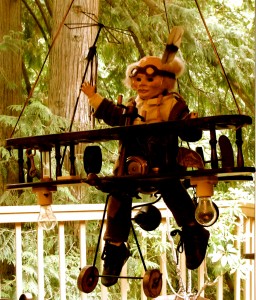
          Aloft Before Drones by Marilynne & Ray

DSC04424

Imagine what it would be like to be walking in center city and suddenly have your space invaded by a swarm of buzzing machines flying within feet of your head. How do you think you would react? Would you be fearful?… swat at them?… want to shoot them down?… or simply stare in awe? A few weeks ago, Superflux, a London design company, planned to introduce the Drone Aviary, ten flying robots, at the Victoria and Albert Museum. Their goal……to emotionally engage the public by getting them to interact with drone technology. Their hope ..… that people will start paying attention to rapid developments in drone engineering presently in use in commercial and military installations. Their desire… to take the flying machines on a world wide tour.

Unfortunately, at the last minute the Drone Aviary had its’ venue cancelled due to safety concerns. This temporary halt in exhibiting, however, does not alter the fact that drones are currently a part of every day life. Over the next few years according to an article published by the American Alliance of Museums, U.S. airspace is expected to have 30,000 civilian and commercial drones flying overhead and the UK and Europe are not far behind.

Celebrities such as Martha Stuart and Jeff Bezos are seeing drones as welcome advances to their retail operations, delivering packages efficiently, thus bypassing mail systems. As drones roam the sky collecting data or delivering items for companies like Amazon, with their proposed Prime Air delivery service, and Google with Project Wing, you and I are going to be faced with an army of flying robots invading our personal space. When I imagine packages flying up and down my quiet neighborhood street, it is not an appealing thought. I would love to know your opinion.

I realize that some of this technology may be good. Robobird drones from Clear Flight Solutions are employed to chase birds away from airport danger. I was fascinated at a trade show when I watched these radio controlled birds of prey fly so realistically through the air. Flapping their wings they move like a Peregrine Falcon and are able to chase undesirable flocks away from airplane engines. Robobird is also used to disperse nuisance flocks from areas such as landfills and from vineyards when grapes are heavy on the vine and birds come to feast.

This robotic revolution is happening now and is not some future science fiction occurrence. Drone kits can be purchased for under $100 in local electronic shops was well as from on-line retailers, putting them within reach of ordinary people. A series of Parrot Mini Drones, are a new line of flying toys. Jumping Sumo can pop up to table height or back to the floor, moving light objects out of its way with ease. Rolling Spider is an ultra-compact flyer that can take to the air or return to earth to travel on its large wheels and Bebop, a flying drone, follows large complex designs drawn on land.

The smallest commercial RC drone, a Nano quad Copter only 45 mm square, rivals the army’s Spy Cam Drone resembling a tiny flying insect. Weighing only 15 grams, Spy Cam costs tens of thousands of dollars and is used much like binoculars to scope out potential threats in military situations. The air force has introduced Bugbot Nano Drone Technology, and to my unsophisticated eye, it seems even more dangerous. Looking like a flying bug with wings, it can provide biological and chemical information to its handler and is being promoted by the military as a future lethal war fighter.

Controversy and fear surrounding military and spy drones is just starting to become intense among civilians who in the past have not given much consideration to this technological phenomenon. Few people think about the computer gaming kids who as young adults are hired to manipulate tiny devices from distant locations. These youth control weapons that go undetected yet cause incredible damage to innocent people near their military targets. According to ABC news on September 29th, though not in harms way, drone operators are subject to sone of the same emotional strain that ground forces face.

I was pleased to learn that museums are taking a leadership position by bringing the drone controversy before the public. I happen to be very curious about this robotic technology and wonder how it will affect my family’s future. In the meantime, while we wait for the exhibit, if you want to see beer being delivered by a drone go to YouTube and type in Lakemaid Beer Drone Delivery. The Air Force Bugbot Nano Drone, also on YouTube, gives an idea of how these aerial devices work for the military.

w3xyjdyvospvue947huh Robodrone – photo by Clear Flight Solutions.

A 2013 FAA report from the National Wildlife Strike. Database says the number of bird strikes by planes has gone from 1,851 incidents in 1990 to 11,315 in 2013. Globally more than 255 people have died and 243 aircraft destroyed . 66% percent occur during daylight hours.

For more information about the drones mentioned go to:
http://www.parrot.com . Parrot Mini Drones

http://www.clearflightsolutions.com – About Robo Drones
.
http://www.multibriefs.com/briefs/aam/AAM092514.php – American Alliance of Museums – About Superflux

http://www.rferl.org/content/drones_who_makes_them_and_who_has_them/24469168.html- about Military drones.

http://www.youtube.com/watch?v=z78mgfKprdg : Bugbot military drone

https://www.google.com/?gws_rd=ssl#q=lakemaid+beer+drone : Lakemaid Beer Drone

http://whatis.techtarget.com/definition/Amazon-Prime-Air-drone : Amazon’s Drone