Tapped out & Running Low

Data collected by NASA’s Gravity Recovery and Climate Experiment, published last week in the journal Science Advances, reveals a sobering trend. Scientists investigated the impact of groundwater loss on global water availability. What they found is alarming: fresh water has been disappearing at an accelerating rate for years, and the drying of Earth is speeding up dramatically.

Nearly six billion people—three-quarters of humanity—live in the 101 countries identified in the study as facing a net decline in water supply. This portends enormous challenges for food production and increases the risk of conflict and political instability.

Their research confirms what we already see on the news daily: droughts and extreme precipitation are growing more intense. Although parts of the planet are becoming wetter, those areas are shrinking, while dry zones are expanding. The study—which excludes the ice sheets of Antarctica and Greenland—concludes that “Earth is suffering a pandemic of continental drying in lower latitudes.”

As the climate warms and vast swaths of land dry rapidly, humanity’s supply of fresh water is under serious threat. In the far northern Arctic regions, the loss stems from melting glaciers and drying subarctic lakes. But in southern, more densely populated regions, the primary cause is the overextraction of groundwater from aquifers, faster than nature can replenish them. Unregulated pumping by farmers, cities, and corporations accounts for a staggering 68% of total freshwater loss in areas without glaciers.

Seventy percent of the world’s fresh water is used for agriculture. As droughts intensify, more of that water comes from underground reserves. Yet only a small portion of it seeps back into aquifers. Most of the water runs off into rivers and streams, eventually reaching the oceans, where it becomes undrinkable salt water. That water can only be recovered through industrial desalination or if it returns as rainfall. But due to climate change, many of these same drying regions are receiving less and less rain.

Across the globe, regions are already suffering severe water scarcity, with devastating consequences for communities, ecosystems, and economies. In India, particularly in states like Maharashtra and Rajasthan, extracting groundwater for agriculture has caused wells to run dry, forcing entire villages to rely on water tankers. In the Middle East, countries like Jordan and Yemen face chronic shortages, with per capita water availability far below the threshold for scarcity.

California’s Central Valley, one of the world’s most productive agricultural regions, has seen groundwater levels plunge due to prolonged drought and excessive pumping. Sub-Saharan Africa faces a growing crisis as erratic rainfall and high temperatures reduce the reliability of both surface and underground water sources, fueling migration and conflict. In parts of Chile and Peru, copper mining and industrial agriculture have drained aquifers, leaving Indigenous communities without reliable access to clean water. These hotspots are not isolated—they are early warnings of a global crisis that is fast becoming unmanageable.

Wake up, America. Enough with the silence. Enough with pretending that climate change isn’t affecting our daily lives. Water loss is already a major driver of poverty, displacement, and desperation. As we’ve seen in Gaza and elsewhere, water scarcity has even become a weapon of war.

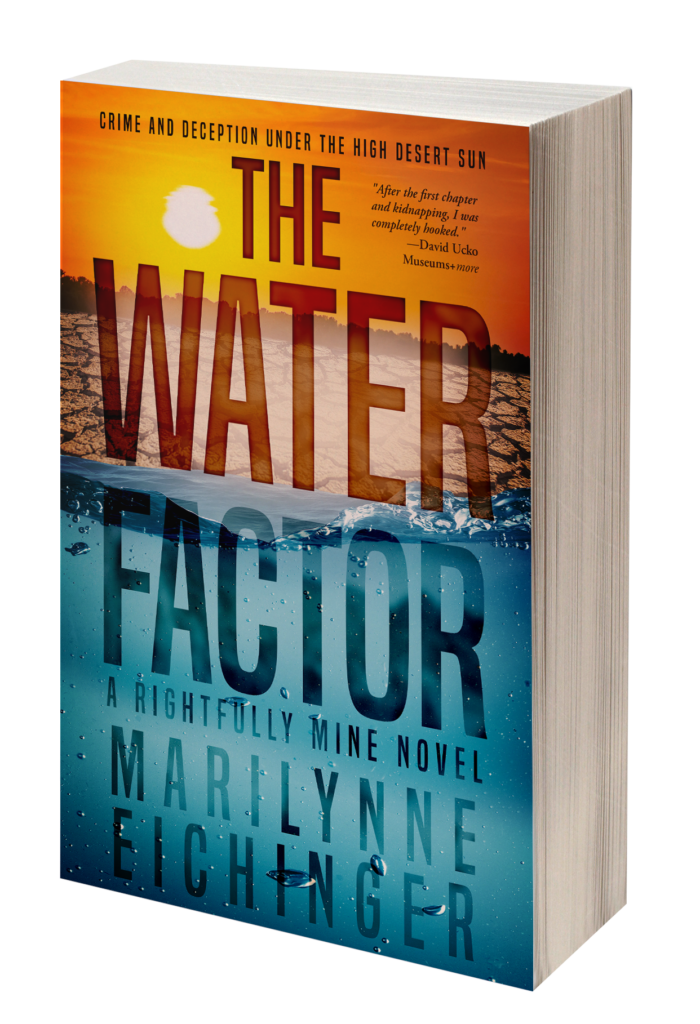
If you’re not inclined to read scientific papers, read The Water Factor instead. It’s a novel with twists and turns that will keep you on the edge of your seat, while also opening your eyes to the global water crisis.
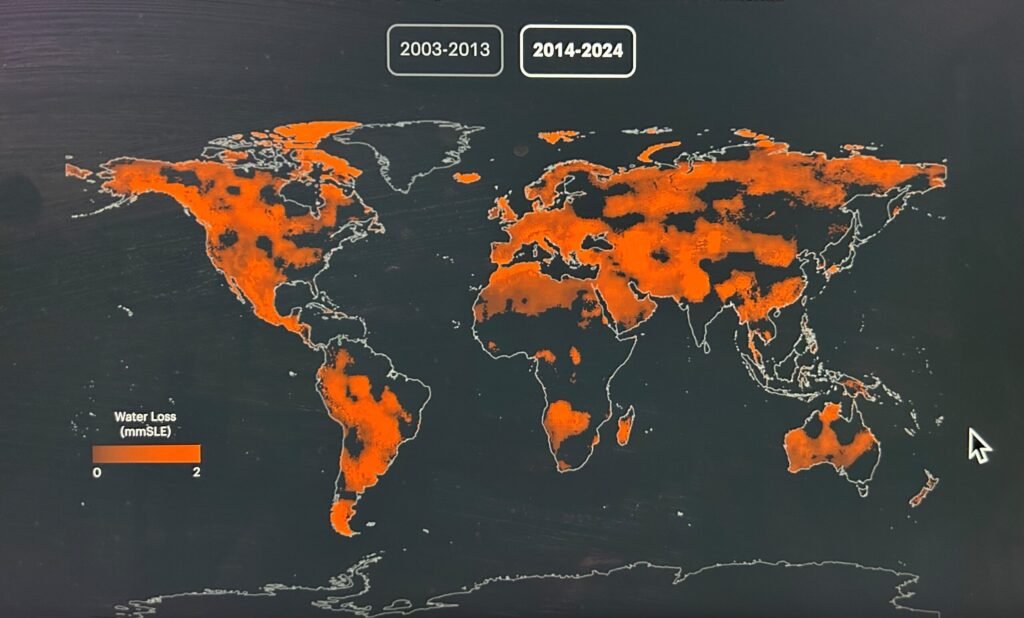
                                                        Water Depletion Worldwide

Resources:

 Buechner, (Lack of Safe Water Far Deadlier than Violence. UNICEF report. Retrieved from https://www.unicefusa.org/stories/unicef-report-lack-safe-water-far-deadlier-violence?gclsrc=aw.ds&gad_source=5&gad_campaignid=22789033677&gclid=EAIaIQobChMIhsCaiNvsjgMVrSGtBh0uwjevEAAYASAAEgLEY_D_BwE

Website US News. (2023) Countries with the Worst Drinking Water. UNICEF report. Retrieved from: https://www.usnews.com/news/best-countries/slideshows/countries-with-the-worst-water-supply

Website,2025.They Drying Planet. ProPublica. Retrieved from PLANET

__________________

Art is always for sale at www.eichingerfineart.com

Start the conversation. Please comment on my blog site. Sign up for my mailing list if you have not already done so. ______________________________________________________________________________

 According to the UN, water is at the center of the climate crisis. THE WATER FACTOR, A RIGHTFULLY MINE NOVEL, is your chance to peer into the near future to a time of water scarcity controls by corporate criminals.  The story is a gripping tale of water scarcity and corporate wrongdoing. The Water Factor is a Firebird International Award winner for best dystopian novel and a Literary Titan recipient for best thriller.  It is available in ebook, paperback, and audio formats. It can be purchased on AMAZON, Barnes and Noble, and as an audiobook on Amazon, Audible, and iTunes. Locally, it can be purchased at Annie Bloom’s Books and Powell’s Books.  
 

The Air Shouldn’t Require Purifiers

The Air Shouldn’t Require Purifiers

When people hear the phrase human rights, they often picture courtrooms, war zones, and political speeches. But human rights aren’t abstract. They’re practical, personal, and of everyday concern. Britannica defines human rights as rights that belong to an individual simply by virtue of being human. The United Nations took it further in the Universal Declaration of Human Rights, recognizing the “equal and inalienable rights of all members of the human family” as the foundation of freedom, justice, and peace.

It’s a powerful statement. But here’s the question that haunts me: What happens when someone’s profit depends on your rights being violated? The answer lies in the details where the struggles of real-world human rights live. The first book in the Rightfully Mine series, The Water Factor, explores whether water, an essential of life, should be treated as a human right or as a commodity, bottled and traded on Wall Street.

In the newly released novel Antheia in the Thorns, the focus shifts to something we rarely think about until it’s taken from us–the air we breathe. In the novel, anthropologist-turned-housewife, Jennifer Russo, and an Antheia activist, Brian Adakai, fight a toxic threat most people have never heard of: Petroleum coke (petcoke)–a dirty byproduct of oil refining. Though rarely used in the U.S., petcoke often replaces coal in energy plants because it’s cheaper to produce and burns at a higher BTU. It’s also more polluting. Petcoke is shipped around the world, where it’s stored in dusty piles that affect air quality. U.S. refineries are the largest producers of petcoke, yet it is treated by Congress as someone else’s problem.

The damage doesn’t show up on corporate balance sheets. It shows up in smog and in people with asthma, allergies, chronic coughs, and in children who can’t run without wheezing or fall into ash piles to die while playing. It devastates communities that don’t have the political power to stop it. That is why petcoke isn’t just an environmental issue. It’s a human rights issue.

If the right to life means anything, shouldn’t it include the right to breathe air that won’t harm you? If freedom means anything, doesn’t it include freedom from pollution you never consented to? And if justice means anything, doesn’t it require environmental laws so corporations can’t hide behind loopholes and legal intimidation? Weakening the EPA and FDA is a travesty we shouldn’t allow.

In Antheia in the Thorns, Jennifer and Brian aren’t fighting a vague evil. They’re fighting against people with names. Oil entrepreneur Abdul Hammed Dillinger has built an empire on profit-first thinking. He has a legal shield in his attorneys, Amy Stuart and her lover, Jennifer’s husband, Jason Russo. They don’t need to win on truth. They only need to win by exhausting their opponents. To do so, they delay, threaten, and bury their opposition in paperwork. They manipulate the system until those fighting back are broke, discredited, or afraid.

This is how human rights are defeated in the modern world. It’s not always with violence, but more often with strategy. And that’s why I wrote this book. Because beneath the legal maneuvering and corporate shields is something more intimate: betrayal, grief, and the moment a woman realizes she has nothing more to lose. Jennifer isn’t a superhero. She’s a wife, a mother, a woman who trusted the wrong people. But when the air itself becomes dangerous, she discovers that courage isn’t about strength. It’s about the refusal to be silenced. “No! Our lungs are not negotiable.”

If you believe clean air shouldn’t require a purifier, if you’ve ever felt outmatched by systems designed to wear people down, if you’ve ever wondered what it takes to stand up when standing up costs everything, then this story is for you.

The ebook and paperback versions of Antheia in the Thorns are currently on Amazon at an introductory price. An audiobook will follow in a few months. If you decide to delve into the story, an honest review helps more than most people realize. It’s the most powerful way to help the truth reach new readers.

_________________________________________________________________

Art can be purchased on my website and shipped free throughout the continental U.S. Contact me at marilynne@eichingerfineart.com with questions.

The World Transformed Keeps its Heart

What is life?

Seventy-one percent of the Earth is covered in water, a substance that takes many forms without ever ceasing to be itself. When heated, it becomes steam; when frozen, it expands and hardens as ice. It falls as snow that children pack into snowmen, then melts and runs into rivers where fish, amphibians, and waterfowl make their homes. It rains onto fields, sinking into soil, nourishing seeds that become food for you and me.

Yet for all its abundance, very little of Earth’s water is available to us. Most freshwater is locked away in glaciers and ice caps. What remains in rivers, lakes, and accessible groundwater is a narrow margin upon which all terrestrial life depends. Water is generous, but it is not infinite.

The human body is a fragile vessel, flesh framed by bone,  holding water that makes up more than half of what we are. It carries oxygen and nutrients, regulates body temperature, and allows cells to communicate. When we die, that water does not vanish. It returns to the earth, moving into soil, plants, air, and other bodies. No matter how many times it transforms or mingles with other fluids, it does not disappear. It remains water.

This is life itself.

We are born, and we spend our days responding to pressures: loss, love, labor, illness, and joy. Each experience reshapes us, just as water reshapes stone into something inspiring or forgettable.  We move forward one step at a time, intersecting with others who are following their own paths. Sometimes those paths converge. A handful moving in the same direction becomes a stream, a stream becomes a current, and occasionally thousands move together, forming something powerful enough to alter the course of history.

Yet when we step back and look at history from a distance, there are familiar patterns. Empires rise and fall. Technologies change. Ideologies replace one another. What endures beneath it all is the same living system, still dependent on water that cycles endlessly through land, air, and body. Progress does not erase that dependency. It only disguises it.

Our mistake is believing that our actions evaporate and that what we take, pollute, or discard simply goes away. But nothing does. Like water, it changes state. Toxins settle into soil and bloodstreams. Carbon lingers in the atmosphere, trapping heat. Decisions made for convenience today resurface as a crisis tomorrow. We are not separate from the world we alter; we are one of its phases.

A single drop seems insignificant. So does a single life, or a single choice. But drops gather. They find low places. Over time, they carve valleys that create Grand Canyons. Movements are watersheds, formed by countless lives shaped by pressure and guided, consciously or not, toward a common direction.

A better future does not depend on conquering nature or outgrowing it. It depends on remembering what never retreats. How we care for water, how we care for the Earth, determines what kind of world our transformations will leave behind.

One day, the water that makes up our bodies will move on without us. It will pass through roots, clouds, rivers, and mouths we will never know. Long after our names fade, that water will still carry the imprint of how it was treated while it passed through our hands. The world will remain. 

The question is what condition we leave it in as we move through it.

_______________________________________________________________________________________

Art is always for sale. Surf’s Up can be purchased through my website at https://www.eichingerfineart.com/workszoom/2277455/surfs-up#/ and shipped to you at no cost in the continental U.S.

I look forward to your comments in English.

Companies worldwide are engaged in a high-stakes poker game around access to clean water. The Water Factor will open your mind and make you ask questions. Available in ebook, paperback, and audio formats. It can be purchased on AMAZONBarnes and Noble, and as an audiobook on Amazon, Audible, and iTunes. Invite me to tune into your book club discussion.  

Antheia in the Thorns, the second eco-thriller in the Rightfully Mine Series, has a February 20th launch date. I hope you will help me launch sales in style. More information will be shared over the following weeks.

Countdown to publishing

Part of writing a book is finding the right title and cover design, and Antheia in the Thorns, going on sale at the end of February, is no exception. Its early working title was The Cave, but after discovering dozens of books with the same name, I set out to find something more distinctive.

That search led me to Antheia, the Greek goddess of gardens and love. Imagining her caught in thorns felt like the perfect metaphor for an approaching environmental reckoning. Does it make you wonder what happened?

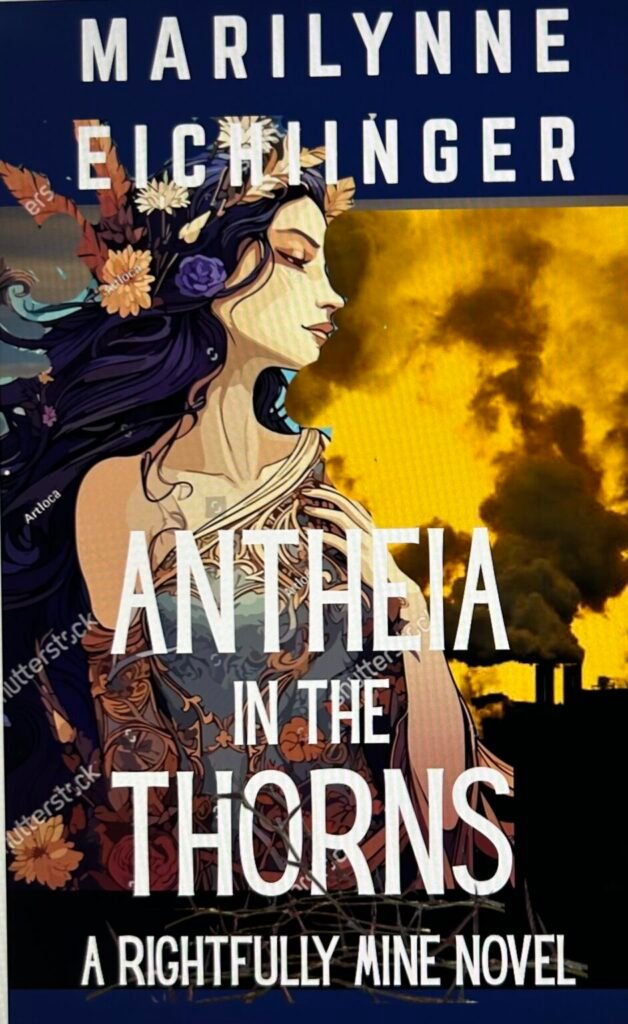
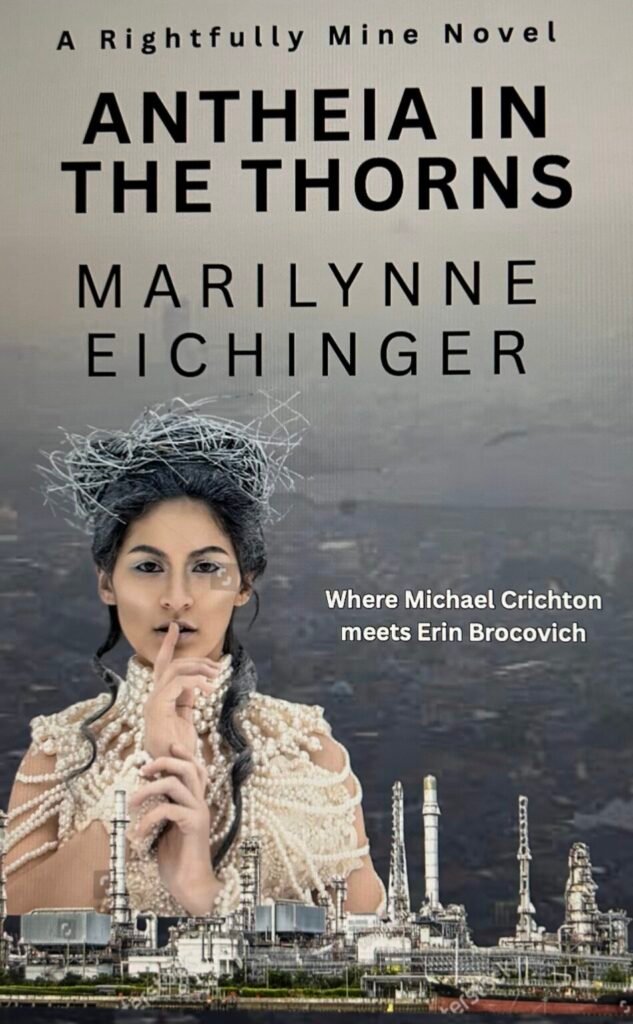
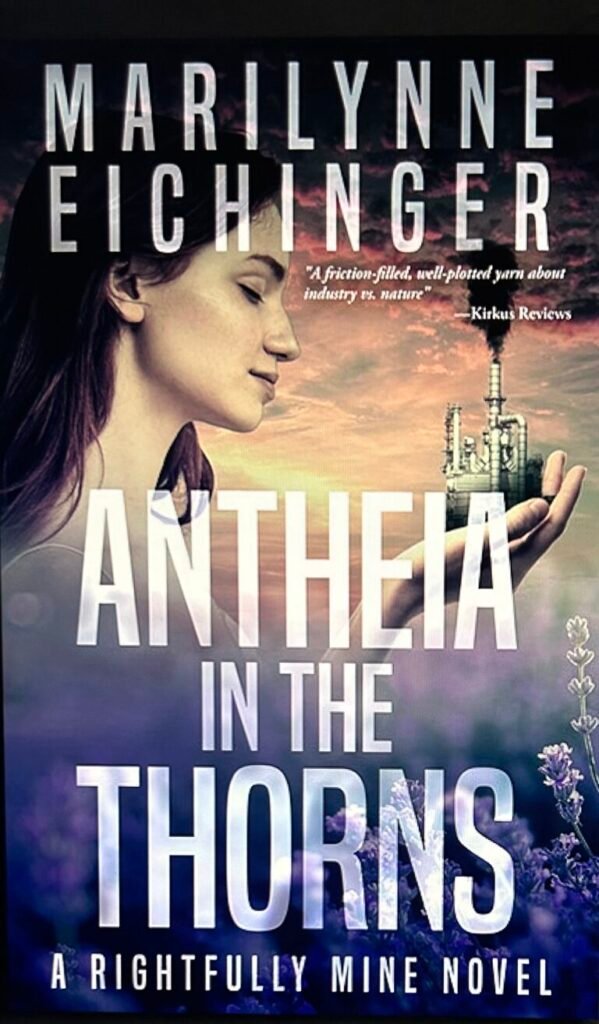
Below are four early cover designs that didn’t make the cut. The final design, created by Streetlight Graphics, will be unveiled next week. Between now and February 22, I hope to whet your appetite for the story behind the thorns.

A Scene Behind Antheia in the Thorns:When I began writing Antheia in the Thorns, I didn’t start with a thesis. I started with a scene.

In the chapter titled “Dying Embers,” the protagonist, Bear Stanton, sits on a curb in the early morning hours, watching smoke rise from what had once been Antheia’s headquarters. Firefighters are packing up their hoses. Reporters circle, microphones extended, eager for outrage or accusation. Somewhere inside the charred building are lost hard drives, children’s artwork, handwritten notes from tribal elders—things that will never make the news crawl.

What struck me as I wrote that scene wasn’t the fire itself, but the silence afterward. The way catastrophe becomes ordinary once the cameras leave. The way destruction is framed as spectacle rather than consequence.

That moment on the curb is fictional, but its emotional truth is not.

As I mentioned in my previous post,  I watched a NOVA program detailing how warming temperatures are destabilizing the Arctic, releasing methane, sinking cities, and accelerating flooding across the globe. These aren’t distant projections or worst-case scenarios. They are unfolding now, quietly, incrementally, often out of sight. When disaster doesn’t arrive with a single dramatic explosion, it’s easier to ignore.

In Antheia in the Thorns, the fire is not just an act of violence—it’s a message. It’s meant to intimidate, to erase evidence, to remind ordinary people how fragile their work is when it challenges powerful interests. That dynamic plays out repeatedly in real life, whether through lawsuits, regulatory pressure, misinformation campaigns, or the slow erosion of public trust in science.

Fiction allows me to place a human face on those forces. To show what it feels like to lose not only a building, but a sense of safety. To ask what happens when the cost of telling the truth becomes personal—and whether it’s still worth paying.

I don’t expect novels to change the world on their own. But I do believe stories can slow us down long enough to feel what headlines encourage us to skim past. If Antheia in the Thorns does anything, I hope it helps readers connect the data we’re shown every day to the lives quietly affected by it—and to the choices still within our control.

Sometimes, the most dangerous fires aren’t the ones that burn buildings, but the ones we pretend not to see.

The Water Factor, the first book in the Rightfully Mine Series, questions whether water should be considered a commodity, as it is now, or a human right. Antheia in the Thorns raises a similar question about air quality. The novel is available in ebook, paperback, and audio formats. It can be purchased on AMAZON, Barnes and Noble, and as an audiobook on Amazon, Audible, and iTunes.

Writing a book is a drawn-out process that includes searching for the right title and cover design. The following discusses a few of my blips on the way to releasing Antheia In The Thorns by February 22. https://www.eichingerfineart.com/blog/204684/countdown-to-publishing I hope you will help spread the word when it is released.

Countdown to Publishing

Part of writing a book is finding the right title and cover design, and Antheia in the Thorns, going on sale at the end of February, is no exception. Its early working title was The Cave, but after discovering dozens of books with the same name, I set out to find something more distinctive.

That search led me to Antheia, the Greek goddess of gardens and love. Imagining her caught in thorns felt like the perfect metaphor for an approaching environmental reckoning. Does it make you wonder what happened?

Below are four early cover designs that didn’t make the cut. The final design, created by Streetlight Graphics, will be unveiled next week. Between now and February 22, I hope to whet your appetite for the story behind the thorns.

A Scene Behind Antheia in the Thorns:When I began writing Antheia in the Thorns, I didn’t start with a thesis. I started with a scene.

In the chapter titled “Dying Embers,” the protagonist, Bear Stanton, sits on a curb in the early morning hours, watching smoke rise from what had once been Antheia’s headquarters. Firefighters are packing up their hoses. Reporters circle, microphones extended, eager for outrage or accusation. Somewhere inside the charred building are lost hard drives, children’s artwork, handwritten notes from tribal elders—things that will never make the news crawl.

What struck me as I wrote that scene wasn’t the fire itself, but the silence afterward. The way catastrophe becomes ordinary once the cameras leave. The way destruction is framed as spectacle rather than consequence.

That moment on the curb is fictional, but its emotional truth is not.

As I mentioned in my previous post,  I watched a NOVA program detailing how warming temperatures are destabilizing the Arctic, releasing methane, sinking cities, and accelerating flooding across the globe. These aren’t distant projections or worst-case scenarios. They are unfolding now, quietly, incrementally, often out of sight. When disaster doesn’t arrive with a single dramatic explosion, it’s easier to ignore.

In Antheia in the Thorns, the fire is not just an act of violence—it’s a message. It’s meant to intimidate, to erase evidence, to remind ordinary people how fragile their work is when it challenges powerful interests. That dynamic plays out repeatedly in real life, whether through lawsuits, regulatory pressure, misinformation campaigns, or the slow erosion of public trust in science.

Fiction allows me to place a human face on those forces. To show what it feels like to lose not only a building, but a sense of safety. To ask what happens when the cost of telling the truth becomes personal—and whether it’s still worth paying.

I don’t expect novels to change the world on their own. But I do believe stories can slow us down long enough to feel what headlines encourage us to skim past. If Antheia in the Thorns does anything, I hope it helps readers connect the data we’re shown every day to the lives quietly affected by it—and to the choices still within our control.

Sometimes, the most dangerous fires aren’t the ones that burn buildings, but the ones we pretend not to see.

The Water Factor, the first book in the Rightfully Mine Series, questions whether water should be considered a commodity, as it is now, or a human right. Antheia in the Thorns raises a similar question about air quality. The novel is available in ebook, paperback, and audio formats. It can be purchased on AMAZON, Barnes and Noble, and as an audiobook on Amazon, Audible, and iTunes.

Writing a book is a drawn-out process that includes searching for the right title and cover design. The following discusses a few of my blips on the way to releasing Antheia In The Thorns by February 22. https://www.eichingerfineart.com/blog/204684/countdown-to-publishing I hope you will help spread the word when it is released.

Sanity in an Era of Upheaval

WaterFactor 3D ALT ANGLE Bookcover Transparent Background

THE WATER FACTOR, A RIGHTFULLY MINE NOVEL, lets you peer into the near future to a time of water scarcity controls by corporate criminals.  The story is a gripping tale of water scarcity and corporate wrongdoing. The Water Factor is a Firebird International Award winner for best dystopian novel and a Literary Titan recipient for best thriller.  It is available in ebook, paperback, and audio formats. It can be purchased on AMAZON, Barnes and Noble, and as an audiobook on Amazon, Audible, and iTunes. Ask your bookstore to order a copy from Ingram. Please leave a review. 

She will enter the workforce wide-eyed and ready to give her all. What will she get in return?

Whatever happened to loyalty?

Wharton Business School aptly dubs the decline of loyalty, ’Shock and Awe for American Workers.’ There was a time when business owners didn’t escort employees out with a guard minutes after delivering news of their dismissal. If laid off for economic reasons, you would be rehired as soon as the economy bounced back. A symbiotic relationship fostered a social contract between management and workers. Skilled laborers who remained faithful to employers throughout their working years earned a decent wage and a pension in return for their hard work.

These fortunate people came of age after World War II when the collective mindset of ‘we’ was crucial to winning the war and dominating world trade. Job hopping was considered a taboo practice and a red flag for recruiters. Businesses encouraged employees to build lifelong relationships.

When you converse with a young worker today, you’ll notice their mindset is different. It primarily focuses on ‘I” rather than the collective. Youth prioritize individual rights, giving less thought to the broader society. They are engaged in a workforce that has doubled since 1970 because it now takes two earners to support a family, and older adults remain in the workforce longer. The shift in mindset had its seeds in the 1970s when economic issues led to widespread downsizing, forcing workers to compete for scarce job opportunities. It was a pivotal time, leading to a breakdown in the relationship between employees and employers. The result was reduced salaries, retirement benefits, healthcare, and other perks.

The rise in automation, technology, and globalization, coupled with the decline of unions, bolstered corporate power. In the new landscape, stockholders began to take precedence over other stakeholders, including customers and workers. The downsizing wave of the ‘70s escalated in the 1980s and 90s, with employers showing little interest in rehiring when the economy rebounded.

In today’s economy, new hires hesitate to commit themselves to a company, fearing the potential hurt it will cause when let go. They constantly  worry that each day might be their last and receive low salaries and minimal benefits under incompetent leaders who don’t recognize their accomplishments. Unsurprisingly, the American workforce is on the move, seeking greater flexibility in work schedules, more caring managers, and a better work-life balance.

The average number of jobs an individual has during their lifetime has skyrocketed to twelve, with twenty-nine percent changing fields completely. The change in the work environment since 1950 is dramatic. American workers are older, better educated, and more diverse in race and gender. Employment opportunities shifted to higher-skilled occupations, making it difficult for those with lower levels of education to find jobs. A staggering thirty-nine percent of college students are over twenty-five, further highlighting the instability in the job market and the search for meaning in work. When younger workers change careers, they look for more than a pay raise. They seek jobs that benefit the world, such as dealing with environmental concerns, healthcare, or helping underprivileged communities.

I worry about my grandchildren and whether they feel valued and if they will live fulfilling lives. Will they find challenges that will help them grow? Do they think their employment is worthwhile, and can they see how it fits into the fabric of human endeavors? Is their job stable enough to purchase and maintain a car and home without fear of losing them? And, will their salaries allow them to save enough to retire comfortably?

As shareholders pour money into AI, Robotics, and other advanced technologies, they should consider how the typical worker will manage in a world that doesn’t need them. Will it lead to more people without jobs living on the streets, and who will support them?

As a consumer, I wonder how long it will take before customers rebel at messages like,”We are experiencing a longer than usual wait time; go to our website for answers.” I am tired of being told to dial one for new service, two for parts, three for hours of operation, until ten when I’m directed to go online and talk to a chat operator. When fortunate enough to speak to a human being after waiting a half hour. In that case, the voice is heavily accented, incomprehensible, or the person doesn’t know the answer to my question.

How dehumanizing can businesses get? These practices certainly aren’t a way to retain a loyal customer, yet workers and consumers let it happen and accept impersonal treatment in the workplace and while shopping. Is more of this all we have to look forward to in a future with AI, or is it time to speak up and put an end to it?

________________________

Art is always for sale. Ellen: Wide Eyed and Ready is an acrylic on canvas painting, 20” x 16” x 2”,  Available for $ 495, includes shipping in the continental U.S. Purchase on my website or contact me at marilynne@eichingerfineart.com

Please share your experience about workplace loyalty in the comment area below.

WaterFactor 400x600 1
WaterFactor 400×600 1

In The Water Factor, the protagonist rejects his parents’ advice to study medicine or law. He attends a job fair, where he is convinced that water is the future growth industry,  and access to it will be the most significant issue his generation will confront. When he takes a job as a truck driver, delivering water to rural communities, he sees how far corporations will go to deprive people of a resource that was rightfully theirs. Young graduates would do well to examine the ramifications of the work they sign up to do.

The Water Factor is a Firefly International Award-winning novel in paperback, ebook, and audiobook versions on AMAZON, Barnes and Noble, Audible, and iTunes.


References:

Podcast (2017) The End of Loyalty: Shock and Awe for Many American Workers. Knowledge at Wharton. Retrieved from https://knowledge.wharton.upenn.edu/podcast/knowledge-at-wharton-podcast/the-end-of-loyalty-shock-and-awe-for-many-american-workers/

Website (2024) 17 Remarkable Career Change Statistics to Know. Apollo Technical. Retrieved from https://www.apollotechnical.com/career-change-statistics/

Naranjoy, A. & Vizcaino, J. (2017) Shifting Times: The Evolution of the American Workplace. Federal Reserve Bank of St. Louis. Retrieved from https://www.stlouisfed.org/publications/regional-economist/fourth-quarter-2017/evolution-american-workplace

Website (2024) Employment Trends by Generation: How Often Do People Change Jobs? PeoplePath. Retrieved from https://peoplepath.com/blog/employment-trends-by-generation-how-often-do-people-change-jobs/

Lisa, A. (2019) 60 Ways the Workforce has Changed in 50 Years. Stacker. Retrieved from https://stacker.com/business-economy/50-ways-workforce-has-changed-50-years

Take in a deep inhale and breathe through the static disturbing your peace.

static intermission

When Anger Turns to Hate

My parents taught me anger was a natural emotion in response to being treated poorly, but it was not all right to hate the person who caused you harm. There are times when it is difficult to follow that advice. Anger comes from annoyance, displeasure, or hostility ranging from mild to irritation to rage. It results from pent-up frustrations, feeling wronged, losing control of a situation, or witnessing unjustness.  When it gets exaggerated to the point that it affects judgment, it can turn into hate, creating barriers to healing that lead to further anxiety, restlessness, obsessive thinking, and paranoia. When hostility is directed at you, it is a painful experience. When handled through dialogue, it can be constructive and lead to change.

Hatred arising during periods of crisis, when people feel vulnerable or threatened, creates a desire for control. Negative assumptions learned from friends, family, and the media easily fan the flames of discontent. Hatred-based religion and political ideology, both artificial phenomena, are handy ways to gain power. Their dehumanizing propaganda has psychological and societal impacts that affect both the sender and the receiver. We have only to look at the conflict between Israel and Gaza to see how anger, distrust, and hatred caused thousands to die.

Hatred is unhealthy, impacting the nervous, immune, and endocrine systems. The National Institute for the Clinical Application of Behavioral Medicine reports that it leaves lasting neural imprints similar to the pathways of addiction. It is almost as challenging to rid yourself of excessive anger and hate as it is to overcome a drug, alcohol, or food addiction.

The good thing is that the human brain is changeable and can learn to love rather than hate. A growing amount of evidence points to humans as having a sense of mortality at birth that distinguishes good from evil and right from wrong. With advances in neuroscience, scientists can see that electrical pathways in the brain are constantly being changed by new experiences that affect who we are and what we believe.

There are days when I feel surrounded by angry people. They make me wary and put me on alert. I don’t want to be like them.  André Fenton, a neurobiologist at New York University, agrees that the human brain is a fundamentally changeable system, but unfortunately, the media understands this too. They are good at stirring anger, turning it into hate, and changing the brain. When this happens, reprogramming is not easy, for hatred releases neurotransmitters, producing bursts of energy hateful people become addicted to. 

I saw a sign at a Jewish protest march that said, “Hatred isn’t born, It’s Taught.” The hatred of the Jewish people dates back to the Greco-Roman era. Since then, Jews have become a scapegoat, blamed for Jesus’s death, for kidnapping and murdering Christian children, for spreading the Bubonic Plague, for rigging the economy, controlling the media, and stirring religious discord. For some unknown reason, they are also blamed for an increase in police brutality, gay rights, climate change, and foreign policy decisions they don’t like.

Embedded hatred is difficult to combat. It starts in backyard barbecues, religious services, and schools where children are taught they are more entitled to life than others. It has plagued for decades between the Hutus and Tutsis, the Sunnis and Shiites, the Muslims and Hindus, Christians and Muslims, Communism and Democracy, Native and African Americans and White Nationalists. What a waste of human life and resources! How much suffering such conflicts cause!

Despite this, there is hope for change. Consider Vietnam, where, during the war, a diorama of a Vietnamese village was erected at the Chicago Museum of Science, encouraging children to plan and shoot at the village with guns. Nineteen-year-old military recruits were taught to hate the North Vietnamese and died because of it. After losing and Vietnam was united under Communist rule, the country blossomed, becoming an important trading partner of the United States. Nearly 212,000 American tourists visited Vietnam in 2023.

Along with many friends, I am frustrated. I’m upset when people ignore warnings about global warming, when grocery store personnel are rude, and when my tire hits a pothole. I’m angry that businesses show little loyalty to employees, that youths bury their noses in phone screens, that so many people are homeless, and that drivers are discourteous at four-way stop signs.

Yet, I don’t have the energy, time, or desire to stew in rage. Life is too precious to waste in anger. Instead, I’ve chosen to redirect it to things I can affect after learning how corporations take possession of resources like water, which should be a right. I wrote The Water Factor to call people to action. Many of my predictions are already coming true. Last week’s news reports reported on the plight of Mexico City residents without water, the theft of water trucks, and how thieves break into pipes to siphon off water for personal use. You and I can change humanity if we put our heads and hearts into it.

Please share your thoughts on my blog site at www.eichingerfineart.com/blog

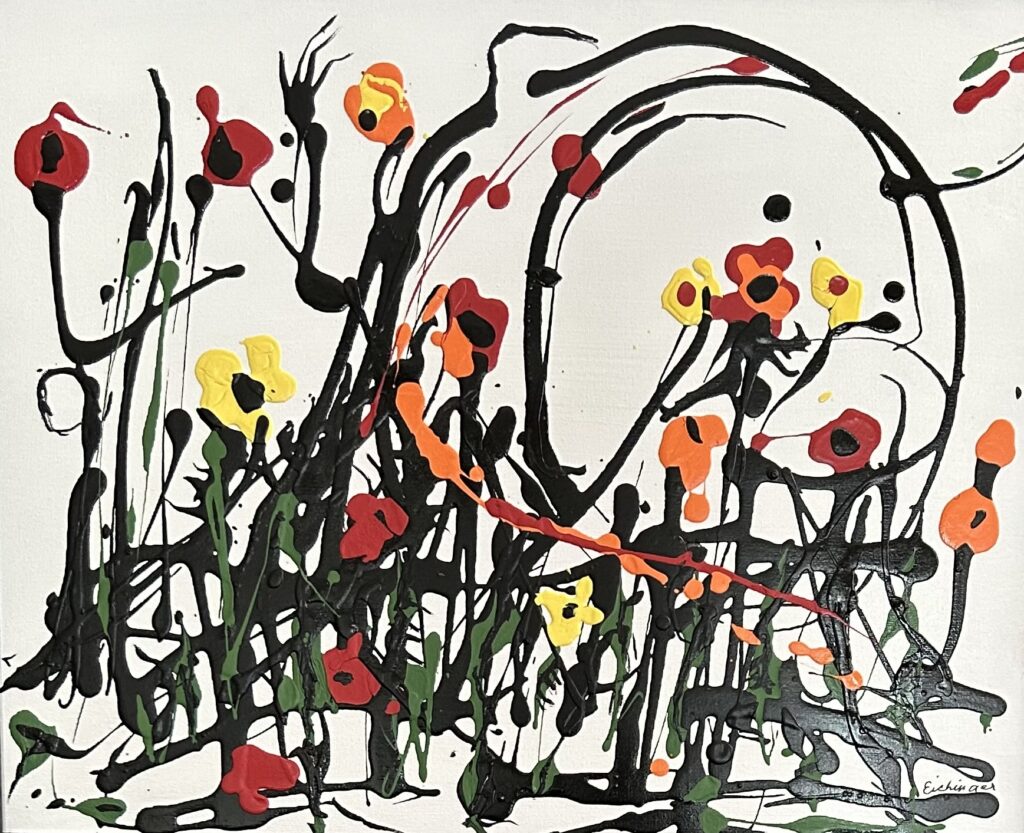
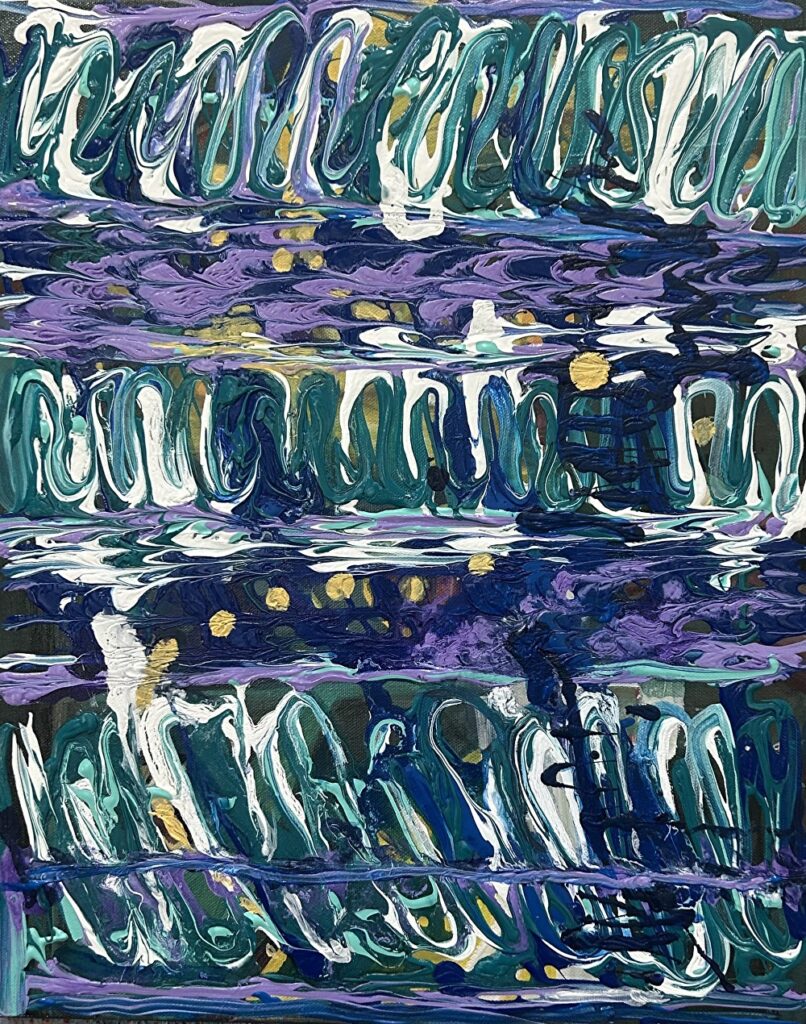
Questions about art? Static Intermission is a 16 “ by 20” painting on thick canvas. It is available for $ 395, including shipping in the continental U.S. For information, contact me at marilynne@eichiungerfinart.com

Add The Water Factor to your summer reading list. Hold your breath with an eco-thriller that will keep you turning pages. You won’t be sorry. Purchase on AMAZON and Barnes and Noble. Look for it in audio format by the end of next week and in bookstores everywhere

References:

Why We Hate: The Biology of Hate Activity. Discovery Education. retrieved from https://www.teachingwithtestimony.com/themes/twt_ui/images/Why-We-Hate-Activity-Biology-Of-Hate.pdf

Lathram, B. 2015. We are Wired to Learn, Change, and Engage: The Brain with Dr. David Eagleman. Getting Smart.Retrieved from https://www.gettingsmart.com/2015/09/23/we-are-wired-to-learn-change-and-engage-the-brain-with-dr-david-eagleman/

Website (2024)10 Tough Questions on Antisemitism Explained. AJC Global Voice. retrieved from https://www.ajc.org/news/10-tough-questions-on-antisemitism-explained

Linehan, M.PhD  &  Porges, S. PhD &McGonigal, K. PhD & O’Hanlon, B. LMFT(2014)How to Work with a Client Who is Hostile and Critical. NICABM.Retrieved from https://www.nicabm.com/program/fb-anger/?del=gad.1034.anger.allext2&network=g&utm_source=google&utm_medium=cpc&utm_campaign=21029941112&ad_group_id

Website (2024) Why do People Hate? MedicineNet. Retrieved from https://www.medicinenet.com/why_do_people_hate/article.htm

When Anger Turns to Hate

Woke Fatigue

I would fall asleep, too, if I had to play Woke games to get elected. The ranting and raving they expose us to are boring, petty, and non-productive.

For many people, rants against Woke slide into a category reserved for closed-minded, intolerant, controlling, and arrogant individuals. If it weren’t for hate-mongers stirring up division, the word would be devoid of emotion and probably relegated to words rarely used. Instead, its usage has become a rallying cry for right and left extremists. 

Woke was first used in the Black community after a 1938 Lead Belly audio recording was released. In Scottsboro Boys, a song telling the story of nine Black teenagers and young men falsely accused of raping two white women in Alabama in 1931, Lead Belly urges listeners to stay woke, a warning to pay attention to social and political injustice by the states and elected officials. In the mid-1900s, progressive Black Americans used Woke in the racial justice movement to refer to someone who was informed, educated, and conscious of social and racial inequality. It wasn’t until 2014, when the Black Lives Matter movement spotlighted police brutality following the police shooting of Michal Brown, that it began being used more often. The word grew in popularity in activist circles spurred by the fatal deaths of Eric Garner, Tamir Rice, George Floyd, and others when it was suddenly co-opted. 

Republican conservatives started labeling liberals with it during the last election, using Wokism as a pejorative term for progressive values. It was popularized byformer President Donald Trump, Florida Gov. Ron DeSantis, and Vivek Ramaswamy, who penned the book “Woke Inc.: Inside Corporate America’s Social Justice Scam. 

According to The Washington Post, the DeSantis administration’s definition of woke is “the belief there are systemic injustices in American society and the need to address them,” an ideology he rejects and fights against.  His anti-woke agenda created the Parental Rights in Education Law to restrict teaching about race, oppression, gender, and sexual orientation in the classroom. The Stop WOKE Act went further, eliminating content in college and high school courses that led to discussions around systems of oppression. DeSantis banned spending on diversity, equity, and inclusion programs from public college campuses. Hundreds of conservative-led efforts across the country have followed his lead.

Because Wokewas associated withBlack people, the word became a club used by white supremacists to batter those who embrace liberal ideology. Democrats view such people as bullies who destroy lives to leverage a cruel agenda. Wokism has been compared to the Inquisition, The Salem Witch Trials, and McCarthyism. A difference from those events is that it is heard on both sides of the political aisle, fueling media-driven hatred of both Donald Trump and Joe Biden.

On the left, Wokism prompted defunding the police laws that resulted in a record number of murders and violent crimes. Without fear of arrest or incarceration, criminals were emboldened to rob, assault, and kill innocent people. On the right, cruelty came to the forefront through racism that indoctrinates black children in schools, teaching them they are innately inferior due to the color of their skin. 

The fight for equity in college admissions at top institutions pits poor white and Asian students with excellent grades and test scores against Black and Hispanic students with lower grades. Environmentalists clamoring to raise gas and oil prices to lower carbon emissions hurt those experiencing poverty with no other option. For Americans who rely on government health clinics and state entitlements, the influx of illegal immigrants is a tremendous problem, burdening health care delivery. 

Social problems are complex and can’t be narrowed down to catchy phrases. They raise moral, economic, and social issues that need to be addressed by rational individuals who don’t throw barbs. Woke agitates and divides people instead of pulling them together. It keeps us from solving problems with compassion, equality, morality, and all the ethical things we were taught to embrace as children, by having us play a rigged game of wealth and power that creates permanent victims. It emphasizes identity politics over social class and ideology and reduces complex issues to simplistic narratives that make people afraid to express opinions for fear of misinterpretation. 

I don’t believe I’m the only one with Woke fatigue and its partisan and ideological rhetoric that threatens stability and harmony. We need to reframe social issues and eliminate vitriolic words and simplistic phrases so problems will be considered from a broad perspective. The Water Factor, the first novel in my Rightfully Mine series, explores environmental issues from various perspectives, asking readers to consider an age-old question, whether the earth’s reserves should be used for individual profit or the common good. As the world’s population increases and natural resources are stretched thin, we must reexamine what constitutes a civil society to avoid bloodshed.

References;

Alfonseca, K. (2024) What does ‘woke’ mean, and why are some conservatives using it?ABC News. Retrieved from https://abcnews.go.com/Politics/woke-conservatives/story?id=93051138

Hanson, V. (2022) Wokism is a Cruel and Dangerous  Cult. Independent Institute. |Retrieved from https://www.independent.org/news/article.asp?id=13968&gad_source=1&gclid=CjwKCAjw1K-

Matter of Opinion podcast (2023) The Woke Burnout Is Real—And Politics is Catching Up. New York Times. Retrieved from https://www.nytimes.com/2023/09/07/opinion/woke-culture-wars-schools.html?

Neiman. S. (2023) The Fatal Tension at the Heart of Wokeism. Time Magazine. Retrieved from https://time.com/6290367/susan-neiman-tension-at-the-heart-of-wokeism/

Please share your thoughts about Woke Fatigue below.

Questions about art? Contact me at marilynne@eichiungerfinart.com

Add The Water Factor to your summer reading list. It is an eco-thriller about corporate crime that will keep you turning pages.

Purchase The Water Factor today. You won’t be sorry! On AMAZON

or Barnes and Noble. Soon to be in audio format and in bookstores everywhere.