Soaring above the Crowd

DSC05258Soaring above the Crowd

It wasn’t until I was in my mid-fifties that I could fly freely. One by one my five children had left the nest and though I did miss them I also enjoyed being free from the responsibilities of parenthood. Days of carpooling and worry about college applications being submitted on time were left behind. I understood howimportant it was to balance work with play and especially looked forward to the play part.

And so I started a new business publishing the Museum Tour Catalog and looked forward to utilizing the knowledge gained from running two museums. Not worried about supporting anyone but myself, I was open to failing or succeeding through my own wits and effort. It was a terrifying, exciting time filled with opportunities in a field that was new to me. I loved every minute of every day even when balancing the budget became difficult. Annual buying trips to China, evaluating hundreds of educational toys, working with talented people and brainstorming w
ays to improve service were challenging and stimulating activities. I lived in the flow at the the top of my abilities , sailing through highs and lows with relative equanimity.

One year our company decided to promote the catalog on a billboard in Times Square. Flashing lights bearing our logo moved across a sign located adjacent to the Toys”R”Us store. I must have gone out of my way a hundred times during a February visit in order to stand and stare at the crowds as they passed under the bil2077484xllboard. My wings were spread and I was flying high.
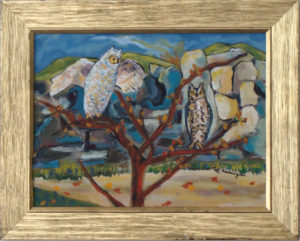
That remembrance returned as I watched a newly hatched Great Horned Owl extending its wings for the fi
rst time. He (or she) was a puffball, looking twice its size while covered in soft white down. Periodically the fledgling shifted, testing his stance while Mom sat stoically on a rock nearby and Dad perched unmoving on an overhead wire. They were waiting for evening to supply food for their chick that demanded ten feedings a day. Owls are patient parents and excellent hunters that often go after prey that is too large for them to swallow. Using their strong beaks and talons they tear off pieces that can be swallowed by their young. Tasty morsels of rabbits, squirrels, snakes, possums and fish augment their diet.

It takes about 9-10 weeks before a hatched chick learns to fly and a bit longer to learn hunting techniques. For another two weeks nurturing continues continues before their offspring is left to fend for themselves. The owl family often stays in the same vicinity over the summer but by fall they disperse to live solitary lives until the next mating season. Each night they can be heard hooting and their shadows observed soaring through the sky as they dive silently for food. You’ve heard them,haven’t you? “hoo-hoo hoooooo hoo-hoo?” I love the sound.

It is now graduation season and my granddaughter, Sanna, is among the thousands of youth nationwide marking the end of childhood and moving on to embrace new experiences. Her parents provided a secure childhood and equipped her with wings to to survive in the adult world. As she arranges to move out of her home, I sit back and contemplate where her flight will take her.

I also think of the freedom my daughter will have when all three children leave home. Her wings have been clipped for a great many years. Will she embrace opportunity or be bothered by an empty house?

Psychology Today describes parenting as a long-term investment. “Be prepared to put far more into it than you get out of it, at least for some time.” they say. Because of the stress of American culture, their happiness factor decreases the minute they become parents. “And it gets worse before it gets better.” Happily, in the long run, parenting is one of the most rewarding jobs life provides.

Children in the United States are often nurtured until they are in their 30s. Rarely are they pushed from home and told that they are on their own. Once they do leave they return for vacations, when they lack money or when jobs turn sour. They appear at the door after devastating divorces or when they are just confused about life’s choices.

Yet as children reach maturity and parental pressures lesson many feel sad, get depressed and grieve. The time and energy previously spent as a caring, nurturing adult has ended and energy needs to be redirected. Even those with returning children create new ways of relating to them. Healthy liaisons evolve into peer relationships that provide space for both parties to move independently. Once new hobbies, careers, and leisure activities develop freedom becomes cherished most parents no longer want to be care givers to their children.

A period of rapid growth and contentment swept over me as I adjusted to an empty nest. I was often surprised that my wings grew stronger with each opportunity seized. I learned to soar to new heights by embracing different activities. Now I notice that though I still fly solo I often travel in flocks with those who have also have also reached this stage in life. Friendships deepened once I accepted my own foibles and realized that we all do the best we can. It is a good time to be alive.

References:

http://www.owlpages.com/owls/species.php?s=1220 – About great horned owls.

https://www.psychologytoday.com/basics/parenting – parenting today.

https://www.psychologytoday.com/conditions/empty-nest-syndrome – Empty Nest Syndrome

Art work is always for sale. Contact me at marilynne@eichingerfineart.com

Do respond below with your thoughts.
___________________________
For sale on Amazon by Marilynne Eichinger: The True Story of Streetwise, overcoming homelessness and beating the odds. Go to AMAZON .


Streetwise

Political Correctness meets Freedom of Expression

Afternoon Tea

Afternoon TeaAcrylic painting / 30” by 22”/ $399

What will be said over tea? Will talk be honest? Politically correct? Will problems be solved or understanding gained?

Political Correctness meets Freedom of Expression

A few weeks ago I received a comment concerning my newsletter about population explosion. The note came through my private email with a request not to publish the response because it was not politically correct. The writer commented that the Catholic Church is the problem underlying overpopulation. Her words made me stop to consider just what it means to be politically correct. What happens to society when thoughts become so constrained as to limit dialog?

 I remember a club I once visited with a policy that excluded members from discussing politics. It seemed strange to me for the associates were friends. In another instance, an acquaintance belonged to a religious organization that instructs parishioners not to participate in activities or form friendships outside of the church. At home our own congressional delegates will not cross party lines to speak to each other. There is little desire for understanding or consideration of diversity in a search for consensus. In these cases the organizations have chosen an effective way to avoid conflict by sealing mouths to differences.

My experience in general is that people want to be polite and are therefore cautious. They may be loath to share beliefs if they think their companions will disagree. Instead unorthodox opinions are hidden for fear of ridicule or even rejection. Yet by doing so, they accept to live in a constant state of tension, stepping gingerly on egg shells as they navigate social situations.

But back to the question of what is politically correct communication? How can we navigate the quagmire of indoctrination, strongly held beliefs and disruptive actions? Let’s consider terrorism.

We have watched ISIS and Taliban extremists terrorize our citizens through both words and horrific deeds. Many Americans develop fears, and are willing to label all Muslims as extremists which unfairly places peace-loving citizens in the terrorist category. It some circles it is even politically incorrect to make comments that look for the causes of Islamic terrorism without being labeled soft or unpatriotic.

Those living in the Middle East may have another view of terrorism. Americans are often seen as the perpetrators by those facing drone attacks and bombings by U.S. planes. It follows logically that a someone living in an area experiencing such threats will develop a closed mind to positive statements about the United States. To them we are the enemy and it would be politically incorrect for one of their countrymen to say something favorable. A great many minds on both sides of the issue are completely closed to further discussion.

Political correctness in these cases is defined through the lens of each particular group. The word itself implies a certain amount of dogma about an unquestionable truth that is not open to opposing comments. Presenting views that are unaccepted by the audience often turns the speaker into a seemingly bad person. The speaker’s motivation may get challenged by a response that closes further conversation. Correctness by most compassionate people condemns hate speak and words that rile angry emotions.

So how does one discuss complex, emotional issues? What is the best way to express personal beliefs to those not wearing the same badge? Is there a way to have an honest dialogue about sensitive issues such as population control and terrorism? I do believe there is a way to use constructive methods to resolve personal, organizational and political conflicts.

Non-violent communication provides a hopeful path leading to peaceful and productive outcomes. It is a compassionate process that shares values rather than dogma. Actions become evaluated by how they contribute to life and the human needs they serve.

Discussion starts by exploring how and why hateful views are passed down within families and communities. By focusing on values participants quickly realize that most people want the same things. Desire for safety, security, health, housing, joy, food ,education, community, and justice is universal. Once these desires are acknowledged the process goes on to evaluate just how successful early teachings and biases are in meeting individual and group needs. By examining root causes of specific situations conversations can become richer and honesty is given a chance to thrive.

Non-violent communication provides a language that invites dialogue, thus enabling empathetic connections. It allows anger to be fully expressed and it promotes rapport in communication without resorting to hostility. This enabling vocabulary breaks down patterns that lead to anger and hopelessness. Feeling words are used to express emotions such as affection, engagement, gratefulness, inspiration, exhilaration and hope. Unsatisfactory expressions are avoided that might produce fear, confusion, embarrassment or tension.

I began this article by mentioning a woman who blames the Catholic Church for problems caused by overpopulation. Let’s consider how she might communicate without creating animosity.

She could start the discussion by stating her own fears and establishing an invitation for further dialogue. For example, “I am afraid that there are not enough resources to support the increase claimed in population projections. I believe water and land will be at unsustainable levels by 2050 and worry that such a mass of humanity will result in increased violence, wars and migrations. I don’t know where my family will find safety in such a world. Does this problem concern you?” It is difficult to get angry at such beginning comments for they establishes a safe forum for truthful expression that will not threaten friendships. It sets a platform for discussing the role of religion without producing dangerous emotions.

As conflicts spread across the globe and cultures continue to merge we need ways to accommodate understanding and compromise. If we are not going to be ruled by war then we have to find win-win alternatives. Books and workshops in non-violent communication are offered throughout the country. Like most things, honing listening skills and inviting dialog does take practice but the rewards of getting to know neighbors on a deeper level is great.

http://www.cnvc.org/about-us – Center for Non-Violent communication.

Nonviolent Communication: A Language of Life, 3rd Edition: Life-Changing
Tools for Healthy Relationships (Nonviolent Communication Guides) Third
Edition, Third edition Edition
by Marshall B. Rosenberg PhD (Author), Deepak Chopra (Foreword)

______________________

Streetwise
    For sale on Amazon by Marilynne Eichinger: The True Story of Streetwise, overcoming homelessness and beating the odds. Go to AMAZON. What is it like to live on the streets? How do we help so many young people escape a life of hopelessness?


Fear Itself

Clarity

Clarity      

         Get the facts, follow the money, discover who benefits               

   Acrylic painting / 36” by 48” / silver frame / $ 699

Fear Itself

In his first inaugural address Franklin D. Roosevelt said, “The only thing we have to fear is fear itself.” Over the years his statement made me wonder what gives rise to fear itself. As a child I was afraid to put my hand over the side of my bed at night in fear that it would be grabbed by a monster living underneath. I huddled under the covers and stayed there until my father came to the rescue to quiet my tears. When I was in my early twenties I was once more drawn into far fetched fears, only this time they were caused by the cold war. I was convinced that a nuclear bomb was about to land on my young family. Cambridge seemed like the perfect target. When friends talked about building bomb shelters I joined their conversations thinking that we needed one too. How crazy was that? Thank goodness my husband was a more rational person since I was a victim of fear itself.

During World War II the Nazis did a good job of churning up hatred for Jews, Gypsies and Homosexuals. Previously compassionate people acted like animals do when afraid. They will do anything necessary to protect themselves from these perceived demons. And, while they were at it, they plundered Jewish art, damaged shops, took over their apartments, and appropriated their money. In the United States fear helped promote our own scapegoats. Japanese citizens became our villains, giving us an excuse to grab their lands and livelihoods. Incarcerating American citizens in concentration camps was one of the most unconscionable moments in our history. And now, not learning from mistakes of the past, many Americans have bought into an irrational fear and are ready to repeat history, only this time with innocent Muslim targets.

Fear is a powerful motivator that can serve good as well as bad masters. When there is a real threat it can illicit a rational reaction. But when fear is manipulated by politicians and media executives it produces irrational reactions that are not based in fact. For instance, if you are in an Alaskan wilderness area and come across a grizzly bear, you will certainly become frightened. You have good reason to be fearful and your body will react with an adrenalin rush that propels you to rise to the occasion. In this situation you benefit by being afraid. Your ability to react quickly may be your ticket to survival.

When powerful figures running for president use oratory skills to hypnotize a nation into doing something I consider who benefits, saying to myself, “follow the money.” TV stations will get more advertisers by promoting an entertainer-in-chief for president than a commander-in-chief. We often hear that we should build a wall to protect us against illegal immigration from Mexico but how much coverage is there to Pew Research Center’s report that in 2012 net migration fell to Zero. We read about child kidnappings and don’t want our children walking to school or talking to strangers but how often do you discover that only 1 in 10,000 children recorded missing are not recovered, that those abducted are usually taken by family members. Abductions by strangers are very rare and fears aroused by the media are out of proportion to the reality.

In 1961, President Dwight Eisenhower discussed what he saw as a great threat to democracy. He warned that a military-industrial complex that unites defense contractors with armed forces will produce ruinous results. “The potential for the disastrous rise of misplaced power exists, and will persist,” he said. And then added, “we must learn how to compose differences not with arms, but with intellect and decent purpose.” As a nation we are stuck with the results of not heeding his concerns. Wars and terrorism have escalated making us fearful once more. So who benefits? Defense contractors, for they make huge profits. As long as wars continue they remain winners eager to fill lucrative contracts for drones, planes and bombs.

Huffington Post mentions 25 companies who benefited from the war in Iraq. We jumped in without evidence because we were led by fearful emotions. Though some call the war a strategic blunder and a monstrous injustice. Others bought into the idea that it was a patriotic mission. But the real beneficiaries were businesses for which war was a lucrative cash-cow. Remember Halliburton? Dick Cheney’s old company received $17.2 billion in war related revenue between 2003-2006 alone. The average taxpayer pays for wars while the war industries make the profits. Follow the money.

How do you get people to go along with a money making machine? It is easy. Insight fear and create scapegoats. Acknowledge hot heads and puff up egos. Claim you are keeping people safe while you use their cash, deplete their resources, and deny their basic rights to health and work.

Ammunition and unmanned aircraft makers are the American’s beneficiaries of the war on ISIS. But you might wonder how ISIS leaders benefit by creating a culture of fear. Why are they killing their own people, demolishing their cities, and sending 19 million refugees from their homeland? According to David Cohen, U.S . Department of the Treasury’s Undersecretary for Terrorism and Financial Intelligence, ISIS has amassed an unprecedented amount of wealth, most of which come form local criminal and terrorist activities. They employ middlemen to smuggle cash in carried in suitcases and on trucks and out of the country. This is similar to the way the Rothchild’s were employed by the German court to move funds in the 1760s. And by insisting on absolute adherence to Sharia law they have a way of controlling their own people.

Newsweek reports, “at its heart, the ISIS money machine runs on the fear-and greed- of the millions of people it controls. It manifests itself in a diverse range of financial activities, many of them outsourced via middlemen and driven by hordes of self-interested parties.” Most of the leaders come from criminal, not religious leaders in their society. According to Cohen it is the best-funded terrorist organization” the U.S. has “ever confronted.” Though it calls for 100 percent adherents to Sharia law, behind the rhetoric it acts like the Mafia while it rakes in money. More than 8 billion Muslim believers are horrified by how Islam has been reinterpreted. Leila Hudson, associate professor at the School of Middle Eastern and North African Studies at the University of Arizona calls ISIS, “deviant and pathological.” It is a far cry from the teachings of the Quran.

Where does that leave us? It is time to be level headed, resist a fear that leads nowhere, take time to follow the money trail and don’t allow it to work for the betterment of a few rather than society as a whole.

References:
http://www.pewhispanic.org/2012/04/23/net-migration-from-mexico-falls-to-zero-and-perhaps-less/ – Net migration statistics from Pew research Center.

http://www.npr.org/2011/01/17/132942244/ikes-warning-of-military-expansion-50-years-later – Eisenhower’s warning of Military Expansion.

http://www.huffingtonpost.com/2008/07/25/iraq-war-profiteers-25-co_n_115004.html – Huffington Post article about who benefits from war.

http://www.newsweek.com/2014/11/14/how-does-isis-fund-its-reign-terror-282607.html- Newsweek article about how ISIS amasses money.

http://fortune.com/2014/09/13/defense-industry-winner-against-isis/ – Fortune magazine article about who wins from the war on ISIS.

http://www.nbcnews.com/storyline/isis-terror/deviant-pathological-what-do-isis-extremists-really-want-n194136 – NBC News story about what ISIS Extremists really want.

Comment below. I look forward to hearing from you. 

Art work is always for sale. I can be contacted at marilynne@eichingerfineart.com.

Politics of Intelligence

Exhibit in Hong KongMy son at the Hong Kong Science Museum using his energy to make things work.

Politics of Intelligence

Last week’s newsletter focused on the plight of 32 million illiterate Americans. I explained how those neglected during childhood often suffer brain impairments that cause societal problems later. For the first time in many years these forgotten citizens have caught the attention of politicians. The subject of jobs and pay equity has come to the forefront of their platforms. It is important to note that illiteracy is not to be confused with intelligence. Though one may impact the other, there is not an absolute correlation. Many factors come into play when considering intelligence, including where your were born, the socio economic position of your family, how education is valued, determination to succeed, and the quality of training you receive as you go through the school system. Testing has played both a good and a divisive role by categorizing people.
IQ tests were started in 1904 when when the French government commissioned Alfred Biney to design a system to help identify intellectually normal children from those who were more challenged. Mensa’s IQ scale is as follows:

Intelligence People in each category

below 55 .1 %
55-70% 2 %
70-85 14 %
85-100 34 %
100-115 34 %
115-129 14 %
130- 145 2 %
145 + .1 %

Of interest: Einstein’s IQ was 160; Madonna – 140; Steve Martin – 142; Sharon Stone – 154; Arnold Schwarzenegger & Matt Damon – 135; Bill Gates -160; Adolph Hitler -141; Bobby Fischer 187; Bill Clinton 137; Paul Allen 170

Other tests were developed to evaluate factors that are not apparent on the standard IQ test. Howard Gardner, proposes his theory of multiple intelligence that tests for other intelligent factors such as:

Kinaesthetic – Body Smart
Linguistic – Word Smart
Logical – Number Smart
Interpersonal – People Smart
Intrapersonal – Myself Smart
Musical – Music Smart
Visual/Spatial – Picture Smart
Naturalistic – Nature Smart

No one wants to label others and say they are not capable of succeeding. However, just as it helps be aware of circumstances surrounding how you were raised, there is benefit in knowing your intelligence strengths when choosing a career.

There are those who take exception to these tests, warning that because culture and literacy affect outcomes they should not be depended on by educators or employers in determining whether to admit a student to university or to make a job offer. Some teachers have concerns that children labeled less intelligent at a young age will be stigmatized throughout life. On the positive side are those who use results to individualize instruction.

My interest, however, is centered on jobs, rather than intelligence. I want to know if there is a correlation between intelligence and future employment opportunities. Since millions of citizens take these test there is a lot of data to support results. It is reasonable to assume that the general population falls into a normal distribution curve. There will always be people at the low and high ends. Tag programs and challenging jobs are available to those at the upper levels of the spectrum. They are the fortunate group.

It is the normal range of the IQ scale that spawns so many angry people at political rallies because their employment opportunities have become limited. To this you might counter by saying, for those who are motivated to get trained, there are still plenty of opportunities. Streetwise is a good example of a young man who spent four years as an apprentice, journeying out to become an industrial painter with a job that will provide a good salary for the rest of his life. I wonder how many of jobs in the trades are available for willing workers?

And what happens to those millions of citizens who have an IQ under 85? In the United States 16.03 percent fall in this range. According to the 2016 Census estimation the nation’s population this March was 324,118,789. This means that 52,831,362 people are categorized as being intellectually challenged. These men and women certainly can work, but they may need special accommodation that includes increased supervision.

Another 110,200,388 people have IQs in the low average category (85-100). By definition, half the people of the country have an IQ of 100 or lower. What will keep these people inspired and willing to put in the effort to learn to read and develop skills leading to employment?

Post WWII a person who was of average intelligence could find honorable, well-paying work . Today the jobs they previously filled are scarce. They have either been sent overseas, supplanted by automation, replaced by technology or become obsolete. In my neighborhood even the trash collectors have gone from two people manning a truck to one. As the employment chain requires more highly skilled personnel even those with over 110 IQ such as paralegals, tax preparers, mid-level managers and desk top publishers are being replaced by software.

Economists say that a highly trained, technologically sophisticated workforce is in our future. According to Jobs for the Future, 68% of U.S. jobs will require postsecondary credentials in the knowledge based world of 2020. This brings us back to the question of what will people with average intelligence and inadequate training do to support themselves.

I’ve heard suggestions that range from, “all people should automatically get paid for doing nothing,” to “the government must provide make-work programs to keep citizens busy and out of trouble.” And then there are those who ask, “why should I support those lazy bums?” We need a conversation. When will it start?

Are you tired of people living on the streets, of gang violence, of an illiterate populace, of lack of jobs, and of gross income disparity? Or do you see a future of armed, walled-in cities, such as now exist in China to protect the fortunate from the rest of society? I visited one outside of Guangzhou. Known as villas they house 1/2 to 1 million people in luxury. The gated areas are complete with shopping centers, restaurants, schools and hospital. Women and children never leave their compounds. Men go off to run their factories.

A 2011 Gallop survey proclaims nine countries claim to have full employment. In each case their government is involved in controlling working conditions. Some limit work hours while other have initiated public work programs. My ex-husband returned from an engineering consultancy job in India where the owners asked him to help design a more efficient factory. In private conversations the workers complained. They needed jobs, not efficiency and automation.

There is a bible saying that warns, “Idle hands are the devil’s workshop.” The passage implies that those who don’t have anything to do with their time are more likely to get into trouble. Sounds reasonable to me and I fear that many of the problems we face in the United States are directly related to inactivity without sense of purpose. Isn’t it also reasonable for a person of average intelligence to be valued and provided an education and training with a guarantee that there is something useful to do at the end?

I look for solutions that will give all people meaningful employment so they can be part of contributing to the greater good. I do believe that it can be done if we make benefiting society and not accumulating wealth our priority.

Your thoughts?

Please respond to this article below.

References

http://www.i3mindware.com/mensa-requirements– Mensa IQ testing.

http://www.bgfl.org/bgfl/custom/resources_ftp/client_ftp/ks3/ict/multiple_int/what.cfm – test for multiple intelligence

http://www.worldometers.info/world-population/us-population/ – Population of the U.S. in 2016

http://www.jff.org/initiatives – Jobs for the future.

http://247wallst.com/special-report/2012/04/25/nine-countries-where-unemployment-does-not-exist/2/ – Countries with the highest employment rates.

http://www.therichest.com/rich-list/most-shocking/10-famous-people-with-surprisingly-high-iqs/ – IQs of the rich and famous.
To view my art go to eichingerfineart.com. Questions can be directed to me at marilynne@eichingerfineart.com.

___________________________________________________________________________

For sale on Amazon by Marilynne Eichinger: The True Story of Streetwise, overcoming homelessness and beating the odds. Go to AMAZON.

Politics of the Uneducated

NurturingNurturing

43 in. by 84”/ gold frame/ acrylic/mixed media / $ 1,100                                                                       Just as we need to care for the environment, we must nurture our citizens. Societies that do not value all lose freedoms and become ripe for autocratic control. They spawn violence, vulgarity and criminal behavior.

Politics of the Uneducated

Do you wonder why so many angry, cursing, ready to fight people are jumping into the political arena this year? What is happening and why is there so much vulgar behavior that I never believed was part of our culture? Donald Trump said proudly after one of his rallies, “Don’t you just love the uneducated!” Though in context he implied that he loves everyone, his comment made me think about uneducated making decisions for me. I don’t like the thought.

According to Ruth Marcus syndicated Washington writer, Trump’s backers tend to be less well-educated and affluent. In the past these people were silent yet this year they run in droves to join Trump’s bandwagon. He appeals to those who hate non-whites, Muslims, want a hands- off government and country that practices isolationism. Like those who who join with Bernie they complain of trade treaties that took jobs overseas. They want manufacturing on American soil and believe that when it returns factory owners will hire them for a fair wage. I am not so sure, and imagine these entrepreneurs will substitute automation for labor. The poorly educated would like to rid the country of illegal immigrants, yet they don’t seem interested in going into the fields to pick strawberries and apples.

What happens when a society has an overabundance of uneducated people and no jobs available for them to fill? How should our politicians address this situation? You be the judge. Bear with me as we wade through a few statistics.

The nation’s graduation rate is currently at 82.3 percent. This is an improvement from the 72 percent rate in 2001 yet the statistic is misleading. Some communities still have 50 percent of their students dropping out. Race and poverty are the most significant factors. Oregon is one of the worst states with 31 percent of students dropping out. 15 other states are nearly as bad. 1000 schools in the U.S. are labeled drop out factories representing one million failing students.

According to the National Assessment of Educational Progress (known as the Nation’s Report Card), though graduation rates are higher, performance is lower. The Huffington Post reports that the U.S. illiteracy rate hasn’t change in ten years. 32 million adults in the U.S. cannot read. That number represents 14 percent of the population. 19 percent of high school graduates are functionally illiterate. What future is there for these youth? What kind of employment opportunities do they have? Would you hire them? Does a high school diploma have the same benefits as it did years ago?

Those without a degree cannot serve in the military. They cannot fill the skilled jobs that our economy depends on. US News predicts that, “the manufacturing labor market, which supported a vibrant middle class at the end of World War II, is never coming back.” Jobs in health care, social assistance and technology will grow, construction stay the same, and mining, manufacturing, and logging will continue to decrease. So what happens to the uneducated?

The Department of Justice states that, “The link between academic failure and delinquency, violence, and crime is welded to reading failure.” The uneducated are more likely to engage in criminal behavior, require social services, live on the streets, have poor health and die younger. Much of their current situation has to do with traumatic childhood experiences. They grew up in poverty with inadequate food and neglectful caretakers. They were subjected to verbal abuse and put-downs (You’ll never amount to anything!), violence, and early exposure to drugs and alcohol. They may have been sexually molested, treated as slaves, become pregnant as a teen or thrown out of the house because of LGBT affiliation.

Research I have read about trauma and its effect on the brain shows that youth raised in stressful environments often exhibit signs of impaired brain development. These young people suffer from a lack of trust, have problems regulating emotions and feel the world to be unsafe. In the classroom they are the spaced-out, daydreamers who don’t pay attention. They lose track of time and have little interest in learning, occupying seats until graduation gives them freedom. Impulsive behavior replaces rational thought and their actions are unpredictable, volatile and extreme. They grow up feeling powerless in the face of adversity and act defensively and aggressively. These are the uneducated. Do they seem like characters in “Lord of the Flies,” rather than kind compassionate citizens? It is these men and women who are attending political rallies in record numbers. They heed the call to punch those who oppose their viewpoint. And yet though they act poorly, they are also crying out for a better future. Their actions are making Americans pay attention. But how do we respond with jobs and housing for so many disaffected citizens who live in poverty?

There are consequences to neglecting this group of citizens, and election speeches are raising many issues that have not come to the forefront of past campaigns. Let’s look at them.

Should wealth be in the hands of a few or many? Do we need to increase our defense budget? Should we pay more attention to education or get rid of the Department of Education? ( remember that more kids are graduating now.) Should cursing, violent movies and videos continue to be plastered on TV and Internet without concern for morality? Is it OK to supersede the melting pot ideal by hatred and isolation? Are guns and drugs the norm for all time in the future? Is the environment as important as the economy? Should we applaud efficiency and let robots replace the uneducated or are jobs more important? Do we limit population so we can afford to care for those who exist? Do we want beggars and the homeless on or off the streets if it costs tax payers money? Do we continue to put record numbers of the mentally ill and those who commit crimes in prison for long years without rehabilitation? Do we keep out those with whom we disagree or do we bring them into our country to teach them our ways?

You decide!!!!
Art work is always for sale. For more information go to  my web site www.eichingerfineart.com.

Please comment on my blog site below.

References:

http://www.npr.org/sections/ed/2015/12/15/459821708/u-s-high-school-graduation-rate-hits-new-record-high- NPR Education Report.

http://www.huffingtonpost.com/2013/09/06/illiteracy-rate_n_3880355.html – Literacy rates

http://money.usnews.com/money/careers/articles/2012/09/10/the-future-workforce -workforce of the future.

Escape from Market-Speak

Grand CanyonThe Grand Canyon

29” by 35” / Acrylic, Gold Frame/ $ 799

The beauty of the Grand Canyon is overwhelming. I was there recently on a snowy day which added to the contrasting shadows and colors.

Escape from Market-Speak

The political wrangling for president has just begun and already I am tired of market- speak. One candidate wants revolution while another prefers walled-in isolation. One plans to bring jobs back, in part by lowering the minimum wage. Another says pay must be raised. And then . . . Get rid of Obamacare . . . transform it . . . replace it with a single payer system. Free community college for all . . . improve education . . . eliminate the Department of Education. “I love the uneducated,” says one. Wall Street is bad, billionaires are bad, businessmen are good, billionaires deserve it all, politicians are weasels (but,mine is OK). Why do the poor feel angry and neglected? She’s a bitch, he has a big penis, he can’t be trusted, she’s a liar, he waffles. He’s a religious fanatic, he’s an atheist, and look at the bigot. Bring on the guns, build defense, reduce the military, negotiate, make deals. We’re Americans and live in the greatest country on earth, but need to be great again. Respect us, fear us, personal freedoms are passé, waterboarding is in. . . bomb the hell out of them. Go to rallies. Yippee!!! a fight! just like Germany when Hitler first came to power! What fun!

 What fun? You’ve got to be kidding.  This year’s scary rhetoric makes me want to escape from news broadcasts and television debates. Where to go?

Last January I revisited the Grand Canyon and was reminded that nature provides the best escape route. The view was beautiful, breathtaking, and expansive. Daily concerns disappeared as I meditated on the millions of years it took to carve such a natural sculpture. The air was still pure and the view unobstructed. Its silence enabled me to hear my own heartbeat underneath the rustling of wind on nearby trees.

We the People deserve to have the Grand Canyon be a National Park as much as we do Oregon’s Malheur National Wildlife Refuge, Yellowstone, and the Everglades. What right do ranchers and militia groups have to take away what is ours for the private ownership of a few. Americans need places to go that remind us that we are of nature and have a relationship to all that live in the natural world. As we destroy much of our planet, those few areas that are set aside for contemplation are increasingly more valuable for they bring us back to reality. It is not the words of politicians that matter most, but the actions of our citizens as good stuarts of the land. In nature we are no longer self-center but reminded of our connection to every tree, particle of air and movement of water.

This year, as much as I can, I plan to breathe the stillness and soak in the beauty of the woods, lakes and oceans. And so I will find my peace.

Art is always for sale. Contact me at marilynne@eichingerfineart.com.

______________________

Streetwise    For sale on Amazon by Marilynne Eichinger: The True Story of Streetwise, overcoming homelessness and beating the odds. Go to http://www.amazon.com/dp/B01AAXMJOG

Why Read?

1353336l (1)TV Diva

acrylic painting, 30” by 40” / $ 499
How do illiterate people get the news? from internet? bloggers, TV personalities,
news channels, friends? church?. . . . or do they just not bother.

Why Read?

A few years ago National Geographic had an article about Australian aborigines. One man was quoted as saying, “Why read books? When you are hungry, can you eat a book?”

To that I say yes. If you can read you have a better chance of getting a job, earning money and putting food on your plate. Many young people, however, do not subscribe to this view. Streetwise, for instance, tells me that there is no need to read for he can get everything he needs to know off of a YouTube Video. He listens to anyone who has a jazzed up message and is not critical about where it comes from.

His attitude disappoints me. I fear being at the mercy of uneducated voters who, without the facts, make decisions that affect my life. If YouTube is their carrier then critical reasoning skills are needed to wade through a lot of misinformation. Though he is literate, reading does not come easy. Getting information from a news article is not part of Streetwise’s repertoire.

Did you know that 1 in 4 children in America grow up without learning how to
read? 44 million adults are unable to read a simple story to their children.

Those who don’t read proficiently by 3rd of 4th grade are 4 times more likely
to drop out of school.

85% of juvenile’s facing court trials are functionally illiterate.

75% of Americans who receive food stamps perform at the lowest 2 literacy
levels. 50% of adults cannot read a book written at the 8th grade level.

50% of unemployed youth between 16 and 21 are functionally illiterate

The US is the only free market company where the current generation is less
educated than the previous one. We rank 12 out of 20 in literacy among high
income countries.

90% of high school drop outs are on welfare.

Literacy is a learned phenomenon while illiteracy is passed along by parents who do not read or write. But what happens when there is a burgeoning illiterate population? Daily living requires adults to read basic texts, understand legal and financial documents and navigate technology. Those who cannot miss out on job opportunities. If employed they earn about $ 230-45 a week and only work 18-19 weeks a year.

Politicians talk of working wage jobs for all but we are not going to get there if we do not solve illiteracy as a fist step. Elections worry me because their are not level playing fields with knowledgeable voters ready to execute their democratic rights. Instead emotional oratory bravado that says little captures the imagination of the public.

Most of the people who pay attention to my blog are readers. They read to their children when young and grandchildren as they come along. Now I implore you to consider going one step further. Mentor a person who needs extra help.

It is not easy to motivate a reluctant reader and involves developing a relationship that is close and trusting. Helping a slow reader requires flexibility and being in tune with psychological blocks that may have impeded learning in the first place. It takes patience, compassion and persistence.

The exciting result, though, is that once a student experiences success, self-motivation often takes over. Eyes light up, understanding occurs and confidence builds. Mentors find that they receive as much as they give.

Consider volunteering today to turn around a life. There are many organizations throughout the country seeking help. Several in my area include The Portland Literacy Council ( http://portlandliteracy.org) , Portland Community College volunteer tutoring ( http://www.pcc.edu/resources/tutoring/volunteer/), the library and the public schools.

Don’t wait. Did you know that in 2015 Portland ranked # 6 out of large cities in volunteering and # 1 for Millennials? We are a caring community.

Art work is always for sale. Contact me at marilynne@eichingerfineart.com

Please respond below. I would love to hear from you..

____________________________________

Streetwise


For sale on Amazon: The True Story of Streetwise, overcoming homelessness and beating the odds. $2.99
Go to http://AMAZON

Repatterning the Brain

Coming Home: 

Children need to grow up in a safe environment
acrylic painting/ 16” by 19” / $ 195

Repatterning the Brain

While reading and interviewing those who work with homeless and runaway youth I kept asking myself if there is hope that we will get ahead of this crisis. The reported number of street kids keeps escalating and I am concerned. Over the past half year, though, I have become more positive in my outlook because I learned of therapies that do work. Some treatments have been developed because of our growing knowledge of how the brain works. I take this opportunity to share what I have learned about repatterining treatments for a better future. Those of you working in the field may want to add to my comments.

As a child we learned to crawl by coordinating our muscles to move – first the right arm, then left leg, left arm followed by right leg. This learned neurological process we developed on the floor was then carried forward to walking. Our practice formed on- off switches that helped co-ordinate the muscles we used in locomotion, posture and balance.

Nerves in our body are alive with energy and every time we do a new exercise or learn a new fact neurological connections are made. The more active we are the stronger the network of nerves develops to keeps us functioning well. Those who do little often lose their ability to move with ease, but those willing to become active soon get it back.

Cross crawl marching, is a therapy employed for people suffering from certain types of traumatic brain injury. The shock to their system that left them confused and uncoordinated caused their muscles to relax with resultant disability. Repatterining exercises are one form of therapy used to fix the problem. Repatterining has been found to be effective in minimizing dyslexia, ADD, handwriting and coordination problems and other learning disabilities.
In addition to the physical realm, trauma can also precipitate emotional disfunction. A newborn child is usually develops trust when surrounded by a nurturing, secure environment. But when trauma is introduced such as child abuse, hunger, loss of home or drugs the child’s brain is shocked. Their newly scrambled neurological connections can lead to a state of confusion.

Researchers can now identify the impact of stress through brain scans that record the result of long-term physical and psychological abuse. The limbic system, often called the ‘emotional brain’ controls emotions that drive survival. It is the center for fight, flight or freeze responses. It communicates with the more rational cortex which is slower to respond.

Most adjusted people rely on the cortex to navigate their way through life. When a child has experienced frequent abusive encounters, however, instead of staying calm to problem solve he or she may misinterpret the threat and respond inappropriately because of an overactive limbic system. Victimized children have nervous systems that are on constant alert because they anticipate further danger.

Just as with physical disabilities repatterning is used as a therapy. It may take many years to repattern a brain and nervous system even after the environment becomes safe. Repatterning is a natural healing remedy used to relieve trauma, abuse, stress, anxiety and fear. It is even used to aide concentration and memory and enhance sports performance. A variety of therapies come under the umbrella of repatterining, including such techniques as Eye Movement Desensitization to targeting stressful thoughts as a way of allowing natural energy to resume and bring relief.

It is good to know that there is hope for turning lives around. Relief is more readily available because of the good work being done by brain researchers.

______________

Art work is always for sale. Contact me at email.

I would love to hear from you. Please respond on my blog site.

Streetwise For sale on Amazon: The True Story of Streetwise, overcoming homelessness and beating the odds. Go to Streetwise.


References:

http://www.headbacktohealth.com/Cross_crawl.html – reference about repatterning.
http://www.cdcrehab.com/brain-integration-therapy – repatterning the brain during therapy
http://www.asca.org.au/WHAT-WE-DO/Resources/General-Information/Impact-on-the-physiology-of-the-brain – From an Adults Surviving Child Abuse article.
http://www.brainbreakthrough.com/modalities.html – Therapies used to repattern.

War of Ideologies

1546585lFamily in a Turkish Village                                                                                                                         acrylic painting / 24” by 48” / $ 690.00

War of Ideologies

Donald Trump shouts about making America strong . I wonder what he really means.  His words imply one direction – increase military might.  Is that where America gets its strength?

Many of the candidates talk of war and fighting ISIS, with no discussion of why so many youth take up the call of Jihad. Their solutions are directed to increasing military spending, decreasing our privacy by freely accessing phone and internet messages, targeting peaceful Muslims, and “bombing the hell out of them” irrespective of whether innocent victims are killed. My head spins and my stomach churns when hearing candidates talk sound bites rather than strategic planning. It reminds me of how Hitler came to power, how he rallied Germans by making the Jews the enemy.

There is no doubt we have a serious threat that has to be handled on many fronts, but an important one is being ignored . . . reinvigorating what made America great in the first place. It was not military might that made immigrants want to come to this country, but the values we professed and the economic possibility for a better life. It was our humanity, the Bill of Rights, the vote, the ability disagree without being put in jail, and the respect given to man, woman and child despite race or religious preference. It was the idea of America as a melting pot and the belief that together we are stronger than any one individual.

ISIS too has a vision of a society, and use their ideology to attract revolutionaries to their cause. It is one in which men make decisions, provide for their families, and live strictly according to Sharia law. Their utopia maintains leadership though control and fear, yet somehow they are able to entice people to make the ultimate sacrifice for rewards after death.

The reality of how a select group of men at the top are getting wealthy and powerful by controlling water and oil is not spelled out in their propaganda. The fact that many revolutionaries are not practicing Muslims is kept quiet. Battle lines they established are philosophical and to fight them we have to answer in-kind. ISIS promotes their version of a good society and we must demonstrate why our way is better. Youth embraces utopian ideals. They want to make a better world. Let’s show them the way.

If the values that established our nation are believable then we must live by them. We should teach children our ideology and speak of it day and night. And we should implore the media to help instead of putting fuel on our advisories’ fire. They have a chance to play an important role by turning a negative, gossipy reporting style upside-down. Rather than feature the worst parts of our nature, I would appreciate equal time given to how neighbor helps neighbor, the richness of our freedoms, and the way so many more people than not do try to live by values imbedded in the constitution. Share with the world a vision of a democratic society that was, and still is, the dream of those who want to be free. We can develop an economy that works for all, so that youth don’t feel that their future is hopeless so they are willing to stay to develop their skills.

If the media— and I include bloggers in this comment — continues to hammer ugliness, if politicians don’t work together for the common good, and if citizens do not take responsibility for making sure that our system of government works, then we are no greater than ISIS. We can and we must do better.

Yes, this is a philosophical war and it is time to remind our citizens how precious and fortunate we are to be Americans. It is also a time to understand why other’s might like to live here so we can make appropriate accommodations to those who do respect our values.

Art work is always for sale. Contact me at marilynne@eichingerfineart.com or to see more, go to  eichingerfineart.com.

I would love to hear your comments below.

It’s All About Water!

surfs-up

Surf’s Up
Acrylic on Canvas: 48” by 36”/ $ 699.

It’s All About Water!

A short while ago I read a book titled The First Americans: In Pursuit of Archaeology’s Greatest Mystery by Jake Page. It was fascinating to learn of cultures who were in this country as far back as 40,000 years. Previous Archaeological thinking had suggested that the Clovis people, a name taken from the arrow points they made, came over the land mass in the Bering Straits approximately 12,000 years ago. It has been quite a struggle to convince Clovis diehards that people populated the Americas before that time.

The part that fascinated me the most, however, had to do with arguments that were made around the advances and receding of various ice ages. What stuck in my memory is that these climate changes occurred rapidly and not over tens of thousands of years as I previously thought.

In paying attention to the Paris talks and listening to climatologists speak of rising sea levels, I am reminded that hundreds of thousands of people face displacement. As I mentioned in my last newsletter, “When we speak of migrations from Syria, we haven’t seen anything like what will happen when low lying countries are flooded.

This week my cousin’s wife brought to my attention an article about the Quinault Indian Tribe in Washington’s Olympic Peninsula. They gained recent press by taking it’s environmental plea to Paris. The tribe has a small village at the mouth of the Quinault River, relying on a sea wall that was recently repaired by the U.S. Army Corps of Engineers to protect them from the encroaching Pacific Ocean. The temporary fix will not last, so the tribe has decided that it is going to have to move their 700 members, school, court, police and homes to another location.

The tribe has also experienced the drying up of a glacier that used to bring them cool water during the summer. Now the river runs dryer, effecting the salmon runs that support their Indian Nation.

In the short run, those who live in coastal cities throughout the world are going to have to prepare now by protecting natural shoreline buffers and building protective barriers. Without preparation, coastal wetlands, that protect the shore from flooding are going to be damaged, leaving local wildlife with less habitat.

Of the 20 countries the largest populations at risk from flooding are in China at about 50 million people, followed by Vietnam, Japan, India, and Bangladesh. By percentage of population the Netherlands is first at 47%, then Vietnam, Thailand and Japan. The US is not immune, with about 3.1 million people at risk.

Other causes of migration have to do with desertification of land due to global warming, over grazing of animals, and expansion of crop-growing ares. These are among the reasons there is currently so much fighting in the middle east. Areas like the Amazon also are in danger of becoming deserts due to deforestation. Forests and rivers running dry affect wildlife and drinking sources, contributing to war over who controls water resources.

It is important not to bury our heads, but a time to take action, to prepare for a future with mass migrations continuing. The climate summit is concerned with stopping greenhouse gasses but that is not enough. Another world wide conference needs to be called to prepare for widespread displacement of populations due to climate change.

Artwork is always for sale. Please contact me at marilynne@eichingerfineart.com.
I look forward to hearing your comments below.
http://www.npr.org/2015/12/01/455745765/facing-rising-waters-a-native-tribe-takes-its-plea-to-paris-climate-talks – About the Quinault tribe.

http://www.weather.com/science/environment/news/20-countries-most-risk-sea-level-rise-20140924 – 20 most at risk countries.

http://www3.epa.gov/climatechange/kids/impacts/effects/coastal.html – about climate change and coastal regions.

http://www.worldpreservationfoundation.org/topic.php?cat=climateChange&vid=23#.VmdmXISsZHg – desertification.