The Patriot

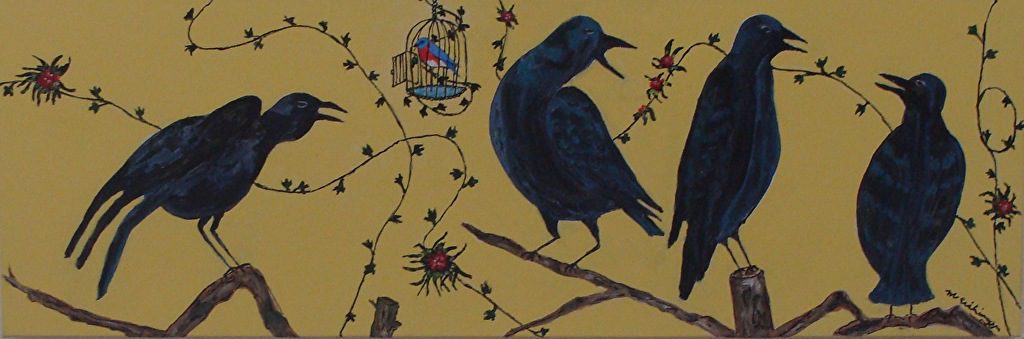
Feeding Crow
Acrylic on Canvas/ gold frame/ 40” by 30” / $ 599
Each of us is called on to defend our country, whether at war or at peace. The rights granted us under the Constitution and the Bill of Rights are worth defending. It is not something for others to do. We will never agree with our neighbors about every issue but our homeland asks us to accept the tenants of democracy.

Call Me Patriot!

Call me Patriot. No one can take that name away from me, neither the right nor the left. In today’s political climate, the word has become loaded with meaning. I love our country and the people I come in contact with daily, even when I do not agree with their political views. Most are good and generous individuals who are ready to help their neighbors in time of need. And, though I am very upset by many things that our politicians do, I see it as my duty to be involved to make things better for the next generation. It upsets me to hear of acquaintances who want to give up their citizenship and go elsewhere. If we want to live on a kinder more compassionate canvas, then it is ours to paint.

A patriot is defined by Webster as a person attached to his or her homeland. Sadly, at times it is difficult to feel connected to ours, especially when congressional delegates act as children and make it hard to believe they have the best interest of the electorate at heart. Wrapped in their own desire to get reelected, they forget they are part of a family unit that gains strength by working together.

Growing up, each of my children had opinions of their own which did not always correspond with mine. Yet I loved them, tried to consider their point of view, and embraced their goodness despite our differences. We always came to some accommodation that permitted us to live in harmony. I would lay down my life for my children no matter how much we disagree.

When it comes to politics, however, I notice that some, who call themselves patriots, take self-centered positions based on identity with such things as social class, race, religion or gender. They may decide that only those who share their culture, ethnic background, language, nationality of origin, profession or sexual orientation are patriots. The dictionary labels them chauvinist patriots for they carry an excess of patriotism. Laying claim to their political position as the valid one, they speak as if only they have the right to the word. Not so!

I fear they do not understand the intent of the Constitution, Bill of Rights and laws that underpin our national identity. Their love of homeland is based on their own mythology. For instance, section 8 in the Constitution says that Congress shall have power, “To regulate Commerce with foreign Nations, and among the several States, and with the Indian Tribes.” This was written, in part, to insure that treaties with Native Americans are respected. Instead, over the years, when money is involved, self-interest has ignored the clause. It seems to me, that since Native-Americans are identified as nations, our government does not have the right to invade tribal lands. If you were an Native-American, wouldn’t you consider a forced pipeline being put through your territory as an act of war? Wouldn’t a Patriot expect the government to honor our agreements?

The Bill of Rights protects free speech, religious freedom, and the freedom of assembly. It does not give permission to isolate those of any one faith, to make inflammatory remarks, or treat them differently. Internet, though, has ushered in shady behavior, for it allows individuals to overstep the bounds of free speech by inciting malicious behavior. A true patriot would not make disparaging comments because of differences in race, gender, or religion.

And, what about voting? All citizens over 18 have the right to vote. A patriot, in my opinion, would not be gerrymandering electoral districts for their own benefit. They would not put obstacles in the way of minority voters, or treat a corporation as an individual. They certainly would not hack emails or spread false information. Unfortunately, that is not how it is, for power brokers who consider themselves patriots, have found ways to go around the laws of our land. Greed controls actions that are difficult to combat.

Many interpretations of the Constitution and its amendments are based on what we imagine the framers meant. It is impossible to get into their heads but common sense says that their intent was always for the good of the people, most people, we the people. The overall goal has always been fairness.

There never will be complete agreement, which is fine. It makes life interesting. We just need to hear each other and respect minority views as having value. Since we are neighbors and often need each other, why not listen compassionately and act with kindness? All human beings are faced with personal difficulties. Why add hate and anger as burdens? Both minority and majority views can be patriotic if the intent is to improve the homeland and actions are done in accordance with the nation’s laws.

That is not what is happening, however. Even those on dating sites such as Match or Zoosk are adding comments to their profiles like, “not interested in a Trump supporter” or “will only date a Republican.” I never would have been born under those circumstances since my parents supported different political parties. They loved each other and their views never seemed to be a burden as they shared their values with their children. I think I was fortunate to be able to evaluate two opposing points of view and take the best ideas from each side of the isle.

Recently, I have been looking at the faces of some of my friends and they are frozen with fear. Since the cold war days, I have not been privy to such raw emotion. They thought that this was their country and now they feel like they are being marginalized. Being fearful is no way to live in America. My America is the land of the free, and it is my patriotic duty to keep it so.
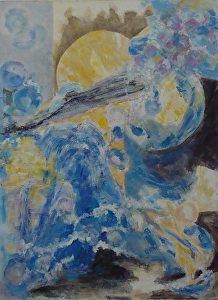

Violent Storms a’ Comin’

Surf’s Up
Acrylic on Canvas, gold frame, 48” by 36” / $ 699

Violent Storms a’ Comin’

A few days ago a friend of mine went to a Buddhist induction ceremony where Initiates were given a bowl and robe and told that from then on these objects would be their only possessions. Letting go of attachment, being mindful and focused, having kindness and compassion, reducing suffering and increasing happiness they are all that matter. Property ownership is meaningless.

His story made me wonder what it would be like to give up everything I own? I realize that you can’t take objects with you when you die but to possess and create beautify art has always made me feel good. As a visual person, the natural and human-made environments are important to me. Just as I appreciate observing birds in the wild I enjoy putting my hands around a lovely piece of pottery I own to feel ripples in the clay that the potter made when crafting a bowl.

While acknowledging that I was attached to my possessions, I switched the television on to the weather channel where they were reshowing images of the aftermath of Hurricane Sandy. I had never paid a great deal of attention to the trauma that beset the New Jersey Coast but when I heard the newscaster say Barnegat Bay, he grabbed my attention. My family had once owned a summer home on Long Beach Island. Located between the Bay and Ocean, the narrow strip of land bore the brunt of the hurricane’s force. It struck me that no longer can I bury my head and say that losing everything is not a possibility.

During the past two years, several trees landed on my property due to erratic weather conditions and rain saturated land. One smashed through the roof of my house and the second demolished a car in the driveway. In both cases, members of our family were inches away from being killed. Are these violent storms going the be the norm in the future? I decided to explore more deeply why a warming climate produces violent storms that include icy cold winters.

As early as 2007, NASA predicted that increased levels of carbon dioxide would make continents warm more quickly than oceans, resulting in storms becoming more vigorous. On the west coast, an increased amount of rain and snow may solve problems of summer drought as long as there are ways to capture water from saturated grounds that are prone to flooding. Overall, though, the west coast will increase lightning strikes which are prone to start wildfires. Central and eastern states will have their own set of problems. They will be especially vulnerable to more numerous severe storms and thunderstorms like Sandy, Katrina, Andrew and Ike. Social, economic, physical and psychological scars will be left behind.

Doyle Rice, writing for USA Today, reported on proceedings of the National Academy of Sciences. They also say that thunderstorms and violent tornadoes will have “ a robust increase across parts of the U.S in upcoming decades because of climate change.” They predict that between the Rockies and the Atlantic severe storms could increase as much as 40 percent.

“Two primary ingredients are needed to produce severe thunderstorms: The first is the fuel needed for these monster storms to develop — what scientists call “convective available potential energy” (CAPE). CAPE is created as the air in the lower atmosphere warms. The warm air rises, carrying with it moisture to higher altitudes. The second is vertical wind shear, a strong current of wind that helps spin up energy and moisture in the atmosphere.”

The Union of Concerned Scientists continues, “ As ocean temperatures rise, there is also less cold, subsurface ocean water to serve as a braking mechanism for hurricanes. When strong storm winds churn up cold subsurface water, the cooler waters can serve to weaken the storm. But if deeper waters become too warm, this natural braking mechanism weakens. Hurricane Katrina, for example, intensified significantly when it hit deep pools of warm water in the Gulf of Mexico.”

The Nature Conservatory predicts that rising temperatures will cause one-quarter of earth’s species to become extinct by 2050. Ocean acidification, heat waves, droughts, and floods are already endangering species. Poverty, hunger, and disease are among the reasons so many people migrate from their homes in Africa and the middle-east. Warlords in the area fight fiercely to control both oil and water. Without water for crops and animals and when homes are bombed, survival is at stake. What can a family do but seek shelter elsewhere? Though there have always been disasters, an increasing number of people worldwide are a displaced due to war and global warming.

Friends, climate change is not a theory. 97 percent of scientists agree that it is happening and that it is human-induced. Why would anyone but greedy people ignore this information? How come scientists are being forbidden to share the results of Surf’s Up

References:

Global displacement statistics from 1989 to Present from the Internal Displacement Monitoring Center: http://internal-displacement.org/global-figures

NASA predicts severe storms, 2007, https://www.nasa.gov/centers/goddard/news/topstory/2007/moist_convection.html
Rice, D, 2013, USA Today, Study: Climate change pumps up the risk of Severe Storms.

Nature Conservancy on Climate change: http://www.nature.org/ourinitiatives/urgentissues/global-warming-climate-change/threats-solutions/index.htm

Union of Concerned Scientists: Hurricanes and Climate Change: http://www.ucsusa.org/global_warming/science_and_impacts/impacts/hurricanes-and-climate-change.html#references

Works of art are always for sale. Surf’s Up / Acrylic on Canvas, gold frame, 48” by 36” / $ 699Contact me at marilynne@eichingerfineart.com

I look forward to hearing your comments. Please respond below.

How Do You Talk to a Bigot

The Next Generation

Acrylic painting on canvas / in black frame (not shown) / $ 450 / 25” by 20”

Will this couple raise their child to think and reason independently or will their prejudices get passed?
____________________________________________

How Do You Talk to a Bigot?

A man must be excessively stupid, as well as uncharitable, who believes there is no virtue but on his own side.
Joseph Addison, The Spectator 243, (8 December 1711).

In high school, one of my teachers asked the class, “ How do you talk to a bigot?” The question stayed with me these many years for I found it tremendously difficult to answer. Examining his query scared me because so many family members and friends spoke out against those not made in their own mold.

In the 1950s and 60s, anti-Semitism was rampant as was hatred towards those of color. When Kennedy sought the presidency, wildly disparaging remarks were made against Irish-Catholics and the Pope. In nightclubs and on television, comics made fun of everyone by calling them Dago, White Trash, Paddy, Mik, Hun, Redskin, Honky, and Chink. The audience laughed. These words were part of common parlance and unflatteringly spoken in living rooms nationwide. Movies reinforced cultural differences by mocking minorities by using character actors who supported common prejudices. During my student years, so many people spouted self-aggrandizing beliefs that put others down that I could not imagine a way to turn their minds and hearts around.

In looking back, I realize that we have come a long way towards overcoming prejudice. No longer do we have segregated bathrooms based on racial identity though we still are not comfortable with sexual deviations. There are no black-faced minstrels dancing like children on stages nor are religious slurs tolerated in the media. Recent events, though, have made me realize that bigotry went underground and has not gone away. Many of us are surprised at the rise of the KKK and Arian Brotherhood who never accepted the idea of the United States as a melting pot of people with diverse backgrounds as an advantage to making the country strong.

Family gatherings are a time that brings to the forefront differences. Some friends complain that family members accept them with smiles to their face but then joke and make racial or sexual slurs when they leave the room. A few of my southern acquaintances mention more overt snubs. With self-righteousness and beliefs in their own superiority, they have relatives who liberally sprinkling sentences with words like faggots and Niggers. Families have been known to break up over such differences.

Bigotry, as defined in Webster’s, is “the stubborn and complete intolerance of any creed, belief, or opinion that differs from one’s own.” Ignorance and fear are two powerful allies of bigotry that seem to be on the increase. Bigoted people ignore the reality of diversity and cover themselves with security blankets to suppress their fear. They irrationally discriminate against those who are different and play on emotions rather than logic. Belief is elevated above thought and credence is given to lies before investigation. The possibility of error is beyond their imagination. Yet, their absolute acceptance that they are in the right causes a lot of pain.

So how do you get rid of bigotry? Eliminating bigoted beliefs often means giving up power which makes many people feel uncomfortable. What do you do when family or friends are the ones promoting disparaging statements? How can tolerance be encouraged and ignorance overcome? Is there a possibility for open, honest communication or do you just have to turn away from those who engage in hateful banter?

Doing nothing is not a good enough response for those living in a democratic society. Democracy only thrives when there is open and honest communication, a willingness to compromise, and an agreement to live by consensus or majority agreements.

I have gathered several suggestions on how to respond to a bigot.

1. Speak up to let the person know how you feel about their extremist remarks. Then walk away if racial, ethnic, or religious slurs continue.

2. Find several like-minded people willing meet the offending person at a less emotionally charged time in order to engage in an educational discussion. The meeting can not be confrontational but rather based on shared feelings that speak to fears and prejudices. Facts that counter long-held prejudices will only be heard if the discussion is non-threatening.

3. Decide in advance how important the relationship is to you and if you are willing to leave if the situation can not be resolved? If you come from a household where bigoted behavior was accepted, acknowledge it, but let your family and friends understand that as an adult you have learned to respect others. If your community is not a loving and respectful one, consider moving to one that is.

4. Don’t expect prejudiced people to instantly agree with you, but do expect that in your and your family’s presence offending statements will not continue.

5. Remind yourself that bigotry is not a political issue. It usually is passed on from one uncritical generation to the next. It exists across party, religious and state lines. It is in your backyard and cannot be ignored.

Comments by others to give you pause for thought:

“I ask you to uphold the values of America, and remember why so many have come here. We are in a fight for our principles, and our first responsibility is to live by them. No one should be singled out for unfair treatment or unkind words because of their ethnic background or religious faith.”
George Walker Bush, Freedom and Fear Are at War: Address to a Joint Session of Congress and the American People (20 September 2001).

“Perhaps travel cannot prevent bigotry, but by demonstrating that all peoples cry, laugh, eat, worry, and die, it can introduce the idea that if we try and understand each other, we may even become friends.”
Maya Angelou, Wouldn’t Take Nothing for My Journey Now (1993), p. 12.

“God deliver us all from prejudice and unkindness, and fill us with the love of truth and virtue.”
William Ellery Channing, “Unitarian Christianity”, an address to The First Independent Church of Baltimore (5 May 1819)

“I know a good many people, I think, who are bigots, and who know they are bigots, and are sorry for it, but they dare not be anything else.”
Edwin Hubbell Chapin, Living Words (1869) p. 125

References:

https://en.wikipedia.org/wiki/Sinophobia#Derogatory_terms> – List of derogatory words.
http://www.lifehack.org/articles/lifehack/bigotry-ignorance-and-fear.html _ About Bigotry
http://www.amnottheonlyone.com/how-to-deal-with-bigotry-among-family-and-friends/
– Bigotry among friends and family.
https://www.splcenter.org/20150126/speak-responding-everyday-bigotry– Southern Poverty Law Center- Speak Yup: Responding to Everyday Bigotry

Going Viral

The Gossips
acrylic on wide canvas/ 12” by 36” / $ 325

Going Viral

In 1972 I was developing my first museum, Impression 5 Science Museum in Lansing, Michigan. It was frustrating, in part, because I did not know what I was doing. I certainly was naïve! It was also exciting because my university friends and I would brainstorm ideas for exhibits, go into our work rooms and make devices that explained science. We took the results of our creative endeavors (not always well made) to schools and shopping centers. Our goal was to eventually create a hands-on place for children and adults to play creatively with science and the arts.

This effort was done under the radar of the press until a newspaper reporter wrote a small article about the fledgling museum. Once in print, our project was legitimatized and I became swept into a maelstrom of activity and purpose. A few people did come forth as a result of the article but not much happened because I did not have money and did not know who or how to ask for it. Though determined, was very inexperienced.

My girlfriend and I went around town talking to community leaders about our project and people listened politely. The mayor’s assistant said I had to wait in line for my project to be considered and that might take five years. The man in charge of the YMCA told me that our museum would not get off the ground because “there were only two things that were important, one was sports and the other was sex.” Impression 5 was about neither.

One frustrating day when I was at my desk which a kind school let me occupy when not being used as a lunchroom, I read that Playboy Bunnies would play sporting events with local celebrities to raise money for charity. Wow! Sports and Sex! I had it made. I called up the Detroit club and sure enough, they were willing to play basketball against our community leaders. In those days the leaders were all men. I invited school superintendents, the mayor, the head of Oldsmobile, the university president, real estate moguls, and other community businessmen of note and money to join the game. No one man turned me down. We acquired Jennison Field House at Michigan State to hold the game and plans were under way.

Except. . . a small article appeared in the editorial section of the newspaper saying that a group of women objected to the game. This was a time of awakening at the start of the women’s liberation movement and sensitivities about women’s issues were mounting. An organized group from the high school and university planned to picket the event causing a few of our volunteer players to opt out of the game.

To prove I was not supporting male chauvinism, I called Michigan State’s Women’s Basketball team and asked them to help as a practice team. They agreed. Six women played in the practice game causing our volunteer men had to be rotated every few minutes to avoid having a heart attack. The difference in skill level was incredible.

The more tried to soften the women’s issue the more newspaper articles fanned the controversy. We didn’t know what to do. Should we cancel the game or proceed surrounded by pickets? Ticket sales were dismal.

Mother nature helped us make the decision. The night before the game it started to rain, and rain, and rain. Rivers flooded their banks and the field house court was drenched in two feet of water. The entire town was needed to sandbag riverbanks.

We never did have the charity event but the museum got under way. It was this event that taught me that that bad publicity is more likely to get people’s attention. The museum concept had gone viral. People loved the idea of the museum but they enjoyed the controversy over women’s rights more and followed arguments in detail. By the time the flood ended, Lansing residents knew about the fledgling science and art museum. Many were ready to join our effort. Impression 5 Science Museum now thrives in its forty-fourth year.

Today, when I think about the false information that is widely being circulated through the media, I remember the lessons I learned so many years ago. The difference is that when information goes viral through the net, it travels faster and is convoluted much like the childhood game, “whispering down the line.” The story changes slightly each time it is repeated until the listener turns it into what he or she wants to hear. A lesson to us all. Beware and check facts so misinformation is never passed on.

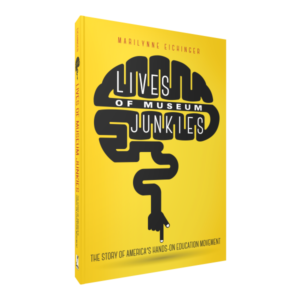
Stories about the start of the nation’s hands-on museum movement can be found in Lives of Museum Junkies. Any new venture takes perseverance, dedication and a willingness to learn from your mistakes. I would love to hear  your experiences in embracing a new enterprise, whether it is a club, hobby or business. Did you succeed? Fail? Learn? How did you spread the word?

Please share your comments below.

Artwork is always for sale: Contact me at marilynne@eichingerfineart.com.
________________

Lives of Museum Junkies: The Story of America’s Hands-On Education Movement
Available at Powells Books, Annie Blooms Books, MAC Emporium, Broadway Books, and on line at Amazon and Barnes and Noble.

SAVE THE DATE: February 9th – Annie Blooms Books, Multnomah Village, Portland, OR – Book talk and signing for Lives of Museum Junkies. The event starts at 7 PM.

A Whirlwind Descends

Heaven-and-Beyond

Heaven and Beyond
The spinning universe brings a mixture of emotions to earth.
/ Acrylic on Canvas / 20” by 24 “/ $399

A Whirlwind Descends

Each December a whirlwind descends, causing most everyone to join in a helter-skelter flurry of activity. Love it? or hate it? Holidays bring out many emotions. I happen to thrive during the holidays, looking forward to large family gatherings of children and grandchildren. Chaos, noise, and mounds of dishes never bother me though my back often creaks by the end of the holiday visit. I spend weeks looking for the perfect gift for each person, happily wrapping them in my basement surrounded by ribbons and bows while listening to jazz.

My husband, on the other hand, dreads the holidays. The confusion and noise of my large family makes him want to retreat to a man cave. He prefers visits from one family at a time and cringes when all 22 people descend on our home. The cat also hides. Thank goodness he is tolerant. Part of my job at holiday time is to arrange quite places and times for one-on-one conversations so he feels comfortable.

A common emotion at holiday time is sadness. Thank goodness, there is no time for that with our large family, but I do know of many people who can not go home for the holiday to reconnect with friends and family. Holiday decorations and carols may remind them of a happier moment from their past, bringing back nostalgic memories that can never be duplicated.

As the winter solstice approaches and the nights become long, people throughout the ages have found reasons to celebrate. Religious as well as secular practices, remind people that life has cycles, the seasons change, the sun will return, there is hope for mankind and there are many fine reasons to celebrate. Festivities have always drawn people together, reinforcing a sense of community and shared values. It is also a time for remembrance of those who are sick, poor and lonely, those who need special attention. Giving swells hearts and people feel good thinking of others. It is why we see an increase in charitable donations, gift buying for the needy and invitations given to guests who are alone.

There isn’t really one way of approaching the holidays, but to embrace the season’s spirit it helps to take the feelings and needs of others into account. When purchasing a gift I ask myself if it really contributes to the growth and well-being of the recipient. Is it educational? Can it be shared? Is it green?

There are lots of opportunities to show love and affection so I enjoy activities that get everyone involved. The goal, of course, is to leave that warm feeling in the belly of everyone. One year each person in my extended family pulled a name out of a hat and was assigned the task of creating something special to honor that individual. One parent assembled photographs and published a book about her son, another wrote a short story. Several children contributed handcrafted items. One painted pottery and another made a potholder. My granddaughter wrote and sang a song while her younger sister played the harp. The youngest child made a picture for his Dad that looked something like a two-legged dinosaur. Our family sat around oohing and ahhing as the gifts were unveiled.

Play reading was another activity we got involved in during several gatherings. Parts were distributed and everyone joined in with their best acting voices. Imagine reading a Shakespeare comedy in plainspoken English that even young children can understand.Try it, it really is a good read!

Putting a 3-D puzzle together was an annual ritual in our household. As soon as the first person arrived at our home, the card table got cleared, a white board set up and a complex puzzle that takes days to assemble gets put together with everyone’s help. It has was quite challenge working on the New York 3 D puzzle.

With a bit of planning, it is easy to get the entire family to feel a welcomed part of the festivities. These moments become the new memories built on a holiday spirit that everyone can embrace.

Lives of Museum Junkies Book

Lives of Museum Junkies: The Story of America’s Hands-On Education Movement
Available on Amazon, Powells and Borders Books

SAVE THE DATE: Annie Blooms Books, Multnomah Village, Portland, OR – Talk and signing for Lives of Museum Junkies. The event starts at 7 PM.

Nourishing Dieversity

1474323m+v=201607111642&m=9999-1Nourishing the Desert

acrylic painting/ 36” by 24”/ $499
A diversity of people composes the fabric of our society. As we look at it from afar we see that the whole creates a beautiful landscape that is more dramatic than the parts. Once the land is nourished the garden can burst into bloom.

The following excerpt is from Lives of Museum Junkies available month end on Amazon. Keep posted for more information. As a museum professional, I was privy to many experiences that influenced how I think about our country’s racial divide. After Martin Luther King’s march, I assumed we had overcome a hurdle and we would live in a more compassionate place. Unfortunately, when I listen to the news today, I realize that lack of understanding between various racial groups continues. Yet, I am reminded of my youth and how a biased childhood made it difficult to understand the implications of a diverse society. I had to change before I could nourish others. The following excerpt is one of many events that made me do so.

Nourishing Diversity

“I got to know of Earvin Johnson’s mother, the school’s cleaning lady, during a time when Earvin became a local hero. She and her husband were supportive of their talented son and encouraged him to better his basketball chances at all white Everette High. The transition was difficult. He encountered a great many racial incidents, as he wrote in his autobiography Life, but eventually realized that they helped him “understand white people, how to communicate and deal with them.”

Earvin was anointed the moniker “Magic” at the age of fifteen when a writer for the local paper recorded a triple-double of 36 points, 18 rebounds and 16 assists. Earvin had so many fans that the high school had to use Michigan State University’s field house for his games. Not giving into pressure to go elsewhere, upon graduation he enrolled locally and we all got to celebrate when MSU’s basketball team won the college championship.
A few years later, while Magic was playing for the Los Angeles Laker I was invited to attend a birthday party his father organized in Lansing. Having lived most of my life in a white environment, the party was a culturally electric experience. I was one of the 10% of attendees who were white and the event made me realize how little I knew about the black community.

Guests were asked to dress in black or white, and once in the ballroom, the fashion show we beheld was spectacular. Johnson’s young female friends were especially dazzling, looking as though they had stepped off of a New York runway while the men, demonstrating their individuality, wore colored spats and bright suspenders under traditional black tuxedos.

At 7 p.m. the doors were locked to late arrivals. I sat down next to a state senator at an all white table when seven L.A. Laker giants, accompanied by tall, stunning females, entered amid flashing lights, and excited shouting fans. Projecting his well-recognized smile, Magic was in his element when speaking, leaving guests to realize that there was much more ambition in him than simply a basketball player. His favorite band had been flown in from L.A. as a birthday gift from his father. While it played, the black crowd moved and applauded to the sounds while those of us who were white sat stoically in our seats wondering, not understanding.

This party was my first total immersion into a culturally unfamiliar environment. Just as Earvin had to learn about white America, I needed to be exposed to and learn about black culture. I observed many interactions during that evening that made me feel uncomfortable, and I began to wonder how difficult it might be for a minority child to visit a museum where most attendees were white. My eyes were just starting to open.”
________________________
Many experiences over many years helped me become invested in seeing that all elements of society receive an education and life a rewarding life. Lives of Museum Junkies explores what I and others have done to ensure that the underrepresented population is served. My present work with street youth is an extension of the sensibilities I gained while working in museums.
______________________________
Art work is always for sale. Contact me at marilynne@eichingerfineart.com

Do respond with your thoughts by clicking BLOG.
___________________________
StreetwiseFor sale on Amazon by Marilynne Eichinger: The True Story of Streetwise, overcoming homelessness and beating the odds. Go to AMAZON .
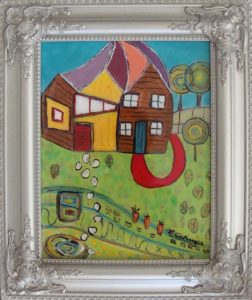

Home as Museum

Coming Home /16” by 19” / acrylic with silver frame / $ 195

Open the door and what do you see? Is home an interesting reflection of you and do others enjoy it? Does it share your personality? Your history? Your curiosity about life?

The following excerpt is from my upcoming book Lives of Museum Junkies that is due out at the end of August. Look for information in upcoming blogs. I will be holding several book signings beginning in Tampa, Florida in September; Lansing, Michigan in October; and Portland, Oregon in November. Information will be forthcoming in the next few weeks. I look forward to seeing you at one of these events.

Home as Museum

“You can easily substitute home for museum and live in an environment made inspiring. Instead of exhibits, consider decorations, furniture and personal treasures. Architecture, use of space, selection and arrangement of furnishings, collections, and the way they are displayed all define you. How you move about your home, share treasures with friends and family, and teach your children to understand their cultural heritage becomes your way of passing on values.

Ray, my life partner, is a maker of totem poles and Northwest Coast masks. Outside of our home, there is a seventeen foot pole that has become a neighborhood marker. “Go to the totem pole and turn left,” is an oft heard direction given by acquaintances. The lower level of our house has both indoor and outdoor shop areas where carving and painting are pursued much to the enjoyment of nosey friends and those hiking an adjacent trail. Strangers who hear the tap, tap, tap of a hammer stop by wanting to know what is going on, and Ray gladly shows them his carvings, entertaining them with stories of Raven and Beaver.

Our home is filled with his carvings, my collections of pottery and masks, canvases that I paint, and art purchased while traveling. Our furnishings are arranged in a restful way, though presented as eye candy for our visitors. I enjoy living surrounded by the items Ray and I have either made or collected. Sharing them with friends lets them into our souls and initiates many conversations about culture, art, and even politics. Our friends often say when entering our home that it looks like a museum, only warmer and more welcoming.

Many children are first introduced to a cultural institution by visiting a children’s museum. These institutions are unique because the ingenuity they apply to educating the young is more than just exciting—it is engaging. Children spend hours engaged in activities such as playing in water (learning physics and hydrodynamics without realizing it), dressing up in period costumes (a study in history), constructing and plumbing buildings (engineering), and a host of other activities that involve physical as well as mental effort. Young visitors often are seen crying as their parents pull them from the building to go home. A secret to their success is that they are centered on the child and organize their spaces in a way that permits freedom of movement. Displays are built to withstand hard use. They encourage learning by using a variety of cleverly hidden techniques.

I encourage parents to think like a professional and start their own museum at home. What better place to inspire your own child than the relaxed environment of a play area or living room? According to The American Association of Children’s Museums, “A children’s museum is defined as an institution committed to serving the needs and interests of children by providing exhibits and programs that stimulate curiosity and motivate learning.” They encourage parents to interact with their children while in the museum in order to make the experience more meaningful.

That definition fit my family to a “T.” When we moved to Lexington, Massachusetts, a community without a hands-on museum, I decided that I could make my own home into one. The Boston Children’s Museum was much too far to travel to on a regular basis. Part of the challenge of my home operation was one of organization. I decided to set up my children’s basement playroom with a Montessori approach.”
_____________
Lives of Museum Junkies offers insight into how I went about doing this on a shoestring. I also encourage grandparents to consider their residences as their private museum. The accumulations from a life time of travel and just plain living can be organized and displayed in such a way as to fascinate friends and family alike. Perhaps you have thought similarly and share your treasures in a unique way. Do share on my blog site, eichingerfineart.com/blog.
_______________
Artwork is always for sale. Contact me at marilynne@eichingerfineart.com.
________________
For sale on Amazon by Marilynne Eichinger: The True Story of Streetwise, overcoming homelessness and beating the odds. Go to AMAZON .

Streetwise

The Importance of Touch

applauding-the-blues

       Applauding the Blues

Acrylic on canvas/ Gold Frame/ 23.5” by 19” / $ 495.00
Do you stop to look, touch or smell the flowers? Perhaps you even taste them.

The following excerpt is from my upcoming book, Lives of Museum Junkies. Due out in August it tells my story along with that of eleven other innovators who influenced the hands-on museum movement in the early 70’s. Publication information will be available in a few weeks.

The Importance of Touch
In 2012, a young social work student at the University of Rochester was featured in national publications as a most unusual entrepreneur. While studying brain and cognitive sciences as an undergraduate, Jacqueline Samuel became aware of the negative effects of living in a culture that does not sanction touch for its own sake. Throughout the world people are more willing to hold hands and hug friends and family than in the United States.

Adverse consequences of tactile isolation are known to be agitation, anxiety and aggression. Jacqueline decided that she would ameliorate the situation by opening a cuddle parlor she named the Snuggery. Her focus centered on bringing the healing power of touch to those who are tactilely isolated. The rules she and her employees devised were strict; staying clean, keeping clothing on and not engaging in any “funny business.” Her non-sexual touch emporium was singularly based on the platonic need for physical closeness. Business boomed, spurring copy-cat cuddle parlors throughout the country.

One even opened where I live in Portland, Oregon.
You might wonder what type of person needs to pay $60 for an hour hug? Clients come for a variety of reasons and include those on graveyard shifts returning home to empty beds, the physically handicapped and the chronically depressed. There are thousands of people, many elderly, others single or with a physical disability who are never touched, held, or hugged. Having a friend to talk to and being cuddled is important for overall emotional well-being.

Jacqueline’s insight is backed by volumes of research showing how touch reduces cortisol, the stress hormone that suppresses the immune system. The Touch Research Institute at the University of Miami is a center that concurs with Jacqueline’s concerns. They recently completed a study showing that teens who lack hugging are more likely to be aggressive than their peers who are regularly hugged. Elderly people who are touched are healthier and less likely to develop dementia. Premature babies who are stroked gain weight faster than those who are not and infants who lack adequate physical and emotional attention are more likely to have behavioral, emotional and social problems as they age. And now we see that tactile learning can also be highly effective.

Hands-on museums are cognizant of sensory research, and tactile solutions especially form the basis of many of their activities. Not only do people need physical contact with others but they also have a need to touch and play with objects. A friend of mine shared an insight that it was not just his auditory sense that made him enjoy playing the piano, but his tactile contact with the keys. . . . . .

My work in the museum field was influenced by an exercise I had to complete as a graduate student in psychology. One of my assignments was to write a paper imagining what it would be like to lose each of my senses. I was also directed to explore my feelings about loss of sexual sensitivity. To start the exercise I would sit for an hour in an easy chair imagining myself as a blind or deaf person. As I delved into the assignment, I was surprised to realize that losing my hands would be one of the most horrendous handicaps I could have. The hour spent with handless imagery was torturous, leaving me scared, almost frozen. What if I could not touch a door knob or wave my hands while talking? How horrible it would be to not be able to tousle my child’s hair. Touch was not the only sensation that affected me deeply. I quickly realized that losing my sight would be just as awful. As a visual and tactile person I am so fortunate to have both of these faculties.
Each of us is controlled by biological predilections and we are most happy when we allow daily activities to be guided by these predispositions. . . . .

Understanding a child’s sensory preference helps parents and teachers design appropriate educational programs. The visual learner may love reading books, but there are many children who are hesitant readers and need to be drawn into the learning process through an alternative sensory route. A history teacher might design a curriculum for tactile learners by challenging them to make dioramas. The process still requires the children to read in order to know what to include in their 3-D pictures, but their interest in the project will be internally motivated. . . . .

Parents, grandparents, friends and teachers please think twice before you tell a child not to touch. Your curious child might just need a little guidance to encourage safe and constructive activities that take advantage of his or her way of communicating. Remember, a broken glass can be dangerous but there are safe ways to turn broken glass into a mosaic . . . touch me, touch me not. . . . .

_______________________________

This summer is a good time to let your children wander and experiment by using the sensory mode they most prefer. A warm hug for effort will go a long way towards developing their passion for learning. And by the way, we parents and grandparents love hugs as well. They provide wonderful feelings of well being.

I look forward to your comments below.
Art work is always for sale. Contact me at marilynne@eichingerfineart.com

For sale on Amazon by Marilynne Eichinger: The True Story of Streetwise, overcoming homelessness and beating the odds. Go to http://www.amazon.com/dp/B01AAXMJOGThe

Streetwise

For the Sake of Righteousness

DSC07016For the Sake of Righteousness

Last week was spent in the sunny (and hot) Bahamas. Among other activities such as swimming with sting rays and snorkeling my granddaughter and I climbed the steps if the Sun Temple in Costa Maya. In ancient times the top platform was used to perform acts of human sacrifice in hope of influencing the gods to provide an abundant harvest. It was an honor to be chosen for this sacrifice and parents offered up their daughters DSC07035willingly. Those who complied were the self-righteous ones.
Their actions are not very different from those of radical Islamists today. Suicide bombers also have religious convictions that they are willing to die for. Their certainty about the way things should be is imbedded in their psyche and their faith is so solid as to not be easily shaken. In many Middle Eastern countries the families of suicide bombers are given a monetary reward for their loss and parents are resteemed for having produced such a religious child.

Christianity is no stranger to this phenomenon. Crusaders marched, maimed and killed for their faith and were respected if they died in the fight. Those who today stalk abortion clinics and are ready to eliminate anyone not sharing their certainty also consider them self to be among the righteous. They are willing to spend a life in prison or even on death row in order to stand up for their beliefs.

Political movements too are rife with followers who substitute a love for humanity for a utopian ideal. They trust their intuition implicitly and have little understanding of the words of Anatole France who said that, “even a little dog is the center of his own universe.” As an anthropology student I learned that cultures throughout time have their own beliefs, political systems and religious teachings. Many are faith based and people attach themselves to it with iron bonds. Trained at an early age by parents and leaders their societies mores are imbedded in their heads. Who is to say which one is right?

When my father had a conviction and wanted us to adhere to his teachings he blasted, “its my way or the highway.” We kids conformed if we didn’t want to get in trouble. We remained silent.

Fear to speak out and express uncertainty or a desire to do things differently is frowned upon in most cultures because people are more comfortable with the status quo. Most prefer to live in a dependable world. Just think of how difficult it is for seniors to adapt to heavy metal, pink hair and tattoos.

Just as was Socrates, I am wary of the unexplored life. I find it difficult to understand why people are so quick to come to conclusions based on feelings and faith and why scientific exploration is not embraced more rigorously. As the earth changes over time so does our knowledge. New information needs to be incorporated in a minute by minute ritual. It took an awfully long time for Europeans to accept that the world is round and men like Galileo suffered because of narrow thinking.

When it comes to righteousness I would rather err on the side of humanity and maintain the belief that people are doing their best to understand and live within the boundaries of their lives. In my belief system there is no room for torture or killing. An enemy today, as we see with Germany and Japan, may be a friend tomorrow.

The challenge for the righteous person is to be understanding and caring. This is sometimes more difficult than killing. I advise those of you who have not already done so to watch Michael Moore’s latest movie, Who do we invade next. He presents a number of solutions developed around the world for improving a sense of self- worth and allowing for a more harmonious existence.

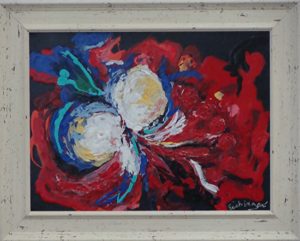
Exploding Emotions

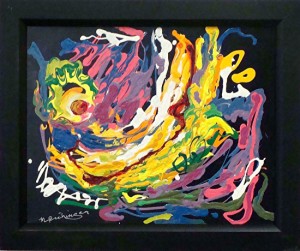
1662376l copyTwin Stars Exploding
Acrylic on Canvas / 16” by 20” / $ 299
Explosions are part of creation. When the product of emotions, they can get channeled for good as well as evil.

Exploding Emotions

Last week I wrote about passion. Due to the horrendous attacks in Orlando my thoughts turn towards anger because the two can be intimately intertwined and also because I need to understand why such things happen. Aggressive behaviors often result from a person passionately embracing a cause that was triggered by real or perceived injustice. Anger festers and churns  eventually became so violent that like a volcano it erupts in an explosion that does great harm to others in the name of passion for a cause.

A terrorist’s violence usually does little good to further his or her stated purpose. Instead, a common public reaction is to close down empathy, shut off communication and increase vows to retaliate. Horror, hatred, punishment and revenge are the overwhelming outcome and questions of why it happened in the first place take a back seat.

In the United States, most of us espouse change by law and not violence, yet a great many frustrated individuals resort to aggression when their way is not endorsed. People who are not heard may decide that the only way to get attention is to maim, kill or destroy property.

I was intrigued by a sentence in a book by Joy Kogawa about the plight of Japanese-Canadians during World War I I.  In ITSUKA she writes about a eulogy given at a funeral. “He praises his dead friend because he never complained, because he paid the price for harmony in a world of discord. He did not add to the din. He was obedient to the command to be meek, but he did not in the end, I am thinking, inherit the earth.”

What is the way forward? Is it better to be quiet and not make waves or to live in the wild west and take law into your own hands? Do we continue to interpret “the right to bare arms,” as permission to use assault weapons? If not to kill then why does anyone need such a lethal machine? It certainly is not for sportsmanlike hunting purposes.

Consider religious fanatics who burn abortion clinics and shoot their doctors. Most of those killers consider themselves to be religious practitioners following the teaching of God. Unfortunately in support of their actions, Christianity, Judaism and Muslim religions are replete with hateful statements about non-believers. Yet, there are also many passages that speak of love. The new testament says, “turn the other cheek” and the ten commandments include, “thou shalt not kill,” but self-righteous fanatics ignore those teachings and commit the very crime they abhor. How did they become radicalized and care so little for humanity?

According to an article by Jennifer Williams for Vox, there is no one religion that can shoulder the blame for violence. It is found among followers of all religions and of every political persuasion. But becoming “radicalized” is not the same as becoming a terrorist. Many individuals who follow extremist views are not violent. Of the 318 events identified in an FBI report only 7% were attributed to Islamic extremists.

The article mentions societal factors associated with a higher risk of radicalization;
• The presence of a large minority population that is socially, politically, and economically marginalized
• Treatment of certain groups as “suspect communities” that are subjected to invasive and overbearing counterterrorism efforts
• A cultural or political hostility toward religion in general or Islam in particular
• Unpopular foreign policies, such as support for repressive regimes or involvement in a military campaign, especially in a predominantly Muslim country (or several of them)
• The presence of preexisting recruitment networks

Following are a few of the individual risk factors;
• Personal ties to an already radicalized individual
• A sense of personal failure, often tied with a yearning to do something important and meaningful with one’s life
• A desire for adventure, rebellion, and life experience
• The need to belong
• Feelings of compassion and concern for the suffering of others with whom one feels some kind of personal connection, often (but not necessarily always) co-religionists
• And, of course, good old-fashioned teenage angst

And NPR reporter mentioned the possibility that the Orlando shooter was confused by his own sexual identity. For years he paid visits to the gay nightclub he massacred. There is no one path to radicalization but the most common either begin in prison or derive from the internet, social media and personal ties to friends and family. . According to Bruce Hoffman in The Daily Beast, terrorists are motivated by altruism, albeit misguided, feelings of self- defense, and a commitment to their faith with the belief that they are divinely commanded. They are difficult to locate in advance which makes dealing with them so difficult.

It is my opinion that we need to rethink our counterterrorism policies by diffusing individualized feelings and working to neutralize organizations that are a threat to our way of life. We need to find ways of changing people’s minds so terror will never be considered a way forward. To do so systems have to be in place that listen to both individual and organized group complaints so that people feel heard. Mental health services can be utilized to help confused, disgruntled people and criminal zealots who have lost their way.

I remember when an close acquaintance of mine allowed his 13 year old daughter to accompany a friend to an evangelical Christian summer camp. It took only one week for her to become brainwashed. Campers were required to stay up past midnight when they were exhausted and vulnerable in order to participate in mind altering services. They were even told how to deal with their parents upon returning home. My friend had to send is daughter to a psychologist who specialized in cult post-trauma recovery. I now understand how easy it is for a vulnerable person to be brainwashed and how difficult it is for that individual to renounce newly adopted beliefs.

There is much that can be done to combat terrorism. Politicians can pay special attention to all of their constituents, not just those with money or share their biases. For instance, many oppose Syrian immigration to the U.S., and though I am not one of them, it is important to listen, reach out and discuss various viewpoints and options before making a decision that affects the country. Citizens want to be heard and responded to with dignity. They have a right to feel comfortable in their homes, not afraid to travel freely and satisfied that their concerns are being addressed.

Government could help by responding more quickly to the needs of the growing army of ignored citizens, many of whom are poor and jobless. The press could be supportive by focusing less on inflammatory remarks and reporting on the news rather than sensationalism. What happened to programs by Edward R. Murrow, John Cameron Swayze, Huntley and Brinkley, Barbara Walters, Tom Brokaw, Peter Jennings, Dan Rather and Walter Cronkite? Where are the reporters who dig deeply for understanding? Who do you trust to report unadulterated news? When did news stations lose their independence?

Lastly, kindness and social awareness need to be taught as part of the school curriculum so violence and bigotry have a chance of being nipped in the bud. Bullies, terrorists and racists are not heroes. The melting pot envisioned by early Americans is a good one that can work to our benefit if we want it to.

http://www.vox.com/2015/11/20/9764078/paris-terrorist-radicalization – How ordinary people become terrorists.

http://www.thedailybeast.com/articles/2013/04/27/answers-to-why-people-become-terrorists.html – Why people become terrorists.

http://www.csj.org/studyindex/studyrecovery/study_trauma.htm – Cult Post-trauma recovery

Art work is always for sale. Contact me at marilynne@eichingerfineart.com

Do respond below with your thoughts.
___________________________
For sale on Amazon by Marilynne Eichinger: The True Story of Streetwise, overcoming homelessness and beating the odds. Go to AMAZON .