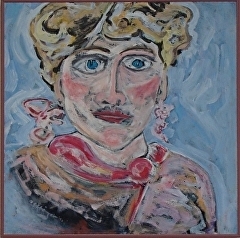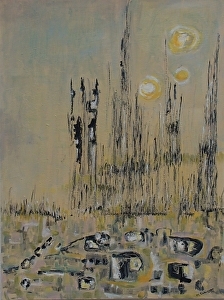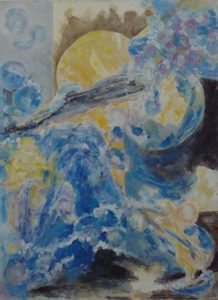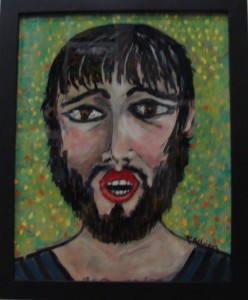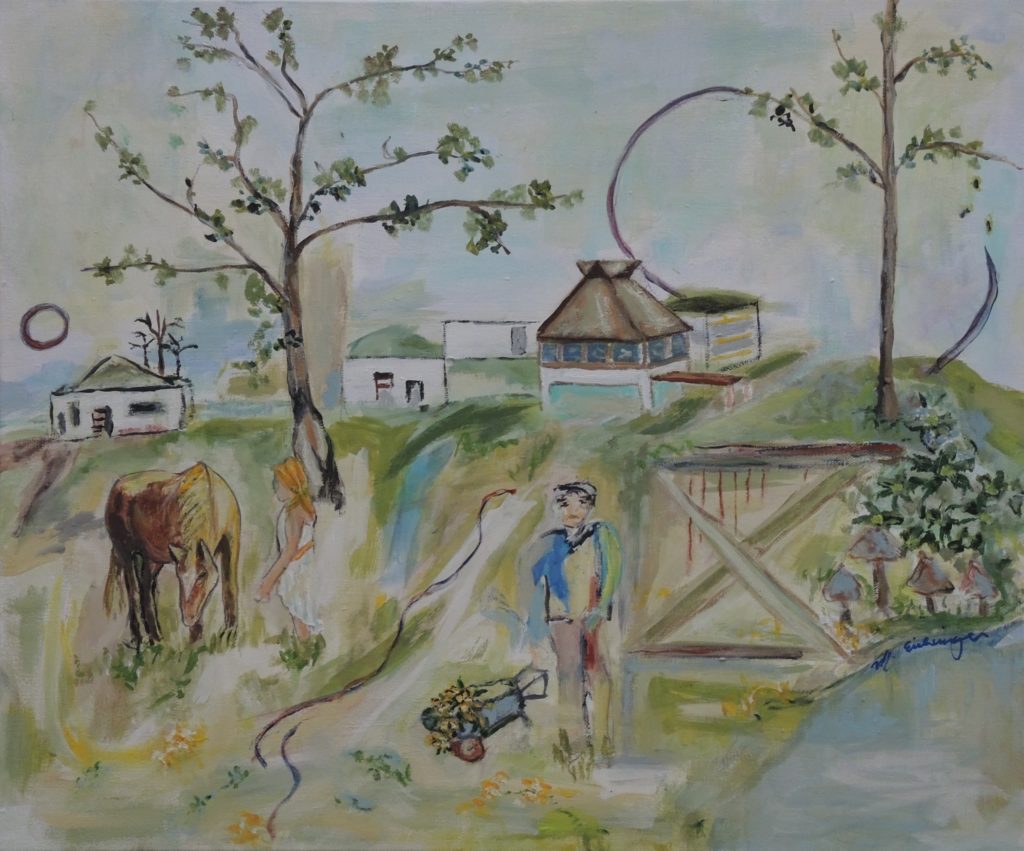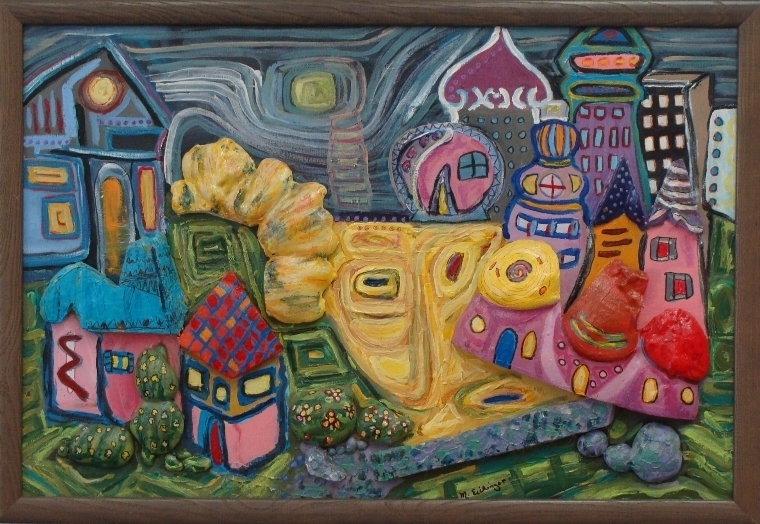
Best of Times / Worst of Times, Part II


Russian Escape

Mixed Media, 3 -D/ 26” x 38” / $ 650
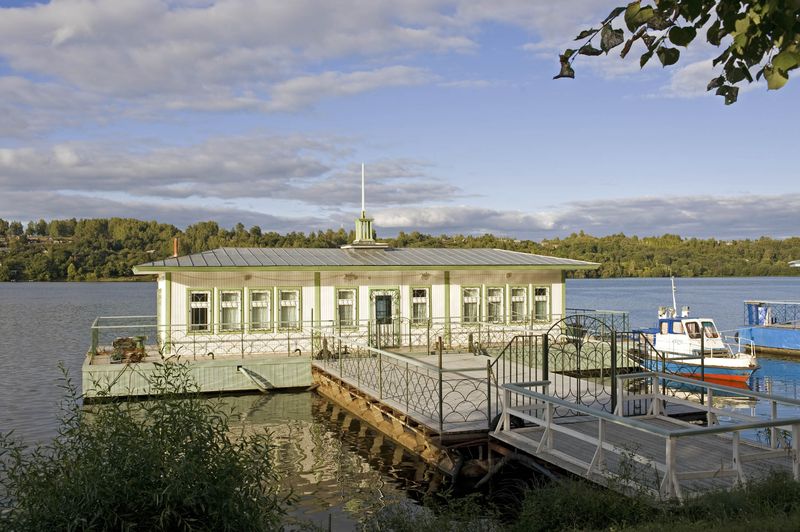
In Russia, the wealthy escape to luxurious homes on the Volga River known as Dachas on. During the communist revolution, Dachas were converted to vacation homes for workers but they have again resurfaced for the elite as exemplified by this seven-figure houseboat on the Volga and a restored traditional wood house in Plyos.

The Best of Times, The Worst of TImes

Fact Checking – In a late December interview with Prince Harry of England, President Obama touted that this is the best of times to be alive. He said that the world is more tolerant, less violent, and that people are healthier, subjects I touched upon in last week’s newsletter. I continue his optimistic statement this week by considering wealth, education, and what might be meant by being more sophisticated.

Part II

Is the world wealthier? When I hear that the world’s eight richest people collectively have the same amount of wealth as the poorest 50 percent of the world, I wonder if dangerous problems lie ahead due to the concentration of wealth among a few. Though the world as a whole might be wealthier, most people do not benefit from this boom. The bottom half struggles to survive. It is grotesque that a handful of rich people are equivalent to 3.6 billion souls living in poverty.

Bill Gates is one of many who echo Obama, agreeing that economic indicators show the world getting wealthier. Yet, when you probe further, he also says that inequality does not matter, which seems to me to be quite a bizarre assessment. The World Bank certainly does not agree with him for it reports that, “No country has successfully developed beyond middle-income status while retaining a very high level of inequality in income or consumption.” In general, those nations with great inequality have higher murder rates and lower life expectancy.

Poverty is defined as a lack of resources needed for a decent life – food and water, housing and energy, healthcare, education, and employment. It is about not having power and being unable to improve your situation. The world’s poverty line is set at $ 2.50 per day and the number of people living below that line increased by 15 percent between 1981 and 2005. So, no. . . the poor are not getting wealthier.

Not only do a handful of billionaires make an extraordinary amount of money, they employ most people. Home Depot’s Bernard Macus and Arthur Blank have over 385,000 employees, Warren Buffet at Berkshire Hathaway, 331,000, Frederick Smith of Fedex, over 400,000, and Peter Buck of Subway over 450,000. If Sam Walton of Wal-Mart were still around he would be credited with 2.3 million jobs. The number of those employed by the world’s 1,645 billionaires (according to Forbes) continues to grow. Don’t think for a minute that wealthy, mostly men, do not control our lives, for they do.

For example, government is influenced by their excessive wealth, for billionaires have the funds to lobby for tax benefits for themselves while making sure that needed government revenues will come from their employee’s taxes. US Tax Code as passed, is designed to permanently benefit corporations and protect the personal savings of the wealthiest but benefits for the middle class are set to expire in five years.

Last year’s stock market went up up by 19 percent. With a simple call to a broker, a billion dollar investment tied to an index fund returned $190,000 million. It is difficult for anyone to spend that much money for groceries, entertainment, cars or housing, so what happens to excessive gains? Will this windfall be plowed back into the economy? Will salaries increase so that those with more modest salaries also benefit?

To answer these questions we need to look at whether Reagan’s trickle-down economics could work under the right circumstances. Douglas Holtz-Eakin, president of the American Action Forum response is, “Trickle. Shmickle. You don’t need a Ph.D. in economics to see that something’s wrong with trickle-down theory. If it were true, inequality would be self-limiting. As soon as the rich started getting richer, wealth would cascade like the Niagara down to the benighted lower classes. Instead, the gap between rich and poor keeps growing.”

The International Monetary Fund concurs that trickle down economics backfires. It isn’t long before policies get instituted that hurt growth. The upper echelon pushes for deregulation of the financial system and puts the middle class at risk. Conflicts become more prevalent, social trust diminishes, and cohesion dissolves. Reasons are well documented as to why policy makers should pay more attention to low wage earners than the wealthy. When the bottom 20 percent of a nation’s population increases its share of national income, stronger growth follows on average within five years.

Among wealthier countries world-wide, poverty has risen since the 1990s. As the ranks of the poor grew, the rich get richer. In our own country, since 2000, the share of middle-class families has shriveled in all 50 states. The United States is an example of runaway inequality. Last November, Bank of America Merrill Lynch surveyed the CEOs of major corporations about how they would invest their foreign-held profits if they brought them back to the states. The majority said funds would be used for debt repayment, share repurchase, and mergers and acquisitions before capital spending. Few businesses planned to increase investments in areas that will benefit middle class Americans, concluded a Wall Street Journal article.

The tax plan that passed in December has winners and losers. The winners are Real estate and other pass through companies, energy drillers, sports team owners, major corporations, tax lawyers, those who don’t want to pay for health insurance, those who will now inherit up to $11 million tax free. The Losers are commuters, residents of high-tax states like New York, New Jersey, and California, and everyone who will now have to contribute to interest payments for a higher budget deficit. 50 Percent of Americans will see their taxes increase after 2025 and 13 million will lose health insurance. Too bad I am not a real estate billionaire like our president, for if I were, I might have had champagne to welcome in the New Year.

Are the People of the World Better Educated? Once more we have to ask ourselves, better educated than when? If we consider primitive societies where learning was passed down from parent to child and tribal member to youth, all children were educated in survival skills. In Egypt, Greece and Rome centers of learning existed since 3,500-3,000 BCE, though the opportunity for literacy were only available to a privileged male elite. It wasn’t until the Middle Ages that book production increased yet it still took centuries for literacy to become universal. Middle class children who were not farmers, were taught by parental example or in the trades in multi-year apprenticeship programs.

If we consider the last two centuries, when literacy became important, then yes, according to the dozens of articles I read, rates have risen globally. Increases are primarily due to enrollment in primary education though in sub-Saharan Africa many countries lag behind with literacy rates below 50 percent of youth. A growing body of research suggests that better education is associated with higher individual income and long-term economic growth. Throughout the world here are large generational gaps, for younger generations are progressively better educated than older ones. In the United States, even low-wage earners are better educated than they were in 1979. For example, in 1979, 39.5 percent had not gone to high school while in 2011 only 19.8 percent had not attended.

It is interesting to note that according the Economist, Immigrants to America are better educated than ever before. Half of all legal migrants have college degrees contrary to the popular belief that they are low-skilled. There is growing interest in the House of Representatives in having a points-based immigration system similar to that of Canada and Australia that gives priority to migrants with degrees, work experience, and fluency in English rather than to families as is the case in America today.

Is the world more sophisticated? I have not the slightest idea and am not sure what President Obama had in mind when he said it was.. What do you think?

Please comment below on my blog site.It will be interesting to hear your comments about these last two newsletters.

Art is always for sale. Contact me at marilynne@eichingerfineart.com

References:

1. Elliott,L. 2017. World’s eight richest people have same Wealth as poorest 50%. The Guardian. retrieved from https://www.theguardian.com/global-development/2017/jan/16/worlds-eight-richest-people-have-same-wealth-as-poorest-50

2. Social Justice Website. 2017. Myth #1: The Poor are Getting Richer. Social Justice Now. retrieved from http://www.globaljustice.org.uk/myth-1-poor-are-getting-richer

3 . Blankfqld,K. 2016. The American Billionaires Behind the Most Jobs. Forbes. retrieved from https://www.forbes.com/sites/kerenblankfeld/2016/10/18/american-billionaires-behind-the-most-jobs/#5b03e27c693f

4. Coy, P. 2017. The Best Way to Spur Growth?Help the Poor, Not the Rich. Bloomberg Business Week. retrieved from https://www.bloomberg.com/news/articles/2017-11-30/the-best-way-to-spur-growth-help-the-poor-not-the-rich

5. Picchi,A. 2015. Is Trickle-down Economics to Blame for Inequality? Money Watch. retrieved from https://www.cbsnews.com/news/the-failure-of-trickle-down-economics/

6. Boak, J. 2017. A look at some winners and losers under the GOP tax plan. ABC News, retrieved from http://abcnews.go.com/Business/wireStory/winners-losers-gop-tax-plan-51903730

7. Roser,M and Ortiz-Ospina,E. 2017, Global Rise of Education. Our World in Data. retrieved from https://ourworldindata.org/global-rise-of-education

8. Economist. 2017. Immigrants to America are better educated than ever before, The Economist Print Edition. United States. retrieved from https://www.economist.com/news/united-states/21723108-far-being-low-skilled-half-all-legal-migrants-have-college-degrees-immigrants


Questioning Life

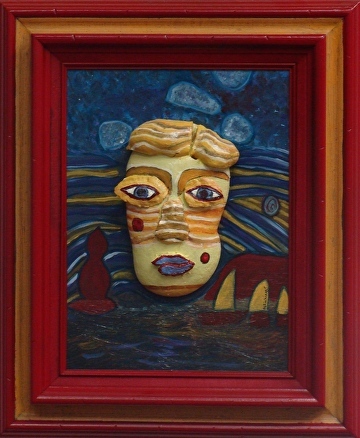
On Top Of It All
20” by 19”, Mixed media, $399.
Questioning how to give meaning and purpose to life is ongoing. Answers evolve and change with age and circumstance.

Winter holidays usher in a joyful bustle of activities with family and friends but since it is the end of one year and start of another, they are also a time to pause for reflection.

When I was sixteen my boyfriend asked, “which is better a life of love or a life devoted to a quest of knowledge and its application to living?” Without hesitation we both chose love, but as years passed, there were times when the quest for knowledge and career ambitions made us rethink our answer. Today I would respond by saying both.

My memory was stirred by an article I read this week on BBC’s news website. Educated Indian women were forced to give up doctoral ambitions to improve people’s health care in order to be full time mothers taking care of their families. Married women “are not expected to want the privilege of thinking and doing research,” said one of homemakers interviewed. Yet, in India, woman are starting to speak up and not give in to custom. They are finding ways to continue their research through online virtual laboratories and participation in conferences conducted through Skype. Instead of being confined solely to housework, these highly educated women have options never before imagined.

Many other questions were raised during my college years. What is the meaning of life and what idoes it mean to live well? Is there a God? What ethical system should I embrace? How will my activities and choice of profession contribute to society? These questions became buried when raising five children and beginning a career. But every once in a while, a decision had to be made that gave me pause to think. Should I choose advancement, money and accompanying stress over family harmony? Do I go on a business trip rather than stay home with a sick child? Is what I do more important than my husband or children’s ambitions?

From time to time these basic questions suddenly pop up and demand an answer.
As an elder, I am once more reflecting on life’s meaning. When I hear friends saying, “I’ve done enough for others. Now it is time to complete my bucket list,” Is that the best way to conclude my years? But somehow this remark doesn’t make sense. What difference does a trip to Bora Bora, sky diving, or snow shoeing in the mountains make?” These activities can’t be the purpose of living. They can only be a way to pass idle time while waiting to die. Why spend the money? Why change the way I find purpose in life? Then again, why not?

Deciding how to live is not just a quest of the young but it is a multi-year process that twists and turns with experience and circumstance. My answers have been challenged many times  as I developed a deeper understanding of the environment and the earth’s far flung inhabitants. Today when I ask what type of person I want to be and what makes life meaningful, I continue to look to the future— not of mine, but of those who will follow me. I still hope that the world will be a better place for my children and grandchildren to live in and would like to share my mistakes and achievements so they can move on from where I leave off. My ongoing quest for knowledge is pleasurable and gives me much do, but I am less focused on a need to achieve and more interested than ever in educating. Helping young adults known as the “me generation”  overcome this stigma seems like a fulfilling mission. Inspiring them to embrace a life of love and giving to others is a gift I would like to leave behind.

Merry Christmas to all.

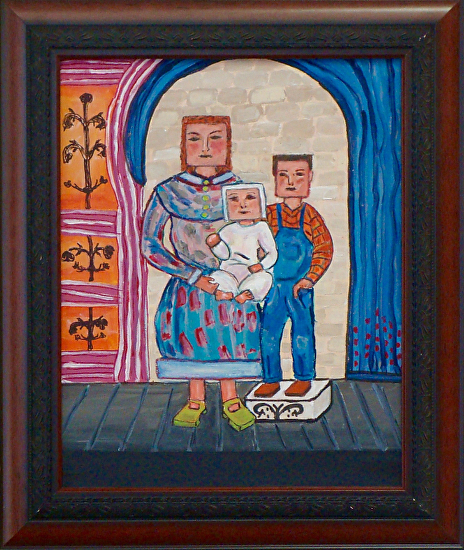
Without Love, What?

Meet the Blockheads

Acrylic on Canvas with glossy polyurethane finish. 26” by 22” / $385/ framed

Without Love, What?

Those fortunate enough to be showered with love during their childhood are likely to become healthy, well adjusted adults.

Without Love, What?

The following passage is taken from the manuscript of Over the Sticker Bush Fence: Scaling Barriers for Homeless and Runaway Youth. In this section I discuss what happens to children who are raised in loveless surroundings. The book is presently under consideration for publication by a well known publisher. It is not too late to comment and I look forward to your insights.

In my naivety, I assumed that love was instinctual and that every newborn, no matter how poor, is a recipient of parental attention. Without some level of care a helpless infant could never survive. But I quickly learned that feelings of responsibility vary from person to person as do emotions elicited by love.

From the manuscript.

“The majority of us are fortunate for we are surrounded by loving parents and relatives. As infants, family members held and cherished us and as adults, we find partners and form bonds based on love and mutual respect. But what happens to children who are never caressed or told that they are special? What are the long-term effects of never having being touched and cuddled? What befalls those children who are physically abandoned, left on door steps or placed in cribs and not attended to when they cry or diapers need changing?”

“A cornerstone study about infant neglect was initiated in the 1980s when Dr. Nathan Fox and colleagues from Harvard Medical School, walked into an orphanage in Romania. Due to a recent ban on abortion, the number of orphan babies had soared. 170,000 children were placed in 700 overcrowded and impoverished facilities across the country, staffed with an insufficient number of caretakers. Though the facilities were clean, the infants were emotionally neglected. Left day and night in their cribs, the babies were changed periodically and fed without being held. The nurseries were eerily quiet places. Since crying infants were ignored, they stopped making sounds. No attention—no cries—only silence.”

“Dr. Fox followed these children for over fourteen years. During the early years of the study, autistic-like behaviors such as head-banging and rocking were common. As the children grew their head circumferences remained unusually small. They had difficulty paying attention and comprehending what was going on around them. Over time, 50 percent of the children suffered from mental illness. They displayed poor impulse control, were socially withdrawn, had problems coping and regulating emotions, and were shrouded in low self-esteem. They manifested pathological behaviors such as tics, tantrums, stealing and self-punishment. Poor intellectual functioning caused them to have low academic success.”

“Those children lucky enough to be put in a caring foster home before the age of two were able to rebound. Unfortunately, those who entered foster care at a later age were not so lucky, for they were permanently damaged.” . . . .

“Without repeated acts of love, a child’s brain doesn’t make the growth hormone needed for proper mental and physical development, leaving the child permanently scarred. Even small insults of shame and rejection can impact a youngster’s ability to develop in a healthy manner. Verbal abuse from adults who say such words as, “I can’t believe you would embarrass me like that,” or “You Idiot! Who do you think you are?” hurt and affect a child’s self-esteem. This type of verbal abuse can lead a child to be cruel to animals, set fires, take drug, and self-withdrawal.”

Parental warmth and love are crucial for a child’s well-being. Writing for Psychology Today, Christopher Bergland concurs that “Toxic childhood stress alters neural responses linked to illness in adulthood.” He writes of a 2013 study published in the Proceedings of the National Academy of Sciences where researchers examined the effects of abuse and lack of parental affection across the regulatory system. They discovered a biological link between negative experiences early in life and poor health in later years. The brains of unloved, neglected children are permanently affected. Their stress levels are high, setting the stage for elevated cholesterol levels, cardiovascular disease, metabolic syndromes, and other conditions that pose a serious health risks.”

“The study was able to document what most healthy families have always known, that children need to be showered with love and kindness and live in a welcoming environment. Love is what helps youth develop defense mechanisms that provide a buffer from abuse and trauma.”

“A good example of the importance of early love is found in Zach’s story. He was loved as a child even though neglected and at times abused by parents high on drugs and alcohol. That he was occasionally smacked and at times not fed, was not as important in the long-run as knowing he was wanted. He was fortunately part of an extended family that lived nearby, so when the situation became intolerable, he often found shelter with relatives. This early attention sustained him through difficult times and made him able to transition as a caring individual.

“Those growing up without the gift of love are not so fortunate. “Charlie” was left alone in his crib for hours on end. When he cried there was no-one there to pick him up and comfort him so eventually he became silent. His diaper was changed irregularly and rashes developed causing more discomfort. While being fed, a bottle was propped on a pillow by his mouth while he lay still in his crib. He rarely felt the warm arms of a loving adult. He remained listless and grew slowly, learning to sit and crawl months after what was developmentally appropriate for his age. By the age of two, he was more like a one-year-old. Over the years “Charlie” never caught up.”

* * *

Parents, there is no such thing as showering your children with too much love. However, I share a cautionary note. Love is not to be confused with spoiling. It does not equate with letting the child do anything he or she wants to do. Parents are responsible for teaching their children the social and cultural mores of society. There are times when “tough love” is called for in order to instill responsibility. But love may also mean, picking your child up over and over again each time he falls down.

References:

1. Nelson, C. & Fox, N. & Zeanah, C. (2014) Romania’s Abandoned Children, Deprivation, Brain Development, and the Struggle for Recovery, Harvard University Press.

2. Parks, G. (2,000) The High/Scope Perry Preschool Project. U.S. Department of Justice; Office of Juvenile Justice and Delinquency Prevention. retrieved from https://www.ncjrs.gov/pdffiles1/ojjdp/181725.pdf alsoRand Published Study http://www.rand.org/pubs/research_briefs/RB9145.html

3. Bergland, C.( 2013) Parental Warmth is crucial for a Child’s Well-being. Psychology Today. retrieved from https://www.psychologytoday.com/blog/the-athletes-way/201310/parental-warmth-is-crucial-child-s-well-being

4. Smith, D. Effects: of The Lack of Attachment. Addictive Behavior Counseling School Student Lecture notes. retrieved 2017 from http://www.darvsmith.com/dox/lackofattachment.html

I would love to hear from you. Please comment below.

Artwork is always for sale. Contact me at marilynne@eichingerfineart.com.

Social Justice

Mean Aunt Martha

An unfulfilled life led her to drink. Her children unfortunately suffered.
acrylic on canvas/ 30” x30”/ gold frame/ $ 399

The following excerpt is from my latest manuscript. Over the Sticker Bush Fence: overcoming barriers for homeless and runaway youth will hopefully be in print in the near future. The printing business moves slowly and methodically. I do look forward to your comments.

Social Justice

“Life has a way of repeating itself, transferring experiences through time from one generation to the next,” said Kate Lore, who at the time was Social Justice Minister at the Unitarian Universalist Church in Portland, Oregon. “As an adult, I’ve worked hard to break the conditions and mindset of poverty experienced by my ancestors, but doing so has not been easy. This is due not only to the lack of resources but to a culture of shame and secrecy. It’s as if part of my destiny is being controlled by unnamed family ghosts.

“The story of my father’s side of the family dates back to Monticello, where my Irish forebears served as indentured servants of Thomas Jefferson in return for passage to America. These farmers eventually paid off their debt and slowly migrated westward, first to Minnesota and then to California. Generation after generation lived hardscrabble lives, never owning the land they farmed, never getting a good education but always working, working, working. Many of these relatives could be characterized as bad apples. Unspoken shame still permeates the family relating to the fact that my father was the product of a forced incestuous relationship between his teenaged mother and her cousin. Also, my paternal grandfather never met his son nor me because his entire life was spent locked up in prison. Though I know he eventually died of cancer, I’ve never found anyone who would tell me what he had done to land behind bars.

“Knowledge of my mother’s family dates back to the Dust Bowl. Though I tried, I never found a relative willing to talk about the past. What I do know is that my mother’s family shared many similarities with my father’s. They were poor, hardworking tenant farmers who migrated west in order to feed their family. They, too, ended up in California, seeking a better life. But like characters out a John Steinbeck novel, Mom’s side of the family migrated to Monterey’s Cannery Row to work the anchovy canneries. I still carry memories of Cannery Row. It was the era before it became a tourist destination: the smell of fish and stale booze, the site of rusted boat hulls and passed-out-winos and the sounds of seagulls screeching over the next incoming fish haul are captured in my mind. Industrial Cannery Row faded over time and eventually the cannery jobs did, too. My grandparents never escaped the poverty and alcoholism that has plagued and continues to plague, my mother’s family.

My parent’s lives came together in the mid-fifties. They met as young adults in church, both eager to break free from their families of origin and have good lives. Married in 1957, their first child came along three years later. Tragically for my sister and me, their love did not last long. By the time of my birth, Dad was having an affair with another woman.

Born in 1960, I was unaware that my parents were not doing well as a couple. At six months of age, Mom moved her children to join Dad in Tanzania where he had accepted a teaching job. She hoped by doing so that his affair would end. My sister, who was then three and I spent the next several years speaking Swahili and living among people native to that land. I found out later that during the entire three years we lived abroad, my father had continued corresponding with the woman with whom he’d been seeing before we left. But the final shock did not set in until we arrived back home to the San Francisco airport. My mother still had luggage and children in hand when my father turned to her and said; “ This is where we part ways. I’m leaving you. You are on your own.” With that announcement he took a few of his personal belongings and left the airport to live with his lover. I would not see him for many, many years to come.

We found ourselves stranded, possessing nothing. We did not know where to go, nor did Mom have any idea of how she was going to find our next meal. In this emergency situation she wound up moving back to her childhood home with alcoholic parents, not a safe place for kids of any age, and bad for little ones who had just lost their father. It was worse for my sister than me, though, because she was always Daddy’s little girl, the one who had my father’s heart. . . or so she thought. Once abandoned, my dark-haired sister started acting out. She became the “evil one” in the family, and I, a blond, reacted by becoming super sweet. My behavior was an effective survival technique. By being a loving, cuddly kid I could get what I needed. I may have been plain but I was smart. Looking back I wondered if my lifelong “good girl” behavior was largely a reaction to the way my sister acted. I’m not sure. But I have come to believe that my compulsion to be good and the compassion I have for others comes from someplace deep within.

Without a college degree, the only work my mother could find was minimum wage employment. When she worked we were left to the care of our grandparents. Two lively little girls living with inebriated adults was a dangerous situation. That became especially apparent when one one day my grandfather had had enough of the noise my sister was making. He drunkenly grabbed a fork and lunged to stab her in the hand. Thankfully she moved in time or she would have been maimed. Mom realized at that moment that she had to move on but again was lost about what to do and where to go.

She sought advice from a previous mentor, a woman who had been her second-grade teacher in elementary school. Connie Sellars had taken a liking to her as a youngster who came to school from an alcoholic family. Connie got her involved in church and encouraged her to sing in the children’s choir. She and my mother remained friends, writing to each other throughout her trials. Being a Good Samaritan, Connie offered us a place to live in a nearby house that she had recently inherited, asking only $75 a month in rent, an amount that was never raised over the years. If it were not for the kindness of this one individual, I’m not sure what we would have done. Housing is a prerequisite to so many things: security, status, and stability.

Still, I felt shame living in our house. Paint was peeling off the walls and the grass was never cut because we could not afford a mower. We never owned a car which meant that for ten hours a day my sister and I were left at home to raise ourselves while mom rode buses long distances to work as a clerk typist in a distant school district.

Neighbors felt sorry for us, two little urchins abandoned by fate, and they treated us kindly even though our presence “brought the neighborhood down.” They helped fill the house with cast off furniture, responding to our needs compassionately. I attribute their help to the fact that homeless families were a rare phenomenon back then. Neighbors were less inclined to judge us and more inclined to help out. The era was before the 1980s when America suddenly began demonizing the poor. Americans still had compassion for the destitute and had not yet been exposed to Ronald Reagan’s portrayal of single moms as being lazy, unproductive “Welfare Queens.”
_______
Kate survived her difficult childhood due to the camera and compassion of neighbors, church members, and educators. The adage, “it takes a village to raise a child” is a wise one that benefited her. Now, as an adult she decided to give back to the community as a minister focused on social justice. She left the church last year for employment with Volunteers of America where she oversees a large network of shelters for abused women. Childhood experiences often affect the career choices we make. Rather than be succumb to self pity or depression she saw life’s beauty and wants to share her blessedness with those who are less fortunate.

A few questions to answer below:

Did you ever have a childhood experience that influenced your career choice?

Have you been motivated to help someone outside of you immediate family?

There are thousands of children in the United States who would benefit by having a mentor. Ever think of getting involved with one or more of them? If so, please, share you experiences.

Art is always for sale. Please contact me at marilynne@eichingerfineart.com.

Dynamo for Change

THREE SUNS
40” by 30” / Acrylic on Canvas / $ 499

Scorching Sun allows fires to burn so that Earth appears dry and lifeless. Life hovers underground waiting for Mother Nature to help it reemerge to make Land beautiful once more.

Dynamo for Change

Over the Sticker Bush Fence is a book in progress about homeless and runaway youth. In it I discuss the difficulties caused by childhood neglect and abuse. Over the past three years I interviewed many people who were motivated to work with this population because of experiences they had in childhood. Today I would like to introduce you to Sean Suib, the executive director of New Avenues for Youth. Sean has a special interest in the plight of foster children. Following is an excerpt from the manuscript.
_____________________________________________

Dynamo for Change – Sean Suib – New Avenues for Youth

“Our foster system is broken,” Sean Suib said forcefully. “The only way we are going to fix it is to get it out of the hands of the government. There are smart people in the system but they can’t change anything. The system, like the children they serve, is traumatized. There is not enough money to operate successfully, but that is only part of the problem. Because the system operates out of a place of crisis, it cannot think strategically or even beyond its most basic function, survival. Evidence of this can be seen in the many recent highly publicized examples of the system failing to act to keep children safe, despite clear information about danger. I don’t want you to think the people running the system are bad, to the contrary, there are man caring, hard working, and well-intended people. They just can not get beyond their systemic crisis to prevent its perpetuation. To understand the intersection between foster care and homelessness for youth, it is helpful to think about the Department of Human Services (DHS) as an impoverished single parent responsible for rearing 10 children at the same time. With too little money to meet every child’s specialized needs, DHS can only focus on keeping the most vulnerable children as safe as possible. Older children are less vulnerable when compared to younger, higher needs youngsters. By the time they get to be an adolescent, a system like DHS is not designed for, resourced for, or able to focus on or meet a teen’s needs. As a result, 50% of the kids who leave the foster care system at the age of 18 find themselves homeless within three years. The private sector needs to take over.”

I was sitting across the table speaking to this tall, handsome man whose every pore seemed energized as a change agent. As director of New Avenues for Youth, he moves purposefully among the many challenges he has to confront each day. Though busy overseeing the center’s diverse programs, he had invited me into his small office and graced me with his rapt attention as though I was the only thing in the world that mattered. In my effort to understand the basis of youth homelessness, I had not considered the foster care system and wondered what should be done. Sean shared his thoughts.

“There are critical intervention points that have to be addressed before transitioning a child out of state supervision. Children need social capital, people not paid to be in their lives, who can be called at 2 in the morning if needed. They need to learn life skills, accountability, given leadership opportunities and ways to connect with their community to practice the skills of being an adult. Programs like ours try to sprinkle as many of these proactive experiences into the young person’s life as possible.”

I quickly learned that New Avenues was quite innovative in their approaches and that their work with youth had come a long way from the juvenile detention policies practiced in the past by social service agencies in conjunction with the judicial system.

“We are beginning to understand the unique circumstances that face foster children,” he responded with intensity, making sure that I followed his words. “Many of them have spent years being shuffled from one home to another, often falling through the cracks educationally and emotionally. We already are making a difference with an array of programs and targeted interventions. One of the interventions we are most excited about is a partnership with a non-profit called Bridge Meadows. Bridge Meadows is a multi-generation housing community in which low-income seniors live in community with families that have adopted young foster children. In this model, the entire community works together to help heal and raise these kids.

recently combined resources to build a second housing facility (15 unit apartment complex) dedicated to youth aging out of foster care. Named New Meadows, the facility will sit on land adjacent to the Bridge Meadows campus and leverage relationships and social capital to foster youth as they move into adulthood. New Avenues will wrap a comprehensive program around housing residents by providing mental health counseling, case management, life skills classes, education and college support, and job training.”

As I listened to Sean talk I couldn’t help but imagine that he could have been a successful businessman, spending his working hours amassing a small fortune for his family. He is engaging, has people and organizational skills, and is a strong spokesman for his cause. Sean knows how to work with teams of people in the community from low income to wealthy donors who make up his board. He is also a practiced tradesman with years of construction experience. It would have been logical for him to run his own company, yet he chose to work with the disenfranchised. I wondered why Sean selected a non-profit route. Why was he so ferociously passionate about what he was doing? With little prodding he shared his story.

_____________________________________________________________

Sean’s path to the directorship of New Avenues was inspired by a rocky family life that made him fend for himself at an early age. His journey took him through traumas caused by drugs, divorce and neglect. Sean’s early employment at Janus Youth Services and Outside In provided experience and insight that enabled him to identify holes in the welfare system. Once Over the Sticker Bush Fence is released you will have and opportunity to see how he was influenced as young and why this entrepreneurial dynamo would choose to help those less fortunate.

Do let me know if you think of these last two posts from my new book, Over the Sticker Bush Fence. If you have suggestions, now is the time to make them, since it has not yet been published.

Art work is always for sale. Contact me at marilynne@eichingerfineart.com.

Importance of Community

Articulated Whales By Ray Losey

Traveling in Community

To see Ray’s totems and masks go to RayLosey.com

Importance of Community

Over the Sticker Bush Fence is a book about homeless and runaway youth. It discusses the difficulties that arise due to childhood neglect and abuse. During the past three years I interviewed many people who were motivated to work with this population because of experiences they had in their own childhood. I introduce you to Kanoe Egleston, a woman employed by Native American Youth and Family Services (NAYA} who learned to value the importance of community. Following is an excerpt from my soon to be published book.

“Born on the outskirts of Oahu, Hawaii, Kanoe grew up surrounded by the love and attention that all children deserve. “My father was employed by the Bishop Estate, a non-profit land trust donated by Bernice Pauahi Bishop, the great-granddaughter of King Kamehameha the great, who united the Hawaiian Islands during the 18th century. Mom worked her way up as a customer service representative at the local telephone company,” Kanoe mused. “Dad enjoyed his job with a culturally responsible agency for it gave him an opportunity to bring his values into their service delivery system.”

His ethical attitude played an important role in developing the young woman who sat across from me in NAYA’s offices. Dark hair and flashing brown eyes sparkled when discussing the work she was doing. She leaned forward as she spoke, peering directly at me to capture my complete attention. The island Kanoe grew up on was replete with relatives who entertained and shared their heritage with the youngsters born into their extended family. Her multiracial background—she says she is part Scottish, Puerto Rican, Chinese, German, Portuguese, Japanese, Hawaiian—helped her grasp the nuances of being a member of a population that deviated from the majority.

“My grandmother taught me a lot,” Kanoe said. “Grandma met her husband during the second world war when he was stationed in Japan. They married and had two children who they brought to the island to raise. At the time Pearl Harbor was still on the minds of most people ‘ya know, and a Japanese wife was not welcome. Grandma Americanized her name, stopped speaking her native language and buried her background. As a result, her children grew up ignorant of part of their heritage.

It wasn’t until we grandchildren came along that she decided we were missing a great deal by not knowing where we came from. Grandma set her mind to teaching us to speak Japanese, learn some of the traditions and do crafts such as flower arranging. In college, I continued to study Japanese.”

At the age of eighteen Kanoe decided to expand her horizons by attending college in the States. “Leaving home and going to the mainland was traumatic. Until that time I lived a pretty charmed life attending private Montessori and Waldorf schools. Mornings were filled with academic subjects and afternoons were for the arts, music, and crafts. There were no grades but the staff gave total attention to developing each child’s strengths. There were only 17 kids in my graduating class.”

Kanoe mentioned with nostalgia, “It wasn’t until I went to the University of Oregon that I realized how different my upbringing was. My Hawaiian skin was darker than that of most students and it isolated me. Even the way I spoke English was different. Common words I used in conversation were not understood by my classmates and vice versa. If it wasn’t for the university’s peer mentorship and diversity program I don’t think I would have lasted.”

“What made you decide to work with disadvantaged youth?” I asked wondering how anyone with such lovely bronzed skin would have difficulty being accepted. She looked every bit like a poster beauty welcoming visitors to the island with a hula.
“Being thrust as I had been, into a racial and cultural divide, made me interested in working with homeless teens. I decided to get my undergraduate degree in psychology and sociology. Part of the program included working with disadvantaged youth. It made me realize what happens when children do not grow up in a loving circle. I realized that my community was how I stayed alive and had hope. These kids felt hopeless. ”

Kanoe’s story reinforces the importance family and friends play in molding a young person’s life. In community, a child learns to trust others, develops socialization skills, and imbibes and ethical consciousness. Those bereft of a caring community may feel an emptiness and longing that leads them to join a gang for support. Others escape to the streets where they there is a transient community of youth to call “friends.” It is a mistake to think that these adolescents don’t have values, for they do and quickly adapt to a complex system of street rules. Extremely loyal to their new companions, many will even go to jail rather than “rat” or leave them stranded. Though street values may appear to be directed against the broader society, they are a strong base for change. Mores that include sharing, loyalty, and a willingness to give emotional and physical support are building blocks needed to create a just society.

Preparing Your Body for Emergencies

Surf’s up

Who knows what a rising sea will portend?
Acrylic on Canvas/ 48” by 36” / $ 600

Preparing your Body for Emergencies

Over the past six months, one disaster story after another was the featured news story. These tragedies brought to light how important it is to be prepared for emergency situations. Agencies like FEMA advise us to have certain supplies on hand, where to go for shelter, and how to get in touch with love ones. They suggest shuttering windows and moving to safe quarters in case of a hurricane and to move to a storm shelter or small interior room to avoid being hurt by a tornado. If caught in a fire we are told to crawl on the grain and not to reenter the house to retrieve something. With earthquakes, sirens will sound and we are to stay away from windows and hide under a table to avoid falling debris. And in case of a tsunami or flash flood, take off immediately to higher ground.

In my earthquake prone part of the country, we are instructed to keep 14 gallons of water on hand per person which is difficult to store to do. And so the list goes on for we know that life is not always fair and unexpected events can come tumbling our way.

Though we are unable to control everything in our environment we can certainly take precautionary steps. Yet, there is a subject, that is not mentioned in emergency response documents, and that is how to prepare your body and mind to face such tragedies. They speak of supplies to have on hand and places to go for shelter but don’t advise us as to what physical abilities are minimally needed to live through a catastrophe.

I was proud of my granddaughter who survived the volley of fire that recently rained down in a Las Vegas concert. Though standing up front, excellent survivor instincts and a well tuned body saved her life. With the first shots she ducked and then, when there was a lull, with one boot on and another off, she took off over the bloody floor towards an exit. Her reflexes were swift and her thinking clear as her limbic system (fight and flight) provided her the necessary energy to find safety.

As we prepare our homes for emergencies it makes sense to also train our bodies in order to react quickly and purposefully. With a bit of advice from Anita Stark, my exercise trainer, I offer a few basic suggestions.

Learn to calm your mind. This skill is the most important one to mention. When trauma strikes, blood pressure tends to rise along with adrenaline bursts which have a way of producing a frantic go-go reaction that may not be helpful. Both body and mind need to be sharp enough to navigate through the event. Mediation, mindfulness, and yoga are practices that focus on calmness. These trainings involve learning to breath deeply in from the nose to clear the mind and exhaling all air out through the mouth before taking action. When a tree landed on my house and shook the foundation, shattering glass and sending objects flying, I felt my heart pounding while my adrenaline went sky high. I had to speak to myself saying, “Marilynne you are a meditator, use your training,” and immediately started doing well practiced breathing exercises. Within one minute I became calm and able to proceed with damage control.

b) Be sure you can get up quickly from the ground. Sit in different positions then rise in a spiral motion using all four corners of your body so that it is comfortable and easy to do. Lie flat on the floor and roll over on all four sides of your body before rising. Emergencies often involve being able to be mobile on three planes—high, middle, and low. If the ground is shaking and objects are flying, you may need to protect your head by turning it face down under a chair or table before you get up to exit the building.

c) Practice moving on your stomach in a creeping army type crawl and then on you knees like a baby. A smoke filled house requires you to stay low to the ground to avoid lung damage. Having the ability to propel yourself forward in this manner might save your life.

d) Challenge your balance. While cooking or brushing your teeth stand on one leg and then the other. Once you can do that with ease, swing the elevated leg in different directions until you can maintain balance. Try balance activities wearing shoes and again while barefoot. Both ways give you different challenges which will be an aide if you need to climb over fallen objects without falling.

e) Move around your home without wearing shoes. In an emergency there is no time to find them. Let you feet become sensitized, for they are like hands that touch the earth. Walk outside on uneven ground, on a trail or over land scattered with rubble. Step over branches and get used to uneven concrete. This is a good practice for many types of disasters or visits to third world countries. Ecuador’s sidewalks had indentations, uplifted sections, uncovered holes, and driveway protrusions. I fell flat on my face the first day I was there because I looked up at falling telephone wires instead of down. I assure you I did not make the same mistake twice.

f) Learn to sink and pivot your body quickly (keeps your joints mobile). Try sprinting a few steps, pivot and change direction. Look around and be prepared to move in the direction of your stare. A friend of mine was in an explosion in an accelerator at Harvard. He immediately moved away from the sound and ran to the exit. And though he suffered some burns on his back, the damage was not as severe as it was for those who froze and looked to see what happened before moving.

g) Walk quickly through your house and out the door. Try doing it again in the dark. Sensitize yourself to move without light in a small space, like your bathroom, before tackling the stairs or a large room. In a smoke filled building or in a nighttime event it may be difficult to see before you.

h) Add strength to your hands and arms so you can carry, push, and lift a small child to safety. When thrown from a raft while in the Amazon, I was caught in a whirlpool two feet under the surface. Though I did not panic for I knew I had the strength to push myself up, I struggled to aid my rescuer. Instructed to grab cleats on the back of his kayak, my arms were weak and I wondered if I could hold on long enough to be taken to safety. I survived unscathed but started lifting weights as soon as I returned home.

i). If you want to be able to help others, learn CPR. I unexpectedly had to help a man who’s heart stopped beating at a trade show in New York. His booth had fallen on him the previous day leaving him a bit shaky. We were talking when his eyes turned up and he slumped to the floor. A crowd formed around him and I shouted, “Does anyone know CPR?” I was very uncomfortable when no one stepped forward but felt compelled to get down and use my limited skills to compress his chest slowly and rhythmically. After about four minutes, with sudden energy that burst explosively in the middle of my hands, his heart started to beat again. It is an amazing feeling to save a life. Though I never thought I would use the training, I was so happy that I had been taught CPR.

No one can afford to be a couch potato and ignore preparing for an emergency. We can become better able to react effectively when there is chaos and confusion. Fortunately, an added benefit is that the suggested exercises are good for your health. So—if you have not been inclined to do so in the past or have just became lazy as you aged, stop procrastinating, get on board and build body and mind so you will be able to confront events that life has a way of throwing when least expected..

In Honor of Hugh Hefner on his death

TV Diva
A television sex-pot selling to a crazed audience.
Acrylic on Canvas/ 40” by 30” /$ 499

In Honor of Hugh Hefner

Surprisingly, Hugh Hefner helped me get my start as director of a science center. Since he died recently I thought I would share the story of how the Playboy Bunnies assisted Impression 5, the Lansing, Michigan museum I founded, over a hurdle and propelled me into my career that eventually brought me to Portland to run the Oregon Museum of Science and Industry (OMSI). At times I am shocked by what I did, but during the early 70’s I was a naive yet ambitious, young housewife interested in providing the best for my young ones.

The year was 1972 and I had just moved with my family from Boston to reside in Lansing, Michigan. There were few museums in the community and with four children running around the house when it rained, there were times I thought I would go crazy. One such day, over a cup of coffee, a friend and I brainstormed about starting a hands-on museum. Friends from the engineering and physics departments at Michigan State University (MSU) enthusiastically helped assemble table-top displays to promote the idea but fundraising was less successful, for wherever we turned we received a “not now” answer. It was frustrating to hear the mayor’s assistant tell us to get in line behind a long list of projects. The director of the YMCA reconfirmed the hopelessness of our cause by saying that we would never get the project off the ground because there were only two things that mattered, one was sports and the other was sex. Since the science center did not promote either, we did not have a chance of succeeding.

What happened next, is from Lives of Museum Junkies: The Story of America’s Hands-on Museums.

“One day, with not much to do, I relaxed in my office reading a magazine article about how the Playboy Bunnies visited communities to engage in sporting events against local celebrities in order to raise money for charity. My brain started churning and I remembered what the director of the YMCA had said: ‘Sports and sex would be the secret of success.’

The Detroit Playboy Club was close enough to Lansing so I immediately called their manager. Much to my amazement, without hesitation or questions, the Bunnies agreed to visit and play basketball against our community businessmen. Days were becoming exciting once more. I telephoned every well-known chief executive I could think of and asked for his involvement. Not one man declined. The game was on with a who’s who of local participants that included the mayor, president of MSU, superintendent of schools, CEOs of various manufacturing companies, real estate developers, the head of Oldsmobile, and state politicians. When the Lansing State Journal learned of the event we had all the makings of the game to became a feature.

One problem, a big one, reared its ugly head and I was reminded of lesson #1: “Nothing ever occurs as you might imagine.” The early 70s heralded in the start of the women’s lib movement with books by Gloria Steinem and Betty Friedan circulating and being read by a wide audience. The equal rights amendment was headed to the states for ratification and organizations like Planned Parenthood and NOW were growing in prominence.

In East Lansing a group of high school students and university women threatened to picket the Bunny Game. What had started out as a fun crazy event was turning into a political nightmare and we didn’t know what to do. Now we had the makings not of a feature but of a gossip column. In fact, the gossip columnist did pick up the controversy with gusto and had a great time splashing the story daily. A number of the men who held public office called to inform me that they were reluctantly compelled to back out of their commitment.

My stomach churned with worry and I started looking for ways to work with the women libbers, finally coming up with the idea of asking Michigan State University’s woman’s basketball team if they would be willing to hold a practice game against our local celebrities. I hoped that by involving the female team the newspaper would soften the Playboy image and make the game acceptable. Their coach agreed to the practice, and the celebrity men arrived for a grueling session. The women were fantastic athletes in perfect condition. The men, many of whom were potbellied, had to be replaced every three minutes to ensure there were no injuries. Our celebrity team enjoyed their practice game, but it was not enough to silence the critics. Ticket sales were sparse and we were prepared to fail when a miracle occurred.

Thankfully for us (though tragically for a great many) we were rescued by Mother Nature. The night before the game clouds exploded and it started to rain and rain and rain. The Lansing area was deluged with a fifty-year flood and all citizens not concerned with water-filled basements were called on to bag the river banks. Jenison Field House at MSU was swamped with two and a half feet of water flooding the basketball court. The Playboy Bunny Game had to be canceled.

My sigh of relief is still carried on the winds today. But the upside to the controversy is that the science museum became a known entity and was on its way to becoming more than just an office in a public school. The entire Lansing community knew what was being planned and though many did not like the Bunny Game they certainly did support our idea for Impression 5.”

Lessons Learned? Bad publicity is sometimes better than no publicity and growth comes from taking risks.

I am now more sympathetic to feminine issues and would not embark on such a sex-based enterprise today. When I see how women are treated on internet pornography sites, in prostitution rings, and with domestic abuse, I am more willing to picket than promote Hefner style enterprises.

“Lives of Museum Junkies” by Marilynne Eichinger shares the good, bad, and ugly of starting the nations hands-on science centers. It is available in though Amazon, Barnes and Nobel, Powells Books, Broadway Books, MAC Emporium, and Kindle.

Terrorized at Home

The Orator
In Hyde Park, England, the Orator stands on a soap box speaking his mind. Sharing views with curious onlookers he occasional appears deranged and at other times brilliant, but his right to express himself is never questioned.

Acrylic on Canvas, 22” x 18” , black frame, $ 325

Terrorized At Home

You may or may not share my political views but I imagine you agree that our citizens do deserve the truth and do not deserved to be terrorized.

A friend recently said that she lived in a bubble surrounded by a state of terror. Her daily life was going well, she enjoyed her family and loved spending time with grandchildren. However, as soon as she slowed down to think or take a walk in the woods, fear washed over her. She was gripped with terror. This kind, compassionate woman was born in Germany and remembered how Hitler came to power by stirring discontent and hate. With deja vu she sees the same rhetoric providing ammunition to a Neo-Nazi movement in our country that is filled with ugliness. Terror affects her life as it is does many of her friends.

Under the guise of freedom, U.S.citizens are watching their right to free expression erode and replaced by confusion over values. Women, once again viewed as sex objects are reengaged in battles they thought had been won. They are subject to increased domestic violence, experience greater inequality in the workplace, and are fearful of losing the right to choose. They worry that their daughters will join the rising tide of raped, assaulted, and prostituted women and that their grandchildren will live in a polluted, overpopulated world. Gays are increasingly bullied and once more relegated to second class citizens while low income families continuously have to fight to keep health care insurance, a right given to citizens in all first world nations. And people of color? . . . those poor misaligned men and women are constantly targeted for the shade of their skin. Hard working Hispanic parents are separated from their families and deported to countries where they can not find work. Black men are shot in shameful numbers by racist and fill the jails due to ignorant police and an antiquated judicial system. No wonder so many people walk the streets feeling terrorized.

Fake news? Anyone watching the recent Ken Burns series on Vietnam learned how presidents in both parties distribute fake or misleading news. Kennedy, Johnson, and Nixon were not above manipulating the press to bend a naive, patriotic chanting crowd to their end. It wasn’t until honest newscasters shed light through investigation and printing on-the-site photos that the public realized the truth about Vietnam. The same thing happened when President Bush deceived the country by claiming Iraq had weapons of mass destruction when it was clear that they did not. He too looked for an excuse for war.

A free press is imperative to support a democratic nation and citizens are needed who care enough to check facts. Having a major news network owned by a foreign capitalist with an extreme political agenda that favors the wealthy is scary enough. But being told by our current president that the media distributes fake news, and to only trust his Tweets, is unconscionable and quite frankly bizarre., stirs divisiveness, and adds discord and tension to the country’s unease. Divide and conquer seems to be his motto, for I see no policy designed to bring citizens together. Instead, we face the potential for civil war.

In 1858, Abraham Lincoln said, “a house divided against itself cannot stand. I do not expect the Union to be dissolved—I do not expect the house to fall—but I do expect it will cease to be divided. It will become all one thing or another.” Lincoln was talking about slave or free states. This may be another defining moment in history when we have to decide which way will we go? Will we be subjected to dictators who espouse Facist ideology favoring the wealthy or do we remain democratic and accept regulated capitalism to benefit the majority. Are we too set in our ways to listen to differing opinions or do we censor those who do not share our beliefs? Do we engage in ethnic cleansing in order to have a white Christian country, or do we enjoy a diversity of races and religions in a tolerant society that the world recognizes as compassionate? And lastly, are we wedded to the idea that we will be at war for the rest of our lives? If we do not choose wisely we run the risk of creating one for generations that follow.

In his farewell address President Eisenhower warned us to beware of the military-industrial complex. As a retired five-start Army general, he recognized it as a threat to our democratic way of life.

“In the councils of government, we must guard against the acquisition of unwarranted influence, whether sought or unsought, by the military-industrial complex. The potential for the disastrous rise of misplaced power exists and will persist.”

War makes money for munitions dealers. Defense contractors send thigh paid lobbyists to congress to lock-in political support for their businesses. Why should they care where the war is, as long as there is one? When warplanes fly near the DMZ and threats are made towards North Korea, they see dollar signs light up the sky.

I find the exchange of words by two mad men who call themselves leaders to be quite frightening. People who play chicken are asking for trouble, yet Citizens Joe and Jane are the ones who will suffer. But, the public’s lack of concern about whether to engage in numerous wars on eastern and western fronts is also unnerving. Since drones we started using instead of foot soldiers, killing innocent people miles away from our homes, we don’t worry about ruined cities and displaced people in distant lands. Instead our citizens are sadly apathetic, easily closing doors to fleeing refugees who have no where to run. Where would you go if bombs reigned down on your head or if severe drought brought famine to your land?

Is living in a state of constant terror to become the mood of the country as it was during the cold war? Will we, as did Germany, bring chaos down on our heads by insisting on a “me first” attitude rather than work with other countries for the common good?

Who is in charge here? The American public? No way. I say, we certainly better get ourselves together, take to back our humanity or learn to live with terror as an expected emotion.

References

Sandum,J. & Johnson,D. (2017) Violent Crime is on the Rise in U.S.Cities. Time. retrieved from http://time.com/4651122/homicides-increase-cities-2016/

Bloom,N (2017) Corporations in the Age of Inequality. Harvard Business Review. retrieved from https://hbr.org/cover-story/2017/03/corporations-in-the-age-of-inequality

(2016) Murders, rapes and assaults rise in US, says FBI report. BBC News. retrieved from http://www.bbc.com/news/world-us-canada-37479529

Duffey, C (2017) LGBt Youth Bullying is on the Rise.https://thepridela.com/2017/07/lgbt-youth-bullying-rise/

Lincoln Home (1958) House Divided Speech. National Park Service. retrieved 2017 from https://www.nps.gov/liho/learn/historyculture/housedivided.htm

NPR Staff (2011 Eisenhour’s Warning Still Challenges A Nation, Oregon Public Broadcasting. retrieved from http://www.npr.org/2011/01/16/132935716/eisenhowers-warning-still-challenges-the-nation

Dream Summer

Dream Summer

Art took over my spirit this week. As usual, my paintings are an expression feelings. In this case, I was happy that summer finally arrived and plan to make the most of my time outdoors but wondered if I will feel the same when the weather is over 100 degrees. 

Hot? Cold?
Winter seemed like it would last forever. Rain, snow, and cold did not bother me at first and I even enjoyed the snow that allowed me to sled down the hill near our house. But, as March turned into April and early blooms did not appear when they usually do, I too had to fight depression. Once the cold left Portland, though, I wondered how long it would take to hear complaints about the heat.

I did not have to wait long, for parts of the country have been buried under sweltering temperatures and Portland is next, for Sunday it is expected to have a 101 degree temperature. My son and his wife took their children to Washington, DC when school ended and are surviving several weeks of a humid heat wave of similar proportions.

Our next door neighbors went to Portugal a week ago, thankfully averting the fire that killed so many people. They wrote that they spend more time than usual in their air conditioned car viewing sites rather than walking in the heat. I was saddened to hear of those in Phoenix where temperatures have reached 122 degrees. I can’t imagine what it is like to go out when the weather is that extreme and now worry that I will face a similar situation when traveling to Ecuador’s Amazon Rainforest in August.

These thoughts make me curious about what it takes to adapt to changes in weather. Historically, people did not have furnaces, yet they managed to survive ice ages and treks through the Sahara Desert. The heat bothers me most for I don’t like touching another person with a sweaty body. If I lived near the equator I probably would never have had five children. I have been assured, however, that I was capable of adapting to extremes in temperature.

As early as 1847, Biologist Carl Bergman noticed that those living in hot climates have less body mass while in colder regions tend to be bulkier. Their greater density provides for more cells to produce heat. Examining the length of appendages in further studies it was noted that there is an advantage in the tropics to be slender with long limbs which assist in evaporating body heat. Those who live in humid conditions have a more difficult time perspiring and are more subject to overheating. This is why those in the tropical Africa with maximum body surface, wide noses which do not warm the air as thin ones do, dark skin to shield solar radiation, and little body fat have advantages. In dry hot climates, though,it is still advantageous to be thin, it is not to be tall for water loss is a problem is are not benefited by long limbs. In areas like at the Middle East, moderate skin pigmentation provides protection from the sun but also permits sweating.

The opposite is true in cold climates where short massive bodies, short arms and legs, flat faces, fat pads over the sinuses, heavier than average layer of body fat are favored. These adaptations allow for increased metabolic rates, minimum heat loss which in the extremities helps grade against frostbite. Narrow nasal passages protect lungs and the base of the brain. Of course, residents are helped by a diet rich in fatty foods, warm clothing and remaining active when outdoors. Moderately cold environments are slightly different for tall, stockily built individuals are favored, though a narrow nose is still favored.

Acclimatization is a physiological response to the environment that can take place within certain parameters. In cold climates, hypothermia, a drop in core body temperature, is a great danger. Normal temperature is 98.6 degrees Fahrenheit but when the body’ s heat falls to 94 degrees the natural temperature regulating system usually fails. In hot climates, it takes only a few days of having a body temperature over 105 degrees to trigger deterioration of internal organs. Though certain bodies favor living in one climate or another, adaptation can take place for those with the willpower (see last week’s blog) to mentally reset their internal thermostat.

Those moving to cold climates are advised to slowly introduce themselves to cooler situations. For example, polar explorer, “Birdie” Bowers went to the South Pole in 1911 with Robert Scott. He was described as a man able to sleep soundly in freezing conditions that were impossible for his companions. He method for adaptation started as soon as he arrived in the Antarctic by starting a routine of throwing icy buckets of water and slush over his naked body every morning. During his first icy excursion in July, he successfully collected three Emperor Penguin Eggs before returning to home base. Unfortunately, acclimatization did not allow him to survive a November expedition to the South Pole, for all members of the team died during a March blizzard when a dog relief team failed to show up.

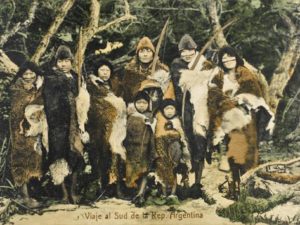
Early missionaries found that the natives of Tierra del fugal at the tip of South American were unclothed even during frigid cold winters. The women swam in 48 degree waters when hunting for shell fish, and families often slept in the open, unsheltered and unclothed. To provide a barrier against the elements they smeared themselves with seal oil. Moving about without shoes they occasionally wrapped their naked bodies in an animal skin on bitterly cold days.

Many studies show that repeated exposure to cold usually results in increased tolerance, a situation which I can anecdotally confirm. When first moving to Lansing, Michigan, I found the cold to be intolerable. Boston winters were never as severe and I thought I would never leave the warmth of my fireplace. After several years, however, I adjusted and loved leaving home to cross country ski after the children were in bed even though the temperature was well below freezing. My husband and I went north for a vacation during the coldest week of the year in order to ski on frozen rivers and drink hot chocolate in nearby inns.

I did jump into a snow melt river in Colorado once and was surprised at how my body adapted. I did not take more than five minutes before I had to get out, but when dry, my body felt hot. I tingled all over and was invigorated as we hiked on.

It is important to be careful when ice swimming, for there are instances of people jumping into cold water to have a heart attack and die. Before entering an ice pond, consider getting used to cold water by lowering body temperature with cold showers and starting with short icy immersions. If you plan to do it often a diet of fatty foods is advisable.

Doug Strain, a man I greatly admired, was a conscientious objector during WWII. He was recruited to participate in a military experiment to study how much food is needed if you you have a lowered body temperature. Each day, subjects were put in a meat freezer without jackets. In the evening, they were allowed out and when sent to bed they were not allowed to use blankets. The subjects needed a tremendous amount of food to maintain body weight. Doug mentioned, that though they ate as much as they wanted, everyone lost pounds. H concluded with a smile, “that an entrepreneur could make a lot of money by starting a freezarium for weight loss.”

Now that summer is here my desire is to be able to adjust to warmth as quickly as possible. The Korey Stringer Institute at the University of Connecticut reports that it takes 7-14 days for the body to adapt to heat. Once it does there will be positive bodily adjustments such as a reduced heart rate, changed skin temperature responses, and a different perception of exertion. The institute stresses the importance of acclimatizing to hot weather slowly, resting between exertions, increasing salt intake, and taking breaks to avoid overheating. They recommend that meal should be small before exercise and that water intake be increased. Athletes especially need to pay attention to these warnings, and those who do, are likely to find themselves with improved blood pressure and a greater ability to handle heat stress during exercise.

References.
Cool Antartica, Cold Acclimation and Acclimatization in Humans- Science of the Cold.
http://www.coolantarctica.com/Antarctica%20fact%20file/science/cold_acclimation_human.php

Adapting to Climate Extremes, http://anthro.palomar.edu/adap

Heat Acclimatization, Korea Stringer Institute, University of Connecticut,
http://ksi.uconn.edu/prevention/heat-acclimatization/

Climatic Adaptation, Physical Anthropology, writtten by editors of Encyclopedia Britannica, https://www.britannica.com/science/climatic-adaptation

Kelly, James, In Search of Paradise Lost in Tierra del Fuego, 2017, Earth island Journal,
http://www.earthisland.org/journal/index.php/elist/eListRead/in_search_of_paradise_lost_in_tierra_del_fuego/gclid=CjwKEAjw1a3KBRCY9cfsmdmWgQ0SJAATUZ8bjJ1p4s3GjhZWynM7Qw8RBa7E7KIK6L8tX4uo1bd1YBoCQVbw_wcB

Art is always for sale. Dream Summer is and acrylic painting on deep canvas / 24” by 20” /
$ 450.for sale / contact marilynne@eichingerfineart.com for information.