Achieving Mastery

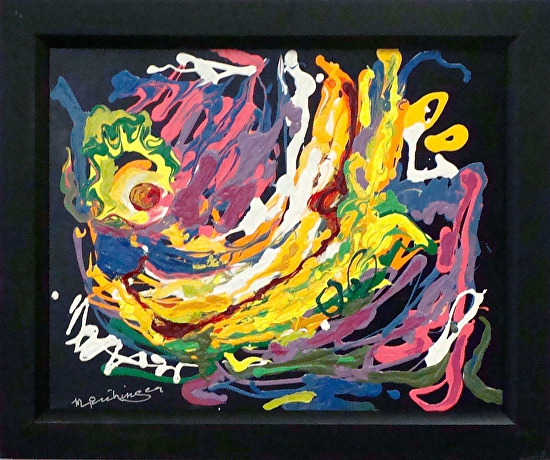
Curious Cat Emerging                                                                                                                                     24” x 28” acrylic painting – NFS                                                                                                         Curiosity motivates one to achieve mastery

When I was in my early thirties I had a dancing partner who could lift me into a wide variety of positions. I would run across the room and leap in his muscular arms to be spun over head and then placed gently on the floor. My body was flexible and strong due to years of practice. The experience was exhilarating because I was able to complete physical moves directed from my imagination. It was the first time that I truly understood the concept of personal mastery. Though I would never be a professional performer, my body was as fine-tuned as it would ever get. Unfortunately, this feeling of physical capability slowly dissolved as I aged and became busy taking care of children while getting a masters degree at Michigan State University.

In the same vein, a friend of mine shared a story that has stayed with me over the years. He taught music in a wealthy suburban high school where many students were excellent musicians. Deciding to start a jazz band with the very best of them, he assumed that with such talent all he had to do is circulate the score and they would play magnificently. Instead of music, however, what he got was discordant sounds that had no semblance of professional orchestration. He told me that he had to take the students back to basics, making sure they all joined in the same rhythm and played in-key before he could permit one or another band member to have freedom of self-expression. His students needed a conductor to closely monitor their movements. Though, each individual had a degree of mastery over his or her instrument, when it came to a collaborative effort, a different type of organization was needed. With his tale I discovered that some mastery results from a team effort.

I started to think about what it takes to be accomplished and why some people attain proficiency but so many more do not. In my teens I traveled across the Atlantic on a Holland American Line ship. The waiters were European and extremely well trained, insuring that every plate was properly placed and orders prepared with style. The server and his apprentice had excellent deportment and gave their complete attention to the diners they served. To me they appeared to be in a zen state, for they acted as one with what they were doing. These men took pleasure in their work and it was satisfying to give them a gratuity at the end of the voyage. Though I have been on a great many ships since that crossing I have never experienced similar service. I realized then that taking pride in what you are doing is an essential part of virtuosity.

More recently I have been become aware of the skills needed to be an industrial painter, noticing the satisfaction shown by graduates who complete four years of apprenticeship training. Because painting requires frequent inspection, their work is well reviewed. Those who are accomplished are recognized and rewarded by boss and colleagues. It is understandable that these skilled workers want to be treated with dignity and compensated for the mastery they bring to their work.

And so it goes . . .surgeons, dentists, computer programers and housecleaners all have an opportunity to master their professions and take pride in their work, but not all do.

Painting company managers complain that they have a difficult time getting enough trained employees willing to put in the effort to maintain excellence. They have to deal with those who are late to the job, leave unfinished spots (called holidays) and work for a pay check rather than out of joy.

I know of a dentist who acted similarly. He would arrive at his office, speak to a few of his most prestigious patients, then turn the work over to a subordinate so he could manage his investments. He made a lot of money and might have been quite competent when younger, but in his forties he lost his passion for his profession. To maintain mastery there needs to be an element of joy in what you are doing.

On June 7th, NPR had a program discussing the thousands of patients who die in small community hospitals from operations done by surgeons who do not have a great deal of experience with a particular type of surgery. Rates of success are much higher in large cities where doctors have opportunities to practice procedures under the watchful eye of an accomplished supervisor. Practice, practice, practice is a necessity for even motivated individuals. And, along with practice comes the need for focus. Mastery often involves putting blinders on to other activities. The old adage, “you can’t do it all,” comes into play.

So, why are some, but not all young people motivated to work for self-improvement rather than grades or monetary compensation? And, how did they obtain a desire for engagement that encompasses a willingness to overcome failures. Where did they acquire their thirst for knowledge?

According to Stanford psychologist Paul O’Keefe school and home environments play a major role in creating motivation. A culture that stresses learning for the sake of learning will more likely produce a person who wants to master an activity rather than simply perform it, and those who are curious are more likely to strive for mastery than those who are detached. If the focus becomes one of outperforming fellow students, rather than getting enjoyment from the activity, then the stress of competition is likely to produce anxiety. Environments that encourage intellectual risk-taking and reduce competition help students gain a desire for proficiency. The student who sets self-learning goals becomes willing to practice.

But, once competent, can everyone go from good to great? This question has been raised by researchers according to author Christopher Bergland, writing for a May 21, 2013 Psychology Today article. Studies show that there are quite a few factors involved in reaching elite status; the age you begin to learn the skill, innate ability, intelligence, amount of sleep you get and your working memory all come into play. Of course, study and practice are also important, but to be really great you have to love what you are doing. As Zach Hambrick of Michigan State University says, “you need to find the sweet spot between boredom and anxiety where your skill level perfectly matches the level of challenge.” With this balance a person obtains what he calls superfluidity, which leads to mastery.

The important lesson is that when people get an accurate assessment of their abilities and interests then they are more likely to choose fields to study where they can achieve their goals. The advice of Hambrick’s research is that you should “love what you do and pour yourself into it.” Without that passion, no amount of practice will make you an expert.

Since no one is good at everything, my advice for students of any age is to keep searching until a special activity is found to be enthralling. It could be a job or hobby, but once discovered, joy will follow from the process of learning and improving. Each successful step will increase motivation, develop confidence, promote happiness, and engender a sense of self-fulfillment.

With these thoughts about individual mastery I will leave the question of group mastery or team work for next week.

Please share your thoughts at eichingerfineart.com/blog.

Art work is always for sale at eichingerfineart.com
References:

http://news.stanford.edu/news/2012/may/shape-achievement-goals-051012.html – The environment had help shape achievement goals.

https://www.psychologytoday.com/blog/the-athletes-way/201305/can-practice-alone-create-mastery Secret to mastering a skill.


Good vs Evil

Apples from Eden

Apples from Eden
a study in Good vs. Evil
40” x 30” acrylic painting, $490

Thank Goodness 
Those of us who pay attention to the news can easily come to the conclusion that there is little hope for humanity. Articles abound with tales of cruelty and dysfunction, reminding us constantly of the negative aspects of human behavior. Road rage, gang warfare, bigotry theft and child abuse are crammed into our brains as though they are the norm rather than the exception.

In support of these negative revelations, I had a fearful experience last month when just past midnight two men tried to break into our home. Due to extensive damage from a February storm, contractors had place scaffolding and trash containers on our property. At night, with lights turned off, it was not surprising that enterprising thieves thought the place had been abandoned during construction. That certainly was not the case.

Awakened by the sound of door handles being jiggled we instantly became alert. Ray immediately recognized what was happening and quietly crept out of bed to dress and locate a flashlight. He then tiptoed to a darkened room near the creaks, peered out the window and shined his flashlight in the surprised eyes of the intruders. Two startled hooded men wasted no time in bolting away. In the meantime, I stayed frozen in my bed, huddled under blankets, wondering whether to call the police. Afterwards Ray and I us discussed the despicable state of society and returned to sleep, never imagining that the men might return. Two hours later soft sounds were again heard, this time on the scaffolding at the other side of the house, and the chase repeated itself. The incident left us very cautions about leaving doors unlocked, bringing great sadness, since we both grew up in neighborhoods where no-one ever locked their doors.

Basically I am a glass is half full type of person and do not dwell on negativity, so it was not long before the incident receded into my sub-conscious. Then a month later, a most upsetting event occurred that made me once more reevaluate my understanding of good vs. evil.

On the way to a pottery class, I had removed my engagement ring in order to protect it from being imbedded with clay. It was very carefully placed along with my car keys in a deep pants pocket. The hours ticked by pleasantly I until returned home and went to put on the ring, only to discover that it was gone. The wash of panic that spread through me was instant. Had I left it in the clay studio? Did it fall out in the parking lot of the art center? I remembered that I had also gone to a supermarket and thought it could have been lost there. The ring probably got caught in my keys and fell to the ground when they were pulled from my pocket.

This ring is very special. Not only was it expensive, but it was given to me with love at an extremely vulnerable time. Ray and I had been looking at diamonds for about a year, exploring Portland jewelry stores as well as merchants as far away as Hong Kong. Unbeknownst to me, he kept returning to visit a local jeweler to inspect an estate ring with a European cut diamond. Instead of using laser tools as they do today, old world craftsmen used to shape diamonds by hand, making each stone unique and special. Since the this particular ring was expensive, it continued to sit at the jewelers for many months while my life went on without it.

Then, eight years ago, I was diagnosed with breast cancer and had to have a double mastectomy. Knowing that I was sad at having to lose a prideful part of my body, Ray acted unexpectedly. He purchased the antique ring and presented it to me, demonstrating his love as well a compassion. My broken body was not going to keep him away. We were engaged to each other.

You might now understand why I was so very upset when the jewelry was lost. Though I did have insurance, this particular item was irreplaceable as a symbol of our commitment to each other. My heart and mind started to race as I sped back to the supermarket to crawl on burning pavement to search under cars. I was sure that by the time of my search someone had already found the ring and kept it to sell. There seemed little chance for it to meet the hands of an honest person, especially at that particular market, but I did give the customer service attendant my information before rushing on to the clay studio which seemed to be the more logical place for the loss.

During these auto trips I thought about what Ray’s reaction would be, imagining the worst. Would he shout and scream about my carelessness and tell me how unthinking and clumsy I am? I wondered if he would leave me over the incident, giving super-credence to the ring as the commitment, rather than one made by two individuals. I cried and started to pray, negotiating for a belief in God if the jewelry was found, knowing that such a conversion would be difficult. The idea of putting up posters and announcing a finders bonus for whomever found the ring entered my head. I considered if it would be better to hide the truth and not tell anyone, at least until the insurance company was contacted or the posters had a chance to work. As thoughts tumbled, my mind raced, heart pounded, and I kept telling myself to drive carefully.

The trip to the clay studio produced equally unsuccessful results even though several staff assisted me in a search. There was nothing left to do but return home and accept the loss.

Upon entering the house I noticed the telephone message light blinking, suspecting it was my sister calling. You might imagine my surprise when I discovered that it was a customer service person saying that someone had found an engagement ring in the supermarket parking lot, and please phone back to describe the one I lost. Not waiting to make the call, I started my third dash to the store, hoping that the diamond was mine and not someone else’s sad loss. Running to the counter I learned that the man who had called my home was on break and no-one there knew whereabouts of a ring. The next half hour was very difficult as I paced back an forth through the isles waiting for the employee to return to his post. The story does end well, thankfully, for the ring was mine, though the gold setting was damaged. A car must have run over it.

I was elated, not only by the thought of someone being able to see a small sparkle amongst parked cars, but that the individual turned it in. A feeling of warmth and happiness spread throughout my body, and I mentally sent out thanks to the good samaritan who had reconfirmed my belief that people are basically good and caring.

Steve Taylor, PhD. in the Aug. 26th issue of Psychology Today in 2013 wrote that, “It’s a dangerous over-simplification to believe that some people are innately ‘good’ while others are innately ‘evil’ or ‘bad.’” He claims that it is misleading to think that bad people are the ones who commit crimes and should be locked up because they are evil. He continues to say that this concept is the fuel for many wars because people start believing that it is just to fight an evil enemy. Good and evil behavior, rather than being intrinsic, he says, is a complex part of human nature. Most people have both good and bad qualities within that are influenced by environmental and family factors.

Recently, European justice systems, unlike our own, started recognizing these complexities. Cases are now prosecuted with the idea of providing restorative justice. Offenders are given the chance to meet their victims and learn about the effects of their crime. What has been discovered is that so called evil people can be affected by these interactions and influenced to change their demeanor. A newly acquired sense of empathy is the first step to their rehabilitation. Though not every criminal is successfully changed, enough are, so that the approach is considered worthwhile.

According to Taylor righteousness emerges when people are connected. I concur with him when he says that “goodness is fundamental to human nature.” Even those who have joined gangs have learned to be loyal and supportive of other members. Evil, in all of its psychopathic forms, is most likely to emerge when when there is social disconnection.

With these lessons in mind, I choose to think that people have more goodness within than not, and that society has the ability to increase humaneness by the way it operates to heal discord.

Please share your thoughts. It would be fun to get a discussion going.

Artwork is always for sale. Contact me at marilynne@eichingerfineart.com or go to my web site eichingerfineart.com to learn more.

Reference:
https://www.psychologytoday.com/blog/out-the-darkness/201308/the-real-meaning-good-and-evil – Good Vs Evil

Whose freedom is it?

Meet the Blockheads
                                   Meet the Blockheads

acrylic painting – 22” x 18” $ 385
Training a child to become independent is an awesome job.

Whose Freedom Is It?
When my granddaughter was 16, she wanted to be free from her parents’ control. As a typical teenager she took her cues from her friends which often led to major disagreements at home. To my children’s credit my granddaughter did not always get her way, but her parents were good at adapting to age related situations in order to give her increased independence. Beach parties were big events in their coastal community and one year my granddaughter wanted to have one for her birthday, without parental supervision. Hummm,. . . .sounds good, but alcohol, drugs, and “what not” were often a part of teen beach events.

What would you do? Say no, or allow the festivities to take place? Her parents took a creative approach that let the party proceed. My son-in-law set up his own solitary party away from the revelers, but located within site lines of his daughter and her friends. The weather was perfect and during the evening he became engrossed in a book in front of his own fire while nibbling on snacks brought from home. He let the kids have fun for as long and they wanted, staying out of the way, but because everyone knew that there was an adult paying attention to their antics, the party proceeded without incident.

All children are going to become old enough to make their own decisions, but a difficult part of parenting is preparing them for this eventuality. Many years ago I read that offspring of parents who are very controlling while their children are in high school are often the wildest ones during freshman year at college. I am reminded of an incident that occurred when I was in 9th grade. While riding a public bus on the way home from school, my friends and I observed girls from a local private school who were made adhere to a strict dress code. As soon as these teens boarded the bus, out came their compact powders, lipsticks and combs. The girls refashioned their hair and added earrings and other jewelry to their attire. In order to soften the look of their uniforms, shirt tails would be pulled out of skirt bands and left casually hanging. Much to the discomfort of other the passengers, the students became loud and boisterous, acting as though they were riding a private vehicle. My friends and I felt sorry for them because they seemed out of control, and we gossiped about them behind their backs.

This incident raises the question of what is free choice, and how much of it should a parent give to their offspring? Freedom tied to responsibility is the goal, but how does one get reach that point? If a child does not clean the dishes or throws his or her clothes on the bedroom floor, is that freedom of choice? Perhaps it is, but those actions also can impinge on the parent’s freedom. If the adult does not agree to let the child use or abuse his own bedroom then the parent becomes a monitor, bringing feelings of anger because of increased household work and paying for clothing that is not valued.

So who and what is free? Teaching responsibility to accompany free choice starts at an early age. It involves discussions and actions that have consequences aimed at exploring the “what if?” question from several points of view. It also involves being present, without anger, when a child makes an honest mistake and stumbles. Being there to sooth raw emotions, and inviting verbal analysis of the event, with the goal of finding a path to avoid future pitfalls, presents an opportunity parents should cherish as long their children remain under their roof. When teens leave for a job or distant college campus, it is too late to teach the analytical skills needed for decision making.

When my children were young, we used the dinner hour as the main time to discuss and dissect daily issues. We would bring problems to the table and try to look at them from several viewpoints. Occasionally and just for the fun of it, I would introduce a complex situation from work, so all could contribute to a “How would you handle it?” discussion. We had lots of discourse, not always agreeing, but constantly thinking and gaining perspective from the various sides of the problem. There were many times when we became frustrated, such as when one child teased another, because we could not find a solution that stopped the behavior. In those occasions we did have to step in with a firm resolution from parental authority. The ensuing discussion about teasing and repercussions did eventually grab hold and helped to alleviate the situation.

My suggestion to parents is to start having philosophical conversations at an early age and bring children into a discussion of outcomes and fair consequences. Even a 5 year old can consider ethical and social issues. For instance, you might ask a youngster a question like, “ What should you do if you find a dollar in the driveway of your neighbor’s house? Do you keep it or return it?”

When the child in a bit older the subject of bullying might be introduced by inquiring, “What roll should a bystander take who observes a friend being bullied?” The conversations will most likely lead to talk of how the bullied person might feel and what would lead a person to becoming a bully. When my youngest child was being heckled because of his short stature, he and my husband spent hours thinking up and practicing quick retorts. By demonstrating that he was not embarrassed or put off by the bully, my son eventually put an end to the unwanted situation. The exercise also taught him to accept himself as a short person and not let it affect his life.

Young women love to talk about around body and facial adornment. It can be fun to debate cultural applications of makeup and tattoos applied in tribal communities, by prostitutes or actors, and by various socio-economic groups in local neighborhoods. Fashion certainly can produce a lively exchange of ideas. Because the discussion becomes a sociological lesson rather than a confrontation, the subject becomes mind expanding. Youngsters learn that a choice of lipstick color is often determined by the pressure of friends, a marketing expert or tribal custom, rather than one of free choice.

There are numerous conversations that might evolve from auto-speak. An adult who is knowledgeable about automobiles could discuss cars and how the selection of one model over another says something about the buyer. The economy, ecology, status symbol, safety, driver’s responsibilities, alternative transportation, even the topic of fuel efficiency at various driving speeds can be debated. It is through these types of conversations that children develop value systems.

So . . . parent’s and grandparents why not have frequent conversations with your children around the subject of freedom. By considering several points of view your child can refine his or her analytical skills. Then as your child ages, permit your youngster to test conclusions, allowing him or her to experience the lows of failure and the highs of success. A parent who is available to insure safety can reassure their child that mistakes are normal. This will go a long way in building their offspring’s self-confidence. It is by examining failures and being encouraged to try again that people grow. In this way parents, grandparents and teachers can help children understand the implications of so called “free choice.”

Passing the Baton

French QuarterNew Orleans 

Acrylic Painting – 12” x 36” – $ 350
A city where cool sounds of Jazz permeates the French Quarter

Passing the Baton
How do you provide a music education when your own experience is limited? Some children are fortunate because their parents are trained musicians. Others, like mine were, have parents who believe that education should include music. Though they pay for lessons, they do not know how to inspire their offspring to become passionate about their instruments, so the money they spend is not used to maximum effect.

Except for the scales and easy pieces played when my siblings and I practiced, music was not heard in our household. Neither radio, television nor record player was used to fill our home with melodies, though we occasionally were taken to children’s concerts. My family finally obtained a phonograph when I was sixteen allowing a few symphonic records and lots of rock n roll to enter our home. With marginal role models pointing the way, as an adult I was committed to creating a more musical home.

When my children were still in pre-school my husband and I set up an instrument tree in our living room. A floor to ceiling pole was erected with clips attached from which to hang all sorts of sound makers. It held tambourines, recorders, maracas, bells, whistles, harmonicas, drums, cymbals, sticks, and a wide variety of shakers. Each day I would put on a record (pre-CDs) and gather my young band members to sing, march and dance around the house while struggling with the challenge of staying on beat. Though visiting friends must of thought us to be a strange, noisy bunch, the kids took their music activities very seriously and had a great time.

As an adult, my husband learned the guitar and encouraged singing in the evenings, on long car rides and around campfires. He eventually became so accomplished as a musician that he and a group of professor friends formed a bluegrass band. The Bluegrass Extension Service practiced in our home and performed weekly in a local pub, attracting hordes of students to clog along with the music. I loved dancing to his music and had a wonderful time chatting with university friends. Our family quickly learned to belt out Rocky Top and Country Roads.

In analyzing my own musical talents, I admit that they were not great. I can not sing on key and though I studied the piano as a child, I was a mediocre player who found it difficult to read and strike a multitude of keys at one time. It still amazes me that people can actually understand complex scores with thirty second notes, trills and chords. In my thirties I decided to try again, this time taking up the flute since there is only one note to read at a time. With children running around the house my squeaky sounds added to the chaos, but the family was tolerant, and I do believe my perseverance may have inspired them.

My retired symphony orchestra teacher was sensitive, quickly realizing that I was not in training to be the next Sir James Galway, Jeanne Baxtresser or Herbie Mann. Instead of assigning hours of practice scales he had me play beginning music that could immediately be enjoyed with friends. A few of my enthusiastic neighbors were even willing to accompany me on the piano, making my practice very pleasurable indeed.

As my children reached their elementary grades their music-anti was raised. A willing teacher offered before-class recorder sessions in our neighborhood school. By the time they were eight, all of my off spring had had experience with musical notations, and were ready and willing to be enrolled in piano lessons. One daughter, who had an exceptional ear for sound, took up the violin as well. (No squeaky sounds there! ) My childhood spinet had a rotating hot seat for several hours each day.

It took a great deal of time to drive children to and from music lessons and recitals, and it was often annoying to be surrounded by discordant sound but in the end I found it to be worth the effort. Two daughters and I formed an ensemble that could play piano, violin and flute trios. The fun we had and pride we took in our small chamber group produced an emotional high I will remember forever.

Why did I believe that music education was so important? Many studies show that early musical training develops the left part of the brain, the side involved in reasoning and language. There also appears to be a link between the ability to perceive things accurately and form mental pictures of them. Music helps in understanding advanced mathematical problems, which may be why geniuses like Albert Einstein play the violin as their preferred leisure time outlet. A ten year study conducted in 2006 by Johnson,C.M. & Memmott, J.E. showed that children, irregardless of socio-economic background, had increased success on standardized tests such as the SAT. It also affirmed that those who play instruments tend to achieve higher school grades.

Columbia University research that “ students in the arts are found to be more cooperative with teachers and pears, more self-confident and better able to express their ideas.” They also found lower aggressive and anti-social behavior. Best of all those who participate in band and orchestra have, “ the lowest lifelong use of alcohol, tobacco and illicit drugs among any group in society.” Participating in a band or orchestra enhances teamwork skills and discipline. Practice improves study habits, and performances help youth accept risks and overcome fear.

When my children aged I was curious to see if their musical experiences would stay with them. Eldest son followed his father’s example and took up the guitar as an adult. He still takes voice and guitar lessens, practices regularly with friends, performs for family, and sings with his sons. When his sons were only two years old he enrolled them in a parent-child singing group that provided a great bonding experience. Now the entire family sings their way through family gatherings and evening camp fires.

Eldest daughter continued to play the piano for her own entertainment until a few years ago when she became very busy with a second career. When her children were young, however, she introduced them to both piano and choral singing. Her son became a classical and Celtic violin player who even serenaded me in the hospital when I was ill, much to the pleasure of the nursing staff and patients in surrounding rooms. Her three children know the words to the latest country/western songs and one even gives line dance lessons. Not sure where that came from!

Violin playing daughter taught music professionally to young children. She was most qualified to help her own family with their lessons. Her daughter studied harp for a while, becoming quite accomplished, at times accompanying her older sister who was taking voice lessons. To my sorrow, the harp was dropped with the mounting pressure of high school activities and a burgeoning social life, though both girls still enjoy the piano. Their younger brother is in the beginning trumpet stage. Yikes!!!

One daughter never achieved personal musical mastery but embraced the vibrant Seattle music scene. Her enjoyment was a pleasure to observe.

Youngest son fell in love with bongo drums as a teenager. Thank goodness he and his friends would go to a local park during the late night hours to beat their rhythmic sounds. He eventually bought a full drum set, but it sits in his abode gathering dust because of complaints by the neighbors. Much of his musical outlet today is around burning man activities. He has many friends who are in bands and they gather in his camp, playing well into the night. Parties in his home are unique because rotating musicians entertain throughout the event.

The benefits of music participation are not limited to youth, for it also is a great asset to the elderly. It can help those with dementia reconnect with their past, becoming more alive and responsive. The health benefits music brings to older people are impressive, especially when mixed with exercise. Moving to rhythmic sounds reduce risk of falling and increase balance. Participants are happier, have enhanced moods and appear more relaxed. Music education can also bring joy to those with special needs when the teacher takes time to adapt a program to the individual’s disability. Not only does music give pleasure to the student, but it gives an increased sense of self-worth.

My flute teacher once told me that when you have music in your life you will always have friends. I acknowledge that his words ring true. For four generations our family has passed on the baton.

Whether opera, metallica, rock or rap there is some form of acoustic harmony that you will find appealing. Music can be meditative when seeking solitude and calmness or equally enjoyable in groups when feeling festive. Whether playing or listening, it is one of the rich offerings in life that I’ve come to appreciate.

How does your family pass the baton from one generation to the next? Do you focus on the arts, literature, sports, nature or something else? Please share your way of passing on your passions to others.  DO RESPOND BELOW

Art is always for sale. Contact me at marilynne@eichingerfineart.com for more information.

References:

http://www.childrensmusicworkshop.com/twelve-benefits-of-music-education/ – Advantages of a music education.

http://musicempowersfoundation.org/why-music/the-importance-of-music – Studies about music, language and mathematics skills.

http://www.npr.org/sections/music-news/ – Elderly and dementia

http://www.dreamsfulfilledthroughmusi-org – Music and special needs

http://www.music2spark.com/2011/11/28/the-elderly-how-music-benefits-their-health/ – music and health.

IQ News and You

Building BlocksBuilding Blocks 

24” x 28” – an acrylic painting by Marilynne – $ 450
Stacking blocks in a prescribed order is a challenge in IQ tests.

IQ News and You
When I was nine years old, a friend of my mother’s was taking university courses in educational psychology. For one class she needed practice subjects to give IQ tests to and used my brother and me as volunteer subjects. The test was quite thorough and included tactile manipulatives as well as pencil and paper answers. Though not at genius level, I remember receiving a score that was enough over average to satisfy my parents. From that day on, they accepted the test result as gospel, and increased their expectation of how well I should do in school. My grades acceptable, because in my father’s eyes a girl was not expected to be a brain. Schooling was there to make me a good mother and educated companion to my future husband. Since I was not as important as my brother, I was not overly pressured. In the long run his lack of attention turned me into an achiever.

My brother did not fare as well as I even though he registered equally high on the Stanford Binet scale. He did not react well to my father’s expectations and pushed back by not completing assignments, cutting classes, and just skating through his high school years. School bored him. For many months he hid in his bedroom engrossed in reading the Encyclopedia Britannica from cover to cover, yet his poor grades trumped his independent study in my parent’s eyes. At the end of high school went so far as to falsify his report card by giving himself straight As, and for a few summer months the family was happy. When he never received a college acceptance letter, however, my mother went to school to find out what was going on and discovered that his A grades were really Fs.

“What will he amount to?” my father shouted. “He is good for nothing. Get out of the house.” Though this brother caused a great deal of chaos, his turbulent childhood turned him into an independent thinker. My father gave up, washing his hands of him so to speak, assuming he would slither through life, amounting to nothing.

Thankfully the story does not end badly. After four years in the military, where he managed to get himself assigned to Germany instead of Vietnam, he graduated in urban studies from a four year college to become a productive development entrepreneur. The test he had taken as a child had neglected to measure drive and perseverance. Though he did not like school, no one considered his ability to concentrate on things he did enjoy. Internal motivations, fear of failure and craving for success to prove to his father that he was OK were strong factors in his ambition. In addition, the test never evaluated his interaction with friends or his ability to organize and impress others. And most importantly it did not take into account that people have the power to change their brain.

One benefit of IQ tests like the Stanford Binet or Weschler IV is that they can identify gifted students early. Many of these children are the ones who wind up bored in school and need extra nurturing at an early age. Talented and gifted programs used to be available for these children, but in much of the nation, due to budget cuts, TAG has unfortunately been eliminated. The tests also help educators identify those below average in order to provide extra instruction for those who risk falling behind. Since No Child Left Behind there appears to be more emphasis on helping slow learners.

The downside of the test for a high scoring child is that it can actually stifle potential. Repeatedly telling a person how smart he or she is may get interpreted as this should be easy for me. When solving a difficult problem the child may not take the challenge and instead give up. I have friends who are very intelligent but have little drive to succeed and so they sit around feeling sorry for themselves. At the other end of the spectrum, the low IQ student may develop a poor self-image and label himself as being dumb, deciding that it is not worth trying.

Expectations: In 1964 classic study was conducted in a San Fransico elementary school by Harvard professor Robert Rosenthal. Teachers were informed that the test he was going to administer had the ability to predict which kids were about to achieve a dramatic growth in their IQ. Once the test was taken he randomly chose several children from each class and informed the teachers “those selected were on the verge of an intense intellectual bloom.” Over the next two years Rosenthal followed the children and discovered that expectations affected teachers interactions in many subtle ways. Those expected to succeed were given more time to answer questions, more specific feedback, and received more approvals. They were consistently touched, nodded to and smile at, and as a result increased their IQ score.

More recently, psychologist Howard Gardner has been trying to change expectations by getting people to think more generally about intelligence. He talks of different types of smart rather than only the linguistic and logical-mathematic abilities usually evaluated by IQ tests. Visual-spacial,interpersonal, bodily-kinesthetic, intrapersonal, auditory-musical are abilities rarely appraised in school testing programs. Yet those strengths, along with a desire to succeed and fortitude, can be more important than traditional IQ measurements.

Good News: Scientists have discovered that the brain can reorganize itself when confronted with new challenges, even through adulthood. A consortium of researchers including Columbia University, Harvard, Blue Cross Blue Shield, and Abbott Labs have developed a program called Luminosity. Basically they have developed a series of exercises aimed at increasing memory, attention, speed, flexibility, and problem solving. It works for those who commit themselves to the process. Living life fully also trains the brain. The boy with the average IQ mentioned above spent much of his young adult years working in jobs that required him to think on his feet. He eventually launched his own company, having to reinvent and improve it over the years in order to be flexible with the times and economy. As he worked he boosted his memory, attention to details and organizational skills.

Bad News: The National Institute on Drug Abuse reports: “ Young people who smoke cannabis for years run the risk of a significant and irreversible reduction in their IQ.” The findings come from a longitudinal study conducted in New Zealand with approximately 1,000 people. Their international team found that those who started using cannabis below the age of 18 – while their brains were still developing – suffered an average of 8% drop in their intelligence, putting them at a great disadvantage throughout their lives. It will be interesting to follow future studies around IQ as cannabis becomes legal in more states.

Interesting News: According to the London Telegraph we are entering the science fiction world of mind enhancing drugs. A British think tank believes that these drugs might be as common as drinking coffee in a few years. Students, who want to improve their grades and those who are losing memory will benefit by new chemical developments. British medical society says “The ethical debate about whether or not to use drugs to improve performance in normal schoolchildren and students will probably be resolved over the next 20 years. Similarly, there will be continued debate about the ethics of using cognition enhancers in the workplace.”

I wonder about the side effects of these drugs and would cautiously look at the results of longitudinal studies before ingesting. What may be good for one body system could be bad for another. According to BBC writer, Mark Kohn in article about pills designed to boost brainpower: “Drugs and catastrophe are seemingly never far apart.” There are other ways to enhance intelligence. The Telegraph also informs, “that a good light’s sleep really does improve the brain.”

Great News: There recently have been many changes in how scientists access the aging brain. They used to look at it in terms of neuron failure. Now, according to University of Southern California’s Monika Guttman, it is clear that if you don’t have a specific disease that causes loss of nerve cells, then most of your neurons remain healthy until you die. New research suggests that the rate of change may be related to life style factors. For instance, lower weight may affect lower rates of disease like Alzheimers. Other factors include education: “Those who use it, don’t lose it as quickly.” New neurons are created by mental and physical exercises. Those who continue to read and question, do puzzles, get a good night’s sleep, stay away from drugs, and exercise regularly are actually increasing their mental capacities. Brain researchers suggest that people try new activities as they age. Changing job, hobbies and exercise routines will help build new synapses and capacities for thinking. Having fun also reduce stress, another inhibitor to a healthy aging brain.

My Thoughts: Keep your brain busy, healthy and wise. Eat well, exercise and challenge yourself with puzzles, games and new adventures. Play…it is good for you. Sleep … it is restorative. Learn new tidbits of information through reading and travel. Take the time to think . . . it promotes neural pathways to increased knowledge. Smile . . . you may be on Candid Camera.

Artwork is always for sale: Go to eichingerfineart.com for pricing or email me at marilynne@eichingerfineart.com

I enjoy your comments. Please respond on my blog page below.
Lots of references:
http://education.seattlepi.com/pros-cons-iq-testing-schools-2014.html – Pros and cons of IQ testing.

http://www.lumosity.com/landing_pages/837?gclid=CjwKEAjws5CrBRD8ze702_2dyjYSJAAAJK9yyltcNqBvx8olsDea_7KDtzxLvTSNNnZutKB-bSBluRoCaxTw_wcB – Luminosity – Brain training games.

http://www.drugabuse.gov/publications/research-reports/marijuana/how-does-marijuana-use-affect-your-brain-body – Marijuana and the brain.

http://www.bbc.com/future/story/20140729 –  the-truth-about-smart-drugs

http://www.telegraph.co.uk/news/earth/earthnews/3347174/A-good-nights-sleep-really-does-improve-the-brain.html – Sleep and the brain

https://news.usc.edu/7569/The-Aging-Brain/ – Monika Guttman on the Aging Brain

http://www.livescience.com/36143-iq-change-time.html – Can your IQ change?

http://www.npr.org/sections/health-shots/2012/09/18/161159263/teachers-expectations-can-influence-how-students-perform – 1964 test given to show how teacher’s expectations influence IQ.

Love, Duty and Instinct

1364104lLady with a Cause  – by Marilynne  

 43” by 23” – 3-D assemblage – $ 785

Love, Duty and Instinct
Are you willing to die to safeguard someone you love? Members of the secret service charged with protecting the President pledge themselves to do just that. I doubt if they love the office holder, though they most likely have a sense of duty for their country and in that way justify their self-sacrifice.

How would your react if a car came barreling towards you while your child or grandchild was walking a few yards in front? Would you run to grab the youngster and protect him or her with your body even if it meant you would get hit, or would you move as fast as you can away from the impending impact to save yourself? I like to imagine (one never knows until it happens) that I would protect my child and willingly sacrifice my life for the one I love, but I wonder if I would do the same for a stranger? I do not feel as secure saying that I would act heroically and risk leaving my own children orphaned? However, it might be that in the crisis moment I would instinctually act the same way.

After the Aurora, Colorado movie theater shooting, psychologists who studied the reaction of theater goers learned that certain people reacted instinctually to protect someone else. Three of the victims died while shielding their girlfriends, and a young woman risked her life by not leaving the side of a friend who was wounded when she heroically stood to warn the audience of danger.

I wonder if these brave heroes responded out of love. Kate Waldman discussed a recent study published in PLOS ONE by Yale researchers who spoke to fifty-one men and woman who had received the Carnegie Hero Medal given to those who risk their lives to save a stranger. All of them claimed that they rescued first and reflected second when faced with their threatening decision. The study goes on to say that when people face a choice that permits time for reflection, they are less likely to be generous with themselves. Though upon consideration the person may eventually decide to act altruistically, unlike the hero, their response is not considered to be innate. After balancing risks and benefits of sacrifice their long-term strategy may not be totally selfless.

At Georgetown University research is currently being conducted around neural regions of the brain. Scientists have discovered a region of activation that processes pleasure when giving to charity. The study suggests that those who donate posses more empathy than those who do not. Researcher Abigail Marsh looked at nineteen people who had donated kidneys to strangers and compared them with twenty individuals who had not. It turned out that the amygdala, an area that monitors emotions, was 8 percent larger in the donor population.

In Altruism and the Holocaust by Jacqueline Macaulay and Leonard Berkowitz published in 1970 about gentiles willing to hide holocaust victims they write that those heroes possessed high self-esteem, a spirit of adventurousness and a willingness to tolerate danger. Their strong sense of community, as shown by frequent interactions with friends and family, led them to action.

There have also been studies demonstrating that in a crowd individuals are less likely to step forward to aide a stranger. I experienced this situation while wandering the floor of a New York trade show. At one booth I stopped to talk to a vendor and noticed his eyes suddenly turn up while his body slumped forward in slow motion. His skin paled and as he slipped to the floor he stopped breathing. A crowd quickly surrounded us. Not being trained in CPR, I shouted to the onlookers, seeking help from someone experienced. Though I asked several times, no-one came forward. Given the type of conference it was, I am sure that there were people in the audience who had been trained in CPR.

I had to act quickly and though uncomfortable with proceeding, I thought it was better to try to do something than just allow the man to die, so I started pumping his chest in a rhythmic way and hoped for the best. After about three minutes (feeling like an interminable 180 seconds), I perceived a violent thump in my hands as his heart restarted. By the time paramedics arrived his complexion had returned to normal and I knew he would live, so I walked away. I am not sure what made me act as I did, except for the fact that I was the one who happened to be talking to the man when he collapsed. If I had been in the crowd of bystanders, I probably would not have stepped forward.

What I have surmised is that heroes tend to be confident individuals who are not adverse to taking risks. Their response is instinctual and done without thought of recompense or material gain. They also have a great deal of empathy and compassion for those in need. Heroes usually are in good physical shape, and trust themselves to succeed, as in the case of a man who pulled a person back from a moving train. Altruists, in contrast, take time to analyze situations, weighing pros and cons before putting their lives on the line.

With training, people can learn to improve their reaction time and mind set to act heroically in emergencies. Navy Seals are an extreme example of men who have learned to respond quickly in dangerous situations. Physical and moral training from childhood on can increase the likelihood of creating a future hero.

Art work is always for sale: For more information go to eichingerfineart.com or contact me at marilynne@eichingerfineart.com.

Interested in learning more about heroic actions? References follow:

http://www.slate.com/articles/health_and_science/medical_examiner/2014/10/psychology_of_heroism_and_altruism_what_makes_people_do_good_deeds.html – Heroism vs. altruism. study by Yale researchers.

http://psychology.about.com/od/socialpsychology/a/the-psychology-of-heroism.htm- About traits of heroes.

http://psychology.about.com/od/the-psychology-of/a/characteristics-of-heroism.htm – traits of heroes.

http://www.apa.org/monitor/2014/01/everyday-heroes.aspx – Am. Psychological Journal article about heroism.

Jacqueline Macaulay; Leonard Berkowitz – Altruism and the HolocaustPublisher: New York, Academic Press, 1970 about holocaust heroism.

https://www.psychologytoday.com/blog/in-the-garden-good-and-evil/201203/moral-courage-heroism-and-heroic-rescue – what it takes to do heroic acts.

Freedom to Fail

Rock Creek AwakensRock Creek Awakens – Children need to be able to roam through rich environments like this acrylic landscape by Marilynne

Freedom to Fail!
One October day, while sitting in my museum office, I heard shouting and the sound of feet running towards my door. Needless to say, I was alarmed, and vaulted from my chair imagining that there had been an accident. Instead, I was greeted at the door by a mother and teacher who were extremely excited and wanted to share incredibly good news. A miraculous event had occurred during their visit; Jenny, a six year old autistic child, spoke for the first time.

The women had been exploring my small Lansing science center with their class of disabled students, but because they had several youngsters to oversee, their attention was turned elsewhere and the young girl had freedom to explore the exhibit hall on her own. She had stopped before an oscilloscope, picked up the microphone, and in order to see the wiggly voice patterns, started making sounds. Jenny became mesmerized with the moving lines and repeated several words over and over again. Without pressure to perform, the child had felt comfortable playing with the display in her own way. Eventually, the adults went to find her, and from a distance observed what was happening. They were so amazed and excited that they immediately ran to give me their wonderful news.

The teacher later shared that she had forgotten about the research that had been conducted with autistic children suggesting use of an oscilloscope to help patients vocalize. The day’s dramatic event reminded her of the study and she said that she planned to requisition a scope for her classroom in order to integrate it into a therapy approach with several other students.

The story does not end here, however. Mother, teacher and child returned to the museum several weeks later, and immediately dovetailed to the oscilloscope. The child was placed in front, handed the microphone, and told to talk into it, while the adults stood behind observing with high expectations of a repeat performance. Instead, they saw what some of you might expect . . . silence. And though they were disappointed in the child’s reaction, it fascinated me for it provided insight into human behavior that reinforced some of my assumptions about learning.

What did this incident teach me? First, it confirmed my belief that children need a rich variety of environments through which to roam. Secondly, it corroborated my opinion that youngsters need freedom to make choices away from the eyes of overly anxious adults.

What I like most about science centers and children’s museums is that they provide a safe environment for self-exploration. They are designed to enable visitors to learn in their own way on their own time scale. Parents do not need to hover over children and teachers are not charged with explaining what should be learned. A child exploring the interactive displays, experiments and forms his or her own conclusions. Very quickly the young visiter learns that it OK to be wrong, no one is watching or testing. I suspect that the right to fail is a gift that most of us would enjoy.

Montessori schools utilize a similar approach in their classrooms. Their educational materials and challenges are organized in such a way that the room becomes child, rather than teacher centered. When each student is ready to proceed to the next level, the teacher demonstrates how to use equipment, grapple with new concepts, and complete exercises, but then the child is left alone to experiment or not. Once the task is mastered, the child often becomes inventive and employs the material in personal ways. New subjects are only introduced as the youngster develops skill and knowledge of previously presented challenges. All materials that have been mastered can be used and reused as the child desires. This method gives students freedom to roam throughout the classroom, choosing to advance according to their own wishes and developmental time line.

I remember my daughter zipping through math manipulatives as fast as they were presented. She perceived them as detective problems to be solved and looked forward to ever more demanding puzzles. My son took a different approach than barreling through the material. Once he mastered the fraction and bead boards in a way that demonstrated understanding, he went on to construct high rise buildings and bridges with the pieces. Both approaches were encouraged within this open ended learning environment.

When my children were young, I did not have a museum or classroom at hand, so my home became a place where I developed a similarly organized education playground. Influenced by Montessori’s approach, our basement space was thoughtfully and purposefully arranged. Shelves were filled with toys and games selected to develop math and language competency and analytic abilities by engaging in a variety of activities. There was never a need to sit still for long periods of time so they did not get bored and tired of hearing a talking head. Since the children were always free to choose what they wanted to do, without realizing it they improved their analytic and conceptual abilities and small and large motor skills. Their explorations helped them become more creative people as they imagined new ways of using their toys. As a mother I was pleased because they also learned to care for their materials by returning them to the shelf before proceeding to another activity.

Children’s and science museums are conceived as large scale exploration centers, making them lots of fun to visit. They mimic schools by having an educational bent, but differ in that their philosophy promotes a hands-on pedagogical approach to learning. Unfortunately entrance fees are expensive and trips to museums are not always practical, so it is up to the caregiver to provide exciting educational opportunities for the children in their charge. Families who want to supplement institutional visits need to focus on ways of stimulating their children’s sensory awareness, feeding their intellect and evoking emotional responses around social issues. But possibilities surround us everyday. As Sesame Street’s Grover Monster says; all you need to do is open the door to everything in the whole wide world museum.

I would love to hear your thoughts about educating children. Please comment below.

Art work is always for sale. Contact me at marilynne@eichingerfineart.com.

Reference:
Grover and the Everything in the Whole Wide World Museum
by Norman Stiles, Daniel Wilcox, Joe Mathieu (Illustrator)

What Saith the Soothsayer?

Heaven-and-BeyondHeaven and Beyond by Marilynne Eichinger

What Saith the Soothsayer?
“If humanity is to survive long-term, it must find a way to get off planet Earth-and fast. In fact, human beings may have less than 200 years to figure out how to escape our planet,” claims famed physicist Stephen Hawking. “Otherwise our species could be at risk for extinction.”

Wow! Those words are are strong and make me wonder how to embrace ideas such as a mass exodus of earthlings from our planet to one in outer space. Though not my immediate concern, I do wonder about my great-grandchildren. What will their lives be like if they continue to live on land that is being increasingly degraded, or will they be first in line to board a space ship?

There are two potential manmade catastrophes of major concern to humanity. The first is climate change and the second, nuclear or biological warfare. (Genetically engineered monocultures are not far behind.) Every day newscasters present stories about pollution and its related sister, global warming. Pictures of rising coastal waters overspilling land in countries like Bangladesh and of polar bears fighting for their lives in search of ice bergs, give graphic examples of species in trouble. How can we continue to exponentially populate the earth, over-fish the waters, and build oasis houses in the desert? According to the United Nations, 7.3 billion people presently inhabit earth and that number is expected to be 11 billion by the end of the century, adding to the depletion of fresh water supplies and oil resources. This mega-population will also accelerate food scarcity and disease outbreaks caused by dense living-quarters. Earth’s inhabitants presently dump 713 million tons of waste annually and destroy habitat for many thousands of species, cutting 18 million acres of forests each year in competition for land. Clean, fresh water, a major cause of conflict in the Middle East and sub-Saharan Africa, is now part of the political wrangling in our own Southwestern states. There is no doubt that natural resources are running out at a much faster rate than they can be replaced.

What about nuclear war? Why aren’t citizens clamoring for more treaties like the one proposed with Iran? And why is it so difficult to reach an agreement about weaponry within our own boundaries? According to the Brookings Institute there are approximately 22,600 stockpiled nuclear weapons around the planet (10,600 in the U.S.). Why do we have them? Isn’t it time for an accord to end proliferation of weapons of mass destruction? Aren’t alternative ways available to coexist other than with the threat of military intervention? Why not make efforts to defuse, rather than arm waring factions?

History shows that when societies develop and stockpile weaponry, war is not far behind. In 1961 President Dwight Eisenhower gave the nation a warning that he labeled “a threat to democratic government.” He described the military-industrial complex as a union of defense contracts and the armed forces that had created a large arms industry. These ammunitions providers need war in order to thrive, and congress seems perfectly happy to feed their needs.
When there is no fighting, plenty of politicians are willing to step forward to devise a threat. The war in Iraq presents a clear example of how a cause for war can be invented for economic reasons. It is time to stop poking our noses into foreign conflicts as though we were God, creating enemies where none had previously existed?

Over the past fifty years you might wonder if there were any forecasters giving notice of the consequences of these political and economic actions. The answer is yes, soothsayers exist in every age. The destruction of our planet, and atomic weaponry that were part of yesterday’s predictions, now ring true. As early as 1940, well before we were part of WWII and the Manhattan project, in Solutions Unsatisfactory, Robert Heinlein postulated a world affected by Atomic weaponry would be one assured of destruction. And then came Hiroshima. The same year George Orwell wrote 1984, warning us of the surveillance state. And then came NSA and the Patriot Act. Shortly after, Aldous Huxley’s Brave New World predicted genetic engineered human beings. And then came test tube babies and cloned sheep. Stand on Zanzibar by John Brunner in 1969 predicted a country plagued with school shootings and terrorist attacks. And then came Colombine and the Twin Towers. William Gibson wrote Newuromacncer, describing what it would be like to live in a scarcity-driven future. Cities like Detroit were depicted as wastelands. And then came Detroit.

Today’s soothsayers are similarly posing questions about where to go from here and how to get there? Will the strain on earth’s resources make people more willing to live in space, and will scientific advancements allow for space-time travel? Scientists and science fiction writers ask us to put aside preconceived notions and embrace a flexible pantheon of ideas to help prepare us for what may eventually become reality. In a book by Philadelphia physicist, Paul Halpern, entitled Cosmic Wormholes, he discusses how to build and use a cosmic wormhole as a interstellar shortcut. Unless astro-physicists come up with ways of traveling to other galaxies at the speed of light, it is going to be difficult to transport a mass population to a livable environment. Yet scientists, such as Harold “Sonny” White of NASA’s Johnson Space Center, are claiming that a ring shaped warp drive device that propels a football-shaped starship even faster than light may be more feasible than previously thought.

Science Fiction writer Kim Stanley Robinson won a 2012 Nebula for Best Novel in his latest book 2312. In it he solves solar system problems by adapting asteroids for the task of housing people. He creates gravity by hollowing out the orbiting space rocks so that they cam be set on their axis to spin. He fills various asteroids with plants and animals from different parts of Earth, making a variety of pleasant environments. His early publication, Red Mars, was a foreshadowing of NASA’s goal of sending six astronauts to live on the planet. Kathleen Ann Goodman, published This Shared Dream in 2011. In it, Alima, a bio-architect, grows from a nanotech seed an engineered habitat for 250,000 people. Huge rotating space stations like the one shown in 2001: A Space Odyssey might be a solution closer to home. The station even houses a Hilton hotel for those using it as a transfer stop from Earth to deep space.

Given current technology and mindset, the billions of dollars needed to make habitats that hold large populations does not seem plausible to me — even one thousand years in the future. Yet, if life on earth gets too difficult, there are bound to be a small number of futurists who will be able to live out their dreams on a real space habitat. It is too bad that I won’t be able to come back from the dead to find out . . . or maybe I will, through advancements in cryogenics.

More realistically, the solution I wish for is that will change their mindset by acting immediately to limit population growth, halt deforestation, reduce trash, ban construction in watershed areas, and tackle pollution. These topics form the political issues of the day, and solving them can make a difference to the lives of our immediate descendants. We can have an impact, because each of us has the means of making a difference through personal conservation, and by electing environmentally savvy, committed legislators.

I do worry about our planet’s future even though I will be long gone. Life already seems more difficult for my children and grandchildren than it was for my generation. My California children are concerned about not having enough water for agricultural and recreational uses. They worry about how they are going to wash their cars. I was raised to believe that my role on earth was to leave it a better place than it was when I was born, but now, I am not sure that I and my peers have done that. I plan to do better, and I count on you think that way as well. Together we can be powerful agents for change.

If you find this is a subject worthy of discussion please comment below:

Art is always for sale. For information go to eichingerfineart.com or email me at marilynne@eichingerfineart.com.

Interested in learning more ?  References follow:

follow:http://www.theworldcounts.com/stories/consequences_of_depletion_of_natural_resources- About depletion of natural resources.

http://bigthink.com/dangerous-ideas/5-stephen-hawkings-warning-abandon-earth-or-face-extinction – Stephen Hawking’s ideas about expansion into space.

http://www.tested.com/tech/concepts/460223-futurists-were-right-10-predictions-made-sci-fi-writers-came-true/item/antidepressants/ and http://mashable.com/2014/07/23/sci-fi-books-the-future/ For Futurist Predictions that have come true.
http://www.livescience.com/41316-11-billion-people-earth.html- What Life would be like with 11 billion people.

http://www.brookings.edu/about/projects/archive/nucweapons/50 – Nuclear weapons

http://www.npr.org/2011/01/17/132942244/ikes-warning-of-military-expansion-50-years-later- Eisenhower’s warning about the military-industrial complex.

http://www.the-scientist.com/?articles.view/articleNo/12428/title/Cosmic-Wormholes–Where-Science-Meets-Science-Fiction/ – About wormholes and space travel. Book written by Paul Halpern a teacher of mathematics and physics at the Philadelphia College of Pharmacy and Science.

http://www.popsci.com/science/article/2013-06/dispatches-future- Predictions of the future from contemporary Science Fiction writers.

http://www.space.com/17628-warp-drive-possible-interstellar-spaceflight.html – Present scientific work with the concept of warp drive.

Humming in the Background

city-scaper

Changing City Scape- by Marilynne 

As wooded areas become high rise condominiums, noise levels and pollution escalate. Garbage, mail trucks and automobiles flow through residential areas from before dawn ‘till late at night. Music blasts from open windows, while rooftop parties contribute to the the din of carousing revelers.

Humming in the Background

In my house there is a running debate about background sounds. Thinker craves music or TV voices humming softly, filling the room’s silence, while Forceful prefers to live in a home devoid of extraneous noise. It is not that he does not like music, but when he listens to it he gives it complete attention. “If it is not quiet then I can not hear myself think,” he complains.

Geeker wants loud Metallica music playing throughout the house, claiming it is a necessary background sound for doing homework. Forceful, as you might imagine, threatens to move out if the noise stays booming . . . a problem easily solved with ear buds. So now Geeker wears them at what is probably ear damaging decibels.

Thinker is an artist and always paints with the radio on, tuning out her immediate surroundings, oblivious to the rest of the house with its extraneous noises. Forceful is also an artist but works without electronically produced sound. He is very sensitive to what is going on in the neighborhood…dogs barking, birds chirping, cars rolling by, people walking and talking, etc. He is always berating Thinker for not hearing things. Thinker thinks that Forceful is much too tuned into neighborhood happenings and gossip. “So what if the garbage truck goes by? Ignore it.” she advises.

Sleep-time presents other issues. Thinker’s daughter, Dreamer, turns on a fan or some artificially produced soothing sound to help her fall asleep. She also trained her children to go to bed listing to white noise. Thinker prefers to fall asleep hearing background voices that are so quiet that the words are indistinguishable. The TV or radio tuned quietly does not disturb her as long as the words don’t make sense. She has tried concert music but that keeps her awake because she pays too much attention to what is playing. Forceful, of course, wants silence so he can hear the owls and coyotes howling.

Audiologists have been complaining for some time that children are listening to music that is too loud. A generation of young adults is now dealing with severe tinnitus, vertigo and hearing loss. Did you know that wearing headphones over 2 hours a day can damage hearing according to recent study by the “Centers for Disease Control.” Loud music also has other ramifications? Because of loud music youth are less tuned into each other and the world around them. They are non-communicative at concerts and become isolated when tuned into their ear plugs. Now that cell phone texting has taken the place of telephone calls, life is more complicated, for children listen to music while sending messages at the same time. Trying to get the attention of someone who is listening to music on their ear phones or gazing at their smart phone is not easy.

I became curious about what decibels I hear in a typical walk-about-day. According to Marshall Chasen at the Center for Human Performance and Health, a normal conversation taking place between 3-5 feet is at 60-70 dB, piano practice is the same. The dial tone of a telephone is at 80 dB, a power saw at 110 dB. Pain begins at 125 dB which is at the level of a pneumatic riveter. A violin has a very high decibel rating at 84-95 dB. Symphonic music peaks at 120 dB but it does not usually last very long at that volume so the public is safe. However, musicians in the orchestra often experience hearing loss due to extended hours of playing. Amplified rock music at 4-6 ft is 120 dB and goes to a peak of 150 dB, a damaging number.

The environmental protection agency recommends that neighborhoods be no louder than 55 dB during waking hours. Prolonged exposure of 85 dB and higher will result in hearing loss so protection is advised. At 90 dB (example-lawn mower, router, snowmobile or hair dryer) you are taking a risk if listening to the sound for more than two hours, so ear plugs are advised. Rock concerts? According to the center for Disease Control and Prevention, exposure for more than 30 seconds can cause loss.

Chronic hearing loss is irreversible. Researchers recommend that noise canceling headphones be used instead of buds and that headphones not be used for more than one hour a day at levels below the 60% of maximum volume. This does create a problem for image conscious teens who find headphones a bit more costly, large and cumbersome.

You might be interested to know that nearly 13 percent of children have noise-induced hearing loss? To deal with this poor statistic some establishments are making changes to the noise level inside their pubs and restaurants. One recent response to painful and prolonged decibel defying sounds shows employers of dance halls handing out sound reducing headphones to staff. There are even concert venues that distribute ear plugs or, for a rental fee, ear buds that bring music directly to you, eliminating background sounds and enabling the concert to be heard at a lower decibel rate. However, beware! Because ear buds are placed directly into the ear they can boost the sound signal as much as six to nine decibels.

This summer when the concert series gets in full swing, be sure to pack your ear plugs. It only takes one hour of listening to a concert that is over 105 DB to damage your ears. Even MTV is telling people to “Turn it Down!” With a bit of foresight you can enjoy your summer and your favorite band and still be able to hear the birds in the forest the next day.

Please let me know your experience with hearing loss by responding to this blog.

Art work is always for sale at eichingerfineart.com.

If you want more information about the decibel level of both occupational and non-occupational sounds go to www.http://e-a-r.com/pdf/jhearingcons/noie_Naf.xls.

Living Vicariously

Girl with Pearls – Her eyes are covered as she goes through life unable to absorb the overlapping universes of each individual.

Living Vicariously at the Center of the Universe

Anatole France once said, “Even a little dog is the center of his own universe.” These words were posted on wall of my college dorm room challenging me to remember that everyone sees the world from their own perspective. The only way I could enter another’s universe was to live with them vicariously through imagination. A few of my favorite actors and actresses, like Meryl Streep and Tom Hanks, have strong empathetic personalities that make them able to slip inside another person’s skin, so why shouldn’t I try?

The first time I realized that I was truly living vicariously was when my first born was nine months old. As a spring baby, he had never experienced snow, so when the first flakes descended I bundled him up and went outside to introduce him to the falling flakes. At first he became very quiet, looking around the yard in awe, eventually reaching out to catch the elusive patterns with his chubby hands. It was then that I knew that with his birth an additional gift had been given to me. His existence was going to enable me to relive childhood and expand my own universe as he developed his.

I was fortunate in having six children, five biological and one adopted child in later life. With my oldest son I experienced strength and vigor. His fantasy world of Dungeons and Dragons held all of the intrigue of a hollywood spectacular and I became captured by the intensity that he and his friends exhibited when playing. His earnestness permeated his waking moments and carried on to other activities in later life. I remember visiting his first apartment at a time he was learning to play tennis. Signs were taped to his bathroom mirror that said things such as, “I am a winner. I focus and am not distracted.” Whether learning to fly a plane, play guitar or ride a bicycle, he does it with total physical and emotional involvement, and each time, though not an expert, he becomes competent. Through him I sensed what it is like to jump into the fray wholeheartedly.


Shortly after my son’s birth I had a daughter who inspired me with her feistiness and astute brain. She understands psychological spheres in great depth, yet sees humor in most situations she encounters, enabling her to gain perspective on life’s unexpected happenings. When she was only seventeen she left college for a year to accept a job as a purchasing agent for a bank and its numerous branches. Sales people would call on her with bribes of gifts and luncheon invitations. She would laugh about their offerings, and demonstrated to me what it takes to stand firm and act ethically in the face of shady business practices. She did this without damaging an ongoing working relationships.

My second daughter helped me to hear more clearly. She has perfect pitch and while practicing the violin I knew that I was listening to a pure note. When she sang there was a smile in her bearing and it was as though the windows opened to spring flowers even on a dark, dank day. Since I was born unable to carry a tune, she gave me insight into what it was like to have expansive auditory senses and experience pleasure from sound. Her access to the world was a path that was foreign to me, but I rode piggyback in order to feel the vibrations of her emotion.

Empathy and caring were gifts my fourth child carried into the birthing room. From a young age this daughter was able to see into the souls of animals. She bleeds inside when an creature is ill and spends hours working to help it survive. With her tales I feel happiness, anxiety and sorrow as she adopts various animals into her life. Her sensitivity produces strong emotions, for she has never erected a protective barrier between herself and the suffering of others. She enables me to see frailty in the animal kingdom and continuously demonstrates that it is important to pay attention to small cues.

Number five offspring, a son, once told me, “ You and Dad work too hard. I’m not going to be like that.” And he is not. He does work with fervor, but is equally engaged with friends in creative activities. He embraces playful endeavors that combine artistry with technology, making him a master tinkerer. My son welds, wires, creates electronic light and sound shows, and fixes engines when not programing computers. Through him I have learned the value of play and of being with friends, getting rid of the guilt that came from having a stubborn work ethic. I vicariously enjoy his ever expanding universe as his circle of friends and unusual projects continue to grow.

The sixth child is a young man who entered my life when he was nineteen. Having lived a difficult childhood, he overcame horrendous beginnings because of an innate desire to survive. He demonstrated that people of every socioeconomic background act in their own self-interest when placed in dire situations, but he also showed me that when given a chance, inner strength can overcome adversity. His appreciation for the assistance he received over the past years has made him generous to those less fortunate. This young man believes that everyone should have a chance to prove his or her self worth, and now so do I.

My family and friends are good models for the theory of an ever expanding cosmos. Each time I vicariously enter their centers to be surrounded by their universes, my understanding of the natural world swells. My blinders are continuously widened when imagining myself in their heads, trying to see through their eyes. My greatest gifts have come from those who over the years let me share the depths of their souls before climbing on their shoulders to look further afield.

Please share your own stories about those who have allowed you to visit the center of their universe.

Artwork is always for sale. Go to eichingerfineart.com for more information.