Good vs Evil

Apples from Eden

Apples from Eden
a study in Good vs. Evil
40” x 30” acrylic painting, $490

Thank Goodness 
Those of us who pay attention to the news can easily come to the conclusion that there is little hope for humanity. Articles abound with tales of cruelty and dysfunction, reminding us constantly of the negative aspects of human behavior. Road rage, gang warfare, bigotry theft and child abuse are crammed into our brains as though they are the norm rather than the exception.

In support of these negative revelations, I had a fearful experience last month when just past midnight two men tried to break into our home. Due to extensive damage from a February storm, contractors had place scaffolding and trash containers on our property. At night, with lights turned off, it was not surprising that enterprising thieves thought the place had been abandoned during construction. That certainly was not the case.

Awakened by the sound of door handles being jiggled we instantly became alert. Ray immediately recognized what was happening and quietly crept out of bed to dress and locate a flashlight. He then tiptoed to a darkened room near the creaks, peered out the window and shined his flashlight in the surprised eyes of the intruders. Two startled hooded men wasted no time in bolting away. In the meantime, I stayed frozen in my bed, huddled under blankets, wondering whether to call the police. Afterwards Ray and I us discussed the despicable state of society and returned to sleep, never imagining that the men might return. Two hours later soft sounds were again heard, this time on the scaffolding at the other side of the house, and the chase repeated itself. The incident left us very cautions about leaving doors unlocked, bringing great sadness, since we both grew up in neighborhoods where no-one ever locked their doors.

Basically I am a glass is half full type of person and do not dwell on negativity, so it was not long before the incident receded into my sub-conscious. Then a month later, a most upsetting event occurred that made me once more reevaluate my understanding of good vs. evil.

On the way to a pottery class, I had removed my engagement ring in order to protect it from being imbedded with clay. It was very carefully placed along with my car keys in a deep pants pocket. The hours ticked by pleasantly I until returned home and went to put on the ring, only to discover that it was gone. The wash of panic that spread through me was instant. Had I left it in the clay studio? Did it fall out in the parking lot of the art center? I remembered that I had also gone to a supermarket and thought it could have been lost there. The ring probably got caught in my keys and fell to the ground when they were pulled from my pocket.

This ring is very special. Not only was it expensive, but it was given to me with love at an extremely vulnerable time. Ray and I had been looking at diamonds for about a year, exploring Portland jewelry stores as well as merchants as far away as Hong Kong. Unbeknownst to me, he kept returning to visit a local jeweler to inspect an estate ring with a European cut diamond. Instead of using laser tools as they do today, old world craftsmen used to shape diamonds by hand, making each stone unique and special. Since the this particular ring was expensive, it continued to sit at the jewelers for many months while my life went on without it.

Then, eight years ago, I was diagnosed with breast cancer and had to have a double mastectomy. Knowing that I was sad at having to lose a prideful part of my body, Ray acted unexpectedly. He purchased the antique ring and presented it to me, demonstrating his love as well a compassion. My broken body was not going to keep him away. We were engaged to each other.

You might now understand why I was so very upset when the jewelry was lost. Though I did have insurance, this particular item was irreplaceable as a symbol of our commitment to each other. My heart and mind started to race as I sped back to the supermarket to crawl on burning pavement to search under cars. I was sure that by the time of my search someone had already found the ring and kept it to sell. There seemed little chance for it to meet the hands of an honest person, especially at that particular market, but I did give the customer service attendant my information before rushing on to the clay studio which seemed to be the more logical place for the loss.

During these auto trips I thought about what Ray’s reaction would be, imagining the worst. Would he shout and scream about my carelessness and tell me how unthinking and clumsy I am? I wondered if he would leave me over the incident, giving super-credence to the ring as the commitment, rather than one made by two individuals. I cried and started to pray, negotiating for a belief in God if the jewelry was found, knowing that such a conversion would be difficult. The idea of putting up posters and announcing a finders bonus for whomever found the ring entered my head. I considered if it would be better to hide the truth and not tell anyone, at least until the insurance company was contacted or the posters had a chance to work. As thoughts tumbled, my mind raced, heart pounded, and I kept telling myself to drive carefully.

The trip to the clay studio produced equally unsuccessful results even though several staff assisted me in a search. There was nothing left to do but return home and accept the loss.

Upon entering the house I noticed the telephone message light blinking, suspecting it was my sister calling. You might imagine my surprise when I discovered that it was a customer service person saying that someone had found an engagement ring in the supermarket parking lot, and please phone back to describe the one I lost. Not waiting to make the call, I started my third dash to the store, hoping that the diamond was mine and not someone else’s sad loss. Running to the counter I learned that the man who had called my home was on break and no-one there knew whereabouts of a ring. The next half hour was very difficult as I paced back an forth through the isles waiting for the employee to return to his post. The story does end well, thankfully, for the ring was mine, though the gold setting was damaged. A car must have run over it.

I was elated, not only by the thought of someone being able to see a small sparkle amongst parked cars, but that the individual turned it in. A feeling of warmth and happiness spread throughout my body, and I mentally sent out thanks to the good samaritan who had reconfirmed my belief that people are basically good and caring.

Steve Taylor, PhD. in the Aug. 26th issue of Psychology Today in 2013 wrote that, “It’s a dangerous over-simplification to believe that some people are innately ‘good’ while others are innately ‘evil’ or ‘bad.’” He claims that it is misleading to think that bad people are the ones who commit crimes and should be locked up because they are evil. He continues to say that this concept is the fuel for many wars because people start believing that it is just to fight an evil enemy. Good and evil behavior, rather than being intrinsic, he says, is a complex part of human nature. Most people have both good and bad qualities within that are influenced by environmental and family factors.

Recently, European justice systems, unlike our own, started recognizing these complexities. Cases are now prosecuted with the idea of providing restorative justice. Offenders are given the chance to meet their victims and learn about the effects of their crime. What has been discovered is that so called evil people can be affected by these interactions and influenced to change their demeanor. A newly acquired sense of empathy is the first step to their rehabilitation. Though not every criminal is successfully changed, enough are, so that the approach is considered worthwhile.

According to Taylor righteousness emerges when people are connected. I concur with him when he says that “goodness is fundamental to human nature.” Even those who have joined gangs have learned to be loyal and supportive of other members. Evil, in all of its psychopathic forms, is most likely to emerge when when there is social disconnection.

With these lessons in mind, I choose to think that people have more goodness within than not, and that society has the ability to increase humaneness by the way it operates to heal discord.

Please share your thoughts. It would be fun to get a discussion going.

Artwork is always for sale. Contact me at marilynne@eichingerfineart.com or go to my web site eichingerfineart.com to learn more.

Reference:
https://www.psychologytoday.com/blog/out-the-darkness/201308/the-real-meaning-good-and-evil – Good Vs Evil
Transitions

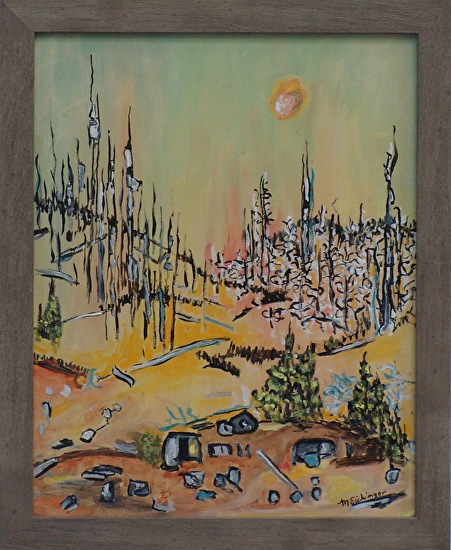
  The Santiam Pass Burn

                                       The Santiam Pass Burn Area – an ecology in transition                                          

 acrylic painting – 22” x 18” $ 275

Transitions Create Energy

My NIA (non impact aerobics) \ teacher commented theater day that transitions create energy. Each time we shifted from one movement or shape to another she encouraged us to spring into the new position with gusto. I appreciated her observation and started to think about the energy needed for transitions other than movement, such as those that impact the environment, my life, and writing.

Several weeks ago, while traveling through central Oregon, I observed the shock caused by a massive fire to land and surviving animals. The view from my car window was chilling, seemingly as though I was peering at an alien planet. Black charred trees contrasted with white gnarled bleached branches that stood naked in the scorched ground. In 2003, fire destroyed 90,769 acres of Oregon forests totaling approximately 100 square miles. The Santiam Pass had succumbed to a failed U.S. Forest Service policy of suppression. Without small and frequent burns to clear underbrush, the forest had grown thicker and drier. It was weakened by disease and drought and demonstrates what can happen after a century of fire suppression and timber harvests that leave brush behind. The burn area is now a land in transition. Caused by energy, it consumed an energy source, and will need years of energetic renewal to repair itself. It will be fascinating to observe primary plant succession in action and see how many animals return to feed on young shoots. After the eruption of Mt. St. Helens, the deer population exploded as growth returned. However, in this case, the sun beams hot, temperatures are elevated and regrowth seems slow.

Leaving childhood, entering college, becoming married, and parenthood were periods that initiated a time of personal transition and growth. On the sad side was my divorce. I was devastated, cried constantly at first and felt like my world was coming apart. “How would I ever be able to live in my creaky house or travel to foreign lands as a single woman?” I wondered.

I decided to let myself mourn for as long a time as needed, but while doing so, wallowing in self-pity would not be acceptable. Since I could no longer depend on someone else to lead the way, I had to create my own path. Match.com became one of my solutions, putting me out into what I thought would be scary situations. Much to my surprise, the website introduced me to some of the nicest men in town. I became energized, and for one year had a blast, feeling like I was reliving my college weekends. I had partners for dancing, visiting art exhibitions and taking long bicycle rides with stops on hot afternoons for drippy ice cream cones. With new acquaintances I visited summer festivals, took in soccer games and went on picnics and hikes in the woods. One man had a mathematics toy that he had invented for elementary school children, and since I was in the educational toy business, I was able to get his product marketed. The royalty checks were fun to receive.

By the end of the year I had a better sense of myself. As a stronger woman I was not as dependent on a partner, no longer afraid of intruders and more willing to travel on my own. In fact, there were times I preferred to be alone because I was more open to meeting interesting strangers along the way. I still valued stable companionship, however, and by the end of the year was once more in a committed relationship. This time though, I was determined to accept my partner and present myself as “take-it-or-leave-it ” packages. We no longer had to blend into one entity but could retain our individuality as we held hands. The transition from marriage to divorce to a partnership required increased energy that helped me better understand close relationships.

Coping with change is a constant that from time to time each of us is bound to face. Transitions: Making Sense of Life’s Changes by William Bridges is a relevant book that discusses how change brings both opportunities and turmoil. Bridges helps readers understand that there are three stages to any transition; the Ending, the Neutral Zone, and eventually the New Beginning. There needs to be patience and acceptance of the steps needed in order to evolve.

Transitions create a period for tremendous growth. New learning has to take place since familiar patterns have changed. Experiences will be different and fear has to be overcome. There are times, as in illness or death, when it is difficult to go through a period of upheaval alone. Imbuing energy to the situation may require the help of a trained professional, or you may be the one called to assist a loved one face their new reality, requiring you to become infused with a strength that you did not know you had. When my son developed cancer, it meant that both my husband and I had to spend two-thirds of our day assisting him while we continued to conduct our ongoing affairs. It was a difficult and emotional time, but I learned a great deal about the medical profession, giving organizations like Make a Wish Foundation, the spirit of the human psyche, and the well of energy within our family that was there when it needed to be called forth. I am thankful that all ended well, and our son is appreciative of his good health, maintaining it with good food habits and exercise.

Giving birth to children, watching them grow up and leave home, and welcoming grandchildren are all milestones that create a changed life style. For the child, transitions can be difficult since they are usually instigated by something beyond their control. Moving, divorce, a new school all create stress that may need the assistance of an an in-tuned parent. It takes fortitude to be attentive to offspring and often requires the adult to acquire new coping skills. None of us are born parents. Most are on-the-job students who become trained when unexpected family situations present themselves.

When each of my five childrenI reached eleventh grade, I mourned the approaching empty nest. By the time they actually graduated, my worry period had ended, for I had used the year to consider next steps. The approaching transitions energized me, and I became busy planning for and learning how to operate a new business.

Bob Dylan sang true when he wrote, The times they are a-changin’.
Come gather ’round people
Wherever you roam
And admit that the waters
Around you have grown
And accept it that soon
You’ll be drenched to the bone
If your time to you
Is worth savin’
Then you better start swimmin’
Or you’ll sink like a stone
For the times they are a-changin’. . . .

As my offspring matured they kept me thinking young, for their conversations were often a windows to new ideas and approaches. In many ways their lives are more difficult than mine was because of changing worldwide economic and environmental conditions, yet they are adapting by embracing ways of enjoying a more frugal existence, eating organic foods, and having lower impact on the environment. The women no longer think of themselves as primary support systems to husbands, but have their own careers and relationships based on shared responsibilities. Since they married at a later age than I did, they had time to develop close-knit circles of friendship that recognize the need for independence yet are there to provide support when needed.

Transitions create energy applies to all of the arts. Just as a dancer is energized by a conversion step giving rise to the next pose and an artist becomes excited by preparing a canvas to take paint, so does a writer become empowered by the use of changeover words and phrases. When writing it is important to know how to get from one thought to the next. Consideration has to be given to the best way to provide energy going forward? Phrases like in addition, not to mention, equally important, and moreover take the author out of a dead end position into the next concept. These words are essential, because they not only connect ideas, but introduce a change, a shift or contrast, an emphasis or agreement. They are vital and useful words that bring purpose or conclusion to an argument.

Yes, transitions do create energy, bringing intensity to nature, work, play, and the arts. They demand that effort be put forth as Dylan says, “if your time to you is worth savin’, then you better start swimmin’.”

Art work is always for sale. Enjoy learning more at ecihingerfineart.com or contact me at marilynne@eichingerfineart.com.

I enjoy hearing from you. Please comment below

References follow:

http://www.amazon.com/Transitions-Changes-Revised-Anniversary-Edition/dp/073820904X – To purchase book about Transitions by William Bridges.

http://education.wichita.edu/caduceus/examples/essay_student/transitions.htm – Transition words.

http://www.azlyrics.com/lyrics/bobdylan/thetimestheyareachangin.html – Lyrics to The Times They are a Changin’ by Bob Dylan.

IQ News and You

Building BlocksBuilding Blocks 

24” x 28” – an acrylic painting by Marilynne – $ 450
Stacking blocks in a prescribed order is a challenge in IQ tests.

IQ News and You
When I was nine years old, a friend of my mother’s was taking university courses in educational psychology. For one class she needed practice subjects to give IQ tests to and used my brother and me as volunteer subjects. The test was quite thorough and included tactile manipulatives as well as pencil and paper answers. Though not at genius level, I remember receiving a score that was enough over average to satisfy my parents. From that day on, they accepted the test result as gospel, and increased their expectation of how well I should do in school. My grades acceptable, because in my father’s eyes a girl was not expected to be a brain. Schooling was there to make me a good mother and educated companion to my future husband. Since I was not as important as my brother, I was not overly pressured. In the long run his lack of attention turned me into an achiever.

My brother did not fare as well as I even though he registered equally high on the Stanford Binet scale. He did not react well to my father’s expectations and pushed back by not completing assignments, cutting classes, and just skating through his high school years. School bored him. For many months he hid in his bedroom engrossed in reading the Encyclopedia Britannica from cover to cover, yet his poor grades trumped his independent study in my parent’s eyes. At the end of high school went so far as to falsify his report card by giving himself straight As, and for a few summer months the family was happy. When he never received a college acceptance letter, however, my mother went to school to find out what was going on and discovered that his A grades were really Fs.

“What will he amount to?” my father shouted. “He is good for nothing. Get out of the house.” Though this brother caused a great deal of chaos, his turbulent childhood turned him into an independent thinker. My father gave up, washing his hands of him so to speak, assuming he would slither through life, amounting to nothing.

Thankfully the story does not end badly. After four years in the military, where he managed to get himself assigned to Germany instead of Vietnam, he graduated in urban studies from a four year college to become a productive development entrepreneur. The test he had taken as a child had neglected to measure drive and perseverance. Though he did not like school, no one considered his ability to concentrate on things he did enjoy. Internal motivations, fear of failure and craving for success to prove to his father that he was OK were strong factors in his ambition. In addition, the test never evaluated his interaction with friends or his ability to organize and impress others. And most importantly it did not take into account that people have the power to change their brain.

One benefit of IQ tests like the Stanford Binet or Weschler IV is that they can identify gifted students early. Many of these children are the ones who wind up bored in school and need extra nurturing at an early age. Talented and gifted programs used to be available for these children, but in much of the nation, due to budget cuts, TAG has unfortunately been eliminated. The tests also help educators identify those below average in order to provide extra instruction for those who risk falling behind. Since No Child Left Behind there appears to be more emphasis on helping slow learners.

The downside of the test for a high scoring child is that it can actually stifle potential. Repeatedly telling a person how smart he or she is may get interpreted as this should be easy for me. When solving a difficult problem the child may not take the challenge and instead give up. I have friends who are very intelligent but have little drive to succeed and so they sit around feeling sorry for themselves. At the other end of the spectrum, the low IQ student may develop a poor self-image and label himself as being dumb, deciding that it is not worth trying.

Expectations: In 1964 classic study was conducted in a San Fransico elementary school by Harvard professor Robert Rosenthal. Teachers were informed that the test he was going to administer had the ability to predict which kids were about to achieve a dramatic growth in their IQ. Once the test was taken he randomly chose several children from each class and informed the teachers “those selected were on the verge of an intense intellectual bloom.” Over the next two years Rosenthal followed the children and discovered that expectations affected teachers interactions in many subtle ways. Those expected to succeed were given more time to answer questions, more specific feedback, and received more approvals. They were consistently touched, nodded to and smile at, and as a result increased their IQ score.

More recently, psychologist Howard Gardner has been trying to change expectations by getting people to think more generally about intelligence. He talks of different types of smart rather than only the linguistic and logical-mathematic abilities usually evaluated by IQ tests. Visual-spacial,interpersonal, bodily-kinesthetic, intrapersonal, auditory-musical are abilities rarely appraised in school testing programs. Yet those strengths, along with a desire to succeed and fortitude, can be more important than traditional IQ measurements.

Good News: Scientists have discovered that the brain can reorganize itself when confronted with new challenges, even through adulthood. A consortium of researchers including Columbia University, Harvard, Blue Cross Blue Shield, and Abbott Labs have developed a program called Luminosity. Basically they have developed a series of exercises aimed at increasing memory, attention, speed, flexibility, and problem solving. It works for those who commit themselves to the process. Living life fully also trains the brain. The boy with the average IQ mentioned above spent much of his young adult years working in jobs that required him to think on his feet. He eventually launched his own company, having to reinvent and improve it over the years in order to be flexible with the times and economy. As he worked he boosted his memory, attention to details and organizational skills.

Bad News: The National Institute on Drug Abuse reports: “ Young people who smoke cannabis for years run the risk of a significant and irreversible reduction in their IQ.” The findings come from a longitudinal study conducted in New Zealand with approximately 1,000 people. Their international team found that those who started using cannabis below the age of 18 – while their brains were still developing – suffered an average of 8% drop in their intelligence, putting them at a great disadvantage throughout their lives. It will be interesting to follow future studies around IQ as cannabis becomes legal in more states.

Interesting News: According to the London Telegraph we are entering the science fiction world of mind enhancing drugs. A British think tank believes that these drugs might be as common as drinking coffee in a few years. Students, who want to improve their grades and those who are losing memory will benefit by new chemical developments. British medical society says “The ethical debate about whether or not to use drugs to improve performance in normal schoolchildren and students will probably be resolved over the next 20 years. Similarly, there will be continued debate about the ethics of using cognition enhancers in the workplace.”

I wonder about the side effects of these drugs and would cautiously look at the results of longitudinal studies before ingesting. What may be good for one body system could be bad for another. According to BBC writer, Mark Kohn in article about pills designed to boost brainpower: “Drugs and catastrophe are seemingly never far apart.” There are other ways to enhance intelligence. The Telegraph also informs, “that a good light’s sleep really does improve the brain.”

Great News: There recently have been many changes in how scientists access the aging brain. They used to look at it in terms of neuron failure. Now, according to University of Southern California’s Monika Guttman, it is clear that if you don’t have a specific disease that causes loss of nerve cells, then most of your neurons remain healthy until you die. New research suggests that the rate of change may be related to life style factors. For instance, lower weight may affect lower rates of disease like Alzheimers. Other factors include education: “Those who use it, don’t lose it as quickly.” New neurons are created by mental and physical exercises. Those who continue to read and question, do puzzles, get a good night’s sleep, stay away from drugs, and exercise regularly are actually increasing their mental capacities. Brain researchers suggest that people try new activities as they age. Changing job, hobbies and exercise routines will help build new synapses and capacities for thinking. Having fun also reduce stress, another inhibitor to a healthy aging brain.

My Thoughts: Keep your brain busy, healthy and wise. Eat well, exercise and challenge yourself with puzzles, games and new adventures. Play…it is good for you. Sleep … it is restorative. Learn new tidbits of information through reading and travel. Take the time to think . . . it promotes neural pathways to increased knowledge. Smile . . . you may be on Candid Camera.

Artwork is always for sale: Go to eichingerfineart.com for pricing or email me at marilynne@eichingerfineart.com

I enjoy your comments. Please respond on my blog page below.
Lots of references:
http://education.seattlepi.com/pros-cons-iq-testing-schools-2014.html – Pros and cons of IQ testing.

http://www.lumosity.com/landing_pages/837?gclid=CjwKEAjws5CrBRD8ze702_2dyjYSJAAAJK9yyltcNqBvx8olsDea_7KDtzxLvTSNNnZutKB-bSBluRoCaxTw_wcB – Luminosity – Brain training games.

http://www.drugabuse.gov/publications/research-reports/marijuana/how-does-marijuana-use-affect-your-brain-body – Marijuana and the brain.

http://www.bbc.com/future/story/20140729 –  the-truth-about-smart-drugs

http://www.telegraph.co.uk/news/earth/earthnews/3347174/A-good-nights-sleep-really-does-improve-the-brain.html – Sleep and the brain

https://news.usc.edu/7569/The-Aging-Brain/ – Monika Guttman on the Aging Brain

http://www.livescience.com/36143-iq-change-time.html – Can your IQ change?

http://www.npr.org/sections/health-shots/2012/09/18/161159263/teachers-expectations-can-influence-how-students-perform – 1964 test given to show how teacher’s expectations influence IQ.

Love, Duty and Instinct

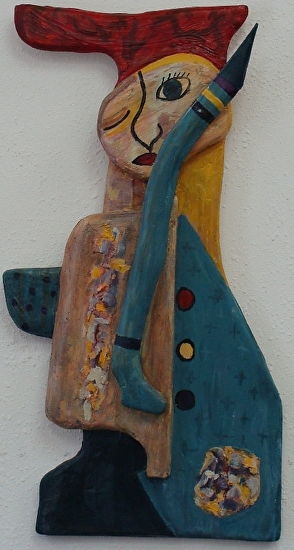
1364104lLady with a Cause  – by Marilynne  

 43” by 23” – 3-D assemblage – $ 785

Love, Duty and Instinct
Are you willing to die to safeguard someone you love? Members of the secret service charged with protecting the President pledge themselves to do just that. I doubt if they love the office holder, though they most likely have a sense of duty for their country and in that way justify their self-sacrifice.

How would your react if a car came barreling towards you while your child or grandchild was walking a few yards in front? Would you run to grab the youngster and protect him or her with your body even if it meant you would get hit, or would you move as fast as you can away from the impending impact to save yourself? I like to imagine (one never knows until it happens) that I would protect my child and willingly sacrifice my life for the one I love, but I wonder if I would do the same for a stranger? I do not feel as secure saying that I would act heroically and risk leaving my own children orphaned? However, it might be that in the crisis moment I would instinctually act the same way.

After the Aurora, Colorado movie theater shooting, psychologists who studied the reaction of theater goers learned that certain people reacted instinctually to protect someone else. Three of the victims died while shielding their girlfriends, and a young woman risked her life by not leaving the side of a friend who was wounded when she heroically stood to warn the audience of danger.

I wonder if these brave heroes responded out of love. Kate Waldman discussed a recent study published in PLOS ONE by Yale researchers who spoke to fifty-one men and woman who had received the Carnegie Hero Medal given to those who risk their lives to save a stranger. All of them claimed that they rescued first and reflected second when faced with their threatening decision. The study goes on to say that when people face a choice that permits time for reflection, they are less likely to be generous with themselves. Though upon consideration the person may eventually decide to act altruistically, unlike the hero, their response is not considered to be innate. After balancing risks and benefits of sacrifice their long-term strategy may not be totally selfless.

At Georgetown University research is currently being conducted around neural regions of the brain. Scientists have discovered a region of activation that processes pleasure when giving to charity. The study suggests that those who donate posses more empathy than those who do not. Researcher Abigail Marsh looked at nineteen people who had donated kidneys to strangers and compared them with twenty individuals who had not. It turned out that the amygdala, an area that monitors emotions, was 8 percent larger in the donor population.

In Altruism and the Holocaust by Jacqueline Macaulay and Leonard Berkowitz published in 1970 about gentiles willing to hide holocaust victims they write that those heroes possessed high self-esteem, a spirit of adventurousness and a willingness to tolerate danger. Their strong sense of community, as shown by frequent interactions with friends and family, led them to action.

There have also been studies demonstrating that in a crowd individuals are less likely to step forward to aide a stranger. I experienced this situation while wandering the floor of a New York trade show. At one booth I stopped to talk to a vendor and noticed his eyes suddenly turn up while his body slumped forward in slow motion. His skin paled and as he slipped to the floor he stopped breathing. A crowd quickly surrounded us. Not being trained in CPR, I shouted to the onlookers, seeking help from someone experienced. Though I asked several times, no-one came forward. Given the type of conference it was, I am sure that there were people in the audience who had been trained in CPR.

I had to act quickly and though uncomfortable with proceeding, I thought it was better to try to do something than just allow the man to die, so I started pumping his chest in a rhythmic way and hoped for the best. After about three minutes (feeling like an interminable 180 seconds), I perceived a violent thump in my hands as his heart restarted. By the time paramedics arrived his complexion had returned to normal and I knew he would live, so I walked away. I am not sure what made me act as I did, except for the fact that I was the one who happened to be talking to the man when he collapsed. If I had been in the crowd of bystanders, I probably would not have stepped forward.

What I have surmised is that heroes tend to be confident individuals who are not adverse to taking risks. Their response is instinctual and done without thought of recompense or material gain. They also have a great deal of empathy and compassion for those in need. Heroes usually are in good physical shape, and trust themselves to succeed, as in the case of a man who pulled a person back from a moving train. Altruists, in contrast, take time to analyze situations, weighing pros and cons before putting their lives on the line.

With training, people can learn to improve their reaction time and mind set to act heroically in emergencies. Navy Seals are an extreme example of men who have learned to respond quickly in dangerous situations. Physical and moral training from childhood on can increase the likelihood of creating a future hero.

Art work is always for sale: For more information go to eichingerfineart.com or contact me at marilynne@eichingerfineart.com.

Interested in learning more about heroic actions? References follow:

http://www.slate.com/articles/health_and_science/medical_examiner/2014/10/psychology_of_heroism_and_altruism_what_makes_people_do_good_deeds.html – Heroism vs. altruism. study by Yale researchers.

http://psychology.about.com/od/socialpsychology/a/the-psychology-of-heroism.htm- About traits of heroes.

http://psychology.about.com/od/the-psychology-of/a/characteristics-of-heroism.htm – traits of heroes.

http://www.apa.org/monitor/2014/01/everyday-heroes.aspx – Am. Psychological Journal article about heroism.

Jacqueline Macaulay; Leonard Berkowitz – Altruism and the HolocaustPublisher: New York, Academic Press, 1970 about holocaust heroism.

https://www.psychologytoday.com/blog/in-the-garden-good-and-evil/201203/moral-courage-heroism-and-heroic-rescue – what it takes to do heroic acts.

Freedom to Fail

Rock Creek AwakensRock Creek Awakens – Children need to be able to roam through rich environments like this acrylic landscape by Marilynne

Freedom to Fail!
One October day, while sitting in my museum office, I heard shouting and the sound of feet running towards my door. Needless to say, I was alarmed, and vaulted from my chair imagining that there had been an accident. Instead, I was greeted at the door by a mother and teacher who were extremely excited and wanted to share incredibly good news. A miraculous event had occurred during their visit; Jenny, a six year old autistic child, spoke for the first time.

The women had been exploring my small Lansing science center with their class of disabled students, but because they had several youngsters to oversee, their attention was turned elsewhere and the young girl had freedom to explore the exhibit hall on her own. She had stopped before an oscilloscope, picked up the microphone, and in order to see the wiggly voice patterns, started making sounds. Jenny became mesmerized with the moving lines and repeated several words over and over again. Without pressure to perform, the child had felt comfortable playing with the display in her own way. Eventually, the adults went to find her, and from a distance observed what was happening. They were so amazed and excited that they immediately ran to give me their wonderful news.

The teacher later shared that she had forgotten about the research that had been conducted with autistic children suggesting use of an oscilloscope to help patients vocalize. The day’s dramatic event reminded her of the study and she said that she planned to requisition a scope for her classroom in order to integrate it into a therapy approach with several other students.

The story does not end here, however. Mother, teacher and child returned to the museum several weeks later, and immediately dovetailed to the oscilloscope. The child was placed in front, handed the microphone, and told to talk into it, while the adults stood behind observing with high expectations of a repeat performance. Instead, they saw what some of you might expect . . . silence. And though they were disappointed in the child’s reaction, it fascinated me for it provided insight into human behavior that reinforced some of my assumptions about learning.

What did this incident teach me? First, it confirmed my belief that children need a rich variety of environments through which to roam. Secondly, it corroborated my opinion that youngsters need freedom to make choices away from the eyes of overly anxious adults.

What I like most about science centers and children’s museums is that they provide a safe environment for self-exploration. They are designed to enable visitors to learn in their own way on their own time scale. Parents do not need to hover over children and teachers are not charged with explaining what should be learned. A child exploring the interactive displays, experiments and forms his or her own conclusions. Very quickly the young visiter learns that it OK to be wrong, no one is watching or testing. I suspect that the right to fail is a gift that most of us would enjoy.

Montessori schools utilize a similar approach in their classrooms. Their educational materials and challenges are organized in such a way that the room becomes child, rather than teacher centered. When each student is ready to proceed to the next level, the teacher demonstrates how to use equipment, grapple with new concepts, and complete exercises, but then the child is left alone to experiment or not. Once the task is mastered, the child often becomes inventive and employs the material in personal ways. New subjects are only introduced as the youngster develops skill and knowledge of previously presented challenges. All materials that have been mastered can be used and reused as the child desires. This method gives students freedom to roam throughout the classroom, choosing to advance according to their own wishes and developmental time line.

I remember my daughter zipping through math manipulatives as fast as they were presented. She perceived them as detective problems to be solved and looked forward to ever more demanding puzzles. My son took a different approach than barreling through the material. Once he mastered the fraction and bead boards in a way that demonstrated understanding, he went on to construct high rise buildings and bridges with the pieces. Both approaches were encouraged within this open ended learning environment.

When my children were young, I did not have a museum or classroom at hand, so my home became a place where I developed a similarly organized education playground. Influenced by Montessori’s approach, our basement space was thoughtfully and purposefully arranged. Shelves were filled with toys and games selected to develop math and language competency and analytic abilities by engaging in a variety of activities. There was never a need to sit still for long periods of time so they did not get bored and tired of hearing a talking head. Since the children were always free to choose what they wanted to do, without realizing it they improved their analytic and conceptual abilities and small and large motor skills. Their explorations helped them become more creative people as they imagined new ways of using their toys. As a mother I was pleased because they also learned to care for their materials by returning them to the shelf before proceeding to another activity.

Children’s and science museums are conceived as large scale exploration centers, making them lots of fun to visit. They mimic schools by having an educational bent, but differ in that their philosophy promotes a hands-on pedagogical approach to learning. Unfortunately entrance fees are expensive and trips to museums are not always practical, so it is up to the caregiver to provide exciting educational opportunities for the children in their charge. Families who want to supplement institutional visits need to focus on ways of stimulating their children’s sensory awareness, feeding their intellect and evoking emotional responses around social issues. But possibilities surround us everyday. As Sesame Street’s Grover Monster says; all you need to do is open the door to everything in the whole wide world museum.

I would love to hear your thoughts about educating children. Please comment below.

Art work is always for sale. Contact me at marilynne@eichingerfineart.com.

Reference:
Grover and the Everything in the Whole Wide World Museum
by Norman Stiles, Daniel Wilcox, Joe Mathieu (Illustrator)

Living Vicariously

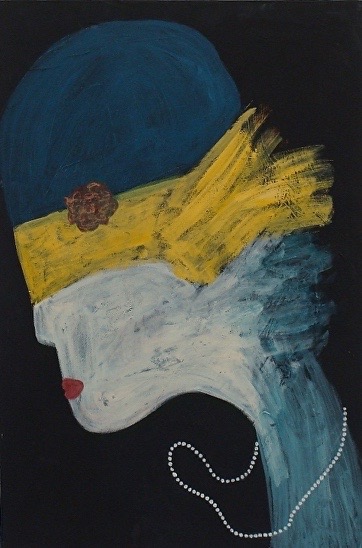
Girl with Pearls – Her eyes are covered as she goes through life unable to absorb the overlapping universes of each individual.

Living Vicariously at the Center of the Universe

Anatole France once said, “Even a little dog is the center of his own universe.” These words were posted on wall of my college dorm room challenging me to remember that everyone sees the world from their own perspective. The only way I could enter another’s universe was to live with them vicariously through imagination. A few of my favorite actors and actresses, like Meryl Streep and Tom Hanks, have strong empathetic personalities that make them able to slip inside another person’s skin, so why shouldn’t I try?

The first time I realized that I was truly living vicariously was when my first born was nine months old. As a spring baby, he had never experienced snow, so when the first flakes descended I bundled him up and went outside to introduce him to the falling flakes. At first he became very quiet, looking around the yard in awe, eventually reaching out to catch the elusive patterns with his chubby hands. It was then that I knew that with his birth an additional gift had been given to me. His existence was going to enable me to relive childhood and expand my own universe as he developed his.

I was fortunate in having six children, five biological and one adopted child in later life. With my oldest son I experienced strength and vigor. His fantasy world of Dungeons and Dragons held all of the intrigue of a hollywood spectacular and I became captured by the intensity that he and his friends exhibited when playing. His earnestness permeated his waking moments and carried on to other activities in later life. I remember visiting his first apartment at a time he was learning to play tennis. Signs were taped to his bathroom mirror that said things such as, “I am a winner. I focus and am not distracted.” Whether learning to fly a plane, play guitar or ride a bicycle, he does it with total physical and emotional involvement, and each time, though not an expert, he becomes competent. Through him I sensed what it is like to jump into the fray wholeheartedly.


Shortly after my son’s birth I had a daughter who inspired me with her feistiness and astute brain. She understands psychological spheres in great depth, yet sees humor in most situations she encounters, enabling her to gain perspective on life’s unexpected happenings. When she was only seventeen she left college for a year to accept a job as a purchasing agent for a bank and its numerous branches. Sales people would call on her with bribes of gifts and luncheon invitations. She would laugh about their offerings, and demonstrated to me what it takes to stand firm and act ethically in the face of shady business practices. She did this without damaging an ongoing working relationships.

My second daughter helped me to hear more clearly. She has perfect pitch and while practicing the violin I knew that I was listening to a pure note. When she sang there was a smile in her bearing and it was as though the windows opened to spring flowers even on a dark, dank day. Since I was born unable to carry a tune, she gave me insight into what it was like to have expansive auditory senses and experience pleasure from sound. Her access to the world was a path that was foreign to me, but I rode piggyback in order to feel the vibrations of her emotion.

Empathy and caring were gifts my fourth child carried into the birthing room. From a young age this daughter was able to see into the souls of animals. She bleeds inside when an creature is ill and spends hours working to help it survive. With her tales I feel happiness, anxiety and sorrow as she adopts various animals into her life. Her sensitivity produces strong emotions, for she has never erected a protective barrier between herself and the suffering of others. She enables me to see frailty in the animal kingdom and continuously demonstrates that it is important to pay attention to small cues.

Number five offspring, a son, once told me, “ You and Dad work too hard. I’m not going to be like that.” And he is not. He does work with fervor, but is equally engaged with friends in creative activities. He embraces playful endeavors that combine artistry with technology, making him a master tinkerer. My son welds, wires, creates electronic light and sound shows, and fixes engines when not programing computers. Through him I have learned the value of play and of being with friends, getting rid of the guilt that came from having a stubborn work ethic. I vicariously enjoy his ever expanding universe as his circle of friends and unusual projects continue to grow.

The sixth child is a young man who entered my life when he was nineteen. Having lived a difficult childhood, he overcame horrendous beginnings because of an innate desire to survive. He demonstrated that people of every socioeconomic background act in their own self-interest when placed in dire situations, but he also showed me that when given a chance, inner strength can overcome adversity. His appreciation for the assistance he received over the past years has made him generous to those less fortunate. This young man believes that everyone should have a chance to prove his or her self worth, and now so do I.

My family and friends are good models for the theory of an ever expanding cosmos. Each time I vicariously enter their centers to be surrounded by their universes, my understanding of the natural world swells. My blinders are continuously widened when imagining myself in their heads, trying to see through their eyes. My greatest gifts have come from those who over the years let me share the depths of their souls before climbing on their shoulders to look further afield.

Please share your own stories about those who have allowed you to visit the center of their universe.

Artwork is always for sale. Go to eichingerfineart.com for more information.

Dealing with Bad News

Hope

hope, love, health, together we survive
painted when my son was first diagnosed with cancer

Dealing with Bad News
“It’s not what happens to you, but how you react to it that matters.”
attributed to Greek philosopher Epictetus.

None of us sails easily through life. At one time or another we will have to confront unpleasantries. It may be loss of a job, a natural disaster, divorce, illness or even death. How we deal with these occasions presents defining moments, and no matter how hard you try to prepare yourself, it will be difficult.

The first time I had to confront serious illness was when my son was diagnosed with Hodgkins disease. My initial reaction was visceral, a wildly beating heart, spiked adrenaline, sweaty hands and increased blood pressure. I then became angry. What I was hearing was not fair. “ Maybe the doctors have it wrong.” I thought. Luckily I knew enough not to drive a car immediately upon hearing the news, having once backed out of a doctor’s office into another vehicle after receiving a questionable test result. Taking a few deep breaths and waiting a half-hour calmed me down enough to participate with my husband in developing a plan of action. My original fight and flight response had worked well to motivate my next moves. The doctor continued by telling us that Hodgkins was a diagnosis for which there was a lot of research, and most people are fine after a grueling round of chemotherapy. We followed her directions, and fortunately all ended well for our son, though it had been difficult to sit in the waiting room during chemo sessions and speak to parents who were facing a less optimistic outcome. I became a supporter of the I Have a Wish Foundation.

Several years ago, when my own body rejected me, it came with a double whammy. The first news, a diagnosis of breast cancer, was later followed by words by my physician spoken at my final appointment. “You will not die of cancer, but you may die of heart failure because you have a leaky aortic valve. You need to see a cardiologist.” So, I went from one office visit to the next, and followed one surgery with another.

Throughout it all, though, I had the confidence of youth (at the age of sixty-eight). I felt healthy and did not believe anything bad would come of it. I laughed when my son presented me with a toy that mooed after a cow’s valve replaced my own. From that day on, I became more conscious of the need to appreciate each day as it comes, making the seconds of each day count. I also made a pact with myself to never worry twice. This meant, not to fret in anticipation of bad news, but to relax and get prepared for whatever the outcome.

How do I relax and keep my mind from racing? As I have mentioned in previous blogs, I am a meditator, and that helps— but not always. Another technique I use is to bury myself in reading a juicy, junkie book, one that I do not want to put down. When facing surgery the book goes with me until the last minute. I stop at a page that compels me to pick it up as soon as possible afterwards in order to discover the ending. Another remedy is to get the bad karma out of my body and on to canvas or in writing. The picture above was one I did when my son was first diagnosed. Once the news was delivered I immediately went to my studio to work it out in my mind.

There are those who employ prayer, perhaps even asking others to pray for them. They give their sorrows over to another entity and clear their body channels of pooled stress. They acknowledge that what will happen is not completely under their control, but on-the-other-hand they usually accept responsibility to confront and right the situation to the best of their ability. Step by step, little by little, friend with friend they progress on the path of living fully until the crisis is over.

Facing minor disasters, such as the tree that landed on my house, though not as critical as illness, is also stressful. In these situations, I have to slow down my go-go, get it done quickly attitude and work on patience. As I engage contractors and insurance agents, I look at it as a game to be played where worry has no place. “Overcoming ordinary problems is what makes life interesting,” I say to myself, “and practice in handling adversity with items that are not life threatening can help me learn to deal with more difficult situations. “

In the United States, we are fortunate not to be facing nightly bombing raids or mass executions like those that occur in Syria. Our run-of-the-mill life and death issues are expected as part of the cycle of life. One of the reasons family and friends are so important is that there are times when sharing bad news experiences not only provides practical information, but it helps you to realize that what you are going through is part of the human experience. It is important to remember that most people like to help others. It makes them feel good. So, when assistance is needed, the mask of I can do it myself has to come off and the cloak of good will by others must be worn with grace.

Please let me know your thoughts  by responding to this blog.

Art work is always for sale. Go to eichingerfineart.com for more information.

Great Expectations

SannaWill she be in control?

Great Expectations
My 13 year-old-daughter returned from two weeks in overnight camp with great anticipation. She later told me that during the car ride home she imagined running into the house and jumping onto the pillows of her favorite living room chair. Unbeknownst to her, while she was away, my husband and I had rearranged the furniture. When my daughter entered the room ready to make her leap, instead of the chair being in its familiar location, it had been moved across the room. She became disoriented and quite upset. “ What have you done to the room? Where is my chair? ” she shouted, blaming us for providing a chaotic and unanticipated homecoming. It was as though we had taken away her sense of belonging and safety from the place she called home.

Her reaction reminded me of a similar situation I experience in my childhood. In that instance I was entering my bedroom and discovered that the bureau was moved away from the wall. I did not notice my grandfather hidden behind the furniture trying to fix an electrical outlet. Instead of thanking Grandpa for helping with the repair, I too exploded in anger. Afterwards I was embarrassed by my behavior, and I still cannot think of the incident today without feeling remorseful.

Those two incidences of angry emotional reaction were singular, but as I aged there was one emotion, that of fear, that stayed with me to cause a great deal of trouble. Public speaking was part of my job as museum director yet for years I would get dizzy as soon as I started talking to a crowd. This dysfunctional reaction had started in fifth grade when I was asked to give a book report before the class. Three minutes into the talk I felt dizzy and my eyes would not focus. I had to sit down and put my head between my legs to avoid fainting.

Years later I considered these past experiences and wondered what triggered such fierce reactions, and asked myself how they could be better controlled. Curiosity led me to study the physiological makeup of the body in closer detail, especially the role of adrenaline.
I learned that the way a person reacts to a situation is commonly labeled as an emotional response (happy, sad, anger, fear etc.), and to create that emotion the body’s involuntary nervous system is at work. Several hundred years ago it was believed that body and brain were separate, but today the idea is accepted that they are connected. How our appendages are moved by thought is something most of us can comprehend, or at least accept, for we have control when using the voluntary part of our nervous system. Think about raising your arm and you can probably do it with ease. The involuntary or less conscious part of our sensorium is more complex, but it is where we need go in order to understand how emotional responses are triggered.

This part of our neurology causes so much havoc that I wanted to figure out why. The autonomic, involuntary or visceral nervous system is a part of the body that acts as a control system below the level of consciousness. Bundles of nerves deal with functions like heart rate, perspiration, glands, digestion and salivation, diameter of the pupils, urination, and sexual arousal. Often their effects are life saving, as when adrenaline jumps in dangerous situations, helping to focus attention and enable a fast reaction. At other times, especially under conditions of prolonged stress, the effect can lead to ulcers or heart disease.

I wondered if these involuntary emotional systems could be controlled? Pharmaceutical companies think so, and have developed a multi-billion dollar industry with pills like Prozac. Many monks and yogis are convinced that it is a learned response that can be possessed after years of practicing meditation. Drug dealers, taking advantage of society’s desire for short cuts, sell mind altering drugs like marijuana and cocaine in order to affect autonomic nerves.

When I was president of The Oregon Museum of Science and Industry we developed an exhibit that showed how the mind can learn to control the involuntary system. A visitor would go into a quiet booth and put two fingers on adjacent probes. The goal was to make one finger warmer than the other through mind control. When the finger temperatures differed by a degree, an electric train placed outside of the booth would be put in motion. A great many visitors were able to accomplish this feat though I never could.
Neurologists teach people how to do “hot hands” to treat migraine headaches. I had a doctor friend who used the process often when working in tense emergency medical situations. He learned a modern technique that used bio-feedback equipment to help speed up the meditative process. The goal of his therapist was to teach migraine sufferers how to make their blood flow from head to hands, opening the restricted vessels in their neck that often cause the pain.

My personal technique for controlling my autonomic reactions is meditation. I practice daily and after many years am able to slow my heart rate and keep adrenaline from spiking uncontrollably, enabling me to make a speech when called on to do so. I have friends who practice yoga or Pilates with similar intent, focusing their mind to control stress and other negative emotions.

As I age, I find it more important than ever to incorporate mind control activities into daily practice. It helps me gain a perspective when dealing with unexpected situations involving family, finances, and illnesses to name a few. My desire to stay completely calm in the face of unexpected situations will probably never be fully realized, but I am better than before. I also have perspective, and accept the fact that many things will go wrong, just as many times there will be pleasant surprises with better than expected outcomes. Watching my daughter embark on new new adventures, I see her taking risks based on dreams where she imagines a happy ending. I hope she has learned how to prepare both body and mind to react to unexpected events in order to emotional balance ups and downs that might get in the way. The knowledge that she has internal resources at her disposal may be all that is needed to provide enough courage for her to pursue ideas with great expectations.
Art work is always for sale. Go to www.eichingerfineart.com for more information.
I would love to hear your thoughts on my blog site. Click eichingerfineart.com/blog to respond.

Art work is always for sale. Go to eichingerfineart.com for more information.

Do you want to know more about the autonomic nervous system?

https://www.rarediseasesnetwork.org/ARDCRC/patients/learnmore/FAQ.htm – also discusses diseases and cures.

https://faculty.washington.edu/chudler/auto.html – great description, written for kids

http://www.drweil.com/drw/u/ART00466/Biofeedback-Dr-Weil-Wellness-Therapies.html – bio feedback and migraines “With practice, biofeedback can allow you to influence the part of the nervous system that regulates the dilation of blood vessels that contribute to migraine symptoms. Once you master this technique, it can be a tool you can use to abort a headache at the start of an attack.”

Smiling Anger – a disconnect

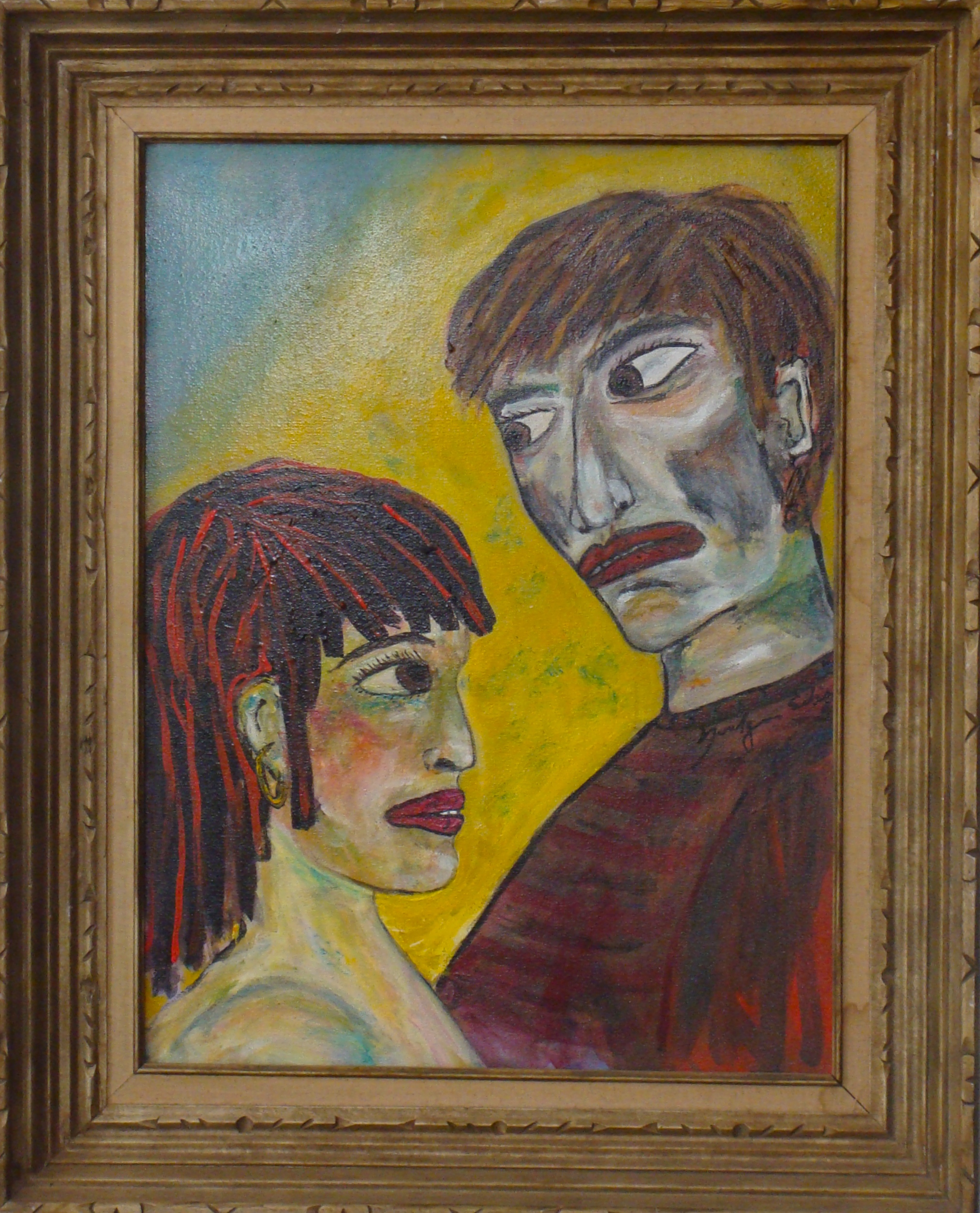
First Fight First Fight by Marilynne Eichinger

Smiling Anger

When I was younger, I went to a counselor who asked me, “Why do you always smile when you are angry or sad?” I did not realize that I had such a disconnect between my emotions and expression of them. After observing myself over time, I started to see that I even giggled occasionally when I had to express a negative opinion. My smile was a way of taking back the argument that expressed my feelings because I was afraid of the reaction I would get. The result was that whoever I was talking to did not believe the intensity of my words, thinking I was joking, and therefore discounted my effort at honest communication. This disconnect between verbal and non-verbal cues made it difficult for even the most empathetic individual to interpret my intent.

It is only since the mid-1960s that non-verbal communication has come under academic scrutiny. The relation between these two emotional processes, the display and the perception of affect via verbal and non-verbal cues, are skills related to emotional intelligence according to an article written for the Journal of Personality and Social Psychology. This type of intelligence includes the ability to identify, use, understand, and manage emotions.

The capacity to display and perceive emotions is learned in childhood by those who are fortunate enough to have parents who are accurate perceivers and clear expressers of feelings. As part of their parenting responsibilities they teach their children the expressive skills. Unfortunately a great many parents act in an opposite manner and train their offspring to inhibit emotional expression. Though not demonstrative, their children may still be able to understand others and relate to subtle displays of emotion. For example, if a child observes abusive parents, he or she may be acutely attune to what is going on because his or her life depends on it. Since these children learn to be stoic and hide their emotions, they are not quite as successful at communicating their message to others.

Children raised in a highly expressive environment often do not need to hone their perception skills to the same level as others. The psychology article gives as a metaphor the following example, “If everyone is shouting then one does not need to hear very well to get the message, but if everyone is whispering then one needs to develop excellent hearing.”

Ideas and theories about perception and communication are quite complex and confusing. The intensity, implications and applications of the impassioned situation all play a part. My sister has severe emotional problems. She now faces a life threatening disease but is not upset or willing to acknowledge the seriousness of her situation. She does become angry at the young doctors whom she thinks are just out to get money or experience in the operating room. In some ways I envy her because her lack of fear is calming, her mood is positive. However, talking with her to discuss a medical plan of action is extremely difficult, and she becomes angry and even lies if anyone takes away her ability to make decisions. Independence is something that she is not willing to give up easily. She is reluctant to have anyone not see her in a weakened state.

There is a dilemma in how to interact with a person who is not in tune with their situation or able and willing to speak honestly of their concerns. Those who grow up being taught to live in a dispassionate manner have a handicap to overcome when older. Every person, at one time or other, will have a need to lean on another’s shoulder. Illness and aging are part of life’s processes that can be accommodated when systems are in place to deal with them. Building relationships based on giving and accepting a helping hand take a long time to develop. Those not internally aware and able to express their own emotions find this type of friendship difficult to obtain. Being able to voice concerns is making a statement that says, “ I am comfortable with myself at this moment in time, and not afraid to share my true feeling.” Overall happiness depends as much on emotional intelligence as it does on intellect.

Art work is always for sale at eichingerfineart.com.

Do you want to know more?

http://apps.olin.wustl.edu/faculty/elfenbeinh/ElfenbeinEisenkraft2010.pdf– Displaying and perceiving Nonverbal Cues.

http://www.helpguide.org/articles/emotional-health/emotional-intelligence-eq.htm – on Emotional Intelligence.

On Being Real

1353336lTV Diva – Who is she?

On Being Real:   I just returned from a talk given by Tom Disrud about being real. It made me consider who I really am and who I want to be. Recently I have been told that I need a different moniker for my art work. My surname changed twice because of marriage, but I stayed with Eichinger because that is how I was known for twenty years, and Marilynne because that is all I ever knew myself to be. Each pseudonym, however, initiated a time of changed responsibilities as housewife, mother, museum president and finally company owner. Last year I sold my business in order to write and paint, and I asked myself if it was time for a new handle. And so I started to explore the meaning of my name.

The word Marilynne, according to baby name lists, conjures up sexy images, bringing to mind Marilyn Monroe. Its origin is a hodgepodge of English, Israeli, and Hebrew languages that blend Mary with Lynn. It is not a popular name today, as it was when I was born (there were three in my homeroom), but its popularity rank over the past two years has been rising again. The problem with this name is that I am now aging. Does sexy still describe me? In Zumba classes we put our hands above our heads pretending to be belly dancers one minute and hip-wiggling salsa dancers the next. A sidewards glance to the mirror had me in stitches when I tried to imitate the sexiest twenty-year old in the room.

My middle name is Hildegarde. Learning to write all of those letters was quite overwhelming when I young and had to sign my name as Marilynne Hildegarde. In Scandinavian mythology Hildegarde was a Valkyrie sent by Odin to escort battle heroes to Valhalla. In America the meaning is Battle, the name is all about war. My exercise program contains a smidgin of Tae Kwan Do and Tai Chi, so now I wonder if am I ready for battle? In front of the mirror I tried making my face fierce, disguising the smile crinkles in the corner of my eyes. “Ayee!!” I shouted. I failed abysmally.

Hildy, the name my grandfather gave me, according to Kabalarian Philosophy, is a person who has a desire to be of service to others, but practicality and attention to detail restricts her spontaneity. I am supposedly patient and will work hard to accomplish my endeavors.( true ) I tend to build a solid foundation of fact and logic ( yes ), but am not inclined to pursue inspirational or creative expression in music or the arts . . . (“uh oh!”) That statement stopped me immediately.) The article I read goes on to say that my ambitions are modest. (My friends would laugh at that one.) I do, however, appreciate a settled home environment that lets me show love for friends and family. It this who I am? Should I sign my art work Hildy?

To consider who I am, I had to divide myself into two parts, the physical being and the spiritual one. I started with the physical since it was easier to dissect.

Since retiring I have made some changes that I do like. My weight has come down to match what it was when in college. But instead of the tiny waist that my father used to wrap his hands around, five children have brought about a permanent increase in spread. Not bad though I can live with the reality of a slightly larger waistline. Exercise has made a big difference and I am stronger than I was a year ago. I can now do squats, kick my leg up to at least ninety-degrees and engage in jumping jacks with ease. Posture is now my bugaboo.

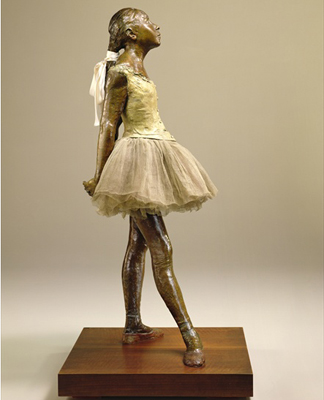
As a child dancer I was taught to stand in first position, and for years walked with toes turned outwards. If you have watched ballerinas you will often see them resting on one leg, the other slightly forward with toes out, belly protruding. (look at Degas sculpture of the Little Dancer.)

DEGAS STORY_339979After carrying babies on my hip, that position became exaggerated and my back suffered. Changing my stance to walk with feet in a parallel position has not been easy, but my back is much better. I feel great!

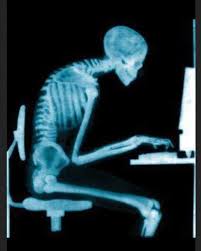
So why the shock when I looked into the mirror to find the real me? I suddenly noticed my bobbing computer head. “How did that get so bad,” I thought. Then I looked around the shopping mall and city streets to observe hundreds of heads dangling at the end of forward bent necks emanating from hunched shoulders. That description really fit me, and I did not like it. Was this just another part of the aging process, and was it something that could be corrected? With a computer head, I certainly could not keep my sexy Marilynne name or do battle as a Hildegarde. I still felt uncomfortable with a Hidly who was not involved in the arts.

I went online to discover something called computer neck. It is a common problem these days because children as well as adults sit at compuimagesters for hours at a time with poor posture. “Ouch!” This stance has made chiropractors wealthy. I learned that there are several things that can be done to get rid of computer neck. When sitting, with head in a neutral upright position, a line drawn straight out form your nose should intersect with the middle of the monitor. Forearms have to be positioned parallel with the floor with elbows close by each side. Feet should sit flat on the floor with thighs parallel to the floor as well while sitting slightly forward on a chair. To maintain the curve of my lumber spine, I decided to use a large chair-ball. Since it is slightly unstable it also forces me to use my core to maintain balance.

I am going to work on improving my stance and keep Marilynne as my name. I like the idea of staying a feisty, sexy woman. As to the spiritual side, well that is a whole other story.

Your thoughts about a name change? 

Artwork is always for sale. For Information explore eichingerfineart.com.

References:
http://orthoinfo.aaos.org/topic.cfm?topic=a0026 – How to sit at a computer.

http://www.kabalarians.com/Female/hildy.htm – meaning of hilly

www.sheknows.com/baby-names/name/marilyn – meaning of marilyn