Oh boy! Stress again!

Peace and contemplation in Eastern Oregon

Acrylic painting on canvas, gold frame, 21″ by 25″ / $ 499. For information contact me at marilynne@eichingerfineart.com

Oh boy! Stress again!

Over the years I’ve written about how children raised in trauma develop fight and flight responses in order to survive. They learn to react quickly when stressed but find it difficult to step back to analyze complex situations. I, and many of my friends, have the opposite problem. We live in our thoughts and are poorly equipped to cope with emergencies that require immediate action. Our minds work overtime, developing worrisome scenarios that may or may not occur in the future. We too are stressed and need to have coping mechanisms, but in a slightly different way.

What makes you calm? Is it a drive in the country? A walk in the woods? Yoga? Meditation? A good book? Do you fall asleep as soon as your head hits the pillow or do you lie awake tossing and turning for hours? When you hear disturbing news can you compartmentalize it so that it does not take over your entire consciousness and ruin your day?

A friend of mine told me that her husband has the ability to put his problems in a box, to take out and explore when the time is right. Whether it is pain or sad news, the input is immediately compartmentalized to be dealt with in a calm manner at the appropriate time. He is “way cool” for I strive for this type of control.

Though stress is destructive when it becomes too much to deal with, it can be good. It keeps life from becoming boring and also helps us perform in dangerous situations. Whether it is good or bad depends on coping mechanisms which dictate a reaction or response. When a situation appears to be overwhelming, we become anxious, which undermines our ability to effectively respond. The pressure also can have a negative effect on our health.

The challenge is to be able to respond quickly and effectively and to leave negative health responses behind. This includes not worrying in advance about something that may never occur, but being prepared in case it does. For instance, a person facing an operation should not worry twice. The operation should be faced with relative equanimity. once the results are known, then it is time to respond. Bad news can then be used as a spur to action. Stress is helpful when it is motivational but not when ‘what if?’ worries continue without end.

Ancient societies used flight or fight training when responding to the many physical dangers they encountered. A wild boar or roaring lion would arouse self-preservation reflexes that were immediately activated since they had been practiced many times in advance. When confronting a dangerous situation, their adrenaline, cortisol levels and heart rate increased to give them enough energy to respond by hiding, running, or attacking. Heightened alertness, muscle preparedness, slowing digestive and immune systems enabled them to move in ways that were essential to their survival. In other words, they were saved by an energized sympathetic nervous system where sensorimotor abilities were integrated with the psychological parts of their brain, allowing them to control emotions and act with speed.

Though the dangers faced today are different, they still exist, and our responses also require training and practice. Our stressors may be triggered by raging road drivers, aggressive skateboarders, or an assault rather than wild animals, but these encounters are no less stressful. Our muscles tense and blood pressure rises just as rapidly as in primordial cultures. These stress signals are a call to action requiring quick reflexes and knowledge in ways to respond.

There can be mental consequences for those who give little thought or practice to emergency situations. The adverse effects of stress may remain for an extended period of time even after the threat is over. Most people I know ignore the fact that our society also has stressors that require attention. We too need to be prepared and gain the skills necessary to survive with a minimum of stress.

One way to discover what is needed is to play a mind game. Begin by sitting quietly in a chair, closing your eyes and imagine dangerous scenarios and how you will respond. Note what when you start to become anxious. The exercise will help you discover what type of training you need in order to lower your stress. Will physical exercise help you improve reflex reaction time? Will classes in personal safety, self-defense or balance lower your stress threshold? One of my teachers suggested I practice shouting with gusto so I will be heard in an emergency. Being prepared for natural and man-made disasters can provide relief from anticipatory worry. Assembling extra water, food, and clothing, and knowing how to turn off gas, water and electricity are basic to handling potential crises.

Meditation was a crutch for me when a tree came smashing down on my roof, shaking the house as though in an earthquake. Glass flew everywhere while rainwater poured through a broken skylight and windows. My immediate reaction was panic, followed by jumping up with confusion about how to respond. My heart beat wildly and I am sure my adrenaline levels peaked. I had to calm myself before I could think and did so by thinking, “Marilynne, you are a meditator—breathe deeply. It took one minute to gain control because of having practiced meditation for many years. Once calm, I assessed the situation was able to respond immediately.

Those who participate in military, fire, or police training are taught how to deal with emergencies. Most ordinary citizens are not. Yet, we need to have these skills for there are bound to be times when we will be vulnerable. Preparation for natural disasters makes sense and should include having a meeting place to go to in case of emergency. Assessing risks and having emergency devices on hand will provide peace of mind.

It is also important to have your body in shape to handle various situations. Exercises that improve balance and reflexes and participating in self-defense, personal safety, and cyber-safety classes can be helpful. Just the process of regular practice can be a stress reducer. And, don’t forget, adequate sleep, a healthy diet and maintaining appropriate weight. The list goes on to include meditation, aroma therapy, warm baths, massage, and herbal teas. Reducing screen time including cell phone, computer, and television use and getting organized are natural stress-reducers. Lastly, in this day of alternative news, I think it is important confront media hype and instead look inward to what you must do to maintain your own sanity.

If we learn to manage the pitfalls of our own environment we are more likely to live with equanimity. We will stop being anxious when our minds play tricks but be ready for action when actually threatened. And, best of all, once the situation is over, we will be able to throw off the extra adrenaline and cortisol circulating throughout our bodies. It is worth the effort to be prepared.

References:

Christian, Nordqvist, December 24, 2015, What is Stress? How to Deal with Stress, Article Medical News Today: http://www.medicalnewstoday.com/articles/145855.php

Stress Symptoms, Signs, and Causes from HELPGUIDE .ORG in collaboration with Harvard Health publications: https://www.helpguide.org/articles/stress/stress-symptoms-causes-and-effects.htm

Uwe Proske, Simon Gandevia, October 2012 Pshysiolgical Reviews, VOl. 92 no. 4, 1651-1597, The Proprioceptive Senses: Their Roles in Signaling Body Shape, Body Position and Movement, and Muscle Force: http://physrev.physiology.org/content/92/4/1651


How Do You Talk to a Bigot

The Next Generation

Acrylic painting on canvas / in black frame (not shown) / $ 450 / 25” by 20”

Will this couple raise their child to think and reason independently or will their prejudices get passed?
____________________________________________

How Do You Talk to a Bigot?

A man must be excessively stupid, as well as uncharitable, who believes there is no virtue but on his own side.
Joseph Addison, The Spectator 243, (8 December 1711).

In high school, one of my teachers asked the class, “ How do you talk to a bigot?” The question stayed with me these many years for I found it tremendously difficult to answer. Examining his query scared me because so many family members and friends spoke out against those not made in their own mold.

In the 1950s and 60s, anti-Semitism was rampant as was hatred towards those of color. When Kennedy sought the presidency, wildly disparaging remarks were made against Irish-Catholics and the Pope. In nightclubs and on television, comics made fun of everyone by calling them Dago, White Trash, Paddy, Mik, Hun, Redskin, Honky, and Chink. The audience laughed. These words were part of common parlance and unflatteringly spoken in living rooms nationwide. Movies reinforced cultural differences by mocking minorities by using character actors who supported common prejudices. During my student years, so many people spouted self-aggrandizing beliefs that put others down that I could not imagine a way to turn their minds and hearts around.

In looking back, I realize that we have come a long way towards overcoming prejudice. No longer do we have segregated bathrooms based on racial identity though we still are not comfortable with sexual deviations. There are no black-faced minstrels dancing like children on stages nor are religious slurs tolerated in the media. Recent events, though, have made me realize that bigotry went underground and has not gone away. Many of us are surprised at the rise of the KKK and Arian Brotherhood who never accepted the idea of the United States as a melting pot of people with diverse backgrounds as an advantage to making the country strong.

Family gatherings are a time that brings to the forefront differences. Some friends complain that family members accept them with smiles to their face but then joke and make racial or sexual slurs when they leave the room. A few of my southern acquaintances mention more overt snubs. With self-righteousness and beliefs in their own superiority, they have relatives who liberally sprinkling sentences with words like faggots and Niggers. Families have been known to break up over such differences.

Bigotry, as defined in Webster’s, is “the stubborn and complete intolerance of any creed, belief, or opinion that differs from one’s own.” Ignorance and fear are two powerful allies of bigotry that seem to be on the increase. Bigoted people ignore the reality of diversity and cover themselves with security blankets to suppress their fear. They irrationally discriminate against those who are different and play on emotions rather than logic. Belief is elevated above thought and credence is given to lies before investigation. The possibility of error is beyond their imagination. Yet, their absolute acceptance that they are in the right causes a lot of pain.

So how do you get rid of bigotry? Eliminating bigoted beliefs often means giving up power which makes many people feel uncomfortable. What do you do when family or friends are the ones promoting disparaging statements? How can tolerance be encouraged and ignorance overcome? Is there a possibility for open, honest communication or do you just have to turn away from those who engage in hateful banter?

Doing nothing is not a good enough response for those living in a democratic society. Democracy only thrives when there is open and honest communication, a willingness to compromise, and an agreement to live by consensus or majority agreements.

I have gathered several suggestions on how to respond to a bigot.

1. Speak up to let the person know how you feel about their extremist remarks. Then walk away if racial, ethnic, or religious slurs continue.

2. Find several like-minded people willing meet the offending person at a less emotionally charged time in order to engage in an educational discussion. The meeting can not be confrontational but rather based on shared feelings that speak to fears and prejudices. Facts that counter long-held prejudices will only be heard if the discussion is non-threatening.

3. Decide in advance how important the relationship is to you and if you are willing to leave if the situation can not be resolved? If you come from a household where bigoted behavior was accepted, acknowledge it, but let your family and friends understand that as an adult you have learned to respect others. If your community is not a loving and respectful one, consider moving to one that is.

4. Don’t expect prejudiced people to instantly agree with you, but do expect that in your and your family’s presence offending statements will not continue.

5. Remind yourself that bigotry is not a political issue. It usually is passed on from one uncritical generation to the next. It exists across party, religious and state lines. It is in your backyard and cannot be ignored.

Comments by others to give you pause for thought:

“I ask you to uphold the values of America, and remember why so many have come here. We are in a fight for our principles, and our first responsibility is to live by them. No one should be singled out for unfair treatment or unkind words because of their ethnic background or religious faith.”
George Walker Bush, Freedom and Fear Are at War: Address to a Joint Session of Congress and the American People (20 September 2001).

“Perhaps travel cannot prevent bigotry, but by demonstrating that all peoples cry, laugh, eat, worry, and die, it can introduce the idea that if we try and understand each other, we may even become friends.”
Maya Angelou, Wouldn’t Take Nothing for My Journey Now (1993), p. 12.

“God deliver us all from prejudice and unkindness, and fill us with the love of truth and virtue.”
William Ellery Channing, “Unitarian Christianity”, an address to The First Independent Church of Baltimore (5 May 1819)

“I know a good many people, I think, who are bigots, and who know they are bigots, and are sorry for it, but they dare not be anything else.”
Edwin Hubbell Chapin, Living Words (1869) p. 125

References:

https://en.wikipedia.org/wiki/Sinophobia#Derogatory_terms> – List of derogatory words.
http://www.lifehack.org/articles/lifehack/bigotry-ignorance-and-fear.html _ About Bigotry
http://www.amnottheonlyone.com/how-to-deal-with-bigotry-among-family-and-friends/
– Bigotry among friends and family.
https://www.splcenter.org/20150126/speak-responding-everyday-bigotry– Southern Poverty Law Center- Speak Yup: Responding to Everyday Bigotry

Did you find your passion?

Grand Prize – Passion Flower

How did you find your passion?

This morning my NIA (non-impact Aerobics) teacher mentioned that 30 years ago at the height of the high impact aerobics craze she went to a conference where she participated in an exercise class with approximately 500 participants.  It wasn’t long before half the class left because, rather than stressing boom-boom, jump and twist movements, it stressed grace and centering practices that come from engaging in modern dance and practicing marshall arts. My teacher was ecstatic since  with a smaller crowd there was more room to stretch and move about. She said that by the end of the class she had tears in her eyes.  The zen-like program spoke to her. She had found her passion, her life’s ambition, and a career that still engages her after 30 years.

Her story made me consider how I discovered the focus that directed my life. It was not long before I realized it was accidental. When I speak of passion, I mean that can’t stop myself from pursuing an interest. I love and embrace activities that keep my mind challenged and engaged in the community. At the core of my being a few dramatic events changed the course of my life.  Eventually, they led to embracing science education wholeheartedly as a career.

The pivotal point, however, started at home. 

I have always been influenced by my children and now grandchildren.  They are the reason I became interested in educational psychology in the first place. They are why I started a museum in my basement and why I became involved in art.  You might ask, “Painting? What does that have to do with education.?” I painted because I believe a well-rounded person is versed in the arts, humanities, and science.  I also needed to relax from busy jobs as museum director and mother. Art provides an avenue to practice creativity but it is also meditative.  Painting slows my mind which struggles with a ‘to do” list that seems to go on and on.  It is impossible to put a dab of paint on a canvas or draw a line and think of something else. Art also set an example for my children by demonstrating that hobbies are as important for developing a sense of who you are as work.  

In retirement I continue to pour an equal about of energy into painting, writing and speaking about how people learn.   I am hopeful that the books I write will touch someone’s soul as much as those I have read have influenced me.  This week I was notified of a review to be published by the San Francisco Book Review.  It is presented here because the reviewer’s insight touched me. He grasped my passion and expressed it well. I especial like the last line and know that a great many of my readers are in similar positions to change the world.

Lives of Museum Junkies: The Story of America’s Hands-On Education Movement
By Marilynne Eichinger
Publisher-Inkwater Press, $19.95, 396 pages,  Available on Amazon, Powells Books, Barnes and Nobel and local bookstores. 
 
Picture a museum in your mind. Did you imagine exhibits, roped-off bits and bobs from history meant to inspire, amaze, and educate, but always out of reach? Even today, this idea of the museum as the look-but-don’t-touch institution persists. But there is another way. For decades, hands-on education has sought to break down the barriers between exhibits and visitors, allowing interested minds of all ages the opportunity to interact with exhibits, to learn firsthand by experiencing scientific principles in action. And Lives of Museum Junkies chronicles the long journey behind bringing science and museums to your fingertips.
 
Marilynne Eichinger uses her story — the story of how the Impression 5 Science Center in Lansing, Michigan, was brought to life — as the framework upon which to mount an encouraging, inspiring tale of dedicated people forging their own path and establishing something new and exciting for their community. This is the story of hard-working, generous, driven people starting from scratch and building something unique, valuable, and hands-on. From marketing and sharing one’s brand to expanding an idea on a national and international scale, the stories of Eichinger’s work at Impression 5 and the Oregon Museum of Science and Industry encompass all aspects of community building, starting a business, and shifting people’s perceptions of just what can be accomplished when creativity meets commitment. Readers also get to meet other key voices and entrepreneurs Eichinger has worked with, people who have inspired her and who have helped blaze new trails for hands-on learning. These profiles bolster Eichinger’s mission to lend credibility to the hands-on museum movement and show the many different paths one can take toward achieving success in ambitious charitable works.
 
Although the many benefits of this truly useful style of education are touted here, Eichinger refuses to paint a rosy picture of the process. The author never shies away from sharing the missteps, obstacles, and hard lessons encountered along the way, including a truly shocking revelation that typifies the gender politics at the time and the long legacy of gender bias in this country that still impacts us today. By pulling science and learning out from behind the glass and velvet ropes of traditional museums, Eichinger helped spark a revolution in understanding how we learn and how to engage (and re-engage) young minds in fundamental concepts of science. Lives of Museum Junkies is part tribute, part handbook, and part inspirational guide, reminding us once again that a small, dedicated group of people can change the world… because they’re the only ones who ever have.  – Reviewed by Glenn Dallas for the San Francisco Book Review

Lives of Museum Junkies Book

Book Launch Party, November 3rd at Marylhurst University, Marylhurst, Oregon – 7 PM, in the Old Library. Come join the fun.

Artwork is always for sale – Contact me at marilynne@eichingerfineart.com

Grand Prize – Passion Flower / acrylic on canvas / 24” by 28” / $ 499

Creating an Interactive Museum

Building BlocksBuilding Blocks

Creating a science museum is like playing with building blocks. It takes imagination, perseverance, and innovation to build a monument to experiential learning. The following excerpt is from the first page of Lives of Museum Junkies. Unusual consequences often occur from obscure beginnings and it is a pleasure to share them with you.

Creating an Interactive Museum: Naïve Beginnings

“Stop running and making so much noise!” I shouted to five rambunctious children playing hide-and-seek in closets throughout the house. It was a cold day and my friend Dee Pumplin was visiting with her son. She and I were having a difficult time hearing each other as we chatted animatedly in the kitchen. It was during this conversation that my homemaker days started to end, when over coffee in my suburban house we brewed up the idea of a hands-on museum that emphasized science. Children are not always polite, studious little creatures set on this planet to impress and please their parents.

Children are not always polite, studious little creatures set on this planet to impress and please their parents. Instead they are balls of energy who love to run, scream and create bedlam. In short they can drive a parent crazy, especially on a rainy day. As Dee and I talked, her one and my four children shouted and squealed, ignoring the storm roaring outside. The increasing noise level was like a drum roll announcing a new idea. We started imagining what it would be like to take our kids to an indoor playground. “Wouldn’t it be magnificent to have a great big barn,” we fantasized, “and fill it floor to ceiling with ramps, poles, and climbing apparatus? What fun it would be for the children and their friends. They would get rid of their energy away from home and our houses would be preserved.” Dee and I started to wonder where we could find a barn and even took the next step of contacting a realtor.

As we learned more, the vision for an indoor play structure grew. The immense dimensions of a working barn inspired our ideas to expand to include interactive learning activities inserted into climbing areas. We imagined children swooping down a sliding board and finding a light table, colored filters, and projectors to use for experimentation. The colored light could be projected on the next child speeding down the slide. We embraced the idea of physical play being integrated with academic challenges in a never-ending cycle of learning.

After months of talk and concept development, we finally located a barn, but it wasn’t long before we faced a dose of reality. The cost to acquire the property was more than we anticipated and building the inside play structure seemed monumental. The barn needed to be heated, insulated, electrified, bathroomed and water sprinkled and once it was upgraded, ongoing utilities would be astronomical. The permitting process was overwhelming to two inexperienced women who began to wonder if the city would even allow this type of play-barn to exist. Insurance was bound to be phenomenal, not only because we were dealing with a wooden structure but because we were planning to let children run throughout. We especially liked the idea of fire poles descending from one level to the next. Sound safe? Costs mounted, reaching an enormous number before we even considered the price of exhibits and staffing. . . . .

Lives of Museum Junkies is available through AMAZON, Barnes and Noble, Powells Books, Inkwater Press, and The-M-porium.

For a signed copy you can purchase from me for $ 19.95 plus $ 4 shipping. Contact me at eichingerbooks@gmail.com.

Artwork is always for sale: Building Blocks is a 24” by 28” acrylic painting on canvas in a gold frame. Cost is $450. Contact me at marilynne@eichingerfineart.com for further information.

perf6.000x9.000.indd

New Release: Former OMSI President Reveals the Good, the Bad, and the Ugly History Behind the Hands-On Education Movement

“…will help you see science museums in a new light.” – David Ucko, Museums+More llc
In this lively, behind-the-scenes look at the evolution of interactive science museums, discover:

How the Brooklyn Museum of Art was saved from closure by Mayor Rudolph Guiliani for showing a painting by Chris

How the Brooklyn Museum of Art was saved from closure by Mayor Rudolph Guiliani for showing a painting by Chris Ofili of the Virgin Mary that contained elephant dong.

Why an autistic child spoke for the first time on a science center visit.

Who kept NOVA from being canceled when congress did not agree with their investigative reporting style that explored sensitive subjects like nuclear energy.

What inspired a poor Appalachian orphan to go from rags to riches to become a museum president who later rented an entire cruise ship to see a global eclipse on the Amazon.

Why executives at the top are subject to sexual abuse and find it nearly impossible to manage.

The outcry caused by the Playboy Bunnies playing basketball with business executives to raise funds for a museum.

“recommended for those who care about museums, libraries and society today.”
– Ginnie Cooper, Directed Washington D.C., Brooklyn, and Portland library systems .


The Importance of Touch

applauding-the-blues

       Applauding the Blues

Acrylic on canvas/ Gold Frame/ 23.5” by 19” / $ 495.00
Do you stop to look, touch or smell the flowers? Perhaps you even taste them.

The following excerpt is from my upcoming book, Lives of Museum Junkies. Due out in August it tells my story along with that of eleven other innovators who influenced the hands-on museum movement in the early 70’s. Publication information will be available in a few weeks.

The Importance of Touch
In 2012, a young social work student at the University of Rochester was featured in national publications as a most unusual entrepreneur. While studying brain and cognitive sciences as an undergraduate, Jacqueline Samuel became aware of the negative effects of living in a culture that does not sanction touch for its own sake. Throughout the world people are more willing to hold hands and hug friends and family than in the United States.

Adverse consequences of tactile isolation are known to be agitation, anxiety and aggression. Jacqueline decided that she would ameliorate the situation by opening a cuddle parlor she named the Snuggery. Her focus centered on bringing the healing power of touch to those who are tactilely isolated. The rules she and her employees devised were strict; staying clean, keeping clothing on and not engaging in any “funny business.” Her non-sexual touch emporium was singularly based on the platonic need for physical closeness. Business boomed, spurring copy-cat cuddle parlors throughout the country.

One even opened where I live in Portland, Oregon.
You might wonder what type of person needs to pay $60 for an hour hug? Clients come for a variety of reasons and include those on graveyard shifts returning home to empty beds, the physically handicapped and the chronically depressed. There are thousands of people, many elderly, others single or with a physical disability who are never touched, held, or hugged. Having a friend to talk to and being cuddled is important for overall emotional well-being.

Jacqueline’s insight is backed by volumes of research showing how touch reduces cortisol, the stress hormone that suppresses the immune system. The Touch Research Institute at the University of Miami is a center that concurs with Jacqueline’s concerns. They recently completed a study showing that teens who lack hugging are more likely to be aggressive than their peers who are regularly hugged. Elderly people who are touched are healthier and less likely to develop dementia. Premature babies who are stroked gain weight faster than those who are not and infants who lack adequate physical and emotional attention are more likely to have behavioral, emotional and social problems as they age. And now we see that tactile learning can also be highly effective.

Hands-on museums are cognizant of sensory research, and tactile solutions especially form the basis of many of their activities. Not only do people need physical contact with others but they also have a need to touch and play with objects. A friend of mine shared an insight that it was not just his auditory sense that made him enjoy playing the piano, but his tactile contact with the keys. . . . . .

My work in the museum field was influenced by an exercise I had to complete as a graduate student in psychology. One of my assignments was to write a paper imagining what it would be like to lose each of my senses. I was also directed to explore my feelings about loss of sexual sensitivity. To start the exercise I would sit for an hour in an easy chair imagining myself as a blind or deaf person. As I delved into the assignment, I was surprised to realize that losing my hands would be one of the most horrendous handicaps I could have. The hour spent with handless imagery was torturous, leaving me scared, almost frozen. What if I could not touch a door knob or wave my hands while talking? How horrible it would be to not be able to tousle my child’s hair. Touch was not the only sensation that affected me deeply. I quickly realized that losing my sight would be just as awful. As a visual and tactile person I am so fortunate to have both of these faculties.
Each of us is controlled by biological predilections and we are most happy when we allow daily activities to be guided by these predispositions. . . . .

Understanding a child’s sensory preference helps parents and teachers design appropriate educational programs. The visual learner may love reading books, but there are many children who are hesitant readers and need to be drawn into the learning process through an alternative sensory route. A history teacher might design a curriculum for tactile learners by challenging them to make dioramas. The process still requires the children to read in order to know what to include in their 3-D pictures, but their interest in the project will be internally motivated. . . . .

Parents, grandparents, friends and teachers please think twice before you tell a child not to touch. Your curious child might just need a little guidance to encourage safe and constructive activities that take advantage of his or her way of communicating. Remember, a broken glass can be dangerous but there are safe ways to turn broken glass into a mosaic . . . touch me, touch me not. . . . .

_______________________________

This summer is a good time to let your children wander and experiment by using the sensory mode they most prefer. A warm hug for effort will go a long way towards developing their passion for learning. And by the way, we parents and grandparents love hugs as well. They provide wonderful feelings of well being.

I look forward to your comments below.
Art work is always for sale. Contact me at marilynne@eichingerfineart.com

For sale on Amazon by Marilynne Eichinger: The True Story of Streetwise, overcoming homelessness and beating the odds. Go to http://www.amazon.com/dp/B01AAXMJOGThe

Streetwise

Exploding Emotions

1662376l copyTwin Stars Exploding
Acrylic on Canvas / 16” by 20” / $ 299
Explosions are part of creation. When the product of emotions, they can get channeled for good as well as evil.

Exploding Emotions

Last week I wrote about passion. Due to the horrendous attacks in Orlando my thoughts turn towards anger because the two can be intimately intertwined and also because I need to understand why such things happen. Aggressive behaviors often result from a person passionately embracing a cause that was triggered by real or perceived injustice. Anger festers and churns  eventually became so violent that like a volcano it erupts in an explosion that does great harm to others in the name of passion for a cause.

A terrorist’s violence usually does little good to further his or her stated purpose. Instead, a common public reaction is to close down empathy, shut off communication and increase vows to retaliate. Horror, hatred, punishment and revenge are the overwhelming outcome and questions of why it happened in the first place take a back seat.

In the United States, most of us espouse change by law and not violence, yet a great many frustrated individuals resort to aggression when their way is not endorsed. People who are not heard may decide that the only way to get attention is to maim, kill or destroy property.

I was intrigued by a sentence in a book by Joy Kogawa about the plight of Japanese-Canadians during World War I I.  In ITSUKA she writes about a eulogy given at a funeral. “He praises his dead friend because he never complained, because he paid the price for harmony in a world of discord. He did not add to the din. He was obedient to the command to be meek, but he did not in the end, I am thinking, inherit the earth.”

What is the way forward? Is it better to be quiet and not make waves or to live in the wild west and take law into your own hands? Do we continue to interpret “the right to bare arms,” as permission to use assault weapons? If not to kill then why does anyone need such a lethal machine? It certainly is not for sportsmanlike hunting purposes.

Consider religious fanatics who burn abortion clinics and shoot their doctors. Most of those killers consider themselves to be religious practitioners following the teaching of God. Unfortunately in support of their actions, Christianity, Judaism and Muslim religions are replete with hateful statements about non-believers. Yet, there are also many passages that speak of love. The new testament says, “turn the other cheek” and the ten commandments include, “thou shalt not kill,” but self-righteous fanatics ignore those teachings and commit the very crime they abhor. How did they become radicalized and care so little for humanity?

According to an article by Jennifer Williams for Vox, there is no one religion that can shoulder the blame for violence. It is found among followers of all religions and of every political persuasion. But becoming “radicalized” is not the same as becoming a terrorist. Many individuals who follow extremist views are not violent. Of the 318 events identified in an FBI report only 7% were attributed to Islamic extremists.

The article mentions societal factors associated with a higher risk of radicalization;
• The presence of a large minority population that is socially, politically, and economically marginalized
• Treatment of certain groups as “suspect communities” that are subjected to invasive and overbearing counterterrorism efforts
• A cultural or political hostility toward religion in general or Islam in particular
• Unpopular foreign policies, such as support for repressive regimes or involvement in a military campaign, especially in a predominantly Muslim country (or several of them)
• The presence of preexisting recruitment networks

Following are a few of the individual risk factors;
• Personal ties to an already radicalized individual
• A sense of personal failure, often tied with a yearning to do something important and meaningful with one’s life
• A desire for adventure, rebellion, and life experience
• The need to belong
• Feelings of compassion and concern for the suffering of others with whom one feels some kind of personal connection, often (but not necessarily always) co-religionists
• And, of course, good old-fashioned teenage angst

And NPR reporter mentioned the possibility that the Orlando shooter was confused by his own sexual identity. For years he paid visits to the gay nightclub he massacred. There is no one path to radicalization but the most common either begin in prison or derive from the internet, social media and personal ties to friends and family. . According to Bruce Hoffman in The Daily Beast, terrorists are motivated by altruism, albeit misguided, feelings of self- defense, and a commitment to their faith with the belief that they are divinely commanded. They are difficult to locate in advance which makes dealing with them so difficult.

It is my opinion that we need to rethink our counterterrorism policies by diffusing individualized feelings and working to neutralize organizations that are a threat to our way of life. We need to find ways of changing people’s minds so terror will never be considered a way forward. To do so systems have to be in place that listen to both individual and organized group complaints so that people feel heard. Mental health services can be utilized to help confused, disgruntled people and criminal zealots who have lost their way.

I remember when an close acquaintance of mine allowed his 13 year old daughter to accompany a friend to an evangelical Christian summer camp. It took only one week for her to become brainwashed. Campers were required to stay up past midnight when they were exhausted and vulnerable in order to participate in mind altering services. They were even told how to deal with their parents upon returning home. My friend had to send is daughter to a psychologist who specialized in cult post-trauma recovery. I now understand how easy it is for a vulnerable person to be brainwashed and how difficult it is for that individual to renounce newly adopted beliefs.

There is much that can be done to combat terrorism. Politicians can pay special attention to all of their constituents, not just those with money or share their biases. For instance, many oppose Syrian immigration to the U.S., and though I am not one of them, it is important to listen, reach out and discuss various viewpoints and options before making a decision that affects the country. Citizens want to be heard and responded to with dignity. They have a right to feel comfortable in their homes, not afraid to travel freely and satisfied that their concerns are being addressed.

Government could help by responding more quickly to the needs of the growing army of ignored citizens, many of whom are poor and jobless. The press could be supportive by focusing less on inflammatory remarks and reporting on the news rather than sensationalism. What happened to programs by Edward R. Murrow, John Cameron Swayze, Huntley and Brinkley, Barbara Walters, Tom Brokaw, Peter Jennings, Dan Rather and Walter Cronkite? Where are the reporters who dig deeply for understanding? Who do you trust to report unadulterated news? When did news stations lose their independence?

Lastly, kindness and social awareness need to be taught as part of the school curriculum so violence and bigotry have a chance of being nipped in the bud. Bullies, terrorists and racists are not heroes. The melting pot envisioned by early Americans is a good one that can work to our benefit if we want it to.

http://www.vox.com/2015/11/20/9764078/paris-terrorist-radicalization – How ordinary people become terrorists.

http://www.thedailybeast.com/articles/2013/04/27/answers-to-why-people-become-terrorists.html – Why people become terrorists.

http://www.csj.org/studyindex/studyrecovery/study_trauma.htm – Cult Post-trauma recovery

Art work is always for sale. Contact me at marilynne@eichingerfineart.com

Do respond below with your thoughts.
___________________________
For sale on Amazon by Marilynne Eichinger: The True Story of Streetwise, overcoming homelessness and beating the odds. Go to AMAZON .

State of Flow

Achieving FlowAchieving Flow

Acrylic on canvas / 18” by 24”/ $ 260
When are you the happiest?

Do you believe most people are happy? Are you? Take a moment to consider those moments you experienced pure joy, when glee and pleasure embraced you, and ask yourself what precipitated that feeling. No, I am not talking about sex, though that too can be satisfying. Instead remember more instances that provided extended contentment and comfort. Why do you think you felt so satisfied?

Was your pleasure dependent on money or was it caused by an activity you engaged in? Psychologist Abraham Maslow tried to understand what contributed to feelings of fulfillment. He started with a pyramid explaining motivation. With basic needs at the base and aesthetics at the peak, he claimed that survival needs have to be satisfied first. Only when basic concerns are met, like food, shelter and love, does a person become motivated enough to fill higher levels leading to self-actualization.

In my late 20’s I was comfortably situated with most of my basic needs met. I started playing the flute thinking I would attain a degree of excellence. Every day I practiced dutifully and even played with musicians who didn’t mind accompanying a novice. Eventually a few friends and I formed a chamber music group. Most of the players had learned their instruments as kids. They were good and relaxed at what they did and best of all tolerant my awkwardness. Though I played for eight years I never achieved a level of comfort. Playing the flute was always an effort in concentration and I found it impossible to lose myself in the music.

Painting is a different matter. No longer am I self-conscious about what I am doing. I picked up a brush over thirty years ago and gave myself over to the process even when completed canvases were marginal. I never thought about becoming a master artist but more about practicing so I could put the images in my mind on canvas. After a great many years, I executed a picture that appeared magically and effortlessly on my canvas. It was a mystical experience. I was immersed in pure creation with no thought of myself. It was a wonderful feeling that left me with an internal glow. What happened?

Hungarian psychologist, Mahaly Cxikszentmihalyi was fascinated by Maslow’s work and took his findings a step further. Mahalo provided a scientific explanation for peak experiences. After studying the happiness factor in thousands of people he developed a concept defined as a “state of flow.” It occurs to those who are so completely absorbed in an activity that they achieve a loss of self-consciousness. It is as though they are in an emotionless state yet total control of what they are engaged in. A monk might call it reaching Zen, a perfect state of equilibrium.

Dr. Csikszentmihalyi, founder of the positive psychology movement, began his research by studying artists and other creative people. His subjects found the process of creating more important than the finished work itself. During times of intense focus and innovation they entered a “flow” state in which Mahaly identified seven factors:

1 You’re completely involved in what you’re doing: you’re completely focused and concentrated.
2 There’s a sense of ecstasy–of being outside of everyday reality.
3 There’s a great inner clarity: you know what needs to be done and you get immediate feedback on how well you’re doing.
4 You know that the activity is doable, that you have the necessary skills to complete the task successfully.
5 You lose your sense of self and all of your worries and concerns drift away.
6 You lose track of time and you’re completely focused on the present moment.
7 There’s an intrinsic motivation—whatever produces flow becomes it’s own reward.

Not content to stop there Mahaly broadened his research base to encompass various socio-economic groups engaged in a wide variety of jobs, hobbies, and sporting activities. He analyzed those who involved in what he calls high-flow activities. Their goals required them to be motivated enough to practice in order to obtain skill and concentration. By being focused in their efforts they were more likely to develop long term happiness than those engaged in low-flow activities such as video games, internet surfing and socializing. In other words, hard work pays off while low-effort enterprises often contribute to depression and poor self-esteem.

In another study Mahaly worked with American teenagers. Social activities were rated and correlated to different levels of happiness. Being alone rated the lowest level while activities with friends rated highest. His colleagues were surprised to discover that those who spent more time pleasure reading had lower levels of happiness that those involved in social activities. They concluded that feeling good about the self, excited, proud, sociable, and active are necessary conditions for a flow experience and the strongest predictors of long-term happiness.

Why? Dr. Csikszentmaihalyi explained in a Ted Talk that the nervous system is incapable of processing more that 110 bits of information per second. Listening to someone speak involves processing 60 bits per second which explains why it is difficult to pay attention to two people talking at the same time. When completely involved in the process of creating you don’t have enough attention left over to monitor how your body feels, whether you are hungry or not, or thoughts about your next task. In other words, you become “zoned out.” You flow.

Flow is studied by psychologists world-wide and applied to all types of professions with similar findings. Streetwise, now a journeyman industrial painter, tells me what it is like to be on on the top of an eighty foot water tower. His sense self-awareness disappears as he expertly moves his brush back and forth without distraction. Work feels effortless even when hanging fearlessly over the edge. In those moments he is in a state of flow.

Developing goals, striving to achieve them, learning to focus and finally attaining competency is the formula for reaching a pure state of being, of living “in the zone.” Dr. Csikszentmihalyiu says that learning how to get there quickly so you can enter flow more often leads to the most productive and creative state of mind in which to work. It is a key to well being and an important component of happiness.

Are you one of the fortunate people who have experienced a state of flow? How long does the feeling last? Does it spill over to the rest of your life and make you happy?

Do share your story below.

References:
http://www.simplypsychology.org/maslow.html – Maslow’s hierarchy of needs.

https://daringtolivefully.com/how-to-enter-the-flow-state – How to enter the flow state

http://www.pursuit-of-happiness.org/science-of-happiness/getting-in-the-flow/ – about Mahaly Cxikszentmihalyi and a state of flow.

https://daringtolivefully.com/how-to-enter-the-flow-state – How to enter the flow state

Art work is always for sale. Contact me at marilynne@eichingerfineart.com.
___________________________
For sale on Amazon by Marilynne Eichinger: The True Story of Streetwise, overcoming homelessness and beating the odds. Go to AMAZON .

Politics of Intelligence

Exhibit in Hong KongMy son at the Hong Kong Science Museum using his energy to make things work.

Politics of Intelligence

Last week’s newsletter focused on the plight of 32 million illiterate Americans. I explained how those neglected during childhood often suffer brain impairments that cause societal problems later. For the first time in many years these forgotten citizens have caught the attention of politicians. The subject of jobs and pay equity has come to the forefront of their platforms. It is important to note that illiteracy is not to be confused with intelligence. Though one may impact the other, there is not an absolute correlation. Many factors come into play when considering intelligence, including where your were born, the socio economic position of your family, how education is valued, determination to succeed, and the quality of training you receive as you go through the school system. Testing has played both a good and a divisive role by categorizing people.
IQ tests were started in 1904 when when the French government commissioned Alfred Biney to design a system to help identify intellectually normal children from those who were more challenged. Mensa’s IQ scale is as follows:

Intelligence People in each category

below 55 .1 %
55-70% 2 %
70-85 14 %
85-100 34 %
100-115 34 %
115-129 14 %
130- 145 2 %
145 + .1 %

Of interest: Einstein’s IQ was 160; Madonna – 140; Steve Martin – 142; Sharon Stone – 154; Arnold Schwarzenegger & Matt Damon – 135; Bill Gates -160; Adolph Hitler -141; Bobby Fischer 187; Bill Clinton 137; Paul Allen 170

Other tests were developed to evaluate factors that are not apparent on the standard IQ test. Howard Gardner, proposes his theory of multiple intelligence that tests for other intelligent factors such as:

Kinaesthetic – Body Smart
Linguistic – Word Smart
Logical – Number Smart
Interpersonal – People Smart
Intrapersonal – Myself Smart
Musical – Music Smart
Visual/Spatial – Picture Smart
Naturalistic – Nature Smart

No one wants to label others and say they are not capable of succeeding. However, just as it helps be aware of circumstances surrounding how you were raised, there is benefit in knowing your intelligence strengths when choosing a career.

There are those who take exception to these tests, warning that because culture and literacy affect outcomes they should not be depended on by educators or employers in determining whether to admit a student to university or to make a job offer. Some teachers have concerns that children labeled less intelligent at a young age will be stigmatized throughout life. On the positive side are those who use results to individualize instruction.

My interest, however, is centered on jobs, rather than intelligence. I want to know if there is a correlation between intelligence and future employment opportunities. Since millions of citizens take these test there is a lot of data to support results. It is reasonable to assume that the general population falls into a normal distribution curve. There will always be people at the low and high ends. Tag programs and challenging jobs are available to those at the upper levels of the spectrum. They are the fortunate group.

It is the normal range of the IQ scale that spawns so many angry people at political rallies because their employment opportunities have become limited. To this you might counter by saying, for those who are motivated to get trained, there are still plenty of opportunities. Streetwise is a good example of a young man who spent four years as an apprentice, journeying out to become an industrial painter with a job that will provide a good salary for the rest of his life. I wonder how many of jobs in the trades are available for willing workers?

And what happens to those millions of citizens who have an IQ under 85? In the United States 16.03 percent fall in this range. According to the 2016 Census estimation the nation’s population this March was 324,118,789. This means that 52,831,362 people are categorized as being intellectually challenged. These men and women certainly can work, but they may need special accommodation that includes increased supervision.

Another 110,200,388 people have IQs in the low average category (85-100). By definition, half the people of the country have an IQ of 100 or lower. What will keep these people inspired and willing to put in the effort to learn to read and develop skills leading to employment?

Post WWII a person who was of average intelligence could find honorable, well-paying work . Today the jobs they previously filled are scarce. They have either been sent overseas, supplanted by automation, replaced by technology or become obsolete. In my neighborhood even the trash collectors have gone from two people manning a truck to one. As the employment chain requires more highly skilled personnel even those with over 110 IQ such as paralegals, tax preparers, mid-level managers and desk top publishers are being replaced by software.

Economists say that a highly trained, technologically sophisticated workforce is in our future. According to Jobs for the Future, 68% of U.S. jobs will require postsecondary credentials in the knowledge based world of 2020. This brings us back to the question of what will people with average intelligence and inadequate training do to support themselves.

I’ve heard suggestions that range from, “all people should automatically get paid for doing nothing,” to “the government must provide make-work programs to keep citizens busy and out of trouble.” And then there are those who ask, “why should I support those lazy bums?” We need a conversation. When will it start?

Are you tired of people living on the streets, of gang violence, of an illiterate populace, of lack of jobs, and of gross income disparity? Or do you see a future of armed, walled-in cities, such as now exist in China to protect the fortunate from the rest of society? I visited one outside of Guangzhou. Known as villas they house 1/2 to 1 million people in luxury. The gated areas are complete with shopping centers, restaurants, schools and hospital. Women and children never leave their compounds. Men go off to run their factories.

A 2011 Gallop survey proclaims nine countries claim to have full employment. In each case their government is involved in controlling working conditions. Some limit work hours while other have initiated public work programs. My ex-husband returned from an engineering consultancy job in India where the owners asked him to help design a more efficient factory. In private conversations the workers complained. They needed jobs, not efficiency and automation.

There is a bible saying that warns, “Idle hands are the devil’s workshop.” The passage implies that those who don’t have anything to do with their time are more likely to get into trouble. Sounds reasonable to me and I fear that many of the problems we face in the United States are directly related to inactivity without sense of purpose. Isn’t it also reasonable for a person of average intelligence to be valued and provided an education and training with a guarantee that there is something useful to do at the end?

I look for solutions that will give all people meaningful employment so they can be part of contributing to the greater good. I do believe that it can be done if we make benefiting society and not accumulating wealth our priority.

Your thoughts?

Please respond to this article below.

References

http://www.i3mindware.com/mensa-requirements– Mensa IQ testing.

http://www.bgfl.org/bgfl/custom/resources_ftp/client_ftp/ks3/ict/multiple_int/what.cfm – test for multiple intelligence

http://www.worldometers.info/world-population/us-population/ – Population of the U.S. in 2016

http://www.jff.org/initiatives – Jobs for the future.

http://247wallst.com/special-report/2012/04/25/nine-countries-where-unemployment-does-not-exist/2/ – Countries with the highest employment rates.

http://www.therichest.com/rich-list/most-shocking/10-famous-people-with-surprisingly-high-iqs/ – IQs of the rich and famous.
To view my art go to eichingerfineart.com. Questions can be directed to me at marilynne@eichingerfineart.com.

___________________________________________________________________________

For sale on Amazon by Marilynne Eichinger: The True Story of Streetwise, overcoming homelessness and beating the odds. Go to AMAZON.

Politics of the Uneducated

NurturingNurturing

43 in. by 84”/ gold frame/ acrylic/mixed media / $ 1,100                                                                       Just as we need to care for the environment, we must nurture our citizens. Societies that do not value all lose freedoms and become ripe for autocratic control. They spawn violence, vulgarity and criminal behavior.

Politics of the Uneducated

Do you wonder why so many angry, cursing, ready to fight people are jumping into the political arena this year? What is happening and why is there so much vulgar behavior that I never believed was part of our culture? Donald Trump said proudly after one of his rallies, “Don’t you just love the uneducated!” Though in context he implied that he loves everyone, his comment made me think about uneducated making decisions for me. I don’t like the thought.

According to Ruth Marcus syndicated Washington writer, Trump’s backers tend to be less well-educated and affluent. In the past these people were silent yet this year they run in droves to join Trump’s bandwagon. He appeals to those who hate non-whites, Muslims, want a hands- off government and country that practices isolationism. Like those who who join with Bernie they complain of trade treaties that took jobs overseas. They want manufacturing on American soil and believe that when it returns factory owners will hire them for a fair wage. I am not so sure, and imagine these entrepreneurs will substitute automation for labor. The poorly educated would like to rid the country of illegal immigrants, yet they don’t seem interested in going into the fields to pick strawberries and apples.

What happens when a society has an overabundance of uneducated people and no jobs available for them to fill? How should our politicians address this situation? You be the judge. Bear with me as we wade through a few statistics.

The nation’s graduation rate is currently at 82.3 percent. This is an improvement from the 72 percent rate in 2001 yet the statistic is misleading. Some communities still have 50 percent of their students dropping out. Race and poverty are the most significant factors. Oregon is one of the worst states with 31 percent of students dropping out. 15 other states are nearly as bad. 1000 schools in the U.S. are labeled drop out factories representing one million failing students.

According to the National Assessment of Educational Progress (known as the Nation’s Report Card), though graduation rates are higher, performance is lower. The Huffington Post reports that the U.S. illiteracy rate hasn’t change in ten years. 32 million adults in the U.S. cannot read. That number represents 14 percent of the population. 19 percent of high school graduates are functionally illiterate. What future is there for these youth? What kind of employment opportunities do they have? Would you hire them? Does a high school diploma have the same benefits as it did years ago?

Those without a degree cannot serve in the military. They cannot fill the skilled jobs that our economy depends on. US News predicts that, “the manufacturing labor market, which supported a vibrant middle class at the end of World War II, is never coming back.” Jobs in health care, social assistance and technology will grow, construction stay the same, and mining, manufacturing, and logging will continue to decrease. So what happens to the uneducated?

The Department of Justice states that, “The link between academic failure and delinquency, violence, and crime is welded to reading failure.” The uneducated are more likely to engage in criminal behavior, require social services, live on the streets, have poor health and die younger. Much of their current situation has to do with traumatic childhood experiences. They grew up in poverty with inadequate food and neglectful caretakers. They were subjected to verbal abuse and put-downs (You’ll never amount to anything!), violence, and early exposure to drugs and alcohol. They may have been sexually molested, treated as slaves, become pregnant as a teen or thrown out of the house because of LGBT affiliation.

Research I have read about trauma and its effect on the brain shows that youth raised in stressful environments often exhibit signs of impaired brain development. These young people suffer from a lack of trust, have problems regulating emotions and feel the world to be unsafe. In the classroom they are the spaced-out, daydreamers who don’t pay attention. They lose track of time and have little interest in learning, occupying seats until graduation gives them freedom. Impulsive behavior replaces rational thought and their actions are unpredictable, volatile and extreme. They grow up feeling powerless in the face of adversity and act defensively and aggressively. These are the uneducated. Do they seem like characters in “Lord of the Flies,” rather than kind compassionate citizens? It is these men and women who are attending political rallies in record numbers. They heed the call to punch those who oppose their viewpoint. And yet though they act poorly, they are also crying out for a better future. Their actions are making Americans pay attention. But how do we respond with jobs and housing for so many disaffected citizens who live in poverty?

There are consequences to neglecting this group of citizens, and election speeches are raising many issues that have not come to the forefront of past campaigns. Let’s look at them.

Should wealth be in the hands of a few or many? Do we need to increase our defense budget? Should we pay more attention to education or get rid of the Department of Education? ( remember that more kids are graduating now.) Should cursing, violent movies and videos continue to be plastered on TV and Internet without concern for morality? Is it OK to supersede the melting pot ideal by hatred and isolation? Are guns and drugs the norm for all time in the future? Is the environment as important as the economy? Should we applaud efficiency and let robots replace the uneducated or are jobs more important? Do we limit population so we can afford to care for those who exist? Do we want beggars and the homeless on or off the streets if it costs tax payers money? Do we continue to put record numbers of the mentally ill and those who commit crimes in prison for long years without rehabilitation? Do we keep out those with whom we disagree or do we bring them into our country to teach them our ways?

You decide!!!!
Art work is always for sale. For more information go to  my web site www.eichingerfineart.com.

Please comment on my blog site below.

References:

http://www.npr.org/sections/ed/2015/12/15/459821708/u-s-high-school-graduation-rate-hits-new-record-high- NPR Education Report.

http://www.huffingtonpost.com/2013/09/06/illiteracy-rate_n_3880355.html – Literacy rates

http://money.usnews.com/money/careers/articles/2012/09/10/the-future-workforce -workforce of the future.

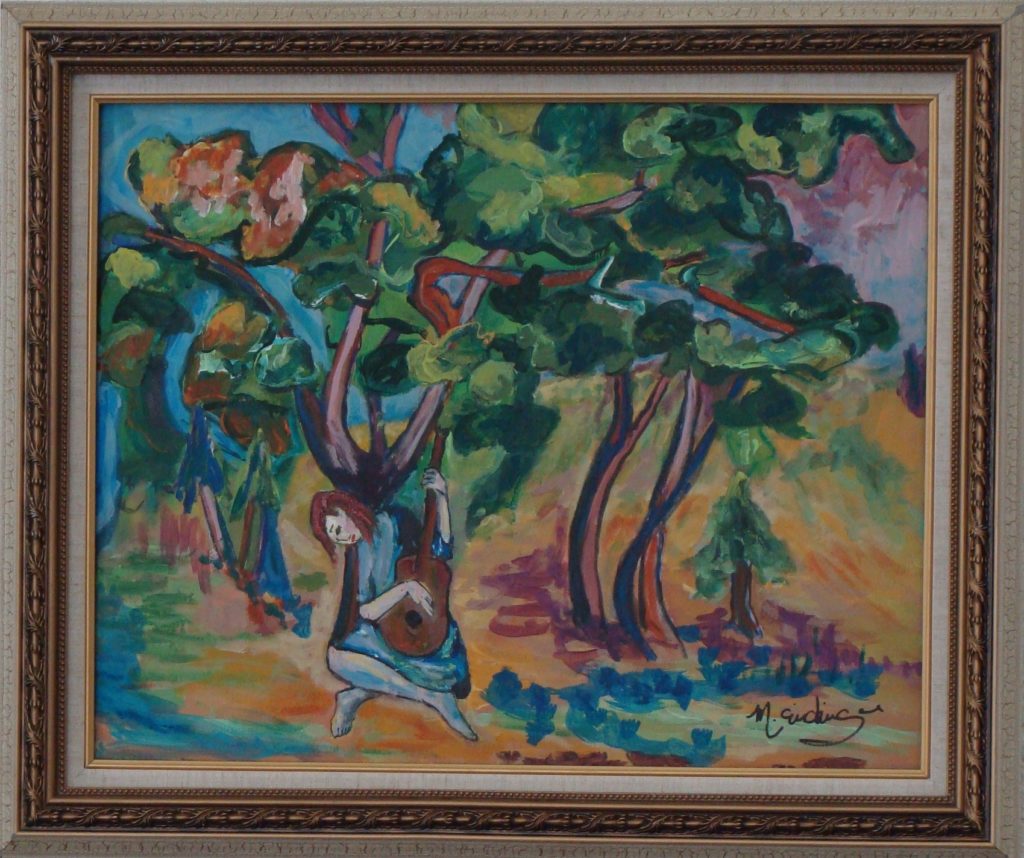
Over the Peanut FenceOver the Peanut Fence
Acrylic/ Gold Frame/ 21” by 25’’ / $299

Look closely at the isolated house and small struggling garden trying to survive on barren land. It is set apart by an almost insurmountable fence. On the other side you see water, growth, lush green plants and colorful flowers. Imagine yourself in the house but wanting to move. How will you get over or around the fence? Are you frighted of what you might find? There may be insects or snakes that you did not know were there. What will you bring with you? How will your present strengths become your platform for a better future?

A Sense of Purpose
We all need a sense of purpose, an overarching mission that unites the different journeys we take throughout our lives. Mine has always been centered on education. Though my career started with raising five kids and evolved to include mental health counseling, running museums, owning a catalog company and authoring books, my underling purpose has always been to inspire a love of learning. Promoting problem solving skills (the job of parent, counselor and teacher ) and independence has always been my quest. Tools I use involve a plethora of sensory-intelligence teaching approaches to fit each individual’s learning style. I implemented this education mission by developing hands-on exhibits and classroom programs, educational toys. I promote philosophical underpinnings through my writing and thought provoking paintings. Reading voraciously and traveling broadly are journeys I take for inspiration.

Having a mission that held steady for most of my life has made transition periods easier. As I moved from childhood, to adulthood, from parenting to empty nesting, and from job to retirement there were many rocky roads to be carefully navigated. I experienced physical energy increase during my 30s, 40s and 50s only to be cut down by illness in my 60s. But then, happily my strength reemerged and I was tasked with continuing my mission.

I also experienced loving relationships that had been carefully nurtured over years become lost because of moves or employment changes. These transition times initiated a period of confusion and impetus to build new friendships. Comfortingly, as my path changed, my goal to improve education remained singular. This consistency provided a smooth passage to my next challenge.

Each of life’s plateaus required rethinking before evolving in a such a way as to take advantage of the knowledge and wisdom I had acquired to date. In retirement I became interested in understanding the crisis facing homeless youth, and you might wonder what it has to do with hands-on education? The more I study the causes, life styles, brain development, and interventions used with this population, the more I realize that individualized education within a loving context is the the way to heal hearts and minds.

What is your sense of purpose? Most people do have one but they may not have stopped to identify it. It is an interesting exercise to look at all of the phases of your life in search for the common denominator or life thread that guides your actions.

Art work is always for sale. Contact me at marilynne@eichingerfineart.com

Please respond on my blog site at eichingerfineart.com/blog.

For sale as an ebook on Amazon: The True Story of Streetwise, overcoming homelessness and beating the odds. $2.99 Go to  AMAZON.