A Writer’s Passion

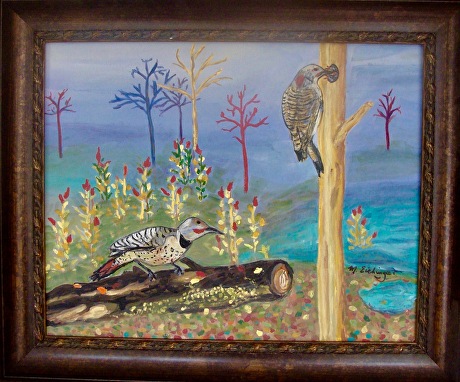
Flickers Caring for Their Young

Access to food and clean water is necessary for the survival of all living species. We need to be diligent about preserving nature’s gifts to humanity. 

A Writer’s Passion

While president of OMSI, I collaborated with Dr. Marion Diamond, my counterpart at the Lawrence Hall of Science in Berkeley. Before assuming its directorship, she was one of the founders of modern neuroscience and the first to demonstrate that the brain improves with experience and enrichment. Though known for her studies of Einstein’s brain, her rat studies showed that an enriched environment (toys and companions) beneficially changed the brain’s anatomy. In contrast, an impoverished environment lowered the capacity to learn. By showing the plasticity of the brain, she shattered past beliefs of the brain as static and unchangeable, degenerating as we age.

Dr. Diamond advised me to stay active after retirement by changing my daily activities, interests, exercise routine, and readings. Doing so, she said, would develop new synapses to keep me vibrant and engaged throughout my senior years. To grow and continue learning throughout my life would keep me relevant and give life purpose.

So…when I retired at seventy-three, I followed her advice. Instead of remaining a consultant to the corporate world, I divested myself of boards, committees, and fundraising activities, choosing to spend my time with individual endeavors instead. Community activities took on a counseling aspect with singular individuals rather than leading groups. I spent hours engrossed in my art. But of all the undertakings, writing is the one I focused on most. I had always been an idea person, but when I put my thoughts on paper, I relied on others to make my thoughts well composed. My retirement goal was to learn how to write. I joined a writers’ group, so what I put down is critiqued before distribution.  The best way to become a writer is to write every day without fail. Sending out a weekly blog keeps me on course, but most of my effort goes towards my books.

Lives of Museum Junkies and Over The Peanut Fences were non-fiction, partly biographical endeavors. The first explored my early involvement with science museums and hands-on learning, how I learned to manage large institutions, and the people who helped the profession grow. The second accounts for the days spent mothering a previously unsheltered youth and getting to know the staff and volunteers of organizations that help young adults heal.

As I watched the environment suffer due to global warming and pollution, I decided it was time to write a novel, a thriller to capture the public’s imagination and to encourage governments to improve their care of life-affirming resources.”

Capturing attention with the written word requires dedication, a nuanced knowledge of the English language, and an understanding of people’s emotions. My first attempt at an environmental novel was focused on petcoke, a little-known petroleum by-product that resembles coal. When I wrote the last chapter, I realized it could have been better, but I needed to figure out what was wrong. I found a teacher who had me flush out character descriptions in the middle of the night when my mind wasn’t sharp. I was advised not to begin my story before I understood how each looked, walked, talked, was raised, and felt. I had to live in the head of each individual and worry about their families and friends.

After three years of research and writing, I completed The Water Factor, a thriller about the corporate takeover of water. It should be in bookstores and online by late spring. Though set in the future, everything I write about has already occurred.  Access to clean drinking water is in peril and will affect everyone’s life in the future. I was shocked to learn that the World Water Forum of 1998 and 2000 led to water being declared a commodity and not a right. This opened the way for it to be traded on Wall Street and privatized by corporations that charge 2000 times more by bottling it than letting it flow through a tap. Backing from the World Bank and the International Monetary Fund followed, giving a handful of international corporations license to take over the management of public water services aggressively, leading to higher water and sanitation rates.

The United Nations recognizes access to water and sanitation as a human right fundamental to everyone’s health, dignity, and prosperity. Unfortunately, well over billions of people today live without water being safely managed. The plot moves from rural Oregon to Ethiopia to a Native American reservation, showing what can happen when corporate interests take over access to clean water.

My purpose in writing The Water Factor is to bring this issue to the forefront so communities can do something about it. The first of the  Rightfully Mine series, the novel shows the depths of manipulation and deceit people will engage in for money. It’s a page-turner to stimulate your brain, though I hope it will do more. The book is a call to action for citizens to monitor how their water and sewage systems are managed. Northwest Natural, an investor-owned gas company in Oregon, has begun purchasing small water companies in Oregon, Idaho, and Washington. The company is positioning itself to buy municipal water systems as it expands. It is time to ask if we want our water to be privatized.

Communities need to take heed of water issues. Lives depend on it. Who is selling, and who is purchasing local water rights? How will this affect your family in the future? I hope you get actively involved. Your effort is bound to stimulate new brain synapses and be a meaningful endeavor. 

References:

United Nations website. Human Rights to Water and Sanitation. Retrieved from https://www.unwater.org/water-facts/human-rights-water-and-sanitation#:

Burtka, A. & Montgomery, W. (2018) A water right—Is water a human right or a commodity? ERB Institute University of Michigan. Retrieved from https://erb.umich.edu/2018/05/30/a-right-to-water-is-water-a-human-right-or-a-commodity

Green, E. (2018)NW Natural is buying water utilities. Should Oregonians be concerned about privatized water? Street Roots. Retrieved from https://www.streetroots.org/news/2018/08/10/nw-natural-buying-water-utilities.

Art is always for sale. Flickers Caring for Young is a 22” x 25” framed acrylic on canvas painting. It is available for $425 and shipped free in the continental U.S.A. For information or to answer questions, contact marilynne@eichingerfineart.com

I look forward to reading your comments below.

Wading through Complexity

The Oregon Museum of Science and Industry
The riverfront museum I spearheaded opened thirty years ago.
 Impression 5, in Michigan, celebrated its fiftieth year.  It is hard to believe.

Wading Through Complex Thoughts

Analyzing your way through complex situations is not easy. On a rainy day in 1972, I was in Lansing, Michigan with four rowdy children and challenged with keeping them from tearing the house apart. So, I started a science museum in my basement. At the time there were only twelve science centers in the United States. Exhibits were push-button displays that mixed chemicals and asked yes and no questions. Fanciful walk-through hearts on Oregon, descent in into the depths of a coal mine in Chicago, fighter jets, and locomotives in Philadelphia covered the floors. What they lacked were interactive activities that called on visitors to experiment and think. A white paper was written pointing fingers at how the Chicago Museum of Science and Industry was a pawn of corporate America.

Public education was also under attack for the way children were held hostage for hours each week. Being pinned to their seats and made to memorize historical facts and formulas was not the way to inspire minds to greatness.John Holt, Howard Gardner, Piaget, and A.S. Neil were among those promoting child-centered ways, age-appropriate ways of teaching.

The table-top exhibits built in the basement of my home with my son recognized that children were not little adults but instead were youngsters with unique ways of learning. Science, engineering, and psychology professors at Michigan State University contributed exhibits and guided me through the learning process. The scientific method became my platform for conceiving interactive displays. 

Scientists approach problems through a seven-step process: make an observation, ask a question, from a hypothesis or testable explanation, make a prediction based on the hypothesis, test the prediction, and use the results to make new hypotheses or predictions. It is the way research progresses.

This way of thinking made sense to me and today is embedded in my psyche as a way to tackle life’s problems and idiosyncrasies. When ASTC, the Association of Science and Technology Centers started, science centers exploded throughout the world. I suddenly had company and reached out to seven small museums, including OMSI and the Pacific Science Center to secure a National Science Foundation grant to study visitor interaction with displays that required them to solve problems. We built exhibits that traveled to each other’s sites. Our staffs met to study hands-on education philosophies and to critique how  we tackled interactive construction techniques. 

We, and the other science centers introduced visitors to computers, technological innovations, and discoveries in genetics, and bio-engineering. What we learned by experimenting with hands-on learning techniques, was incorporated into the teacher education and outreach programs. Our museums became a model for the free school movement. They were places where visitors moved freely through displays, learning in their own way, at their own pace.  

You might ask, why I am saying something about this now. I am still involved with the education of young children and am more concerned than ever. The reliance on the computer for teaching has gone ballistic. Children no longer see that moss prefers to grow on North-facing surfaces. They don’t know how to use a hammer and nails to build a birdhouse. They don’t know how to change the oil in their car or sew a seam that burst on a dress. They don’t have the patience to build a balloon-powered card using cardboard and bottle caps to see how far it will go. They are too hyper to start a grow box and watch the way seeds turn into plants. They would rather play computer games than construct a solar oven to cook marshmallows while exploring thermal energy, reflection, and convection. 

All of our activities were designed to help young experimenters question and think. They require patience, dexterity, and a willingness to try and at times fail.  These are basic needs that adults as well as children need as they conduct their lives. 

When I moved to Oregon to run a science museum with greater resources, I was more determined than ever to show visitors how the scientific method is useful when tackling everyday problems. We built a new waterfront museum where people could satisfy their curiosity by conducting experiments on the floor of our exhibit halls. When designing Busy Town for young children, for example, we included a component for parents that focused them on observing their children so they could question their preconceived ideas about the way they learned.

As the world grapples with environmental change, economic challenges, and pandemics, we need clear minds, and a citizenry willing to dig into issues and think problems through. Analyzing these issues can be great fun if we put our heads to it. It calls for more feet on the ground stomping through communities and parks—putting more hands on binoculars, hammers, saws, needles, and thread as a complement to eyes on the computer screen. It requires reading, discussing, arguing, and coming to conclusions you are willing to test. The scientific method provides a way to proceed. Practice solving little problems so the large ones will fall into place.

For a behind-the-scene look at science centers and how they influenced education read Lives of Museum Junkies.

Art is always for sale. Check out my new cart-enabled website eichingerfineart.com to purchase the painting of OMSI or any other that tickles your fancy. 

Please share your thoughts below. What do you do when you escape the computer and remember that the physical world is filled with beauty?

A Sneak Preview

Last week I announced the launch of Over the Peanut Fence: Scaling Barriers for Homeless and Runaway Youth. It is a hopeful book about  adolescents  overcoming childhood abuse and about professionals and volunteers who help street youth  succeed. Following is a sneak preview from The Story of Zach, Chapter I.

Getting around

The Story of Zach

Cory and I are life partners, sharing a home in Portland, Oregon. In 2011, I owned and operated Museum Tour, a national education supply catalog and Cory was employed in a handful of ventures that used his engineering and carpentry skills. Under our house in the woods, he set up a shop and outdoor area to carve totem poles and Northwest coast masks, which he sells to a burgeoning clientele. When not at work, I spent my hours painting in a sunlit studio located on the lower floor of our contemporary seven-level house. The two of us had few encumbrances as we freely traveled, worked and made art. 

All that changed one blustery November day when Cory noticed a youth pass in front of his car while waiting for the light to change. When the boy stumbled, he caught Cory’s full attention, for he recognized Zach, whom he knew as a child from a troubled family who lived in his old neighborhood. Pulling over to greet the youth, Cory immediately saw that the lad was ill. Fearing pneumonia, he phoned me and after a short conversation we invited Zach for dinner in order to assess his well-being. Within an hour of his arrival and learning that he lived in shelters, we suggested he stay for a few days to be nursed back to health. 

Zach quickly improved after sleeping in a comfortable warm bed and eating nutritious meals and by the end of the week was ready to return to the streets. Winter started early that year, the weather was wet and bitterly cold, and we were reluctant to send 

him back only to become ill again. Zach appeared to be such a young, lost and confused youth that I felt tenderness for him. 

It was an emotional week, for Cory and I were uncertain as to the role we wanted to play in his future. Friends feared for our safety and were quite worried about us getting deeply involved. A few neighbors watched Zach moving about our yard and called to warn us of a vagrant trespassing on our property, advising us to call the police. 

Zach certainly looked like a street transient. I must admit to my middle-class bias in that I did not like his appearance. He wore ragged clothing and had plugs in his ears. His reddish hair was greasy, straggly and unkempt, and he gave off a strong body odor. He walked hunched over, with a shifty look in eyes that never seemed to focus. Zach’s appearance spoke emphatically of a downtrodden boy. Speaking softly when queried, his responses were a short yes, no, or I don’t know. Though we certainly tried, it was difficult to get a complete sentence out of him. 

Knowing that he came from a family that pilfered from one another, we feared he might steal so when we decided to let Zach stay we kept a constant vigil as he moved about the house, insisting he go to his room when we went to bed. My purse was always stored safely in our bedroom at night. This decision proved wise, for we suspect he took money one time when it was unguarded. 

Once Zach agreed to our conditions, which required a haircut and removing the plugs in his ears, we let him remain for the winter. Zach was not happy to lose his straggly locks, but we insisted that if he was going to live with us he had to look like he belonged to our family. We took him to Goodwill and Ross Dress for Less to be outfitted from his feet up. Zach needed everything from undergarments to jeans, a warm coat, gloves and hat. 

House rules included a daily shower, cleaning his room, and making the bed. As time went by, a daily exercise routine was added, and Zach was occasionally asked to help with chores such as shoveling snow and chopping wood. Our goal was to break up the hours he spent lounging aimlessly around the house or watching television. 

One activity he participated in without being asked pleased us greatly—he continued to attend a drug rehab program. Thankfully, Zach had never been addicted to opioid drugs but was a light pot, molly, meth and occasional shroom (psychedelic mushrooms) user. While he was enrolled in the drug program, we never worried about him backsliding, and our trust has since been rewarded. We were concerned about his finances, however, because he had a large fine for possession of marijuana that had to be paid to a municipal district, and we wondered how Zach was going to meet his obligation without an income. 

We decided to lend him money to keep the judicial system from compounding interest, but he needed to find employment. Fortunately, I was able to help, for my catalog company was in the middle of its busy retail season, and we needed workers to ship warehouse products. It was easy to provide a six-week seasonal job, though to keep it, Zach had to pass a drug test and prove he could do the work. He was somewhat concerned about the test. When we discovered there was a pill he could take that would purge his body of narcotics, we took him to a head shop to purchase it. Before we spent a lot of money, the proprietor suggested Zach be tested and thankfully the results showed that he was clean. I was especially glad of the outcome because I was uncomfortable with the idea of helping him disguise an addiction. In addition to becoming an enabler, I would have been a hypocrite for ignoring my own employment requirements. to read on . . .

Why do some youth overcome abusive childhoods while others do not?

Currently available on Amazon in paperback and Kindle. Go to AMAZON.

Please rate on Amazon after reading to bring attention to the plight of homeless youth.

Internationally in bookstores and other internet sites April 22nd.

For speaking engagements contact eichingerbooks@gmail.com.

Over the Peanut Fence

Be First to Review

“A powerful glimpse into the trauma and abuse that forces young people to run to the streets. Their stories are a call for action to libraries, government, youth agencies, universities, parents, and volunteers to work together to solve this national problem.” —Pam Sandlian Smith, Public Library Association

++++++++++

Provide a bravo launch for Over the Peanut Fence, a book aboutscaling barriers for homeless and runaway youth.Currently available on Amazon in paperback ($14.99) and on Kindle ($6.99) versions, it will find its way to other e pub sites and bookstores internationally in approximately three weeks. Help attract attention to youth homelessness by purchasing today and commenting on Amazon’s website.

My goal in writing this Over the Peanut Fence was to discover if psychological problems caused by early childhood abuse can be overcome. Four years of interviewing homeless youth, research into why they run to the streets, and studying interventions used by caregivers, gave me much to consider. The following Kirkus Review summarizes the book well.

A blend of memoir and sociocultural commentary analyzes the problem of teenage homelessness. Eichinger had known Zach when he was just a child, the victim of his parents’ chronic “negligence and abuse. The author divides her book into several distinct parts: a remembrance of her experience with Zach; a reflection on the root causes of homelessness in the United States; a synopsis of the latest research regarding the functioning of a youth’s brain; an homage to organizations that make a positive difference; and two short stories that dramatize ways in which adolescents can be effectively assisted. While always pragmatic and rigorously empirical, Eichinger finds considerable cause for cautious optimism, especially given studies demonstrating the deep resiliency of youths’ minds to overcome their early traumas. The author’s account is lucidly written, both intellectually thorough and emotionally affecting. In addition, this isn’t a work of ax-grinding political partisanship—Eichinger prefers cool-headed analysis to grandstanding. Further, at the heart of her ‘part memoir and part storybook’  is a profound reflection on the ailing condition of American society, withering from the widespread disintegration of the family and the grim plague of ‘lovelessness.’ An astute and moving assessment of an urgent societal problem.”—Kirkus Reviews

To Purchase advance copy go to AMAZON

Mentally iIl Homeless Youth


Change

Mental Illness is a changing tableau with twists, swoops and buds that blossom over time

Acrylic on Canvas/ black frame/ $ 299

The following section is an excerpt from the section on Mental Illness in Over the Peanut Fence, scheduled for release in late September.  A book signing event is planned for a Sunday in October. I’ll keep you posted on the date.


Mental Illness

“My early training in mental heath was during the time large state hospitals were emptied of their patients. Simultaneously, government subsidies were cut. Community health centers, were inadequate to care for the needs of so many seriously ill people, ushered in an era of in- creased homelessness.

The Canadian Journal of Adolescent Psychiatry conducted a random study of 60 youth in homeless shelters and found 50 percent of them to be clinically symptomatic or with a drug ad- diction problem.116 The study, one among many, provides evidence that mental illness undermines problem-solving abilities needed for survival. Only recently have social agencies for the homeless started addressing psychiatric diseases, but it is becoming a growing area of concern. The Canadian teen population mirrors that of the United States, so I include the following information as an approach to combat hopelessness.

There is conflicting evidence about whether lack of shelter undermines hope. Therapists believe that without optimism, there is suffering, which in severe cases can lead to suicide. Youths with stable housing are more likely to feel hopeful and able to perceive themselves as resilient, are less lonely, and engage in fewer life-threatening behaviors. Those in unstable living situations are more likely to have bleak, hopeless attitudes, becoming easily depressed and in need of psychiatric intervention. Counselors face a conundrum, for unless a mentally ill youth walks into their clinic seeking help, there is not much that can be done for a disturbed adolescent wandering the streets.

Homeless adolescents never use fee-based services and only rarely use those that are free. Hospital emergency rooms are the path of least resistance when health concerns are serious. Since most teens consider themselves to be more mentally stable than they actually are, the bur- den falls on emergency room and clinic practitioners to identify those who are unstable and offer services beyond the presenting illness.

U. S. statistics report that 20 to 25 percent of people who live on the streets suffer from severe mental illness as compared to 6 percent of the general population. Psychological problems contribute to an inability to develop stable relationships, and the youths often push away care- givers, family members and friends willing to assist.

Emotional problems often lead to physical disease because of neglectful health practices and inadequate hygiene. Skin diseases, exposure to tuberculosis or HIV, and respiratory diseases are among those commonly seen in emergency room settings. Minorities are especially vulnerable. Those who are mentally ill are prone to self-medicate by using readily available street drugs.

Contrary to popular belief, once identified and contacted by a health provider, mentally ill adolescents tend to accept treatment willingly. Housing, though a first concern of runaways and caseworkers, does not give adequate care for emotionally challenged teens in need of a trusting counselor. Those from impoverished backgrounds also may need lessons in personal hygiene, finances and how to navigate the health care system. Emotional problems are not easily mended and require treatment and supportive services over many years. Education, employment, money management and peer support need to be integrated into medical and psychological treatment plans.

Mental problems tend to accelerate in the late teens and early 20s, causing impulsive acts and irrationality. But oftentimes, symptoms are visible earlier, well before the youth gets into serious trouble and leaves home. Family physicians and parents need to intervene when distress is first suspected, for once the teen has left home it’s harder to get help. Homeless youth are wary and tend to distrust the medical system because they don’t think they will be taken seriously. They believe adult solutions are likely to involve pills being thrown at them rather than helping them understand the root cause of their problems. When sent to mental wards that serve a mixed- age group, they don’t feel free to discuss their problems. Adolescents need to be in environments among their peers, and not with mature adults.

It is important to remember that treatment only works if the person is ready and not compelled. Culturally specific counseling of a nontraditional nature that prepares them to go through the stages of change has a better chance of succeeding. For instance, a depressed LGBTQ youth might need peer mentors who are encouraging, while an anorexic teen might be aided by someone who overcame an eating disorder. A learning disabled child might benefit from tutoring. In each case, the counseling goal is to motivate the youth to want to overcome their dysfunction and develop a personalized action plan.”

Do comment on bellow. It is always good to hear from you.

For art  please contact me at marilynne@eichingerfineart.com

Lovelessness

The following excerpt from Over the Peanut Fence discusses one of  the causes of youth homelessness. Lack of love is devastating to a child’s physical and mental growth. Over the Peanut Fence is in its final pre-production stage and will be for sale  late September.  An signing party is being organized for October. I’ll keep you posted.

Lovelessness

As I wander around Portland, observing dozens of teens hanging out, I wonder who will have a productive, happy life and which ones will fail. If you’re like me, you do not enjoy having homeless youths take over neighborhood parks or sit on public sidewalks begging for a handout as you pass. If you’re like me, you don’t enjoy descending the stairwell of city-center parking garages that smell like urine. And, if you are like me, you feel intimidated when a gang of youths walks down the street making lewd remarks.

Helping these adolescents is important, not only for their sake, but selfishly for mine. This is why I questioned whether street youth were permanently damaged. I wanted to know if they lost all sense of morality. What I discovered was that antisocial behavior is aimed at society at large and not their own peer group. Most follow a strict set of rules that define street-life values. They care for friends by sharing food, cigarettes, information and a code against “ratting”.

These are hopeful behaviors because they can be exploited and transferred to society at large. My questioning continued. When did they acquire a willingness to help others? Did lack of parental love affect their behavior? I had always assumed love is instinctual and that every newborn is a recipient of warm parental care. Without it, I reasoned, a helpless infant could never survive. I now realize feelings of love and responsibility are not a given.

The majority of us are fortunate in that we are surrounded by affectionate parents and relatives. As infants, we were held and cherished. And as adults, we find partners and form bonds based on fondness and mutual respect. But what happens to children who are never caressed or told they are special? What are the long-term effects of never having been touched or cuddled? What befalls those who are abandoned, left on doorsteps or placed in cribs and not attended to when they cry or their diapers need to be changed?         . . . . . . . . 

“Between 1962 and 1967, the HighScope Perry Preschool Project, in conjunction with nurse-family practitioners ran another insightful study conducted with three and four year old African- American children.28 The school had an average child-teacher ratio of 6:1 and their curriculum included decision-making and problem-solving activities as well as physical movement. Program directors asked parents to participate in weekly visits designed to bring them into the education process.

The project is important because it followed the children until the age of forty, proving the effectiveness of early intervention. In-depth analysis enabled educators to design successful curriculums. The study concluded that “without repeated acts of love, a child’s brain doesn’t make the growth hormone needed for proper mental and physical development.” The child is left scarred and permanently affected. Their stress levels are high, setting the stage for elevated cholesterol levels, cardiovascular disease, metabolic syndromes and other conditions that pose serious health risks.

Even small insults of shame and rejection can impact a youngster’s health. Adults who say “I can’t believe you would embarrass me like that,” or “You Idiot! Who do you think you are?” hurt the child and affect the child’s self-esteem. Many children act out by being cruel to animals, setting fires, taking drugs or simply withdrawing into themselves. Warmth and love are crucial for a child’s well-being.

Zach’s story is a good example of the importance of attachment. Though often neglected and occasionally abused, he was loved by his parents. When they were high on drugs or alcohol he was occasionally smacked and at times not fed, yet those instances were not as important in the long-run as knowing he was wanted. Since he belonged to an extended family that lived nearby, when the situation became intolerable he found shelter with relatives. This minimal amount of support during difficult times helped him grow into a caring person. Those who have never been the recipient of affection are not so fortunate.

Complainers


The Orator

Acrylic on Canvas/ $325/ 18” x 22”

He stands on his box and complains to an audience of onlookers who egg him on. They applaud and laugh at the crazy way he rails against government, politicians, and certain religions.  It’s entertaining to watch him shout and rave about injustice. He isn’t take seriously, though, for he has few solutions to unite people for change.


Complainers

Complainers.  You know them well, for they pop in from every direction. Some whine, others murmur, grumble or growl. They find fault easily and are dissatisfied with most things they come in contact with, commenting frequently on how much worse the world is today than it was when they were young.

In the company of a complainer, I often tune out. After hearing an injustice repeated multiple times, it is difficult to pay attention. Complaints about traffic jams, bicyclists, potholes and homeless people urinating on the street may need to be addressed, but complaining about them to me serves no purpose. I can’t do much more about the situation than you can. Complainers rarely view their observations as calls to action, but instead, wallow in misery, affecting the mood of those around them

Complainers come in a variety of packages.  Some are jumpers. These people react quickly letting everyone know immediately how upset they are. Some jumpers become whiners who continue repeating their complaints.  Once they start, they never let up. Comments such as, “he’ll never stop drinking. I don’t know why I stay married,“ or “all politicians are corrupt. You can’t trust any of them,” may echo for years.

Then there are the venters, the angry frustrated people who complain to solicit attention and sympathy. They speak in loud demanding voices, repeat themselves endlessly and consider their views to be so important that insist everyone stop what they are doing to hear them. Venters seek validation and want to be surrounded by yes sayers. They lack interest in problem solving discussions. When asked to share their views and contribute to finding a solution, they turn away, complaining that the situation is hopeless.

Venters can easily wear a listener down. “The bus is late. The doctors don’t know what they are doing. My neighbor is a jerk. The coffee XXX makes is crummy.” After putting so much attention on all that is bad, venters occasionally get fed up and decide to move to greener pastures only to find new reasons to complain. It is in their nature, until they willingly alter their outlook.

Perfectionists can also be complainers. When I ran Impression 5 Science Museum in Lansing, Michigan, I hired a woman to direct our education department. She focused so heavily on problems that she was unable to see the good she did. Her reaction to positive happenings was, “That’s nice, but look at this? It’s not up to par.”  She was miserable much of the time, for she believed that her colleagues and the teachers  she hired would never be able to live up to her expectations. She also made it clear to all on staff that she was better able to do their jobs. Perhaps she was, but she could not be everywhere at once. She had to delegate and was unhappy doing so. Education programs blossomed under her leadership, yet she was so dispirited that she resigned.

Let’s not forget the jokers who make light of their complaints. They use humor as a way of venting frustrations. They don’t want to appear selfish for not putting out effort to solve a problem, so they hide their displeasure by smothering it with jokes, especially with  strangers. They pretend to be happy when they are not.  Though they think they are communicating clearly, the person they are speaking to is often confused by the joking manner.

More cautious are the hesitaters. They wait until a mysterious threshold is reached before they begin to complain. Hesitaters tend to be more introverted than jumpers, whiners and venters. How much control they have over a situation determines how and when they will react. They wait to hear a variety of opinions, preferring to stay positive if at all possible.  Hesitaters are good at listening to complaints before deciding if there is a legitimate point that requires further investigation. They realize the importance of not passing on unsubstantiated facts and gossip.

I’m an occasional hesitater.  When my suitcase was misplaced on a flight to Morocco, I was upset but took my complaint to the airline counter.  Hearing that my bag wouldn’t  arrive until the next day, I bought a clean shirt, undies and toothbrush. My complaint worked to take care of the problem. Much of the time, complaints are ignored because the solution is not readily available. Focusing on such things as homeless people loitering the streets is fruitless. Instead of complaining  that the city is going to pieces, homelessness is a call for attention—at least for me it is.

Complainers tend to be unhappy. They see problems wherever they go, and are convinced that they will never be solved. They spout their displeasure and let bad situations continue as a way of proving their point. They don’t believe it is their responsibility to do more. They’re convinced they deserve better, that the problem is not their fault and that they have the right to get more from life. They believe that if they were in charge, the world would be better, and they are determined that if they can’t be happy, then no one else should be.

Thankfully, there are also the good complainers—the doers. Their complaints identify problems which motivate them to action. In general, they are a happier bunch than the jumpers, winers, jokers and venters, because they have goals and strategically plan ways to meet them. Though their complaint may not get completely solved, they feel rewarded by taking baby steps in the right direction.

A way to be happier, is to limit making complaints as well as your exposure to complainers. Why dampen your mood and that of others with negativity? It is important not personalize the thoughts of chronic complainers, but to have empathy for their misery. They see the world through a reality that can affect their health, for there are physical side affects to complaining. Neck and shoulder muscles tighten, migraines occur and the heart can be affected.

Being around people who complain is exhausting, frustrating and unproductive. Unfortunately, there are times when you can not just ignore them, but have to decide to move on or your own health will suffer.

I agree with Anais Non who wrote,

“You are in charge of how you react to the people and events in your life. You can either give negativity power over your life or you can choose happiness instead. Take control and choose to focus on what is important in your life.”

My suggestions?  Assess complaints for their opportunity. Identify problems that need attention and  commitment and only complain when you think it will effect real, positive change. Choose one problem to work on and try to make a difference.

References:

Moodie, K .(2017)  Here’s How Much Each Personality Type Complains.Personality Growth.   retrieved from https://personalitygrowth.com/heres-how-much-each-personality-type-complains/

Biswas-Diener,r. (2017) The Three Types of Complaining.  Psychology Today. retrieved from https://www.psychologytoday.com/us/blog/significant-results/201706/the-three-types-complaining

Herald, M. (2015) How to protect Yourself from Chronic Complainers. Emotionally Resilient Living. retrieved from https://www.emotionallyresilientliving.com/how-to-protect-yourself-from-chronic-complainers

Davis, A. (2017) 6 Reasons Why Complainers Are the Most Miserable People. HuffPost. retrieved from   https://www.huffingtonpost.com/adam-davis/6-reasons-why-complainers_b_9818706.html

Nin, A .(author) Herron, P. (Editor) (2015) The Quotable Anais Nin: 365 Quotations with Citations. Sky Blue Press


Art is always for sale. Contact me at marilynne@eichingerfineart.com.

Xennials: Finding Community

Walking on Air

Above they city they pass in search of life’s meaning and a way to cope in a rapidly changing technological stratified society.

Acrylic on canvas/ 26.5″ x 49.5”/ wood frame/  $650.00


Xennials: Finding Community

The parenting focus in my last two newsletters discussed why couples with children born in the the United States score at the bottom of an international scale for happiness. Last week I shared these findings with young adults who visited my “Do You Need A Mother?” booth which my son set up for me at Shift-Festival, an Oregon techno-art-music extravaganza (similar to Burning Man). A great many attendees appeared relieved to have a chance to talk about problems they were facing. I learned of a myriad of concerns Xennials have when coping with social and economic issues.

Who are these Xennials?  They previously were under the “Millennia” umbrella, but found that it covered such a broad spectrum of ages they did not fit in.  So, Mellenial was subdivided into two groups—Xennials (born between 1977 and 1983) and Millennials (born 1984 to 2,000). Millennials are often labeled as narcissistic and spoiled by helicopter parents. They are blamed for much of what is wrong in society today. Baby Boomers say they are lazy and entitled. Xennials didn’t want to be associated with such negativity which is why they christened a new category. Now, in their 30s and 40s, they are able to affect the dynamics of our country.

Though not digital natives, Xennials are comfortable with technological advances. They still remember dial-up internet and heavy mobile phones. In their teens, they mixed music on cassette tapes, owned a walkman and remember when they first heard about Google and Facebook. Xennials were the first group to embrace social media but squeezed through high school and college before it overtook their lives. They are cynical, though not as pessimistic as early Gen Xers and remain somewhat optimistic, though not as much as Gen Yers.

Xennials got rid of paper bank statements, brought down bar soap, nixed nine-to five works days and ended the time when interactions started off-computer. They are the sandwich generation, caught between analog and digital computers, and were hit hardest by a recession that caused job loss and created excessive student debt. Highly influenced by the tragedy of 9/11, they lost much of their optimism. As Monica Hunter-Heart says, “they were first given a sweet taste of the good life, and then kicked in the face.”

Most of the people I met attending Shift-Festival belong to the Xennial generation. They embrace health and wellness trends and have slightly more disposable income than the Millennials who follow.  Many have chosen not to have children, but if they do, they  likely waited until in their thirties and have only one. Xennial’s believe in relaxation and science based solutions, spending time and income on taking several vacations per year. They want to “do good,” support feminist ideals and accept those of LGBTQ persuasion.

Since they are not in the top economic echelon, the middle class world they inhabit is more brutal than the one I experienced at the same age. Their coping mechanisms do not depend on family or small town community fabric. Rather than go it alone, however, they band together sharing residences and forming friendship groups based on common interests. Meetup and Maker events lead the way. Festivals like Burning Man and Shift have camps composed of friends who design art and science projects that are worked on throughout the year. Sculptures, circus acts and musical entertainment are then brought to summer events. These social groups are reminiscent of the krewes that sponsor floats and balls for Mardi Gras in New Orleans.

The people I met at Shift are middle income Americans. For the most part, they are college educated computer scientists, engineers, teachers  and psychologists or they received advanced training at a technical school. Though they applied themselves to their studies, upon graduation, they had a difficult time getting a meaningful job. Those who did, discovered that their salary was barely enough to cover living expenses and repay college debt.

Most began their careers enthusiastically and worked hard in hope of improving society, but when the market crashed, they became discouraged. Though previously earning a decent wage, a great many were suddenly deprived of employment and security.  If married, the added stress contributed to depression and relationships that ended in divorce. They settled into a state of  stress and worry and became hesitant to make long term commitments. Instead they started seeking gratification through rotating connections and continuous partying.

Many times over I heard people say they were engaged in a search for meaning. They were looking for something, but knew not what it was, and hoped to regain the passion they had felt when younger. They want a job that will help build community, provide a meaningful focus and contribute to their financial stability. Unfortunately, there are few job opening for those with a social conscience. They lucky few who don’t find what they are looking for at work are able to discover a purpose through Maker friendship groups.

So— instead, they attend festivals and dance in night long marathons, often escaping in a haze of alcohol and drugs. Underneath their cheerful exterior and wishful words, I heard fear and uncertainty. They expressed concerned about what will happen  without having children to care for them as they age.

Yet, despite their confusion, I am cautiously optimistic that they will find a path. It will be different than mine, but their search for meaning and community is already taking expression in numerous communal forms. Living in over populated cities, affected by crime and climate change, they experiment with new friendship forms that meet their desire for family. I can’t help but admire the compassion and creativity they bring to their work and play.  I hope that they will be better able to create a just society than the hippies of the 60’s espousing peace and love.

As Sharon Jackson wrote in the Star Tribune, “Baby boomers are stereotyped as hippies and tree-hugging idealists. Gen Xers are considered jaded slackers. Millennials are disparaged as coddled narcissists. But for the newly coined Xennials, there’s no bad rap: Their story hasn’t been written.”

Addendum:

Marriage status for each generation at age 25-30

Boomers -1980 = 60%

Gen X – 1990-54%

Gen X -2000 -50%

Xennials 2010- 38%

Millenials-2015 33%

References:

Lord, E. (2017) 11 Sisgns  That You’re a Xennial Not a Millennial. Notable Live. retrieved from  https://notablelife.com/xennial-millennial-definition/

Haunter-Hart.M. (2017) What is an Xennial? What People Born Between ’77-’83 Need to Know. The Bleeding Edge (A Netflix Documentary) retrieved from https://www.inverse.com

Wertz, Jia. (2018) Analog and Digital: Xennials present a Unique Opportunity for Marketers, Forbes, retrieved from https://www.forbes.com/sites/jiawertz/2018/04/19/analog-digital-xennials-present-unique-opportunity-for-marketers/#35da894266ba

Jackson, S. (2017) ‘Sandwiched’ between Gen X and Millennials, Xennials seek own identity.  Star Tribune. retrieved from http://www.startribune.com/sandwiched-between-gen-x-and-millennials-xennials-seek-own-identity/461129323/

For the Love of Kids

  Julia                                                                          25” by 36”/ Acrylic on Canvas / $ 425                                                                                 Resting from a day job, housework and chauffeuring children, she considers the pile of requests and applications to teachers, healthcare providers, camps and colleges that remain piled on her desk.

 For the Love of Kids

Eight senior managers were employed to help me run OMSI. Though all were married, only one beside me had children. Four interacted with kids on a regular basis while the remaining mangers handled the business of running a large institution. All were committed and worked tirelessly to ensure the museum’s success.

It surprised me that adults interested in educating children did not want to become parents. Several mentioned concern about overpopulation, but most wanted freedom to immerse themselves in work, travel and other interests.

I realized they were happily engaged in what they were doing, but privately thought they were missing out on the most important part of life. As they near retirement, I wonder if they still believe they made the right choice. I worry about their a safety net for end of life needs.

Though they have adequate resources to enter comfortable retirement facilities, who will visit?  Who will take the time time to hear their stories, shower them with love and mourn when they are no longer alive. 

Before the nineteenth century, children were important to their parent’s welfare. They worked on the family’s farm, were sent into mines at the age of thirteen or took after-school jobs carrying groceries. In old age, their children took care of them.

The economic value of children decreased with transformation from an agrarian to urban society. Medical advances led to a decline in childhood mortality rates. Since fewer children were needed for economic reasons, birth rates declined.

At the same time, cost of raising their offspring increased. Schooling added to the family’s expenses for children have to be fed, clothed, enrolled in after-school activities and provided with an indoor place to study. Children, once treated as property, were given entitlements. Parents became more egalitarian, friendlier and less strict. Motherhood began to lose its value. 

The government demanded an ever-larger share of earnings in the form of taxes. As usable income declined, both parents had to work to make ends meet. Children were a hardship to exhausted couples embroiled in debt. Divorce rates escalated, adding to the burden of single parents.  According to 2017 consumer expenditure statistics, the average cost to raise a child through age 17 is $284,570.

Approximately 67 percent of women decide as teenagers to have two children and, by and large, do so, even though they view motherhood as an overwhelming commitment. 15 percent of American women never experience motherhood. Free from child-care responsibility, they peruse careers, travel and socialize. Women were given  freedom to work while men benefited by having freedom from work.

Judged negatively, those who do not choose parenthood are pressured by family and friends. Over time, many become concerned about their lack of forming a love-bond with a child. They may be successful in their jobs, have financial security, but become bored by chasing happiness. This is seen in a 6 percent upswing of people over 40 becoming parents. Children start to be viewed as the legacy they hope to leave behind, the minds they hope to mold to their way of thinking.

Childless couples also consider their legacy, but rather than through parenthood, they pursue it through art, science, religion or career. Friendship and professional networks are developed as a substitute to having a young family. And, childless couples claim to be just as satisfied with their lives as parenting women (except for teen moms).

Yet, I still maintain that childless couples miss out on life’s greatest pleasure. Following are thoughts about what children mean to me. 

1. Children keep alive my thirst for knowledge. I relearned math, history and literature as my children went through school. By the time they were adults, their opinions often challenged my beliefs and helped me adapt to change.

2. They make me happy. When they give me a kiss, tell me they love me or say positive things, everything seems right in the world.

3. When young, they kept me involved in healthy activities. Taking them to museums, zoos, water parks and on hikes took me far away from stress.

4. They kept me alert, for they acted in surprising ways that often involved problem solving. If they needed a science fair project their father or I became involved. I was both a booster and cheerleader enabling them to take risks, overcome difficulties  and act creatively.

5. They keep me laughing. Starting in infancy, their big smiles, giggles and oft-times crazy antics made me smile and laugh. Jumping on a trampoline, trying to free a frisbee caught in a tree and winning at scrabble were happy times. They continue sending emails that make me laugh.

6.  My children taught me to see more clearly. I will never forget when my 9 month old son saw snow for the first time. The expression on his face wrapped me in the beauty and mystery of the moment as though I too was seeing it for the first time. 

7. The occasionally provided me with an alibi for getting out of something I didn’t want to do. I shamelessly used their slightest sniffle as a reason for staying home. 

9. Children gave our family tax savings which was important, for their costs were great.

10. Lastly, my children kept me sane, contrary to the belief that most will drive you crazy. The crazy part was momentarily while the sanity was long lasting.  I had to rise to the occasion of being a dependable presence who loved them unconditionally and appreciated their accomplishments.

As a mother, I never asked about the purpose of life or whether what I was doing was worthwhile. I knew in my heart and soul that it was. Inspiring thoughtful, happy, creative children who contribute to bettering society, was the most important thing I could do. 

References

Perry, S. (2014) Children aren’t worth very much —that’s why we no longer make many. Family Values. retrieved from https://qz.com/231313/children-arent-worth-very-much-thats-why-we-no-longer-make-many/

Khazan, O. (2017) How People Decide Whether to Have Children. The Atlantic. retrieved from https://www.theatlantic.com/health/archive/2017/05/how-people-decide-whether-to-have-children/527520/

 Lino, M. (2017) The Cost of Raising a Child. Center for Nutrition Policy and Promotion report in Food and Nutrition. retrieved from https://www.usda.gov/media/blog/2017/01/13/cost-raising-child

  (2012) Common myths about having a child later in life. CBS News. retrieved from https://www.cbsnews.com/media/common-myths-about-having-a-child-later-in-life/


Is it Possible to Multitask?

Powe of the Universe
The planets revolve in their orbits, focused on only one ask. We can depend on the to continue, at least in our lifetime.  Acrylic on Canvas 16 x 20 x 0 $299.00 USD

Is it Possible to Multitask?

When asked, I proudly tell people that I am an accomplished multitasker, but I recently became aware of research saying that I am not.  I  ride an exercise bicycle and watch TV while doing so.  Isn’t that multitasking? while  I imagine I might be a better cyclist if I was not distracted but I would probably get bored and give up after ten minutes.

A receptionist answers the phone while greeting visitors, a parent talks to a child while preparing dinner, and partners have sex while making mental plans to see a lover. Aren’t they doing two things at one time? I once observed a very successful canvas artist work on eight, 4 by 8 foot canvases spread out on the floor of his studio. He added colorful pigments and details moving from one to the next and back again. He was fast and working on so many at once permitted paint to dry while focusing on the next canvas. I was impressed by his ability to develop unique creations. When finished, though, he did not have eight masterpieces. One was exceptionally good but the rest were mediocre. He sold them all, however, which was his intent.

As do most  working executives, I thought of myself as a multitasker, for I was able to move rapidly from one subject to the next. An hour could easily be filled with 10minute meetings on topics ranging from a broken plumbing pipe, budget and insurance issues, discussion around marketing to interviewing a prospective employee. If someone interrupted me for an emergency I was able to handle it and then turn back to the topic I had been working on. I labeled this behavior as multitasking. What I haves since learned is that most of us think we are multitasking when we aren’t. I wasn’t do two things at the same time, but rather was compartmentalizing my mind. I was a fast shifter. Each activity required complete attention and it was easy for me to go back and forth quickly.

This skill is not easily transferred to art work or writings. To paint, I need 100 percent focus on what I am doing. It is not possible to select a color, put a dab on a brush , and apply it to a canvas without complete attention. Young children who are less focused, leave art sessions with with paint on their clothes or spilled on the floor. I attest to having cleaned up quite a few messes.

For nearly all people, in every situation, multitasking is near impossible. The neuroscience presented is clear. We are wired to be mono-taskers. Attempting to do two things at the same time is an illusion for most of us.

Over the past ten years many businesses downsized to become a lean and, in some instances, a mean workplace. As employees dwindled, loads increased, requiring workers to do more, producing short term effectiveness and long term disasters. When overworked, people become stressed, develop migraines, and suffer adult ADHD according the the American Management Association. The young man Ray and I mentored was injured on the job, in part, because management worked him physically 10-12 hours a day, six or seven days a week, month after month. His manager kept challenging him to man up, go faster, paint while balancing precariously. Since it is easier to move without wearing a heavy harness, he took short cuts and was rewarded with praise for being efficient—that is until he fell from scaffolding and became a quadriplegic.

One of the keys to successful mono-tasking is to slow down, not speed up. Learning to do move from topic to topic and place to place quickly takes time. The brain and muscles have to be well trained in order to switch from one activity to the next without getting overloaded. Multitasking is a misnomer for doing any task well requires full attention to the project at hand. What effective managers learn to do efficiently is to switch between tasks quickly. Basically, they single task with intention, often using cheat lists to store enabling information. And—most importantly—they know to take brain rests. They use the full amount of time allocated for lunch and work breaks in order to turn off their mind.

I am always impressed with the skills at-home parents develop by caring for children, cleaning, and engaging in social and community activities. To accomplish a multitude of tasks they develop organizational and time management abilities that rival those practiced by corporate managers.

So, can the brain do two things at one time? The estimate is that 2 to 2.5 percent of the population are capable of doing more than one complex thing at a time. One of the tasks is usually automatic, like walking or tying a shoelace while talking.

When activities are unrelated, the two hemispheres split the labor, with each side taking on a task. However, both tasks tend to suffer and errors greatly compound, for neither has the brain’s full attention. For instance, those walking briskly down a street become slower when they talk. You seemingly can cook and talk on the phone at the same time but not efficiently. A third goal will get discarded altogether by the prefrontal cortex.

One Stanford University study showed that those who believe they are the best multitaskers are actually the worst, for they are chronically distracted and find it difficult to focus. Multitasking is more wasteful than it is timesaving. The more we multitask the less we are able to accomplish because we lose the ability to focus enough to learn. According to an article by Kabu and Machado, “empirical research has demonstrated that multitasking with technology (such as texting, listening to music, checking emails) negatively impacts studying, doing homework, learning and grades.“

So, yes, we can practice switching from one task to the next quickly and no, you will not be multitasking. It is unlikely that you will ever be able to do two things at the same time and do them well.

References:

Secrets of Multitasking: slow Down to Speed Up. (2018) American Management Association. retrieved from web site http://www.amanet.org/training/articles/secrets-of-multitasking-slow-down-to-speed-up.aspx

Goodman, N. (2013) How to Train Your Brain to Multitask Efficiently. Entrepreneur. retrieved from https://www.entrepreneur.com/article/225865

Glowatz, E. ( 2016) Do You Struggle with Multitasking? Why The Brain Can Only Focus on one thing at a time. Medical Daily. retrieved from http://www.sciencemag.org/news/2010/04/multitasking-splits-brain

Telis, G. (2010) Multitasking Splits the Brain. Science Magazine. retrieved from http://www.sciencemag.org/news/2010/04/multitasking-splits-brain

Kabu,C. & Machado, A. (2017) Why Multitasking is Bad for You. Time.retrieved from
http://time.com/4737286/multitasking-mental-health-stress-texting-depression/

Art is always for sale. Contact me at Marilynne@eichingerfineart.com