Home as Museum

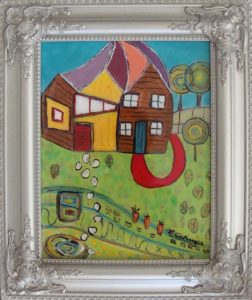
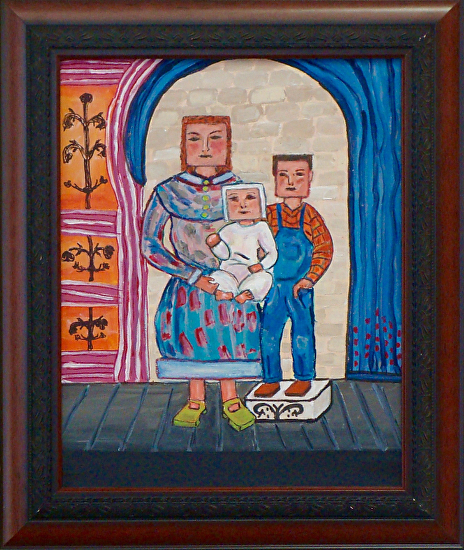
Coming Home /16” by 19” / acrylic with silver frame / $ 195

Open the door and what do you see? Is home an interesting reflection of you and do others enjoy it? Does it share your personality? Your history? Your curiosity about life?

The following excerpt is from my upcoming book Lives of Museum Junkies that is due out at the end of August. Look for information in upcoming blogs. I will be holding several book signings beginning in Tampa, Florida in September; Lansing, Michigan in October; and Portland, Oregon in November. Information will be forthcoming in the next few weeks. I look forward to seeing you at one of these events.

Home as Museum

“You can easily substitute home for museum and live in an environment made inspiring. Instead of exhibits, consider decorations, furniture and personal treasures. Architecture, use of space, selection and arrangement of furnishings, collections, and the way they are displayed all define you. How you move about your home, share treasures with friends and family, and teach your children to understand their cultural heritage becomes your way of passing on values.

Ray, my life partner, is a maker of totem poles and Northwest Coast masks. Outside of our home, there is a seventeen foot pole that has become a neighborhood marker. “Go to the totem pole and turn left,” is an oft heard direction given by acquaintances. The lower level of our house has both indoor and outdoor shop areas where carving and painting are pursued much to the enjoyment of nosey friends and those hiking an adjacent trail. Strangers who hear the tap, tap, tap of a hammer stop by wanting to know what is going on, and Ray gladly shows them his carvings, entertaining them with stories of Raven and Beaver.

Our home is filled with his carvings, my collections of pottery and masks, canvases that I paint, and art purchased while traveling. Our furnishings are arranged in a restful way, though presented as eye candy for our visitors. I enjoy living surrounded by the items Ray and I have either made or collected. Sharing them with friends lets them into our souls and initiates many conversations about culture, art, and even politics. Our friends often say when entering our home that it looks like a museum, only warmer and more welcoming.

Many children are first introduced to a cultural institution by visiting a children’s museum. These institutions are unique because the ingenuity they apply to educating the young is more than just exciting—it is engaging. Children spend hours engaged in activities such as playing in water (learning physics and hydrodynamics without realizing it), dressing up in period costumes (a study in history), constructing and plumbing buildings (engineering), and a host of other activities that involve physical as well as mental effort. Young visitors often are seen crying as their parents pull them from the building to go home. A secret to their success is that they are centered on the child and organize their spaces in a way that permits freedom of movement. Displays are built to withstand hard use. They encourage learning by using a variety of cleverly hidden techniques.

I encourage parents to think like a professional and start their own museum at home. What better place to inspire your own child than the relaxed environment of a play area or living room? According to The American Association of Children’s Museums, “A children’s museum is defined as an institution committed to serving the needs and interests of children by providing exhibits and programs that stimulate curiosity and motivate learning.” They encourage parents to interact with their children while in the museum in order to make the experience more meaningful.

That definition fit my family to a “T.” When we moved to Lexington, Massachusetts, a community without a hands-on museum, I decided that I could make my own home into one. The Boston Children’s Museum was much too far to travel to on a regular basis. Part of the challenge of my home operation was one of organization. I decided to set up my children’s basement playroom with a Montessori approach.”
_____________
Lives of Museum Junkies offers insight into how I went about doing this on a shoestring. I also encourage grandparents to consider their residences as their private museum. The accumulations from a life time of travel and just plain living can be organized and displayed in such a way as to fascinate friends and family alike. Perhaps you have thought similarly and share your treasures in a unique way. Do share on my blog site, eichingerfineart.com/blog.
_______________
Artwork is always for sale. Contact me at marilynne@eichingerfineart.com.
________________
For sale on Amazon by Marilynne Eichinger: The True Story of Streetwise, overcoming homelessness and beating the odds. Go to AMAZON .

Streetwise

The Importance of Touch

applauding-the-blues

       Applauding the Blues

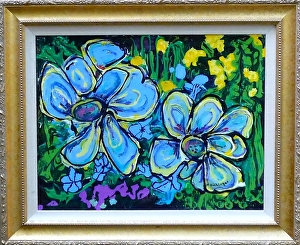
Acrylic on canvas/ Gold Frame/ 23.5” by 19” / $ 495.00
Do you stop to look, touch or smell the flowers? Perhaps you even taste them.

The following excerpt is from my upcoming book, Lives of Museum Junkies. Due out in August it tells my story along with that of eleven other innovators who influenced the hands-on museum movement in the early 70’s. Publication information will be available in a few weeks.

The Importance of Touch
In 2012, a young social work student at the University of Rochester was featured in national publications as a most unusual entrepreneur. While studying brain and cognitive sciences as an undergraduate, Jacqueline Samuel became aware of the negative effects of living in a culture that does not sanction touch for its own sake. Throughout the world people are more willing to hold hands and hug friends and family than in the United States.

Adverse consequences of tactile isolation are known to be agitation, anxiety and aggression. Jacqueline decided that she would ameliorate the situation by opening a cuddle parlor she named the Snuggery. Her focus centered on bringing the healing power of touch to those who are tactilely isolated. The rules she and her employees devised were strict; staying clean, keeping clothing on and not engaging in any “funny business.” Her non-sexual touch emporium was singularly based on the platonic need for physical closeness. Business boomed, spurring copy-cat cuddle parlors throughout the country.

One even opened where I live in Portland, Oregon.
You might wonder what type of person needs to pay $60 for an hour hug? Clients come for a variety of reasons and include those on graveyard shifts returning home to empty beds, the physically handicapped and the chronically depressed. There are thousands of people, many elderly, others single or with a physical disability who are never touched, held, or hugged. Having a friend to talk to and being cuddled is important for overall emotional well-being.

Jacqueline’s insight is backed by volumes of research showing how touch reduces cortisol, the stress hormone that suppresses the immune system. The Touch Research Institute at the University of Miami is a center that concurs with Jacqueline’s concerns. They recently completed a study showing that teens who lack hugging are more likely to be aggressive than their peers who are regularly hugged. Elderly people who are touched are healthier and less likely to develop dementia. Premature babies who are stroked gain weight faster than those who are not and infants who lack adequate physical and emotional attention are more likely to have behavioral, emotional and social problems as they age. And now we see that tactile learning can also be highly effective.

Hands-on museums are cognizant of sensory research, and tactile solutions especially form the basis of many of their activities. Not only do people need physical contact with others but they also have a need to touch and play with objects. A friend of mine shared an insight that it was not just his auditory sense that made him enjoy playing the piano, but his tactile contact with the keys. . . . . .

My work in the museum field was influenced by an exercise I had to complete as a graduate student in psychology. One of my assignments was to write a paper imagining what it would be like to lose each of my senses. I was also directed to explore my feelings about loss of sexual sensitivity. To start the exercise I would sit for an hour in an easy chair imagining myself as a blind or deaf person. As I delved into the assignment, I was surprised to realize that losing my hands would be one of the most horrendous handicaps I could have. The hour spent with handless imagery was torturous, leaving me scared, almost frozen. What if I could not touch a door knob or wave my hands while talking? How horrible it would be to not be able to tousle my child’s hair. Touch was not the only sensation that affected me deeply. I quickly realized that losing my sight would be just as awful. As a visual and tactile person I am so fortunate to have both of these faculties.
Each of us is controlled by biological predilections and we are most happy when we allow daily activities to be guided by these predispositions. . . . .

Understanding a child’s sensory preference helps parents and teachers design appropriate educational programs. The visual learner may love reading books, but there are many children who are hesitant readers and need to be drawn into the learning process through an alternative sensory route. A history teacher might design a curriculum for tactile learners by challenging them to make dioramas. The process still requires the children to read in order to know what to include in their 3-D pictures, but their interest in the project will be internally motivated. . . . .

Parents, grandparents, friends and teachers please think twice before you tell a child not to touch. Your curious child might just need a little guidance to encourage safe and constructive activities that take advantage of his or her way of communicating. Remember, a broken glass can be dangerous but there are safe ways to turn broken glass into a mosaic . . . touch me, touch me not. . . . .

_______________________________

This summer is a good time to let your children wander and experiment by using the sensory mode they most prefer. A warm hug for effort will go a long way towards developing their passion for learning. And by the way, we parents and grandparents love hugs as well. They provide wonderful feelings of well being.

I look forward to your comments below.
Art work is always for sale. Contact me at marilynne@eichingerfineart.com

For sale on Amazon by Marilynne Eichinger: The True Story of Streetwise, overcoming homelessness and beating the odds. Go to http://www.amazon.com/dp/B01AAXMJOGThe

Streetwise

Soaring above the Crowd

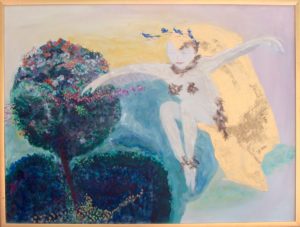
DSC05258Soaring above the Crowd

It wasn’t until I was in my mid-fifties that I could fly freely. One by one my five children had left the nest and though I did miss them I also enjoyed being free from the responsibilities of parenthood. Days of carpooling and worry about college applications being submitted on time were left behind. I understood howimportant it was to balance work with play and especially looked forward to the play part.

And so I started a new business publishing the Museum Tour Catalog and looked forward to utilizing the knowledge gained from running two museums. Not worried about supporting anyone but myself, I was open to failing or succeeding through my own wits and effort. It was a terrifying, exciting time filled with opportunities in a field that was new to me. I loved every minute of every day even when balancing the budget became difficult. Annual buying trips to China, evaluating hundreds of educational toys, working with talented people and brainstorming w
ays to improve service were challenging and stimulating activities. I lived in the flow at the the top of my abilities , sailing through highs and lows with relative equanimity.

One year our company decided to promote the catalog on a billboard in Times Square. Flashing lights bearing our logo moved across a sign located adjacent to the Toys”R”Us store. I must have gone out of my way a hundred times during a February visit in order to stand and stare at the crowds as they passed under the bil2077484xllboard. My wings were spread and I was flying high.

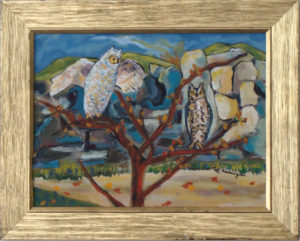
That remembrance returned as I watched a newly hatched Great Horned Owl extending its wings for the fi
rst time. He (or she) was a puffball, looking twice its size while covered in soft white down. Periodically the fledgling shifted, testing his stance while Mom sat stoically on a rock nearby and Dad perched unmoving on an overhead wire. They were waiting for evening to supply food for their chick that demanded ten feedings a day. Owls are patient parents and excellent hunters that often go after prey that is too large for them to swallow. Using their strong beaks and talons they tear off pieces that can be swallowed by their young. Tasty morsels of rabbits, squirrels, snakes, possums and fish augment their diet.

It takes about 9-10 weeks before a hatched chick learns to fly and a bit longer to learn hunting techniques. For another two weeks nurturing continues continues before their offspring is left to fend for themselves. The owl family often stays in the same vicinity over the summer but by fall they disperse to live solitary lives until the next mating season. Each night they can be heard hooting and their shadows observed soaring through the sky as they dive silently for food. You’ve heard them,haven’t you? “hoo-hoo hoooooo hoo-hoo?” I love the sound.

It is now graduation season and my granddaughter, Sanna, is among the thousands of youth nationwide marking the end of childhood and moving on to embrace new experiences. Her parents provided a secure childhood and equipped her with wings to to survive in the adult world. As she arranges to move out of her home, I sit back and contemplate where her flight will take her.

I also think of the freedom my daughter will have when all three children leave home. Her wings have been clipped for a great many years. Will she embrace opportunity or be bothered by an empty house?

Psychology Today describes parenting as a long-term investment. “Be prepared to put far more into it than you get out of it, at least for some time.” they say. Because of the stress of American culture, their happiness factor decreases the minute they become parents. “And it gets worse before it gets better.” Happily, in the long run, parenting is one of the most rewarding jobs life provides.

Children in the United States are often nurtured until they are in their 30s. Rarely are they pushed from home and told that they are on their own. Once they do leave they return for vacations, when they lack money or when jobs turn sour. They appear at the door after devastating divorces or when they are just confused about life’s choices.

Yet as children reach maturity and parental pressures lesson many feel sad, get depressed and grieve. The time and energy previously spent as a caring, nurturing adult has ended and energy needs to be redirected. Even those with returning children create new ways of relating to them. Healthy liaisons evolve into peer relationships that provide space for both parties to move independently. Once new hobbies, careers, and leisure activities develop freedom becomes cherished most parents no longer want to be care givers to their children.

A period of rapid growth and contentment swept over me as I adjusted to an empty nest. I was often surprised that my wings grew stronger with each opportunity seized. I learned to soar to new heights by embracing different activities. Now I notice that though I still fly solo I often travel in flocks with those who have also have also reached this stage in life. Friendships deepened once I accepted my own foibles and realized that we all do the best we can. It is a good time to be alive.

References:

http://www.owlpages.com/owls/species.php?s=1220 – About great horned owls.

https://www.psychologytoday.com/basics/parenting – parenting today.

https://www.psychologytoday.com/conditions/empty-nest-syndrome – Empty Nest Syndrome

Art work is always for sale. Contact me at marilynne@eichingerfineart.com

Do respond below with your thoughts.
___________________________
For sale on Amazon by Marilynne Eichinger: The True Story of Streetwise, overcoming homelessness and beating the odds. Go to AMAZON .

Streetwise

Mean Aunt Martha’s Brain

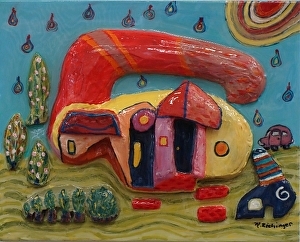
1356531mMean Aunt Martha                                                                                                                                      Acrylic/ 30” by 30” / gold frame/ $ 399
She was a beautiful, talented alcoholic who was mean to her children.
What type of brain did she have?

Over and Under-stimulated Brains

Sean Suib director of New Avenues for Youth recently told me that there are two types of brains. The thought intrigued me so I did a little research. What I discovered is that one brain type is over-stimulated while at rest. I have one of those. My brain does not like going on roller coaster rides or being exposed to extreme circumstances. We who are over-stimulated are hypersensitive since our brains are continuously at an “all systems go” level. Our brains often cause us to have social anxiety and exhibit fear based responses.

When it comes to taking physical risks I am cautious even though I like to get up on the roof and sweep off the leaves. Heights don’t seem to bother me as much as my neighbors who worry about me falling. I am smart enough to attach a rope if I have to go to a particularly dangerous spot where the ground is 40 feet below.

It takes courage to grow up and strike out on your own. Those of us with over-stimulated brains have a difficult time becoming independent unless we learn to calm our minds. In my twenties my career suffered because of anxiety and fear. I turned down a wonderful position offered by the Boston Children’s Museum when I first graduated from college. I had to learn how to overcome my disability and eventually did so through the practice of Transcendental Meditation. When I first started Impression 5, a science museum in Lansing Michigan, I sat in my car meditating for 20 minutes before going to appointments. Over time, I learned to relax and eventually to enjoy the chaos of a stimulating work environment. I started to thrive under the pressure of daily decision making that was required in my challenging job a president of OMSI. Though I now consider myself a risk-taker when it comes to my personal and business life, I am rarely impulsive. My moves are well analyzed and calculated.

The second brain type is under-stimulated. Those with this type of brain have constant feelings of boredom. They become the thrill seekers who love roller coaster rides and high speed car chases. These individuals are in danger of depression and acquiring compulsive behaviors like drinking and gambling. They seek extreme activities to overcome boredom and have a propensity for poor impulse control. Under-stimulated brains tend to feel and move through life without thinking of the future. Under-stimulation is often paired with a psychological condition known as motivational syndrome, defined as a low desire to participate in social situations. They are often apathetic to what goes on in the world outside of themselves.

Streetwise, as do many homeless teens, has an under-stimulated brain. When we first met him he constantly complained of boredom. With a lack of motivation nothing interested him saying nothing interested him. He could sit staring into space for hours, not responding to our suggestions to go out and enjoy the world. . “Go visit a friend.” I would say or “ If you are bored, why not join a bowling team or get involved with a hobby.” The answer was always, “I’m not interested.” However, when it came to physical risks his response was different. Streetwise was ready to jump into a risk taking position as long as someone else initiated the interaction. I would hear of his dreams of bungee jumping, skydiving, speed racing, and skateboarding as they swirled around his head while he lay on the sofa.

One day Ray and I noticed how much Streetwise enjoyed getting up on the roof to look over the edge without being tied on by a rope. One section of our roof is over 50 feet off the ground but its height did not phase him. The higher the roofline he could stand on the happier he was. His attraction to danger is what led us to suggest that he become an industrial painter. This career puts him on 75 foot water towers where he can hang over the side to sand blast and paint. At times he has to walk along narrow platforms and climb cables on bridges that span huge distances over turbulent water. Streetwise embraced his training and apprenticeship program with gusto. He has excellent job possibilities ahead of him as long as he stays safe. We have observed a big change in the way he problem solves so I am optimistic. His brain has adapted making him a more outgoing personality who is comfortable in social situations once he has been pushed into attending.

I do believe that Aunt Martha was in many ways similar to Streetwise.  Her under stimulated brain, however, took her towards self medication through alcohol.  She reacted instinctually when she did not like something and slashed out at her children with biting verbal remarks.  Her anger was a way of stimulating adrenaline, making her feel alive.

Which of the two categories do you fall into? Is your brain over or under-stimulated? Have you ever had to overcome adversity due to the way your mind works? Have you tried to repattern the way you think?

Do share your thoughts below.
Art is always for sale. Contact me at marilynne@eichingerfineart.com

For sale on Amazon: The True Story of Streetwise, overcoming homelessness and beating the odds. Go to AMAZON.

 
References:

http://hubpages.com/health/processing-disorders-under-stimulated-brain – About the overstimulated brain.

http://www.ehow.com/way_5418991_mean-feel-understimulated.html – Understimulated brain.

Create a Museum at Home

totally-modern

Totally Modern : A home museum can be full of adventure
Mixed media / 16” x 20” x 2” /$ 425

2 copy 3In The True Story of Streetwise; overcoming homelessness and beating the odds, I talk of the education system and how traditional classroom teaching is not right for all children. The addition of tactile experiences makes a difference for a great many learners. Parents and grandparents can take matters into their own hands and make sure it happens. The True Story of Streetwise is available for $ 1.25 as an ebook on Amazon:
Create a Museum at Home

Why are hands-on museums unique? As a previous museum director I visited hundreds of children’s museums and science centers, finding their creativity and ingenuity to be more than just little bit exciting. They are places of engagement where children spend hours doing activities such as water play (learning physics and hydrodynamics without realizing it), dressing up in period costumes (learning history), constructing and plumbing buildings (engineering), watching balls speed down ramps and a host of other activities that involve the whole body as well as mind. Young visitors often cry as their parents pull them away from the exhibits to go home.

When my children were young I often visited the Boston CHildren’s Museum and was influenced by their educational approach. At preschool age, I decided to send them to Montessori schools where classrooms are laid out as mini-museums. Students are permitted to approach materials at their own developmental time frame and are encouraged to master a concept before going on to the next.

According to The American Association of Children’s Museums, a children’s museum is “an institution committed to serving the needs and interests of children by providing exhibits and programs that stimulate curiosity and motivate learning.” That definition fit my philosophy perfectly. When I moved to a community without a hands-on museum I decided to turn my home into one.

Part of the challenge was organizational, so I decided to set up our playroom as a museum with a Montessori approach. I envisioned it as a place filled with meaningful toys that promoted factual learning and creative imagination.

Maria Montessori had a major influence in the education of young children. A 19th century physician turned educator, she became involved in designing Casa dei Bambini, a school for low-income children. As she experimented with curriculum and classroom design, “she began to see independence as the aim of education and the role of the teacher as an observer and director of children’s innate psychological development.”

Montessori believed young children were sensitive to order, enjoyed doing activities repetitively and were happiest doing practical things. She developed an environment that was kid-size so that materials could be easily reached and put away when completed. Over time, very sophisticated materials were developed for for sale with teachers specially trained in her methodology.

I did not have the training or money to set up a true Montessori school but I did have the ability to develop a child-sized, child-centered environment. I started by organizing different locations in our play area for various activities. Shelves were divided into sections for math manipulatives, reading readiness, puppetry, puzzles, costumes, and a crafts. I added a carpentry area with safe tools and a music tree filled with percussion instruments. Once in place I took the tine to demonstrate how to use various toys and learning materials. As my kids succeeded with an activity, they were encouraged to use the objects more imaginatively before returning them to their storage locations.

A big part of training was putting items away after use. The task was easily accomplished by being consistent. Keeping the environment clean for the next project not only makes a parent’s job easier but it provides an uncluttered work space. A secret to a successful home museum is introducing toys (activities) one at a time. I began by demonstrating the item’s use. Then I sat back and observed my child in action, making sure the clean up phase was part of the cycle. Once these steps were mastered, I would note if he or she was ready for a more difficult challenge. My goal was to have my children master the activities independently. With each success they became motivated to continue to learn.

This home-museum environment does take careful planning, but once operational the task becomes easier because children will navigate the space on their own.They choose toys they know how to use. Because they enjoy the challenge they concentrate and move progressively from one skill level to the next.

One last thought — a child of two and a half is ready for a home museum. At first only a few toys should be visible and easily accessible. Once the manipulative is mastered, introduce another toy, the next challenge. If you have several children at home then each child needs to understand which items they have earned the right to use.

Yes, hands-on museums are fun because they are child centered and permit freedom of movement. If you do decide to set up a museum at home, I would love to hear from you and learn of your success or difficulties. What toys did you select? What problems have you encountered?

A Crafty Way

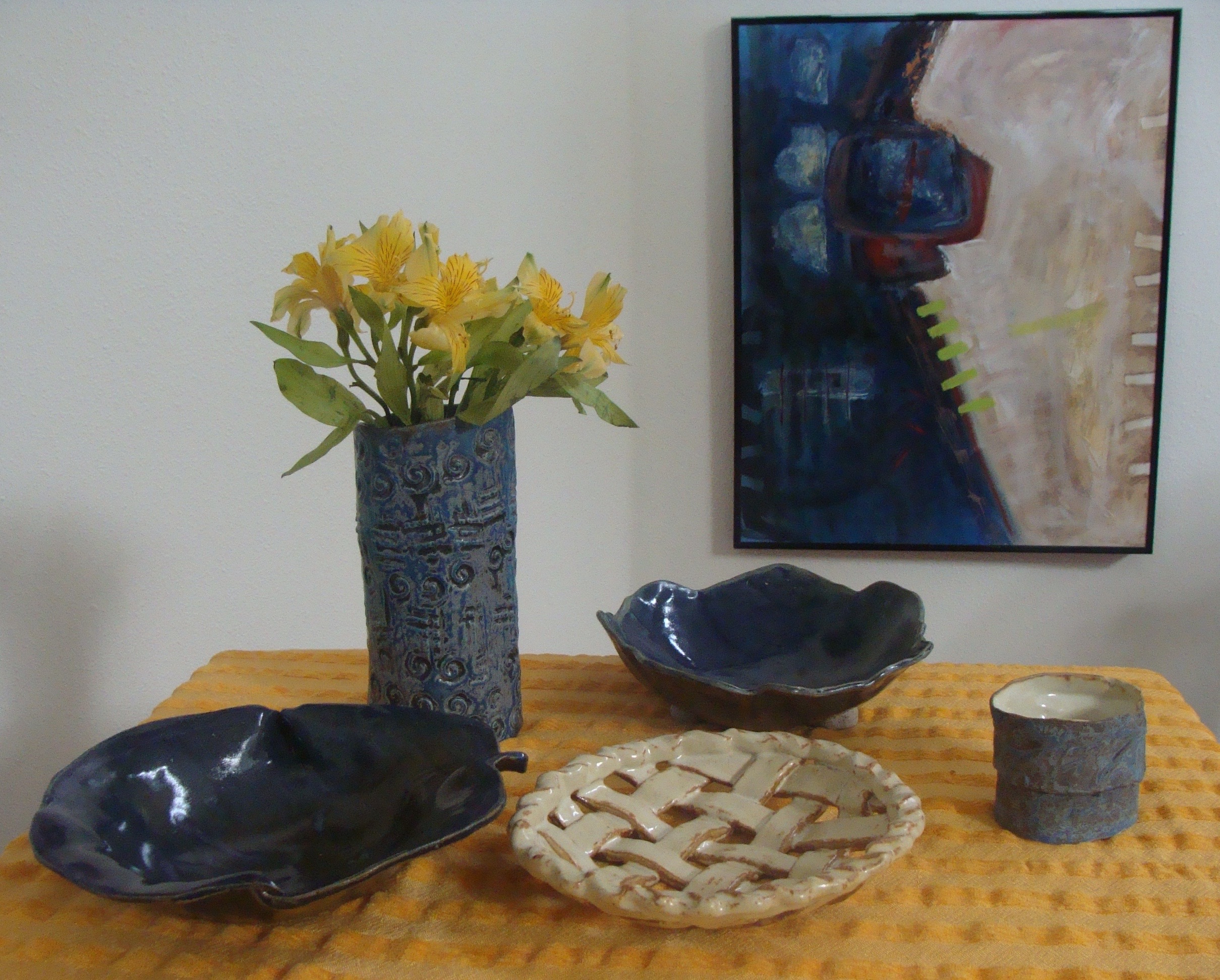
DSC06355Sampling my pottery – a new hobby. Picture in background is one of my acrylic paintings: Seeing Infinity / 30 in. x 24 in. / $ 549.00

Keep those Fingers Busy
A crafty way to stay out of trouble

When I was a child my grandmother and mother used to teach what I considered to be the womanly arts. I was introduced to a sewing machine at the age of eleven and made a white pinafore. I was certainly proud of my creation and wore it everywhere I went. Today I remember everything about the process, from laying out a pattern, to cutting, pinning and sewing. My mother helped me every step of the way.

Grandma was a knitter, with needles that went click, click, click as they speedily moved. She never had to look down at her work to see if she was doing it correctly. Grandma used to take me to the neighborhood yarn shop where a small group of women sat gossiping around a big table while sweaters, scarves and afghans rolled down their laps. I was often asked to spread yarn between outstretched hands while she turned it into a ball. In time, grandma taught me to knit, and I made simple items like mittens, hats and scarves but I could never duplicate her speed or complexity. She died over 40 years ago yet I still use one of her beautiful handmade blankets.

Needlecraft and crocheting were also part of my education. A few days ago, when cleaning a closet, I discovered a towel embellished with flowers that I embroidered as a child. I also found a lacy doily, though to my disappointment it was torn and had to be discarded.

Sewing and knitting were not the only crafts I learned. In sixth grade it was customary for my friends to exchange Christmas gifts. I identified 10 girls and my teacher as needing presents . . . a major expense for me at that age. So, following mother’s suggestion and assistance, I made autograph books with wooden covers. In the process I learned to use a jig saw, to sand until my arm hurt, and to varnish wood to a deep luster. My wood burning set was put to good use to engrave each recipient’s name. A stack of paper was sandwiched between the front and back covers held together by a threaded red ribbon. My gifts were greatly admired by my friends, making me realize that creative entrepreneurship is a valued commodity.

Why am I telling you this? I don’t knit, sew, crochet, do needlepoint or woodworking today. I do paint, tried weaving once, and take pottery classes. I have become appreciative of the time it takes to develop into a master artist and have great admiration for quality craftsmanship. Best of all I cherish the connection between my grandmother, mother and myself. They demonstrated me how to enjoy creative activities so I would never be bored.

In addition to art appreciation, craft projects introduced me to problem solving. I had to decide what to make, it’s design, color and size. Budgeting, selection of materials, arranging a storage area and developing a time line were part of the process. I employed math skills for measuring and estimating, and considered consequences such as, “who pays if I start a project and don’t finish?” Craft activities promoted patience and concentration and they improved my small motor skills.

Children I have recently observed are given limited exposure to arts and crafts in school and home. It is too bad, for developing patience and concentration are skills that carry over to school and work. The thrill of completing a project is a great motivator for future endeavors. The warmth of being mentored by a supportive parent, grandparent or craft instructor develops security and feelings of love.

Is craft time, play time? Not really, yet crafts are a form of entertainment, though, as in the case of pottery, they can have very practical purposes. Some crafts have purely decorative uses that, when done well, can bring beauty into your home.

Getting involved in a craft is certainly worth a try. If you are already hooked why not explore something new. Challenges are good for brain health. Whatever craft you choose it is bound to be captivating. Happy crafting to you and yours.

Do comment below or contact me at marilynne@eichingerfineart.com.

DSC06364

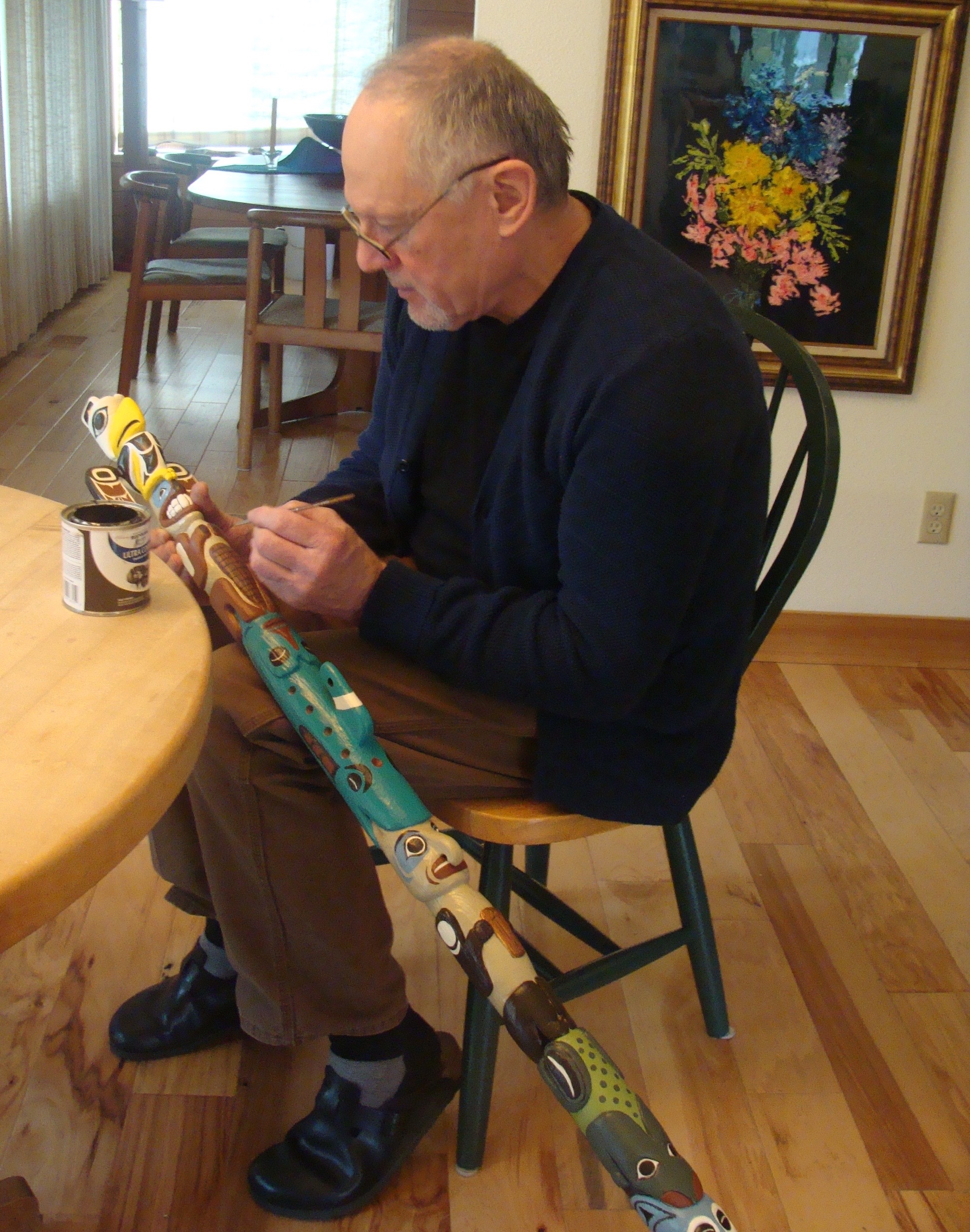
Ray Losey practicing his craft. Totem Pole is
6 feet tall, 6” at wing span / Price $ 1900 / Early bird price before completion – one week only thru January 17th. . . $1650
Animals on totem are eagle, beaver, whale, wolf, frog and owl.

Art work is always for sale. Contact me at marilynne@eichingerfineart.com.

Please share your craft stories on my blog page below.

You Never Know!

Oregon Museum of Science and Industry

Oregon Museum of Science and Industry                                                                                                 Acrylic painting- 27” by 22”: $450
Science Centers are special places for hands-on learning.

You Never Know!
While sitting in my museum office one quiet fall day, I heard the sounds of shouting voices and footsteps running towards my door. Needless to say I was worried and jumped from my seat thinking that there had been an accident. Instead, a surprising story greeted me. An autistic child had spoken for the first time and the excited observers wanted to share their wonder with me.

Both mother and teacher were visiting the science center with a class of disabled elementary age children. A young girl happened to have been left alone for a few minutes and allowed to explore the small exhibit hall on her own. The child had stopped before an oscilloscope, picked up the microphone and started vocalizing. As she made a noise, her voice pattern was displayed on the scope. Since neither adult was paying attention, the child she felt free to play with the display without having to perform for an audience of concerned educators. When the mother turned to check on her daughter and observed what happening, she grabbed the teacher, and with excitement the two ran to share the news.

The teacher later told me that the incident was a reminder of research that suggested an oscilloscope be used to help non-verbal children. Back in her school she put in a requisition for a scope to use during therapy sessions with several children.

The conclusion of this story, however, gave me pause for thought. Parent, teacher and child returned to the museum a week later. The three immediately dovetailed to the oscilloscope where the child was handed the microphone and instructed to talk. There were high expectations of a repeat performance. Instead they got silence and disappointment in the child’s reaction. I thought the experience provided an interesting insight into human behavior and I tucked it away for further analysis.

What conclusions did I draw from the incident? Several . . . first, children need a rich and varied environment within which to roam and second, they need freedom to make choices away from the eyes of overly anxious adults.

What I like about science centers and children’s museums is that they provide a safe environment for self-exploration. They are designed to enable participants to learn in their own way and in their own time scale. Parents do not need to hover over their children and teachers are not asked to comment about what should or should not be learned. The visitors experiment with the displays and form their own conclusions. Since no one is watching or testing it is acceptable to make mistakes and then try once again.

Montessori schools take a similar approach. Their educational materials are organized in such a way that the room becomes child rather than teacher centered. In a Montessori classroom the teacher shows the child how to use age appropriate equipment but then lets the child alone to use it or not. Once a basic skill is mastered experimentation with other variations is encouraged as imagination dictates.

When I was a child the neighborhood was my domaine. During vacations I often left the house early, meeting friends to ride bicycles and explore the adjacent woods. Our parents were not worried, assuming we would come home when we were hungry or tired. In this way I experienced nature, found abandoned bird nests, listened to bull frogs, tried to catch polliwogs and climbed trees. When our apples fell in the dirt we picked them up and washed them off in the nearest stream. My friends and I made up stories and played our parts as lost princesses to be found by daring knights. To experiment with outdoor cooking, I put an egg in a frying pan to see if the sun was hot enough to cook it. After three hours the fried egg was well done but not very attractive for eating.

Childrearing practices today make me concerned that parents and grandparents have forgotten that children need freedom to explore their communities and need to be allowed to make mistakes. Instead they create pristine environments for play and provide constant praise for the smallest success or inconsequential achievement, making sure that the child is are never bored. Without realizing it they are working against their child’s ability to be self- sufficient and develop confidence in their own competency.

A woman I met last week told me that her brother invited her to the Spaghetti factory for a celebration. When she asked about the occasion she was told that her five year old niece had just completed her first week at school. The woman, a teacher, was concerned that a kindergartner should be awarded for having attended a week at school and wondered how the accolades were going to continue as the child aged.

The teacher went on to say how spoiled and demanding her students were. They (and their parents) insist on being given good grades even if they were not earned. These helicopter parents hover over their children, contributing to their homework, and observing every activity. When away, cell phones put their child in regular contact, and they text frequently, remaining in constant contact. Their children are told how to behave, what to do and where to do it. And when they do something wrong there are few consequences. All of this loving attention creates spoiled children who talk back and rule the household. By the time they are teenagers they are difficult to control yet have not learned how to make sensible decisions on their own.

By not being given the freedom to experiment and fail, or allowed to experience boredom and find their own amusement, many children grow up ill prepared to leave home. Going away to college can be a traumatic exercise. I know of a single mom who went so far as to move to her child’s college town, renting an apartment in order to be near. Parents are texted back and forth throughout the day to lessen the confusion, fear and loneliness that comes from being away from home for the first time. The result of these actions denies the student the experience of joy and confidence building that comes from having to overcome difficulties.

You never really know what is going to happen in life, and there is no way to protect children from every possible disaster. The best we can do is to let them know of our love. We can help them learn to problem solve, give them skills needed for working, and then leave them to find their own way.

Whose freedom is it?

Meet the Blockheads
                                   Meet the Blockheads

acrylic painting – 22” x 18” $ 385
Training a child to become independent is an awesome job.

Whose Freedom Is It?
When my granddaughter was 16, she wanted to be free from her parents’ control. As a typical teenager she took her cues from her friends which often led to major disagreements at home. To my children’s credit my granddaughter did not always get her way, but her parents were good at adapting to age related situations in order to give her increased independence. Beach parties were big events in their coastal community and one year my granddaughter wanted to have one for her birthday, without parental supervision. Hummm,. . . .sounds good, but alcohol, drugs, and “what not” were often a part of teen beach events.

What would you do? Say no, or allow the festivities to take place? Her parents took a creative approach that let the party proceed. My son-in-law set up his own solitary party away from the revelers, but located within site lines of his daughter and her friends. The weather was perfect and during the evening he became engrossed in a book in front of his own fire while nibbling on snacks brought from home. He let the kids have fun for as long and they wanted, staying out of the way, but because everyone knew that there was an adult paying attention to their antics, the party proceeded without incident.

All children are going to become old enough to make their own decisions, but a difficult part of parenting is preparing them for this eventuality. Many years ago I read that offspring of parents who are very controlling while their children are in high school are often the wildest ones during freshman year at college. I am reminded of an incident that occurred when I was in 9th grade. While riding a public bus on the way home from school, my friends and I observed girls from a local private school who were made adhere to a strict dress code. As soon as these teens boarded the bus, out came their compact powders, lipsticks and combs. The girls refashioned their hair and added earrings and other jewelry to their attire. In order to soften the look of their uniforms, shirt tails would be pulled out of skirt bands and left casually hanging. Much to the discomfort of other the passengers, the students became loud and boisterous, acting as though they were riding a private vehicle. My friends and I felt sorry for them because they seemed out of control, and we gossiped about them behind their backs.

This incident raises the question of what is free choice, and how much of it should a parent give to their offspring? Freedom tied to responsibility is the goal, but how does one get reach that point? If a child does not clean the dishes or throws his or her clothes on the bedroom floor, is that freedom of choice? Perhaps it is, but those actions also can impinge on the parent’s freedom. If the adult does not agree to let the child use or abuse his own bedroom then the parent becomes a monitor, bringing feelings of anger because of increased household work and paying for clothing that is not valued.

So who and what is free? Teaching responsibility to accompany free choice starts at an early age. It involves discussions and actions that have consequences aimed at exploring the “what if?” question from several points of view. It also involves being present, without anger, when a child makes an honest mistake and stumbles. Being there to sooth raw emotions, and inviting verbal analysis of the event, with the goal of finding a path to avoid future pitfalls, presents an opportunity parents should cherish as long their children remain under their roof. When teens leave for a job or distant college campus, it is too late to teach the analytical skills needed for decision making.

When my children were young, we used the dinner hour as the main time to discuss and dissect daily issues. We would bring problems to the table and try to look at them from several viewpoints. Occasionally and just for the fun of it, I would introduce a complex situation from work, so all could contribute to a “How would you handle it?” discussion. We had lots of discourse, not always agreeing, but constantly thinking and gaining perspective from the various sides of the problem. There were many times when we became frustrated, such as when one child teased another, because we could not find a solution that stopped the behavior. In those occasions we did have to step in with a firm resolution from parental authority. The ensuing discussion about teasing and repercussions did eventually grab hold and helped to alleviate the situation.

My suggestion to parents is to start having philosophical conversations at an early age and bring children into a discussion of outcomes and fair consequences. Even a 5 year old can consider ethical and social issues. For instance, you might ask a youngster a question like, “ What should you do if you find a dollar in the driveway of your neighbor’s house? Do you keep it or return it?”

When the child in a bit older the subject of bullying might be introduced by inquiring, “What roll should a bystander take who observes a friend being bullied?” The conversations will most likely lead to talk of how the bullied person might feel and what would lead a person to becoming a bully. When my youngest child was being heckled because of his short stature, he and my husband spent hours thinking up and practicing quick retorts. By demonstrating that he was not embarrassed or put off by the bully, my son eventually put an end to the unwanted situation. The exercise also taught him to accept himself as a short person and not let it affect his life.

Young women love to talk about around body and facial adornment. It can be fun to debate cultural applications of makeup and tattoos applied in tribal communities, by prostitutes or actors, and by various socio-economic groups in local neighborhoods. Fashion certainly can produce a lively exchange of ideas. Because the discussion becomes a sociological lesson rather than a confrontation, the subject becomes mind expanding. Youngsters learn that a choice of lipstick color is often determined by the pressure of friends, a marketing expert or tribal custom, rather than one of free choice.

There are numerous conversations that might evolve from auto-speak. An adult who is knowledgeable about automobiles could discuss cars and how the selection of one model over another says something about the buyer. The economy, ecology, status symbol, safety, driver’s responsibilities, alternative transportation, even the topic of fuel efficiency at various driving speeds can be debated. It is through these types of conversations that children develop value systems.

So . . . parent’s and grandparents why not have frequent conversations with your children around the subject of freedom. By considering several points of view your child can refine his or her analytical skills. Then as your child ages, permit your youngster to test conclusions, allowing him or her to experience the lows of failure and the highs of success. A parent who is available to insure safety can reassure their child that mistakes are normal. This will go a long way in building their offspring’s self-confidence. It is by examining failures and being encouraged to try again that people grow. In this way parents, grandparents and teachers can help children understand the implications of so called “free choice.”

Transitions

  The Santiam Pass Burn

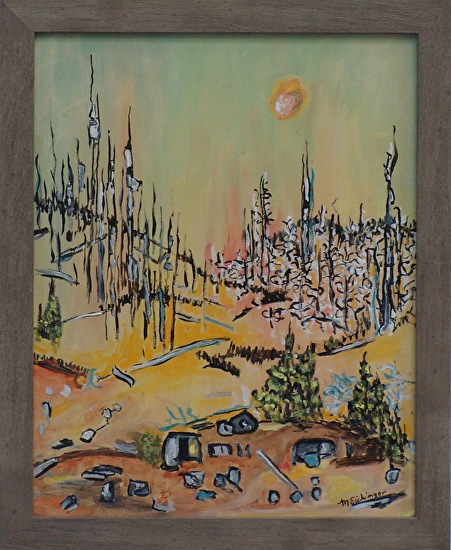
                                       The Santiam Pass Burn Area – an ecology in transition                                          

 acrylic painting – 22” x 18” $ 275

Transitions Create Energy

My NIA (non impact aerobics) \ teacher commented theater day that transitions create energy. Each time we shifted from one movement or shape to another she encouraged us to spring into the new position with gusto. I appreciated her observation and started to think about the energy needed for transitions other than movement, such as those that impact the environment, my life, and writing.

Several weeks ago, while traveling through central Oregon, I observed the shock caused by a massive fire to land and surviving animals. The view from my car window was chilling, seemingly as though I was peering at an alien planet. Black charred trees contrasted with white gnarled bleached branches that stood naked in the scorched ground. In 2003, fire destroyed 90,769 acres of Oregon forests totaling approximately 100 square miles. The Santiam Pass had succumbed to a failed U.S. Forest Service policy of suppression. Without small and frequent burns to clear underbrush, the forest had grown thicker and drier. It was weakened by disease and drought and demonstrates what can happen after a century of fire suppression and timber harvests that leave brush behind. The burn area is now a land in transition. Caused by energy, it consumed an energy source, and will need years of energetic renewal to repair itself. It will be fascinating to observe primary plant succession in action and see how many animals return to feed on young shoots. After the eruption of Mt. St. Helens, the deer population exploded as growth returned. However, in this case, the sun beams hot, temperatures are elevated and regrowth seems slow.

Leaving childhood, entering college, becoming married, and parenthood were periods that initiated a time of personal transition and growth. On the sad side was my divorce. I was devastated, cried constantly at first and felt like my world was coming apart. “How would I ever be able to live in my creaky house or travel to foreign lands as a single woman?” I wondered.

I decided to let myself mourn for as long a time as needed, but while doing so, wallowing in self-pity would not be acceptable. Since I could no longer depend on someone else to lead the way, I had to create my own path. Match.com became one of my solutions, putting me out into what I thought would be scary situations. Much to my surprise, the website introduced me to some of the nicest men in town. I became energized, and for one year had a blast, feeling like I was reliving my college weekends. I had partners for dancing, visiting art exhibitions and taking long bicycle rides with stops on hot afternoons for drippy ice cream cones. With new acquaintances I visited summer festivals, took in soccer games and went on picnics and hikes in the woods. One man had a mathematics toy that he had invented for elementary school children, and since I was in the educational toy business, I was able to get his product marketed. The royalty checks were fun to receive.

By the end of the year I had a better sense of myself. As a stronger woman I was not as dependent on a partner, no longer afraid of intruders and more willing to travel on my own. In fact, there were times I preferred to be alone because I was more open to meeting interesting strangers along the way. I still valued stable companionship, however, and by the end of the year was once more in a committed relationship. This time though, I was determined to accept my partner and present myself as “take-it-or-leave-it ” packages. We no longer had to blend into one entity but could retain our individuality as we held hands. The transition from marriage to divorce to a partnership required increased energy that helped me better understand close relationships.

Coping with change is a constant that from time to time each of us is bound to face. Transitions: Making Sense of Life’s Changes by William Bridges is a relevant book that discusses how change brings both opportunities and turmoil. Bridges helps readers understand that there are three stages to any transition; the Ending, the Neutral Zone, and eventually the New Beginning. There needs to be patience and acceptance of the steps needed in order to evolve.

Transitions create a period for tremendous growth. New learning has to take place since familiar patterns have changed. Experiences will be different and fear has to be overcome. There are times, as in illness or death, when it is difficult to go through a period of upheaval alone. Imbuing energy to the situation may require the help of a trained professional, or you may be the one called to assist a loved one face their new reality, requiring you to become infused with a strength that you did not know you had. When my son developed cancer, it meant that both my husband and I had to spend two-thirds of our day assisting him while we continued to conduct our ongoing affairs. It was a difficult and emotional time, but I learned a great deal about the medical profession, giving organizations like Make a Wish Foundation, the spirit of the human psyche, and the well of energy within our family that was there when it needed to be called forth. I am thankful that all ended well, and our son is appreciative of his good health, maintaining it with good food habits and exercise.

Giving birth to children, watching them grow up and leave home, and welcoming grandchildren are all milestones that create a changed life style. For the child, transitions can be difficult since they are usually instigated by something beyond their control. Moving, divorce, a new school all create stress that may need the assistance of an an in-tuned parent. It takes fortitude to be attentive to offspring and often requires the adult to acquire new coping skills. None of us are born parents. Most are on-the-job students who become trained when unexpected family situations present themselves.

When each of my five childrenI reached eleventh grade, I mourned the approaching empty nest. By the time they actually graduated, my worry period had ended, for I had used the year to consider next steps. The approaching transitions energized me, and I became busy planning for and learning how to operate a new business.

Bob Dylan sang true when he wrote, The times they are a-changin’.
Come gather ’round people
Wherever you roam
And admit that the waters
Around you have grown
And accept it that soon
You’ll be drenched to the bone
If your time to you
Is worth savin’
Then you better start swimmin’
Or you’ll sink like a stone
For the times they are a-changin’. . . .

As my offspring matured they kept me thinking young, for their conversations were often a windows to new ideas and approaches. In many ways their lives are more difficult than mine was because of changing worldwide economic and environmental conditions, yet they are adapting by embracing ways of enjoying a more frugal existence, eating organic foods, and having lower impact on the environment. The women no longer think of themselves as primary support systems to husbands, but have their own careers and relationships based on shared responsibilities. Since they married at a later age than I did, they had time to develop close-knit circles of friendship that recognize the need for independence yet are there to provide support when needed.

Transitions create energy applies to all of the arts. Just as a dancer is energized by a conversion step giving rise to the next pose and an artist becomes excited by preparing a canvas to take paint, so does a writer become empowered by the use of changeover words and phrases. When writing it is important to know how to get from one thought to the next. Consideration has to be given to the best way to provide energy going forward? Phrases like in addition, not to mention, equally important, and moreover take the author out of a dead end position into the next concept. These words are essential, because they not only connect ideas, but introduce a change, a shift or contrast, an emphasis or agreement. They are vital and useful words that bring purpose or conclusion to an argument.

Yes, transitions do create energy, bringing intensity to nature, work, play, and the arts. They demand that effort be put forth as Dylan says, “if your time to you is worth savin’, then you better start swimmin’.”

Art work is always for sale. Enjoy learning more at ecihingerfineart.com or contact me at marilynne@eichingerfineart.com.

I enjoy hearing from you. Please comment below

References follow:

http://www.amazon.com/Transitions-Changes-Revised-Anniversary-Edition/dp/073820904X – To purchase book about Transitions by William Bridges.

http://education.wichita.edu/caduceus/examples/essay_student/transitions.htm – Transition words.

http://www.azlyrics.com/lyrics/bobdylan/thetimestheyareachangin.html – Lyrics to The Times They are a Changin’ by Bob Dylan.

Passing the Baton

French QuarterNew Orleans 

Acrylic Painting – 12” x 36” – $ 350
A city where cool sounds of Jazz permeates the French Quarter

Passing the Baton
How do you provide a music education when your own experience is limited? Some children are fortunate because their parents are trained musicians. Others, like mine were, have parents who believe that education should include music. Though they pay for lessons, they do not know how to inspire their offspring to become passionate about their instruments, so the money they spend is not used to maximum effect.

Except for the scales and easy pieces played when my siblings and I practiced, music was not heard in our household. Neither radio, television nor record player was used to fill our home with melodies, though we occasionally were taken to children’s concerts. My family finally obtained a phonograph when I was sixteen allowing a few symphonic records and lots of rock n roll to enter our home. With marginal role models pointing the way, as an adult I was committed to creating a more musical home.

When my children were still in pre-school my husband and I set up an instrument tree in our living room. A floor to ceiling pole was erected with clips attached from which to hang all sorts of sound makers. It held tambourines, recorders, maracas, bells, whistles, harmonicas, drums, cymbals, sticks, and a wide variety of shakers. Each day I would put on a record (pre-CDs) and gather my young band members to sing, march and dance around the house while struggling with the challenge of staying on beat. Though visiting friends must of thought us to be a strange, noisy bunch, the kids took their music activities very seriously and had a great time.

As an adult, my husband learned the guitar and encouraged singing in the evenings, on long car rides and around campfires. He eventually became so accomplished as a musician that he and a group of professor friends formed a bluegrass band. The Bluegrass Extension Service practiced in our home and performed weekly in a local pub, attracting hordes of students to clog along with the music. I loved dancing to his music and had a wonderful time chatting with university friends. Our family quickly learned to belt out Rocky Top and Country Roads.

In analyzing my own musical talents, I admit that they were not great. I can not sing on key and though I studied the piano as a child, I was a mediocre player who found it difficult to read and strike a multitude of keys at one time. It still amazes me that people can actually understand complex scores with thirty second notes, trills and chords. In my thirties I decided to try again, this time taking up the flute since there is only one note to read at a time. With children running around the house my squeaky sounds added to the chaos, but the family was tolerant, and I do believe my perseverance may have inspired them.

My retired symphony orchestra teacher was sensitive, quickly realizing that I was not in training to be the next Sir James Galway, Jeanne Baxtresser or Herbie Mann. Instead of assigning hours of practice scales he had me play beginning music that could immediately be enjoyed with friends. A few of my enthusiastic neighbors were even willing to accompany me on the piano, making my practice very pleasurable indeed.

As my children reached their elementary grades their music-anti was raised. A willing teacher offered before-class recorder sessions in our neighborhood school. By the time they were eight, all of my off spring had had experience with musical notations, and were ready and willing to be enrolled in piano lessons. One daughter, who had an exceptional ear for sound, took up the violin as well. (No squeaky sounds there! ) My childhood spinet had a rotating hot seat for several hours each day.

It took a great deal of time to drive children to and from music lessons and recitals, and it was often annoying to be surrounded by discordant sound but in the end I found it to be worth the effort. Two daughters and I formed an ensemble that could play piano, violin and flute trios. The fun we had and pride we took in our small chamber group produced an emotional high I will remember forever.

Why did I believe that music education was so important? Many studies show that early musical training develops the left part of the brain, the side involved in reasoning and language. There also appears to be a link between the ability to perceive things accurately and form mental pictures of them. Music helps in understanding advanced mathematical problems, which may be why geniuses like Albert Einstein play the violin as their preferred leisure time outlet. A ten year study conducted in 2006 by Johnson,C.M. & Memmott, J.E. showed that children, irregardless of socio-economic background, had increased success on standardized tests such as the SAT. It also affirmed that those who play instruments tend to achieve higher school grades.

Columbia University research that “ students in the arts are found to be more cooperative with teachers and pears, more self-confident and better able to express their ideas.” They also found lower aggressive and anti-social behavior. Best of all those who participate in band and orchestra have, “ the lowest lifelong use of alcohol, tobacco and illicit drugs among any group in society.” Participating in a band or orchestra enhances teamwork skills and discipline. Practice improves study habits, and performances help youth accept risks and overcome fear.

When my children aged I was curious to see if their musical experiences would stay with them. Eldest son followed his father’s example and took up the guitar as an adult. He still takes voice and guitar lessens, practices regularly with friends, performs for family, and sings with his sons. When his sons were only two years old he enrolled them in a parent-child singing group that provided a great bonding experience. Now the entire family sings their way through family gatherings and evening camp fires.

Eldest daughter continued to play the piano for her own entertainment until a few years ago when she became very busy with a second career. When her children were young, however, she introduced them to both piano and choral singing. Her son became a classical and Celtic violin player who even serenaded me in the hospital when I was ill, much to the pleasure of the nursing staff and patients in surrounding rooms. Her three children know the words to the latest country/western songs and one even gives line dance lessons. Not sure where that came from!

Violin playing daughter taught music professionally to young children. She was most qualified to help her own family with their lessons. Her daughter studied harp for a while, becoming quite accomplished, at times accompanying her older sister who was taking voice lessons. To my sorrow, the harp was dropped with the mounting pressure of high school activities and a burgeoning social life, though both girls still enjoy the piano. Their younger brother is in the beginning trumpet stage. Yikes!!!

One daughter never achieved personal musical mastery but embraced the vibrant Seattle music scene. Her enjoyment was a pleasure to observe.

Youngest son fell in love with bongo drums as a teenager. Thank goodness he and his friends would go to a local park during the late night hours to beat their rhythmic sounds. He eventually bought a full drum set, but it sits in his abode gathering dust because of complaints by the neighbors. Much of his musical outlet today is around burning man activities. He has many friends who are in bands and they gather in his camp, playing well into the night. Parties in his home are unique because rotating musicians entertain throughout the event.

The benefits of music participation are not limited to youth, for it also is a great asset to the elderly. It can help those with dementia reconnect with their past, becoming more alive and responsive. The health benefits music brings to older people are impressive, especially when mixed with exercise. Moving to rhythmic sounds reduce risk of falling and increase balance. Participants are happier, have enhanced moods and appear more relaxed. Music education can also bring joy to those with special needs when the teacher takes time to adapt a program to the individual’s disability. Not only does music give pleasure to the student, but it gives an increased sense of self-worth.

My flute teacher once told me that when you have music in your life you will always have friends. I acknowledge that his words ring true. For four generations our family has passed on the baton.

Whether opera, metallica, rock or rap there is some form of acoustic harmony that you will find appealing. Music can be meditative when seeking solitude and calmness or equally enjoyable in groups when feeling festive. Whether playing or listening, it is one of the rich offerings in life that I’ve come to appreciate.

How does your family pass the baton from one generation to the next? Do you focus on the arts, literature, sports, nature or something else? Please share your way of passing on your passions to others.  DO RESPOND BELOW

Art is always for sale. Contact me at marilynne@eichingerfineart.com for more information.

References:

http://www.childrensmusicworkshop.com/twelve-benefits-of-music-education/ – Advantages of a music education.

http://musicempowersfoundation.org/why-music/the-importance-of-music – Studies about music, language and mathematics skills.

http://www.npr.org/sections/music-news/ – Elderly and dementia

http://www.dreamsfulfilledthroughmusi-org – Music and special needs

http://www.music2spark.com/2011/11/28/the-elderly-how-music-benefits-their-health/ – music and health.