The Innately Rebellious

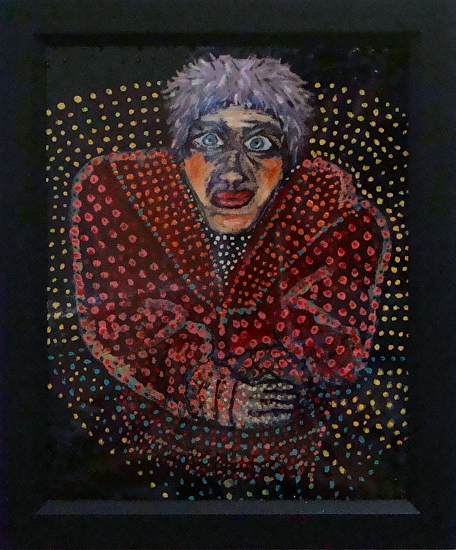
Cool Daddy
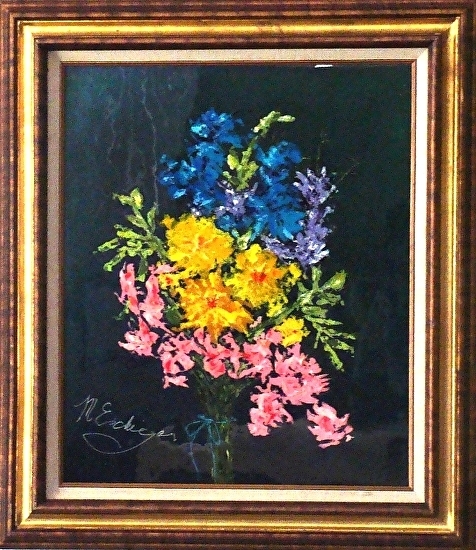
Acrylic painting by Marilynne and Talik Eichinger/ nfs

The Innately Rebellious

The following passage is taken from the manuscript of Over the Sticker Bush Fence: Scaling Barriers for Homeless and Runaway Youth. In this section I discuss what happens to at-risk teens. Most youth go through tumultuous times in their struggle to become a responsible adult. Without adequate parenting, however, the task is arduous and success is marginal.

From the manuscript. Please do not reproduce without my agreement.

“Teen years are a time for rebellion. The following quote is a reminder from the sages. ‘Our youth now love luxury, they have bad manners, contempt for authority; they show disrespect for elders, and love to chatter in place of exercise. Children are now tyrants, not the servants of their households. They no longer rise when elders enter the room. They contradict their parents, chatter before company, gobble up their food and tyrannize their teachers.’ According to Plato, it was attributed to Socrates who died in 399 BC. Some things never change.

“Parents try to blend their child’s need for independence with suffering the consequences of their actions. Wanting to make decisions on their own, teens measure success in terms of independence while their parents evaluate it by rightful actions. The Amish know this tumultuous time well, which is why they let their youth participate in Rumspringa, a period of “running around.” Adolescents, especially boys, are allowed to test the waters of freedom before joining the church. Though parents do not encourage their children to be wild, they do turn their eyes from the behavior they view as unacceptable, believing that their youth will outgrow their rebelliousness.

“During Rumspringa, the adventurous may drink and party late into the night, joy ride in cars, wear the latest “worldly” clothing, and attend movies. The more rebellious may even go bar hopping, smoke, dance in nightclubs, and engage in premarital sex. Though their parents (and minister) may have a thing or two to say about their behavior they are not shunned by the church. The Amish believe that by getting rebellion out of their system this period of deviant activity will pass, helping them freely choose to stay within the faith rather than leave permanently for the outside world of the “English.” Most, but not all, do end up returning to their religion and leading responsible lives. Having been grounded in the community’s values since birth, they have absorbed an ethos that is difficult to leave.

“Though the transition from childhood to adulthood may be turbulent for all teens, it is especially difficult for those without adequate adult supervision. In a “caring family,” behavioral guidelines are introduced and practiced throughout childhood. Over the teen years, most parents increase their youth’s opportunities to problem solve and make decisions. In the early stages of their independence, they are monitored, encouraged and discouraged as their behavior dictates. And, as loving parents, they are available to pick their child up if he or she should fall. What attentive parents do, is lead their adolescents toward responsibility and autonomy. Understanding that rebellion is a part of growing up, they learn to work around it.

“According to researcher Joy Dryfoos, the tasks necessary for responsible adulthood include the following:

• Finding self-definition.
• Developing a personal set of values.
• Acquiring competencies necessary for adult roles, such as problem- solving, and decision-making.
• Acquiring competencies necessary for social interaction with parents, peers, and others.
• Achieving emotional independence from parents.
• Becoming able to negotiate between the pressure to achieve and the acceptance of peers.
• Experimenting with a wide array of behaviors, attitudes, and activities.

“At-risk children have the same needs but have to deal with additional difficulties resulting from living in a climate of uncertainty and fear. If they grow up and remain functionally illiterate (the new untouchables) they risk never becoming responsible adults.

“Neglected children lack parental guidance and older family friends willing to intervene when necessary and help them find their way. Left alone, without good role models, they have neither the training nor experience with which to base sound decision-making. Many react instead by joining gangs, engaging in criminal behavior, or getting involved in drugs or prostitution, thereby putting themselves on a course of destruction. If severely depressed, their actions can tragically lead to suicide or dangerous behaviors that could be fatal.

“Those who commit crimes may be removed from their homes and put in foster care or juvenile correctional facilities. Sadly, the criminal justice system is not the place to go to get your life back on course. It tends to narrow options and train delinquents to be more successful at managing life as a criminal. Rather than building job skills and providing a career path forward, correctional facilities tear down what little self-esteem the youth possesses, producing negative consequences.

“Earlier in my manuscript I write of Zach, a young man who survived childhood neglect, poverty, and a family involved with drugs and alcohol abuse. He escaped to the streets and lived by his wits for four years before my partner and I took him into our home.

“It took five years for Zach to become a fully contributing member of society with enough life and work skills to make us believe that he can carry on on his own. He had to learn table manners, proper English, how to communicate his needs, and to manage money. Numerous times he had social and financial problems that required adult intervention. In other instances, we became involved because of a bad decision he made that affected his ability to remain in his training program. Though it was his life, we were there to help him evaluate the consequences of his actions and nudge him towards sound decisions. His issues were emotional, exasperated by not understanding the causes and effect of his behavior. When the slightest thing went wrong he became excessively upset and instantly depressed. He had to learn to relax before he could deal with his problems.

“Just as middle class parents oversee the idiosyncrasies of their children, those counseling troubled youth need to develop individualized treatment plans for each child in their care. Patience and understanding are important attributes for a caregiver to have because progress does not happen in a straight line. Two steps forward and one back is the norm. Since it took years for the youth to choose homelesses an equal amount of time  may be needed to overcome a childhood filled with trauma.

__
Have you ever had to deal with an  adolescent? Most parents experience occasional moments when they wonder what type of alien monster they are raising. Eventually the parent does focus on the problem and seeks ways towards a peaceful resolution that the entire family can live with. When children are neglected, there is no-one at home to care about their behavior and so, unattended they lash out at society.

References:
Complaining of the Youth (2017). The Literature Network. retrieved from http://www.online-literature.com/forums/showthread.php?17788-Socrates-Plato-Complaining-of-the-Youth

2. Rumspringa (2017).Amish Studies, the Young Center. retrieved from home page http://groups.etown.edu/amishstudies/cultural-practices/rumspringa/

3. Larson, J. (1997). Teenage Rebellion. Culture + Youth Studies. retrieved from http://cultureandyouth.org/troubled-youth/articles-troubled-youth/teenage-rebellion/

4. Dryfoos, J. (1990) Adolescents at Risk, Prevalence And Prevention:. Oxford University Press.

Do comment on my blog site at eichingerfineart.com/blog. What did you do to confront your
unruly teen? What happened to you when you were a youth and acted out?

Art work is always for sale. Contact me at marilynne@eichingerfineart.com.
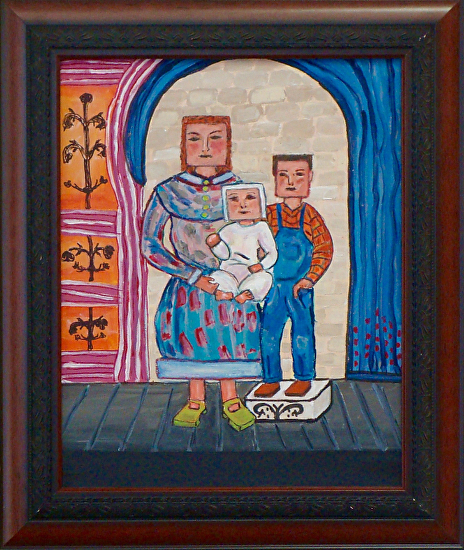
Without Love, What?

Meet the Blockheads

Acrylic on Canvas with glossy polyurethane finish. 26” by 22” / $385/ framed

Without Love, What?

Those fortunate enough to be showered with love during their childhood are likely to become healthy, well adjusted adults.

Without Love, What?

The following passage is taken from the manuscript of Over the Sticker Bush Fence: Scaling Barriers for Homeless and Runaway Youth. In this section I discuss what happens to children who are raised in loveless surroundings. The book is presently under consideration for publication by a well known publisher. It is not too late to comment and I look forward to your insights.

In my naivety, I assumed that love was instinctual and that every newborn, no matter how poor, is a recipient of parental attention. Without some level of care a helpless infant could never survive. But I quickly learned that feelings of responsibility vary from person to person as do emotions elicited by love.

From the manuscript.

“The majority of us are fortunate for we are surrounded by loving parents and relatives. As infants, family members held and cherished us and as adults, we find partners and form bonds based on love and mutual respect. But what happens to children who are never caressed or told that they are special? What are the long-term effects of never having being touched and cuddled? What befalls those children who are physically abandoned, left on door steps or placed in cribs and not attended to when they cry or diapers need changing?”

“A cornerstone study about infant neglect was initiated in the 1980s when Dr. Nathan Fox and colleagues from Harvard Medical School, walked into an orphanage in Romania. Due to a recent ban on abortion, the number of orphan babies had soared. 170,000 children were placed in 700 overcrowded and impoverished facilities across the country, staffed with an insufficient number of caretakers. Though the facilities were clean, the infants were emotionally neglected. Left day and night in their cribs, the babies were changed periodically and fed without being held. The nurseries were eerily quiet places. Since crying infants were ignored, they stopped making sounds. No attention—no cries—only silence.”

“Dr. Fox followed these children for over fourteen years. During the early years of the study, autistic-like behaviors such as head-banging and rocking were common. As the children grew their head circumferences remained unusually small. They had difficulty paying attention and comprehending what was going on around them. Over time, 50 percent of the children suffered from mental illness. They displayed poor impulse control, were socially withdrawn, had problems coping and regulating emotions, and were shrouded in low self-esteem. They manifested pathological behaviors such as tics, tantrums, stealing and self-punishment. Poor intellectual functioning caused them to have low academic success.”

“Those children lucky enough to be put in a caring foster home before the age of two were able to rebound. Unfortunately, those who entered foster care at a later age were not so lucky, for they were permanently damaged.” . . . .

“Without repeated acts of love, a child’s brain doesn’t make the growth hormone needed for proper mental and physical development, leaving the child permanently scarred. Even small insults of shame and rejection can impact a youngster’s ability to develop in a healthy manner. Verbal abuse from adults who say such words as, “I can’t believe you would embarrass me like that,” or “You Idiot! Who do you think you are?” hurt and affect a child’s self-esteem. This type of verbal abuse can lead a child to be cruel to animals, set fires, take drug, and self-withdrawal.”

Parental warmth and love are crucial for a child’s well-being. Writing for Psychology Today, Christopher Bergland concurs that “Toxic childhood stress alters neural responses linked to illness in adulthood.” He writes of a 2013 study published in the Proceedings of the National Academy of Sciences where researchers examined the effects of abuse and lack of parental affection across the regulatory system. They discovered a biological link between negative experiences early in life and poor health in later years. The brains of unloved, neglected children are permanently affected. Their stress levels are high, setting the stage for elevated cholesterol levels, cardiovascular disease, metabolic syndromes, and other conditions that pose a serious health risks.”

“The study was able to document what most healthy families have always known, that children need to be showered with love and kindness and live in a welcoming environment. Love is what helps youth develop defense mechanisms that provide a buffer from abuse and trauma.”

“A good example of the importance of early love is found in Zach’s story. He was loved as a child even though neglected and at times abused by parents high on drugs and alcohol. That he was occasionally smacked and at times not fed, was not as important in the long-run as knowing he was wanted. He was fortunately part of an extended family that lived nearby, so when the situation became intolerable, he often found shelter with relatives. This early attention sustained him through difficult times and made him able to transition as a caring individual.

“Those growing up without the gift of love are not so fortunate. “Charlie” was left alone in his crib for hours on end. When he cried there was no-one there to pick him up and comfort him so eventually he became silent. His diaper was changed irregularly and rashes developed causing more discomfort. While being fed, a bottle was propped on a pillow by his mouth while he lay still in his crib. He rarely felt the warm arms of a loving adult. He remained listless and grew slowly, learning to sit and crawl months after what was developmentally appropriate for his age. By the age of two, he was more like a one-year-old. Over the years “Charlie” never caught up.”

* * *

Parents, there is no such thing as showering your children with too much love. However, I share a cautionary note. Love is not to be confused with spoiling. It does not equate with letting the child do anything he or she wants to do. Parents are responsible for teaching their children the social and cultural mores of society. There are times when “tough love” is called for in order to instill responsibility. But love may also mean, picking your child up over and over again each time he falls down.

References:

1. Nelson, C. & Fox, N. & Zeanah, C. (2014) Romania’s Abandoned Children, Deprivation, Brain Development, and the Struggle for Recovery, Harvard University Press.

2. Parks, G. (2,000) The High/Scope Perry Preschool Project. U.S. Department of Justice; Office of Juvenile Justice and Delinquency Prevention. retrieved from https://www.ncjrs.gov/pdffiles1/ojjdp/181725.pdf alsoRand Published Study http://www.rand.org/pubs/research_briefs/RB9145.html

3. Bergland, C.( 2013) Parental Warmth is crucial for a Child’s Well-being. Psychology Today. retrieved from https://www.psychologytoday.com/blog/the-athletes-way/201310/parental-warmth-is-crucial-child-s-well-being

4. Smith, D. Effects: of The Lack of Attachment. Addictive Behavior Counseling School Student Lecture notes. retrieved 2017 from http://www.darvsmith.com/dox/lackofattachment.html

I would love to hear from you. Please comment below.

Artwork is always for sale. Contact me at marilynne@eichingerfineart.com.

Dynamo for Change

THREE SUNS
40” by 30” / Acrylic on Canvas / $ 499

Scorching Sun allows fires to burn so that Earth appears dry and lifeless. Life hovers underground waiting for Mother Nature to help it reemerge to make Land beautiful once more.

Dynamo for Change

Over the Sticker Bush Fence is a book in progress about homeless and runaway youth. In it I discuss the difficulties caused by childhood neglect and abuse. Over the past three years I interviewed many people who were motivated to work with this population because of experiences they had in childhood. Today I would like to introduce you to Sean Suib, the executive director of New Avenues for Youth. Sean has a special interest in the plight of foster children. Following is an excerpt from the manuscript.
_____________________________________________

Dynamo for Change – Sean Suib – New Avenues for Youth

“Our foster system is broken,” Sean Suib said forcefully. “The only way we are going to fix it is to get it out of the hands of the government. There are smart people in the system but they can’t change anything. The system, like the children they serve, is traumatized. There is not enough money to operate successfully, but that is only part of the problem. Because the system operates out of a place of crisis, it cannot think strategically or even beyond its most basic function, survival. Evidence of this can be seen in the many recent highly publicized examples of the system failing to act to keep children safe, despite clear information about danger. I don’t want you to think the people running the system are bad, to the contrary, there are man caring, hard working, and well-intended people. They just can not get beyond their systemic crisis to prevent its perpetuation. To understand the intersection between foster care and homelessness for youth, it is helpful to think about the Department of Human Services (DHS) as an impoverished single parent responsible for rearing 10 children at the same time. With too little money to meet every child’s specialized needs, DHS can only focus on keeping the most vulnerable children as safe as possible. Older children are less vulnerable when compared to younger, higher needs youngsters. By the time they get to be an adolescent, a system like DHS is not designed for, resourced for, or able to focus on or meet a teen’s needs. As a result, 50% of the kids who leave the foster care system at the age of 18 find themselves homeless within three years. The private sector needs to take over.”

I was sitting across the table speaking to this tall, handsome man whose every pore seemed energized as a change agent. As director of New Avenues for Youth, he moves purposefully among the many challenges he has to confront each day. Though busy overseeing the center’s diverse programs, he had invited me into his small office and graced me with his rapt attention as though I was the only thing in the world that mattered. In my effort to understand the basis of youth homelessness, I had not considered the foster care system and wondered what should be done. Sean shared his thoughts.

“There are critical intervention points that have to be addressed before transitioning a child out of state supervision. Children need social capital, people not paid to be in their lives, who can be called at 2 in the morning if needed. They need to learn life skills, accountability, given leadership opportunities and ways to connect with their community to practice the skills of being an adult. Programs like ours try to sprinkle as many of these proactive experiences into the young person’s life as possible.”

I quickly learned that New Avenues was quite innovative in their approaches and that their work with youth had come a long way from the juvenile detention policies practiced in the past by social service agencies in conjunction with the judicial system.

“We are beginning to understand the unique circumstances that face foster children,” he responded with intensity, making sure that I followed his words. “Many of them have spent years being shuffled from one home to another, often falling through the cracks educationally and emotionally. We already are making a difference with an array of programs and targeted interventions. One of the interventions we are most excited about is a partnership with a non-profit called Bridge Meadows. Bridge Meadows is a multi-generation housing community in which low-income seniors live in community with families that have adopted young foster children. In this model, the entire community works together to help heal and raise these kids.

recently combined resources to build a second housing facility (15 unit apartment complex) dedicated to youth aging out of foster care. Named New Meadows, the facility will sit on land adjacent to the Bridge Meadows campus and leverage relationships and social capital to foster youth as they move into adulthood. New Avenues will wrap a comprehensive program around housing residents by providing mental health counseling, case management, life skills classes, education and college support, and job training.”

As I listened to Sean talk I couldn’t help but imagine that he could have been a successful businessman, spending his working hours amassing a small fortune for his family. He is engaging, has people and organizational skills, and is a strong spokesman for his cause. Sean knows how to work with teams of people in the community from low income to wealthy donors who make up his board. He is also a practiced tradesman with years of construction experience. It would have been logical for him to run his own company, yet he chose to work with the disenfranchised. I wondered why Sean selected a non-profit route. Why was he so ferociously passionate about what he was doing? With little prodding he shared his story.

_____________________________________________________________

Sean’s path to the directorship of New Avenues was inspired by a rocky family life that made him fend for himself at an early age. His journey took him through traumas caused by drugs, divorce and neglect. Sean’s early employment at Janus Youth Services and Outside In provided experience and insight that enabled him to identify holes in the welfare system. Once Over the Sticker Bush Fence is released you will have and opportunity to see how he was influenced as young and why this entrepreneurial dynamo would choose to help those less fortunate.

Do let me know if you think of these last two posts from my new book, Over the Sticker Bush Fence. If you have suggestions, now is the time to make them, since it has not yet been published.

Art work is always for sale. Contact me at marilynne@eichingerfineart.com.

Positive Psychology

Bursting Forth
Acrylic on Canvas/ gold frame/ 37” by 31” / 459
Flowers make me happy. I love visiting fragrant gardens and also enjoy bringing vibrancy home.

Positive Psychology

It may sound elusive, but being happy is primarily under under your own control. I have always thought so, which is not surprising, since I characterize myself as a glass is a half-full person. Born in a protective bubble, perhaps I am happy because of loving parents who had few expectations for me other than to be a good wife and mother. Without stress, I was free to study whatever I wanted and encouraged to take classes and get involved in activities of interest rather than for practical reasons. My university education was broad based, centering on ideas and concepts that expanded my understanding of the world. Increased curiosity made me thirst for new experiences that I anticipated would be joyful. I never imagined the bubble bursting to unveil tragedy. It was only with maturity that I learned that misfortune and adversity are part of most people’s lives, and mine was no exception.

And so, I was coerced to grow from struggles and develop coping mechanisms. There are times affliction made me stronger, so rather than complain, I explored how to emotionally benefit from what happened. I had to learn how to greet divorce, death and illness and transform the confusion and sadness they created into enabling energy. When my son was ill, I painted my grief on canvas and then researched every avenue for making him well again. As I did this, I noticed that planning ways to improve the future is enjoyable in itself. The process of engaging in possibilities provided motivation with feelings of hope and contentment. I said yes to life.

When told that a museum could not be built in Michigan, I was determined to ignore nay sayers and find ways to achieve my goal. The process was often fearful for I was forced to leave my comfort zone and do things, like fundraising and public speaking, that I never thought I could. As I succeeded I began more confident and stepped forward further.

I often wonder why so many people focus on negative events, digging trenches into sadness, and becoming frozen in the believe that they can not overcome adversity. The media takes advantage of this fascination with tragedy, showing grim images far more often than celebratory ones. By spotlighting negativity they contribute to a stressed, unhappy nation of people who view their glasses as half-empty.

I decided to do a bit of investigation on the subject of happiness and began by looking at wealth, since that seems to be an area of major discontent. I discovered that money is only important to the point that it provides freedom from worry about the basics. Once housing, safety, food, clothing and health care are provided the happiness that separates a billionaire from a family earning $50,000 is small. People in every socio-economic group, whether in tribal compounds, on family farms, or in senior citizen communities, can be found with positive, joyful outlooks. More important factors than money control mood and a positive outlook, though researchers have been slow in investigating (Treadmill, 2017).

It is only since the 1990s that psychiatrists turned their attention to positive psychology (Srinvasan, 2015). Previously, most researchers focused on abnormal behaviors like depression and schizophrenia, subjects they believed could be quantified. But, “Why not measure happiness?” thought Martin Seligman after his 5 year old daughter chastised him for being a grouch? He decided then and there, that rather than fixate on what was wrong, he would focus on what was right. Since contemporary living gives us time for play, why not understand what can be done to enhance feelings of joy?

Happiness is commonly defined as a state of well-being that comes from living a life with meaning, one that provides a deep sense of satisfaction. It results from both intentional and strategic planing though DNA also plays a role. Dutch researchers recently isolated three genetic variants of happiness (Woollaston, 2016). It is now thought that a large part of cheerfulness comes from the very structure of the human genome and is inherited. But, lest we be complacent, genetic makeup is only part of the story. Life circumstances, achievements, marital status, and social relationships are also important factors. Feeling happy is contagious and having family and friends nearby are major contributors to a sunny outlook.

Happy people do things in a slightly different way than unhappy ones, for they are willing to move out of their comfort zone and take risks (Biswas-Diener, 2013). Though they start with a set-point of contentedness they periodically move out in order to get a boost of joy before returning to their natural set-point. By continuing to engage in new behaviors, over time habits and choices begin to push the needle forward, providing an increased sense of well-being. I can attest to this growth in my own life. For years I was uncomfortable traveling abroad on my own until I finally decided to try going to Kenya on my own. The trip was exhilarating. Other people I met were often coupled in their home life, but traveled solo when they went on adventures. I enjoyed creating my own schedule, talking to someone as long as I liked, and not being asked if I was ready to leave. The next time an opportunity for travel presented itself I looked forward to the opportunity, anticipating a good time.

Happy people also spend quite a bit of time nourishing small pleasures. They indulge themselves by watching birds splash in a backyard fountains or sitting glued to a park bench as the sky turned rainbow colors at sunset. These small diversions provide entertainment and can give great satisfaction. Absorption in work, exercise, a good book, artistic challenges, enjoyment in setting and meeting goals, and getting in the flow give me a great deal of contentment.

Over the past 20 years, a series of interventions to promote positivity have been tested in labs. They may sound simple, but they work. Certain drills do bring about feelings of well-being. Two of the most documented activities are kindness and gratitude exercises devised by Keiko Otake (2006). Volunteers were asked to jot down and then meditate on facts of kindness (or gratitude) they engaged in during the week. They found that happy people become more kind and grateful simply by counting and acknowledging their actions. Regular practice in recognizing kindness and gratitude increases happy memories and improves the quality and quantity of happy moments. Over the course of a few weeks, as feelings of well-being increase, permanent changes are visible on brain scans.

A brain imaging study published in Social Cognitive and Affective Neuroscience explains why self-affirmation works (Jarrett, 2015). Subjects asked to focus on values and situations that gave them the pleasure showed increased activity in the part of the cortex known to be involved in expecting and receiving rewards. When directed to think of a time in the future when they anticipate having fun with family or friends, scans show even greater positive activity.

Each of us has the ability to cultivate what is best within ourselves and to enhance experiences of love, work, and play. Life is a see-saw that needs to adjusted and continuously put in balanced. There is no need to dwell on all of the negative garbage the media throws at us when happiness can be increased by practicing positive thinking and embracing the good in life.

References:
Biswas-Diener, R. & Kashdan, T. (2013) What Happy People Do Differently, Psychology Today. retrieved from https://www.psychologytoday.com/articles/201307/what-happy-people-do-differently

Jarrett,C. (2015) Brain Scans Can Help Explain Why Self-Affirmation Works. Science of Us. retrieved from http://nymag.com/scienceofus/2015/11/why-self-affirmation-works.html.

Otake,K. (2006) Happy People Become Happier Through Kindness: A Counting Kindness Intervention, University of North Carolina at Chapel Hill. retrieved from
https://uncch.pure.elsevier.com/en/publications/happy-people-become-happier-through-kindness-a-counting-kindnesse

Srinivasan,T. (2015).THe 5 Founding Fathers and A History of Positive Psychology.
Positive Psychology Program. retrieved from https://positivepsychologyprogram.com/founding-fathers/

Treadmill,H. (2017). The Art of Happiness. Psychology Today. retrieved from https://www.psychologytoday.com/basics/happiness

Woollaston, V.(2016) Is Happiness in Your DNA? Daily Mail. retrieved from http://www.dailymail.co.uk/sciencetech/article-3559114/Is-happiness-DNA-Study-finds-genes-affect-mood-prone-depression-neuroticism.html.

Art is always for sale. Contact me at marilynne@eichingerfineart.com

Do share your happy experiences below.

A Museum at Home

This summer, greet your young visitors with a museum in your home. It is enjoyable to organize and fun to observe smiling faces that move independently without creating chaos.
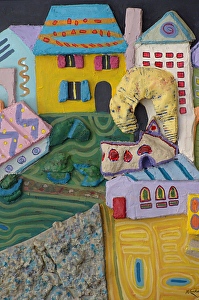
3-D image, Mixed-media, 32” by 22”, gold frame, $ 599.

Museum at Home

It is summer and the children wll either be home home or taking trips to friends relatives. Most adults don’t plan for the onslaught of vacationing children and as much as they look forward to their company, they also dread it. With a bit of preplanning, much can be done to make the time spent in your house (or at a family gathering) special. It is possible to organize a space to permit creative activities to occur without having to worry about cherished possessions being destroyed.

Why not create a hands-on museum in your home. . .one that will stimulate curiosity and absorb the attention of active children? By thinking like a museum director you can provide opportunities for house bound youngsters to engage in creative, educational and thoughtful pursuits. It is not uncommon in hot weather for kids to spend hours in water play. With a bit of foresight their play will be a lesson in physics and hydraulics as well as a way to cool down. THey can dress in period costumes (culture and history), constructing forts and buildings (engineering), putting together 3-D puzzles (spacial challenges), putting on puppet plays (imaginative writing) and engage in activities that involve physical movement as well as mental stimulation. By expanding educational opportunities during summer vacation you also have a chance to test your own ingenuity and creativity. The process can be challenging and a great deal of fun.

When my children were young I was a frequent visitor to children’s museums and noted the way they were organized to permit kids to roam freely within environments packed full of learning materials designed for their age level. According to The American Association of Children’s Museums, “A children’s museum is defined as an institution committed to serving the needs and interests of children by providing exhibits and programs that stimulate curiosity and motivate learning.” They encourage parents to interact with their children while in the museum in order to make the experience more meaningful. That definition fits my family to a “T” so, when I moved to a community without a hands-on museum, I decided that I would make my home into one.

Maria Montessori had a great influence. She was a 19th century physician turned educator who became involved in designing Casa dei Bambini, a school for low-income children. As she experimented with curriculum and classroom design, “she began to see independence as the aim of education and the role of the teacher as an observer and director of children’s innate psychological development.” When my children were preschoolers I enrolled them in Montessori schools which I quickly realized were simply classrooms set up as mini-museums. They were organized spaces that permitted students to access materials when they wanted to do so. Manipulative were designed for problem solving, mastery, and use in surprisingly creative ways.

Montessori believed that young children were sensitive to order, enjoyed doing activities repetitively and were happiest doing practical things. She even taught two year olds how to peel carrots. Montessori developed an environment that was kid-size so that materials could be easily reached and put away when completed. Over time, very sophisticated materials were developed for schools run by teachers specially trained in her methodology.

With Montessori’s approach in mind, I started my own in-home museum to be operated on a shoe-string. Part of the challenge of permitting children to roam freely involves developing an organizational plan. I began by selecting a dedicated area for my grand experiment. It was a place devoid of objects that could be accidentally destroyed but could be filled with materials, supplies and educational toys to promote creativity and imaginative play.

I added shelving and assigned different locations to hold games and toys. There were construction areas, a place with math manipulatives, a reading area with pillows and a rug, a puppet stage, assigned shelves for puzzles and educational toys, a dress-up bin and a craft station. I also built a music tree with clips to hold percussion instruments that the entire family enjoyed grabbing during musical gatherings.

Before entering the play area children were given instructions for its use. They were told that they could take whatever toys or supplies wanted but they had to return them to their original location before selecting a new item. Training children to put items away after use is not difficult if the rules are explained and if you consistently follow up. Keeping the area clear for future projects not only makes a parent’s job easier but it makes the child’s space more accessible.

If an item was new, I took the time to demonstrate its use, exiting the scene as soon as it was evident that the toy was mastered and they could continue with their own creations. Part of the secret of a successful home museum is to introduce toys (activities) one at a time. When there were lots of little parts I put them on a tray that the child could take to a table or the floor. This made the clean-up cycle easier. Once my child knew how to use the toy in its intended way, she or he was free to create variations in the way they played with it. The goal was for my young ones was to master the activity and become independent of my interference. I wanted them to gain satisfaction from their successes and become motivated for the next challenge.

A home-museum environment does take careful planning, but once operational the task becomes more routine because the child has learned to select his/her own activity, concentrate on the task at hand, and move progressively from one skill level to the next. The toys are not jumbled one on top of another as they would be in a toy box and are within easy reach. Again, independence is the goal.

One last thought. . .a child of about two and a half years old is ready for your home-museum. At first it is best not to have too many toys available so the child will not choose items he does not know how to operate. When the manipulative is successfully mastered then the next challenge can be introduced. If several children use the space, each needs to understand which items they have earned the right to use. This system provides motivation and works well for older children as well as preschoolers. It oftn encourages older children to teach younger ones.

When I became a grandparent, I did not have a playroom available but I still wanted my grandchildren to enjoy a degree of freedom when visiting and of course, I wanted them to be engaged in meaningful pursuits. I used a large buffet in my dining area for it contained shelving and doors. It was perfect for storage and when the doors were open, shelves held a neat, organized arrangement of fun filled opportunities. Toys and supplies were well positioned at child height with areas for books, puzzles, art supplies, construction materials, etc. A separate box holding legos served as a plant base when the children were not there. Between meals, the dining table was covered with a protective cloth to avoid paint and clay spills. a wood floor permitted buildings to be constructed and small wheeled vehicles to be assembled from parts. Even after my grandchildren graduated to more sophisticated electronic toys and computers, the cabinet was kept ready for visiting youngsters. I wanted to be prepared and not worried about them getting bored while I spent time talking to their parents.

Yes, children’s museums are fun because they are child centered and permit freedom of movement. Exhibits are designed to allow learning to take place and are built to withstand use. Since a mob of children are not your concern, there are hundreds of toys on the market that will serve your purpose. If you do decide to set up a museum in your home, I would love to hear back from you to hear about your success. What toys did you select? What problems have you encountered?

Do comment below.
_________________________________________________________________________________

Food Habits

Food Habits
True Gold, (Sold)
If you were a bird you would probably not having anyone telling you that you are overeating. A medium sized bird like a Cooper’s Hawk eats 12 percent of its body weight. In human terms, a 150 pound person would eat18 pounds a day or about six extra-large pizzas. It gets even better if you are a little chickadee for then you could eat 35 percent of your weight or 600 granola bars each day. How lucky!

Food Habits

Yumm! I love ice cream sundaes, smothered in hot fudge, topped with walnuts, whipped cream and a red cherry on top. I also adore Eggs Florentine, with lots of hollandaise sauce. Thankfully, I don’t indulge very often, for I know that what I like is not always good for me. Eating well is a trade off that keeps me from getting diabetes, hypertension or clogged arteries. When I do crave sweets and creamed sauces, I do take a bite, never denying myself completely. The rest of the time it is fruit and veggies of all types. Did I neglect to say that I like beet salad as well as any sweet? I am addicted to the feta cheese mixed in.

As a child growing up in Philadelphia, I was happy when grandma took me to Horn and Hardart’s for lunch. In those days, you put a quarter in a slot next to a cubby hole covered with a glass door displaying an enticing selection of food. Everything was made fresh by chefs who worked on the other side of the wall refilling the empty cubbies. It was fun running from widow to window to find the best looking dishes. Vegetables were my food of choice with a fresh fruit cup for desert. My mouth salivates at the memory.

It seems strange that last week healthy food suddenly became a political issue. How could that happen? One of the best things Michelle Obama did was make the nation aware that we are raising a country of fat kids. Childhood obesity has tripled since the 1970s with one in five school-aged children affected.

According the the Centers for Disease control there are many reasons for obesity including:

genetics
metabolism—how the body changes food and oxygen into usable energy
eating and physical activity
environmental factors
Social and individual psychology

The most prominent reason, however, is due to consuming more energy from foods and beverages than the body needs to function well. The ramifications for obese children of indulging in a poor diet are many. They miss more days of school compared to those with a normal weight, are often bullied, and find it more difficult to perform academically. And, since they carry extra pounds, it is difficult to for them engage in the second most import weight reducing activity—exercise.

Scientists—yes, that recently malighned breed—studied the results of the reformed school meal program and found it to be effective in stemming obesity. . With 31 million students enrolled in this federally assisted meal program, it is easy to document if healthy choices have had a positive effect. There has been a noticeable reduction in obesity in elementary and middle schools over the past several years. There still is a way to go with teens who grew up with the old system.

Why change a program that appears to be working? Is the goal to have more children visiting health care providers because of acquiring a preventable disease? As of last week’s executive order, schools can increase the salt they put in their meals and they are not required to serve whole grain options. In other words, schools can return to serving flour, water, and salt, a formula used for making paste. Thankfully, the rule remains for students to take fruits and vegetables, though some want to get rid of that as well.

Since it is not easy to take off weight, wouldn’t it be smarter to start children on the right path so they will not have to struggle to take pounds off as they age? Certainly, kids like salt and chocolate and sugary carbonated drinks, but so what? Adults are supposed to be the educators who set the standards. I say, nonsense to the argument about children not making good choices. If they are hungry they will select food from the options before them. If they are filling up on junk food at home, then they must be getting money from somewhere to purchase it. Why pay for them to be part of the school meal program if they eat bad food that ruins their appetite? Look friends, the U.S. obesity epidemic is worse than ever. 38 percent of adults are obese as are 17 percent of teenagers.

Yes, socioeconomic factors are involved, for those with lower income and education are disproportionately more likely to be obese. Some communities have limited access to supermarkets so frozen meals, crackers , chips and cookies are foods of choice. It would be good to do something about having healthier choices in small markets as well, but since we can not tackle everything at once, lets continue with something we can do— provide children nutritious choices in school.

You, who follow my blog, most likely are healthy souls so I risk preaching to the converted. But, all of us should be concerned about the rest of our nation’s children. We have been feeding poor students since 1946,so why not do unto others as you would do unto your own family? Turning healthy nutritional options in school lunch programs into a political issue is a disgrace! Don’t let this happen in your community.

References:

Bird Note, 2017, How Much Do Birds Eat? http://birdnote.org/show/how-much-do-birds-eat

Centers for Disease Control and Prevention, Childhood Obesity Facts, https://www.cdc.gov/healthyschools/obesity/facts.htm

National School Lunch Program,https://www.fns.usda.gov/sites/default/files/NSLPFactSheet.pdf

Jalonick, Mary Clare, Associated Press, 2017, Government relaxes nutrition standards for school lunches, http://www.pbs.org/newshour/rundown/government-relaxes-nutrition-standards-school-lunches/

Mayo Clinic Staff, Childhood obesity, 2017, http://www.mayoclinic.org/diseases-conditions/childhood-obesity/symptoms-causes/dxc-20268891

Did you find your passion?

Grand Prize – Passion Flower

How did you find your passion?

This morning my NIA (non-impact Aerobics) teacher mentioned that 30 years ago at the height of the high impact aerobics craze she went to a conference where she participated in an exercise class with approximately 500 participants.  It wasn’t long before half the class left because, rather than stressing boom-boom, jump and twist movements, it stressed grace and centering practices that come from engaging in modern dance and practicing marshall arts. My teacher was ecstatic since  with a smaller crowd there was more room to stretch and move about. She said that by the end of the class she had tears in her eyes.  The zen-like program spoke to her. She had found her passion, her life’s ambition, and a career that still engages her after 30 years.

Her story made me consider how I discovered the focus that directed my life. It was not long before I realized it was accidental. When I speak of passion, I mean that can’t stop myself from pursuing an interest. I love and embrace activities that keep my mind challenged and engaged in the community. At the core of my being a few dramatic events changed the course of my life.  Eventually, they led to embracing science education wholeheartedly as a career.

The pivotal point, however, started at home. 

I have always been influenced by my children and now grandchildren.  They are the reason I became interested in educational psychology in the first place. They are why I started a museum in my basement and why I became involved in art.  You might ask, “Painting? What does that have to do with education.?” I painted because I believe a well-rounded person is versed in the arts, humanities, and science.  I also needed to relax from busy jobs as museum director and mother. Art provides an avenue to practice creativity but it is also meditative.  Painting slows my mind which struggles with a ‘to do” list that seems to go on and on.  It is impossible to put a dab of paint on a canvas or draw a line and think of something else. Art also set an example for my children by demonstrating that hobbies are as important for developing a sense of who you are as work.  

In retirement I continue to pour an equal about of energy into painting, writing and speaking about how people learn.   I am hopeful that the books I write will touch someone’s soul as much as those I have read have influenced me.  This week I was notified of a review to be published by the San Francisco Book Review.  It is presented here because the reviewer’s insight touched me. He grasped my passion and expressed it well. I especial like the last line and know that a great many of my readers are in similar positions to change the world.

Lives of Museum Junkies: The Story of America’s Hands-On Education Movement
By Marilynne Eichinger
Publisher-Inkwater Press, $19.95, 396 pages,  Available on Amazon, Powells Books, Barnes and Nobel and local bookstores. 
 
Picture a museum in your mind. Did you imagine exhibits, roped-off bits and bobs from history meant to inspire, amaze, and educate, but always out of reach? Even today, this idea of the museum as the look-but-don’t-touch institution persists. But there is another way. For decades, hands-on education has sought to break down the barriers between exhibits and visitors, allowing interested minds of all ages the opportunity to interact with exhibits, to learn firsthand by experiencing scientific principles in action. And Lives of Museum Junkies chronicles the long journey behind bringing science and museums to your fingertips.
 
Marilynne Eichinger uses her story — the story of how the Impression 5 Science Center in Lansing, Michigan, was brought to life — as the framework upon which to mount an encouraging, inspiring tale of dedicated people forging their own path and establishing something new and exciting for their community. This is the story of hard-working, generous, driven people starting from scratch and building something unique, valuable, and hands-on. From marketing and sharing one’s brand to expanding an idea on a national and international scale, the stories of Eichinger’s work at Impression 5 and the Oregon Museum of Science and Industry encompass all aspects of community building, starting a business, and shifting people’s perceptions of just what can be accomplished when creativity meets commitment. Readers also get to meet other key voices and entrepreneurs Eichinger has worked with, people who have inspired her and who have helped blaze new trails for hands-on learning. These profiles bolster Eichinger’s mission to lend credibility to the hands-on museum movement and show the many different paths one can take toward achieving success in ambitious charitable works.
 
Although the many benefits of this truly useful style of education are touted here, Eichinger refuses to paint a rosy picture of the process. The author never shies away from sharing the missteps, obstacles, and hard lessons encountered along the way, including a truly shocking revelation that typifies the gender politics at the time and the long legacy of gender bias in this country that still impacts us today. By pulling science and learning out from behind the glass and velvet ropes of traditional museums, Eichinger helped spark a revolution in understanding how we learn and how to engage (and re-engage) young minds in fundamental concepts of science. Lives of Museum Junkies is part tribute, part handbook, and part inspirational guide, reminding us once again that a small, dedicated group of people can change the world… because they’re the only ones who ever have.  – Reviewed by Glenn Dallas for the San Francisco Book Review

Lives of Museum Junkies Book

Book Launch Party, November 3rd at Marylhurst University, Marylhurst, Oregon – 7 PM, in the Old Library. Come join the fun.

Artwork is always for sale – Contact me at marilynne@eichingerfineart.com

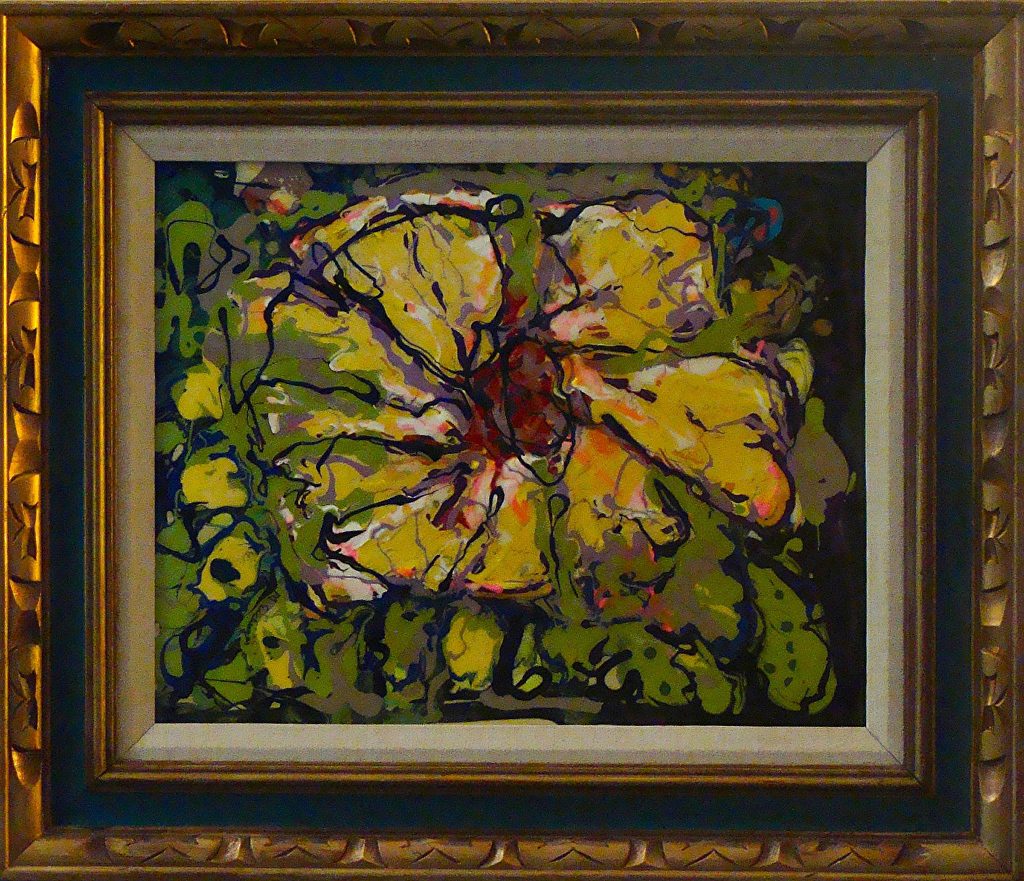
Grand Prize – Passion Flower / acrylic on canvas / 24” by 28” / $ 499

Filled with STEAM

Autumn Breeze
Fall is a time of beauty that makes me consider the changing seasons, vibrant colors, and slow moving rivers in need of replenishing. It is science. It is art. It is comforting and it can be wild when rain and the wind batter the land.

Filled with STEAM

Many parents have heard STEM initiatives bandied about in education circles. Schools are now abuzz with programs that provide science, technology, engineering and math options to meet perceived needs for a technologically able workforce. This expanded curriculum has opened the way for more hands-on teaching. It is a good start.

STEM activities, however, fall short of addressing the needs of all students since they do not always engage those with a more humanitarian or artistic bent. To address this lack the formula is starting to change. By putting art (and design) into the acronym, some educators have given birth to STEAM.

The movement, championed by the Rhode Island School of Design among others, has also been fostered through festivals such as Burning Man where art and technology join in a burst of sensory stimulation. STEAM offers a way to reach those who claim disinterest or fear of science and math. Organizations like the National Science Foundation (NSF) are now collaborating with the arts and humanities by giving grants to multi-disciplinary proposals. NSF recognizes that people are needed to solve problems that deal with pollution, global warming, energy, bio-genetics and advanced technologies. Emotional appeals through the arts can lure those who are hesitant and reach new audiences.

I have many friends who claim they are only interested in the arts and humanities. “I have no head for numbers,” they say. Or, I don’t understand science and never read technical articles.” Yet, these same people may enjoy science fiction and are interested in history. They attend laser light shows, put shoes on their children with heels that flash when they walk and change cell phones regularly to own the latest technology. By tuning into their stated interests and working to entice them with fun approaches to learning, those who are hesitant can be drawn into wanting to understand science and mathematics.

Why bother with all this subterfuge you might ask? Because voters need to grapple with fracking, global warming, and genetically modified food if a democracy is to be maintained. Ignorance will allow technocrats, politicians, and economists to control our lives rather than the other way around. I see confusion regularly in people trying to understand statistics thrown at them from many sources. Numbers can be skewed and misunderstood if you do not have a basic understanding of statistics.

Science and art are intrinsically bound. The scientifically literate see nature through one lens while artists explore it through another. They meet in the middle. Understanding sound waves and how people hear has led to surround sound and improved speakers. Electronics enabled digital production methods to be integrated when producing concerts and films. Studies of gas led to neon sign artistry. Chemistry aides chefs develop seasoning blends and mixtures to tantalize our pallets. Steve Jobs understood that candy-colored sleek casings would shake consumers up and make his computers more popular than others. The interaction of biology and art on the public’s understanding of science is being explored by the Haseltine Foundation for Medical Science and the Arts and the New York Academy of Science.

Sesame Street also has joined the trend to use the arts promote STEM curriculums. “Elmo the Musical” is an interactive, fun-filled adventure created by Elmo and the child at home. With lots of singing and dancing, Elmo uses his imagination and math skills, such as enumeration, relational concepts, addition/subtraction, and geometric shapes to solve problems.” Other segments are being planned to combine the visual and performing arts with STEM.

I read of an anatomy professor who presents her beginning medical students with a CD of songs that help them memorize the various body systems The Nurses Medication song heard on YouTube aids nurses learn the names and uses of various commonly used of medications. For those with kinesthetic intelligence, Living AnatomME, was developed by two medical students in conjunction with the Director of Anatomyat Mt. Sinai School of Medicine in New York to teach musculoskeletal anatomy through yoga and Pilates.

The Cushman school in Florida is one of many embracing STEAM. Following is a sample of the type of curriculum they are offering. It is a good introduction to state of the art thinking.
“The implementation of our STEAM program allows students the opportunity to learn through real-life applications in the critical areas of Science, Technology, Engineering, the Arts and Math. Students become engaged in hands-on projects where problem-solving, collaboration, and the results of their efforts make the lessons more relevant than a textbook alone ever could. By creating real things that “matter,” STEAM, at its essence, is like the apprenticeship of a bygone era.  
 
Our new Innovation Center offers cutting-edge equipment in a free flowing workspace designed to encourage flexibility of thought and creative solutions applicable to today’s competitive marketplace. This active participation in society’s productivity helps students develop an entrepreneurial mindset and effectively prepares them to be leaders in the respective STEAM fields.

Our STEAM programming includes: 
 
• Artists-in-Residence program
• Architectural Design class using Revit
• Video Game Design using Alice software
• Music Composition using Propellerhead Reason (version 4) and Pro Tools 9
• Engineering and Robotics Clubs
• Lego and Vex Robotics
• Music Festival Series that brings professional bands to campus for concerts
• TD Bank – Financial Literacy 
• Common Threads – Teaching children how to cook wholesome, healthy meals through a professional led, curriculum-based program”

I am thrilled to see this type of effort going into education. It is similar to the message Science Centers have embraced for over the past 40 years. And it is a bandwagon worth you and your family joining.
Resources:

http://stemtosteam.org – What is STEAM

http://www.pbs.org/parents/education/music-arts/boost-memory-and-learning-with-music/ – boosting memory through music

http://www.cushmanschool.org/our-program/steam-initiative/ – Sample of a STEAM curriculum within a grade school.

http://www.nyas.org/Publications/Ebriefings/Detail.aspx?cid=1a6933bd-bdd8-422f-b5f8-815972a905aa Biology and Art, Two Worlds or One?

https://www.deepdyve.com/lp/wiley/living-anatome-teaching-and-learning-musculoskeletal-anatomy-through-xdok4g4KYB – Living Anatomy CD

Artwork is always for sale. Contact me at marilynne@eichingerfineart.com
Autumn Breeze – acrylic painting / 28” by 22” / $ 399.

For the Love of Learning

the gossips

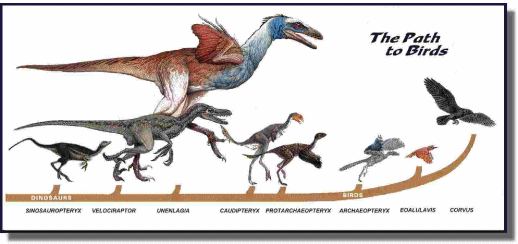
Are These Birds Dinosaurs?

dino_path_to_birdsThe Path to Birds
image from westcoastemiko.weebly.com

The Love of Learning

Last week I was in Tampa, Florida reliving my  life  as a museum junkie. Though I was ostensibly there to sell my book, I was  reunited with the passion for educating children I had when first starting a museum in my basement. Meeting past friends and enthusiastic staff at the beginning of their careers was invigorating. Once more I was comforted by the fact that there are good people ready to move our country forward towards better days.  Museum professionals are caring, tolerant and curious, all attributes I admire.

M During his chat, he called today’s birds dinosaurs. Apparently, there is evidence from over twenty dinosaur species that shows they had bird-like skin and feathers. Did you know that the Brontosaurus we studied as children had the skeleton one creature and the head of another that was unearthed in a nearby dig? Paleontologists in the late 18th century decided that the body was that of Apatosaurus and the head belonged to Camarasaurus. For years our favorite gentle vegetarian no longer existed in scientific circles. However, that changed recently. In 2015, just like Arnold Schwarzenegger, he returned. Paleontologists now think that Brontosaurus is different enough from the Apatosaur to be recognized on its own merits. Confused?

Discussions with colleagues ranged from issues around diversity to the latest brain research. We discussed drones, driverless cars and STEAM initiatives.  Practical matters such as fundraising, architecture, outreach programs and exhibitions were also on the agenda. I learned that museums built over 20 years ago like OMSI are facing major facility problems. Just like in a home, wall paint was peeling, roofs leaking, and carpets stained. Exhibitors struggled to keep out of order signs off of displays.

Money, money, money . . . what is to be done in a country that puts its resources into armaments rather than learning. Despite the fact that 92 million people visit science centers every year there is are inadequate resources going to support these institutions.   In second and third would countries the situation differs. China is building 250 well-equipped science museums in order to promote science literacy. Even Saudi Arabia has gotten on the bandwagon by building four, open to men on certain days of the week and women on others.

Most staff agreed that hands-on learning opportunities are not available to children as they were a generation ago. Noticing that kids are not permitted to play and problem-solve without hovering adults nearby was a  theme of many conversations. Moving in the ‘free-school’ atmosphere of a science center provides some relief. Yet  the experience could be improved with a larger variety of informal materials available to encourage more original thinking. Tinkering spaces are springing up to allow for more creative expression.

Tinkering space

It is difficult to serve the variety of learning styles and specialized needs of visitors.  But it is good to know that staff continues to try to understand their differences and understand how they learn.  Perhaps the day will come when as a nation we realize that there is nothing more important than educating children if they are to understand how to live in a technological environment that is also sustainable and inviting.  Maybe we will also realize that adults need to stay abreast of change if they are going to maintain a robust democracy that is fair to all.

references:
http://www.unmuseum.org/dinobront.htm – what happened to the Brontosaurus?

http://www.scientificamerican.com/article/the-brontosaurus-is-back1/ The Brontosaurus returns.

Art is aways for sale. Contact me at marilynne@eichingerfineart.com
The Gossips shown above is an acrylic painting, 12” by 36”, $ 350.

perf6.000x9.000.indd

To learn more about what goes on behind the scenes at museums read the newly released Lives of Museum Junkies available through Amazon, Barnes and Noble, Powells Books, Inkwater Press and many other local bookstores.

Dates to remember : Book reading/signing
October 11 – Broadway Books, NE Broadway, Portland
October 15 – Impression 5 -Lansing, Michigan – all day
November 3 – Marylhurst University, Old Library – 7 pm – Book Launch Party

Creating an Interactive Museum

Building BlocksBuilding Blocks

Creating a science museum is like playing with building blocks. It takes imagination, perseverance, and innovation to build a monument to experiential learning. The following excerpt is from the first page of Lives of Museum Junkies. Unusual consequences often occur from obscure beginnings and it is a pleasure to share them with you.

Creating an Interactive Museum: Naïve Beginnings

“Stop running and making so much noise!” I shouted to five rambunctious children playing hide-and-seek in closets throughout the house. It was a cold day and my friend Dee Pumplin was visiting with her son. She and I were having a difficult time hearing each other as we chatted animatedly in the kitchen. It was during this conversation that my homemaker days started to end, when over coffee in my suburban house we brewed up the idea of a hands-on museum that emphasized science. Children are not always polite, studious little creatures set on this planet to impress and please their parents.

Children are not always polite, studious little creatures set on this planet to impress and please their parents. Instead they are balls of energy who love to run, scream and create bedlam. In short they can drive a parent crazy, especially on a rainy day. As Dee and I talked, her one and my four children shouted and squealed, ignoring the storm roaring outside. The increasing noise level was like a drum roll announcing a new idea. We started imagining what it would be like to take our kids to an indoor playground. “Wouldn’t it be magnificent to have a great big barn,” we fantasized, “and fill it floor to ceiling with ramps, poles, and climbing apparatus? What fun it would be for the children and their friends. They would get rid of their energy away from home and our houses would be preserved.” Dee and I started to wonder where we could find a barn and even took the next step of contacting a realtor.

As we learned more, the vision for an indoor play structure grew. The immense dimensions of a working barn inspired our ideas to expand to include interactive learning activities inserted into climbing areas. We imagined children swooping down a sliding board and finding a light table, colored filters, and projectors to use for experimentation. The colored light could be projected on the next child speeding down the slide. We embraced the idea of physical play being integrated with academic challenges in a never-ending cycle of learning.

After months of talk and concept development, we finally located a barn, but it wasn’t long before we faced a dose of reality. The cost to acquire the property was more than we anticipated and building the inside play structure seemed monumental. The barn needed to be heated, insulated, electrified, bathroomed and water sprinkled and once it was upgraded, ongoing utilities would be astronomical. The permitting process was overwhelming to two inexperienced women who began to wonder if the city would even allow this type of play-barn to exist. Insurance was bound to be phenomenal, not only because we were dealing with a wooden structure but because we were planning to let children run throughout. We especially liked the idea of fire poles descending from one level to the next. Sound safe? Costs mounted, reaching an enormous number before we even considered the price of exhibits and staffing. . . . .

Lives of Museum Junkies is available through AMAZON, Barnes and Noble, Powells Books, Inkwater Press, and The-M-porium.

For a signed copy you can purchase from me for $ 19.95 plus $ 4 shipping. Contact me at eichingerbooks@gmail.com.

Artwork is always for sale: Building Blocks is a 24” by 28” acrylic painting on canvas in a gold frame. Cost is $450. Contact me at marilynne@eichingerfineart.com for further information.

perf6.000x9.000.indd

New Release: Former OMSI President Reveals the Good, the Bad, and the Ugly History Behind the Hands-On Education Movement

“…will help you see science museums in a new light.” – David Ucko, Museums+More llc
In this lively, behind-the-scenes look at the evolution of interactive science museums, discover:

How the Brooklyn Museum of Art was saved from closure by Mayor Rudolph Guiliani for showing a painting by Chris

How the Brooklyn Museum of Art was saved from closure by Mayor Rudolph Guiliani for showing a painting by Chris Ofili of the Virgin Mary that contained elephant dong.

Why an autistic child spoke for the first time on a science center visit.

Who kept NOVA from being canceled when congress did not agree with their investigative reporting style that explored sensitive subjects like nuclear energy.

What inspired a poor Appalachian orphan to go from rags to riches to become a museum president who later rented an entire cruise ship to see a global eclipse on the Amazon.

Why executives at the top are subject to sexual abuse and find it nearly impossible to manage.

The outcry caused by the Playboy Bunnies playing basketball with business executives to raise funds for a museum.

“recommended for those who care about museums, libraries and society today.”
– Ginnie Cooper, Directed Washington D.C., Brooklyn, and Portland library systems .