How Animals Teach

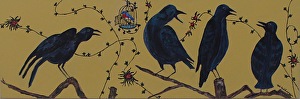
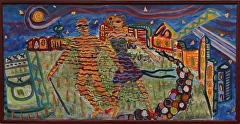
The Gossips
Acrylic on Canvas/ 12” by 36”/ $325

A Birdie Told Me So

A birdie with a yellow bill,
Hopped upon the window sill,
Cocked his shining eye and said:
Ain’t you ‘shamed, you sleepy head!

This poem, by Robert Louis Stevenson, impacted me much as the proverb popularized by Benjamin Franklin that said, “Early to bed and early to rise, makes a man healthy, wealthy and wise.” It reminds me that messages of wisdom are found in the natural world for those who pay close attention. Birds and animals sharing our planet are more intelligent and complex than most people imagine, and they have a lot to teach us.

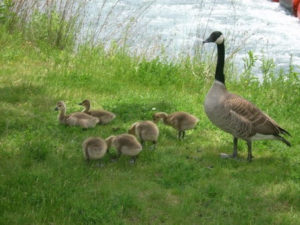
A friend recently shared a story about a goose that sought help from a policeman who was sitting in his car. The officer assumed the goose wanted food when she pecked at his window, quaked and walked away—but that was not the case. When ignored, the goose returned until the man exited his car and followed to see what she wanted. He was led to a grassy spot where a newly hatched chick’s feet were tangled in a cord. Amidst loud but unaggressive quacking, the concerned mother goose stood by while his partner rescued the panicked gosling and set it free near an adjacent creek. The mother then hustled her brood to the water and all was well.

People talk about training their pets but rarely do they mention how their animals train them. We direct cats to litter boxes, teach dogs to fetch balls and even train them to be the eyes of blind people. I proudly taught my black poodle to jump through a hoop, but I too learned from the experience. Patience, caring, fun are a few words that come to mind. Just because we don’t speak their language, doesn’t mean they are not intelligent or that we can’t learn from them.

Our cat, Franny, can tell time. She sits by her food bowl at 7 each morning and promptly at 5:30 in the afternoon. She has trained us to feed her on time—which is fine, because she returns the favor. Somehow, she knows exactly when to wake up our adopted son so that he is never late for work. Much to our surprise, Franny didn’t miss a beat when daylight savings time arrived. How can that be?

A wealthy acquaintance sent his son to a private boarding school during his high school years. On the day he first arrived, he was assigned a horse to care for and exercise during his stay. All students were required to feed, brush and ride their animals rain or shine. Many of the arriving freshmen had been spoiled by generous parents who never required them to do a bit of work. Quite a few suffered from having been emotionally neglected by their parents. Learning to care and be responsible for an animal was a life altering experience for these youth. Though the horses required their attention, they learned that caring for another living organism has rewards. Being trusted by and receiving unconditional love from their horses were life altering experiences for the majority of students.

Animals are often used as an aid for mental or physically ill people. A young woman I know spent much many years suffering from severe depression. Her life went from bad to worse and she was unable to motivate herself to prepare meals or clean her apartment. Obtaining and keeping employment was a distant dream—that is, until she got a care-dog. Her perky pet was not concerned with her depression but trusted her to care for his needs. He required a morning walk and wanted to be fed several times each day. Her dog needed someone to brush his long hairs, bathe him occasionally, and play with him regularly. Though at times the dog was a burden, he gave a lot back in return.

Since dogs live in the moment, he taught her to do so as well. His daily walks improved his owner’s health, with fresh air contributing to her skin glowing. Since he was well cared for, he was happy and flourished, which made her feel good. Though she still suffered from occasional bouts of depression, the woman became more content and less depressed. She and her dog managed to get through bad times knowing that good moments will return. The dog gifted the woman with a nonjudgmental love. A few wet licks, a hug, and a friendly wagging tail is all it took for me to know that the two are a joyful team.

I recently read about how prisoners in many western states are becoming cowboys who train wild horses. As example, in Nevada for the past 17 years, felons have been allowed to leave their minimum-security prison to spend eight hours a day on a ranch where they are addressed as “horse trainer” instead of “inmate.” They represent a tough bunch of men who were incarcerated because their aggressive, impatient behaviors led to conflicts with the law. Some were drug dealers, others burglarized, and many were charged with assault. By the time they learn how to train temperamental mustangs, however, they go through a transformation.

Man and horse bond around a number of issues. Neither are used to being caged. When captured, both react by becoming mean and scary. Yet, in order to be released, they have to exhibit a softer way of acting that embraces respect and trust.

When a trainer is first put in a pen with a mustang, he confronts a wild, angry, snorting animal. It can take weeks before the horse is willing to be touched and many more days before it can be haltered, saddled, and ridden. The trainer works with his animal in a stressful and often dangerous environment. As one man put it, “climbing a 1000 lb. beast that keeps bucking you to the dirt also requires true grit.” When the men return at day’s end, other prisoners and guards do not mess with them. They exude self-confidence as they develop self-worth and respect for all living things.

Though the horses are put up for adoption every four months, the inmates remain supervised until their sentences are complete. During this time they are treated like men, instead of prisoners, and because they love what they are doing, they qucikly discard defensive behaviors and learn patience. Working with horses requires requires emotional control and focus on what they are doing. These skills help them find employment upon their release.

According to veterinarian Vint Virga, animals can teach us a a great deal about being human. Since animals mainly pay attention to the present, they demonstrate how to savor the moment rather than be easily distracted by past and future thoughts. Taking a cue from their behavior, we can learn to appreciate more fully your current activity by focusing on what is most important.

Animals tune into impressions from the world around them, trusting and acting on their instincts. If we too learn to acknowledge our hunches, we will become more open to new choices and opportunities. Rather than taking ourselves too seriously and work all of the time, we will acknowledge that rest and play are also vital to our happiness. Animals vary moments of rest, relaxation and reflection with periods for discovery, invention and joy. They become fully absorbed when playing and do not worry about how good they are at the game. When my dog played catch, she was completely focused and never paid attention to distractions in the environment.

Animals exude unconditional love for those who take the time to know and share their world. A few kind words, a belly rub and neck scratch will produce a friend who is there to greet you when you return from a busy day. By applying what is learn from pets and by taking the time to nurture family and friends, we will expand our circle of warmth and delight.

References:

Virga,Vint, THe Soul of All living Creatures, 10 Things Animals Can Teach Us about Being Human, Psychology Today.https://www.psychologytoday.com/blog/the-soul-all-living-creatures/201501/10-things-animals-can-teach-us-about-being-human

Hernandez,Dan, True grit: how wild horses are turning Nevada Inmates into cowboys. The Guardian, Feb 25, 2015. https://www.theguardian.com/global/2015/feb/25/true-grit-wild-horses-nevada-inmates-cowboys
Still STEAMing!

1353607x240

Walking on Air, by Marilynne Eichinger
Painting made after visiting Bath, England.

The following article was written by my son, Ryan Rosenberg for the Los Gatos Education Foundation. It is an appropriate follow-up to my blog about STEAM education. Thank you for the many comments and suggestions you made to that particular article. The only parts I changed were the pictures.

Study finds arts, music can be the “secret” to a successful tech career 9/26/2016

Successful tech entrepreneurs seem to have a surprising “secret” to their accomplishments – studying art, music, and hands-on creative activities (such as wood or metal working).

A study published in the journal Economic Development Quarterly (1) found that participation in artistic activities boosts the chance of entrepreneurial success in technical fields.

Researchers followed a group of Michigan State University honors college graduates from 1990 to 1994 who majored in science, technology, engineering or mathematics (STEM).

Graduates who were successful entrepreneurs — those who went on to found companies or produce patents — were significantly more likely to have had participation in art, music and hands-on creative activities than those who did not.

And it’s not just entrepreneurs who benefit from the arts; a strong link was found with STEM graduates overall. In fact, the STEM practitioners in this study were 62% more likely to have had classes in visual arts than the general population, 59% more likely to have been taught music, 39% more likely to have had dance instruction, and 38% more likely to have taken acting lessons.

So how does their music, arts, and hands-on creative experience help these engineers and scientists in the real world? It seems artistic thinking is crucial to their work.

The study asked participants to identify the types of tools they used for problem-solving and found, “as one would expect of science and engineering professionals, the vast majority reported using logic while doing their work…[but] an overwhelming majority also reported using ‘artistic’ styles of thinking: 95.3% reported using exploratory play as a method of problem solving; 80% reported using either intuition, imagination, or both; and about 80% reported using analogies. In other words, these successful STEM professionals use ‘artistic’ types of thinking at work just as often as they use stereotypical ‘scientific’ modes of thinking.”

In summary, researchers determined that “participation in various arts and crafts positively correlates with the production of patentable inventions and the founding of new companies, and can differentiate the entrepreneurs from less innovative individuals, even among a group of highly successful individuals such as Honors College STEM professionals.”

Reference:
Arts and Crafts: Critical to Economic Innovation
LaMore et al., Economic Development Quarterly, August 2013, 27 (3), p. 221

Guest Author – Ryan Rosenberg for the Los Gatos Education Foundation

artwork is always for sale. Contact me at marilynne@eihingerfineart.com.
Walking on Air -Acrylic on Canvas / 25.5” by 49.5” / $ 650

Did you find your passion?

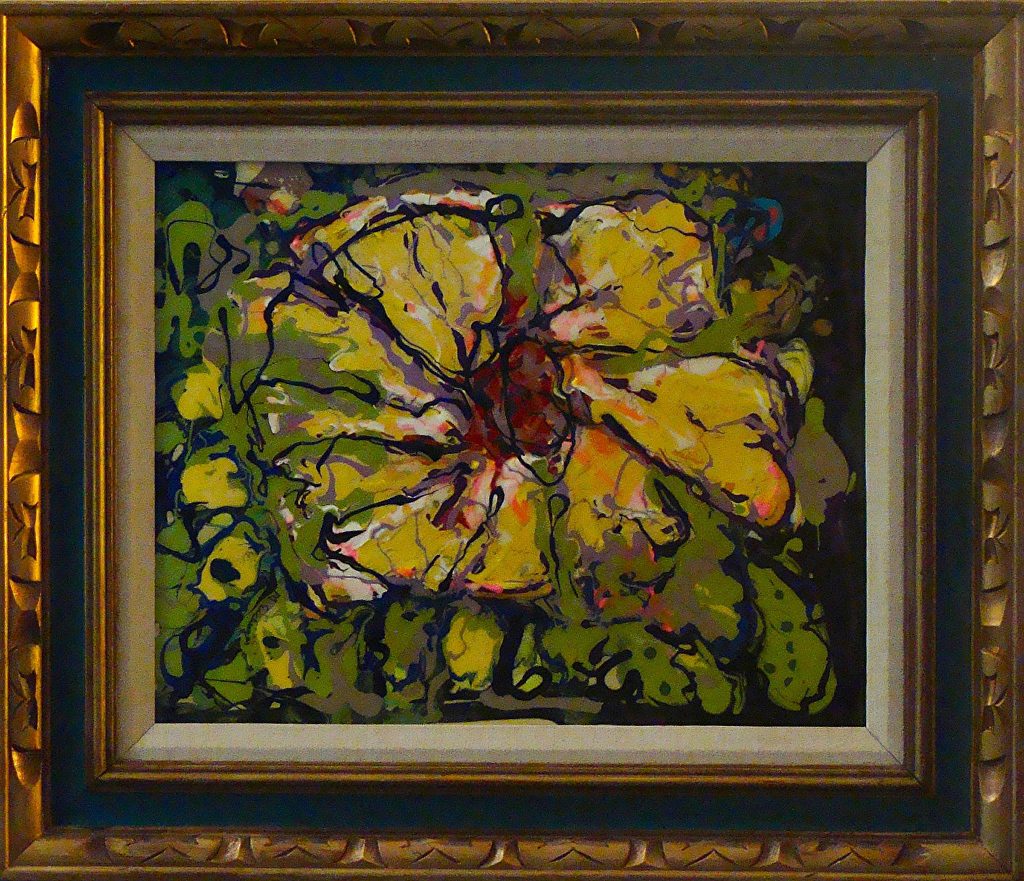
Grand Prize – Passion Flower

How did you find your passion?

This morning my NIA (non-impact Aerobics) teacher mentioned that 30 years ago at the height of the high impact aerobics craze she went to a conference where she participated in an exercise class with approximately 500 participants.  It wasn’t long before half the class left because, rather than stressing boom-boom, jump and twist movements, it stressed grace and centering practices that come from engaging in modern dance and practicing marshall arts. My teacher was ecstatic since  with a smaller crowd there was more room to stretch and move about. She said that by the end of the class she had tears in her eyes.  The zen-like program spoke to her. She had found her passion, her life’s ambition, and a career that still engages her after 30 years.

Her story made me consider how I discovered the focus that directed my life. It was not long before I realized it was accidental. When I speak of passion, I mean that can’t stop myself from pursuing an interest. I love and embrace activities that keep my mind challenged and engaged in the community. At the core of my being a few dramatic events changed the course of my life.  Eventually, they led to embracing science education wholeheartedly as a career.

The pivotal point, however, started at home. 

I have always been influenced by my children and now grandchildren.  They are the reason I became interested in educational psychology in the first place. They are why I started a museum in my basement and why I became involved in art.  You might ask, “Painting? What does that have to do with education.?” I painted because I believe a well-rounded person is versed in the arts, humanities, and science.  I also needed to relax from busy jobs as museum director and mother. Art provides an avenue to practice creativity but it is also meditative.  Painting slows my mind which struggles with a ‘to do” list that seems to go on and on.  It is impossible to put a dab of paint on a canvas or draw a line and think of something else. Art also set an example for my children by demonstrating that hobbies are as important for developing a sense of who you are as work.  

In retirement I continue to pour an equal about of energy into painting, writing and speaking about how people learn.   I am hopeful that the books I write will touch someone’s soul as much as those I have read have influenced me.  This week I was notified of a review to be published by the San Francisco Book Review.  It is presented here because the reviewer’s insight touched me. He grasped my passion and expressed it well. I especial like the last line and know that a great many of my readers are in similar positions to change the world.

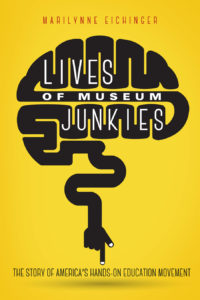
Lives of Museum Junkies: The Story of America’s Hands-On Education Movement
By Marilynne Eichinger
Publisher-Inkwater Press, $19.95, 396 pages,  Available on Amazon, Powells Books, Barnes and Nobel and local bookstores. 
 
Picture a museum in your mind. Did you imagine exhibits, roped-off bits and bobs from history meant to inspire, amaze, and educate, but always out of reach? Even today, this idea of the museum as the look-but-don’t-touch institution persists. But there is another way. For decades, hands-on education has sought to break down the barriers between exhibits and visitors, allowing interested minds of all ages the opportunity to interact with exhibits, to learn firsthand by experiencing scientific principles in action. And Lives of Museum Junkies chronicles the long journey behind bringing science and museums to your fingertips.
 
Marilynne Eichinger uses her story — the story of how the Impression 5 Science Center in Lansing, Michigan, was brought to life — as the framework upon which to mount an encouraging, inspiring tale of dedicated people forging their own path and establishing something new and exciting for their community. This is the story of hard-working, generous, driven people starting from scratch and building something unique, valuable, and hands-on. From marketing and sharing one’s brand to expanding an idea on a national and international scale, the stories of Eichinger’s work at Impression 5 and the Oregon Museum of Science and Industry encompass all aspects of community building, starting a business, and shifting people’s perceptions of just what can be accomplished when creativity meets commitment. Readers also get to meet other key voices and entrepreneurs Eichinger has worked with, people who have inspired her and who have helped blaze new trails for hands-on learning. These profiles bolster Eichinger’s mission to lend credibility to the hands-on museum movement and show the many different paths one can take toward achieving success in ambitious charitable works.
 
Although the many benefits of this truly useful style of education are touted here, Eichinger refuses to paint a rosy picture of the process. The author never shies away from sharing the missteps, obstacles, and hard lessons encountered along the way, including a truly shocking revelation that typifies the gender politics at the time and the long legacy of gender bias in this country that still impacts us today. By pulling science and learning out from behind the glass and velvet ropes of traditional museums, Eichinger helped spark a revolution in understanding how we learn and how to engage (and re-engage) young minds in fundamental concepts of science. Lives of Museum Junkies is part tribute, part handbook, and part inspirational guide, reminding us once again that a small, dedicated group of people can change the world… because they’re the only ones who ever have.  – Reviewed by Glenn Dallas for the San Francisco Book Review

Lives of Museum Junkies Book

Book Launch Party, November 3rd at Marylhurst University, Marylhurst, Oregon – 7 PM, in the Old Library. Come join the fun.

Artwork is always for sale – Contact me at marilynne@eichingerfineart.com

Grand Prize – Passion Flower / acrylic on canvas / 24” by 28” / $ 499

Filled with STEAM

Autumn Breeze
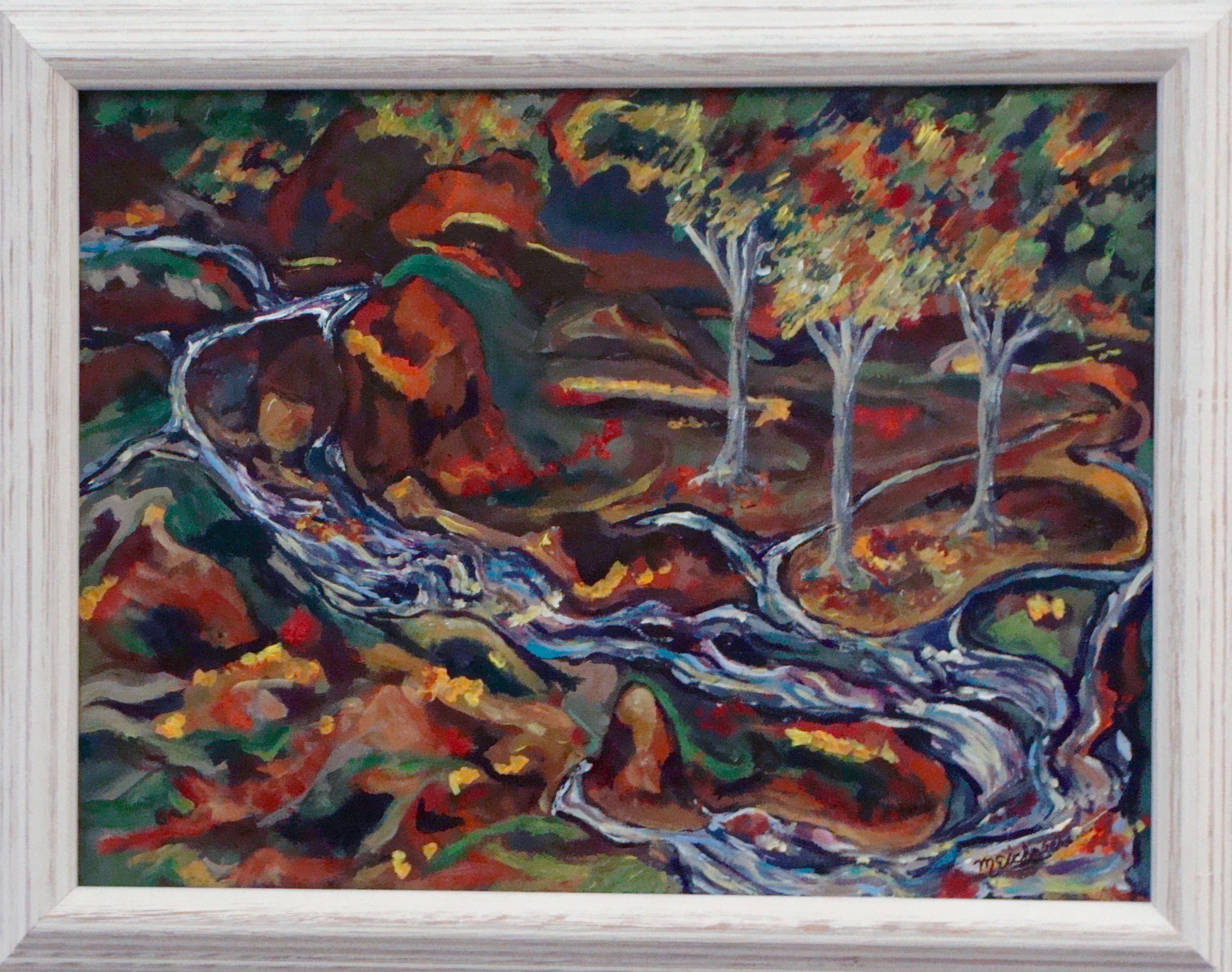
Fall is a time of beauty that makes me consider the changing seasons, vibrant colors, and slow moving rivers in need of replenishing. It is science. It is art. It is comforting and it can be wild when rain and the wind batter the land.

Filled with STEAM

Many parents have heard STEM initiatives bandied about in education circles. Schools are now abuzz with programs that provide science, technology, engineering and math options to meet perceived needs for a technologically able workforce. This expanded curriculum has opened the way for more hands-on teaching. It is a good start.

STEM activities, however, fall short of addressing the needs of all students since they do not always engage those with a more humanitarian or artistic bent. To address this lack the formula is starting to change. By putting art (and design) into the acronym, some educators have given birth to STEAM.

The movement, championed by the Rhode Island School of Design among others, has also been fostered through festivals such as Burning Man where art and technology join in a burst of sensory stimulation. STEAM offers a way to reach those who claim disinterest or fear of science and math. Organizations like the National Science Foundation (NSF) are now collaborating with the arts and humanities by giving grants to multi-disciplinary proposals. NSF recognizes that people are needed to solve problems that deal with pollution, global warming, energy, bio-genetics and advanced technologies. Emotional appeals through the arts can lure those who are hesitant and reach new audiences.

I have many friends who claim they are only interested in the arts and humanities. “I have no head for numbers,” they say. Or, I don’t understand science and never read technical articles.” Yet, these same people may enjoy science fiction and are interested in history. They attend laser light shows, put shoes on their children with heels that flash when they walk and change cell phones regularly to own the latest technology. By tuning into their stated interests and working to entice them with fun approaches to learning, those who are hesitant can be drawn into wanting to understand science and mathematics.

Why bother with all this subterfuge you might ask? Because voters need to grapple with fracking, global warming, and genetically modified food if a democracy is to be maintained. Ignorance will allow technocrats, politicians, and economists to control our lives rather than the other way around. I see confusion regularly in people trying to understand statistics thrown at them from many sources. Numbers can be skewed and misunderstood if you do not have a basic understanding of statistics.

Science and art are intrinsically bound. The scientifically literate see nature through one lens while artists explore it through another. They meet in the middle. Understanding sound waves and how people hear has led to surround sound and improved speakers. Electronics enabled digital production methods to be integrated when producing concerts and films. Studies of gas led to neon sign artistry. Chemistry aides chefs develop seasoning blends and mixtures to tantalize our pallets. Steve Jobs understood that candy-colored sleek casings would shake consumers up and make his computers more popular than others. The interaction of biology and art on the public’s understanding of science is being explored by the Haseltine Foundation for Medical Science and the Arts and the New York Academy of Science.

Sesame Street also has joined the trend to use the arts promote STEM curriculums. “Elmo the Musical” is an interactive, fun-filled adventure created by Elmo and the child at home. With lots of singing and dancing, Elmo uses his imagination and math skills, such as enumeration, relational concepts, addition/subtraction, and geometric shapes to solve problems.” Other segments are being planned to combine the visual and performing arts with STEM.

I read of an anatomy professor who presents her beginning medical students with a CD of songs that help them memorize the various body systems The Nurses Medication song heard on YouTube aids nurses learn the names and uses of various commonly used of medications. For those with kinesthetic intelligence, Living AnatomME, was developed by two medical students in conjunction with the Director of Anatomyat Mt. Sinai School of Medicine in New York to teach musculoskeletal anatomy through yoga and Pilates.

The Cushman school in Florida is one of many embracing STEAM. Following is a sample of the type of curriculum they are offering. It is a good introduction to state of the art thinking.
“The implementation of our STEAM program allows students the opportunity to learn through real-life applications in the critical areas of Science, Technology, Engineering, the Arts and Math. Students become engaged in hands-on projects where problem-solving, collaboration, and the results of their efforts make the lessons more relevant than a textbook alone ever could. By creating real things that “matter,” STEAM, at its essence, is like the apprenticeship of a bygone era.  
 
Our new Innovation Center offers cutting-edge equipment in a free flowing workspace designed to encourage flexibility of thought and creative solutions applicable to today’s competitive marketplace. This active participation in society’s productivity helps students develop an entrepreneurial mindset and effectively prepares them to be leaders in the respective STEAM fields.

Our STEAM programming includes: 
 
• Artists-in-Residence program
• Architectural Design class using Revit
• Video Game Design using Alice software
• Music Composition using Propellerhead Reason (version 4) and Pro Tools 9
• Engineering and Robotics Clubs
• Lego and Vex Robotics
• Music Festival Series that brings professional bands to campus for concerts
• TD Bank – Financial Literacy 
• Common Threads – Teaching children how to cook wholesome, healthy meals through a professional led, curriculum-based program”

I am thrilled to see this type of effort going into education. It is similar to the message Science Centers have embraced for over the past 40 years. And it is a bandwagon worth you and your family joining.
Resources:

http://stemtosteam.org – What is STEAM

http://www.pbs.org/parents/education/music-arts/boost-memory-and-learning-with-music/ – boosting memory through music

http://www.cushmanschool.org/our-program/steam-initiative/ – Sample of a STEAM curriculum within a grade school.

http://www.nyas.org/Publications/Ebriefings/Detail.aspx?cid=1a6933bd-bdd8-422f-b5f8-815972a905aa Biology and Art, Two Worlds or One?

https://www.deepdyve.com/lp/wiley/living-anatome-teaching-and-learning-musculoskeletal-anatomy-through-xdok4g4KYB – Living Anatomy CD

Artwork is always for sale. Contact me at marilynne@eichingerfineart.com
Autumn Breeze – acrylic painting / 28” by 22” / $ 399.

For the Love of Learning

the gossips

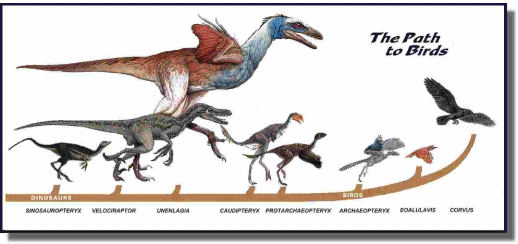
Are These Birds Dinosaurs?

dino_path_to_birdsThe Path to Birds
image from westcoastemiko.weebly.com

The Love of Learning

Last week I was in Tampa, Florida reliving my  life  as a museum junkie. Though I was ostensibly there to sell my book, I was  reunited with the passion for educating children I had when first starting a museum in my basement. Meeting past friends and enthusiastic staff at the beginning of their careers was invigorating. Once more I was comforted by the fact that there are good people ready to move our country forward towards better days.  Museum professionals are caring, tolerant and curious, all attributes I admire.

M During his chat, he called today’s birds dinosaurs. Apparently, there is evidence from over twenty dinosaur species that shows they had bird-like skin and feathers. Did you know that the Brontosaurus we studied as children had the skeleton one creature and the head of another that was unearthed in a nearby dig? Paleontologists in the late 18th century decided that the body was that of Apatosaurus and the head belonged to Camarasaurus. For years our favorite gentle vegetarian no longer existed in scientific circles. However, that changed recently. In 2015, just like Arnold Schwarzenegger, he returned. Paleontologists now think that Brontosaurus is different enough from the Apatosaur to be recognized on its own merits. Confused?

Discussions with colleagues ranged from issues around diversity to the latest brain research. We discussed drones, driverless cars and STEAM initiatives.  Practical matters such as fundraising, architecture, outreach programs and exhibitions were also on the agenda. I learned that museums built over 20 years ago like OMSI are facing major facility problems. Just like in a home, wall paint was peeling, roofs leaking, and carpets stained. Exhibitors struggled to keep out of order signs off of displays.

Money, money, money . . . what is to be done in a country that puts its resources into armaments rather than learning. Despite the fact that 92 million people visit science centers every year there is are inadequate resources going to support these institutions.   In second and third would countries the situation differs. China is building 250 well-equipped science museums in order to promote science literacy. Even Saudi Arabia has gotten on the bandwagon by building four, open to men on certain days of the week and women on others.

Most staff agreed that hands-on learning opportunities are not available to children as they were a generation ago. Noticing that kids are not permitted to play and problem-solve without hovering adults nearby was a  theme of many conversations. Moving in the ‘free-school’ atmosphere of a science center provides some relief. Yet  the experience could be improved with a larger variety of informal materials available to encourage more original thinking. Tinkering spaces are springing up to allow for more creative expression.

Tinkering space

It is difficult to serve the variety of learning styles and specialized needs of visitors.  But it is good to know that staff continues to try to understand their differences and understand how they learn.  Perhaps the day will come when as a nation we realize that there is nothing more important than educating children if they are to understand how to live in a technological environment that is also sustainable and inviting.  Maybe we will also realize that adults need to stay abreast of change if they are going to maintain a robust democracy that is fair to all.

references:
http://www.unmuseum.org/dinobront.htm – what happened to the Brontosaurus?

http://www.scientificamerican.com/article/the-brontosaurus-is-back1/ The Brontosaurus returns.

Art is aways for sale. Contact me at marilynne@eichingerfineart.com
The Gossips shown above is an acrylic painting, 12” by 36”, $ 350.

perf6.000x9.000.indd

To learn more about what goes on behind the scenes at museums read the newly released Lives of Museum Junkies available through Amazon, Barnes and Noble, Powells Books, Inkwater Press and many other local bookstores.

Dates to remember : Book reading/signing
October 11 – Broadway Books, NE Broadway, Portland
October 15 – Impression 5 -Lansing, Michigan – all day
November 3 – Marylhurst University, Old Library – 7 pm – Book Launch Party

Creating an Interactive Museum

Building BlocksBuilding Blocks

Creating a science museum is like playing with building blocks. It takes imagination, perseverance, and innovation to build a monument to experiential learning. The following excerpt is from the first page of Lives of Museum Junkies. Unusual consequences often occur from obscure beginnings and it is a pleasure to share them with you.

Creating an Interactive Museum: Naïve Beginnings

“Stop running and making so much noise!” I shouted to five rambunctious children playing hide-and-seek in closets throughout the house. It was a cold day and my friend Dee Pumplin was visiting with her son. She and I were having a difficult time hearing each other as we chatted animatedly in the kitchen. It was during this conversation that my homemaker days started to end, when over coffee in my suburban house we brewed up the idea of a hands-on museum that emphasized science. Children are not always polite, studious little creatures set on this planet to impress and please their parents.

Children are not always polite, studious little creatures set on this planet to impress and please their parents. Instead they are balls of energy who love to run, scream and create bedlam. In short they can drive a parent crazy, especially on a rainy day. As Dee and I talked, her one and my four children shouted and squealed, ignoring the storm roaring outside. The increasing noise level was like a drum roll announcing a new idea. We started imagining what it would be like to take our kids to an indoor playground. “Wouldn’t it be magnificent to have a great big barn,” we fantasized, “and fill it floor to ceiling with ramps, poles, and climbing apparatus? What fun it would be for the children and their friends. They would get rid of their energy away from home and our houses would be preserved.” Dee and I started to wonder where we could find a barn and even took the next step of contacting a realtor.

As we learned more, the vision for an indoor play structure grew. The immense dimensions of a working barn inspired our ideas to expand to include interactive learning activities inserted into climbing areas. We imagined children swooping down a sliding board and finding a light table, colored filters, and projectors to use for experimentation. The colored light could be projected on the next child speeding down the slide. We embraced the idea of physical play being integrated with academic challenges in a never-ending cycle of learning.

After months of talk and concept development, we finally located a barn, but it wasn’t long before we faced a dose of reality. The cost to acquire the property was more than we anticipated and building the inside play structure seemed monumental. The barn needed to be heated, insulated, electrified, bathroomed and water sprinkled and once it was upgraded, ongoing utilities would be astronomical. The permitting process was overwhelming to two inexperienced women who began to wonder if the city would even allow this type of play-barn to exist. Insurance was bound to be phenomenal, not only because we were dealing with a wooden structure but because we were planning to let children run throughout. We especially liked the idea of fire poles descending from one level to the next. Sound safe? Costs mounted, reaching an enormous number before we even considered the price of exhibits and staffing. . . . .

Lives of Museum Junkies is available through AMAZON, Barnes and Noble, Powells Books, Inkwater Press, and The-M-porium.

For a signed copy you can purchase from me for $ 19.95 plus $ 4 shipping. Contact me at eichingerbooks@gmail.com.

Artwork is always for sale: Building Blocks is a 24” by 28” acrylic painting on canvas in a gold frame. Cost is $450. Contact me at marilynne@eichingerfineart.com for further information.

perf6.000x9.000.indd

New Release: Former OMSI President Reveals the Good, the Bad, and the Ugly History Behind the Hands-On Education Movement

“…will help you see science museums in a new light.” – David Ucko, Museums+More llc
In this lively, behind-the-scenes look at the evolution of interactive science museums, discover:

How the Brooklyn Museum of Art was saved from closure by Mayor Rudolph Guiliani for showing a painting by Chris

How the Brooklyn Museum of Art was saved from closure by Mayor Rudolph Guiliani for showing a painting by Chris Ofili of the Virgin Mary that contained elephant dong.

Why an autistic child spoke for the first time on a science center visit.

Who kept NOVA from being canceled when congress did not agree with their investigative reporting style that explored sensitive subjects like nuclear energy.

What inspired a poor Appalachian orphan to go from rags to riches to become a museum president who later rented an entire cruise ship to see a global eclipse on the Amazon.

Why executives at the top are subject to sexual abuse and find it nearly impossible to manage.

The outcry caused by the Playboy Bunnies playing basketball with business executives to raise funds for a museum.

“recommended for those who care about museums, libraries and society today.”
– Ginnie Cooper, Directed Washington D.C., Brooklyn, and Portland library systems .


The Importance of Touch

applauding-the-blues

       Applauding the Blues

Acrylic on canvas/ Gold Frame/ 23.5” by 19” / $ 495.00
Do you stop to look, touch or smell the flowers? Perhaps you even taste them.

The following excerpt is from my upcoming book, Lives of Museum Junkies. Due out in August it tells my story along with that of eleven other innovators who influenced the hands-on museum movement in the early 70’s. Publication information will be available in a few weeks.

The Importance of Touch
In 2012, a young social work student at the University of Rochester was featured in national publications as a most unusual entrepreneur. While studying brain and cognitive sciences as an undergraduate, Jacqueline Samuel became aware of the negative effects of living in a culture that does not sanction touch for its own sake. Throughout the world people are more willing to hold hands and hug friends and family than in the United States.

Adverse consequences of tactile isolation are known to be agitation, anxiety and aggression. Jacqueline decided that she would ameliorate the situation by opening a cuddle parlor she named the Snuggery. Her focus centered on bringing the healing power of touch to those who are tactilely isolated. The rules she and her employees devised were strict; staying clean, keeping clothing on and not engaging in any “funny business.” Her non-sexual touch emporium was singularly based on the platonic need for physical closeness. Business boomed, spurring copy-cat cuddle parlors throughout the country.

One even opened where I live in Portland, Oregon.
You might wonder what type of person needs to pay $60 for an hour hug? Clients come for a variety of reasons and include those on graveyard shifts returning home to empty beds, the physically handicapped and the chronically depressed. There are thousands of people, many elderly, others single or with a physical disability who are never touched, held, or hugged. Having a friend to talk to and being cuddled is important for overall emotional well-being.

Jacqueline’s insight is backed by volumes of research showing how touch reduces cortisol, the stress hormone that suppresses the immune system. The Touch Research Institute at the University of Miami is a center that concurs with Jacqueline’s concerns. They recently completed a study showing that teens who lack hugging are more likely to be aggressive than their peers who are regularly hugged. Elderly people who are touched are healthier and less likely to develop dementia. Premature babies who are stroked gain weight faster than those who are not and infants who lack adequate physical and emotional attention are more likely to have behavioral, emotional and social problems as they age. And now we see that tactile learning can also be highly effective.

Hands-on museums are cognizant of sensory research, and tactile solutions especially form the basis of many of their activities. Not only do people need physical contact with others but they also have a need to touch and play with objects. A friend of mine shared an insight that it was not just his auditory sense that made him enjoy playing the piano, but his tactile contact with the keys. . . . . .

My work in the museum field was influenced by an exercise I had to complete as a graduate student in psychology. One of my assignments was to write a paper imagining what it would be like to lose each of my senses. I was also directed to explore my feelings about loss of sexual sensitivity. To start the exercise I would sit for an hour in an easy chair imagining myself as a blind or deaf person. As I delved into the assignment, I was surprised to realize that losing my hands would be one of the most horrendous handicaps I could have. The hour spent with handless imagery was torturous, leaving me scared, almost frozen. What if I could not touch a door knob or wave my hands while talking? How horrible it would be to not be able to tousle my child’s hair. Touch was not the only sensation that affected me deeply. I quickly realized that losing my sight would be just as awful. As a visual and tactile person I am so fortunate to have both of these faculties.
Each of us is controlled by biological predilections and we are most happy when we allow daily activities to be guided by these predispositions. . . . .

Understanding a child’s sensory preference helps parents and teachers design appropriate educational programs. The visual learner may love reading books, but there are many children who are hesitant readers and need to be drawn into the learning process through an alternative sensory route. A history teacher might design a curriculum for tactile learners by challenging them to make dioramas. The process still requires the children to read in order to know what to include in their 3-D pictures, but their interest in the project will be internally motivated. . . . .

Parents, grandparents, friends and teachers please think twice before you tell a child not to touch. Your curious child might just need a little guidance to encourage safe and constructive activities that take advantage of his or her way of communicating. Remember, a broken glass can be dangerous but there are safe ways to turn broken glass into a mosaic . . . touch me, touch me not. . . . .

_______________________________

This summer is a good time to let your children wander and experiment by using the sensory mode they most prefer. A warm hug for effort will go a long way towards developing their passion for learning. And by the way, we parents and grandparents love hugs as well. They provide wonderful feelings of well being.

I look forward to your comments below.
Art work is always for sale. Contact me at marilynne@eichingerfineart.com

For sale on Amazon by Marilynne Eichinger: The True Story of Streetwise, overcoming homelessness and beating the odds. Go to http://www.amazon.com/dp/B01AAXMJOGThe

Streetwise