Will Tariffs Help in the Fight Against Global Warming?

CITY LIFE

As the world faces the urgent challenges posed by climate change, the imposition of tariffs on foreign-made automobiles, parts, and oil may yield unexpected environmental benefits. While these tariffs could lead to higher prices for consumers, they may also encourage a significant shift in behavior towards more sustainable transportation options. For instance, I’ve noticed a striking reduction in road traffic in Portland due to rising gasoline prices. The forty-minute drive to Vancouver, Washington, now takes just twenty minutes, reminiscent of the empty highways during the COVID-19 lockdowns. My husband and I were amazed at how quickly the air cleared, showcasing the immediate impact of reduced vehicle emissions.

A crucial component of Portland’s public transportation network is the Metropolitan Area Express (MAX), a light rail system operated by TriMet, which serves the greater metropolitan area. MAX trains were among the first second-generation American light rail systems, emerging from the freeway revolts of the 1970s. Construction began in 1982, and today, MAX operates alongside the Portland Streetcar and the WES Commuter Rail, connecting seamlessly with other transit options such as Amtrak, the airport, and intercity buses.

Despite significant investments in the MAX system, ridership consistently falls short, averaging less than 75 percent of monthly projections. The Eastside Light Rail is often described as an “underused wonder,” with the majority of current MAX riders having previously relied on buses. Unfortunately, the enhanced system has not succeeded in converting car commuters to rail travel.

I wonder if the tariffs imposed by the Trump administration, coupled with Canada’s retaliatory tariffs on oil, could shift consumer behavior. As gas prices rise and the cost of new vehicles increases, consumers may become more inclined to explore alternative commuting options.

American-made cars struggle to compete with their foreign counterparts in quality, efficiency, and design. According to Consumer Reports, brands like Subaru, Lexus, and Toyota lead in reliability ratings, while GMC, Cadillac, and Rivian rank at the bottom. Furthermore, the lack of hands-on experience among today’s youth may deter them from pursuing careers in manufacturing. With only about 70,000 undergraduate engineers graduating annually in the U.S., compared to 600,000 in China and 350,000 in India, it’s evident that American manufacturing is at a disadvantage. Notably, China leads in STEM graduates relative to its population.

For American manufacturing to thrive, we need a technologically, mathematically, and scientifically educated workforce. Young workers should not feel embarrassed by manual labor; rather, they must cultivate a strong work ethic and take pride in their contributions. Building facilities to bring manufacturing back home will take time, and when it happens, robotics and automation will likely handle most of the manual labor and data collection.

In the meantime, the planet has a chance to heal. We may witness decreased pollution and improved air quality with reduced reliance on fossil fuels and a greater emphasis on public transportation. The recent move by the Trump administration to revive coal-fired plants is a setback that is unlikely to succeed in the long run.

As consumers adapt to the realities of a warming planet, they may discover powerful allies in their economic needs. When socially conscious leaders listen to public concerns about safety, health, and cleanliness, we may find that today’s financial challenges lead to a greater embrace of public transportation and electric vehicles.

Reference:

Website (2025)Who Makes the Most Reliable New Cars? Consumer Reports. Retrieved from https://www.consumerreports.org/cars/car-reliability-owner-satisfaction/who-makes-the-most-reliable-cars-a7824554938/

________________

I enjoy reading your comments.  Please do so on my blog site at

CITY LIFE : Medium: Acrylic on Canvas/ Size: 20″ x 20″ / Includes shipping within the continental United States. $450.  For information to ship abroad, contact me at marilynne@eichingerfineart.com.

https://www.eichingerfineart.com/blog/200684/will-tariffs-help-in-the-fight-against-global-warming

Passover & Freedom

Final Blooms

Passover is a celebration of spring and a reminder of what it means to live free.

Passover is an eight-day Jewish holiday that began at sundown last Saturday evening. It commemorates the emancipation of the Israelites from slavery in ancient Egypt. It is marked by the family Seder meal, which includes four cups of wine, the eating of matzah and bitter herbs, and the retelling of the Exodus story. The Chabad religious organization encapsulates this narrative beautifully:

“As told in the Bible, after many decades of slavery to the Egyptian pharaohs, during which the Israelites endured backbreaking labor and unbearable horrors, G‑d saw the people’s distress and sent Moses to Pharaoh with a message: ‘Send forth My people, so that they may serve Me.’ Despite numerous warnings, Pharaoh refused to heed G‑d’s command. Consequently, G‑d unleashed ten devastating plagues upon Egypt, afflicting them and destroying everything from livestock to crops.

At the stroke of midnight on 15 Nissan in the year 2448 from creation (1313 BCE), G‑d visited the last of the ten plagues on the Egyptians, killing all their firstborn. G‑d spared the children of Israel, thereby “passing over” their homes—hence the name of the holiday. Pharaoh’s resistance was ultimately broken, and he virtually chased his former slaves out of the land. The Israelites left in such haste that the bread they had prepared did not have time to rise. Six hundred thousand adult males, along with many women and children, departed Egypt that day, beginning their journey to Mount Sinai and their establishment as G‑d’s chosen people.”

Though I am a practicing Unitarian, I was raised in a Jewish family and continue to observe many of the religion’s customs, including the Seder. For this practice to hold meaning, I find it essential to reflect on the issue of slavery as it exists in our world today. I am consistently shocked by its prevalence. According to the Global Estimates of Modern Slavery, an estimated 50 million people are victims of involuntary servitude.

The most common forms of modern-day slavery include:

  • Child Labor: Minors (under 18) are forced to work against their will.
  • Sex Trafficking: Individuals are coerced into sexual activities. In the U.S., there were 7,500 reported cases of sex trafficking in 2021, primarily involving pornography, illicit massage and spa businesses, the hotel sector, and residence-based commercial sex. Vulnerable children may come from homelessness, the foster care system, unstable family situations, or identify as members of the LGBTQI+ community. The pandemic increased these risks, as children lost access to protective environments like schools.
  • Debt Bondage: Victims are compelled to pay off debts, a situation that often leaves migrants particularly vulnerable to forced labor.
  • Domestic Servitude: This occurs in private households, where domestic workers are often exploited through passport withholding, physical and verbal abuse, and isolation. The Internet has emerged as a primary tool for soliciting buyers in sex trafficking cases.
  • Forced Labor: Adults (18 and older) are required to work involuntarily. In the U.S., much of this forced labor is seen within the prison system, which has the largest prison population in the world. This burden disproportionately affects people of color. Additionally, forced labor among unaccompanied migrant children is alarmingly high.
  • Forced Marriage: Victims are compelled to marry without their consent, with approximately 28 million people affected worldwide. In the U.S., forced marriage among children is well-documented and remains legal in eight states. A study from 2021 revealed that nearly 300,000 children were legally married in the U.S. between 2000 and 2018, with 96 percent involving children aged 16 to 17, and some married as young as 10.

Countries with the highest prevalence of modern slavery include North Korea, Eritrea, Mauritania, Saudi Arabia, Türkiye, Tajikistan, the United Arab Emirates, Russia, Afghanistan, and Kuwait. The G20 nations are not far behind: India (11 million), China (5.8 million), Russia (1.9 million), Indonesia (1.8 million), Türkiye (1.3 million), and the United States (1.1 million) are all implicated.

G20 nations contribute to the issue of modern slavery by permitting forced labor within global supply chains. While traditionally associated with industries like mining, logging, and textile manufacturing, forced labor is increasingly evident in renewable sectors critical for the transition to clean energy. Climate change exacerbates modern slavery, displacing millions and making them more susceptible to exploitation.

Some countries, such as Australia, Canada, Germany, and Norway, have enacted legislation to hold businesses and governments accountable for exploitation. I wonder why the United States has not followed suit. Are Americans truly so indifferent? Do we have the right to celebrate our freedom during Passover while millions remain enslaved around the world?

As we gather for Seder, let us reflect on the meaning of freedom and the responsibility we have to advocate for those still in chains.

I look forward to your comments on by blog site at https://www.eichingerfineart.com/blog/200598/passover-and-freedom

Art is always for sale, Final Blooms is an acrylic painting , 12” by 36” on deep canvas. Available for $ 359. Purchase on my website at https://www.eichingerfineart.com/workszoom/5287595/final-blooms#/.   Questions?  contact me at marilynne@eichingerfineart.com

References:

Website. (2025) What is Passover (Pesach0? Chabad.org. Retrieved from https://www.chabad.org/holidays/passover/pesach_cdo/aid/871715/jewish/What-Is-Passover-Pesach.htm

Website, (2022) 50 million people worldwide in modern slavery. International Labour Organization. Retrieved from https://www.ilo.org/resource/news/50-million-people-worldwide-modern-slavery-0

Website  (2023) The Global Slavery Index 2023. Reliefweb. Retrieved from https://reliefweb.int/report/world/global-slavery-index-2023

SederTable

Brain Drain

Will my novel be next because it reveals the misery caused by the corporate takeover of water?

As a member of The Authors Guild, a national writers’ organization, I was alarmed by this week’s newsletter headline: Writers Are Under Attack—Help Us Fight Back. “The freedom to write, research, and publish is the bedrock of our democracy, yet it is under siege. Book bans are silencing writers. AI companies are exploiting authors’ work without consent, threatening their livelihoods. Journalists face intimidation simply for reporting the truth. These are direct assaults on free expression, and we cannot allow them to stand.”

Historically, intellectual migration has been a boon to the United States. During World War II, brilliant minds such as Albert Einstein, Thomas Mann, and Bertolt Brecht sought refuge here, enriching our scientific and cultural landscape. For decades, the U.S. has been a global leader in research, attracting top talent worldwide. But this is changing. Since Donald Trump’s presidency, European nations have sought to capitalize on America’s growing hostility toward intellectuals and researchers. With the government cutting funding for universities and research facilities, many scientists are looking elsewhere. A recent Nature Magazine survey revealed that more than 1,200 U.S.-based scientists out of the 1,600 surveyed are considering relocating to Europe or Canada.

NPR reports that prestigious institutions in France have established financial incentives for American scientists. The engineering school at CentraleSupélec allocated approximately $3.2 million to fund projects that can no longer continue in the United States. Aix-Marseille University, one of France’s oldest and largest universities, has launched a “Safe Place for Science” program, offering $16 million over three years to support up to 15 American scientists. The Netherlands and Canada are also implementing similar initiatives to attract displaced researchers.

Throughout history, intellectuals have been persecuted for challenging authority. Totalitarian regimes often employ anti-intellectualism to suppress dissent. Trump, both during his first administration and now in his second, has popularized “fake news” and “alternative facts,” distorting reality to serve his agenda.

History offers grim lessons on the consequences of such repression. During the White Terror (1936-1945), Spanish dictator Francisco Franco executed 200,000 intellectuals, including teachers, scientists, artists, and writers. Pol Pot’s regime in Cambodia systematically annihilated the country’s educated class. Argentina’s President Juan Carlos Onganía imposed rigid censorship, silencing the press, literature, theater, and cinema.

Mao Zedong’s Cultural Revolution (1966-1976) forced musicians to hide their instruments and writers to bury their work, as intellectualism was deemed counter-revolutionary. Adolf Hitler and the Nazis consolidated power by banning books, persecuting opposition, and using fear to control the populace. They targeted anti-Nazi judges, trade unions, religious leaders, Jewish communities, and Romani people, establishing concentration camps with horrific conditions. By the time the world intervened, Germans within the country had lost the power to get rid of Hitler.

A few days ago, I spoke to a woman who protested Israel’s treatment of Palestinians. Though the U.S. has not declared war on Gaza or Hamas, she fears punishment for expressing her views. Her Egyptian-born son-in-law, despite his legal status, now feels targeted. Columbia, Harvard, and Portland State face threats of losing billions in funding for upholding free speech around the Palestinian issue.

I fear that the president is waiting for Democratic protests to turn violent as an excuse to declare martial law and seize dictatorial power. His recent rhetoric about invading Greenland and Panama is reckless. If he follows through, the only way to remove him might be through international intervention—a scenario too dire to imagine.

We must remain resolute and continue to speak out. Protests must remain nonviolent and follow Martin Luther King Jr.’s example of resisting oppression through peaceful means. Excuses to crack down on intellectuals and free expression will further erode democracy.

Our right to think, write, conduct research, and speak freely must be defended at all costs.
Resources:

BBC website.(2025)  Why the Nazis were able to stay in power. Bitesize. Retrieved from https://www.bbc.co.uk/bitesize/guides/zgtyvcw/revision/3

NPR Website. (2025) Countries boost recruitment of American scientists amid cuts to scientific funding. Retrieved from https://www.npr.org/2025/03/29/nx-s1-5343966/countries-boost-recruitment-of-american-scientists-amid-cuts-to-scientific-funding

Britannica – Cultural Revolution: Chinese political movement. Retrieved from https://www.britannica.com/event/Cultural-Revolution

_______

Access to clean water cuts to the core of democracy. It is being weaponized, pilfered, polluted, traded, and sold at astronomical prices that poor people can’t afford. Water should be considered a human right and not a commodity.

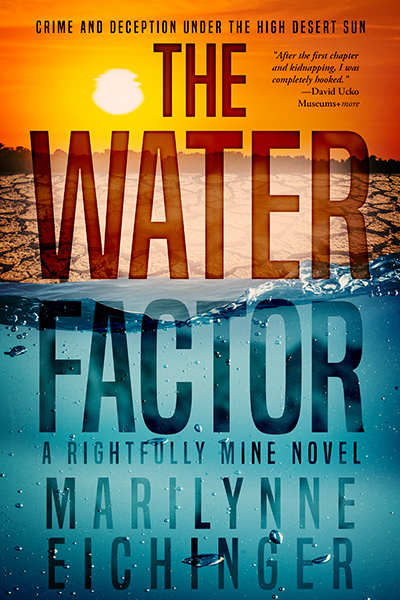
The Water Factor is a Firebird International Award winner for best dystopian novel and a Literary Titan recipient for best thriller. Though fun to read, it carries a severe message about water scarcity. It is available in ebook, paperback, and audio formats. It can be purchased on AMAZON, Barnes and Noble, and as an audiobook on Amazon, Audible, and iTunes. Ask your bookstore to order a copy from Ingram. Please leave a review on Amazon after reading. Purchase while you can, and invite me to Zoom into your book club discussion.

Great Expectations

Spring has Sprung

Though AI is changing the job market, the need for creative artists and writers will remain constant.

According to a survey of 1,568 young adults conducted by the American University in Washington, D.C., their visions of the American Dream differ from those held by older generations. Youth prioritizes happiness, fulfillment, and the freedom to make life decisions above all else. Meaningful personal relationships follow, with financial success next. High school dropouts and college-bound students share the belief that they will have a happy, successful life. That is, until asked to consider political and environmental factors when their confidence diminishes. The study made me question the likelihood of their dreams being realized.

Understanding Finlands Model of Well-Being and Its Lessons for America

Finland consistently ranks among the happiest countries in the world, a distinction attributed to several key factors: high levels of trust in government, robust social support systems, personal freedoms, a strong sense of community, and a comprehensive focus on overall well-being. The Finnish social safety net allows citizens to embrace the joys of nature and family life without the constant stress of meeting basic needs. Public funding plays a crucial role in supporting essential services such as education, healthcare, childcare, and assistance for the elderly. As Professor Arto Salonen eloquently states, “When you know what is enough, you are happy.”

In stark contrast, American society prioritizes individualism, which can lead to a lack of awareness regarding the collective welfare. True happiness, as evidenced by Finland’s success, is rooted in the well-being of the community. Those who are fortunate recognize their responsibility to care for those who are less fortunate.

If we aspire to make America great again, we must first address several human factors that create barriers to health, wealth, and security: intelligence, health, education, wealth, and age.

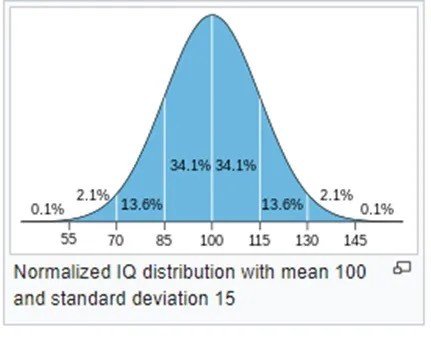
  • Intelligence Distribution: The breakdown of intelligence categories reveals significant disparities:
    • Genius (130–145 IQ): 6.6 million
    • Gifted (115–130 IQ): 46.6 million
    • Above average (100–115 IQ): 113 million
    • Below average (80–100 IQ): 113 million
    • More below average (70–85 IQ): 46.6 million
    • Most below average (55–70 IQ): 6.6 million Society must extend its support to the 53.2 million individuals in the lower two categories, many of whom struggle to earn a living wage.
  • Health and Wellness: According to the CDC, approximately 70 million adults in the U.S. live with a disability. It is imperative that society provides care and support for these individuals, ensuring they have access to the resources needed to thrive.
  • Age: As of 2023, about 17.3% of the population—approximately 50.15 million individuals—are retired and reliant on Social Security. Alarmingly, a quarter of these retirees lack supplemental savings, leading many into homelessness. Additionally, 21% of the population, or 72.8 million people, are under the age of eighteen. Society bears the responsibility for the well-being of both retirees and children.
  • Education: Each year, over 1.2 million students drop out of high school, and an estimated 39 to 40 million adults lack a high school diploma. This growing trend leaves many youth unprepared for the workforce. It is vital to provide training and job opportunities that engage these individuals and prepare them for success.
  • Employment: Currently, more than 28% of Americans are seeking employment. While artificial intelligence presents new opportunities for skilled workers, it poses significant challenges for those in manual labor and low-skill jobs. Many fields, such as finance, media, and customer service, are particularly vulnerable to automation. Conversely, there will be a growing demand for roles in cybersecurity, healthcare, and skilled trades. Society must ensure that ample job opportunities exist at every skill level and commit to retraining programs to help workers adapt to technological advancements.

The U.S. population stands at approximately 346 million. With around 250 million people classified as young, old, or disabled, only about 95 million individuals are actively supporting the rest. This stark statistic highlights the urgent need for a collective effort to support vulnerable populations, particularly those unable to secure a living wage.

As we consider who should bear the responsibility for the well-being of the elderly, young, disabled, and unemployed, the answer likely lies in a combination of government action, community support, and individual responsibility. In Finland, a culture of shared responsibility prevails, where citizens contribute to a collective safety net that prevents homelessness and supports those in need. Wealth distribution is more equitable, minimizing the extremes seen in the U.S., where fortunes are often amassed for personal luxury rather than community benefit.

Finland’s democratic engagement stands as a testament to its citizens’ commitment to social welfare, evidenced by an 80% voter turnout in the 2024 elections compared to just 63.7% in the U.S. Entrepreneurs and businesses in Finland contribute fairly to the economy, fostering a low-crime environment and a generally content populace.

To emulate Finland’s success and meet the expectations of young adults, the U.S. must prioritize community welfare and equitable wealth distribution. We need to collectively determine how to care for our most vulnerable citizens and retrain those displaced by technological changes. Only through a communal approach can we create a society where happiness and well-being are accessible to all.

12

Resources

Website ( 2025) Reimagining The American Dream: Views from Young Americans. Sine Institute of Policy & Politics at American University. Retrieved from https://www.american.edu/sine-institute/

Website ( 2025) Dropout rates. National Center for Education Statistics. Retrieved from https://nces.ed.gov/fastfacts/display.asp?id=16

2024 World Happiness Report. Retrieved from https://happiness-report.s3.amazonaws.com/2024/WHR+24.pdf

Colston, P. (2023) The Finnish Secret to Happiness? Knowing When You Have Enough. New York Times

Website (2024) CDC Data Shows Over 70 Million U.S. Adults Reported Having a Disability. Retrieved from https://www.cdc.gov/media/releases/2024/s0716-Adult-disability.html#:~:text=The latest data, as having a disability in 2022.

Website. Dropout Rates. National Center for Education Statistics. Retrieved from https://nces.ed.gov/programs/coe/indicator/coj/status-dropout-rates

Website. Voting Turnout 2025. Statistics Finland. Retrieved from https://stat.fi/en/publication/cln47x0wh2keq0avtslszg9x0website.

Election results, 2024: Analysis of Voter Turnout in the 2024 election. Ballotpedia. Retrieved from https://ballotpedia.org/Election_results,_2024:_Analysis_of_voter_turnout_in_the_2024_general_election

Stelmah, A. 2025. How Artificial Intelligence Is Transforming The Job Market: A Guide To Adaptation And Career Transformation. Forbes.https://www.forbes.com/councils/forbestechcouncil/2025/01/10/how-artificial-intelligence-is-transforming-the-job-market-a-guide-to-adaptation-and-career-transformation/

_________________

Art is available for sale. Spring Has Sprung is a 40” x 30” acrylic painting on canvas. It is available for $ 585 (includes shipping in continental U.S.) Purchase online at https://www.eichingerfineart.com/workszoom/2033414#/ or contact me at marilynne@eichingerfineart.com

Love the Uneducated

MAO

In 1949, Mao Tse-tung proclaimed the People’s Republic of China. He launched his Great Leap Forward campaign that destroyed the agricultural system, causing a famine in which 27 million people starved to death. In 1966, he manufactured a cultural revolution that ordered the closure of schools and sent young intellectuals to the countryside to be re-educated through manual labor. The revolution destroyed much of China’s traditional cultural heritage including books and musical instruments, as well as created economic and social chaos. During this era, Mao’s cult of personality grew to immense proportions.

Love the Uneducated?

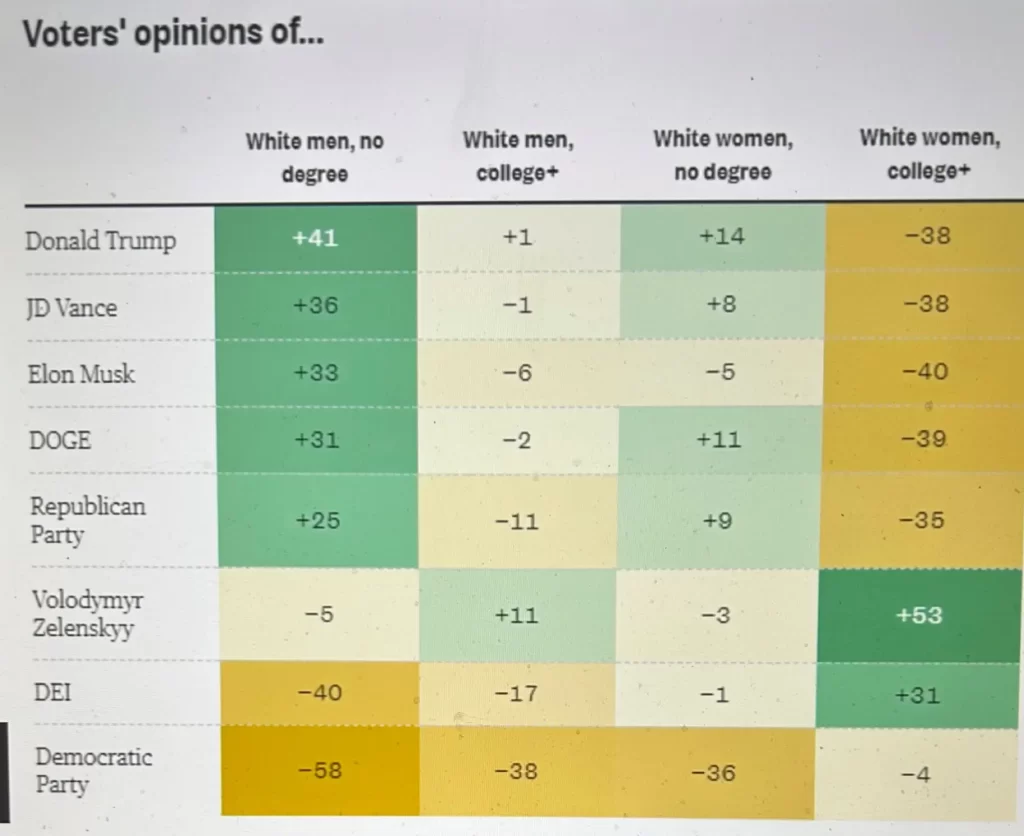
During his 2020 victory speech in Nevada, then-president-elect Donald Trump was quoted as saying, “Don’t you just love the poorly educated?” The quote went viral, appearing on t-shirts and bumper stickers. This statement highlights a concerning reality about the relationship between education levels and political manipulation. An NBC opinion poll sheds light on the subject:

  • 41% of white men without a college degree supported Trump.
  • 1% of white men with a college degree favored him.
  • 14% of white women without a degree favored him.
  • 28% of white women with a degree opposed him.
  • Similar statistics hold for figures like J.D. Vance and Elon Musk.

The reason Trump and others court the uneducated is that they are more susceptible to manipulation and often lack the resources to challenge misinformation. Many of them did not complete high school. As of 2024, 79% of the U.S. population is literate, with 43 million adults considered functionally illiterate. The skill level of 54% of the population is below a 6th-grade level; 20% are below a 5th-grade level. Massachusetts has the highest rate of child literacy, while New Mexico has the lowest. New Hampshire has the highest percentage of literate adults, and California the lowest. The U.S. ranks 36th among nations in literacy—a troubling statistic for a global superpower.

Project 2025 has targeted the Department of Education for elimination, along with cuts to research funding and programs promoting scientific and critical thinking. Historically, dismantling educational institutions and intellectual hubs is a common tactic of authoritarian regimes to consolidate power.

The Department of Education accounts for approximately 4% of the federal budget. Its elimination would negatively impact millions of students, colleges, and universities. Though efforts have been made to weaken the department, it has not yet been entirely dismantled. Federal education funding supports Pell Grants, work-study programs, and student loans. Roughly 28% of its budget is allocated to states, while the remainder supports programs for disadvantaged children from low-income families, students with disabilities, after-school improvement programs, and classroom technology. Contrary to some beliefs, this funding would not simply be transferred to states to use as they see fit. Instead, underfunded schools would suffer even more significant setbacks.

The Republican push to shift education to church-run schools and private equity firms would further exacerbate economic disparities. It would reduce diversity in K-12 classrooms and college dorms while increasing the cost of education, as private entities prioritize profit over equitable access to learning.

Totalitarian governments have historically promoted anti-intellectualism to suppress political dissent. This allows authoritarian leaders to manipulate patriotic fervor, foster intolerance, and spread misinformation unchecked. In communist dictatorships such as Joseph Stalin’s Soviet Union and Mao Zedong’s China, intellectualism was seen as a threat to agrarian communism. Hitler’s Third Reich took anti-intellectualism to a sinister level, banning books, controlling artistic expression, and persecuting intellectual dissenters. General Francisco Franco’s White Terror from 1936-1939 led to the execution of 200,000 critical and creative thinkers. The Cambodian genocide (1975-1979) under Pol Pot nearly eradicated the country’s educated population. Under Trump’s presidency, terms like “fake news” and “alternative facts” became central tools for eroding trust in education and expertise.

Does anyone besides a politician genuinely value the uneducated? While many people without formal education are kind, hardworking, and loving, they are also more vulnerable to misinformation, fear-mongering, and manipulation. Limited access to education often leads to economic hardship, low-paying jobs, and fewer opportunities for upward mobility.

I serve as an “education grandma” to a family whose adults left school after the eighth grade. Their days are spent in low-paying jobs to provide food, clothing, and shelter for the family. Though they love their children, they don’t read to them, assist with homework, review report cards, engage with teachers, or discuss personal or current events. The children have little exposure to cultural or community events and rarely spend time in nature. Because their parent’s vocabulary is limited, so is the children’s. And while love is essential, it alone cannot prepare a child for economic independence and success in America.

I admire this family’s courage in fleeing a repressive regime and their work ethic, yet I also struggle with frustration at their reliance on magical thinking. Their situation fills me with sadness, anger, and determination. My goal is to help their children access the opportunities that will lead to fulfilling lives.

Any government that does not make education a top priority is failing its people. Eliminating the Department of Education would only deepen these struggles, leaving millions more vulnerable to systemic disadvantage. Education is not just a pathway to success—it is a safeguard against exploitation.

References:

The Nevada victory speech video at https://www.facebook.com/watch/?v=10154493986991509

Schueler, B., Lyon, M., Beiberg, J. (2023) Do state takeovers of school districts work? Brookings. https://www.brookings.edu/articles/do-state-takeovers-of-school-districts-work/

Website of National Literacy Institute Literacy Statistics 2024-2025. ( Where awe are now) Retrieved from https://www.thenationalliteracyinstitute.com/post/literacy-statistics-2024-2025-where-we-are-now

WIse, ALana ( 2020) Trump announces Patriotic Education Commission A largely Political Move, NPR. Retrieved from https://www.npr.org/2020/09/17/914127266/trump-announces-patriotic-education-commission-a-largely-political-moveSteves, R.\

Steves, R. ( 2019)  The story of Fascism: Hitler’s Anti-Intellectualism. Retrieved from  YouTube

Butler, D, Thadani., and others. (2025) Elon Musk’s business empire is built on $38 billion in government funding. The Washington Post. Retrieved from https://www.washingtonpost.com/technology/interactive/2025/elon-musk-business-government-contracts-funding/

I look forward to your comments on my blog site

Art is always for sale. Mao in a 16″ x20″ mixed media painting on canvas. Available for $595, including shipping. Order on my website ot contact me at Marilynne@eichingerfineart.com

WaterFactor 400x600 1

Access to clean water cuts to the core of democracy. Access to clean water cuts to the core of democracy. It is being weaponized, pilfered, polluted, traded, and sold at astronomical prices. We need to return water to being a human right and not a commodity.

The Water Factor is a Firebird International Award winner for best dystopian novel and a Literary Titan recipient for best thriller. Though fun to read, it carries a severe message about water scarcity. It is available in ebook, paperback, and audio formats. It can be purchased on AMAZON, Barnes and Noble, and as an audiobook on Amazon, Audible, and iTunes. Ask your bookstore to order a copy from Ingram. Please leave a review on Amazon after reading.

All my friends are in therapy!

4777122w460 (1)

Hope Exploding

Political grief has driven many of my depressed friends to seek the help of a therapist—the fortunate ones who can find one, that is. Particularly striking is the number of men who once considered therapy unmanly but have now overcome their aversion. A close friend of my son went so far as to take his life while his wife was at home.

With the public mood marked by negativity, anxiety, and discontent, many feel the country is headed in the wrong direction. Therapists have never been busier and are increasingly closing their doors to new patients. Some are experiencing troubled dreams as they listen to one person after another express their fears, complaints, and confusion about the future.

Sarah Darghouth, a clinical psychologist at Massachusetts General Hospital, described her struggle to control her breathing the morning after the election. She allowed herself nine minutes to cry before composing herself for her first therapy session of the day. Aware that the best way to support distressed patients is to remain calm, she wondered how she would manage. Dealing with angst, grief, and existential threats is no easy task.

Vulnerable groups, including members of the LGBTQ+ community, immigrants, undocumented migrants, racial minorities, individuals who lost jobs due to government downsizing, business owners facing declining sales, and victims of hate speech, enter therapy sessions asking, often between sobs, “What do I do now?”

If you are politically depressed, consider the following.

  1. Basic Needs Come First: Safety, security, housing, and food form the foundation of Maslow’s hierarchy of psychological needs. These must be met before you can focus on self-esteem and self-actualization. Prioritizing self-care is essential.
  2. Addressing Work and Relationships: Resolving issues related to employment and personal relationships can help restore a sense of normalcy.
  3. Media Consumption and PTSD: Experiencing political defeat or witnessing distressing news coverage of abused migrants, war casualties, and environmental disasters can trigger PTSD. It is crucial to be mindful of media consumption. Grieving and mourning are natural, but staying in the present and avoiding worst-case scenarios is key.
  4. Managing Political Loss: Every election has winners and losers. Victors should be cautious not to humiliate those who lost, while the losing side benefits from self-reflection rather than placing blame. Learning to manage stress is both necessary and possible. Approaching political differences with an open mind and seeking common ground can be constructive.
  5. Understanding and Overcoming Social Pathologies: Issues such as xenophobia, sexism, gender discrimination, racism, anti-Asian hate, anti-Semitism, cult-like thinking, and climate denial can contribute to widespread distress. Recognizing these problems is the first step toward developing innovative solutions. Engaging with others to spread truth, transforming hateful perspectives into pathways to peace, and participating in movements that aim to create a better future for all Americans can foster hope and happiness.
  6. The Power of Community: Political action requires collective effort; it cannot be done in isolation. Secluding oneself at home can lead to a downward spiral, clouding judgment and impairing mental clarity. Acknowledging that one’s feelings are shared by many can provide reassurance. Problems affecting mental health are best addressed through community-driven solutions.
  7. Avoiding Burnout: It is essential to balance activism with self-care. Good food, enjoyable activities, and regular exercise should complement serious endeavors. Spending time with friends, immersing oneself in nature, and maintaining family connections can improve well-being. Focusing on what is within one’s control, engaging in laughter, and seeking relaxation within a supportive community can provide the energy needed to tackle complex challenges.

References:

Website. (2025) What the 2024 election looks like from the therapist’s room. STAT.rreports from the frontiers of health and medicine. retrieved from https://www.statnews.com/2024/11/08/therapy-2024-election-trump-anxiety-mental-health/

Muffin, S. (2024) How can Psychiatrists Help Our Post-Election Mental Health? Psychiatric Times. Retrieved from https://www.psychiatrictimes.com/view/how-can-psychiatrists-help-our-post-election-mental-health

Hall, R. (2025) Stressed about Trump’s return? You’re not alone. Therapists are inundated with people worried about Trump 2.0. Independent U.S. Edition. Retrieved from https://www.independent.co.uk/news/world/americas/trump-presidency-2-therapists-inauguration-b2682699.html

Mental Health Crisis in U.S> Population. NeuroStim TMS Centers. Retrieved from https://neurostimtms.com/mental-health-crisis-politics-2025-inauguration/

How are you surviving these tumultuous times? Share your thoughts on my blog site.https://www.eichingerfineart.com/blog/200042/all-my-friends-are-in-therapy

Hope Exploding is a 30″ by 22″ acrylic painting on deep canvas. Purchase for $595 online at Questions? Contact me at marilynne@eichingerfineart.com

Why Water?

The Water Factor: A Rightfully Mine Novel is a thriller with all it takes to motivate young adults to protect their right to clean air and water, which will be lost if they do nothing. James Hokama Byrne is an eighteen-year-old who rejects his parents’ desire for him to attend college. His interests are travel, adventure, and women. He supports himself by delivering water to rural communities in Oregon and Ethiopia. His encounters open his eyes; the world isn’t as rosy as he thought. The novel explores the conflict over the values of uninformed youth, people trapped by the way industry operates, and the corporate executives whose concern is increasing profits.

People ask why I chose water as the subject of the book. The answer is straightforward. Plants and animals need water to survive. UNICEF reports that four billion people, almost two-thirds of the world’s population, experience severe water scarcity for at least one month each year.

 When corporate interests make access too expensive, our communities must regain ownership and operation of their water systems.  Numerous studies conclude that private companies are not better managers than Public Utility Companies. The need to pay dividends to shareholders increases homeowner rates by 30%. Those with few resources can’t pay such high bills. Programs devised to assist them are underwritten by you and me, not the owners.

Before the Industrial Revolution, clean water and air were taken for granted. That changed when we built cities dependent on fossil fuels. Attempts to regulate industrial pollution and ensure that clean, affordable water is available for all receive continuous pushback from industry. Global warming intensified the crisis over water, especially in arid regions of the world. The increase in migration is partly due to a lack of water for farming and in part to wars over water rights. UNICEF says that some 700 million people will likely be displaced by intense water scarcity by 2030.   Matters worsened when water was declared a commodity rather than a right in the 1980s. It is heavily traded on Wall Street, adding to the world’s poverty.

Our lives will worsen if we don’t put skids on energy companies like Northwest Natural, which buy water rights in a five-state region. We need to control local governments from subcontracting services where there is marginal transparency. The companies have clever ways to increase expenses and hide profits. It takes a skilled auditor to uncover what is going on.

Do purchase and enjoy The Water Factor. It is a fast-moving novel that will make you think. If you are in Portland, you can learn more by attending my book talk at Annie Bloom’s on March 13th. I will read from the novel and explain the research that led to the situations the characters find themselves in.

I enjoy participating in book club discussions connected through Zoom. The first 25 clubs to contact me will be cost-free.  If this interests you, let’s discuss this at a convenient time: marilynne@eichingerfineart.com.

Alive in Interesting Times

Twin Stars
‘The sky is falling in,” said Chicken Little.

On the PBS television show The Newshour with Jim Lehrer he spoke to Dr. Ho Young about the phrase, May you live in interesting times. Young explained that “interesting,” rather than suggesting good times, refers to dangerous, war-mongering, political, and turbulent times. It is more of a curse than a good wish, making the recipient crave a simpler, more peaceful life. The most fascinating periods in history were filled with tumult and upheaval. Amazon has over 70,000 nonfiction books about World War II and at least 20,000 on the Holocaust. I remember being told it was it was an ancient Chinese proverb. Chinese scholar Torrey Whitman says it is more likely an English saying spread by Lord Chamberlain in the late 1930s.

Though the phrase may not be Chinese, much can be learned from studying China’s thirteen dynastic periods that start with the Xia Dynasty (c. 2070-1600 BC). The Quig dynasty (1644-1912) was the last imperial dynasty, though some consider the Communist party ruling today, its latest.

A political theory about the Dynastic Periods in Chinese history says the public initially favored new dynasties. They often initiated a political, cultural, and economic revival, bringing peace and prosperity after an era of conflict. Regime collapse follows in future generations due to corrupt government officials, economic declines, and poorly handled natural disasters like famine and floods. It reaches a breaking point when the peasants decide the monarch no longer has a “Mandate from Heaven” to rule. Revolt follows, and a new regime takes over.

In China, it was the ordinary person, the common man or woman, who initiated change. Not all people have the courage to do that.  When times are bad, some cultures take a different path than action; they retreat, fearing the end of days. They become insular, divest themselves of belongings, and lose hope for their future. Like ostriches, they appear to bury their heads in the sand rather than overthrow an evil regime. We see this today when people follow toxic leaders rather than rise against those who take our rights away, spread falsehoods, act immorally, poorly manage national disasters, support evil regimes, and show little compassion.

Websites like the one put up after Hurricane Katrina abound. It was a pulpit espousing that God sent the hurricane because New Orleans was a wicked city and was sending a warning to the rest of the nation. Octogenarian Harold Camping’s nightly bible show tormented its doomsday listeners into believing that in 2011, waves from a gigantic earthquake would roll over the earth, killing all in its path. Many followers gave up their friends, homes, and life savings. When the world didn’t end, and no one rose to heaven, rather than feel like fools, they clung together with a changed date and a different narrative about God’s intention. The many who felt embarrassed usually altered their belief in God.

 “A Brief History of the Apocalypse ( https://www.abhota.info/end1.htm)  gives a timeline of end-time predictions.  An Assyrian clay tablet unearthed dating to approximately 2800 BC is one of the earliest examples of the perception of moral decay being interpreted as a sign of the imminent end. It bears the words, “Our earth is degenerate in these latter days. There are signs that the world is speedily coming to an end. Bribery and corruption are common.”

The apocalypse list continues to grow, with politics and environment added to the list of reasons for the earth’s demise. False prophets continue to spread untruths to gullible people through the internet. Scientists predict that the sun will swell into a red giant star, swallowing Mercury, Venus, Earth, and perhaps Mars in 4,400,000,000 AD, and that this will be the actual end of the world.

All of earth’s creatures will undoubtedly suffer if we don’t care for the water, air, and land that nurtures us. We will die in wars if we don’t find ways to get along. Falling prey to corrupt and greedy politicians brings hardships, but not the end of the world. There will be survivors, though it may not be you or me if we don’t have the resources to withstand “interesting times.”  This is why ordinary people have to take action and no longer sit in easy chairs, praying, and hoping for better days. It is incumbent on everyone to get involved and install a regime that works for the common good.

I look forward to your comments on my BLOG SITE.

Twin Stars is a 16” by 20” framed acrylic painting. It is available and shipped free in the continental U.S.  for $ 395. Purchase on my website at https://www.eichingerfineart.com/workszoom/1662376/twin-stars#/  Questions? Contact me at marilynne@eichingerfineart.com.

Resources:

Yong, H.,(2025) May you Live in Interesting Times? China Sprout, Chinese Cultural Education Products. Retrieved from https://www.chinasprout.com/community/guestcolumns/21

Website (2025) What were the 13 Major dynasties of China? Encyclopedia BritannicaRetrieved from https://www.britannica.com/video/learn-about-Chinas-six-ruling-dynasties/-259717

Website (2011) A Brief History of the Apocalypse https://www.abhota.info/end1.htm

Huus, K. (2005)  Apocalypse, now? NBC New. Retrieved from https://www.nbcnews.com/id/wbna9731623#.UjBbjNKsiSo

Website (2025) Here’s how our Universe will (probably) End. Science Focus. Retrieved from https://www.abhota.info/end1.htm

Lipman-BLumen, J. (2005) THE ALLURE OF TOXIC LEADERS: WHY FOLLOWERS RARELY ESCAPE THEIR CLUTCHEs. Ivey Business Journal. Retrieved from https://iveybusinessjournal.com/publication/the-allure-of-toxic-leaders-why-followers-rarely-escape-their-clutches/

Bartlett, T. (2012) A year after the non-Aapocalpse: where are they now? Religion Dispatches. Retrieved from https://religiondispatches.org/a-year-after-the-non-apocalypse-where-are-they-now/

Frames of Mind

SEE ALL
What does this painting say to you? Show it to friends and see what they say. Do some look at the details, others the shapes? Are there people who don’t want to look at it? Do they prefer the tactile feel of sculpture?  After reading this article, consider what intelligence skills they bring to viewing art.

The theory of multiple intelligences drove how I educated my children, developed science exhibits, and ran my company. Howard Gardner’s comprehensive approach to education empowers teachers to create joyful and engaging classrooms. The crux of his teaching is that humans’ intellectual competencies vary based on genetic factors and experiences. He claimed there are nine, perhaps more, ways people across the globe access and process information. Like most, we’re a mixture of the nine intelligences, with some a great deal more potent than others.

  1. Verbal-linguistic intelligence (well-developed verbal skills and sensitivity to the sounds, meanings, and rhythms of words) career possibilities: lawyer, speaker, host, author, journalist, curator.
  2. Spatial-visual intelligence (capacity to think in images and pictures, to visualize accurately and abstractly) career possibilities: Pilot, Surgeon, Architect, Graphic Artist, Interior Decorator, Painter.
  3. Bodily-kinesthetic intelligence (ability to control one’s body movements and to handle objects skillfully)  Career Possibilities: Dancer, Athlete, Surgeon, Mechanic, Carpenter, Physical Therapist, Veterinarian.
  4. Musical intelligence (ability to produce sound and appreciate rhythm, pitch, and timber) Career Possibilities: Singer, Composer, DJ, Musician, Linguist
  5. Interpersonal intelligence (capacity to detect and respond appropriately to the moods, motivations, and desires of others) Career possibilities: Teacher, Psychologist, Manager, Salesperson Public Relations, Physician,
  6. Intrapersonal intelligence (capacity to be self-aware and in tune with inner feelings, values, beliefs, and thinking processes) Career Possibilities: Therapist, Psychologist,
  7. Naturalist intelligence (ability to recognize and categorize plants, animals, and other objects in nature) Career Possibilities: Botanist, Gardener, Animal Care, Landscaper, Forestry, Zoology, Veterinarian.
  8. Existential intelligence (Critical Evaluation) Sensitivity and capacity to tackle deep questions about human existence such as, “What is the meaning of life? Why do we die? Where did we come from? How did we get here?” Career Possibilities: Religious leader, Philosopher, Teacher, Historian, Anthropologist.

These intelligences make sense to me, as I’m a tactile person who loves to read. I’m not musical or mathematical and am more in tune with interpersonal feelings and values than intrapersonal ones. The challenge for parents, teachers, and trainers is understanding the individual’s learning style and designing programs that take advantage of that skill.

I befriended a young man whose school tests showed him to have a low IQ. The test didn’t distinguish among the nine intelligences. He struggled to get through school and had difficulty keeping a job. One afternoon, I took him to the Portland Art Museum, where we toured the displays and discussed the paintings in detail. I was surprised at the depth of his interpretations. His insights added to my understanding of the art. Later that summer, my husband and I took him to an art fair. We had to pull him away from the booths when it was time to leave. He spent hours talking to the vendors about their art. Unfortunately, his strength was not understood or integrated into his education. Instead of thriving, he became a drug addict who couldn’t hold a job. If his visual abilities had been better understood, he would have been an excellent museum guard and helpful to visitors. Though not a good reader or artist, he absorbs what museum guides and artists say about their work. He would have been proud to come to work wearing a guard’s uniform and have stayed a loyal worker until death.

After leaving my job at the Oregon Museum of Science and Industry, I founded the Museum Tour Catalog with the help of 27 museums. The company supplied interactive educational toys, books, and materials to over a million households annually for eighteen years. Catalog pages were named after museums, art, science, history, and exhibit halls, such as engineering, symphony, nature center, etc. Gardener’s frames of mind theory influenced what we carried. Engineering and technology pages featured more than material and electronic devices to assemble. They contained science fiction and how-to books, computer programs, design projects, and historical devices like those devised by Da Vinci. The goal of the catalog was to sell products that piqued the recipient’s interest so they’d want to know more. It was to help parents better understand the way their children think.

Whether you are a parent, friend, reporter, politician, or teacher, if you want to be a better communicator, it helps to put your audience through the sieve of Gardner’s categories. Friends and students often nod and pretend they understand what you are saying when they don’t. You might need a different way to get your point across. My husband can watch a YouTube video before repairing equipment and know what to do. I prefer reading instructions when they’re outlined 1,2,3… I get confused and bored watching the footage, zone out, and can’t remember what to do first.


It is essential to understand that biological, psychological, and experiential factors play a role in problem-solving and creating products of cultural value. Awareness of the differences in intelligence skills can make one more curious and less critical.

I look forward to your comments at https://www.eichingerfineart.com/blog/199537/frames-of-mind

Art is always for sale. See All is a 48″ by 24″ acrylic painting on deep canvas. Available for $895, shipping included. Purchase through my website at https://www.eichingerfineart.com/workszoom/5558644/see-all#/

For further information, contact me at marilynne@eichingerfineart.com


References:

Website (2024) Howard Gardner’s Theory of Multiple Intelligences.Northern Illinois University Center for Innovative Teaching and Learning. Retrieved from https://www.niu.edu/citl/resources/guides/instructional-guide/gardners-theory-of-multiple-intelligences.shtml

Website. (2025) Howard Gardner’s Multiple Intelligences Overview and Theory. Study.com. Retrieved from https://study.com/buy/academy/lesson/multiple-intelligences.html?

Marenus,< (2024) Howard Gardner’s Theory of Multiple Intelligences. |Simply Psychology. Retrieved from https://www.simplypsychology.org/multiple-intelligences.html

Mark your calendar

Location: Annie Bloom’s Books

Date: Thursday, March 13th – 7 pm
Address: 7834 SW Capital Hwy, Portland, Oregon 97219

Annie Bloom’s Books welcomes Portland author Marilynne Eichinger for a reading from The Water Factor: A Rightfully Mine Novel.

The Water Factor has several themes besides the corporate takeover of water. It explores what will turn a young person into an activist. When you read the novel, consider Howard Gardner’s Frames of Mind and see where the characters in the book fit into his theory.

The Water Factor is an International Firebird Book Award winner for best dystopian novel and a Literary Titan Gold Award recipient for best thriller. The novel is available in ebook, paperback, and audio formats. It can be purchased on AMAZONBarnes and Noble, Annie Bloom Books, and Powell Books Online atand as an audiobook on Amazon, Audible, and iTunes. Ask your bookstore to order a copy from Ingram. Please leave a review.

Beyond Revenge

Hope Exploding

According to a 2023 Gallup poll, about three in four Americans identify with a specific religious faith; twenty-two percent say they have no religious preference. When asked if they believe in their religious teachings, forty-seven percent say yes, and thirty-three percent say they are spiritual.

From people’s actions, not their speech, I question their religion’s impact on daily life. Americans continue to elect officials to high offices who have predatory sexual pasts, who don’t pay their taxes, underpay employees, lie under oath, spread false information, support ruthless dictators, and seek revenge and retribution at the slightest snub. It’s easy to talk about being a good, upright person, but following through is difficult. It’s their behavior that counts.

The way people act is hypocritical to the beliefs they espouse. Why do religious people hold the Bible and Ten Commandments in high esteem yet commit adultery, kill, steal, support the death penalty, and ignore their parents? Are their circumstances pacifists will fight in a war? Why do good people seek revenge when they are wronged? Australian social psychologist researcher Ian McKee says people motivated by power, authority, and the desire for status tend to be more vengeful. They will lie and cheat for fear of losing face.

In a society with a weak rule of law, revenge is a way to keep order. Power-seekers use revenge to remind others not to trifle with them. Some people use revenge as a cathartic measure, though studies show it doesn’t make them feel better. Rather than helping the person move on with life, it causes them to dwell on the situation and keeps them unhappy.

University of Maryland psychology professor Dr. Michele Gelfand studied 150 students, finding that those who showed a deference to authority and a respect for traditions and social dominance were more favorable toward revenge and retribution. The more students focused on universal connectedness values, the less likely they were to seek revenge.

Cultural differences also play a role. Americans become offended when their rights are violated. They might seek revenge if someone infringes on their right to voice opinions. Koreans are offended if their sense of duty and obligation is threatened. Public criticism that’s embarrassing can trigger a desire for revenge.

The Old Testament leaves revenge to God to dole out. Judaism forbids revenge and the harboring of grudges. The Torah teaches that God is the arbitrator of justice and that true faith in God eliminates the need for revenge.

  • Yet in Exodus 21:23, the Bible instructs us to punish an offender by “Giving life for life, eye for eye, tooth for tooth, hand for hand, foot for foot.”
  • Leviticus 19:18 says: “Do not seek revenge or bear a grudge against anyone among your people, but love your neighbor as yourself. I am the Lord.”
  •  

The New Testament also considers God the arbitrator of justice.

  • Romans 12:19-21: “Do not take revenge, my dear friends, but leave room for God’s wrath, for it is written: ‘It is mine to avenge; I will repay,’ says the Lord.”
  • Matthew 5:38-39: “You have heard that it was said, ‘An eye for an eye and a tooth for a tooth.’ But I say to you, Do not resist the one who is evil. But if anyone slaps you on the right cheek, turn to him the other also.”
  •  

The Hindu Bhagavad Gita advises against revenge, promoting forgiveness and understanding. It teaches that actions should be based on duty and righteousness, not a personal vendetta. It emphasizes the importance of self-control and the harmful effects of anger and hatred.

The Quran says that revenge is not a solution. It only increases the problem.

  • Quran 2:178: “If you choose to forgive, you will be rewarded by Allah, and if you go beyond the limits, you will be punished by Allah.”
  • As in the Old Testament, there is an out. Quaran 16:126:”If you want to retaliate, retaliate to the same degree as the injury done to you. But if you are patient, it is better to be so.
  •  

A Pacifist’s thought about revenge.

“With regard to provocation situations, pacifists may pursue goals that run counter to revenge-seeking and, thereby, inhibit vengeful actions. This could include, for example, the goal of maintaining positive relationships and the goal of regulating emotional reactions when angry.”

Buddhism teaches that revenge is wrong.

“Buddha said that those who harm others are not trainees in virtue. Revenge is giving in to anger and self-cherishing and is incompatible with practicing compassion.”

Martin Luther King Jr. says, “The old law of ‘an eye for an eye’ leaves everybody blind.’

Building Bridges is a song sung by protesters in 1981

Building bridges between our divisions,

I reach out to you, won’t you reach out to me?

With all our voices and all our visions,

Friends, we can make such sweet harmony.

From Greenham Common Peace Occupation1: 1981 protest to challenge the decision to site 96 Cruise nuclear missiles in Berkshire, England.

If my family or nation’s safety were threatened, I would fight, but I doubt I would seek revenge when the event ended. I hope for peaceful solutions that come from understanding and communicating.

Though most philosophers and religious teachers warn against revenge and retribution, there are conflicts in their teachings. Where do you stand on the spectrum? Please comment below.

Art is always for sale. Hope Exploding is a 30″ by 24″ acrylic painting on deep canvas. Available for $695, shipping included. Purchase through my website at https://www.eichingerfineart.com/workszoom/4777122/hope-exploding#/

For further information, contact me at marilynne@eichingerfineart.com

Resources:

Buckles, S. (2025) What does the Bhagavad Gita say about revenge? Wisdom Short. Retrieved from https://wisdomshort.com/books/bhagavad-gita/revenge

Website. What is Islam’s view on Revenge? CPSInternational center for peace and spirituality. Retrieved from https://cpsglobal.org/books/the-seekers-guide/9-what-is-islams-view-on-revenge

Adolesc, J (2018). (2025) Pacifists and Revenge-Seekers in Response to Unambiguous Peer Provocation. National Library of Medicine.Retrieved from https://pmc.ncbi.nlm.nih.gov/articles/PMC6053336/#:~:text

Zakilkowski, D. (2025)What Does Judaism Say About Taking Revenge?” Chabad, org. Retrieved from https://www.chabad.org/library/article_cdo/aid/1842551/jewish/What-Does-Judaism-Say-About-Taking-Revenge.htm

Luke. (2015) Is Revenge ever allowed in Buddhism?Dharma Wheel. retrieved from https://www.dharmawheel.net/viewtopic.php?t=21450

Price, M. (20090) Revenge and the People Who Seek It. American Psychological Association/. Retrieved from https://www.apa.org/monitor/2009/06/revenge

Website (2024). How Are Religious Americans? Gallup. Retrieved from https://news.gallup.com/poll/358364/religious-americans.aspx

Though it might be surprising, a loyalty code of conduct exists among those without a home. This is especially true in youth who fled unsavory homes. They become friends, united in adversity.