Science vs Belief

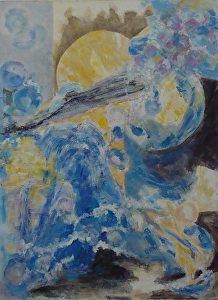
Rub a Dub Dub Five Men in a Tub
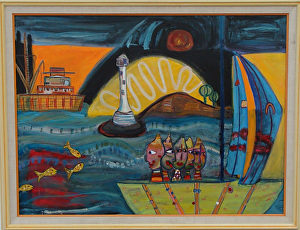
Acrylic painting on Canvas/ 42” by 54” / $ 790

Courageous explorers set out to sea and disproved the flat earth theory. What if they hadn’t? Galileo was punished for saying the earth travelled around the sun. What if he (and others) hadn’t? Salk wiped out polio with a vaccine? What if people had refused to give it to their children?

Science vs Belief

In 2015, Julie Beck wrote an article for The Atlantic saying Americans Believe in Science, Just Not its Findings. Though 79 percent of Americans do think life is much easier because of science and that investments in research are worthwhile, they question their findings. A recent Pew Research study shows that there is a large gap between what the public believes compared to the beliefs of scientists. I quote the following:

Genetically modified foods: 88 percent of scientists say they’re “generally safe” to eat; 37 percent of the public agrees.

Vaccines: 86 percent of scientists believe they should be required in childhood, compared to 68 percent of the public.

Climate change: 94 percent of scientists say it’s a “very serious” or “somewhat serious” problem; 65 percent of the public agrees. 87 percent of scientists blame humans; 50 percent of the public does too.

Evolution: 98 percent of scientists say they believe humans evolved over time, compared to 65 percent of the public.

There were also large disparities on issues like whether it’s safe to eat foods grown with pesticides (scientists: 68 percent; public: 28 percent), and
whether the world’s growing population will be a problem (scientists: 82 percent; public: 59 percent).

Instead of trusting facts, the public tunes into feelings. People are quick to go to pseudoscience when they want to refute a claim they dislike, for most any reason. Strangely, though they trust and respect scientists, they don’t believe in their evidence-heavy research. Dan Kahan, professor at Yale Law Schools says there is a “creeping anti-science sensibility” overtaking the country and it is gradually getting worse. I wanted to know why?

Pew research scientists say that the fault is with the media because of they don’t know how to present complex information in a concise manner that can be easily digested by the public. Scientific information does not lend itself to be communicated through sound bites and reporters don’t know how to capture people’s attention for a long enough period of time to present all of the facts and nuances. Most people have stopped reading newspapers altogether and they avoid cumbersome science stories.

However, there are other factors to consider besides the media. Religion, jobs, and past experience with faulty science causes people to reject studies they don’t like. Preferring childhood indoctrinations and the faulty conclusions they surmised from personal experiences, they use them as a guide to evaluate valid research findings. In other words, they stay committed to their own beliefs which may or may not be based on tested results. It may be why so many people believe that ghosts are real, that holding your laptop on your lap will make you sterile, that talking on your cell phone will give you cancer, or that sugar makes your kids craz. They also commonly spout that hair and nails continue to grow after you die, that crossing your legs gives you varicose veins, and that brown eggs are better for you than white.(they are both the same)

The 2015 international student assessment test (PISA), given to 15 year olds, showed that out of 71 countries the United States placed 38th in math and 24th in science. Though math scores steadily increased since the early 1990s, in 2009 they once again started to dip. Science scores showed only a slight improvement. The American Association for the Advancement of Science (AAAS) blames our country’s overall weak scores on poor STEM education in the schools.

The numbers are worse when evaluating adults, for over 70 percent of Americans are not able to read and understand the science section of the New York Times. Only 28 percent of the population qualifies as being scientifically literate.The small percentage of those who are interested in science and engineering and continue on for advanced degrees excel. “The United states has done more to advance science in the modern world than any other country on earth,” says physician/researcher Danielle Teller.

Our engineering schools are among the top in the world and even medical research still remains among the best. At the highest level of academic achievement we do well, but among the general public’s understanding we fall behind. One reason may be that science writers have not been able to connect researched facts to daily life in order for it to have meaning. Instead, information is presented in confusing bullets that claim one thing to be the truth and then shortly after we are told their are nuances to the study that need to be more carefully evaluated. It is difficult for the average person to know what to make of the information so they stop trying. Rather than show their ignorance, many simply say, “I don’t believe it and who says so?”

What do we do about the public’s lack of understanding of science? How do we communicate to those who are not interested in science and what is important for them to know? For over 50 years the National Science Foundation (NSF) had a science initiatives that funded programs like NOVA, encouraged the building of science centers, and supported innovations in teaching. The present administration, however, wants to reverse the trend by cutting research budgets for NSF and NIS (National Institute of Health) as well as funds targeted to increase science literacy. I suppose their reasoning is that if they are not going to accept the outcome of the research, why conduct studies? If they do not want any one to discuss the contribution of fossil fuels uto global warming, why give out research grants? Should we care?


Science literacy is not just about facts for it prescribes what to do with them. It is about being able to predict and explain natural phenomena like volcanoes, tornadoes, and tidal waves. It enables informed participation in civic, cultural, and economic affairs and defines ways to make judgements about the future. Scientific literacy is crucial in that it affects everyday decision making, but it is also personal in that it encompasses societal values. Since many value-laden beliefs get applied to critical issues, to find science useful you have to accept that it is much more than the latest study.

Science is a way of thinking—a process involving ideas, collecting data, developing a hypothesis (an educated guess), testing, and coming to a conclusion only to start the process over again. It is not focused on the absolute perfect answer but rather the outcome based on the best information available. at the time. It involves challenging preconceived notions, over and over again in a never ending cycle.

It is difficult to live in a world without absolutes but due to high speed communication we are forced to do so. It is important to understand research findings and resultant innovations in order to decide if they benefit society. There are decisions to made and they can’t be based on thin air. We know how to make robots and drones. The societal question involves how we want to use them? Should they deliver packages, pick up passengers, clean our homes and add to workplace unemployment? How do we deal with the problems they create for those who lose their jobs? Answering questions like, “Do all children need to be vaccinated? Is there such a thing as clean coal? What is an acceptable level of toxins to allow in drinking water?” require knowledgeable decision makers.

Scientific literacy also includes understanding how data is manipulated and purposefully misinterpreted for political and business reasons. Informed people need to ask how data is being collected, what biases are involved, and who is footing the bill for the study. They need to be able to interpret statistical information in order to not be fooled. It also behooves us to look for mental laziness on the part of the investigator and to make sure that comfort results that reinforce cherished beliefs are not being sought. .

Facts can be used to reenforce long held beliefs or they can be used to shed light on the universe. They can serve as answers to curious inquiries and a platform for the next great discovery or as fodder for industrial moguls who want to negate findings. Whether science is used for good or for evil depends on our values and motivations. Since we are traveling speedily through the universe, clinging to the land by means of earth’s gravity, it behooves us to understand as much about it as possible in order to protect and sanely develop our spaceship.

References:

Beck, Julie, The Atlantic, 2015 , Americans Believe in Science, Just not its findings, In https://www.theatlantic.com/health/archive/2015/01/americans-believe-in-science-just-not-its-findings/384937/

Desilver, Drew, Pew Research Center, 2017, U.S. Students’ academic achievement still lags that of their peers in many other countrieshttp://www.pewresearch.org/fact-tank/2017/02/15/u-s-students-internationally-math-science/

Lombrozo, Tania, 2015, NPR, Scientific Literacy: It’s Not Just about the facts,
http://www.npr.org/sections/13.7/2015/09/14/440213603/scientific-literacy-it-s-not-just-about-the-facts

Teller, Danielle Quartz MEdia LLC, 2016,There’s a good reason Americans are horrible at science,https://qz.com/588126/theres-a-good-reason-americans-are-horrible-at-science/

Art is always for sale. Contact me at
marilynne@eichingerfineart.com

Please share your thoughts below.

____________________________________________
CELEBRATE! and learn about hands-on learning and the growth of art and science museums by naive but passionate directors from throughout the country.  Laugh and cry with them as you read their stories of trying to navigate the quagmire of running a non-profit organization.  
 
Lives of Museum Junkies — Upcoming Book Talks

Old Boys Club – Tigard –  April 28, 2017

Museum of Natural and Cultural History, University of Oregon,
Eugene – May 23, 2017
 
Lake Oswego Library  – June 20, 2017
 
High Desert Museum, Bend – October 5, 2017
 
Available for $19.95 Powells Books, Amazon, Barnes and Noble, Broadway Books, MAC Emporium, Also on Kindle for signed copy contact the author.


Carried on the Wind

Yellow Headed Blackbirds – sold

These birds are like canaries in the coals mine in that they let us know if the air is safe. So far, their habitat is good, they have a wide range, and are not considered vulnerable. Let’s keep it that way. Birds suffer from air pollution just like we do and the emissions that drive climate change are an immediate health concern for them as well. According to the Audobo n society, birds are exposed to more airborne particles than humans because birds have a higher breathing rate and spend more time in the open air.”

Carried on the Wind

Starting in 1996, and for the following seventeen years, my catalog business took me to Hong Kong each January. I looked forward to the 14 hour trip because I escaped Portland’s cold, rainy weather and landed in the warmth and sun of the South China Sea. In the early years, the sky was a beautiful blue and people clipped along crowded streets dressed in short sleeved shirts. Eight years later, I noticed a change in the weather and had to alter my attire. Slightly overcast skies made me carry a spring jacket but it was still pleasant. By my fourteenth trip the clouds were so thick that the sun could not get through and I needed a winter coat. During my last visit, face masks were sprinkled throughout the crowd of walkers as they hurried to get inside. Yellow smog stung my eyes, making the trip much less enjoyable.

Hong Kong and Kowloon, it’s nearby neighbor, are not manufacturing hubs. They face the water and have gentle breezes washing over them. I couldn’t understand where the smog was coming from and why it didn’t just dissipate out sea. It took an excursion to the mainland before I discovered what was happening. During the excursion a friend took me to see the sights of Shenzhen. While riding in the backseat with my partner, I could not our driver navigating the streets. I mentioned the smog and rotten odors, and asked my friend if he was concerned. To my surprise he proudly answered, “That is the smell of money.” Factories lined the road belching black smoke from coal burning furnaces and since the winds have no boundaries, the foul air was drifting over Hong Kong.


2003 – The blue skies, short sleeved shirts


2012 – What a change!


2013 – Coats needed in the Bird Market

China’s economy has certainly improved, but at a tremendous cost to human health. There used to be hundreds of bicycles scurrying everywhere. These have since been replaced by automobiles and busses discharging black exhaust. The country is plagued with rising costs of treating people with asthma and lung disease.

I was horrified. How shortsighted I thought. They are crowding local hospitals with asthmatics and those suffering from lung cancer. I was happy to return home where the air is clear most of the time—or at least it used be. Knowing that there are certain days when we are warned to stay inside, I decided to investigate Portland’s air quality and discovered that our city is among among the worst polluted in the country. On hazy summer days, you can see toxic substances floating in the air and in some neighborhoods you can smell them through the year.

I was surprised and wondered where our protectors were. How do we clean up our nest so we are not drinking foul water and breathing polluted air? Who is concerned with my family’s health? I don’t have the luxury of being able to escape to a house in the mountains or beach.

This is why I became upset when the heart was taken out of the EPA, one of the few government agencies set up to help. Because of their work, over the past 50 years, automobile emissions standards have greatly improved. Since the Clean Air Act, carbon monoxide is no longer a problem. And, by removing lead from gasoline, lead pollution has decreased with the exception of those cities where there are still large lead-emitting industrial facilities.

EPA recently reported improvements in air quality but added that pollution remains unhealthy in a great many areas of the country. They warn that bad air can cause premature death, asthma, harmful effects on the cardiovascular system, and have an increased likelihood of heart attacks and strokes. Health Magazine confirms that, “Fine particles emitted by vehicles (especially diesel-powered ones), coal-fired power plants, and burning wood can penetrate deep into the lungs, while car exhaust, heat, and sunlight contribute to high ozone levels.” When I drive around town I no longer open the window on nice days because as automobiles crowd the streets the air from their exhaust bothers me.

Just as in China, our economy is positively affected when controls are enacted. Air pollution caused by energy production cost $175 billion in 2002 but that number decreased to $131 billion in damages in 2011. These numbers demonstrate that healthcare costs can come down if proper safeguards are enacted.

During the Obama years we were all protected by more stringent standards. I cry now that they are being reversed. The American Lung Association says that more than half the people in the U.S. breathe air that is dirty enough to cause health problems. I knew that cities like Long Beach, California and Denver, Colorado were at the top of the list but had no idea that areas I always thought of as pristine like Fairbanks and Anchorage, Alaska, are also at risk. You and I are at risk for nationwide pollution is carried on the winds to affect us all.

Are you prepared to just sit back and not cry out? Do you want coal powered plants operating in your city? any city? Would you send your son down into a mine to work? Would you live in a city where, because of fracking, fire comes out of the kitchen faucet instead of water? I bet you do care about the air your children and grandchildren breathe and the water they drink.

As far as I am concerned there isn’t enough money in the whole world to make up for the health ravages that will be caused by increased pollution. Sorry coal miners, and oil frackers, but these are changing times and you need to take the responsibility to get retrained to work in clean energy industries. Let’s not allow the economic concern of a few to take away the health of a nation. Let’s ensure that there are birds around to sing us awake each morning.

References:
Qin, Kenneth, Audubon Audublog, 2015, Birds suffer from air pollution, just like we do. http://ca.audubon.org/news/birds-suffer-air-pollution-just-we-do

Koberstein, Paul, Study: Portland Air among worst in nation, March 2, 2016 Koin 6. http://koin.com/2016/03/02/study-portland-air-among-worst-in-nation/

EPA, Clean Air Act OVerview, 2017https://www.epa.gov/clean-air-act-overview/air-pollution-current-and-future-challenges%20

10 Peoples, Lynne, U.S. Cities with the Worst Air Pollution , Health, 2017 http://www.health.com/health/gallery/0,,20490855,00.html

Harvery, Chelsea, Jan. 29, 2016, The Staggering economic cost of air pollution, Washington Post,

How Animals Teach

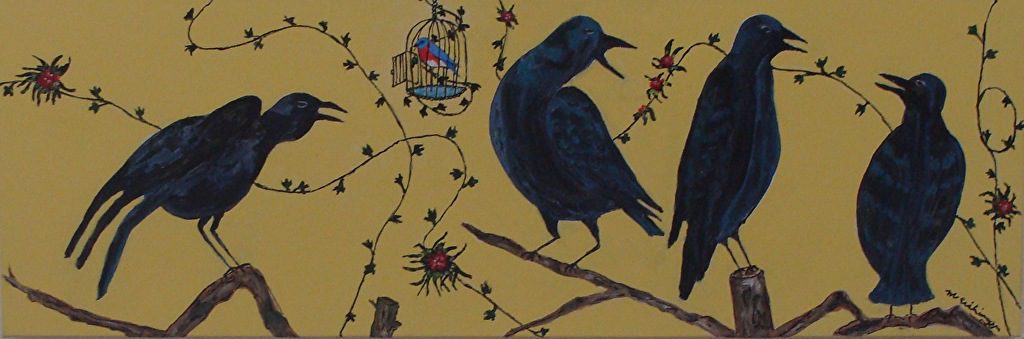
The Gossips
Acrylic on Canvas/ 12” by 36”/ $325

A Birdie Told Me So

A birdie with a yellow bill,
Hopped upon the window sill,
Cocked his shining eye and said:
Ain’t you ‘shamed, you sleepy head!

This poem, by Robert Louis Stevenson, impacted me much as the proverb popularized by Benjamin Franklin that said, “Early to bed and early to rise, makes a man healthy, wealthy and wise.” It reminds me that messages of wisdom are found in the natural world for those who pay close attention. Birds and animals sharing our planet are more intelligent and complex than most people imagine, and they have a lot to teach us.

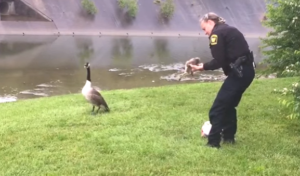
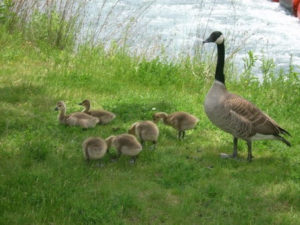
A friend recently shared a story about a goose that sought help from a policeman who was sitting in his car. The officer assumed the goose wanted food when she pecked at his window, quaked and walked away—but that was not the case. When ignored, the goose returned until the man exited his car and followed to see what she wanted. He was led to a grassy spot where a newly hatched chick’s feet were tangled in a cord. Amidst loud but unaggressive quacking, the concerned mother goose stood by while his partner rescued the panicked gosling and set it free near an adjacent creek. The mother then hustled her brood to the water and all was well.

People talk about training their pets but rarely do they mention how their animals train them. We direct cats to litter boxes, teach dogs to fetch balls and even train them to be the eyes of blind people. I proudly taught my black poodle to jump through a hoop, but I too learned from the experience. Patience, caring, fun are a few words that come to mind. Just because we don’t speak their language, doesn’t mean they are not intelligent or that we can’t learn from them.

Our cat, Franny, can tell time. She sits by her food bowl at 7 each morning and promptly at 5:30 in the afternoon. She has trained us to feed her on time—which is fine, because she returns the favor. Somehow, she knows exactly when to wake up our adopted son so that he is never late for work. Much to our surprise, Franny didn’t miss a beat when daylight savings time arrived. How can that be?

A wealthy acquaintance sent his son to a private boarding school during his high school years. On the day he first arrived, he was assigned a horse to care for and exercise during his stay. All students were required to feed, brush and ride their animals rain or shine. Many of the arriving freshmen had been spoiled by generous parents who never required them to do a bit of work. Quite a few suffered from having been emotionally neglected by their parents. Learning to care and be responsible for an animal was a life altering experience for these youth. Though the horses required their attention, they learned that caring for another living organism has rewards. Being trusted by and receiving unconditional love from their horses were life altering experiences for the majority of students.

Animals are often used as an aid for mental or physically ill people. A young woman I know spent much many years suffering from severe depression. Her life went from bad to worse and she was unable to motivate herself to prepare meals or clean her apartment. Obtaining and keeping employment was a distant dream—that is, until she got a care-dog. Her perky pet was not concerned with her depression but trusted her to care for his needs. He required a morning walk and wanted to be fed several times each day. Her dog needed someone to brush his long hairs, bathe him occasionally, and play with him regularly. Though at times the dog was a burden, he gave a lot back in return.

Since dogs live in the moment, he taught her to do so as well. His daily walks improved his owner’s health, with fresh air contributing to her skin glowing. Since he was well cared for, he was happy and flourished, which made her feel good. Though she still suffered from occasional bouts of depression, the woman became more content and less depressed. She and her dog managed to get through bad times knowing that good moments will return. The dog gifted the woman with a nonjudgmental love. A few wet licks, a hug, and a friendly wagging tail is all it took for me to know that the two are a joyful team.

I recently read about how prisoners in many western states are becoming cowboys who train wild horses. As example, in Nevada for the past 17 years, felons have been allowed to leave their minimum-security prison to spend eight hours a day on a ranch where they are addressed as “horse trainer” instead of “inmate.” They represent a tough bunch of men who were incarcerated because their aggressive, impatient behaviors led to conflicts with the law. Some were drug dealers, others burglarized, and many were charged with assault. By the time they learn how to train temperamental mustangs, however, they go through a transformation.

Man and horse bond around a number of issues. Neither are used to being caged. When captured, both react by becoming mean and scary. Yet, in order to be released, they have to exhibit a softer way of acting that embraces respect and trust.

When a trainer is first put in a pen with a mustang, he confronts a wild, angry, snorting animal. It can take weeks before the horse is willing to be touched and many more days before it can be haltered, saddled, and ridden. The trainer works with his animal in a stressful and often dangerous environment. As one man put it, “climbing a 1000 lb. beast that keeps bucking you to the dirt also requires true grit.” When the men return at day’s end, other prisoners and guards do not mess with them. They exude self-confidence as they develop self-worth and respect for all living things.

Though the horses are put up for adoption every four months, the inmates remain supervised until their sentences are complete. During this time they are treated like men, instead of prisoners, and because they love what they are doing, they qucikly discard defensive behaviors and learn patience. Working with horses requires requires emotional control and focus on what they are doing. These skills help them find employment upon their release.

According to veterinarian Vint Virga, animals can teach us a a great deal about being human. Since animals mainly pay attention to the present, they demonstrate how to savor the moment rather than be easily distracted by past and future thoughts. Taking a cue from their behavior, we can learn to appreciate more fully your current activity by focusing on what is most important.

Animals tune into impressions from the world around them, trusting and acting on their instincts. If we too learn to acknowledge our hunches, we will become more open to new choices and opportunities. Rather than taking ourselves too seriously and work all of the time, we will acknowledge that rest and play are also vital to our happiness. Animals vary moments of rest, relaxation and reflection with periods for discovery, invention and joy. They become fully absorbed when playing and do not worry about how good they are at the game. When my dog played catch, she was completely focused and never paid attention to distractions in the environment.

Animals exude unconditional love for those who take the time to know and share their world. A few kind words, a belly rub and neck scratch will produce a friend who is there to greet you when you return from a busy day. By applying what is learn from pets and by taking the time to nurture family and friends, we will expand our circle of warmth and delight.

References:

Virga,Vint, THe Soul of All living Creatures, 10 Things Animals Can Teach Us about Being Human, Psychology Today.https://www.psychologytoday.com/blog/the-soul-all-living-creatures/201501/10-things-animals-can-teach-us-about-being-human

Hernandez,Dan, True grit: how wild horses are turning Nevada Inmates into cowboys. The Guardian, Feb 25, 2015. https://www.theguardian.com/global/2015/feb/25/true-grit-wild-horses-nevada-inmates-cowboys

Oh boy! Stress again!

Peace and contemplation in Eastern Oregon

Acrylic painting on canvas, gold frame, 21″ by 25″ / $ 499. For information contact me at marilynne@eichingerfineart.com

Oh boy! Stress again!

Over the years I’ve written about how children raised in trauma develop fight and flight responses in order to survive. They learn to react quickly when stressed but find it difficult to step back to analyze complex situations. I, and many of my friends, have the opposite problem. We live in our thoughts and are poorly equipped to cope with emergencies that require immediate action. Our minds work overtime, developing worrisome scenarios that may or may not occur in the future. We too are stressed and need to have coping mechanisms, but in a slightly different way.

What makes you calm? Is it a drive in the country? A walk in the woods? Yoga? Meditation? A good book? Do you fall asleep as soon as your head hits the pillow or do you lie awake tossing and turning for hours? When you hear disturbing news can you compartmentalize it so that it does not take over your entire consciousness and ruin your day?

A friend of mine told me that her husband has the ability to put his problems in a box, to take out and explore when the time is right. Whether it is pain or sad news, the input is immediately compartmentalized to be dealt with in a calm manner at the appropriate time. He is “way cool” for I strive for this type of control.

Though stress is destructive when it becomes too much to deal with, it can be good. It keeps life from becoming boring and also helps us perform in dangerous situations. Whether it is good or bad depends on coping mechanisms which dictate a reaction or response. When a situation appears to be overwhelming, we become anxious, which undermines our ability to effectively respond. The pressure also can have a negative effect on our health.

The challenge is to be able to respond quickly and effectively and to leave negative health responses behind. This includes not worrying in advance about something that may never occur, but being prepared in case it does. For instance, a person facing an operation should not worry twice. The operation should be faced with relative equanimity. once the results are known, then it is time to respond. Bad news can then be used as a spur to action. Stress is helpful when it is motivational but not when ‘what if?’ worries continue without end.

Ancient societies used flight or fight training when responding to the many physical dangers they encountered. A wild boar or roaring lion would arouse self-preservation reflexes that were immediately activated since they had been practiced many times in advance. When confronting a dangerous situation, their adrenaline, cortisol levels and heart rate increased to give them enough energy to respond by hiding, running, or attacking. Heightened alertness, muscle preparedness, slowing digestive and immune systems enabled them to move in ways that were essential to their survival. In other words, they were saved by an energized sympathetic nervous system where sensorimotor abilities were integrated with the psychological parts of their brain, allowing them to control emotions and act with speed.

Though the dangers faced today are different, they still exist, and our responses also require training and practice. Our stressors may be triggered by raging road drivers, aggressive skateboarders, or an assault rather than wild animals, but these encounters are no less stressful. Our muscles tense and blood pressure rises just as rapidly as in primordial cultures. These stress signals are a call to action requiring quick reflexes and knowledge in ways to respond.

There can be mental consequences for those who give little thought or practice to emergency situations. The adverse effects of stress may remain for an extended period of time even after the threat is over. Most people I know ignore the fact that our society also has stressors that require attention. We too need to be prepared and gain the skills necessary to survive with a minimum of stress.

One way to discover what is needed is to play a mind game. Begin by sitting quietly in a chair, closing your eyes and imagine dangerous scenarios and how you will respond. Note what when you start to become anxious. The exercise will help you discover what type of training you need in order to lower your stress. Will physical exercise help you improve reflex reaction time? Will classes in personal safety, self-defense or balance lower your stress threshold? One of my teachers suggested I practice shouting with gusto so I will be heard in an emergency. Being prepared for natural and man-made disasters can provide relief from anticipatory worry. Assembling extra water, food, and clothing, and knowing how to turn off gas, water and electricity are basic to handling potential crises.

Meditation was a crutch for me when a tree came smashing down on my roof, shaking the house as though in an earthquake. Glass flew everywhere while rainwater poured through a broken skylight and windows. My immediate reaction was panic, followed by jumping up with confusion about how to respond. My heart beat wildly and I am sure my adrenaline levels peaked. I had to calm myself before I could think and did so by thinking, “Marilynne, you are a meditator—breathe deeply. It took one minute to gain control because of having practiced meditation for many years. Once calm, I assessed the situation was able to respond immediately.

Those who participate in military, fire, or police training are taught how to deal with emergencies. Most ordinary citizens are not. Yet, we need to have these skills for there are bound to be times when we will be vulnerable. Preparation for natural disasters makes sense and should include having a meeting place to go to in case of emergency. Assessing risks and having emergency devices on hand will provide peace of mind.

It is also important to have your body in shape to handle various situations. Exercises that improve balance and reflexes and participating in self-defense, personal safety, and cyber-safety classes can be helpful. Just the process of regular practice can be a stress reducer. And, don’t forget, adequate sleep, a healthy diet and maintaining appropriate weight. The list goes on to include meditation, aroma therapy, warm baths, massage, and herbal teas. Reducing screen time including cell phone, computer, and television use and getting organized are natural stress-reducers. Lastly, in this day of alternative news, I think it is important confront media hype and instead look inward to what you must do to maintain your own sanity.

If we learn to manage the pitfalls of our own environment we are more likely to live with equanimity. We will stop being anxious when our minds play tricks but be ready for action when actually threatened. And, best of all, once the situation is over, we will be able to throw off the extra adrenaline and cortisol circulating throughout our bodies. It is worth the effort to be prepared.

References:

Christian, Nordqvist, December 24, 2015, What is Stress? How to Deal with Stress, Article Medical News Today: http://www.medicalnewstoday.com/articles/145855.php

Stress Symptoms, Signs, and Causes from HELPGUIDE .ORG in collaboration with Harvard Health publications: https://www.helpguide.org/articles/stress/stress-symptoms-causes-and-effects.htm

Uwe Proske, Simon Gandevia, October 2012 Pshysiolgical Reviews, VOl. 92 no. 4, 1651-1597, The Proprioceptive Senses: Their Roles in Signaling Body Shape, Body Position and Movement, and Muscle Force: http://physrev.physiology.org/content/92/4/1651

The Merry-Go-Round

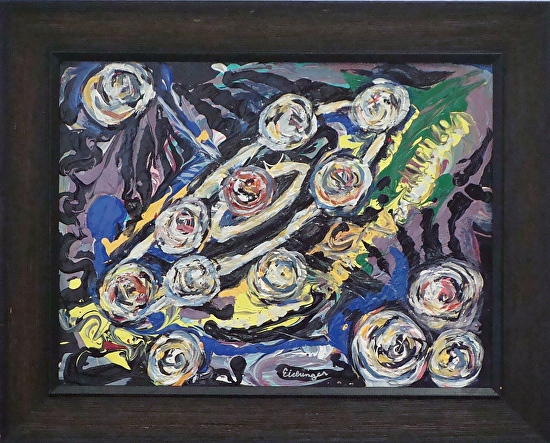
Solar System Planets

The Merry-Go-Round

An old Chinese curse says: “May you live in interesting times.” We certainly do. Each day, events bombard us in the news, and though terrible, they certainly make this era a most interesting one. Twelfth century Chinese believed that the most fascinating periods in history were those filled with upheaval and chaos. I relate to their belief for when I open my eyes in the morning I can’t wait to discover what happened while I slept. Though emotionally, I don’t like living through turmoil, intellectually I do enjoy stepping outside of conflicts to let my mind make sense of the staged events. In order to keep balance, I remind myself that historically peace and war, wealth and poverty, played cyclical games that can last hundreds of years.

Global travel clarifies many of the changes that have taken place during my own short life. Boundaries have moved so often that I keep having to get new maps. Eritrea became independent from Ethiopia in 2002, the Aouzou Strip in Libya was given to Chad, and Somaliland has declared independence, though without UN recognition. Three years ago I went to the Ukraine. Now the borders and access to the land are different. The Crimea was annexed in 2014 after Russia decided that their need for seaports was more important than Ukraine’s sovereignty. By controlling the area they consider historically to be theirs, they gain natural gas rights in the Black Sea and oversight of Sevestapol, the seaport that houses their military fleet. Russia also aquired more wealth by retaining military equipment left behind by the Ukraine people, and they now control access to the remaining Ukrainian seaports. Some power still remains with Ukraine, though, for it owns most electrical plants as well as access to fresh water. The entire region, however, has become a powder keg.

I feel like I am on a merry-go-round and am not sure how to get off. As it cycles I pass an escalating tide of humanity who suffer because of our poorly advised invasion of Iraq. But, what surprises me the most, are the Americans who have become reluctant to help destitute refugees fleeing from harm’s way? I wonder what I would do if bullets rained down on my head? Would anyone be there to help me?
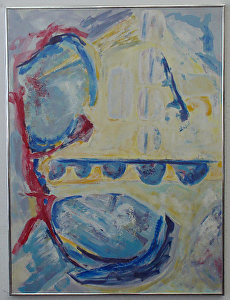

Then I spin past billionaire mansions in gated communities and watch their inhabitants deny workers fair wahes, health care and affordable housing. I pass streets filled with tents and eyeball beggars asking for handouts. I witness illegal farmworkers being emoved by immigration officers while their employers are not fined for hiring them in the first place. Their innocent children live in fear that they will be separated from their parents. If it is so important to remove illegal residents from our country, why aren’t the employers who have become wealthy by their past labor not asked to pay for their resettlement costs? I am curious to discover who will remain working as low pay farm labor and who will make the beds in luxury hotels?

Students of history know that times of peace and prosperity cycle with those of war and chaos. There are eras when demigods, emperors, and kings control the masses and those when the proletariate rise up and rebel. The Magna Carter was the result of one such uprising and our own country rose to expell British rule. China’s dynasties present another example. Each time the wealthy rulers became corrupt the dynasty was threatened, eventually overthrown, and a new government formed. The children of thereformers, would become lazy and spoiled over time and the cycle would start over again. Fascinating? Depressing? Scary? Is this what is happening in our country? Are our leaders corrupt and self-centered? Is this what we are beginning to see throughout the world?

You can’t turn on the news without being blasted with stories of Greece’s fragile economy, removal of the president of South Korea due to corruption, Neo-Nazi’s in the Netherlands, and migrations due to land and resource grabs. We hear that with Brexit, the survival of the European Union is challenged, that pollution in China directly affects our own air quality, that fracking in Oklahoma causes earthquakes, and that overfishing is depleting an important source of the world’s food supply. Interesting times? The merry-go-round continues to cycle with its horses traveling up and down. I ride on it but it is not always fun.

Connected we are, whether we want to be or not. With international banking, mega corporations and trade agreements we left our isolationist past behind a long time ago. Do you know that warming trends have negatively affected coffee growth in Sierra Leone thereby increasing coffee prices in the U.S.? That extreme weather brought on by rising temperatures and changes in precipitation threaten the food we eat, the air we breathe, and the water we drink? Yes, we are a global earth.

Remember the saying “nature abhors a vacuum?” As an anthropology student I was taught that if a poor overpopulated country is located near a wealthier one with a smaller population those living in poverty will soon be pushing boundaries and moving into the country with greater resources. There may be local laws trying to prevent that movement but the laws of nature say that governmental laws will lose in the end because the desire to survive is so great that people will do whatever they can to feed their families.

Countries may try to stop immigrants from coming to their soil but any anthropologist will say that in dire times, need overcomes law. Population movements can’t help but effect the lives of lawful reseidents. Last year 65 million people migrated from war-torn countries and the from those affected by global warming. Severe drought affected livestock and farming and lack of drinking water meant thousands moved or died. Rising sea levels put farmland under water in Bangladesh and the island of Kiribai. What will it be next year? Will we continue to ignore this threat and let people die? What if Manhattan has another severer hurricane that threatens their food supply?

Changing long held thought patterns is difficult. It involves digging for unbiased updated information and a willingness to shift beliefs when presented with new facts. Analysis can be emotional because results often challenge minds that basically want to remain comfortable by clinging to old ways. Still, adapting to change should not be more difficult than learning how to use the latest App. Yet, it is. Strangely, fewer than 50% of American adults believe in evolution. These non-believers view scientists as a threat to their worldview rather than as researches and providers of information from which to reevaluate decisions. Perhaps there is a benefit to clinging on to old ways and thought patterns.

I am an example of a person who resisted using computers when they were first mass marketed. As a museum director, I made sure they were near by but I had other people operate them for I did not want to “waste” my time on the computer. That was a bad decision. Now I realize that staying abreast of social, political, and technological landscapes are requirements for living fully and in the moment. They certainly are a must for any parent educating a child.

Though I often write of how to suvive upheavals, this interesting era is not all terrible. It can be fascinating to put yourself on a merry-go-round when your eyes are open and your heart hopeful for a gold ring to be there to grab. Figuring out underlying causes and developing ways to solve problems can be challenging and rewarding. I am remain ever curious to discover what will happen next. I’d like to return to earth in 200 years and see how this political turmoil will evolve? What is your prediction for the future?

References:

Latest countries formed https://www.washingtonpost.com/news/worldviews/wp/2014/09/16/the-9-newest-countries-in-the-world/?utm_term=.b4297be5a30a

National Center for Science Education –https://ncse.com/node/16774

Effects of Rising Sea Levels –http://www.nationalgeographic.com/environment/global-warming/sea-level-rise/

Global Climate Change, Vital Signs of the Planet: https://climate.nasa.gov/e

NASAffects/ EPA- Effects of global warming: https://www.epa.gov/climate-impacts/climate-impacts-human-health

Please comment below.

Art is always for sale: contact me at marilynne@eichingerfineart.com.

Seeing with Clarity: Recognizing Hope

Seeing with Clarity: Recognizing Hope

Last week I finished reading the Lost Symbol by Dan Brown. His writing style keeps me on edge as he has one mysterious occurrence blending into the next, one clue opening a door leading to a twist in the road that ends with a wall to be scaled. In The Lost Symbol, the topic interested me because it deals with metaphysical questions involving wisdom. Injected into a labyrinth of secrets, codes and hidden truths was a villain who wanted power that he believed came from a single word—one that would give life meaning. At the risk of spoiling the ending, I was surprised that the final revelation was simply the word “hope.”

Words are symbols that can carry deep meaning. And though it has been weeks since completing the book, I have been unable to get this symbol out of my mind. Composed of four ordinary letters, hope elicits more power than I had originally thought possible.

Hope. President Obama wrote a book called, The Audacity of Hope, which contributed to his election. President Trump’s campaign also gave hope, especially to white middle class men who had been feeling left out. Bernie Sander’s did the same for young adults by energizing them to believe that a world based on equality and fairness is possible.

All people want to believe that their lives matter and that their concerns will be taken seriously. Everyone wants to trust that there is a purpose to their existence and that dreams hold promise. But hope only flourishes when we finally accept ourselves and acknowledge that we are enough as we are, even without having billions of dollars. Each is a soul in transition, capable of growth and change so that we can reinvent ourselves over and over again. Just as hope embraces acceptance, it also envelops forgiveness and offers love, for these elements allow for a new start.

During tough times it is difficult to embrace adversity and engage in fighting it. But it is your choice. It is your struggle and your decision to move forward. Believing in yourself as a survivor can help surmount terrible obstacles just as the embracing hope of thousands of people who are willing to fight for democratic values will help our country survive with dignity.

But, there are times when people need our assistance so that they can see a ray of sunshine. Their stumbling blocks may be so severe that hope does not enter their consciousness. For instance, a single mother, living in poverty, raising her children in a drug inflicted neighborhood faces barriers that seemingly have no end. A mentally ill man, experiencing difficulty in getting and keeping a job, may wonder how he will ever house and feed himself. A prisoner sentenced in his youth for years without parole, faces slowly moving minutes without hope for better way forward. An honor role student who watches her mother deported because she immigrated illegally so her children could have a better life may lose hope for her own future. And, it is easy to understand why the 32 million illiterates living within our borders who have little chance for full time employment at a livable wage may despair of hope.

But these people do not have to stay among the hopeless. They too can join the march towards economic security and fulfillment though we may have to give them a boost and help them dig their way out of quicksand that has trapped their feet. If we let them stand on our shoulders they will be able to look over the fence of poverty and entrapment. But, to maintain their hope, what they see must be a land devoid of unbridled capitalism that ignores the welfare of many for the benefit of a few. The sun must shine through air that is healthy to breathe and it must sparkle on streams and green pastures that are maintained for future generations. The fields must be leveled so men and women of all races and religions are treated equitably and without fear of being bullied. The school bell must ring out messages that call all to understand the history of our past and the science and technology of our future so that citizens will want to participate in bettering society.

Once the multitude can see a light shining on tidings that sparkle with promise, then their dreams will compound to add strength to the nation. Hope for a better future is what always brought people to our shores and it is by restoring hope that we will make America great again.

Please comment below on my blogsite.

Artwork is always for sale: Contact me at marilynne@eihingerfineart.com. Seeing with Clarity is acrylic on canvas/ 48″ by 36″/ $ $699.

The Patriot

Feeding Crow
Acrylic on Canvas/ gold frame/ 40” by 30” / $ 599
Each of us is called on to defend our country, whether at war or at peace. The rights granted us under the Constitution and the Bill of Rights are worth defending. It is not something for others to do. We will never agree with our neighbors about every issue but our homeland asks us to accept the tenants of democracy.

Call Me Patriot!

Call me Patriot. No one can take that name away from me, neither the right nor the left. In today’s political climate, the word has become loaded with meaning. I love our country and the people I come in contact with daily, even when I do not agree with their political views. Most are good and generous individuals who are ready to help their neighbors in time of need. And, though I am very upset by many things that our politicians do, I see it as my duty to be involved to make things better for the next generation. It upsets me to hear of acquaintances who want to give up their citizenship and go elsewhere. If we want to live on a kinder more compassionate canvas, then it is ours to paint.

A patriot is defined by Webster as a person attached to his or her homeland. Sadly, at times it is difficult to feel connected to ours, especially when congressional delegates act as children and make it hard to believe they have the best interest of the electorate at heart. Wrapped in their own desire to get reelected, they forget they are part of a family unit that gains strength by working together.

Growing up, each of my children had opinions of their own which did not always correspond with mine. Yet I loved them, tried to consider their point of view, and embraced their goodness despite our differences. We always came to some accommodation that permitted us to live in harmony. I would lay down my life for my children no matter how much we disagree.

When it comes to politics, however, I notice that some, who call themselves patriots, take self-centered positions based on identity with such things as social class, race, religion or gender. They may decide that only those who share their culture, ethnic background, language, nationality of origin, profession or sexual orientation are patriots. The dictionary labels them chauvinist patriots for they carry an excess of patriotism. Laying claim to their political position as the valid one, they speak as if only they have the right to the word. Not so!

I fear they do not understand the intent of the Constitution, Bill of Rights and laws that underpin our national identity. Their love of homeland is based on their own mythology. For instance, section 8 in the Constitution says that Congress shall have power, “To regulate Commerce with foreign Nations, and among the several States, and with the Indian Tribes.” This was written, in part, to insure that treaties with Native Americans are respected. Instead, over the years, when money is involved, self-interest has ignored the clause. It seems to me, that since Native-Americans are identified as nations, our government does not have the right to invade tribal lands. If you were an Native-American, wouldn’t you consider a forced pipeline being put through your territory as an act of war? Wouldn’t a Patriot expect the government to honor our agreements?

The Bill of Rights protects free speech, religious freedom, and the freedom of assembly. It does not give permission to isolate those of any one faith, to make inflammatory remarks, or treat them differently. Internet, though, has ushered in shady behavior, for it allows individuals to overstep the bounds of free speech by inciting malicious behavior. A true patriot would not make disparaging comments because of differences in race, gender, or religion.

And, what about voting? All citizens over 18 have the right to vote. A patriot, in my opinion, would not be gerrymandering electoral districts for their own benefit. They would not put obstacles in the way of minority voters, or treat a corporation as an individual. They certainly would not hack emails or spread false information. Unfortunately, that is not how it is, for power brokers who consider themselves patriots, have found ways to go around the laws of our land. Greed controls actions that are difficult to combat.

Many interpretations of the Constitution and its amendments are based on what we imagine the framers meant. It is impossible to get into their heads but common sense says that their intent was always for the good of the people, most people, we the people. The overall goal has always been fairness.

There never will be complete agreement, which is fine. It makes life interesting. We just need to hear each other and respect minority views as having value. Since we are neighbors and often need each other, why not listen compassionately and act with kindness? All human beings are faced with personal difficulties. Why add hate and anger as burdens? Both minority and majority views can be patriotic if the intent is to improve the homeland and actions are done in accordance with the nation’s laws.

That is not what is happening, however. Even those on dating sites such as Match or Zoosk are adding comments to their profiles like, “not interested in a Trump supporter” or “will only date a Republican.” I never would have been born under those circumstances since my parents supported different political parties. They loved each other and their views never seemed to be a burden as they shared their values with their children. I think I was fortunate to be able to evaluate two opposing points of view and take the best ideas from each side of the isle.

Recently, I have been looking at the faces of some of my friends and they are frozen with fear. Since the cold war days, I have not been privy to such raw emotion. They thought that this was their country and now they feel like they are being marginalized. Being fearful is no way to live in America. My America is the land of the free, and it is my patriotic duty to keep it so.

Violent Storms a’ Comin’

Surf’s Up
Acrylic on Canvas, gold frame, 48” by 36” / $ 699

Violent Storms a’ Comin’

A few days ago a friend of mine went to a Buddhist induction ceremony where Initiates were given a bowl and robe and told that from then on these objects would be their only possessions. Letting go of attachment, being mindful and focused, having kindness and compassion, reducing suffering and increasing happiness they are all that matter. Property ownership is meaningless.

His story made me wonder what it would be like to give up everything I own? I realize that you can’t take objects with you when you die but to possess and create beautify art has always made me feel good. As a visual person, the natural and human-made environments are important to me. Just as I appreciate observing birds in the wild I enjoy putting my hands around a lovely piece of pottery I own to feel ripples in the clay that the potter made when crafting a bowl.

While acknowledging that I was attached to my possessions, I switched the television on to the weather channel where they were reshowing images of the aftermath of Hurricane Sandy. I had never paid a great deal of attention to the trauma that beset the New Jersey Coast but when I heard the newscaster say Barnegat Bay, he grabbed my attention. My family had once owned a summer home on Long Beach Island. Located between the Bay and Ocean, the narrow strip of land bore the brunt of the hurricane’s force. It struck me that no longer can I bury my head and say that losing everything is not a possibility.

During the past two years, several trees landed on my property due to erratic weather conditions and rain saturated land. One smashed through the roof of my house and the second demolished a car in the driveway. In both cases, members of our family were inches away from being killed. Are these violent storms going the be the norm in the future? I decided to explore more deeply why a warming climate produces violent storms that include icy cold winters.

As early as 2007, NASA predicted that increased levels of carbon dioxide would make continents warm more quickly than oceans, resulting in storms becoming more vigorous. On the west coast, an increased amount of rain and snow may solve problems of summer drought as long as there are ways to capture water from saturated grounds that are prone to flooding. Overall, though, the west coast will increase lightning strikes which are prone to start wildfires. Central and eastern states will have their own set of problems. They will be especially vulnerable to more numerous severe storms and thunderstorms like Sandy, Katrina, Andrew and Ike. Social, economic, physical and psychological scars will be left behind.

Doyle Rice, writing for USA Today, reported on proceedings of the National Academy of Sciences. They also say that thunderstorms and violent tornadoes will have “ a robust increase across parts of the U.S in upcoming decades because of climate change.” They predict that between the Rockies and the Atlantic severe storms could increase as much as 40 percent.

“Two primary ingredients are needed to produce severe thunderstorms: The first is the fuel needed for these monster storms to develop — what scientists call “convective available potential energy” (CAPE). CAPE is created as the air in the lower atmosphere warms. The warm air rises, carrying with it moisture to higher altitudes. The second is vertical wind shear, a strong current of wind that helps spin up energy and moisture in the atmosphere.”

The Union of Concerned Scientists continues, “ As ocean temperatures rise, there is also less cold, subsurface ocean water to serve as a braking mechanism for hurricanes. When strong storm winds churn up cold subsurface water, the cooler waters can serve to weaken the storm. But if deeper waters become too warm, this natural braking mechanism weakens. Hurricane Katrina, for example, intensified significantly when it hit deep pools of warm water in the Gulf of Mexico.”

The Nature Conservatory predicts that rising temperatures will cause one-quarter of earth’s species to become extinct by 2050. Ocean acidification, heat waves, droughts, and floods are already endangering species. Poverty, hunger, and disease are among the reasons so many people migrate from their homes in Africa and the middle-east. Warlords in the area fight fiercely to control both oil and water. Without water for crops and animals and when homes are bombed, survival is at stake. What can a family do but seek shelter elsewhere? Though there have always been disasters, an increasing number of people worldwide are a displaced due to war and global warming.

Friends, climate change is not a theory. 97 percent of scientists agree that it is happening and that it is human-induced. Why would anyone but greedy people ignore this information? How come scientists are being forbidden to share the results of Surf’s Up

References:

Global displacement statistics from 1989 to Present from the Internal Displacement Monitoring Center: http://internal-displacement.org/global-figures

NASA predicts severe storms, 2007, https://www.nasa.gov/centers/goddard/news/topstory/2007/moist_convection.html
Rice, D, 2013, USA Today, Study: Climate change pumps up the risk of Severe Storms.

Nature Conservancy on Climate change: http://www.nature.org/ourinitiatives/urgentissues/global-warming-climate-change/threats-solutions/index.htm

Union of Concerned Scientists: Hurricanes and Climate Change: http://www.ucsusa.org/global_warming/science_and_impacts/impacts/hurricanes-and-climate-change.html#references

Works of art are always for sale. Surf’s Up / Acrylic on Canvas, gold frame, 48” by 36” / $ 699Contact me at marilynne@eichingerfineart.com

I look forward to hearing your comments. Please respond below.

How Do You Talk to a Bigot

The Next Generation

Acrylic painting on canvas / in black frame (not shown) / $ 450 / 25” by 20”

Will this couple raise their child to think and reason independently or will their prejudices get passed?
____________________________________________

How Do You Talk to a Bigot?

A man must be excessively stupid, as well as uncharitable, who believes there is no virtue but on his own side.
Joseph Addison, The Spectator 243, (8 December 1711).

In high school, one of my teachers asked the class, “ How do you talk to a bigot?” The question stayed with me these many years for I found it tremendously difficult to answer. Examining his query scared me because so many family members and friends spoke out against those not made in their own mold.

In the 1950s and 60s, anti-Semitism was rampant as was hatred towards those of color. When Kennedy sought the presidency, wildly disparaging remarks were made against Irish-Catholics and the Pope. In nightclubs and on television, comics made fun of everyone by calling them Dago, White Trash, Paddy, Mik, Hun, Redskin, Honky, and Chink. The audience laughed. These words were part of common parlance and unflatteringly spoken in living rooms nationwide. Movies reinforced cultural differences by mocking minorities by using character actors who supported common prejudices. During my student years, so many people spouted self-aggrandizing beliefs that put others down that I could not imagine a way to turn their minds and hearts around.

In looking back, I realize that we have come a long way towards overcoming prejudice. No longer do we have segregated bathrooms based on racial identity though we still are not comfortable with sexual deviations. There are no black-faced minstrels dancing like children on stages nor are religious slurs tolerated in the media. Recent events, though, have made me realize that bigotry went underground and has not gone away. Many of us are surprised at the rise of the KKK and Arian Brotherhood who never accepted the idea of the United States as a melting pot of people with diverse backgrounds as an advantage to making the country strong.

Family gatherings are a time that brings to the forefront differences. Some friends complain that family members accept them with smiles to their face but then joke and make racial or sexual slurs when they leave the room. A few of my southern acquaintances mention more overt snubs. With self-righteousness and beliefs in their own superiority, they have relatives who liberally sprinkling sentences with words like faggots and Niggers. Families have been known to break up over such differences.

Bigotry, as defined in Webster’s, is “the stubborn and complete intolerance of any creed, belief, or opinion that differs from one’s own.” Ignorance and fear are two powerful allies of bigotry that seem to be on the increase. Bigoted people ignore the reality of diversity and cover themselves with security blankets to suppress their fear. They irrationally discriminate against those who are different and play on emotions rather than logic. Belief is elevated above thought and credence is given to lies before investigation. The possibility of error is beyond their imagination. Yet, their absolute acceptance that they are in the right causes a lot of pain.

So how do you get rid of bigotry? Eliminating bigoted beliefs often means giving up power which makes many people feel uncomfortable. What do you do when family or friends are the ones promoting disparaging statements? How can tolerance be encouraged and ignorance overcome? Is there a possibility for open, honest communication or do you just have to turn away from those who engage in hateful banter?

Doing nothing is not a good enough response for those living in a democratic society. Democracy only thrives when there is open and honest communication, a willingness to compromise, and an agreement to live by consensus or majority agreements.

I have gathered several suggestions on how to respond to a bigot.

1. Speak up to let the person know how you feel about their extremist remarks. Then walk away if racial, ethnic, or religious slurs continue.

2. Find several like-minded people willing meet the offending person at a less emotionally charged time in order to engage in an educational discussion. The meeting can not be confrontational but rather based on shared feelings that speak to fears and prejudices. Facts that counter long-held prejudices will only be heard if the discussion is non-threatening.

3. Decide in advance how important the relationship is to you and if you are willing to leave if the situation can not be resolved? If you come from a household where bigoted behavior was accepted, acknowledge it, but let your family and friends understand that as an adult you have learned to respect others. If your community is not a loving and respectful one, consider moving to one that is.

4. Don’t expect prejudiced people to instantly agree with you, but do expect that in your and your family’s presence offending statements will not continue.

5. Remind yourself that bigotry is not a political issue. It usually is passed on from one uncritical generation to the next. It exists across party, religious and state lines. It is in your backyard and cannot be ignored.

Comments by others to give you pause for thought:

“I ask you to uphold the values of America, and remember why so many have come here. We are in a fight for our principles, and our first responsibility is to live by them. No one should be singled out for unfair treatment or unkind words because of their ethnic background or religious faith.”
George Walker Bush, Freedom and Fear Are at War: Address to a Joint Session of Congress and the American People (20 September 2001).

“Perhaps travel cannot prevent bigotry, but by demonstrating that all peoples cry, laugh, eat, worry, and die, it can introduce the idea that if we try and understand each other, we may even become friends.”
Maya Angelou, Wouldn’t Take Nothing for My Journey Now (1993), p. 12.

“God deliver us all from prejudice and unkindness, and fill us with the love of truth and virtue.”
William Ellery Channing, “Unitarian Christianity”, an address to The First Independent Church of Baltimore (5 May 1819)

“I know a good many people, I think, who are bigots, and who know they are bigots, and are sorry for it, but they dare not be anything else.”
Edwin Hubbell Chapin, Living Words (1869) p. 125

References:

https://en.wikipedia.org/wiki/Sinophobia#Derogatory_terms> – List of derogatory words.
http://www.lifehack.org/articles/lifehack/bigotry-ignorance-and-fear.html _ About Bigotry
http://www.amnottheonlyone.com/how-to-deal-with-bigotry-among-family-and-friends/
– Bigotry among friends and family.
https://www.splcenter.org/20150126/speak-responding-everyday-bigotry– Southern Poverty Law Center- Speak Yup: Responding to Everyday Bigotry

Going Viral

The Gossips
acrylic on wide canvas/ 12” by 36” / $ 325

Going Viral

In 1972 I was developing my first museum, Impression 5 Science Museum in Lansing, Michigan. It was frustrating, in part, because I did not know what I was doing. I certainly was naïve! It was also exciting because my university friends and I would brainstorm ideas for exhibits, go into our work rooms and make devices that explained science. We took the results of our creative endeavors (not always well made) to schools and shopping centers. Our goal was to eventually create a hands-on place for children and adults to play creatively with science and the arts.

This effort was done under the radar of the press until a newspaper reporter wrote a small article about the fledgling museum. Once in print, our project was legitimatized and I became swept into a maelstrom of activity and purpose. A few people did come forth as a result of the article but not much happened because I did not have money and did not know who or how to ask for it. Though determined, was very inexperienced.

My girlfriend and I went around town talking to community leaders about our project and people listened politely. The mayor’s assistant said I had to wait in line for my project to be considered and that might take five years. The man in charge of the YMCA told me that our museum would not get off the ground because “there were only two things that were important, one was sports and the other was sex.” Impression 5 was about neither.

One frustrating day when I was at my desk which a kind school let me occupy when not being used as a lunchroom, I read that Playboy Bunnies would play sporting events with local celebrities to raise money for charity. Wow! Sports and Sex! I had it made. I called up the Detroit club and sure enough, they were willing to play basketball against our community leaders. In those days the leaders were all men. I invited school superintendents, the mayor, the head of Oldsmobile, the university president, real estate moguls, and other community businessmen of note and money to join the game. No one man turned me down. We acquired Jennison Field House at Michigan State to hold the game and plans were under way.

Except. . . a small article appeared in the editorial section of the newspaper saying that a group of women objected to the game. This was a time of awakening at the start of the women’s liberation movement and sensitivities about women’s issues were mounting. An organized group from the high school and university planned to picket the event causing a few of our volunteer players to opt out of the game.

To prove I was not supporting male chauvinism, I called Michigan State’s Women’s Basketball team and asked them to help as a practice team. They agreed. Six women played in the practice game causing our volunteer men had to be rotated every few minutes to avoid having a heart attack. The difference in skill level was incredible.

The more tried to soften the women’s issue the more newspaper articles fanned the controversy. We didn’t know what to do. Should we cancel the game or proceed surrounded by pickets? Ticket sales were dismal.

Mother nature helped us make the decision. The night before the game it started to rain, and rain, and rain. Rivers flooded their banks and the field house court was drenched in two feet of water. The entire town was needed to sandbag riverbanks.

We never did have the charity event but the museum got under way. It was this event that taught me that that bad publicity is more likely to get people’s attention. The museum concept had gone viral. People loved the idea of the museum but they enjoyed the controversy over women’s rights more and followed arguments in detail. By the time the flood ended, Lansing residents knew about the fledgling science and art museum. Many were ready to join our effort. Impression 5 Science Museum now thrives in its forty-fourth year.

Today, when I think about the false information that is widely being circulated through the media, I remember the lessons I learned so many years ago. The difference is that when information goes viral through the net, it travels faster and is convoluted much like the childhood game, “whispering down the line.” The story changes slightly each time it is repeated until the listener turns it into what he or she wants to hear. A lesson to us all. Beware and check facts so misinformation is never passed on.

Stories about the start of the nation’s hands-on museum movement can be found in Lives of Museum Junkies. Any new venture takes perseverance, dedication and a willingness to learn from your mistakes. I would love to hear  your experiences in embracing a new enterprise, whether it is a club, hobby or business. Did you succeed? Fail? Learn? How did you spread the word?

Please share your comments below.

Artwork is always for sale: Contact me at marilynne@eichingerfineart.com.
________________

Lives of Museum Junkies: The Story of America’s Hands-On Education Movement
Available at Powells Books, Annie Blooms Books, MAC Emporium, Broadway Books, and on line at Amazon and Barnes and Noble.

SAVE THE DATE: February 9th – Annie Blooms Books, Multnomah Village, Portland, OR – Book talk and signing for Lives of Museum Junkies. The event starts at 7 PM.