Social Isolation-a Crisis of Our Time

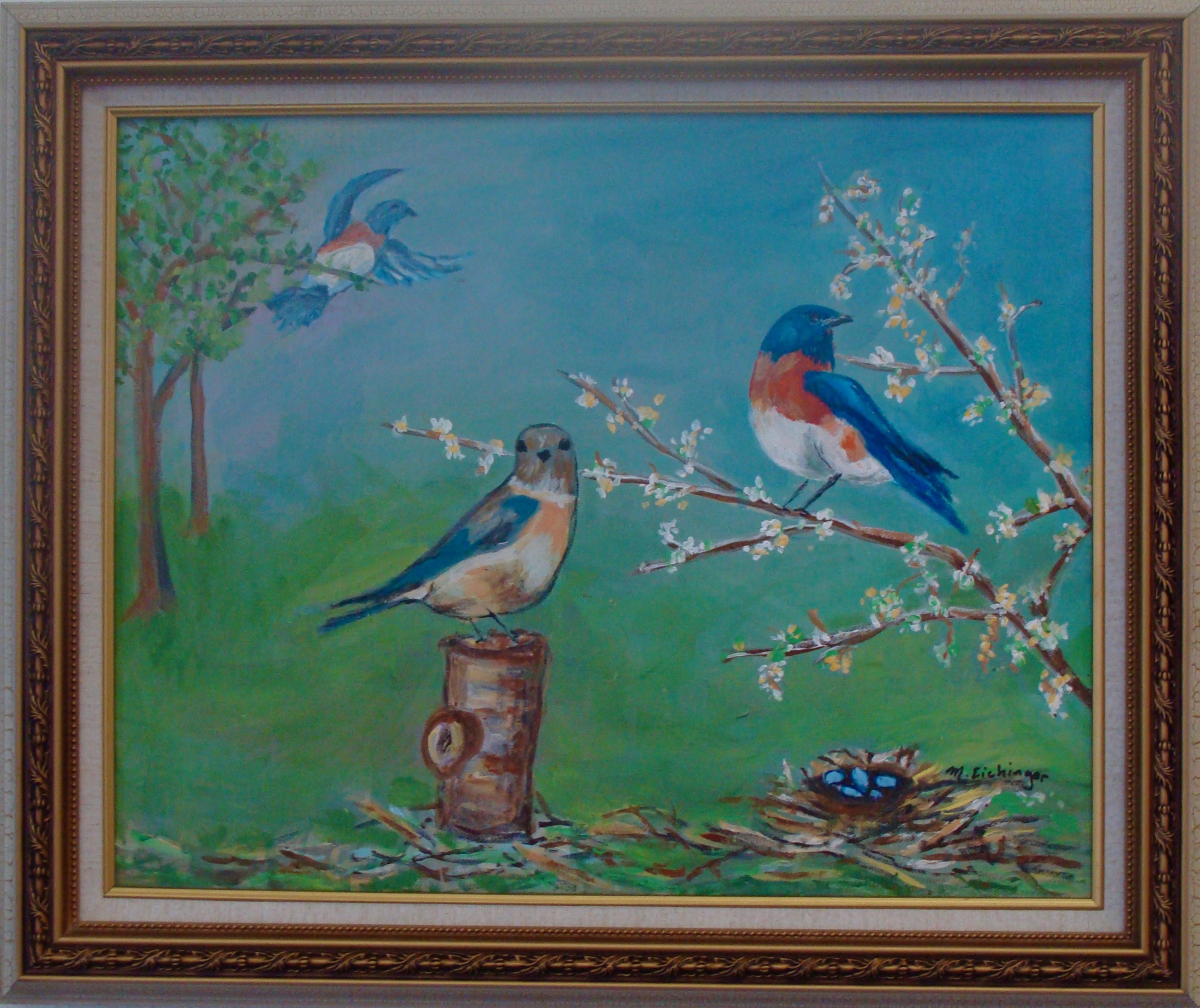
Western Blue Bird
It is spring, when birds join together to produce and care for their offspring. All creatures have a need to be connected to others of their kind.
Acrylic on canvas/ framed/ 20.5” by 24.5”/ $375

Social Isolation – a Crisis of Our Time

Most recently, an elderly acquaintance was alone in a hospital room when his heart stopped beating. There were no friends or family around to hold his hand through his illness nor to mourn the moment of passing. When younger, this man led a vibrant, engaged ilife. He loved to travel, give thought provoking talks, party with friends, and enjoyed interacting with a wide circle of work contacts. By his waning years, however, most close friends were gone and he was left stranded alone. He had no children and his few relatives were either ill or had died years earlier.

Serving as a lay ministry at the Unitarian Church in Portland, made me aware of the large number of people who are socially isolated. About one-third of Americans over 65 are alone with their anxieties, depression, and health issues. The friends and family members they assumed would always be there to help them as they aged, dispersed throughout the country and are unwilling or unable to care for their needs. No one calls or stops by their home to chat. Those without children, peers, or counselors  are not able to share the ups and downs of life.  Feelings of loneliness often become a trigger, accelerating cognitive decline and premature death.

As a stuendt of human behavior, however, I am aware that social isolation is not exclusively a problem of the elderly, for it increasingly plagues youth and middle aged Americans. Health professions consider it a growing epidemic with severe mental, physical and emotional consequences. Some of their studies show childhood isolation to be the cause of poor health twenty years later.

In the United States, adults become isolated for many reasons. When moving to a new community because of a job opportunity, many people become immersed in their work, not realizing how important it is to reestablish close friendships. In other instances, it is friends or family members who do the moving, leaving the person behind with feelings of abandonment. Drug addiction, mental illness, sexual orientation, abuse and poverty cause some people to turn inward rather than share the embarrassing truth of their situation. Their problems are likely to push close acquaintances to withdraw their love and support. After all, who wants to deal with a drug addicted friend or one who is depressed? Not fun.

My greatest surprise was to discover the growing problem middle aged men face with loneliness. According to studies by Judy Chu and Niobe Way, obesity, smoking or lack of exercise are not the biggest threats to middle aged men, but isolation is, and it threatens their health. Their loneliness is linked to increased risk of cardiovascular disease, stroke, and Alzheimer’s. I started to wonder how active men slide into social isolation so I did a bit of investigating. What I discovered is certainly not true of all men, but the number experiencing isolation is increasing at a rate that is alarming to health professionals.

What I learned is that when men are in their thirties and forties, their high school and college buddies start taking a back burner to work and family. Male contacts become limited to those whose paths they accidentally cross while at work or in the locker room. Not nurturing friendships with men initiates their slow drift into social isolation. Their tendency is to have more casual relationships which are harder to maintain. According to a Boston Globe article, a contributing factor is a belief that talking about personal matters with other men is not manly.

Adding to their difficulties are changes in the job market that cause growing numbers of men to lose employment while in their fifties. In some cases, advancing technologies make their skills obsolete. Those employed in physically demanding jobs develop aches and pains as their bodies wear out. Without work, they feel rejected and marginalized and no longer needed. Years of focus on work left little time to develop hobbies, relationships, or for involvement in meaningful community activities. Not knowing how to occupy their time initiates a downward spiral that leads some to drink, take drugs or sit around the house all day watching sporting events.

To prevent this progression from happening, it is important to develop and maintain activities with other men. Bonding relationships need to be nurtured and strengthened over time. Unlike women, who can keep a friendship by simply talking on the phone, in general, men become closer when sharing activities. Hooking up with others to play cards, attend sporting events, or go hiking is more comfortable. Since childhood they have been taught not to show or talk about feelings. Relationship building, however, requires sharing and a willingness to show strong emotions. Men who avoid social isolation are those who overcome homophobic fears and make time for male companionship.

When women feel isolated they become lonely and depressed while men in a similar circumstances are more likely to become angry. A Psychology Today article notes that married women are lonelier than their husbands, but men feel lonelier when they are single. Makes one wonder about the reasons for marriage.

Since women tend to be more social and concerned about the quality of one-on-one relationships, they often maintain closer contacts outside of romantic ones. However, the links they have to other women are few and the label “friend’ is applied sparingly. Therefore, when a close relationship sours, it is felt deeply and its end is mourned for a long time. Though depression often follows, most women seek out someone with whom they can share their feelings.

Men react differently by staying silent and keeping their emotions bottled inside. Their feelings of alienation are lessened if their friendship group is dense. The group is their buffer to the loss of a close friend.

Being connected to others is a fundamental human need. According to AARP’s Loneliness Study, 42.6 million adults over age 45 suffer from chronic loneliness. 1/4th of the population lives alone. 1/2 are unmarried, and over the past half century the number of children per household has declined. Multi generation families no longer stay together. But the need for human contact is as strong as it ever was.

In order to avoid health pitfalls caused by isolation, society will have to give greater prioritization to human connectedness. It will help to start social skill training in elementary grades with programs continuing through high school. The medical profession can also help by encouraging their patients to maintain active social lives. Preparations for retirement should focus on social as well as financial well being. Community developers can play a major role by promoting shared social spaces that encourage gathering and interaction. Recreation centers, community gardens, tennis and bocce ball courts, community art centers should be within easy reach of everyone.

Social isolation is  a major public health threat in need of serious attention

References:

Khullar,D. (2016) How Social Isolation is Killing Us. The New York Times. retrieved from https://www.nytimes.com/2016/12/22/upshot/how%2Dsocial%2Disolation%2Dis%2Dkilling%2Dus.html

Ashbrook,T. (2017) Middle-Aged Men Need More Friends. On Point http://www.wbur.org/onpoint/2017/08/22/middle-aged-men-need-more-friends

Green, M. (2017) The Terrible Price of Our Epidemic of Male Loneliness. The Good Men Project. retrieved from http://www.wbur.org/onpoint/2017/08/22/middle-aged-men-need-more-friends

Asatruam.K. (2016) 3 Surprising Truths about Gender and Loneliness, Psychology Today. retrieved from https://www.psychologytoday.com/us/blog/the-art-closeness/201601/3-surprising-truths-about-gender-and-loneliness

American Psychological Association.( 2017) Social isolation, loneliness could be greater threat to public health than obesity. Science Daily. retrieved from https://www.sciencedaily.com/releases/2017/08/170805165319.htm

My Hope for Wisdom


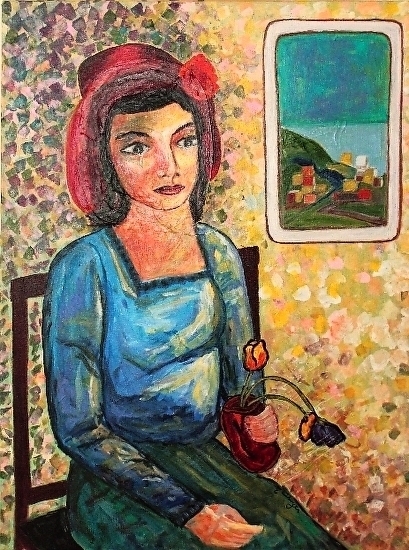
Down Covered Baby Owl with Mother (sold)

Is an owl wise? According to western folklore, the owl is wise, silent and solitary. It is associated with lunar deities—symbols of wisdom. It is also the animal representation of Athena, Greek goddess of wisdom. In India, however, owls are considered dumb and foolish. They have a small brain for their size. It may be that their big eyes and a serious look make them appear smart. Their laser-like vision and excellent hearing allows them to easily catch prey.

Hope for Wisdom

“Between hope and despair, choose hope. It is harder to bear.” These words written by Boris Novak speak to me. They seem especially poignant in a time of discord when so many people wonder how to blend divergent view points. Hope. . .for wisdom.

All of my life I’ve dreamed, wished, and hoped. When I was young I hoped to get older quickly, when older, to feel younger. As I aged, I wanted to be wiser.

I didn’t have to do much to bring about my first wish. Birthdays marking the way were not under my control. Feeling younger was another story, one that required work. Exercise, turning away from ice cream sundaes and eliminating stress remain ongoing challenges.

But wisdom—that is my elusive hope. How does one go about becoming wise?

Wisdom has been defined as a process of integrating experience, knowledge, and good judgement. It involves accepting the uncertainties of life and knowing how how to make decisions that maintain a sense of balance. In general, wise people are optimistic, believing that life’s problems are solvable, and thus they are calm when faced with difficult decisions. They are able to see the big picture and to apply a sense of proportion to the situation. In other words, they have the ability to think.

ome think of philosophers as wise, in part, because they were the first to coin the name Philosophy that implies that they are smart thinkers. The word comes from Greek roots, philo-sophia, which means “a friend of wisdom. Philosophers supposedly practice their love of wisdom.

Men like Socrates, though, struggled with wisdom, believing that it starts with wondering about a topic and later admitting ignorance. Knowing the limits of knowledge is difficult. Socrates once said, “I do not think that I know what I do not know.” Socrates was humble and was aware that many of his beliefs were uncertain. Time might well prove them wrong. He thought true wisdom could only be only possessed by the gods, not human beings.

Despite Socrates nixing mortal wisdom, I still hope to become wiser with age and wondered how to go about doing so? Studying the attributes of those I consider  wise was my starting point. Each person I investigated was certainly well experienced. Some were old and others young but all were kind and insightful beyond their years.

Wise people are like sponges, soaking up lessons wherever they go. They also are able to see the obvious, that which is right in front of them, their relationships, and knowledge of their own mortality. They engage in mind games to balance self-interest with that of others and they look at both short and long-term perspectives. Wisdom brings with it the ability to adapt to changing situations and environments.

People who live long lives are survivors. They probably had to face one type of trauma or another at some time along the way but they didn’t succumb to their difficulties and become depressed, instead they grew from their situations. They relied unashamedly on the strong support network they previously assembled to help them through bad times.

Most of us see those who are wise as compassionate and tolerant of differences. They spend time seeking self-understanding which helps them recognize boundaries that separate their own biases from those of others. They accept that each person lives at the center of his or her own universe, realizing that individuals see, have goals and priorities, and make responses that vary from their own.

Having wisdom has many benefits besides the ability to make good decisions. Psychologists associate it with higher life satisfaction, better relationships, less depression and fewer negative feelings. Though not related to intelligence, it is related to a level of well-being. It is also interesting to note that wise actions can be influenced by relationships. People tend to be wiser among friends who help them see other perspectives—the big picture.

Now that I  put words to my desire for wisdom, it is up to me to be so. It will not be easy. Gathering facts, reflection and analysis of even the smallest decision. takes time. Judgements will have to include the impact my decision will have on others. Will my footprints contribute to the greater good?

If I hope to be wise, perhaps, like Socrates, acknowledging how little I know will be my first step.

References:
Brindle, B. (2018) 10 Wildly Wrong Animal stereotypes. How Stuff Works. retrieved from https://animals.howstuffworks.com/animal-facts/10-wildly-wrong-animal-stereotypes7.htm

Wisdom: 2018. All about Wisdom. Psychology Today, retrieved from https://www.psychologytoday.com/basics/wisdom

Westacott, E. (2017) Socratic Wisdom. Thought Co. retrieved from https://www.thoughtco.com/socratic-wisdom-2670665

Rusnell, Q. (2016) If Philosophy is literally the love of wisdom, then how do you define wisdom? Quora. retrieved from https://www.quora.com/If-Philosophy-is-literally-the-love-of-wisdom-then-how-do-you-define-wisdom

Pearson, C. (2014) 7 Secrets of Wise People ( And How to become one . . . Now) Huffpost. retrieved from https://www.huffingtonpost.com/2014/04/08/wisdom-tips_n_5086606.html

Hammond, C. (2017) What is wisdom? And can you learn it? BBC. retrieved from http://www.bbc.com/future/story/20170124-how-to-be-wiser

Five years to grieve?

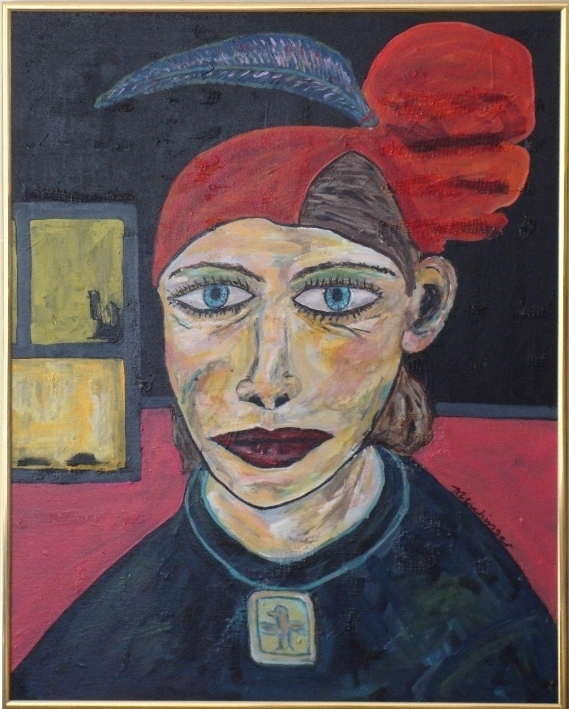
EVA
Acrylic on Canvas/ 40” x 30″ / $599.00 USD

A tear rolls down her cheek as she wonders what the future has in store for her.

Five years to grieve?

Grief. It happens to us all at one time or another so we should not be surprised. People die, friends move, divorce occurs and accidents change lives. How we deal with grief is the challenge, for loss can be enormous and almost unbearable.

When my mother died in an automobile accident, I cried uncontrollably for days. Her death was so sudden and it took years before moments of intense sadness stretched into weeks and eventually months. Forty years later, I still miss her. Divorce affected me similarly, for it was also a death. I plunged into darkness and it was a good five years before I felt warmth in the light. In both cases, however, I continued living fully with the expectation that happiness would return one day to fill the empty pit in my gut.

When mass shootings occur, I grieve with the families for nothing can prepare a parent for the loss of a child. They must feel as though a piece of them has been taken away.

When a friend lost one of her twin babies shortly after his birth, she sank into a depression even though she hardly knew the child and still had one lefte to care for. Her psychologist aid that it was not unusual for grief to last five or more years and advised that she continue her activities until they once more came naturally.

Death of a close friend can be as devastating as losing a sibling. Feelings of abandonment, loneliness, fear and insecurity coalesce with sadness and grief. If the friend has shared life changing events with you, their loss can be so severe that it affects daily living. A roller coaster of emotions can give way to numbness and lack of energy. When a sibling dies, those remaining have to reorder their relationship with those still alive. Feeling a loss of innocence is common as is guilt for having survived.

When a grandparent dies, it may be the first time a chid encounters the death of someone significant. Intense surprise or shock may induce sadness, anger, rage, and a insecurity. Though the intensity of losing a grandparent or sibling may be great, oft times sympathy and caring offered by friends and family is inadequate for the grieving child’s need.

Sad emotions do not go away easily. Unfortunately, many supportive people distance themselves after being around a depressed person for a period of time. In many cultures, laws and customs push grieving people into new roles before they are ready. Religions and cultural groups, attempting to regulate the process are more likely to do so with widows than widowers.

According to my father, Jewish men are supposed to remarry at the end of a year of mourning. His friends began suggesting he do so even before my mother’s funeral was held. According to Jewish law, “The duty of marriage is discharged after the birth of a son and a daughter (Yeb. 61a). Still no man may live without a wife even after he has many children (ib.). Women are exempted from the duty of marriage, although, to avoid suspicion, they are advised not to remain single (ib. 65b; “Yad,” l.c. 2, 16; ib. Issure Biah, xxi. 26; Eben ha-‘Ezer, 1, 13; see Woman)”.

In the old days, when a man died without leaving children, his brother had to marry the widow. The custom was a way of insuring economic security. It is still the law in Israel today, though not always practiced. A woman and brother-in-law who choose not to marry are supposed to participate in a ceremony where the woman kneels, removes a special handmade shoe from the man’s foot, spit on the ground next to him and recite a verse that frees them from their obligation to marry.

Death does not always end the marriage. In India, for example, widowhood can mean a “social death.” Without a husband to support their children, widows lose their status and are consigned to the margins of society. In recent times, most countries have enacted laws to protect women but customs in religious groups may take precedence. Some Hindu women shave their heads, no longer wear a red dot theirr foreheads, and will not display jewelry. In the old days she was expected to walk barefoot. Thank goodness the custom to throw herself on her husband’s funeral pyre is outlawed.

In some third world countries such as Nigeria, a woman is expected to have sex with her brother-in-law or another male-designate after her husband’s death. This ritual cleaning by sex is supposed to ward off evil spirits and keep her children from suffering. Though most women find the practice repugnant, refusal can subject them to violence. They may be forced to drink water that the corpse has been washed in, confined indoors for up to a year, prohibited from washing their bodies for months, and be forced to sit naked on a mat, ritually crying and screaming at specific times, day and night.

Orthodox Christian women living in parts Russia, Czechoslovakia ,Greece, Italy and Spain customarily used to wear black for the remainder of their lives after losing a husband. Though this practice has mostly died out, there are Immigrants to the US who still don black as a show of devotion.

Christians often ask religious leaders if they stay married in heaven after death. The idea provides solace to those who have been in long time committed relationships. What I read says that a woman is free to marry if her husband dies. According to Jesus, in Luke 20:34-36, there are no marriages in heaven. Marriage is a legal contract and does not make it to heaven, for according to the bible, “marriages here are a foreshadowing of the event that is to come when we are joined together with Christ our God forever.”

Muslim customs can vary by community. According to Shykh Saalih al-Munajjid, after death the widow has to practice Iddah, and wait four months and ten days before remarrying. Husbands are instructed to bequeath a year’s worth of maintenance and residence in case of death. During the time of mourning a widow may not wear decorative clothes, apply kohl to her eyes, use perfume or sleep outside her house unless afraid for her own safety. She is still required to take care of the shopping, cooking, cleaning, laundry, children, etc. If a family member other than her husband dies then mourning lasts no more than three days.

Psychiatrists in the United States tell us that grieving is a process that is uniquely different for every individual. Grief tends to come in waves of emotions that move between anger, disbelief, sadness, and even happiness. Kubla-Ross, in her pioneer study of death, spoke of five stages to grief, not necessarily in a specific order. She mentions denial and isolation, anger, bargaining, depression, acceptance.

Sometimes grief leads to an untimely death of the remaining partner. Known as the widowhood effect, mortality rates are known to rise during the first three months of a spouse’s death. As one spouse’s health declines the surviving person may stop taking care of his or her own health and becomes ill as well. Men, over 50 are at greater risk than women, though income and wealth do make a difference. Without the support of family and friends, lifestyle habits tend to worsen. Men especially, eat poorly, forget to take medications, stop exercising and do not sleep well. They are less proactive than women in seeking solace.

I wrote this article because a number of my friends have recently lost loved ones and I want them to know that I am here to support them for as long as they need me. One thing I am trying to absorb as I age is patience, but I also know that those who dwell too long on their miseries find it hard to over come them. Making motions towards normalcy can be a difficult first step towards healing. Engaging in a cause, like gun control or raising money for cancer can also help with the healing process. It is a way of turning tragedy into a meaningful endeavor that will positively affect the next generation.

References

Schecter, S. & Greenstone,J. (1906) Marriage Laws. Jewish Encyclopedia. retrieved from http://www.jewishencyclopedia.com/articles/10435-marriage-laws

Death and Dying (2018) Widows in Third World Nations. retrieved from website http://www.deathreference.com/Vi-Z/Widows-in-Third-World-Nations.html

A Voice in the Wilderness (2011) Marriage after Death: Can we be married forever. retrieved from https://heraldinthewilderness.wordpress.com/2011/05/03/marriage-after-death-can-we-be-married-forever/

Saalih al-Munajjid, M. (2018) Rulings on the mourning of a woman whose husband has died. Islam Question and Answer. Retrieved from https://islamqa.info/en/2628

Condolence (218) What are the Stages of Grief? Learning Center. Grief and Coping. retrieved from http://www.econdolence.com

Jegtvig,S (2013) Widowhood effect strongest during first three months. REUTERS. retrieved from https://www.reuters.com/article/us-widowhood-effect/widowhood-effect-strongest-during-first-three-months-idUSBRE9AD0VU20131114

Do comment below. Your thoughts are intersting and always welcome.

Art is always for sale. Please contact me at Marilynne@eichingerfineart.com.

Honored Citizen Pride


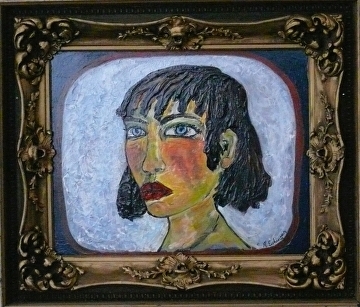
 Delilah
Acrylic on Canvas/  30” by 24”/ gold Frame/ $ 750
What are her thoughts? What does she live for? When she looks in the mirror does she find her youth or only wrinkles?

Honored Citizen Pride

Shortly after my company sold, I spoke to a doctor about retirement.  I mentioned that I was worried that I would shrivel up and die within the year.  His response was a belly laugh and then, after wiping his eyes, he said that I wasn’t the type–I had too many interests outside of work. “But,” he continued, “some people do whither away.  Since they never had hobbies and spent little time developing friendships, they become couch potatoes, age quickly and poof—they’re gone.”

When still employed , I kept a to-do list on my desk that kept me organized. That habit did not stop with retirement.  Once the big decision was finalized,  I put together an exciting plan to carry me through the next several years.  I wanted to learn to write well and to improve my artistic abilities in order to share  thoughts, ideas, and yes—wisdom.   In order to become more accomplished, I knew it would mean hard work, for I had few years remaining to live.

I’ve had a hell of a life—ran two non- profit museums, founded a for-profit catalog company, raised five children,  loved eight grandkids, adopted a street youth, and traveled extensively. Why not share my good fortune with the next generation?  Perhaps I can keep a few young souls from making the same mistakes I made. I thought that if I passed on everything I  learned during my life-journey then they would have a head start to improving society.  I fear that in many ways, my peers and I failed.

Armed with this purpose, I vowed to become a better listener, act compassionately, speak judiciously, and spend more time with family and friends.   Then one day, several unhappy thoughts popped into my head.  Does anyone want to listen to an aging lady?  Is my advice welcome or seen as interference?

The young people I meet today are busily immersed in their own challenges, and don’t seem to mind making mistakes.  They want independence and to be allowed to fail, though they do relish encouragement to try again. They see the world through a slightly different lens than I do.  Yet, they act similarly to the way my son did when, at 15 months,  he learned to climb stairs.  Each time I put him at the bottom of our carpeted steps, he took the climb as a challenge and went at it with a vengeance.  There was no stopping him. He was determined  and single mindend as he climbed to the top over and over again, never fearful of falling.  When I went to take him to another place he cried so hard that we stayed put for almost an hour.  I turned him bottom first so he could climb down as well as up.  My hands were always in place, ready to catch him.

Perhaps the real test of wisdom, is not sharing what you know but rather creating  possibilities for others to discover on their own. It means stepping back into the shadows, yet remaining as an available safety net in case of a fall.  The same son, now and adult, recently told me that the reason he was able to take risks at work, was that he knew that neither his father nor I would let him starve or go homeless. We were a security blanket folded in the back of his mind that allowed him to soar.  Interestingly, our role was simply to witness and applaud his successes and commisurate with him about his failures.

Now adults, my children do not need me. They are independent, well launched, travel their own roads, and do so with gusto. Most have families to care for and don’t live nearby.  I am at the edge of their thoughts, and when we get togethers it is as companion and friend, not parent or teacher.

Since I don’t have to work, raise children, babysit grandkids, or even decorate the house, what keeps me ticking?  I like learning.  I don’t want to be a dinosaur stuck in the mud to be covered and fossilized.  Reading, thinking, traveling, analyzing, embracing change—and yes sharing ideas, especially when I get a response, give me energy.

Secondly, I like helping the young people I come in contact with achieve their own dreams.   What fascinating challenges they have as they move through a  technological, social media connected world and what wonderful enjoyment I derive from watching them!  It is hard to keep up with their comings and goings.  Lucky me.   I plod on, a little wiser—maybe, a bit more silent, always older and seeking the truth in all things.  ______________________________

Do share your thoughts about aging below.  There are many times when we are called on to rethink our purpose in life. What is yours?

Art is always for sale. Contact me at marilynne@eichingerfineart.com.

Strange Customs of “The Others”

In Ecuador, babies are carried in shawls on mother’s backs. In Rotterdam, buildings swerve and jut looking like Escher configurations that can’t possibly stand. In Scotland villages are small and streets walkable. In New Orleans balconies hold diners above parading revelers. In Eastern Oregon, the land is vast. In Pueblos, Natives walk on roofs to visit neighbors.

Strange Customs of “The Others”

An acquaintance shared his experience of being the first white person to own a home in a black Portland neighborhood. He was welcomed into a friendly community of people who relaxed on their front porches and chatted amicably with those wandering by. He knew and counted as friends most everyone living on his block. Twenty years later, he speaks longingly of that time. When gentrification came and Black-Americans were pushed out of the neighborhood, the new owners kept to themselves. Today he knows no-one on his block. It is a different community with a different culture—one he does not like as well.

The first time I was fully aware of the subtleties of cultural differences was in Lansing, Michigan. To support the Urban League, my husband and I attended a fundraising dinner, arriving on time to an empty hall. When the meal was served, one token man of color joined our table set for 8. I felt sorry for the director because attendance was so disappointing.

But—not so quickly—I misjudged. By eleven that evening, the place was packed with elegantly dressed men and women enjoying themselves on a crowded dance floor. Party goers arrived after dinner and stayed into the wee hours of the morning.

A few weeks later I sat next to a professor of back studies at George Washington University while flying to D.C. When I mentioned the Urban League event he laughed and told me that the custom to arrive late originated in Africa where people walked miles, sometimes days, to attend a wedding or funeral. It was impossible to predict what time guests would arrive.
Once aware of this custom, I was not surprised to receive an invitation to Magic Johnson’s birthday party with instructions saying, “Doors open at 6 and close at 7. No one will be admitted after the hour.” The party planners did not want an Urban League type response accommodating late arrivals.

There are many cultural differences that are learned during childhood when we ingest social mores, biases and misconceptions from our community (tribe). Composed of family and friends, our tribes are influenced by location, religion, race, and sexual orientation. We became locked into these early indoctrinations.
To overcome these biases it is helpful to think like anthropologists who meet newcomers as a subjects of interest. They explore customs and values, and learn how people function in their particular culture.

So many of us are uncomfortable and afraid to make a blunder that we prefer to judge “others” as inferior rather than have to accept their differences. By taking this path, however, we make mistakes and at times develop enemies.

Ignorant missionaries who burned Native American totem poles in the 19th century is a case in point. These evangelists thought the poles were religious objects replete with animalistic gods. They didn’t understand that they were either lineage poles serving as a family crests or story telling poles featuring animals from tales similar to Aesop’s fables. Their ignorance turned into a rampage that destroyed well crafted art and denied a peace loving people their cultural heritage.

Who is the potentate to decide who and what is superior?

In my twenties, I ran a summer Montessori program in a low income neighborhood. During a teacher conference one mother refused to face me. I was uncomfortable for I was trained to always look a person in the eyes while communicating. When the woman responded to my questions, she glanced sideways, answering in monosyllables. I interpreted her actions as lack interest in her child. It was years before I understood that she was trained to never look a white person in the face. She was being respectful and I was being—well not sure, but at the time I extrapolated to the larger race and harbored negative feelings about poor black women not caring about their children.

Childhood indoctrinations create subtle social tensions. It was not until I lived in Great Britain that I felt like an American. Why? Because in the United States I was identified by others as being Jewish first. This conviction was reinforced often, such as when my husband and I stepped into a Massachusetts real estate office and asked an agent to help us find an apartment near Boston College. The woman replied, “you don’t want to live in this neighborhood. You’ll be much happier if you move to Brookline, where there are more of your kind of people.” I naively thought she didn’t hear me correctly for I knew where I wanted to live. But my husband got her message immediately, and pulled me out the door.

It hurts to be regarded as a commodity. It is not fun to be put in a box and have differences labeled as bad. The Bill of Rights was written to fight against discrimination, yet cultural differences continue to be misunderstood and prejudicial judgments made. White and black, gay and straight, Christian Jew, and Muslim are engaged in the blame game. It takes time and openness to know thy neighbor and treat him or her as you would like to be treated.

One last thought. I watched Bill Maher’s TV program when Republican, Anthony Scaramucci was his guest. Anthony tried to explain the emotions and anger held by white men who feel threatened because their way of life, jobs, and social positions are being eroded. His presentation was cut short because Bill and other panel members rudely interrupted him. “Look what Republicans have done to us? Trump’s base does not count.” was their message which immediately negated concerns held by a good portion of the country.

It is scary to lose your job. It is frightening to have the values you were raised with challenged. It is uncomfortable to hear most people speaking a foreign language in your local grocery store. And, it is difficult to adapt without understanding and trust. If we are to transition to a more equitable society, then the fears and concerns of every sub-culture, every tribal member within our borders need to be taken into account.

Sharing spaceship earth, means recognizing our own prejudices and engaging the “others” in conversation. New technologies push us to shift gears faster than we had to generations ago. It doesn’t do any good to just dig in and say the old ways were better. I’ve lived long enough to see that fanatics who won’t change can lead us to war. Why not work instead towards a new world order with solutions that are greater than any one of the parts?


Do comment below. Your thughts are iimportant to me.

Art is always for sale. Go to Eichingerfineart.com to view prices.

Effects of trauma on children

Janna

Acrylic on canvas/ carved gold frame/ 23” by 27”/ $ 599

Janna learned suddenly that the world is not always safe when shooting started while she was enjoying a rock concert in Las Vegas. Fortunately she managed to escape without physical damage but mental scars remain.  She and many of survivors of the tragedy have to contend with with fear,  nightmares, and depression.  She is fortunate to have a loving family and a precious new kitten by her side.

Following is a section from my soon to be published book, Over the Sticker Bush Fence. Trauma is one of many reasons kids take to the streets.   Though I write about homeless youth in America what I say can also be applied to immigrants coming from the Middle East. It helps understand why their many of their children become radicalized. These youth  face many of the same problems as do our own , only they have the added burden of moving to a land with a strange culture.  Their difficulties are compounded by lack of acceptance in school by their peers and by poor job opportunities upon graduation.

Please do not  copy article without permission.

Trauma 

Abuse, violence, and naturally occurring disasters such as war or accidents are trauma producing events as are painful medical procedures and the loss of a loved one. Neglect, verbal put-downs, being treated like a slave, and starvation can lead to a chain of trauma induced reactions. These situations are debilitating, often leading to dysfunctional behavior patterns that affect the youth’s ability to grow into a balanced thoughtful adult.

Sara was in a horrendous boat accident when she was eleven. On a sunny summer day a waterspout developed that suddenly hit the family’s boat from behind. The small craft was capsized and her mother lost a part of a finger as she floated out to sea. Her father’s leg was partially severed while he held on to his daughter by a poorly secured life jacket. The family was fortunately rescued by a passing stranger and taken to a local hospital. After the accident, the girl’s friends started calling her a jinx. Since she was physically fine, her parents did not realize that she needed psychological counseling to get over the incident. The emotional damage of the event stayed hidden and was one of several traumatic instances that led to a mental breakdown at the age of eighteen.

Negligent caretakers, even if naive as in the above case, keep children from developing into strong, healthy adults. Instead of developing confidence, their children grow up feeling that the world is unsafe. They may lose trust in older people and have problems regulating emotions. As they age, they draw into themselves and find it difficult to connect with other people. their own age. As teens they are likely to have conflicts with authority and create unnecessary problems in school, at work or with law enforcement. Romantic relationships and friendships tend to be sparse and unhealthy

The stress from growing up in an abusive environment contributes to impaired brain development, chronic or recurrent physical problems such as headaches, stomach aches, rapid breathing, and heart-pounding. It is not unusual for a traumatized child to self-medicate with drugs, alcohol, and overeating. Some children become hypersensitive and act out inappropriately while others are just the opposite and become disassociated from their senses. Constant anxiety and fear, more often than not, lead to severe depression.

In school, a traumatized child tends to space-out by daydreaming and not paying attention to assignments. Childhood trauma and neglect can affect the child’s ability to learn to read. It is hard to pay attention when your home problems are of more immediate concern than schoolwork. Their wandering minds lose track of time and, in many cases, impulsive behavior replaces rational thought, making the youth unpredictable, volatile, and extreme. Believing they are powerless in the face of adversity, traumatized youth compensate by becoming defensive and acting aggressively when feeling blamed or attacked. A great many move towards high-risk behaviors like self-mutilation, unsafe sex, and high-speed auto races.

Since abused children have difficulty thinking and reasoning clearly, they are unable to plan ahead and anticipate their future. Their fight and flight reactions take precedence over rational thought and problem-solving. Without hope or purpose life has little meaning and is without value. Without the ability to influence their lives, they operate in survival mode.

Though it may take years to turn around negative feelings of self-worth, with the right intervention, it can be done. My friend Caroline shared her up-bringing with me. As a child, she was raised in poverty in a small Appalachian community. Though loved, her young life was traumatized by poverty and illness. As the oldest of five children, she was called on to care for the younger ones and assist her mother in household chores. Daily activities were especially cumbersome, for her mentally unstable mother was hospitalized frequently. When Caroline was in fifth grade, her father developed Tuberculosis (TB) and was hospitalized at the same time her mother was committed to a distant mental hospital. In those days there were limited ways to treat TB and most patients spent years in a sanatorium. The family was without a bread winner facing starvation. At eleven years, Caroline was in charge of her younger brothers and sister.

When the state finally learned of the situation a social worker found Caroline foraging by herself in the woods. She and her siblings were separated by the state, with two boys sent to one orphanage and the two girls to another. Caroline wondered if she would ever see her young brothers again. Describing her feelings of that time she said, “I believed that my family was no good trash. After all, we were poor with no chance of improvement. I thought that since things were so horrible, we must be bad people who got what we deserved. I was sure that I too would come down with TB and suffer from mental illness as I got older. I assumed that all of our misfortunes were inherited.”

Fortunately, Caroline was taken in by a loving couple, both doctors, who dedicated themselves to caring for the homeless children of Appalachia. The two adults were inspirational role models for the young girl. With scarce finances to operate their orphanage but with a big I-can-do infectious attitude, they impacted the lives of thousands of children. Their perseverance and positive outlook attracted help from others in the nearby city of Charlotte. At one point the doctors decided to build a clinic. Without the necessary money to do so, they relied on old fashioned community help by organizing the children and mountain neighbors to help dig river rocks for the building’s foundation. To earn additional revenue, they collected used clothing from wealthy in-town donors and started a thrift shop that is now over fifty years old. Their actions and positive attitude were role models for young Caroline.

Most importantly, they showered her with attention and love. They convinced Caroline that tuberculosis and her mother’s mental state had nothing to do with her. As an adolescent she gained in self-esteem and began to believe that the tragedies she had experienced could be surmounted. Upon graduation from high school, Caroline was awarded a scholarship to college where she studied nursing. She fell in love and married a physician who provided a comfortable home where she became a social force in the community as she raised five children. As they aged she went on to direct a prestigious science center.
Caroline is still attached to the mountains of Appalachia and continues to support the orphanage that helped her become a successful businesswoman. The sister who had accompanied her to the orphanage also flourished under the tutelage of the two doctors. Unfortunately, her brothers did not fare as well in their group home and struggled throughout their lives.

Not only does trauma burden children but it causes economic and political repercussions that carry a high price. Medical, law enforcement, and legal expenses are paid for by the rest of society.

Parents who leave their children alone for long hours, whether due to illness, drugs, or excessive work schedules, are often faced with unexpected consequences. In poor neighborhoods, many children play outside to a combative, primeval atmosphere similar to that described by William Golding in Lord of the Flies. They move about in city jungles without adult guidance, join gangs and exist in a survival mode. They become unruly and unwilling to play by the rule of law, with little regard for the consequences of their actions. These youngsters add to the burdens of our courts, foster care, and juvenile detention systems. Each year, the country incurs between $8-21 billion in long term costs for confining young people.

References:

Larson, S. (1997) Teenage Rebellion. Culture and Youth Studies. retrieved 2017 from http://cultureandyouth.org/troubled-youth/articles-troubled-youth/teenage-rebellion/

(2014) Calculating the Full Price Tag for Youth Incarceration. Justice Policy Institute. retrieved 2017 from http://www.justicepolicy.org/uploads/justicepolicy/documents/sticker_shock_final_v2.pd

Art work is always for sale. Contact me at marilynne@eichingerfineart.com

Do comment on my blog post below. Have  you or your family experienced trauma?

Where do Ideas come from?


Soaring
Mixed Media on Canvas/ Gold Frame / 38” x 49 “ / $ 765

Soaring high above the mundane we see new horizons


Where do Ideas Come From?

1 + 1 = 3. “What?” you might say. “That is not what I learned in school.” You will be right, though mathematics does play a role, you have to look at reality to learn that facts are not always able to be put in neat summations that make sense. New ideas fall into the category of t unexplained and unexpected happenings that are sometimes exhilarating and at times delusional. So, what brings about great ideas and is there a way to increase ingenuity?

According to Drew Boyd in Psychology Today, many artists, authors, and composers use templates to their stimulate their creativity. Paul McCartney of the Beatles said that John often came up with the first verse and that it gave direction to the whole song. Agatha Christy used a template in the over 60 novels she wrote. Use of a familiar pattern helped both artists be more imaginative.

Regulated, systematic actions provided a templet a teacher friend used when directing his high school jazz band. His students were all well trained musicians, but unable to improvise harmoniously (in fact it was chaotic) until he provided a musical template that all could subscribe to. Once grounded, band members were able to improvise individually, building on what the last person’s contribution. The band won awards for their well coordinated, uniquely melodic sounds.

Dr. Boyd writes that there are five ways to regulate thinking to trigger innovation on demand. He uses a mathematical model.

First is subtraction, the elimination of something that at seems essential but is not necessarily so.

Second is unification, adding an additional component that the product was not originally designed to do.

Multiplication follows third, when a component is copied and changed in a counterintuitive way.

With division the product is divided and then put back together in a new way.

Fifth is dependency where there is a correlation between two attributes, product and environment, so if one changes the other does as well.

My experience is that most people have an appetite for novelty, though some more than others. Many like change and fight against repetitive tasks. They enjoy varying the clothes they wear and changing the car they drive. Some are propelled by an intrinsic need to do something different. I, for instance, when driving home from the grocery store purposefully vary my route. I want to see if anything in the neighborhood has changed since my last tour down the road.

There are times in life when everything seems to be going smoothly. When that happens for an extended period of time, it is not unusual to seek new challenges that interrupt you comfort zone though creating occasional unwanted chaos. What people do is introduce a new puzzle (problem) that needs solving, one that requires out of the box thinking, the stuff that makes them want to get up in the morning.

When that happens to me I often use the forth way of problem solving, and divide my new puzzle into pieces. Life is likely toget disorderly before it is reassembled into a new and hopefully better configuration.

There are also unwanted occurrences like illness, accidents, divorce, and even death, but these too are problem puzzles that require creative solutions. A person who loses a loved one is likely to use subtraction as their path to innovation. Living as one, rather than two, requires the grieving person to find new ways of coping. Counselors often suggest going through motions, and making a to-do list, and following a schedule. Over time, the daily templet becomes a comfortable tool that makes it possible to reach out, try new activities, and become more innovative.

Ideas rarely happen in a vacuum. Information is passed down from one generation to the next for others to contribute to and modify. But occasionally, someone comes forward with an idea that transforms the way we view the world. Physicist Richard Feynman supposedly envisioned nanotechnology from his own imagination, spurring the growth of a billion dollar industry. What he and other brilliant innovators are able to do is synthesize information from across various fields. Their ability to cross pollinate ignites a creative spark within.

When you are in need of inspiration, it is important to look, grab , and blend what you see with other unrelated ideas. A friend shared that when young, he studied law for a year in order to augment his training in philosophy. With an understanding of two analytical approaches he engineered a cutting edge career as a medical ethicist whose advice is sought by hospitals, physicians and patients.

There is one other important factor leading to that wonderful “aha moment” when a new concept takes shape.  Dr. Jonathan Schooler and Claire Zedelius at the University of California, Santa Barbara, study creativity and offer their insight. Their research shows that an increased tendency to mind wander is associated with an increase in creativity when there is an analytic strategy (templet) in place for considering a dilemma. All aspects of the problem need to be understood before a relaxed period of mind wandering can provide insight leading to an “Aha” moment that points to a change in direction.

Increased mindfulness, on the other hand, leads to reduced intuition, which impairs performance that relies on spontaneous insights. Artists such as writer Suzanne Collins, author of the Hunger Games got her idea of youth fighting death matches when lying in bed channel surfing between a reality TV program where a group of young people were competing and coverage where young people were fighting an actual war. She claims that she was tired and that the two stories started to blur in her mind.

In conclusion, I like to remind myself that creativity is a practice. There are tricks that can be used to increase your ability to see things in a new way. However, you also have to be prepared for a time spent in confusion because problem solving is not straight forward. Relaxed attention and a willingness to seek input from multiple sources is a sure path for enriching life.

Please share your creative moments on my blog post below.

References:

1. Boyd,D. 2016. Where Do Creative Ideas Come From? Psychology Today. retrieved from https://www.psychologytoday.com/blog/inside-the-box/201611/where-do-creative-ideas-come

2. Jones,O. 2016. Where Do Truly Original Ideas Come From? Big Think. retrieved from http://bigthink.com/ideafeed/where-do-truly-original-ideas-come-from

4. Schooler, J. & Zedelius.C. 2015. Mind wandering”Ahas” versus Mindful reasoning: alternative Routes to Creative Solutions. ResearchGate. retrieved from  https://www.researchgate.net/publication 278678064_Mind_Wandering_Ahas_versus_Mindful_Reasoning_Alternative_Routes_to_Creative_Solution

Best of Times / Worst of Times, Part II


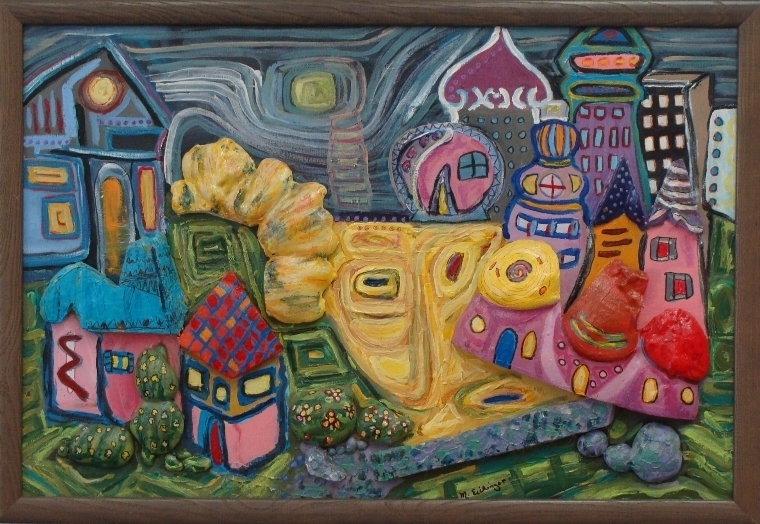
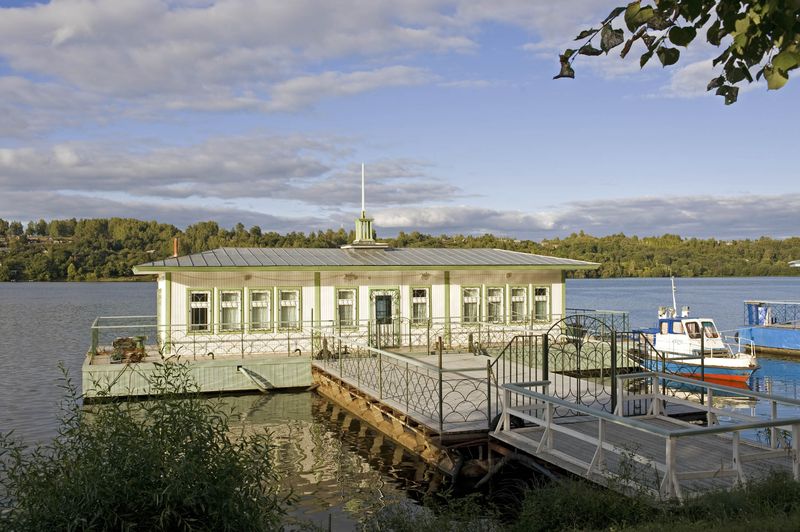
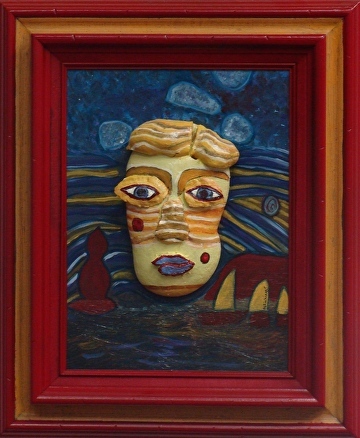
Russian Escape

Mixed Media, 3 -D/ 26” x 38” / $ 650
In Russia, the wealthy escape to luxurious homes on the Volga River known as Dachas on. During the communist revolution, Dachas were converted to vacation homes for workers but they have again resurfaced for the elite as exemplified by this seven-figure houseboat on the Volga and a restored traditional wood house in Plyos.

The Best of Times, The Worst of TImes

Fact Checking – In a late December interview with Prince Harry of England, President Obama touted that this is the best of times to be alive. He said that the world is more tolerant, less violent, and that people are healthier, subjects I touched upon in last week’s newsletter. I continue his optimistic statement this week by considering wealth, education, and what might be meant by being more sophisticated.

Part II

Is the world wealthier? When I hear that the world’s eight richest people collectively have the same amount of wealth as the poorest 50 percent of the world, I wonder if dangerous problems lie ahead due to the concentration of wealth among a few. Though the world as a whole might be wealthier, most people do not benefit from this boom. The bottom half struggles to survive. It is grotesque that a handful of rich people are equivalent to 3.6 billion souls living in poverty.

Bill Gates is one of many who echo Obama, agreeing that economic indicators show the world getting wealthier. Yet, when you probe further, he also says that inequality does not matter, which seems to me to be quite a bizarre assessment. The World Bank certainly does not agree with him for it reports that, “No country has successfully developed beyond middle-income status while retaining a very high level of inequality in income or consumption.” In general, those nations with great inequality have higher murder rates and lower life expectancy.

Poverty is defined as a lack of resources needed for a decent life – food and water, housing and energy, healthcare, education, and employment. It is about not having power and being unable to improve your situation. The world’s poverty line is set at $ 2.50 per day and the number of people living below that line increased by 15 percent between 1981 and 2005. So, no. . . the poor are not getting wealthier.

Not only do a handful of billionaires make an extraordinary amount of money, they employ most people. Home Depot’s Bernard Macus and Arthur Blank have over 385,000 employees, Warren Buffet at Berkshire Hathaway, 331,000, Frederick Smith of Fedex, over 400,000, and Peter Buck of Subway over 450,000. If Sam Walton of Wal-Mart were still around he would be credited with 2.3 million jobs. The number of those employed by the world’s 1,645 billionaires (according to Forbes) continues to grow. Don’t think for a minute that wealthy, mostly men, do not control our lives, for they do.

For example, government is influenced by their excessive wealth, for billionaires have the funds to lobby for tax benefits for themselves while making sure that needed government revenues will come from their employee’s taxes. US Tax Code as passed, is designed to permanently benefit corporations and protect the personal savings of the wealthiest but benefits for the middle class are set to expire in five years.

Last year’s stock market went up up by 19 percent. With a simple call to a broker, a billion dollar investment tied to an index fund returned $190,000 million. It is difficult for anyone to spend that much money for groceries, entertainment, cars or housing, so what happens to excessive gains? Will this windfall be plowed back into the economy? Will salaries increase so that those with more modest salaries also benefit?

To answer these questions we need to look at whether Reagan’s trickle-down economics could work under the right circumstances. Douglas Holtz-Eakin, president of the American Action Forum response is, “Trickle. Shmickle. You don’t need a Ph.D. in economics to see that something’s wrong with trickle-down theory. If it were true, inequality would be self-limiting. As soon as the rich started getting richer, wealth would cascade like the Niagara down to the benighted lower classes. Instead, the gap between rich and poor keeps growing.”

The International Monetary Fund concurs that trickle down economics backfires. It isn’t long before policies get instituted that hurt growth. The upper echelon pushes for deregulation of the financial system and puts the middle class at risk. Conflicts become more prevalent, social trust diminishes, and cohesion dissolves. Reasons are well documented as to why policy makers should pay more attention to low wage earners than the wealthy. When the bottom 20 percent of a nation’s population increases its share of national income, stronger growth follows on average within five years.

Among wealthier countries world-wide, poverty has risen since the 1990s. As the ranks of the poor grew, the rich get richer. In our own country, since 2000, the share of middle-class families has shriveled in all 50 states. The United States is an example of runaway inequality. Last November, Bank of America Merrill Lynch surveyed the CEOs of major corporations about how they would invest their foreign-held profits if they brought them back to the states. The majority said funds would be used for debt repayment, share repurchase, and mergers and acquisitions before capital spending. Few businesses planned to increase investments in areas that will benefit middle class Americans, concluded a Wall Street Journal article.

The tax plan that passed in December has winners and losers. The winners are Real estate and other pass through companies, energy drillers, sports team owners, major corporations, tax lawyers, those who don’t want to pay for health insurance, those who will now inherit up to $11 million tax free. The Losers are commuters, residents of high-tax states like New York, New Jersey, and California, and everyone who will now have to contribute to interest payments for a higher budget deficit. 50 Percent of Americans will see their taxes increase after 2025 and 13 million will lose health insurance. Too bad I am not a real estate billionaire like our president, for if I were, I might have had champagne to welcome in the New Year.

Are the People of the World Better Educated? Once more we have to ask ourselves, better educated than when? If we consider primitive societies where learning was passed down from parent to child and tribal member to youth, all children were educated in survival skills. In Egypt, Greece and Rome centers of learning existed since 3,500-3,000 BCE, though the opportunity for literacy were only available to a privileged male elite. It wasn’t until the Middle Ages that book production increased yet it still took centuries for literacy to become universal. Middle class children who were not farmers, were taught by parental example or in the trades in multi-year apprenticeship programs.

If we consider the last two centuries, when literacy became important, then yes, according to the dozens of articles I read, rates have risen globally. Increases are primarily due to enrollment in primary education though in sub-Saharan Africa many countries lag behind with literacy rates below 50 percent of youth. A growing body of research suggests that better education is associated with higher individual income and long-term economic growth. Throughout the world here are large generational gaps, for younger generations are progressively better educated than older ones. In the United States, even low-wage earners are better educated than they were in 1979. For example, in 1979, 39.5 percent had not gone to high school while in 2011 only 19.8 percent had not attended.

It is interesting to note that according the Economist, Immigrants to America are better educated than ever before. Half of all legal migrants have college degrees contrary to the popular belief that they are low-skilled. There is growing interest in the House of Representatives in having a points-based immigration system similar to that of Canada and Australia that gives priority to migrants with degrees, work experience, and fluency in English rather than to families as is the case in America today.

Is the world more sophisticated? I have not the slightest idea and am not sure what President Obama had in mind when he said it was.. What do you think?

Please comment below on my blog site.It will be interesting to hear your comments about these last two newsletters.

Art is always for sale. Contact me at marilynne@eichingerfineart.com

References:

1. Elliott,L. 2017. World’s eight richest people have same Wealth as poorest 50%. The Guardian. retrieved from https://www.theguardian.com/global-development/2017/jan/16/worlds-eight-richest-people-have-same-wealth-as-poorest-50

2. Social Justice Website. 2017. Myth #1: The Poor are Getting Richer. Social Justice Now. retrieved from http://www.globaljustice.org.uk/myth-1-poor-are-getting-richer

3 . Blankfqld,K. 2016. The American Billionaires Behind the Most Jobs. Forbes. retrieved from https://www.forbes.com/sites/kerenblankfeld/2016/10/18/american-billionaires-behind-the-most-jobs/#5b03e27c693f

4. Coy, P. 2017. The Best Way to Spur Growth?Help the Poor, Not the Rich. Bloomberg Business Week. retrieved from https://www.bloomberg.com/news/articles/2017-11-30/the-best-way-to-spur-growth-help-the-poor-not-the-rich

5. Picchi,A. 2015. Is Trickle-down Economics to Blame for Inequality? Money Watch. retrieved from https://www.cbsnews.com/news/the-failure-of-trickle-down-economics/

6. Boak, J. 2017. A look at some winners and losers under the GOP tax plan. ABC News, retrieved from http://abcnews.go.com/Business/wireStory/winners-losers-gop-tax-plan-51903730

7. Roser,M and Ortiz-Ospina,E. 2017, Global Rise of Education. Our World in Data. retrieved from https://ourworldindata.org/global-rise-of-education

8. Economist. 2017. Immigrants to America are better educated than ever before, The Economist Print Edition. United States. retrieved from https://www.economist.com/news/united-states/21723108-far-being-low-skilled-half-all-legal-migrants-have-college-degrees-immigrants


Questioning Life

On Top Of It All
20” by 19”, Mixed media, $399.
Questioning how to give meaning and purpose to life is ongoing. Answers evolve and change with age and circumstance.

Winter holidays usher in a joyful bustle of activities with family and friends but since it is the end of one year and start of another, they are also a time to pause for reflection.

When I was sixteen my boyfriend asked, “which is better a life of love or a life devoted to a quest of knowledge and its application to living?” Without hesitation we both chose love, but as years passed, there were times when the quest for knowledge and career ambitions made us rethink our answer. Today I would respond by saying both.

My memory was stirred by an article I read this week on BBC’s news website. Educated Indian women were forced to give up doctoral ambitions to improve people’s health care in order to be full time mothers taking care of their families. Married women “are not expected to want the privilege of thinking and doing research,” said one of homemakers interviewed. Yet, in India, woman are starting to speak up and not give in to custom. They are finding ways to continue their research through online virtual laboratories and participation in conferences conducted through Skype. Instead of being confined solely to housework, these highly educated women have options never before imagined.

Many other questions were raised during my college years. What is the meaning of life and what idoes it mean to live well? Is there a God? What ethical system should I embrace? How will my activities and choice of profession contribute to society? These questions became buried when raising five children and beginning a career. But every once in a while, a decision had to be made that gave me pause to think. Should I choose advancement, money and accompanying stress over family harmony? Do I go on a business trip rather than stay home with a sick child? Is what I do more important than my husband or children’s ambitions?

From time to time these basic questions suddenly pop up and demand an answer.
As an elder, I am once more reflecting on life’s meaning. When I hear friends saying, “I’ve done enough for others. Now it is time to complete my bucket list,” Is that the best way to conclude my years? But somehow this remark doesn’t make sense. What difference does a trip to Bora Bora, sky diving, or snow shoeing in the mountains make?” These activities can’t be the purpose of living. They can only be a way to pass idle time while waiting to die. Why spend the money? Why change the way I find purpose in life? Then again, why not?

Deciding how to live is not just a quest of the young but it is a multi-year process that twists and turns with experience and circumstance. My answers have been challenged many times  as I developed a deeper understanding of the environment and the earth’s far flung inhabitants. Today when I ask what type of person I want to be and what makes life meaningful, I continue to look to the future— not of mine, but of those who will follow me. I still hope that the world will be a better place for my children and grandchildren to live in and would like to share my mistakes and achievements so they can move on from where I leave off. My ongoing quest for knowledge is pleasurable and gives me much do, but I am less focused on a need to achieve and more interested than ever in educating. Helping young adults known as the “me generation”  overcome this stigma seems like a fulfilling mission. Inspiring them to embrace a life of love and giving to others is a gift I would like to leave behind.

Merry Christmas to all.

Social Justice

Mean Aunt Martha

An unfulfilled life led her to drink. Her children unfortunately suffered.
acrylic on canvas/ 30” x30”/ gold frame/ $ 399

The following excerpt is from my latest manuscript. Over the Sticker Bush Fence: overcoming barriers for homeless and runaway youth will hopefully be in print in the near future. The printing business moves slowly and methodically. I do look forward to your comments.

Social Justice

“Life has a way of repeating itself, transferring experiences through time from one generation to the next,” said Kate Lore, who at the time was Social Justice Minister at the Unitarian Universalist Church in Portland, Oregon. “As an adult, I’ve worked hard to break the conditions and mindset of poverty experienced by my ancestors, but doing so has not been easy. This is due not only to the lack of resources but to a culture of shame and secrecy. It’s as if part of my destiny is being controlled by unnamed family ghosts.

“The story of my father’s side of the family dates back to Monticello, where my Irish forebears served as indentured servants of Thomas Jefferson in return for passage to America. These farmers eventually paid off their debt and slowly migrated westward, first to Minnesota and then to California. Generation after generation lived hardscrabble lives, never owning the land they farmed, never getting a good education but always working, working, working. Many of these relatives could be characterized as bad apples. Unspoken shame still permeates the family relating to the fact that my father was the product of a forced incestuous relationship between his teenaged mother and her cousin. Also, my paternal grandfather never met his son nor me because his entire life was spent locked up in prison. Though I know he eventually died of cancer, I’ve never found anyone who would tell me what he had done to land behind bars.

“Knowledge of my mother’s family dates back to the Dust Bowl. Though I tried, I never found a relative willing to talk about the past. What I do know is that my mother’s family shared many similarities with my father’s. They were poor, hardworking tenant farmers who migrated west in order to feed their family. They, too, ended up in California, seeking a better life. But like characters out a John Steinbeck novel, Mom’s side of the family migrated to Monterey’s Cannery Row to work the anchovy canneries. I still carry memories of Cannery Row. It was the era before it became a tourist destination: the smell of fish and stale booze, the site of rusted boat hulls and passed-out-winos and the sounds of seagulls screeching over the next incoming fish haul are captured in my mind. Industrial Cannery Row faded over time and eventually the cannery jobs did, too. My grandparents never escaped the poverty and alcoholism that has plagued and continues to plague, my mother’s family.

My parent’s lives came together in the mid-fifties. They met as young adults in church, both eager to break free from their families of origin and have good lives. Married in 1957, their first child came along three years later. Tragically for my sister and me, their love did not last long. By the time of my birth, Dad was having an affair with another woman.

Born in 1960, I was unaware that my parents were not doing well as a couple. At six months of age, Mom moved her children to join Dad in Tanzania where he had accepted a teaching job. She hoped by doing so that his affair would end. My sister, who was then three and I spent the next several years speaking Swahili and living among people native to that land. I found out later that during the entire three years we lived abroad, my father had continued corresponding with the woman with whom he’d been seeing before we left. But the final shock did not set in until we arrived back home to the San Francisco airport. My mother still had luggage and children in hand when my father turned to her and said; “ This is where we part ways. I’m leaving you. You are on your own.” With that announcement he took a few of his personal belongings and left the airport to live with his lover. I would not see him for many, many years to come.

We found ourselves stranded, possessing nothing. We did not know where to go, nor did Mom have any idea of how she was going to find our next meal. In this emergency situation she wound up moving back to her childhood home with alcoholic parents, not a safe place for kids of any age, and bad for little ones who had just lost their father. It was worse for my sister than me, though, because she was always Daddy’s little girl, the one who had my father’s heart. . . or so she thought. Once abandoned, my dark-haired sister started acting out. She became the “evil one” in the family, and I, a blond, reacted by becoming super sweet. My behavior was an effective survival technique. By being a loving, cuddly kid I could get what I needed. I may have been plain but I was smart. Looking back I wondered if my lifelong “good girl” behavior was largely a reaction to the way my sister acted. I’m not sure. But I have come to believe that my compulsion to be good and the compassion I have for others comes from someplace deep within.

Without a college degree, the only work my mother could find was minimum wage employment. When she worked we were left to the care of our grandparents. Two lively little girls living with inebriated adults was a dangerous situation. That became especially apparent when one one day my grandfather had had enough of the noise my sister was making. He drunkenly grabbed a fork and lunged to stab her in the hand. Thankfully she moved in time or she would have been maimed. Mom realized at that moment that she had to move on but again was lost about what to do and where to go.

She sought advice from a previous mentor, a woman who had been her second-grade teacher in elementary school. Connie Sellars had taken a liking to her as a youngster who came to school from an alcoholic family. Connie got her involved in church and encouraged her to sing in the children’s choir. She and my mother remained friends, writing to each other throughout her trials. Being a Good Samaritan, Connie offered us a place to live in a nearby house that she had recently inherited, asking only $75 a month in rent, an amount that was never raised over the years. If it were not for the kindness of this one individual, I’m not sure what we would have done. Housing is a prerequisite to so many things: security, status, and stability.

Still, I felt shame living in our house. Paint was peeling off the walls and the grass was never cut because we could not afford a mower. We never owned a car which meant that for ten hours a day my sister and I were left at home to raise ourselves while mom rode buses long distances to work as a clerk typist in a distant school district.

Neighbors felt sorry for us, two little urchins abandoned by fate, and they treated us kindly even though our presence “brought the neighborhood down.” They helped fill the house with cast off furniture, responding to our needs compassionately. I attribute their help to the fact that homeless families were a rare phenomenon back then. Neighbors were less inclined to judge us and more inclined to help out. The era was before the 1980s when America suddenly began demonizing the poor. Americans still had compassion for the destitute and had not yet been exposed to Ronald Reagan’s portrayal of single moms as being lazy, unproductive “Welfare Queens.”
_______
Kate survived her difficult childhood due to the camera and compassion of neighbors, church members, and educators. The adage, “it takes a village to raise a child” is a wise one that benefited her. Now, as an adult she decided to give back to the community as a minister focused on social justice. She left the church last year for employment with Volunteers of America where she oversees a large network of shelters for abused women. Childhood experiences often affect the career choices we make. Rather than be succumb to self pity or depression she saw life’s beauty and wants to share her blessedness with those who are less fortunate.

A few questions to answer below:

Did you ever have a childhood experience that influenced your career choice?

Have you been motivated to help someone outside of you immediate family?

There are thousands of children in the United States who would benefit by having a mentor. Ever think of getting involved with one or more of them? If so, please, share you experiences.

Art is always for sale. Please contact me at marilynne@eichingerfineart.com.