For the Love of Kids

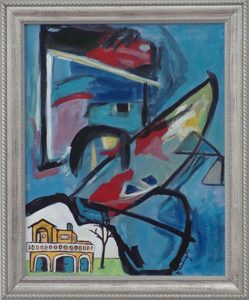
  Julia                                                                          25” by 36”/ Acrylic on Canvas / $ 425                                                                                 Resting from a day job, housework and chauffeuring children, she considers the pile of requests and applications to teachers, healthcare providers, camps and colleges that remain piled on her desk.

 For the Love of Kids

Eight senior managers were employed to help me run OMSI. Though all were married, only one beside me had children. Four interacted with kids on a regular basis while the remaining mangers handled the business of running a large institution. All were committed and worked tirelessly to ensure the museum’s success.

It surprised me that adults interested in educating children did not want to become parents. Several mentioned concern about overpopulation, but most wanted freedom to immerse themselves in work, travel and other interests.

I realized they were happily engaged in what they were doing, but privately thought they were missing out on the most important part of life. As they near retirement, I wonder if they still believe they made the right choice. I worry about their a safety net for end of life needs.

Though they have adequate resources to enter comfortable retirement facilities, who will visit?  Who will take the time time to hear their stories, shower them with love and mourn when they are no longer alive. 

Before the nineteenth century, children were important to their parent’s welfare. They worked on the family’s farm, were sent into mines at the age of thirteen or took after-school jobs carrying groceries. In old age, their children took care of them.

The economic value of children decreased with transformation from an agrarian to urban society. Medical advances led to a decline in childhood mortality rates. Since fewer children were needed for economic reasons, birth rates declined.

At the same time, cost of raising their offspring increased. Schooling added to the family’s expenses for children have to be fed, clothed, enrolled in after-school activities and provided with an indoor place to study. Children, once treated as property, were given entitlements. Parents became more egalitarian, friendlier and less strict. Motherhood began to lose its value. 

The government demanded an ever-larger share of earnings in the form of taxes. As usable income declined, both parents had to work to make ends meet. Children were a hardship to exhausted couples embroiled in debt. Divorce rates escalated, adding to the burden of single parents.  According to 2017 consumer expenditure statistics, the average cost to raise a child through age 17 is $284,570.

Approximately 67 percent of women decide as teenagers to have two children and, by and large, do so, even though they view motherhood as an overwhelming commitment. 15 percent of American women never experience motherhood. Free from child-care responsibility, they peruse careers, travel and socialize. Women were given  freedom to work while men benefited by having freedom from work.

Judged negatively, those who do not choose parenthood are pressured by family and friends. Over time, many become concerned about their lack of forming a love-bond with a child. They may be successful in their jobs, have financial security, but become bored by chasing happiness. This is seen in a 6 percent upswing of people over 40 becoming parents. Children start to be viewed as the legacy they hope to leave behind, the minds they hope to mold to their way of thinking.

Childless couples also consider their legacy, but rather than through parenthood, they pursue it through art, science, religion or career. Friendship and professional networks are developed as a substitute to having a young family. And, childless couples claim to be just as satisfied with their lives as parenting women (except for teen moms).

Yet, I still maintain that childless couples miss out on life’s greatest pleasure. Following are thoughts about what children mean to me. 

1. Children keep alive my thirst for knowledge. I relearned math, history and literature as my children went through school. By the time they were adults, their opinions often challenged my beliefs and helped me adapt to change.

2. They make me happy. When they give me a kiss, tell me they love me or say positive things, everything seems right in the world.

3. When young, they kept me involved in healthy activities. Taking them to museums, zoos, water parks and on hikes took me far away from stress.

4. They kept me alert, for they acted in surprising ways that often involved problem solving. If they needed a science fair project their father or I became involved. I was both a booster and cheerleader enabling them to take risks, overcome difficulties  and act creatively.

5. They keep me laughing. Starting in infancy, their big smiles, giggles and oft-times crazy antics made me smile and laugh. Jumping on a trampoline, trying to free a frisbee caught in a tree and winning at scrabble were happy times. They continue sending emails that make me laugh.

6.  My children taught me to see more clearly. I will never forget when my 9 month old son saw snow for the first time. The expression on his face wrapped me in the beauty and mystery of the moment as though I too was seeing it for the first time. 

7. The occasionally provided me with an alibi for getting out of something I didn’t want to do. I shamelessly used their slightest sniffle as a reason for staying home. 

9. Children gave our family tax savings which was important, for their costs were great.

10. Lastly, my children kept me sane, contrary to the belief that most will drive you crazy. The crazy part was momentarily while the sanity was long lasting.  I had to rise to the occasion of being a dependable presence who loved them unconditionally and appreciated their accomplishments.

As a mother, I never asked about the purpose of life or whether what I was doing was worthwhile. I knew in my heart and soul that it was. Inspiring thoughtful, happy, creative children who contribute to bettering society, was the most important thing I could do. 

References

Perry, S. (2014) Children aren’t worth very much —that’s why we no longer make many. Family Values. retrieved from https://qz.com/231313/children-arent-worth-very-much-thats-why-we-no-longer-make-many/

Khazan, O. (2017) How People Decide Whether to Have Children. The Atlantic. retrieved from https://www.theatlantic.com/health/archive/2017/05/how-people-decide-whether-to-have-children/527520/

 Lino, M. (2017) The Cost of Raising a Child. Center for Nutrition Policy and Promotion report in Food and Nutrition. retrieved from https://www.usda.gov/media/blog/2017/01/13/cost-raising-child

  (2012) Common myths about having a child later in life. CBS News. retrieved from https://www.cbsnews.com/media/common-myths-about-having-a-child-later-in-life/
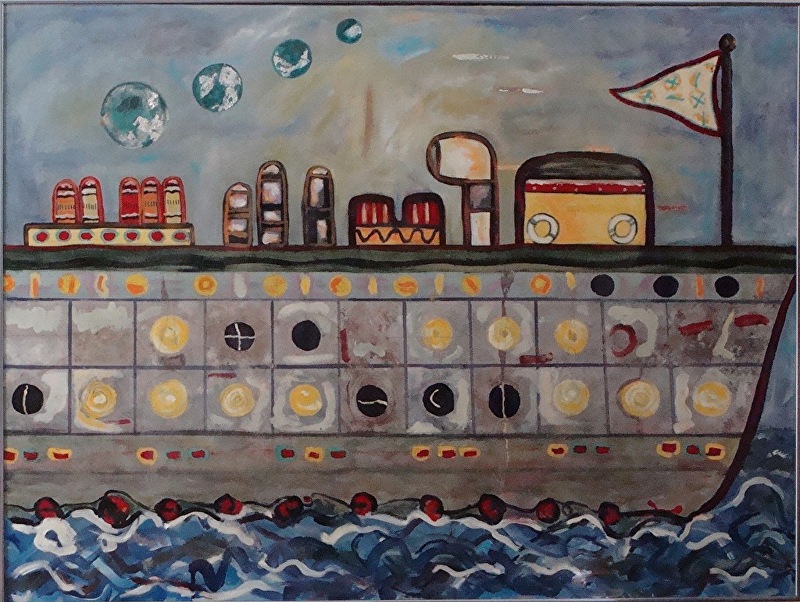
  

Why Travel?

All Aboard

Acrylic on Canvas framed/ 36” by 48”/ $ 695 /sale price $ 556 Holiday special through July 10th

Why Travel?

Adventure travel calls out to me, for I enjoy visiting foreign countries and meeting people with unfamiliar customs. I go at it much as an anthropologist does, studying art, exploring political and social systems, seeing how meals are shared and observing celebrations of life’s passages . But recently, I’ve questioned whether globe-trotting is worth the hassle.

When in college, I occasionally traveled from Philadelphia to Boston by plane to visit my fiancé. On one such trip, I was late getting to the airport. By the time I reached the gate the doors were closed and the plane had started taxiing toward the runway. Seeing my distress a smiling the ticket taker contacted the pilot and directed him to stop the plane.  He did so, lowered the stairs and waited on the tamarack until I arrived. Now that’s what I call customer service! Hail to the good old days.

When Homeland Security took over, a new era began. It introduced the period of ticket holders only, shoes off, jackets off, electronic devices out, no liquids, no, no, no. I know a man who cracked a joke (another no) to one of the security guards causing him to be escorted to a side room and strip searched. It is not unusual for international travelers to have their belongings scanned two or three times before boarding. The process is particularly terrible for those with an accent or skin color that is not “lily white.”

  Travelers are understandably frustrated. In 2012, a Portland man took off all of his cloths in protest of TSA rules. When changed with a misdemeanor he decided to go to trial for being unlawfully hassled. Since public nudity is legal in Portland, he was acquitted by a local Judge. He didn’t get away unscathed, though, for TSA fined him $ 1,000. This man is not the only inconvenienced traveler to respond by stripping. It happened in Russia when a flight to Jamaica was overbooked. Times are improving ,however, for in 2017, a man was permitted to pass through Milwaukee security as though he was the emperor who has no clothes.He was deemed not to be a security threat.

I wonder what would happen if everyone took off their garments while waiting in line? Imagine the press that action would generate and the statement it would make. TSA must be paying some attention to these complaints, for with a five year pass you can now keep all your clothes on. Of course, that costs extra money and the lines are apt to be long.

Once through security most of us breathe deeply with relief, that is, until we sit down and find our knees bumping into the seat in front or are pushed sideways by a fat neighbor. I  am relieved that there’s no smoking on planes. Do you think we could petition for people to take showers before traveling? How about insisting they’re healthy and will not a spread cold?

If you don’t like airport security lines or expensive parking lots, perhaps you prefer driving to your destination. Freeways are a good choice for those traveling between 10pm and 5am in the morning. Near some small towns you can also move freely between 10am and 3pm. It is in metropolitan areas and tourist locations that drivers have to contend with speed maniacs weaving in and out of lanes and men who raise their middle fingers as though it was an item of sculptural beauty. To counterbalance road rage, however, you can relax behind those beatific seniors who drive ten miles under the speed limit while gracing you with broad smiles when they signal left and turn right. At least their grandchildren are there to entertain you with waves and funny faces when traffic stops moving.

Is it worth the it? Is travel more cumbersome today than it was in prior years? It took my mother twelve hours to travel from New York to London in 1961 when my first son was born. The average flight today takes seven hours. Even with security issues the trip takes less time. A few years from now a supersonic flight is expected to cross the ocean in three hours. 

What about cost? Has anyone noticed that since 1978 the average round trip on domestic flights has dropped 50 percent? Traveling by plane was a big deal when I was in my twenties. It is why I crossed the ocean four times by ship. But what a luxurious fairy tale experience that was. On my first trip with Holland American Lines there were white gloved waiters training apprentices who were proud to be of service. Staff pampered us over a five day period. By the time we arrived in Europe I was thoroughly rested but more importantly I was ready to transition to a different reality. Later crossings took only three days to complete, not nearly enough time to unwind.

In the 1900s, most people vacationed close to home, but change was coming.  In 1903, Horatio Nelson (known as “The Mad Doctor”) and his mechanic, responding to a $50 bet were the first to travel from New York to San Francisco in a Winton touring car. It took 63 days and cost them $ 8,000.  According to reporter, Peter Fimrite, “they left the trail littered with broken parts, tools, clothes, flat tires and tears.” Today, a cross-country trip can be accomplished in two days if you drive nonstop or go by train. It is much faster than going by covered wagon. In the early 1800s, the trip from the Missouri River to Sacramento, California took four to six months. Even then there were choices. You could go by train and save a great deal of time.  In the 1830s, in five weeks you could travel from New York to Minnesota. By 1856, you could reach California in just over a month. Just love that speed, don’t  you?

Construction of the interstate system was the gift that made long distance driving possible. It was authorized in 1956 by President Dwight D. Eisenhower when he signed the Federal-Aid Highway Act. Three states, Missouri, Kansas and Pennsylvania claim they were the first to complete their roads.

How exciting it was to speed down empty highways going 80 to 90 miles an hour while avoiding the policemen hiding behind billboards. No need to worry about that today, however, for there are few traffic-free roads. Yet, even with clogged freeways, the wonders of the country are within reach of most people. Just as in yesteryear, those who travel need patience. As you plan your vacation, take time to enjoy the process. Consider how fortunate your are to be able to stay connected to your love ones and to explore beautiful sites worldwide without having to travel by sailing ship or wagon train.

References:

Thompson, D. (2013) How Airline Ticket Prices Fell 50% in 30 Years.THe Atlantic. retrieved from https://www.theatlantic.com/business/archive/2013/02/how-airline-ticket-prices-fell-50-in-30-years-and-why-nobody-noticed/273506/

Fimrite,P. (2003) Long before the interstate . . . SF Gate.  retrieved from https://www.sfgate.com/news/article/Long-before-the-interstates-there-was-a-Winton-2608886.php

Richard, M.(2012) How fast could you travel across the U.S. in the 1800s? Mother Nature Network.retrieved from https://www.mnn.com/green-tech/transportation/stories/how-fast-could-you-travel-across-the-us-in-the-1800s

Art is always for sale. Contact me at marilynne@eichingerfineart.com

How do you feel about travel. I would love to hear your experiences both good an bad.


Three Clicks to Home

Window to Home                                                         

Where is home— the place that makes you truly  happy? Is it a structure, part of nature or do you    find it in an activity you engage in? Is it a place for solitary refection or for joyous camaraderie?

acrylic on canvas /20” by 16”/ $325


Three Clicks to Home      It was easy for Dorothy find home. The Wizard told her to click her heels three times and she was transported back to Kansas. She knew where she wanted to be, where she felt safe and where she was loved.

Many of us do not have a physical place to ground us throughout the years. As we move from house to house and community to community we leave love ones  and favorite haunts behind. And we learn to live with emptiness as our grown children do the same.

I was born in Pennsylvania, spent summers in New Jersey and went to college in Massachusetts, where  I gave birth to four babies. I then moved to Michigan, had another child, before finally settling in Oregon. During my working years, my close friends were primarily those I met through my businesses. They were scattered throughout the country. But now that I am retired, we no longer meet at conferences to share a meal and get family updates, and they are not nearby when I need help.

What is home? Is it a building or a place where the heart is? Does it provide love and promote dreams? Does home connect you to memories? To nature? To beauty? I realize now, that over the years, I’ve redefined its meaning several times.

Today I see home, not as a house, but rather as a place to go to for comfort, to find happiness and to create memories. It is where I am fully centered. Though its location changes from time to time, it is not because of moving, but because my mind and physical abilities have evolved.

As a child, I spent summers with my family on beaches off the coast of New Jersey. I loved listening to the sounds of waves and marveled at the sun as it set over the horizon. White sandy beaches on the Atlantic coast were joyous places. They were where I spent time with my first love and where I became healthy jogging along the water’s edge after a winter indoors.

Shortly after moving to Michigan, I discovered a secret location several miles from my house. With my infant daughter strapped in a child seat, I’d ride my bicycle through fields and wooded areas imagining that I was a world traveler. I rode through savannah lands, marshes, jungles, mountains and farmland, all the while creating adventures in my mind that rivaled reality. These excursions enabled me to express the emotional ups and downs of raising a family. When upset, I screamed at the top of my lungs, at times crying until my miseries dissolved. When happy, the sun shone overhead even on cloudy days, and I was energized.

A sense of adventure accompanied my move to Portland. The forty-mile loop  outside the front door of my new house provided a rejuvenating trail within easy reach. Unfortunately, over the past years, many people discovered my special refuge. Now, part of the 4-t trail, it brings hundreds of hikers past my door and compelled me to look further afield for a place that speaks to my soul.

I am fortunate to live in a state of incomparable beauty and it wasn’t long before being caught by a magical spell. The John Day area of central Oregon is my new home, for spending time there makes me whole. It is where I feel complete, connected to the earth and at peace with the world. It is where I belong.

As a city girl, the emptiness of the high desert was strange at first. It took time to be comfortable with traveling through miles of sagebrush devoid of inhabitants. But eventually, the grasslands, expansive skies with brilliant stars undimmed by city lights and wind-etched rocks holding millions of years of history, spoke to me. Hillsides are splash with vibrant colors made by volcanic eruptions. Families of deer unafraid of hunters come out to feed each evening, while sounds of wildlife echo in the distance. The high desert renews me and provides shelter for my heart. When not there, I dream about what I’ve seen and try to capture on canvas the emotions and scenery that remain vivid in my mind.

A friend recently shared that he too moves around a lot. He also does not think of a dwelling as home. When I asked him where home was for him, he said that it is the feeling he gets when surfing. Waves cresting under his feet, the vast ocean and his ability to move in harmony with the motion of his board as it sails towards land, provides him with comfort that has no equal. It is perfect.

Everyone needs a happy place, a spot to go to for comfort and renewal. Daily responsibilities can impinge on our thoughts so strongly that it is easy to forget we are part of nature, live in community and are a speck in the universe. A place to call home  puts momentary concerns into proper perspective. It allows you to stand still, and though the world spins, you never get dizzy.

Where is home for you? Do share thoughts of your special place below.

Works of art are always for sale.  Contact me at marilynne@eichingerfineart.com.

The 3 Rs Plus Technology


   Oregon City Falls

Acrylic on Canvas / 436” x 49” / $ 1,100

Oregon City is the site of the first electric power transmission line in North America. We have come a long way since then. Miniaturized components enable us to operate devices that were never imagined during the late 1880s.

The 3 R’s plus Electronics?                       

For over 300,000 years, humans worked with stone and metal hand tools. But 150 years ago, with the invention of electronic devices, many of these helpers became obsolete. Since 1835, when American scientist, Joseph Henry invented the electric relay, emerging technologies have changed the way we live and do business. It is difficult to imagine a home without television, mobile phones, computers or internet connections. We rely on microwaves, remote controls, satellite dishes, keyless automobiles, global positioning devices and baby monitors. These devices that control homes and keep us secure have created a demand for skilled workers who can design, build, install, test and maintain them. It makes me wonder what schools are doing to prepare students for technological jobs.

Elementary schools concentrate on the 3 Rs – reading writing,  ‘rithmatic but the notion of introducing young children to  technology has not been embraced by educators. To most adults, techno-specialists speak a foreign language. We do not know what a diode, capacitor or resister does nor do we understand how electrons flow through wires and light traveling through fibers is converted to electricity.

Are you staying abreast of changes in cognitive science, biotechnology, artificial intelligence, robotics and nanotechnology? Most people aren’t. These subjects feel too foreign—too scary. It is for this reason that we need to introduce young children to these technologies through games and interactive devices. Their minds are adaptive and they have not been programmed against them. All one has to do is look at youths to see how much easier it is for them to use computer operated devices than their parents.

Art, music, sports, cooking and craft programs provide hands-on experiences that stimulate the sense and use the creative side of the brain. Assembling robots, electrical boards or drones do the same thing. The first time I put together a theremin was exhilarating because it was such a foreign activity. Once I overcame my fear of being thought stupid, I discovered success was a matter of learning a few new words (electronic-speak), following directions and being patient. As I assembled the small components, I discovered my eye-hand coordination and ability to concentrate also improved..

Assembling electronic devices requires organization in the same way a cook organizes ingredients for a favorite recipe.  Collecting, measuring, storing ingredients and cleaning are part of the process. They are both problem solving activities that can have satisfying outcomes.

Schools do not think about hardware in the same way they do software, yet workers are needed to repair electric cars, computers and home monitoring devices. Engineers of the future will continue to make devices go faster and more efficient. Those who are technically savvy are the pace setters for tomorrow and our education system must be challenged to teach to them.

Many educational devices have been invented that make techno-learning fun. They can be purchased in upscale toy stores and are used in many after school science programs. It is now time to bring them into the public school system. Tinkering and taking things stimulates the imagination and makes life exciting. Leonardo da Vinci, knew this for he was not only and fine painter for an amazing engineer.

Of course, not everyone is a hands-on learner. Some enjoy reading, learning history, and using their knowledge to analyze change. For these individuals, there will be ethical questions to explore and laws to enact. Questions will be asked such as, should infants be tagged with an electronic device under their skin that will follow them through life and how will people survive if robots continue to replace workers. Historians, philosophers and journalists will have plenty to do.

So in addition in helping children become familiar with hardware and software they will need to develop ways of thinking about ethical issues and social change. Embracing innovation is complex and needs our full attention or we will continuously be surprised as was Mark Zuckerberg over Facebook’s privacy issues.  Let’s get out front of technology and consider ramifications before we are in trouble. 

Reference:

World Economic Forum. (2017) Top 10 Emerging Technologies of 2017. Scientific American. retrieved from https://www.scientificamerican.com/report/top-10-emerging-technologies-of-20171/

I look forward to hearing you opinion Go to eichingerfineart.com/blog to comment.

Sasquatch and the Bear

     Beginnings 

Acrylic on canvas /30” by 40” / $499

Did primitive man start the Bigfoot myth thousands of years ago?


 Sasquatch and the Bear

Stories of gigantic human-like creatures hiding in the northwest woods have been told for hundreds, maybe thousands of years. Last century the Sasquatch flame was fueled by a 1923 investigation that took place on the east side of Mt. St. Helens. The area, now known as Ape Canyon, was so named because of a Bigfoot siting by a group of gold prospectors. The men were discovered shaking in fear as they ran from the woods shouting that they were attacked by 7 foot tap ape-like animals throwing boulders. A member of the party said that the animals were first spotted in the afternoon One creature fell off a cliff after shooting him three times with his rifle. 

That evening the“gorilla men” returned to attack their small cabin near Spirit Lake. The prospectors described four erect standing creatures moving about with human-like strides and were covered with long, black hair. “Their ears are four inches long and stick straight up. They have four toes, sort and stubby,” described one witness who estimated that each animal weighed over 400 pounds.  

About 50 years later, just south of the Oregon boarder, images were caught by Yakima cowboys who claimed to have seen a gorilla-like creature covered in fur. Though it too stood upright, it was hunched over with exposed breasts. The animal, named “Patty” was captured on a film that is considered to be the best of the Bigfoot documents. To date, no-one has definitively proven that the creature on the film is a fake, but then again, no one can say it was staged. Images of Patty can be found on mugs, magnets, cards and t-shirts around the world in gift shops around the world.

There have been hundreds of other sitings and numerous theories about whether they exist or not. I have a new one that popped into my head after looking at a true-to-life sized image of a short faced bear.  I saw it at the Columbia Gorge Discovery Center in the Dalles and was amazed at its size and demeanor. It made me wonder if it was possible that stories surrounding Bigfoot originated with native people who lived during the same time period as the now extinct bear.

For decades, first Americans were thought to have traveled over Beringia, a land bridge between Siberia and Alaska,10,000 to 13,000 years ago.  A 2014 genetic study of a one-year old boy believed to have died about 12,700 years ago is among the oldest Clovis skeletons found. However, evidence has been building that shows that the first humans occupied the Americas much earlier.  Remains  uncovered in 2017 are of people who lived in a cave system in the Northern Ukon Territory of Western Canada going back 24,000 years. 

These recent finds are changing the way archeologists think about how the Americas were populated. They still commonly believe that people landed in Beringia when the climate was a bit warmer and damper than on the mainland, allowing vegetation to grow. They image that woody shrubs and animal bones provided enough fuel for several small settlements to exist over 15,000 years ago.  And, when the ice sheets melted they endorse the idea that hunter gatherers started to disperse south. 

However, they are now open to other theories concerning human occupation of the Americas. Recent discoveries in South America show genetic links in common with people from Australia, New Guinea and the Andaman Islands. Evidence of human settlements in Chile dates between 14,500 and 18,500 years ago.  They believe tribal members built fires, ate seafood and used stone tools. How they got to Chile is still a mystery.  Some anthropologists hang on the the Bering land bridge theory and conjecture that there was a break in the ice sheet on the Pacific coast that allowed canoes to travel south while others postulate that they came by boat from southern Asia and Australia. 

Learning that human beings were on the continent 20-25,000 years ago made me curious about how they lived and what they thought their young. Following is my own idea concerning the myth of Sasquatch.  I’m certainly not an expert but it is fun to imagine. 

The short faced bear was a giant animal considered to be the fastest running bear that ever lived.  When he stood on his hind legs he reached between 12 and 14 feet. Unlike the pigeon-toed bears seen today, its toes pointed straight forward which let him run over 40 miles and hour despite weighing over 1,500 lbs. (One was found that weighed 2,500 lbs.) The bear roamed North America from 1.8 million years ago until 11,000 years ago.  There were plenty of years when their presence overlapped with settlements of primitive Americans. 

The animal was so large that it most likely had to consume 35 pounds of meat daily to survive. At one time about 800,000 roamed the land, making them the most abundant species of bear in North America. As the human population grew, however, bears were forced to compete with hunters for food. And, as hunting skills increased, they were able to kill the bears for their fur and meat. Eventually, as the ice age ended and the climate warmed,, the species became extinct.

My thought is that standing bears with their short snouts and forward pointing feet look human. I can image parents sitting around the fire at night telling stories to their children of what will happen to them if they wander off alone in the woods. Tales passed down from generation to generation are like down the lane, the grown and change over time.  A mythology eventually builds to grabs the imagination of thousands of people who believe the myth is factual. 

What do you think?


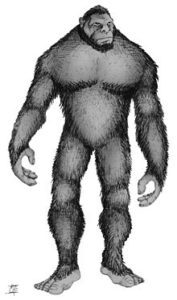
  Left _ Artist’s rendition of Bigfoot

Right- Reconstruction of Short Faced Bear


1.According National Geographic, for years Clovis people were thought to be the first people to occupy the Americas. They were were named for their distinctive spearheads  found near Clovis, New Mexico.  However, new radiocarbon dating shows that they inhabited the continent later and for a shorter period of time than previously believed. There is evidence that there were people living in the Americas before the Clovis people arrived.

References: 

Hogenboom, M. (2017) The first people who populated the Americas. BBC.retrieved from http://www.bbc.com/earth/story/20170328-the-first-people-who-populated-the-americas

North American Bear Center, (2018) Extinct Short-faced Bear. retrieved from web site 

https://www.bear.org/website/bear-pages/extinct-short-faced-bear.html

Giant Short-Faced Bear Facts.( 2018) Extinct Animal Facts. retrieved from web site at  http://extinct-animals-facts.com/Extinct-Animals-List/Giant-Short-Faced-Bear-Facts.html

hofer,J. (2017) 7 Facts about an Extinct Giant Bear. Wide Open Spaces. retrieved from http://www.wideopenspaces.com/7-facts-extinct-giant-bear/

Sottile, L. (2017 )50 Years Ago, One Scratchy Home Movie Made Bigfoot a Northwest Icon. Northwest Lore. retrieved from   https://www.pdxmonthly.com/articles/2017/9/13/50-years-ago-one-scratchy-home-movie-made-bigfoot-a-northwest-icon

Lovgren,S. (2007) Clovis People Not Firsr Americans, Study Shows, National Geographic News. retrieved from  https://news.nationalgeographic.com/news/2007/02/070223-first-americans.html

Case for a History Sleuth


  Family in a Turkish Village 

 Acrylic on Canvas/  Black Frame24” x 48” / $690

The Kurds are an ethnic group that spans Turkey, Iran, Iraq and Syria. Historically and linguistically they are classified as belonging to the Iranian people. Since the end of the Ottoman Empire they have been separated by boundaries created by foreign interests. During the 20th century the Kurds regained their voice  and instigated a call for Kurdish nationalism. What is the right path for these people? Who is to decide their future?  And who should take responsibility for upheaval and displacements when they occur?               

Case for a History Sleuth

In the New Reformers (1844) Ralph Waldo Emerson said, “We are students of words: we are shut up in schools and colleges and recitation rooms for ten or fifteen years and come out at last with a bag of wind, a memory of words and we do not know a thing.”

Emerson’s sentiment rings true to me.  I had a difficult time studying history and found the required readings had little relevance to my life.  As a teen, anything that occurred before I was born, was unimportant. My focus was on the present moment and what I would do with the rest of my life. 

This myopic view is not uncommon. What occurred  hundreds of years ago doesn’t matter to most children. One of my grandsons is an exception. His interest in history was actually peaked in school by a teacher that did not require him to memorize dates and battles but inspired him through games and play acting. More likely, though, he likes history because he has been fortunate enough to travel abroad with his family and see remnants of the past for himself. Walking grounds where past civilizations tread or reading letters by eye witnesses can make the past come alive.

Yet, despite visiting ruins and reading about the ancient world, I doubt that teens understand how history influences what is going on in the world today. For most children, the past is represented by storybook tales that have nothing to do with computers, YouTube, cell phones or space exploration. They are enthralled by League of Legends, Minecraft, and Tetris.

A grasp of history is imperative for our leaders but also important for the rest of society. It is not the facts, but the values, mistakes, and influences on the direction human civilization that matters most.  Past events provide avenues for contemplation that test our values and contribute to our sense of identity. 

“Those who cannot remember the past are condemned to repeat it,” said philosopher George Santayana. There is truth in his words. Wars in the United Staes and Europe have often served as breeding grounds for more wars.  After WWII we carved countries into new entities without understanding the ties that previously stabilized the regions. Distrust and ongoing fights within these new borders continue to plague these politically created entities. Men like Napoleon, Stalin, and Mao Tse Tung used war as opportunity for regime change.  Over time their initial good intentions led to dictatorships. When foreign powers intervene in the internal affairs of sovereign states, war becomes protracted. This pattern is repeated time and again throughout the ages. 

How can studying history be made fascinating yet useful? Primitive people used to gather around the fireplace to teach through oral presentations that stimulated emotions. Stories of creation and historical events were combined with moral lessons often animated by dancers and masked actors. Until television, storytellers in were in great demand and commanded respect. Troubadours in the middle ages sang about historical as well as current events. Abraham Lincoln mastered the art of storytelling and spun tales that captured the imagination of his audiences in order to get his point across.  Information is digested more easily when facts  are connected to emotions. Stories help people to remember what is said and provide a way for them to relate to one another.

Another way to teach history is to develop cases that challenge with hidden messages.  Students are asked to become detectives who unravel clues from by gone eras. Facts become illuminated as the past is unravelled and not because it has been presented for memorization. Cases can be entertaining and offer opportunities to observe, interact, and understand human nature. 

Just as forensic experts are scientists who use sleuth-like strategies to solve crimes, case system participants are similarly immersed in the scientific method. They form hypotheses, collect data, analyze it, and report results. The outcome may shed light on a current societal issue and inspire a new hypothesis to be tested that is relevant for today’s.  Using the scientific method as a system for solving  problems can help understand conflicting and confusing data. 

For example, the Supreme Court is often asked to clarify what the signers of the constitution meant when they wrote certain articles. Though it is difficult to put ourselves into a dead person’s mind there are many clues that can help in our analysis. Were the signers religious? Well educated? Family men? What were their professions? Were they wealthy or poor?  And a topic I find most interesting—what happened to the founders later in life because of their earlier involvement? Did you know that that some were considered traitors? Several became bankrupt.  A few had their homes ransacked? 

Change does not happen smoothly as can be seen by many convicts that plague the world today. By studying past revolutions, however, students learn to question and develop insight into the cost of freedom. 

As parents and grandparents it behooves us to help youth become history sleuths. We have an opportunity during vacations to look behind the surface when we take children on trips to parks and historical places. It is our job to teach the next generation how to think.  I do believe we can do a better job of showing them how the past relates to the many conflicts of today.

References:

Clairmont, N. (2017) “Those Who Do Not Learn History are doomed to repeat it. Really? Big Think. retrieved from http://bigthink.com/the-proverbial-skeptic/those-who-do-not-learn-history-doomed-to-repeat-it-really

Do comment below. Your thoughts are meaningful.

Does your word mean anything?

 Seeking Perfection                                                                                                                                          Acrylic on Canvas / 20” by 24” / $399                                                                                                                  What do you see as the truth of this image? Do you think you and your neighbor would describe it in the same way?

Do You Mean It?

When you say something do you mean it? Can another person depend on your words and attest to the integrity of your intention? What do you do when you make arrangements to meet someone and an opportunity arises that is more interesting? Do you break your commitment by phon, text, email? If you do, are you honest about your reason for backing out of the engagement or do you tell a little white lie?

There was a time when a person’s word and a handshake was something to be counted on. It was all it took to seal a deal—no notaries, legal documents or witnesses needed. When there were disputes they were taken to the tribal leader who would dispense justice.

In our country, we are urged to be more careful for times have changed greatly in our litigious society? An attorney friend recently said that if it wasn’t signed and sealed there was no promise. He mentioned that we can basically say anything and change our minds without concern for a lawsuit.

I’ve since discovered, however, that this lawyer’s remark was nuanced. Verbal agreements are binding as long as the proof will hold up in court—which isn’t easy. So what has to be done to turn a verbal promise into a court approved contract?  

One way to validate an oral agreement is to put your words into immediate action. If one party acts and the other is in compliance, evidence is created that proves there was a deal. Emails, letters, memos and receipts all reinforce handshake deals. Telling a friend what happened at the meeting and sending a “thank you” letter describing what was said are two other ways to seal a deal.

It is unusual for handshake arrangements to wind up in court, though it is possible. When they fall apart it is usually over details.  If you are exchanging a toaster oven for two hours of roof cleaning, you are probably OK with a verbal agreement but to rent an apartment or engage in work for hire, for clarity it is best put the arrangement in writing. Both parties must be crystal clear over the terms of the agreement they have entered into. If all details are not clear then there is a potential for a dispute. You may make an agreement for someone to design a logo for your business that is not in  writing. But once it is complete, you may discover that you do not own the logo because transferring intellectual property rights is not bound by a verbal agreement.

You may wonder why I bring this topic to your attention. Once again, it is because we live in a political climate that is filled with he said/she said accusations. It makes me wonder about truth and how a person can be held accountable for words spoken in private. Fabrications have been part of American politics for a long time.  Resumes are routinely puffed up, misdeeds hidden, sexual affairs denied, and false information presented to the public.  But today’s lies are blasted through internet sites at ever increasing speed. We are burdened by so many untruths that I wonder about the consequences of making false political claims.  It takes so much time to fact check that most of us are unwilling to look into the truth of most comments. 

Entrepreneurs often say they will only do business with someone they trust. They are quite content with a handshake agreement, believing that written contracts somehow undermine trust. However, since no one can ever assume that something will not wind up in court, it is at least wise to have credible witnesses to a business agreement. 

Politicians are another story for most voters don’t think of them as people to be trusted. The consequences of making false claims are rarely strong enough to dissuade voters from supporting those who espouse their political views.  Political fabrication has become an art with “Pants on Fire” burning tolerance-to-falsehoods into our psyche.  

I’m concerned. Are you?

Do comment at eichingerfineart.com/blog 

Nixon,S ( 2014) When your word and a handshake meant something ChicagoNow.   retrieved from http://www.chicagonow.com/lupus-purple-reigns/2014/12/when-your-word-and-a-handshake-meant-something/

Harline, K. (2018) Oral Contracts: Do They Carry Any Weight? legalzoom. retrieved from https://www.legalzoom.com/articles/oral-contracts-do-they-carry-any-weight

Walker,D (2018) Does a handshake form a legally binding contract? Business advice. retrieved from http://businessadvice.co.uk/business-development/business-planning/does-a-handshake-form-a-legally-binding-contract/

Sleuths for Truths

            Flickers Caring for the Next Generation 

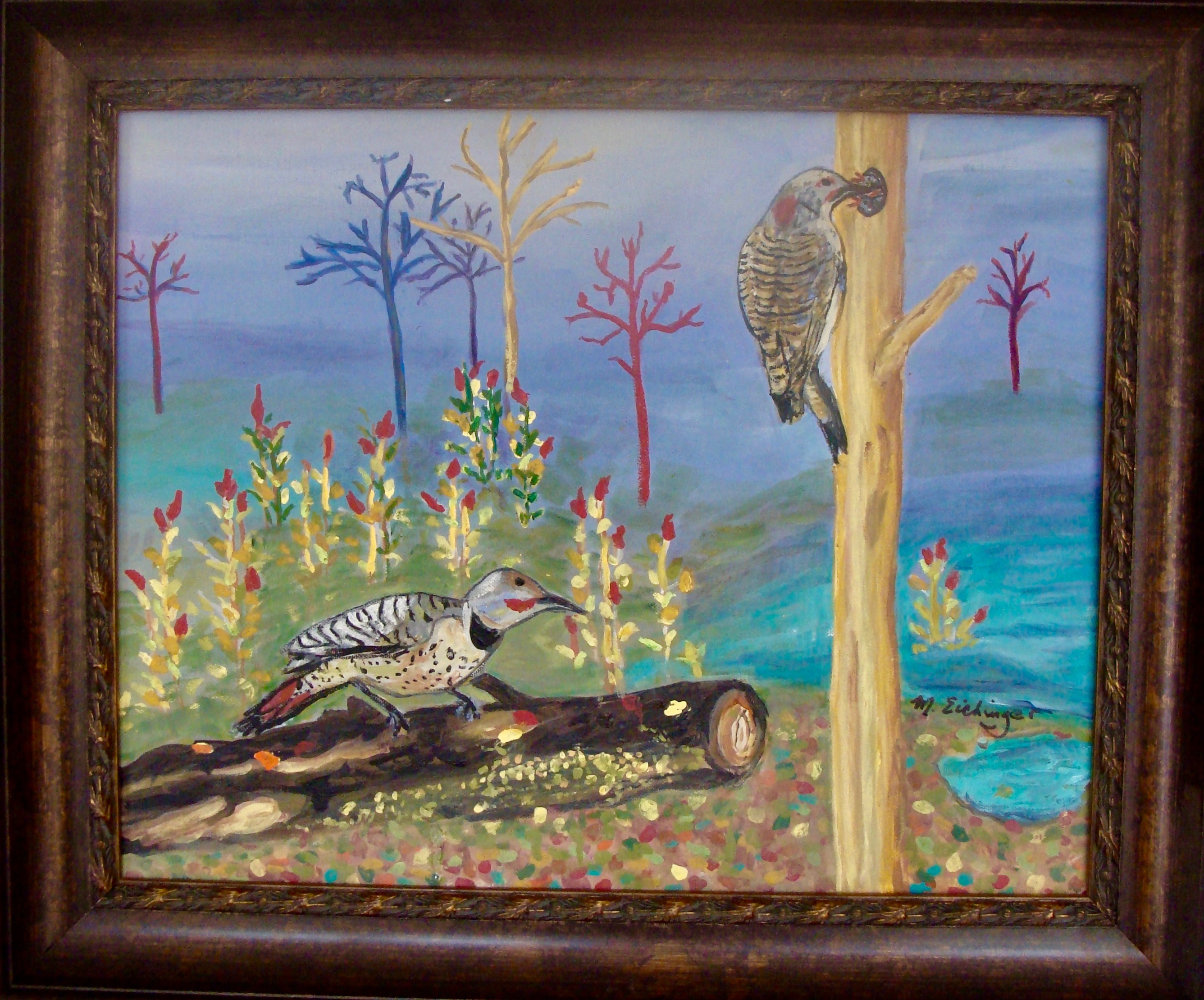
Birds have little need for politics though they have great need for human beings to act as stewards on their behalf. 

Sleuths for Truths

During the last election cycle we often heard stories about Horrible Hillary. Taunts about her private email servers turn her into a criminal in the minds of many. However, she wasn’t the only one to use private email accounts. Competing politicians such as Jeb Bush, Mike Pence, Jared Kushner, and Sean Spicer acted similarly without receiving public rancor. 

Hypocrisy and name calling are not new to politics, but chants that Clinton was a criminal unfit for office imbedded thoughts that she was shady. Lies abounded, like the video clip narrated by a medical doctor saying that she had Parkinson’s disease. The possibility that one lie might be true made us tremendously uncomfortable. Bullying and hacked internet sites bludgeoned her so thoroughly that it became impossible to separate truth from fiction. Could she have done anything differently to change the public’s mind? 

For many years scientists have been trying to discover what factors influence beliefs. Every study I read came to the same conclusion—facts do not change minds. Back in 1957 Festinger, Riecken, and Schacter wrote in When Prophecy Fails: 

“A man with a conviction is a hard man to change. Tell him you disagree and he turns away. Show him facts or figures and he questions your sources. Appeal to logic and he fails to see your point…Suppose that he is presented with evidence, unequivocal and undeniable evidence, that his belief is wrong: what will happen? The individual will frequently emerge, not only unshaken, but even more convinced of the truth of his beliefs than ever before.”

Psychologists say that we are influenced by motivated reasoning. It is why we remain convinced that our beliefs are correct even when they are proven wrong. We are more comfortable holding on to false ideas and double down in our convictions when presented with conflicting evidence. We tend to seek out information we find agreeable and avoid or devalue contradictory arguments. Most people do not watch a variety of  channels in order to obtain a balanced perspective on the news.

It took many years to convince sailors they would not fall off the end of the earth when traveling across the Atlantic. Strangely, some still hang on to that notion. The Flat World Society boasts of an increase in membership, proving that even when beliefs are totally refuted some people will not alter their thinking. In many instances, those appearing to be reasonable turn out to be the most irrational.

Harvard cognitive scientists Mercier and Sperber say the reason people turn away from rational thinking is because we are a cooperative species.  We seek supporting information to confirm the group’s beliefs. Concerned with social standing, we feel more secure when our beliefs are not questioned. Arguments that call for change are likely to be at odds with the group’s expectations. New facts and information can burden the recipient with the responsibility to change the group’s thinking—not an easy task.  We saw this play out when we learned that there were no weapons of mass destruction in Iraq, yet the establishment still decided to proceed with going after Saddam Hussein.

A Stanford University study divided a group of students into two categories based on their support for or disagreement with capital punishment. Participants were then presented with bogus pro and con articles to read. Filled with statistics, the papers gave solid sounding evidence in support of each point of view.  By the conclusion of the study, those who started out in the pro camp were more in favor than they were before and those opposed became more hostile to using capital punishment. In other words, both sides dug into their positions and were stuck in the mud. 

Most people do not understand the origin of their beliefs. Scientists say global warming is human induced, but those of us who accept their conclusions find it difficult to explain the basis of their claims to another person. Those against global warming theories are also unable to give reasoned arguments to support their point of view. The public mostly relies on media accounts that filter comments that come in sound bites by expert witnesses. Viewers do not want to receive information requiring them to change their way of life.  If I were willing to follow my belief in global warming then I would become a vegan and stop driving, something I don’t want to do.  Few of us are willing to take the time to analyze hidden agendas or understand the science behind our beliefs. Yet, despite our inadequate knowledge, we are quick to share misinformation with friends. 

In the United States, technological developments are more readily accepted than sociological shifts. There is often an advantage to being an early adaptor of technology. The first people to use calculators were much more efficient than their slide rule colleagues and they got ahead in their work.

The political realm is more likely to get us into trouble for we cling to feelings around many issues. The need to be wary of those who are smug about their biased beliefs for they can easily become a danger to society. 

Good science allows no room for bias and results doming from a well executed research plan provides a path towards rational decision making.  It is a way to get unstuck from false beliefs. Yes, there are times when research needs to be confirmed with replication ,but at least the scientific method provides a system to encourage critical thinking.

In my opinion, Hillary was a poor campaigner who did not know how to inspire her audience. Her arguments were well researched but that is not what listeners wanted to hear.  She talked statistics, presented facts and spoke in such a cerebral manner that people tuned out. Her audiences would have preferred receiving messages that spoke to their hearts instead of their brains. By not doing so, her arguments were ignored in favor of slogans from opposing candidates. 

It is not unusual for an intellectual campaigner to be defeated in their bid for public office. Intellectuals as presidents are few—perhaps eight in all—two Adamses, Jefferson, Madison, Lincoln, Teddy Roosevelt, Wilson, and Obama (who tried to disguise it). Those who win are smart enough to package their intelligence as wit. Jokes, gibes, and slogans do more to inspire crowds than lectures.  

References:

Meyers,S (2016) Use of Unclassified Email Systems Not Limited to Clinton. New York Times. retrieved from  https://www.nytimes.com/2016/05/11/us/clinton-emails-routine-practice.html

Apuzzo,M & Haberman.M (2017) At Least 6 white House Advisers Used Private Email Accounts. New York times. retrieved from https://www.nytimes.com/2017/09/25/us/politics/private-email-trump-kushner-bannon.html

Beck,J. ( 2017) This Article won’t Change Your Mind.. The Atlantic. retrieved from https://www.theatlantic.com/science/archive/2017/03/this-article-wont-change-your-mind/519093/

Kolbert,E. (2017) Why Facts Don’t Change Our Minds. The New Yorker. retrieved from    https://www.newyorker.com/magazine/2017/02/27/why-facts-dont-change-our-minds

Cooper JR.,J ( 2017) The Historical Presidency: Few and Mostly Far Between: Reflections on Intellectuals as Presidents. Wiley Online Library. retrieved from abstract https://onlinelibrary.wiley.com/doi/full/10.1111/psq.12398

Curious Cat Emerging

Curious Cat Emerging
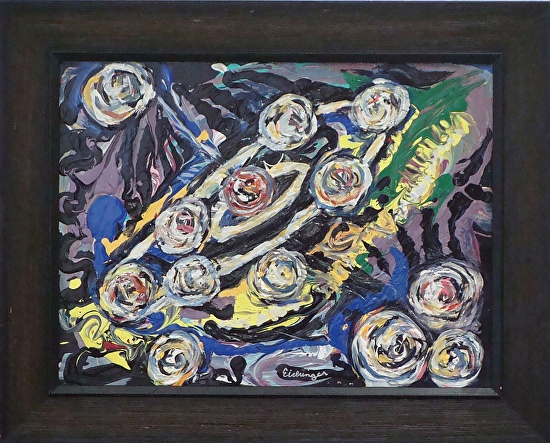
The back deck of our house is visited by many birds. Large and small come to feast on suet bricks or seeds from several dispensers. In warm weather we enjoy standing by the window watching them take turns eating and splashing in the bird bath. They look like they are having a great deal of fun, but I have to keep an constant eye on my cat.

Franny is a warm weather feline reluctant to go outside when it is cold. During the winter, she moves lazily from room to room in search of a comfortable pillow. Much of her day is spent sleeping soundly near a heater vent. The only time Franny bounds with energy is during morning and evening feedings. During those times she cries incessantly until a dish of salmon or mackerel is placed before her. Accustomed to a gourmet diet, Franny became a little butter ball this winter. Unfortunately, she gained so much weight that on her last visit the vet told us to reduce her portions if we didn’t want her to get diabetes.

We quickly learned that our cat had other ideas. If we are not going to feed her then she is prepared to augment her own diet. We began to notice her spending hours at the glass doors leading to the back deck. Staring, without moving a muscle, she watched every motion made by the visiting birds. If we weren’t careful opening the door she scooted between our legs to run for the deck. Her readiness to pounce on our feathered friends made us quite nervous.

Now that is warmer Franny has evonlved into a different kind of cat. Awake and energized after hibernating all winter causes us worry for she started to resume her old feline tricks. Last year, for example, she caught mice and brought them into the house to bat around as playmates. She would release her captives in order to hunt them over and over again. She arrived with one mouse that was pregnant and it wasn’t long before a litter of babies ran through the house.

To escape Franny’s clutches the small bodies scurried to the top of a curtain rod over a large picture window. The mice ran back and forth afraid to come down while our cat sat stone still for hours watching their antics. As soon as one bravely descended, Franny was ready to spring towards her prey. She usually batted it around before releasing it though sometimes the mouse became her meal. In an effort to rid the house of Franny’s playmates, Ray tripped down the living room stairs determined to catch them. I watched with bated breath.

Baby birds, mice, and moles are all targets of our domesticated cat. But since we are unwilling to confine her completely to the house, putting her on a diet has become a family joke. Who are we to regulate her meals when she is outside.  We can’t control what she swallows for she certainly knows how to fill her belly.

Franny makes me aware that just as I don’t have power over her diet, neither do I have over my family’s. I can’t make husband, children (or myself) eat reasonably sized portions of a healthy diet unless they are willing to do so. They always manage to find a way around food austerity measures. If they want sodapop, candy, or ice cream they know where to find them. Willpower is an elusive subject and obesity is a problem that bothers more than 30 percent of the population. It is not one I am ready to tackle, however.  So–if you have a solution, do let me know.

Please comment belose with your cat stories .


Is it Possible to Multitask?

Powe of the Universe
The planets revolve in their orbits, focused on only one ask. We can depend on the to continue, at least in our lifetime.  Acrylic on Canvas 16 x 20 x 0 $299.00 USD

Is it Possible to Multitask?

When asked, I proudly tell people that I am an accomplished multitasker, but I recently became aware of research saying that I am not.  I  ride an exercise bicycle and watch TV while doing so.  Isn’t that multitasking? while  I imagine I might be a better cyclist if I was not distracted but I would probably get bored and give up after ten minutes.

A receptionist answers the phone while greeting visitors, a parent talks to a child while preparing dinner, and partners have sex while making mental plans to see a lover. Aren’t they doing two things at one time? I once observed a very successful canvas artist work on eight, 4 by 8 foot canvases spread out on the floor of his studio. He added colorful pigments and details moving from one to the next and back again. He was fast and working on so many at once permitted paint to dry while focusing on the next canvas. I was impressed by his ability to develop unique creations. When finished, though, he did not have eight masterpieces. One was exceptionally good but the rest were mediocre. He sold them all, however, which was his intent.

As do most  working executives, I thought of myself as a multitasker, for I was able to move rapidly from one subject to the next. An hour could easily be filled with 10minute meetings on topics ranging from a broken plumbing pipe, budget and insurance issues, discussion around marketing to interviewing a prospective employee. If someone interrupted me for an emergency I was able to handle it and then turn back to the topic I had been working on. I labeled this behavior as multitasking. What I haves since learned is that most of us think we are multitasking when we aren’t. I wasn’t do two things at the same time, but rather was compartmentalizing my mind. I was a fast shifter. Each activity required complete attention and it was easy for me to go back and forth quickly.

This skill is not easily transferred to art work or writings. To paint, I need 100 percent focus on what I am doing. It is not possible to select a color, put a dab on a brush , and apply it to a canvas without complete attention. Young children who are less focused, leave art sessions with with paint on their clothes or spilled on the floor. I attest to having cleaned up quite a few messes.

For nearly all people, in every situation, multitasking is near impossible. The neuroscience presented is clear. We are wired to be mono-taskers. Attempting to do two things at the same time is an illusion for most of us.

Over the past ten years many businesses downsized to become a lean and, in some instances, a mean workplace. As employees dwindled, loads increased, requiring workers to do more, producing short term effectiveness and long term disasters. When overworked, people become stressed, develop migraines, and suffer adult ADHD according the the American Management Association. The young man Ray and I mentored was injured on the job, in part, because management worked him physically 10-12 hours a day, six or seven days a week, month after month. His manager kept challenging him to man up, go faster, paint while balancing precariously. Since it is easier to move without wearing a heavy harness, he took short cuts and was rewarded with praise for being efficient—that is until he fell from scaffolding and became a quadriplegic.

One of the keys to successful mono-tasking is to slow down, not speed up. Learning to do move from topic to topic and place to place quickly takes time. The brain and muscles have to be well trained in order to switch from one activity to the next without getting overloaded. Multitasking is a misnomer for doing any task well requires full attention to the project at hand. What effective managers learn to do efficiently is to switch between tasks quickly. Basically, they single task with intention, often using cheat lists to store enabling information. And—most importantly—they know to take brain rests. They use the full amount of time allocated for lunch and work breaks in order to turn off their mind.

I am always impressed with the skills at-home parents develop by caring for children, cleaning, and engaging in social and community activities. To accomplish a multitude of tasks they develop organizational and time management abilities that rival those practiced by corporate managers.

So, can the brain do two things at one time? The estimate is that 2 to 2.5 percent of the population are capable of doing more than one complex thing at a time. One of the tasks is usually automatic, like walking or tying a shoelace while talking.

When activities are unrelated, the two hemispheres split the labor, with each side taking on a task. However, both tasks tend to suffer and errors greatly compound, for neither has the brain’s full attention. For instance, those walking briskly down a street become slower when they talk. You seemingly can cook and talk on the phone at the same time but not efficiently. A third goal will get discarded altogether by the prefrontal cortex.

One Stanford University study showed that those who believe they are the best multitaskers are actually the worst, for they are chronically distracted and find it difficult to focus. Multitasking is more wasteful than it is timesaving. The more we multitask the less we are able to accomplish because we lose the ability to focus enough to learn. According to an article by Kabu and Machado, “empirical research has demonstrated that multitasking with technology (such as texting, listening to music, checking emails) negatively impacts studying, doing homework, learning and grades.“

So, yes, we can practice switching from one task to the next quickly and no, you will not be multitasking. It is unlikely that you will ever be able to do two things at the same time and do them well.

References:

Secrets of Multitasking: slow Down to Speed Up. (2018) American Management Association. retrieved from web site http://www.amanet.org/training/articles/secrets-of-multitasking-slow-down-to-speed-up.aspx

Goodman, N. (2013) How to Train Your Brain to Multitask Efficiently. Entrepreneur. retrieved from https://www.entrepreneur.com/article/225865

Glowatz, E. ( 2016) Do You Struggle with Multitasking? Why The Brain Can Only Focus on one thing at a time. Medical Daily. retrieved from http://www.sciencemag.org/news/2010/04/multitasking-splits-brain

Telis, G. (2010) Multitasking Splits the Brain. Science Magazine. retrieved from http://www.sciencemag.org/news/2010/04/multitasking-splits-brain

Kabu,C. & Machado, A. (2017) Why Multitasking is Bad for You. Time.retrieved from
http://time.com/4737286/multitasking-mental-health-stress-texting-depression/

Art is always for sale. Contact me at Marilynne@eichingerfineart.com