

Creativity: Nature or Nurture?

IMG_0082

Creativity:   Nature or Nurture?

Is creativity something that can be taught, or are a lucky few born with amazing talent? Are there genes that spark inventiveness or is imagination developed as a result of experience? These questions raise an age-old dilemma: nature or nurture?

While in my thirties, I took a class in creativity. It was designed to open minds to think inventively and to increase problem-solving abilities. For each session the instructor arrived with a packet of playful challenges and tests. One day, he brought in an old L’eggs stockings container that was shaped like an Easter egg with an opening in the middle. The class was instructed to close our eyes and imagine walking up and down the aisles of a supermarket as a stimulus for developing new uses for the plastic egg. Over eighty suggestions came bubbling forth, everything from using the container as a plant starter to making a musical rattle with dried peas inside.

The method our teacher so dramatically employed is known as Image Streaming (not to be confused with today’s computer use of the phrase). Behind closed eyelids it promotes the ability to recognize and describe mental images. To give it a try, start by concisely identifying a problem. Chose one where you understand all of the known surrounding facts. Now let your mind wander in and out of the problem by combining your subject with unrelated images. Lastly, find a place to relax and embrace your leisure time as an important part of the creative process. And voila!. . . you might be surprised at the outcome.

One of my university friends told me that when he gets stuck with a engineering problem he has a big lunch followed by an hour long nap. He claims that he usually opens his eyes to a new approach that leads around his obstacle. There are times when I like to take a trip in my car leading to nowhere in particular, letting my mind wander aimlessly while I pay attention to the road. On other occasions I set off for a long walk through the woods. Either activity suffices to give my ideas a boost.

MRI studies of grey matter structure show that during periods of relaxation, brains (especial those of creative people) are more active than previously imagined. In other words, your brain never really shuts down. Ferris Jabr, in a Scientific American article about why Your Brain Needs More Downtime writes, “Research on naps, meditation, nature walks and the habits of exceptional artists and athletes reveals how mental breaks increase productivity, replenish attention, solidify memories and encourage creativity.” These moments of relaxation are why so any people have their “ah ha” experiences while singing in the shower or shaving in front of a mirror. Putting concerns (and the computer) away and adding mental breaks to the day by walking in nature or meditating will add to your mental efficiency and ability to maintain attention.

Image streaming is generally practiced along with relaxation techniques for the purpose of challenging traditional thinking used in daily routines. We walk through a supermarket and buy food, never considering new uses for the products we see. Creative chefs do though. As they travel the isles their inner eye combines the herbs and produce they peruse in a never ending variety of palate pleasing mental images.

I am a strong believer that creative thinking processes can be learned or, at the very least, enhanced and am continually looking for tricks and practices to help me expand the visionary part of the formula. One game I have tried focuses on the mind’s ability to visualize. Over the holidays you might enjoy trying this exercise with your family. Start with closed eyes and imagine walking on hot coals. After a few minutes, describe the experience out loud, especially the sensory part of it. Then ask each person in turn act out what it is like to walk on hot coals. Have markers and paper nearby so everyone can draw a picture of the experience. These mental images are now captured for future contemplation.

Another goal of mine has been to improve my observation skills so that I have strong images to mingle when on a quest for a new idea. The following exercise works well with a mixed age group of children and adults. Place random objects in front of the participants and challenge them to look carefully at their shape, size and color. tell your party to ignore the original purpose of the objects and consider alternatives uses that can be silly and ridiculous, as well as practical. Anything goes when brainstorming. Children are very good at this exercise and often stimulate the adults to become more playful. Unfortunately, with age we find ourselves brainwashed by traditions that cause our minds to travel through narrow thought tunnels.

The arts provide a direct path to creativity. I once visited an art school in Cambridge, Massachusetts that held drawing classes for young children. For one exercise the staff made a large dark tunnel and placed it in the middle of the art studio. Each child was given a flashlight and asked to walk alone into the opening. Upon exiting, the student was immediately given a piece of paper and chalk and told to draw the experience. The images the children concocted were wonderful and varied, demonstrating how emotional experiences also influence outcome.

To help the young:  parents, grandparents and teachers can enrich the lives of their children by enrolling them in creative art programs. Employment opportunities of the future are likely to go to visionary individuals who have a flexible approach to thinking.

To stay inventive as an adult: take advantage of vacations or retirement as an opportunity for liberating your thinking processes so you are ready to pursue a new round of creative endeavors.

Want to know more?
http://www.scientificamerican.com -Why your Brain Needs More Downtime
 

It’s a no-brainer – Secrets of a Museum Junkie

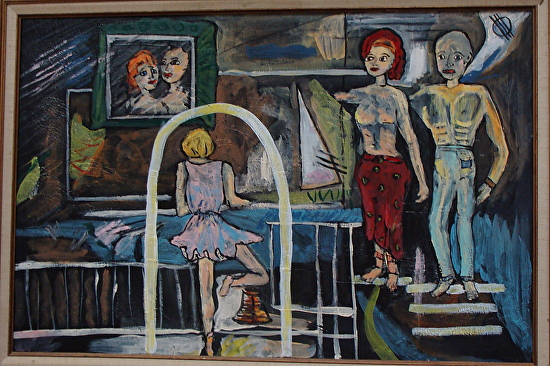
1339829lThe Studio    

 A young girl innocently practices dancing while elders observe. Will her life embrace the grace and happiness she imagines? With age will her body remain supple? Her brain alert?

It’s a no-brainer

Since my retirement I have been engaged in new exercise classes and am enthralled. At the top of my list is Nia, a program that combines Martha Graham type modern dance with Tai Chi, Tai Kwan Do and mindfulness. Nia’s website claims that “it is a movement and well being program that connects body, mind, emotions and spirit by paying attention to sensation.” To get a better idea of this eclectic study, imagine yourself as a child, twirling gracefully with head thrown back to the falling leaves when a danger suddenly approaches. You stop, look around, tightening your body and prepare to run. Nia alternates a graceful flow that feels like you are moving in a bowl of jello with precision, balance, and speed. There is no room for a wandering mind as you move in preparation for the unexpected. As Mark Morris of the Mark Morris Dance Group says,
“ movement is like having a sixth sense, one that helps you understand your position in space.”

As a child I was clumsy and my mother was concerned because I tripped while walking so she enrolled me in dance classes. However, falling at a young age was not a worrisome condition since my body was close to the ground. Now that I am older, a fall could be quite serious, so coordination and balance are skills that I am inviting back into my life. But best of all, with this exercise regime I feel more spirited.

I started to wonder why I have the sensation of being more alert, and decided to do a bit of research about the influence of movement on the brain. What I discovered is that as I practice, signals are being sent from my motor cortex through 20 million nerve fibers in my spinal cord to my legs and arms, enabling me to go through my day with greater ease. A constant internal conversation is taking place between my muscles and my brain. Every small step or blink of the eyelid gives proof that the highway between between these two parts of my body are actively engaged. The brain directs our bodies much like an orchestra leader, telling it where and how to turn, tap, or flow through space. Resulting movement has the effect of improving mood and concentration.

The Cambridge Centre for Ageing and Neuroscience (Cam-CAN) refutes the popular view of aging as one of decline and decay. They say that “the brain remains flexible and adaptable across the lifespan.” Since most neuroscientists now claim that the brain can continue to expand its neural network, rather than sit lazily at home, we are advised to take on new challenges throughout life. “Change your job, try a new hobby, vary your exercise routine and socialize with others,” is the advice given for building new synapses.

My daily program also focuses on mindfulness, which according to Harvard neuroscientists can change brain structures after only eight weeks of practice. Their research suggest integrating mindful intention into all daily activities including walking, eating, sitting, making the bed, etc. The Harvard study revolved around 45 minutes of exercises that included yoga, sitting mediation and some sort of mindful movement. As a result, practitioners gained a sense of peacefulness and physical relaxation along with cognition and psychological benefits that lasted throughout the day. MRI scans confirmed that mindfulness increased gray matter in the areas of the brain involved in learning, memory, emotion regulation, sense of self, and perspective-taking (the ability to take the perspectives of others).

I had been fearful of retirement, imagining that without work I would start to wither. Instead, the opposite is happening and I have a sense that my mind and body are burgeoning. My participation in movement and mindfulness classes has led me to feel, energetic and happy to engage in new ventures.

It would be fun the hear what you are doing to keep your brain developing.
Click the URL at the bottom of this page and respond on the Blog site.

References:

http://www.brainfacts.org/sensing-thinking-behaving/movement/- discussion of movement and dancing and the brain.

Society for Neoroscience- reviewed May 2014 – Dancing and the Brain.

http://www.ascd.org/about-ascd.aspx – Curriculum development for mind-body links

https://nianow.com/practice – Information about Nia.

http://www.mindbodygreen.com/0-12793/how-meditation-changes-your-brain-a-neuroscientist-explains.html – Harvard study about mindful meditation.

http://www.cam-can.org – Cambridge Centre for Ageing and Neuroscience – Recent research on aging.

http://learn.fi.edu/learn/brain/exercise.html – Information about the brain from an exhibit at Philadelphia’s Franklin Institute.

Delilah the Do-Gooder

 Delila is delightful once you get past her serious exterior.
Delilah is delightful once you get past her serious exterior.  Acrylic painting  30″ by 24″.

Delilah the Do-Gooder     by Marilynne Eichinger

Managing a museum and running a household have a lot in common. You think you’re in control only to discover that you have more bosses than you care to consider. In a museum, government, bankers and board members are the ultimate bosses, but staff, consultants and even the public also have a say. To the director it seems like everyone knows the best way to do your job and they are not shy about telling you how to develop and market new programs, oversee the budget or supervise your staff. Disgruntled visitors are quick to use social media before contacting you and relish telling others about their dissatisfaction. Success is judged by attendance and the bottom line while being the first to create a blockbuster exhibit becomes a contest among the presidents of sister institutions. With tight budgets directors become timid about taking chances and refrain from bringing critical issues before the public.

In a family, there may be a spouse, partner parent or child who claims to understand you “better than you do yourself.” These relatives consider themselves to be Good Samaritans who are the knowledgeable gurus needed for your survival. My now deceased grandmother offers a perfect example of a well intentioned meddling do-gooder. When I was a teen, Grandma was not shy about sharing her opinions. She would sit in my room while I dressed for a date and tell me tales about the women she knew who ruined their reputation by engaging in pre-marital sex. Though Grandma never addressed the subject directly, through stories she did assertively make her opinions known along with her expectations of “good girl” behavior. She was relentless in her insistence that I pay close attention to her tales. I loved my grandmother and did not want to disappoint her but there are times I look back at her advice and wonder if it led to my eventual divorce.

Do-Gooders tend to be concerned individuals who do not like to witness sadness or incompetence. It is often hard for them to hold back what they perceive to be helpful words and actions because they are sure they know the way to improve your situation. I may be one of those caring people who want to jump into the difficulty and help immediately. I worry that I have a do-gooder gene that is similar to my grandmother’s. Now that my children have families of their own I find it difficult to sit on the sidelines and just watch them unfurl their lives.  I still feel protective and have a strong desire to share my life’s experiences through stories of my own. It is difficult to let go of control and just observe my child as she or he heads towards a pending disaster, especially when from time to time there is a return home for additional support. My husband has a standing joke that says, “when the children reach 60 they are on their own.”

I don’t think parents ever relinquish a sense of responsibility for their own children no matter how old they are. Without realizing what they are doing they often make their point known through a psychological concept known as magical thinking. They wind up using a process that applies unjustified reasons to a relationship between action and outcome. A funny example of magical logic can be found in a bowling ally where bowlers try to control outcome after the ball has been released by making movements with their bodies. It is humorous to watch them use hands and feet in an effort to bewitchingly guide the ball down the ally.

Magical thinking is often employed in subtle ways. When a brother-in-law of mine lost his job his father told him that his prayer group was going to pray for his success. His father made sure to keep his son informed of the group’s weekly intervention asking the Almighty for help. My brother-in-law was reminded regularly that quite a few people were thinking about him and acting on his behalf and that he had better progress towards solving his problem or his father would be disappointed in front of his friends. The psychological effect of the group was powerful and did have some effect in getting my brother-in-law motivated and moving in a useful direction. No one told this young man what to do but the message was clearly communicated that sitting around and feeling sorry for himself was not OK.

There are times when troubled family members become victims of gossip that at first appears to be malicious but may actually be helpful. When caring relatives pay attention to chatter that helps them better understand a dire situation it has a chance eo leading to positive action. Once a family gathers to share ideas about remediation, the group can work together in offering a beneficial intervention. Rather than having ten nagging voices, the relative in need is more likely to accept help that is given from a pool of love and respect.

Over the years I have learned that it is good to take the time to listen well and plan intercessions carefully. A short wait and see period gives me a moment to contemplate an appropriate response. I realize now that those in need of my assistance, want it given freely without strings attached, and though sometimes this is not possible, it does help to understand that the unhappy individual does not want another boss in his already confused life. A person in need does appreciate being heard but utmost tact must be used when giving advice, even if it has been requested.

One approach I’ve employed is to help a troubled friend or relative expand his or her thinking processes in order to become open to new ways of problem solving. In this way, the individual becomes empowered by skills that can used in finding solutions to a difficult situation. However, if there is the slightest hesitation created by this type of conversation then it is best to back off after explaining that you are available when the time is appropriate to continue the discussion. It is only when the individual is ready to hear suggestions that there is a chance of being an effective Do-Gooder.