
She will enter the workforce wide-eyed and ready to give her all. What will she get in return?

Whatever happened to loyalty?

Wharton Business School aptly dubs the decline of loyalty, ’Shock and Awe for American Workers.’ There was a time when business owners didn’t escort employees out with a guard minutes after delivering news of their dismissal. If laid off for economic reasons, you would be rehired as soon as the economy bounced back. A symbiotic relationship fostered a social contract between management and workers. Skilled laborers who remained faithful to employers throughout their working years earned a decent wage and a pension in return for their hard work.

These fortunate people came of age after World War II when the collective mindset of ‘we’ was crucial to winning the war and dominating world trade. Job hopping was considered a taboo practice and a red flag for recruiters. Businesses encouraged employees to build lifelong relationships.

When you converse with a young worker today, you’ll notice their mindset is different. It primarily focuses on ‘I” rather than the collective. Youth prioritize individual rights, giving less thought to the broader society. They are engaged in a workforce that has doubled since 1970 because it now takes two earners to support a family, and older adults remain in the workforce longer. The shift in mindset had its seeds in the 1970s when economic issues led to widespread downsizing, forcing workers to compete for scarce job opportunities. It was a pivotal time, leading to a breakdown in the relationship between employees and employers. The result was reduced salaries, retirement benefits, healthcare, and other perks.

The rise in automation, technology, and globalization, coupled with the decline of unions, bolstered corporate power. In the new landscape, stockholders began to take precedence over other stakeholders, including customers and workers. The downsizing wave of the ‘70s escalated in the 1980s and 90s, with employers showing little interest in rehiring when the economy rebounded.

In today’s economy, new hires hesitate to commit themselves to a company, fearing the potential hurt it will cause when let go. They constantly  worry that each day might be their last and receive low salaries and minimal benefits under incompetent leaders who don’t recognize their accomplishments. Unsurprisingly, the American workforce is on the move, seeking greater flexibility in work schedules, more caring managers, and a better work-life balance.

The average number of jobs an individual has during their lifetime has skyrocketed to twelve, with twenty-nine percent changing fields completely. The change in the work environment since 1950 is dramatic. American workers are older, better educated, and more diverse in race and gender. Employment opportunities shifted to higher-skilled occupations, making it difficult for those with lower levels of education to find jobs. A staggering thirty-nine percent of college students are over twenty-five, further highlighting the instability in the job market and the search for meaning in work. When younger workers change careers, they look for more than a pay raise. They seek jobs that benefit the world, such as dealing with environmental concerns, healthcare, or helping underprivileged communities.

I worry about my grandchildren and whether they feel valued and if they will live fulfilling lives. Will they find challenges that will help them grow? Do they think their employment is worthwhile, and can they see how it fits into the fabric of human endeavors? Is their job stable enough to purchase and maintain a car and home without fear of losing them? And, will their salaries allow them to save enough to retire comfortably?

As shareholders pour money into AI, Robotics, and other advanced technologies, they should consider how the typical worker will manage in a world that doesn’t need them. Will it lead to more people without jobs living on the streets, and who will support them?

As a consumer, I wonder how long it will take before customers rebel at messages like,”We are experiencing a longer than usual wait time; go to our website for answers.” I am tired of being told to dial one for new service, two for parts, three for hours of operation, until ten when I’m directed to go online and talk to a chat operator. When fortunate enough to speak to a human being after waiting a half hour. In that case, the voice is heavily accented, incomprehensible, or the person doesn’t know the answer to my question.

How dehumanizing can businesses get? These practices certainly aren’t a way to retain a loyal customer, yet workers and consumers let it happen and accept impersonal treatment in the workplace and while shopping. Is more of this all we have to look forward to in a future with AI, or is it time to speak up and put an end to it?

________________________

Art is always for sale. Ellen: Wide Eyed and Ready is an acrylic on canvas painting, 20” x 16” x 2”,  Available for $ 495, includes shipping in the continental U.S. Purchase on my website or contact me at marilynne@eichingerfineart.com

Please share your experience about workplace loyalty in the comment area below.
WaterFactor 400x600 1
WaterFactor 400×600 1

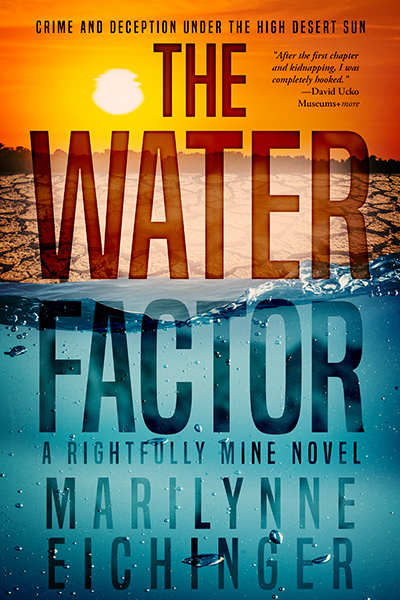
In The Water Factor, the protagonist rejects his parents’ advice to study medicine or law. He attends a job fair, where he is convinced that water is the future growth industry,  and access to it will be the most significant issue his generation will confront. When he takes a job as a truck driver, delivering water to rural communities, he sees how far corporations will go to deprive people of a resource that was rightfully theirs. Young graduates would do well to examine the ramifications of the work they sign up to do.

The Water Factor is a Firefly International Award-winning novel in paperback, ebook, and audiobook versions on AMAZON, Barnes and Noble, Audible, and iTunes.


References:

Podcast (2017) The End of Loyalty: Shock and Awe for Many American Workers. Knowledge at Wharton. Retrieved from https://knowledge.wharton.upenn.edu/podcast/knowledge-at-wharton-podcast/the-end-of-loyalty-shock-and-awe-for-many-american-workers/

Website (2024) 17 Remarkable Career Change Statistics to Know. Apollo Technical. Retrieved from https://www.apollotechnical.com/career-change-statistics/

Naranjoy, A. & Vizcaino, J. (2017) Shifting Times: The Evolution of the American Workplace. Federal Reserve Bank of St. Louis. Retrieved from https://www.stlouisfed.org/publications/regional-economist/fourth-quarter-2017/evolution-american-workplace

Website (2024) Employment Trends by Generation: How Often Do People Change Jobs? PeoplePath. Retrieved from https://peoplepath.com/blog/employment-trends-by-generation-how-often-do-people-change-jobs/

Lisa, A. (2019) 60 Ways the Workforce has Changed in 50 Years. Stacker. Retrieved from https://stacker.com/business-economy/50-ways-workforce-has-changed-50-years

Take in a deep inhale and breathe through the static disturbing your peace.

static intermission

When Anger Turns to Hate

My parents taught me anger was a natural emotion in response to being treated poorly, but it was not all right to hate the person who caused you harm. There are times when it is difficult to follow that advice. Anger comes from annoyance, displeasure, or hostility ranging from mild to irritation to rage. It results from pent-up frustrations, feeling wronged, losing control of a situation, or witnessing unjustness.  When it gets exaggerated to the point that it affects judgment, it can turn into hate, creating barriers to healing that lead to further anxiety, restlessness, obsessive thinking, and paranoia. When hostility is directed at you, it is a painful experience. When handled through dialogue, it can be constructive and lead to change.

Hatred arising during periods of crisis, when people feel vulnerable or threatened, creates a desire for control. Negative assumptions learned from friends, family, and the media easily fan the flames of discontent. Hatred-based religion and political ideology, both artificial phenomena, are handy ways to gain power. Their dehumanizing propaganda has psychological and societal impacts that affect both the sender and the receiver. We have only to look at the conflict between Israel and Gaza to see how anger, distrust, and hatred caused thousands to die.

Hatred is unhealthy, impacting the nervous, immune, and endocrine systems. The National Institute for the Clinical Application of Behavioral Medicine reports that it leaves lasting neural imprints similar to the pathways of addiction. It is almost as challenging to rid yourself of excessive anger and hate as it is to overcome a drug, alcohol, or food addiction.

The good thing is that the human brain is changeable and can learn to love rather than hate. A growing amount of evidence points to humans as having a sense of mortality at birth that distinguishes good from evil and right from wrong. With advances in neuroscience, scientists can see that electrical pathways in the brain are constantly being changed by new experiences that affect who we are and what we believe.

There are days when I feel surrounded by angry people. They make me wary and put me on alert. I don’t want to be like them.  André Fenton, a neurobiologist at New York University, agrees that the human brain is a fundamentally changeable system, but unfortunately, the media understands this too. They are good at stirring anger, turning it into hate, and changing the brain. When this happens, reprogramming is not easy, for hatred releases neurotransmitters, producing bursts of energy hateful people become addicted to. 

I saw a sign at a Jewish protest march that said, “Hatred isn’t born, It’s Taught.” The hatred of the Jewish people dates back to the Greco-Roman era. Since then, Jews have become a scapegoat, blamed for Jesus’s death, for kidnapping and murdering Christian children, for spreading the Bubonic Plague, for rigging the economy, controlling the media, and stirring religious discord. For some unknown reason, they are also blamed for an increase in police brutality, gay rights, climate change, and foreign policy decisions they don’t like.

Embedded hatred is difficult to combat. It starts in backyard barbecues, religious services, and schools where children are taught they are more entitled to life than others. It has plagued for decades between the Hutus and Tutsis, the Sunnis and Shiites, the Muslims and Hindus, Christians and Muslims, Communism and Democracy, Native and African Americans and White Nationalists. What a waste of human life and resources! How much suffering such conflicts cause!

Despite this, there is hope for change. Consider Vietnam, where, during the war, a diorama of a Vietnamese village was erected at the Chicago Museum of Science, encouraging children to plan and shoot at the village with guns. Nineteen-year-old military recruits were taught to hate the North Vietnamese and died because of it. After losing and Vietnam was united under Communist rule, the country blossomed, becoming an important trading partner of the United States. Nearly 212,000 American tourists visited Vietnam in 2023.

Along with many friends, I am frustrated. I’m upset when people ignore warnings about global warming, when grocery store personnel are rude, and when my tire hits a pothole. I’m angry that businesses show little loyalty to employees, that youths bury their noses in phone screens, that so many people are homeless, and that drivers are discourteous at four-way stop signs.

Yet, I don’t have the energy, time, or desire to stew in rage. Life is too precious to waste in anger. Instead, I’ve chosen to redirect it to things I can affect after learning how corporations take possession of resources like water, which should be a right. I wrote The Water Factor to call people to action. Many of my predictions are already coming true. Last week’s news reports reported on the plight of Mexico City residents without water, the theft of water trucks, and how thieves break into pipes to siphon off water for personal use. You and I can change humanity if we put our heads and hearts into it.

Please share your thoughts on my blog site at www.eichingerfineart.com/blog

Questions about art? Static Intermission is a 16 “ by 20” painting on thick canvas. It is available for $ 395, including shipping in the continental U.S. For information, contact me at marilynne@eichiungerfinart.com

Add The Water Factor to your summer reading list. Hold your breath with an eco-thriller that will keep you turning pages. You won’t be sorry. Purchase on AMAZON and Barnes and Noble. Look for it in audio format by the end of next week and in bookstores everywhere

References:

Why We Hate: The Biology of Hate Activity. Discovery Education. retrieved from https://www.teachingwithtestimony.com/themes/twt_ui/images/Why-We-Hate-Activity-Biology-Of-Hate.pdf

Lathram, B. 2015. We are Wired to Learn, Change, and Engage: The Brain with Dr. David Eagleman. Getting Smart.Retrieved from https://www.gettingsmart.com/2015/09/23/we-are-wired-to-learn-change-and-engage-the-brain-with-dr-david-eagleman/

Website (2024)10 Tough Questions on Antisemitism Explained. AJC Global Voice. retrieved from https://www.ajc.org/news/10-tough-questions-on-antisemitism-explained

Linehan, M.PhD  &  Porges, S. PhD &McGonigal, K. PhD & O’Hanlon, B. LMFT(2014)How to Work with a Client Who is Hostile and Critical. NICABM.Retrieved from https://www.nicabm.com/program/fb-anger/?del=gad.1034.anger.allext2&network=g&utm_source=google&utm_medium=cpc&utm_campaign=21029941112&ad_group_id

Website (2024) Why do People Hate? MedicineNet. Retrieved from https://www.medicinenet.com/why_do_people_hate/article.htm