Data collected by NASA’s Gravity Recovery and Climate Experiment, published last week in the journal Science Advances, reveals a sobering trend. Scientists investigated the impact of groundwater loss on global water availability. What they found is alarming: fresh water has been disappearing at an accelerating rate for years, and the drying of Earth is speeding up dramatically.
Nearly six billion people—three-quarters of humanity—live in the 101 countries identified in the study as facing a net decline in water supply. This portends enormous challenges for food production and increases the risk of conflict and political instability.
Their research confirms what we already see on the news daily: droughts and extreme precipitation are growing more intense. Although parts of the planet are becoming wetter, those areas are shrinking, while dry zones are expanding. The study—which excludes the ice sheets of Antarctica and Greenland—concludes that “Earth is suffering a pandemic of continental drying in lower latitudes.”
As the climate warms and vast swaths of land dry rapidly, humanity’s supply of fresh water is under serious threat. In the far northern Arctic regions, the loss stems from melting glaciers and drying subarctic lakes. But in southern, more densely populated regions, the primary cause is the overextraction of groundwater from aquifers, faster than nature can replenish them. Unregulated pumping by farmers, cities, and corporations accounts for a staggering 68% of total freshwater loss in areas without glaciers.
Seventy percent of the world’s fresh water is used for agriculture. As droughts intensify, more of that water comes from underground reserves. Yet only a small portion of it seeps back into aquifers. Most of the water runs off into rivers and streams, eventually reaching the oceans, where it becomes undrinkable salt water. That water can only be recovered through industrial desalination or if it returns as rainfall. But due to climate change, many of these same drying regions are receiving less and less rain.
Across the globe, regions are already suffering severe water scarcity, with devastating consequences for communities, ecosystems, and economies. In India, particularly in states like Maharashtra and Rajasthan, extracting groundwater for agriculture has caused wells to run dry, forcing entire villages to rely on water tankers. In the Middle East, countries like Jordan and Yemen face chronic shortages, with per capita water availability far below the threshold for scarcity.
California’s Central Valley, one of the world’s most productive agricultural regions, has seen groundwater levels plunge due to prolonged drought and excessive pumping. Sub-Saharan Africa faces a growing crisis as erratic rainfall and high temperatures reduce the reliability of both surface and underground water sources, fueling migration and conflict. In parts of Chile and Peru, copper mining and industrial agriculture have drained aquifers, leaving Indigenous communities without reliable access to clean water. These hotspots are not isolated—they are early warnings of a global crisis that is fast becoming unmanageable.
Wake up, America. Enough with the silence. Enough with pretending that climate change isn’t affecting our daily lives. Water loss is already a major driver of poverty, displacement, and desperation. As we’ve seen in Gaza and elsewhere, water scarcity has even become a weapon of war.
If you’re not inclined to read scientific papers, read The Water Factor instead. It’s a novel with twists and turns that will keep you on the edge of your seat, while also opening your eyes to the global water crisis.
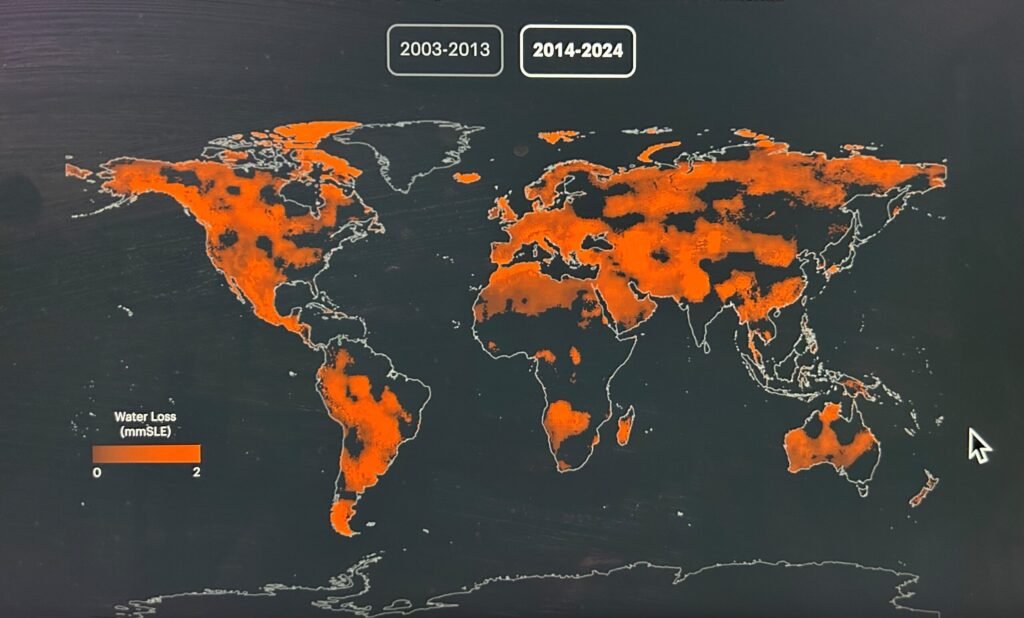
Water Depletion Worldwide
Resources:
Buechner, (Lack of Safe Water Far Deadlier than Violence. UNICEF report. Retrieved from https://www.unicefusa.org/stories/unicef-report-lack-safe-water-far-deadlier-violence?gclsrc=aw.ds&gad_source=5&gad_campaignid=22789033677&gclid=EAIaIQobChMIhsCaiNvsjgMVrSGtBh0uwjevEAAYASAAEgLEY_D_BwE
Website US News. (2023) Countries with the Worst Drinking Water. UNICEF report. Retrieved from: https://www.usnews.com/news/best-countries/slideshows/countries-with-the-worst-water-supply
Website,2025.They Drying Planet. ProPublica. Retrieved from PLANET
__________________
Art is always for sale at www.eichingerfineart.com
Start the conversation. Please comment on my blog site. Sign up for my mailing list if you have not already done so. ______________________________________________________________________________
According to the UN, water is at the center of the climate crisis. THE WATER FACTOR, A RIGHTFULLY MINE NOVEL, is your chance to peer into the near future to a time of water scarcity controls by corporate criminals. The story is a gripping tale of water scarcity and corporate wrongdoing. The Water Factor is a Firebird International Award winner for best dystopian novel and a Literary Titan recipient for best thriller. It is available in ebook, paperback, and audio formats. It can be purchased on AMAZON, Barnes and Noble, and as an audiobook on Amazon, Audible, and iTunes. Locally, it can be purchased at Annie Bloom’s Books and Powell’s Books.