The World Transformed Keeps its Heart

What is life?

Seventy-one percent of the Earth is covered in water, a substance that takes many forms without ever ceasing to be itself. When heated, it becomes steam; when frozen, it expands and hardens as ice. It falls as snow that children pack into snowmen, then melts and runs into rivers where fish, amphibians, and waterfowl make their homes. It rains onto fields, sinking into soil, nourishing seeds that become food for you and me.

Yet for all its abundance, very little of Earth’s water is available to us. Most freshwater is locked away in glaciers and ice caps. What remains in rivers, lakes, and accessible groundwater is a narrow margin upon which all terrestrial life depends. Water is generous, but it is not infinite.

The human body is a fragile vessel, flesh framed by bone,  holding water that makes up more than half of what we are. It carries oxygen and nutrients, regulates body temperature, and allows cells to communicate. When we die, that water does not vanish. It returns to the earth, moving into soil, plants, air, and other bodies. No matter how many times it transforms or mingles with other fluids, it does not disappear. It remains water.

This is life itself.

We are born, and we spend our days responding to pressures: loss, love, labor, illness, and joy. Each experience reshapes us, just as water reshapes stone into something inspiring or forgettable.  We move forward one step at a time, intersecting with others who are following their own paths. Sometimes those paths converge. A handful moving in the same direction becomes a stream, a stream becomes a current, and occasionally thousands move together, forming something powerful enough to alter the course of history.

Yet when we step back and look at history from a distance, there are familiar patterns. Empires rise and fall. Technologies change. Ideologies replace one another. What endures beneath it all is the same living system, still dependent on water that cycles endlessly through land, air, and body. Progress does not erase that dependency. It only disguises it.

Our mistake is believing that our actions evaporate and that what we take, pollute, or discard simply goes away. But nothing does. Like water, it changes state. Toxins settle into soil and bloodstreams. Carbon lingers in the atmosphere, trapping heat. Decisions made for convenience today resurface as a crisis tomorrow. We are not separate from the world we alter; we are one of its phases.

A single drop seems insignificant. So does a single life, or a single choice. But drops gather. They find low places. Over time, they carve valleys that create Grand Canyons. Movements are watersheds, formed by countless lives shaped by pressure and guided, consciously or not, toward a common direction.

A better future does not depend on conquering nature or outgrowing it. It depends on remembering what never retreats. How we care for water, how we care for the Earth, determines what kind of world our transformations will leave behind.

One day, the water that makes up our bodies will move on without us. It will pass through roots, clouds, rivers, and mouths we will never know. Long after our names fade, that water will still carry the imprint of how it was treated while it passed through our hands. The world will remain. 

The question is what condition we leave it in as we move through it.

_______________________________________________________________________________________

Art is always for sale. Surf’s Up can be purchased through my website at https://www.eichingerfineart.com/workszoom/2277455/surfs-up#/ and shipped to you at no cost in the continental U.S.

I look forward to your comments in English.

Companies worldwide are engaged in a high-stakes poker game around access to clean water. The Water Factor will open your mind and make you ask questions. Available in ebook, paperback, and audio formats. It can be purchased on AMAZONBarnes and Noble, and as an audiobook on Amazon, Audible, and iTunes. Invite me to tune into your book club discussion.  

Antheia in the Thorns, the second eco-thriller in the Rightfully Mine Series, has a February 20th launch date. I hope you will help me launch sales in style. More information will be shared over the following weeks.

Countdown to publishing

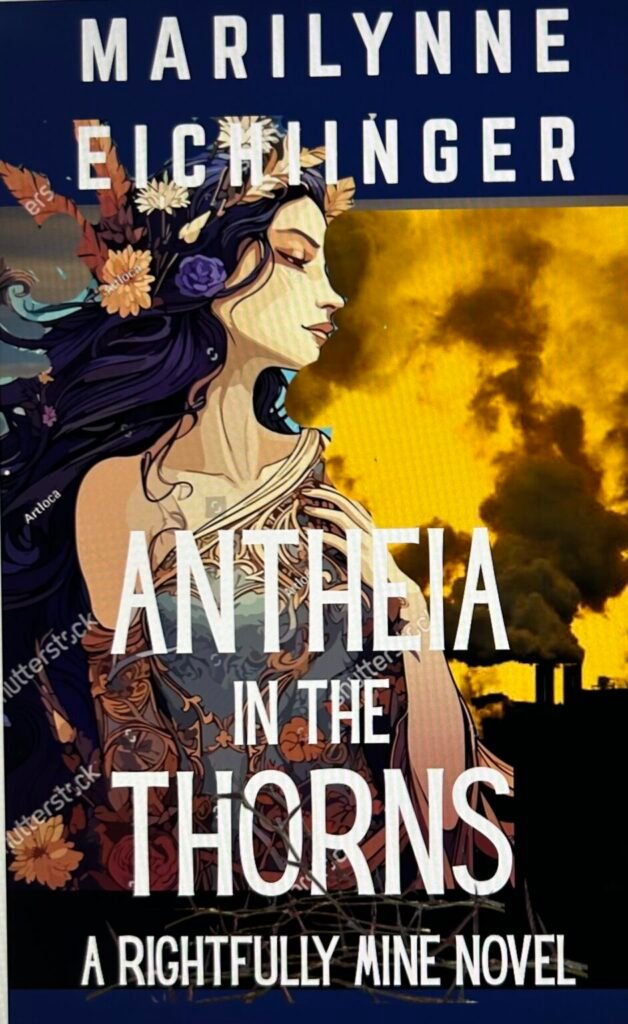
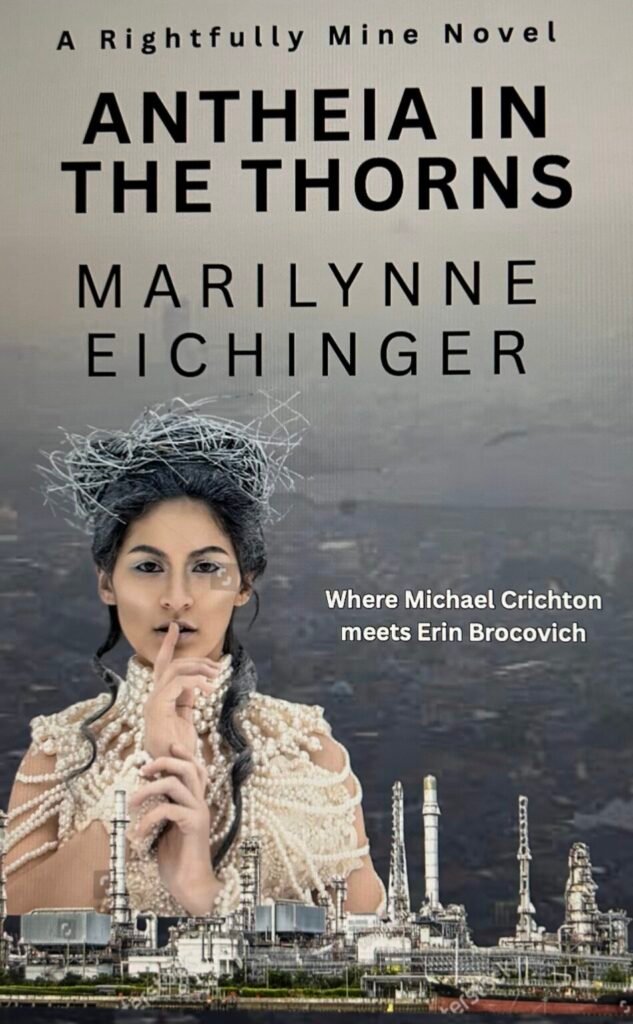
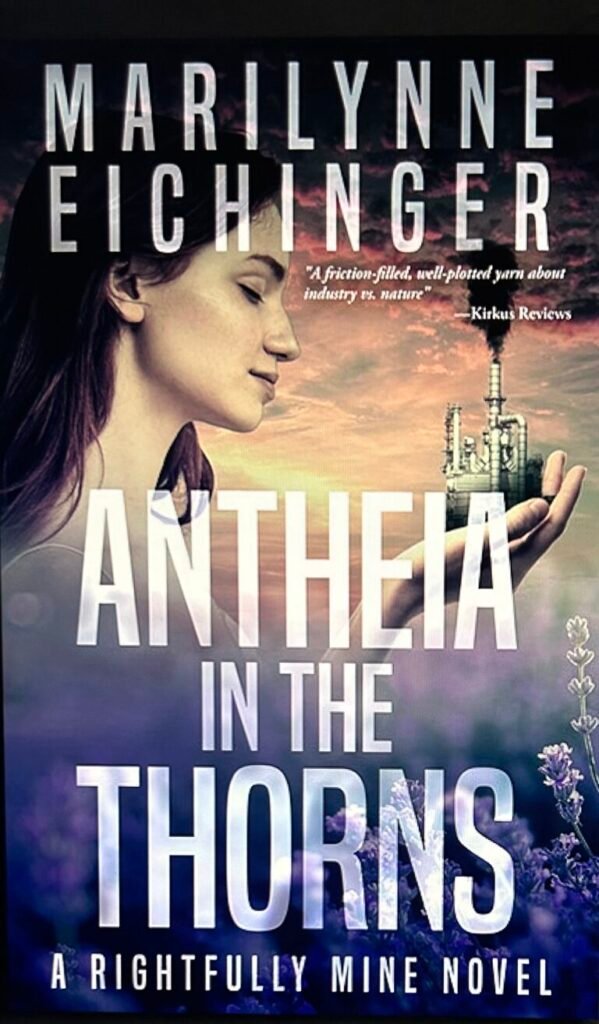
Part of writing a book is finding the right title and cover design, and Antheia in the Thorns, going on sale at the end of February, is no exception. Its early working title was The Cave, but after discovering dozens of books with the same name, I set out to find something more distinctive.

That search led me to Antheia, the Greek goddess of gardens and love. Imagining her caught in thorns felt like the perfect metaphor for an approaching environmental reckoning. Does it make you wonder what happened?

Below are four early cover designs that didn’t make the cut. The final design, created by Streetlight Graphics, will be unveiled next week. Between now and February 22, I hope to whet your appetite for the story behind the thorns.

A Scene Behind Antheia in the Thorns:When I began writing Antheia in the Thorns, I didn’t start with a thesis. I started with a scene.

In the chapter titled “Dying Embers,” the protagonist, Bear Stanton, sits on a curb in the early morning hours, watching smoke rise from what had once been Antheia’s headquarters. Firefighters are packing up their hoses. Reporters circle, microphones extended, eager for outrage or accusation. Somewhere inside the charred building are lost hard drives, children’s artwork, handwritten notes from tribal elders—things that will never make the news crawl.

What struck me as I wrote that scene wasn’t the fire itself, but the silence afterward. The way catastrophe becomes ordinary once the cameras leave. The way destruction is framed as spectacle rather than consequence.

That moment on the curb is fictional, but its emotional truth is not.

As I mentioned in my previous post,  I watched a NOVA program detailing how warming temperatures are destabilizing the Arctic, releasing methane, sinking cities, and accelerating flooding across the globe. These aren’t distant projections or worst-case scenarios. They are unfolding now, quietly, incrementally, often out of sight. When disaster doesn’t arrive with a single dramatic explosion, it’s easier to ignore.

In Antheia in the Thorns, the fire is not just an act of violence—it’s a message. It’s meant to intimidate, to erase evidence, to remind ordinary people how fragile their work is when it challenges powerful interests. That dynamic plays out repeatedly in real life, whether through lawsuits, regulatory pressure, misinformation campaigns, or the slow erosion of public trust in science.

Fiction allows me to place a human face on those forces. To show what it feels like to lose not only a building, but a sense of safety. To ask what happens when the cost of telling the truth becomes personal—and whether it’s still worth paying.

I don’t expect novels to change the world on their own. But I do believe stories can slow us down long enough to feel what headlines encourage us to skim past. If Antheia in the Thorns does anything, I hope it helps readers connect the data we’re shown every day to the lives quietly affected by it—and to the choices still within our control.

Sometimes, the most dangerous fires aren’t the ones that burn buildings, but the ones we pretend not to see.

The Water Factor, the first book in the Rightfully Mine Series, questions whether water should be considered a commodity, as it is now, or a human right. Antheia in the Thorns raises a similar question about air quality. The novel is available in ebook, paperback, and audio formats. It can be purchased on AMAZON, Barnes and Noble, and as an audiobook on Amazon, Audible, and iTunes.

Writing a book is a drawn-out process that includes searching for the right title and cover design. The following discusses a few of my blips on the way to releasing Antheia In The Thorns by February 22. https://www.eichingerfineart.com/blog/204684/countdown-to-publishing I hope you will help spread the word when it is released.

Countdown to Publishing

Part of writing a book is finding the right title and cover design, and Antheia in the Thorns, going on sale at the end of February, is no exception. Its early working title was The Cave, but after discovering dozens of books with the same name, I set out to find something more distinctive.

That search led me to Antheia, the Greek goddess of gardens and love. Imagining her caught in thorns felt like the perfect metaphor for an approaching environmental reckoning. Does it make you wonder what happened?

Below are four early cover designs that didn’t make the cut. The final design, created by Streetlight Graphics, will be unveiled next week. Between now and February 22, I hope to whet your appetite for the story behind the thorns.

A Scene Behind Antheia in the Thorns:When I began writing Antheia in the Thorns, I didn’t start with a thesis. I started with a scene.

In the chapter titled “Dying Embers,” the protagonist, Bear Stanton, sits on a curb in the early morning hours, watching smoke rise from what had once been Antheia’s headquarters. Firefighters are packing up their hoses. Reporters circle, microphones extended, eager for outrage or accusation. Somewhere inside the charred building are lost hard drives, children’s artwork, handwritten notes from tribal elders—things that will never make the news crawl.

What struck me as I wrote that scene wasn’t the fire itself, but the silence afterward. The way catastrophe becomes ordinary once the cameras leave. The way destruction is framed as spectacle rather than consequence.

That moment on the curb is fictional, but its emotional truth is not.

As I mentioned in my previous post,  I watched a NOVA program detailing how warming temperatures are destabilizing the Arctic, releasing methane, sinking cities, and accelerating flooding across the globe. These aren’t distant projections or worst-case scenarios. They are unfolding now, quietly, incrementally, often out of sight. When disaster doesn’t arrive with a single dramatic explosion, it’s easier to ignore.

In Antheia in the Thorns, the fire is not just an act of violence—it’s a message. It’s meant to intimidate, to erase evidence, to remind ordinary people how fragile their work is when it challenges powerful interests. That dynamic plays out repeatedly in real life, whether through lawsuits, regulatory pressure, misinformation campaigns, or the slow erosion of public trust in science.

Fiction allows me to place a human face on those forces. To show what it feels like to lose not only a building, but a sense of safety. To ask what happens when the cost of telling the truth becomes personal—and whether it’s still worth paying.

I don’t expect novels to change the world on their own. But I do believe stories can slow us down long enough to feel what headlines encourage us to skim past. If Antheia in the Thorns does anything, I hope it helps readers connect the data we’re shown every day to the lives quietly affected by it—and to the choices still within our control.

Sometimes, the most dangerous fires aren’t the ones that burn buildings, but the ones we pretend not to see.

The Water Factor, the first book in the Rightfully Mine Series, questions whether water should be considered a commodity, as it is now, or a human right. Antheia in the Thorns raises a similar question about air quality. The novel is available in ebook, paperback, and audio formats. It can be purchased on AMAZON, Barnes and Noble, and as an audiobook on Amazon, Audible, and iTunes.

Writing a book is a drawn-out process that includes searching for the right title and cover design. The following discusses a few of my blips on the way to releasing Antheia In The Thorns by February 22. https://www.eichingerfineart.com/blog/204684/countdown-to-publishing I hope you will help spread the word when it is released.

Feeling Empty While Having It All

IBIS: Starng Into the Void

Over the holidays, I had several conversations that stayed with me long after they ended. I spoke with different people, living very different lives, yet beneath each exchange lingered the same quiet question: Is this all there is? Those conversations led me to think more deeply about emptiness, and about how easily it is misunderstood.

We are born as empty vessels, not deficient but open, waiting to be shaped by experience. While the news often focuses on childhoods marked by trauma, most of us grow up in homes that are loving, stable, and quietly nurturing. As infants, we learn to signal hunger and comfort, warmth and fear. We laugh at silly faces and fall asleep in familiar arms. Curiosity pulls us forward—first crawling, then walking—opening our minds to an ever-widening world. We ask endless questions, and each answer expands our sense of what is possible. Over time, our lives fill slowly, piece by piece, guided by parents and relatives toward school, careers, relationships, and the versions of success our culture values most.

I was fortunate to grow up in a loving extended family. What I value most from that time was not security or achievement, but the nurturing of my curiosity. My parents did not treat my questions as nuisances. Instead, they encouraged them. That early permission to wonder still shapes how I experience the world. I do not experience the open space inside myself as emptiness, but as a room that allows for new ideas, new explorations, and new ways of seeing.

Of the people I counsel, a great many experience their inner space very differently. On paper, their lives look complete: education, careers, homes, families. Yet they describe a hollowness they struggle to name. It is not exactly sadness. It is more a sense that life has lost its texture and meaning, that they are going through the motions without feeling fully present. The question their thoughts circle when alone is unsettling in its simplicity: Is this all there is?

This feeling often emerges during times of change. It can surface after a marriage ends, when children leave home, or when retirement arrives without a clear next chapter. It also appears when work or daily life becomes repetitive and uninspiring. Outwardly, everything looks fine, but inwardly, there is fatigue and disconnection. Meaning rarely announces its absence loudly. It tends to fade quietly, and that quiet can be dangerous.

Psychologist Muhammad Tuhin offers a helpful perspective: “Emptiness isn’t a sign of failure. It’s often the product of living according to someone else’s definition of success.” In a culture shaped by visibility and performance, it is easy to confuse appearing fulfilled with actually being fulfilled. Emptiness, then, may have less to do with lack than with misalignment—the growing distance between who we are and who we have learned to present to the world.

I saw this clearly while managing a “Do You Need a Mother?” booth at a summer music festival. Many visitors in their forties and fifties spoke candidly about losing their sense of purpose. Some had left lucrative careers to search for meaning through travel. When they returned, however, they were unwilling to step into lower-paying work that felt more aligned with their values. Still shaped by an early definition of success that equated worth with income, they found themselves struggling financially and emotionally, uncertain how to move forward. Their search for meaning remained unresolved.

What struck me was not their failure, but their honesty. In these moments, emptiness was not an endpoint but a signal. Though the hollowness they felt suggested it was time to move on, they had not yet discovered where to go next.

Emptiness has little to do with financial circumstances, yet once it takes hold, it can be difficult to escape. The only real option is to pay attention to the space it creates, because that space can become an opening through which curiosity returns. At first, this curiosity may be small and unimpressive, taking the form of questions without immediate answers or interests that do not earn approval. Life’s meaning usually reemerges quietly.

For some, it returns through time spent in nature. For others, it is rekindled through cooking, art, music, or helping someone else. Meaning rarely arrives fully formed. More often, it grows through attention.

Curiosity requires energy to survive. Movement, rest, connection, and reflection all matter. So does noticing what brings warmth or light into an ordinary week and allowing that to shine through the darkness. It was not until I retired that I took writing seriously. I had to consider what I wanted to say and why I wanted to say it. My neco-thriller, Antheia in the Thorns, which explores corporate environmental crime, is about to be published, and a third novel is currently being edited. Writing did not eliminate emptiness for me. Instead, it transformed it into spaciousness.

When emptiness begins to soften, it often gives way to a sense of freedom. The pressure to become someone new diminishes, leaving room to become more fully you.  Emptiness is not a broken state. It can be energizing to realize that, at any age, you are still unfinished, with more life yet to explore.

Have you ever been plagued with emptiness? How did you overcome it? yourself—and more of life—waiting to be explored. I look forward to your comments on my blog site at https://www.eichingerfineart.com/blog/204492/feeling-empty-while-having-it-all

Art is always for sale. Ibis can be purchased on my website by going to https://www.eichingerfineart.com/workszoom/6373371/ibis#/   Questions” Contact me at marilynne@eichngerfineart.com

For information about my books, click on my author’s website at https://secretsofamuseumjunkie.com/

References:

Scottie, (2025) The True Peri: Emptiness, Not Sadness. NW Survival Magazine. zRetrieved from https://www.nwsurvival.us/2025/10/31/emptiness-not-sadness/

Tuhin, M. (2025). Why We Feel Empty Even When Life Looks Full. Science News Today. Retrieved from https://www.sciencenewstoday.org/why-we-feel-empty-even-when-life-looks-full